
For independent brands and retailers navigating the competitive bag market, agility is key. The ability to test new designs, respond to trends, and manage inventory efficiently often hinges on sourcing partners who embrace small batch production and frequent design iterations. China remains a powerhouse in bag manufacturing, but understanding its landscape for smaller, more dynamic orders is crucial. This guide cuts through the noise to explain how Chinese factories handle flexibility, MOQs, and design changes – and how you can leverage this for your brand’s success.
The Allure of Small Batch Production: Why Flexibility Matters
Gone are the days when you needed to commit to thousands of units to access quality manufacturing. The rise of e-commerce, direct-to-consumer models, and fast fashion cycles has driven a significant shift. Many Chinese bag factories now actively cater to startups and independent brands with dedicated low Minimum Order Quantity (MOQ) programs. This flexibility allows you to:
Test the Market: Launch new designs with minimal financial risk.
Manage Cash Flow: Avoid tying up capital in large, unsold inventories.
Respond to Trends: Quickly adapt designs based on customer feedback or emerging styles.
Offer Variety: Build a diverse catalog without massive initial commitments.
Reduce Waste: Operate more sustainably by producing closer to actual demand.
Understanding Typical MOQs for Custom Bag Orders in China
The “typical” MOQ isn’t one-size-fits-all. It varies dramatically based on several factors:
1. Factory Type & Specialization:
High-Volume Factories: Traditionally focus on large orders (1,000+ units per style/color). They prioritize efficiency and lower per-unit costs achievable through scale. Flexibility for small batches or frequent changes is often limited.
Specialized Low-MOQ / Niche Factories: These are the champions of flexibility. They explicitly advertise programs for startups and small brands. Their MOQs can range impressively low:
General Custom Bags: Can start as low as 10-50 pieces per design, especially for simpler styles or using stock materials. (e.g., “We accept minimum MOQ 10pcs/design”).
Common Range: Many established low-MOQ factories operate comfortably with orders of 100-500 pieces per style/color. This is often seen as a sweet spot balancing feasibility and cost.
Premium/Leather Goods: While traditionally higher, specialized workshops now offer surprisingly low MOQs. For genuine leather bags, MOQs can be as low as 100 pieces per design (“Genuine leather bags MOQ can be as low as 100pcs/design”).
Micro-Batch & Prototyping: Some advanced or boutique workshops even offer single-piece or micro-batch (under 50 pieces) customization, ideal for high-end designers or rigorous prototype testing.
2. Bag Complexity: Simple totes will have lower MOQs than intricate backpacks with multiple compartments, specialized hardware, or complex quilting.
3. Material Availability: Using common, in-stock materials facilitates smaller runs. Custom or exotic materials often require higher minimums due to supplier MOQs.
4. Level of Customization: A simple logo print on a standard bag shape has a lower MOQ than a fully bespoke design requiring unique patterns, molds, and hardware.
How Chinese Suppliers Handle Design Modifications: Navigating Changes
Flexibility extends beyond order quantity to how changes are handled during production. Here’s the breakdown:
1. The Sampling Phase is Key: This is where the bulk of changes should occur. Reputable factories, especially those specializing in OEM/ODM development, expect and accommodate multiple revisions during sampling (typically 1-3 rounds). You can freely tweak colors, materials, hardware finishes, pocket configurations, stitching details, and logo placements. The goal is to arrive at a perfect “Golden Sample” that is signed off by both parties. This is the most cost-effective and efficient time for changes.
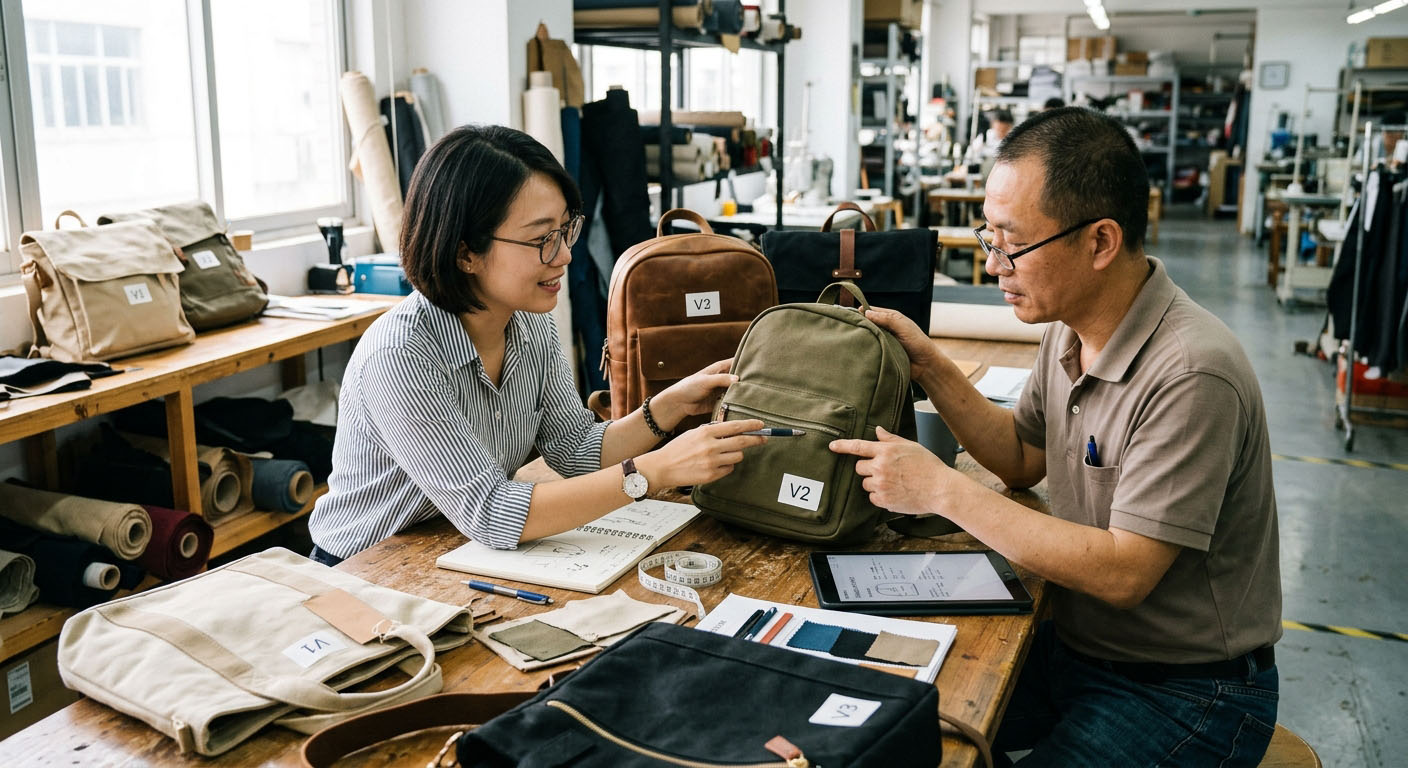
2. Changes During Bulk Production: Once bulk production starts based on the approved Golden Sample, the flexibility tightens.
Minor Adjustments: Factories, particularly those focused on small batches, will often try to accommodate minor tweaks if feasible without significant disruption or material waste (“we generally actively cooperate with customers to complete [changes]“). Examples might include a slight thread color change or adjusting strap length slightly if the material allows.
Major Structural Changes: Significant alterations (e.g., changing the bag’s fundamental shape, adding/deleting major compartments, switching core hardware types after production begins) are usually not feasible without causing major delays and cost overruns. If accepted, they will almost certainly incur significant additional charges (“but may incur partial costs”) and extend your lead time considerably.
Communication is Crucial: Clearly communicate any potential need for late changes upfront and understand the factory’s specific policy. Ask: “How many revisions are included in sampling? At what point do design changes start to incur extra charges or delays?”*
3. Strategies for Ongoing Flexibility:
Modular Design: For collections with frequent drops or variations, design styles that share a common base pattern or core components. This allows for “semi-custom” changes where you only modify colors, fabrics (from a pre-approved selection), or logos between batches – something low-MOQ factories excel at.
Phased Production: If you anticipate frequent updates, work with suppliers who can handle multiple small Purchase Orders (POs) per year. Discuss their capability and willingness to potentially hold core materials to facilitate quicker turnarounds for updates.
Are There Additional Costs Associated with Small Batch Production in China?
Yes, it’s essential to understand the trade-offs. While MOQs are lower, the per-unit cost (FOB price) for a small batch will almost always be higher than for a large order of the same bag. Why?
Fixed Setup Costs: Activities like pattern making, mold creation (if needed), machine setup, and creating production instructions have a fixed cost. This cost is spread over all* units produced. With 500 units, the setup cost per bag is higher than with 5,000 units.
Material Sourcing: Factories often get better material pricing for larger quantities. Buying smaller amounts of materials for your order might mean paying a higher price per meter/yard.
Production Efficiency: Large runs allow lines to hit maximum efficiency. Small batches require more frequent changeovers and setups, reducing overall throughput.
However, this higher per-unit cost needs to be balanced against the total capital outlay and risk. Spending $20 per bag on 100 units ($2,000 total) is often far more manageable and less risky than spending $12 per bag on 1,000 units ($12,000 total), especially for a new design. Cost-effectiveness for small batches is about balancing affordability with adaptability.
IP Protection Measures for New Designs: Safeguarding Your Creativity
Protecting your intellectual property (IP) when manufacturing overseas is a valid concern. While no system is foolproof, responsible Chinese factories offer several measures:
1. Non-Disclosure Agreements (NDAs): A legally binding contract prohibiting the factory from sharing your designs or using them for others. Essential to sign before sharing detailed tech packs.
2. Confidentiality Clauses in Contracts: Your manufacturing contract should explicitly state that the designs, patterns, and specifications are your sole property.
3. Controlled Access: Reputable factories limit access to sensitive designs and samples within their facility.
4. Tiered Production: For highly sensitive designs, some brands split production stages (e.g., pattern making in one trusted factory, cutting in another, assembly in a third) to minimize any single entity having the complete picture.
5. Due Diligence: Research the factory’s reputation. Look for suppliers with Western clients or those who explicitly mention IP protection on their websites/platforms. Visiting the factory builds trust and allows you to assess their operations.
Choosing the Right Partner: Key Questions to Ask Potential Suppliers
Finding a factory that aligns with your need for flexibility is paramount. Don’t just ask about MOQ; dig deeper:
1. Small Batch Focus: “Do you have a dedicated low-MOQ program or ‘incubator’ option for startup/small brands?” “What is your minimum order quantity per style and per color?”
2. Design Change Policy: “How many design revisions are typically included during the sampling process?” “At what stage do changes start to incur additional fees or cause delays?” “Can you provide examples of minor vs. major changes?”
3. Ongoing Flexibility: “Are you able to handle multiple small production runs per year for the same product line with design updates?” “Would you be willing to hold core materials to support faster turnaround on future small batches with variations?”
4. Communication & Process: “What is your standard sampling process and timeline?” “How do you typically communicate updates and challenges (e.g., email, project management platform)?”
5. IP Protection: “What specific measures do you have in place to protect client designs and intellectual property?” “Do you sign Non-Disclosure Agreements (NDAs)?”
Conclusion: Leveraging Chinese Flexibility for Your Independent Brand
Chinese bag manufacturing offers a spectrum of possibilities for independent brands. While traditional large-scale factories exist, a growing ecosystem of specialized, flexible suppliers has emerged to meet the demand for small batches and adaptable production. By understanding the realistic MOQ ranges (from as low as 10-100 pieces for some types), strategically managing design changes primarily within the sampling phase, accepting the inherent per-unit cost structure of small runs, implementing IP safeguards, and meticulously vetting suppliers with the right questions, you can successfully leverage Chinese manufacturing for your brand’s growth.
The key is finding the right partner whose business model is built around flexibility, not just tolerating it. Target suppliers who advertise “low MOQ,” “small batch,” or “startup friendly” – their systems are designed for your needs. With clear communication and realistic expectations, China can be a powerful ally in bringing your unique bag designs to market efficiently and responsively.
Ready to explore small batch bag production? Share your target quantities and design change frequency in the comments, and we can discuss what type of supplier profile might be best for your brand!
Post time: Mar-25-2026