
Introduction: Why Quality Control Matters More Than Ever for Bag Importers
If you’re running a small online business selling bags, you’ve likely discovered that sourcing from China offers remarkable opportunities—but also unique challenges. The global bag market is fiercely competitive, and your reputation hinges on every stitch, every zipper, and every detail that reaches your customer. This is precisely why quality control processes at multiple production stages have become non-negotiable for serious importers.
When you purchase bags from China, you’re not just buying products—you’re investing in a partnership that requires vigilant oversight. The difference between a thriving bag business and one drowning in returns often comes down to how rigorously you manage quality assurance throughout the manufacturing process.
This comprehensive guide will walk you through everything you need to know about establishing bulletproof quality control for your bag orders from China. From hiring third-party inspectors to understanding AQL standards, from decoding inspection reports to knowing your rights when defects exceed tolerance levels—we’ve got you covered. By the end of this article, you’ll have a complete roadmap for ensuring that every shipment meets the standards your customers expect and your brand deserves.
Section 1: Understanding the Multi-Stage Quality Control Framework
Why Single-Point Inspection Is No Longer Enough
Many novice importers make the mistake of relying solely on a final inspection before shipment. While this approach might seem logical, it leaves you vulnerable to significant problems. Think about it this way: if an entire production run uses substandard zippers, discovering this only at pre-shipment inspection means you’ve already lost valuable time and money. The factory has completed production, materials have been invested, and now you’re facing delays, negotiations, or worse—accepting defective goods.
A robust quality control strategy operates across three distinct stages, each serving a unique purpose in protecting your investment and ensuring product excellence.
Stage One: Incoming Quality Control (IQC)
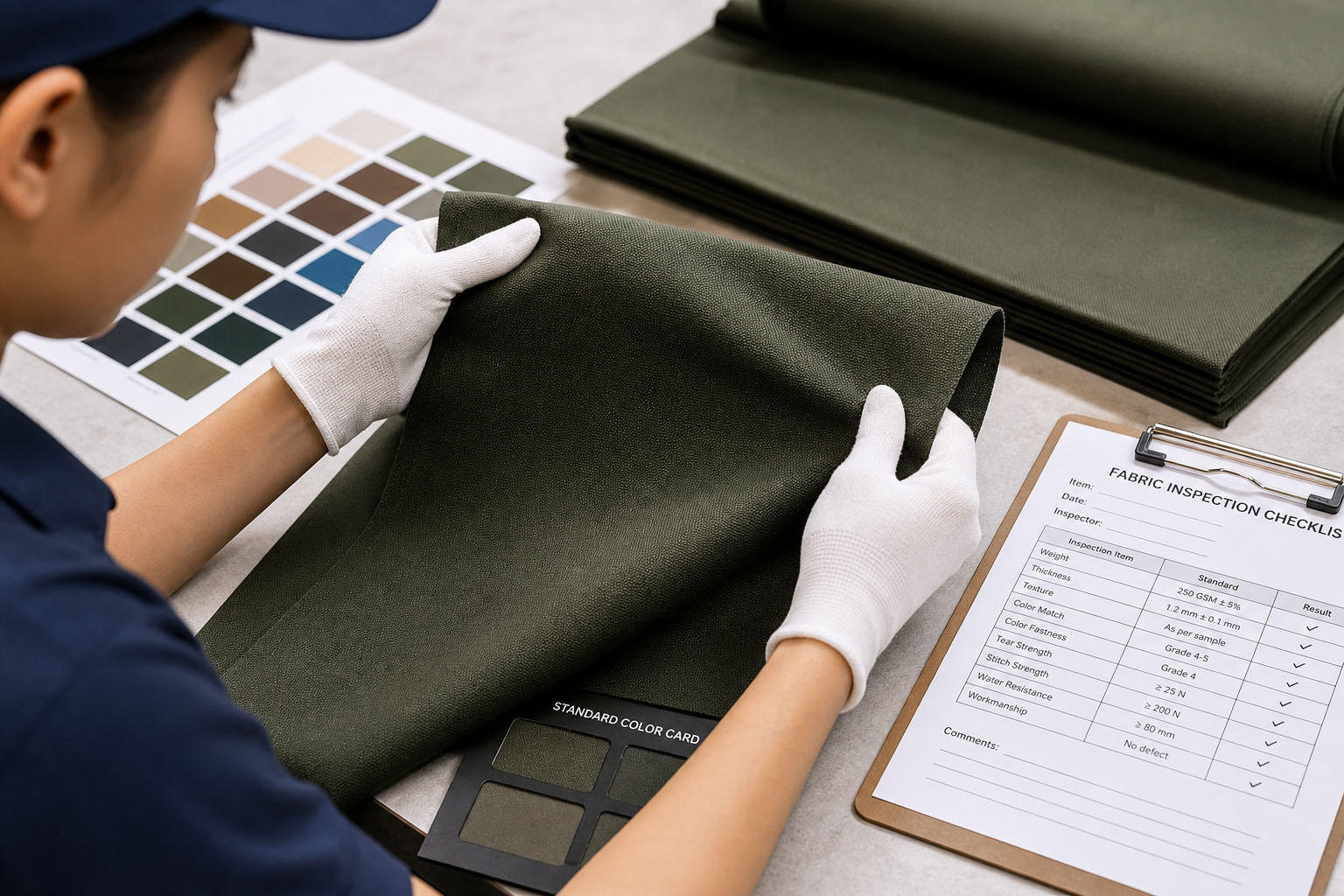
Before a single bag is assembled, the raw materials must meet your specifications. This is where Incoming Quality Control becomes critical. During this stage, inspectors examine all components that will go into your bags:
Fabrics and Materials: Whether you’re sourcing canvas, leather, nylon, or synthetic materials, each batch must match your approved samples in terms of weight, texture, color, and durability characteristics. Color consistency verification between approved samples and bulk production requires standardized color-matching tools to prevent mismatched batches that could ruin your product line’s visual coherence.
Hardware Components: Zippers, buckles, clasps, D-rings, and metal accents must be tested for functionality and finish quality. A zipper that snags or a clasp that tarnishes within weeks will generate customer complaints and damage your reputation.
Straps and Handles: These load-bearing elements require particular attention. Material durability testing for critical bag components including straps, zippers, seams, and clasps validates structural integrity before export. The last thing you want is handles separating from bags after minimal use.
Linings and Labels: Interior fabrics, tags, brand labels, and care instruction tags should all be inspected for correct placement, secure attachment, and accurate information.
Stage Two: In-Production Inspection (IPI)
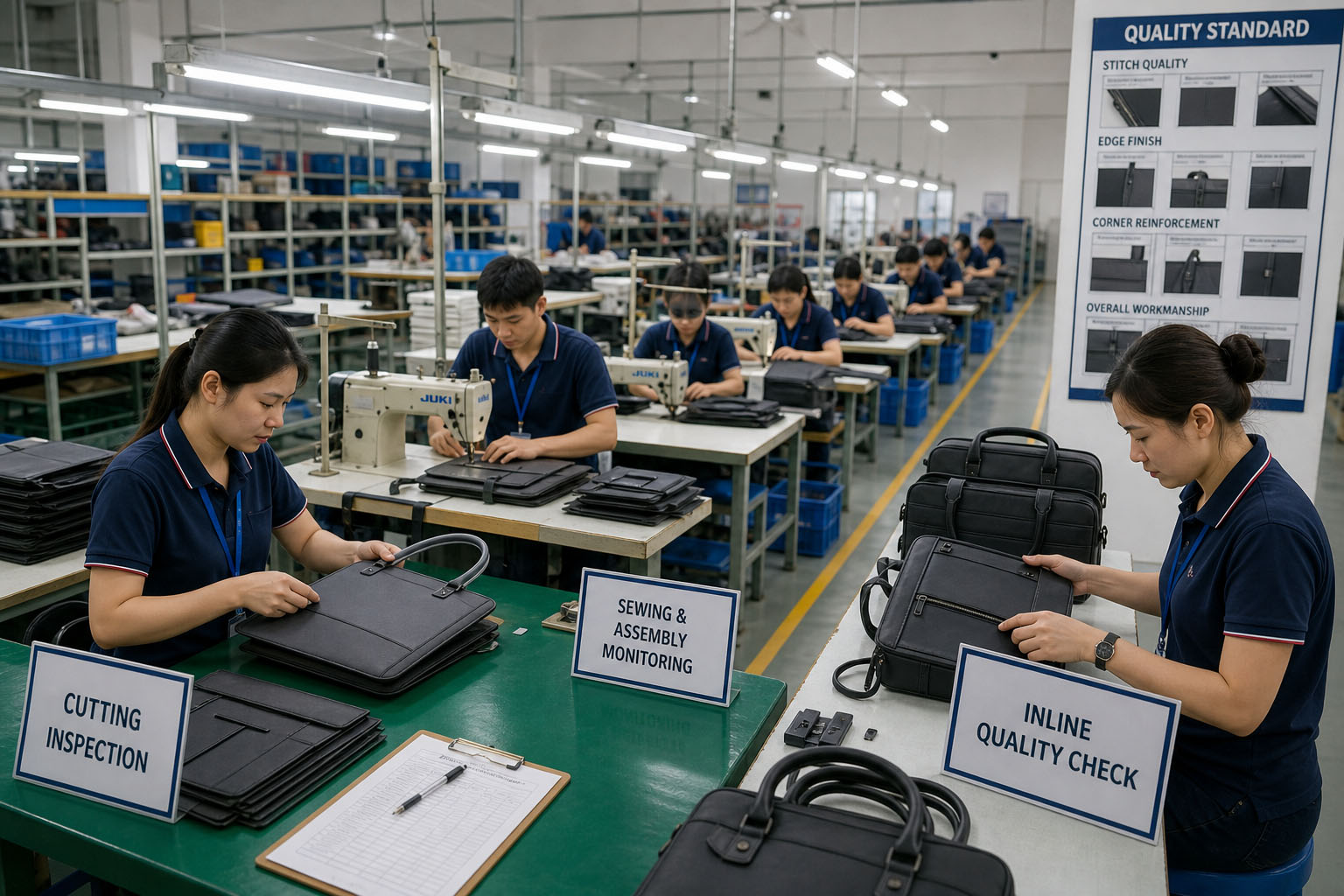
During-production inspections identify quality issues early in the manufacturing process, allowing corrections before full production runs are completed. This stage typically occurs when approximately 20-30% of production is complete, giving you enough visibility to catch systematic problems while there’s still time to address them.
During in-process checks, inspectors observe:
Cutting Operations: Ensuring pattern pieces are cut accurately and consistently, with proper seam allowances
Sewing and Assembly: Monitoring stitch quality, tension consistency, and proper seam construction
Finishing Work: Checking edge binding, corner reinforcement, and overall craftsmanship
Workmanship Standards: Verifying that workers follow established procedures and that quality standards are being maintained throughout the production floor
The beauty of during-production inspection is that it provides an early warning system. If inspectors find that stitch tension is inconsistent or that certain workers are making repeated errors, you can request corrective action before the problem affects your entire order.
Stage Three: Pre-Shipment Inspection (PSI)
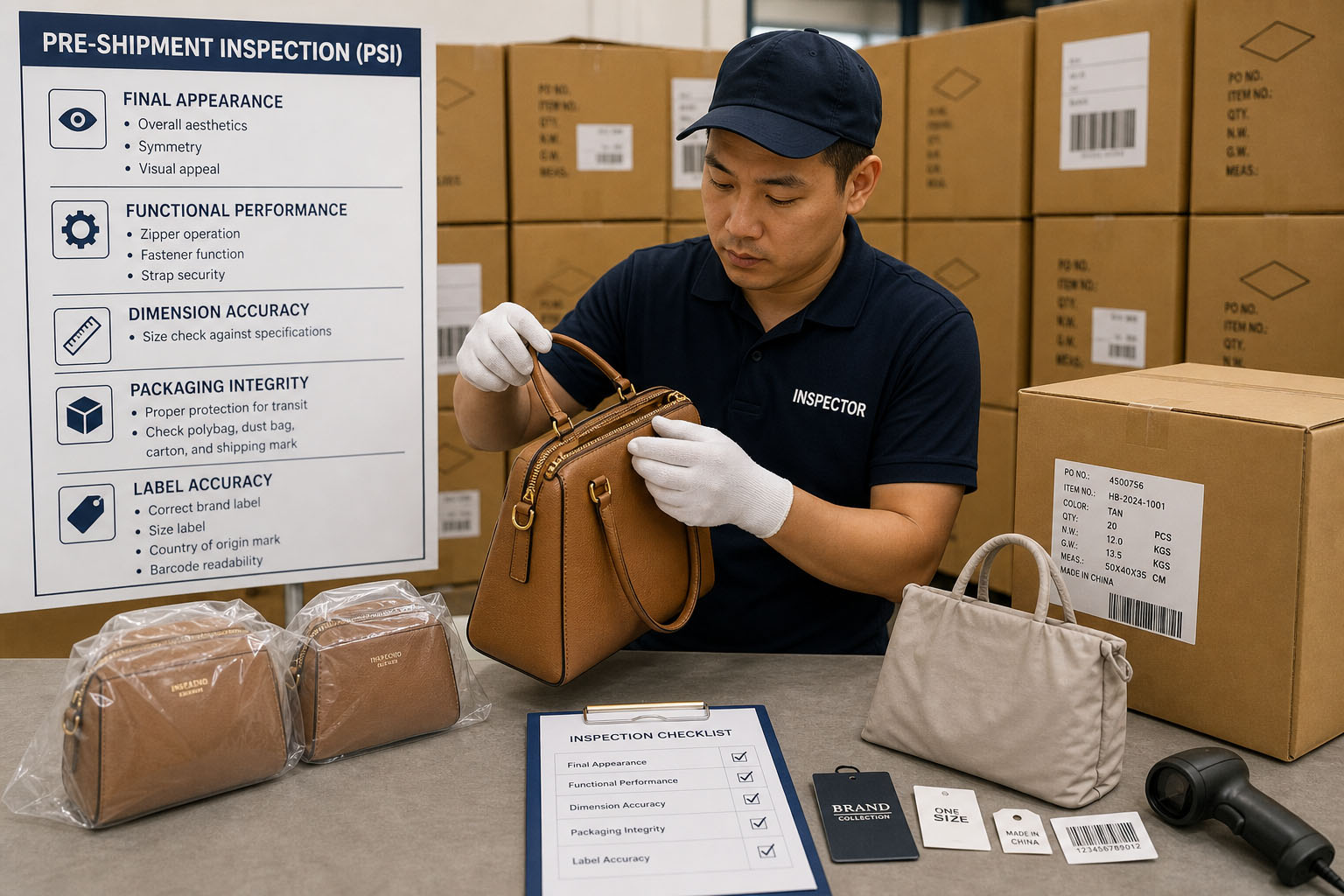
Pre-shipment inspection serves as the final quality gate before goods leave the factory, preventing costly returns and customer complaints. This is your last opportunity to verify that finished products meet your specifications before they enter your supply chain.
At this stage, goods are packed and ready for export, allowing inspectors to evaluate:
Final Appearance: Overall aesthetic quality, symmetry, and visual appeal
Functional Performance: Zipper operation, clasp functionality, strap security
Dimensional Accuracy: Size verification against specifications
Packaging Integrity: Proper protection during transit, including check of poly bags, dust bags, boxes, and shipping labels
Labeling Accuracy: Correct brand labels, size tags, country of origin markings, and barcode readability
Section 2: Hiring and Coordinating Third-Party Inspection Services
Why Third-Party Inspection Is Essential
You might wonder why you can’t simply trust your supplier’s own quality control team. The answer lies in alignment of interests. Your supplier’s QC team is employed by the factory—they face pressure to approve orders and maintain the business relationship. Third-party inspection companies such as SGS, Bureau Veritas, and TÜV offer objective, professional quality assessments independent of manufacturer interests.
This objectivity is invaluable. A third-party inspector has no stake in whether your order passes or fails—they report what they find. This transparency protects both you and helps legitimate factories demonstrate their commitment to quality.
Selecting the Right Inspection Partner
For small businesses, several reputable inspection companies offer scalable services:
Global Inspection Companies: Firms like SGS, Bureau Veritas, Intertek, and TÜV have worldwide networks and standardized procedures. They offer comprehensive services but may have higher minimum fees.
China-Focused Services: Companies like QIMA, AsiaInspection, and CTI offer competitive pricing for China-based inspections with experienced local inspectors.
Specialized Bag/Soft Goods Inspectors: Some firms specialize in textile and leather goods, bringing industry-specific expertise to your inspections.
When evaluating inspection services, consider:
Network Coverage: Can they inspect at your specific factory location?
Turnaround Time: How quickly can they schedule inspections?
Reporting Standards: Do they use recognized protocols like AQL sampling?
Language Capabilities: Can they communicate effectively with your factory?
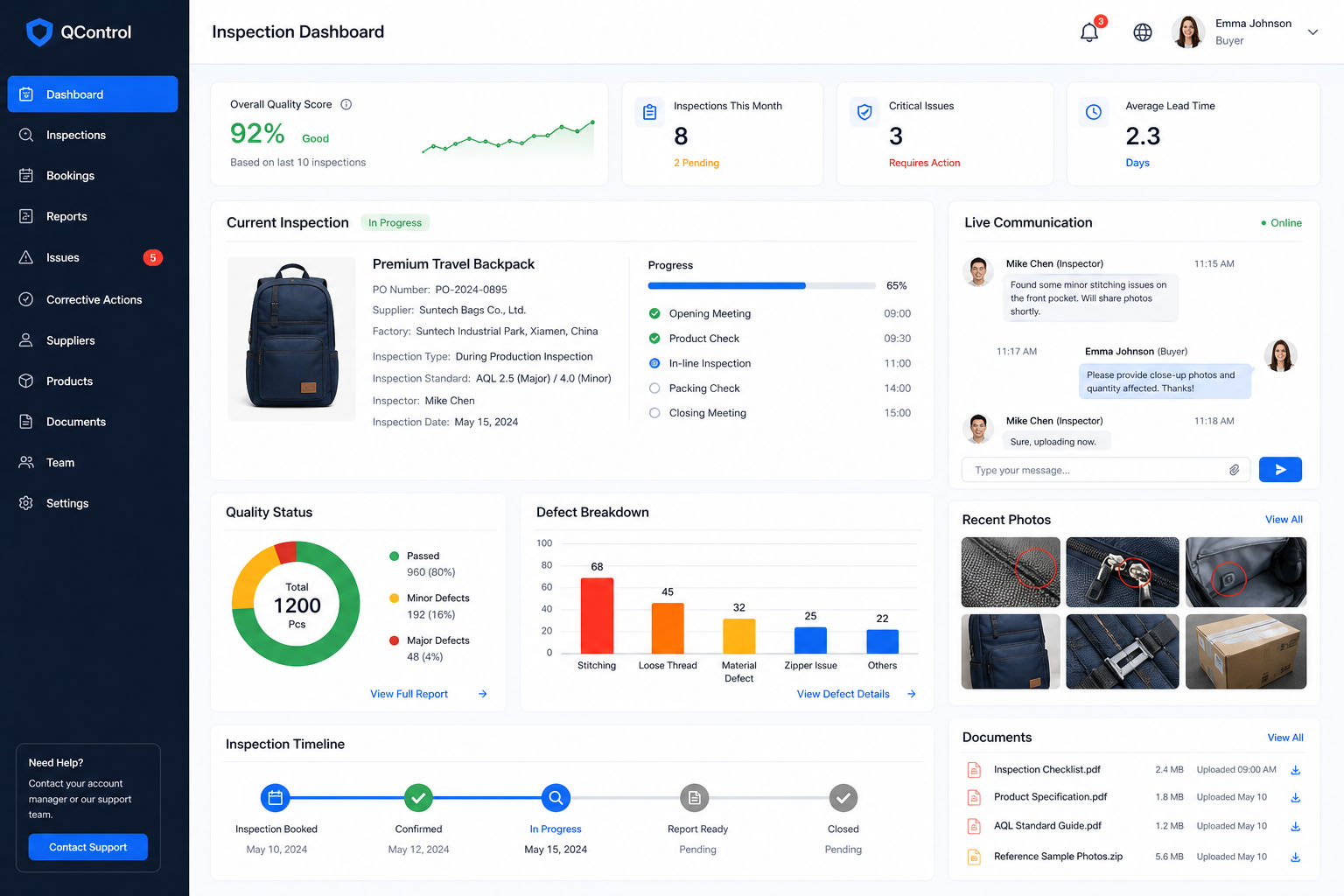
Digital Platforms: Do they offer real-time reporting, photo uploads, and instant communication between buyers and inspectors, streamlining the entire quality assurance workflow?
Coordinating Your First Inspection
Here’s a practical approach for small business owners:
Step 1: Establish Requirements in Writing
Before production begins, communicate your QC requirements clearly to your supplier. Lock the QC requirements into the purchase order or contract so the factory knows photos and reports are mandatory, not optional. Specify:
Which inspection stages you require
Minimum AQL standards
Reporting format expectations
Inspector access provisions
Step 2: Schedule Inspections in Advance
Don’t wait until goods are ready to arrange inspection. Contact your chosen inspection company early to:
Confirm their availability at your required dates
Provide factory details and contact information
Share your specification sheet and acceptance criteria
Establish communication protocols
Step 3: Prepare Your Inspector
Provide your inspection company with:
Complete product specifications including materials, dimensions, stitching requirements, logo placement, and packaging details
Approved reference samples
Your AQL requirements and defect classification system
Any special tests or checks specific to your products
Clear instructions on reporting format and photo requirements
Step 4: Maintain Communication
Digital QC platforms enable real-time reporting, photo uploads, and instant communication between buyers and inspectors. Stay engaged throughout the process. Request updates during lengthy inspections, ask clarifying questions about any defects identified, and maintain an open dialogue with your inspector.
A Message You Can Send to Your Factory
To ensure clarity and prevent misunderstandings, consider sending your supplier a formal message like this:
“We require QC at raw material, in-process, and pre-shipment stages. Please provide inspection reports with photos for each stage, including workmanship, zipper/strap testing, dimensions, packaging, labeling, and any defects found before shipment. Our third-party inspector must have full access to production areas and finished goods. Inspection reports must be submitted to us before goods are shipped.”
Section 3: Understanding AQL Standards and Sampling Procedures
What Is AQL?
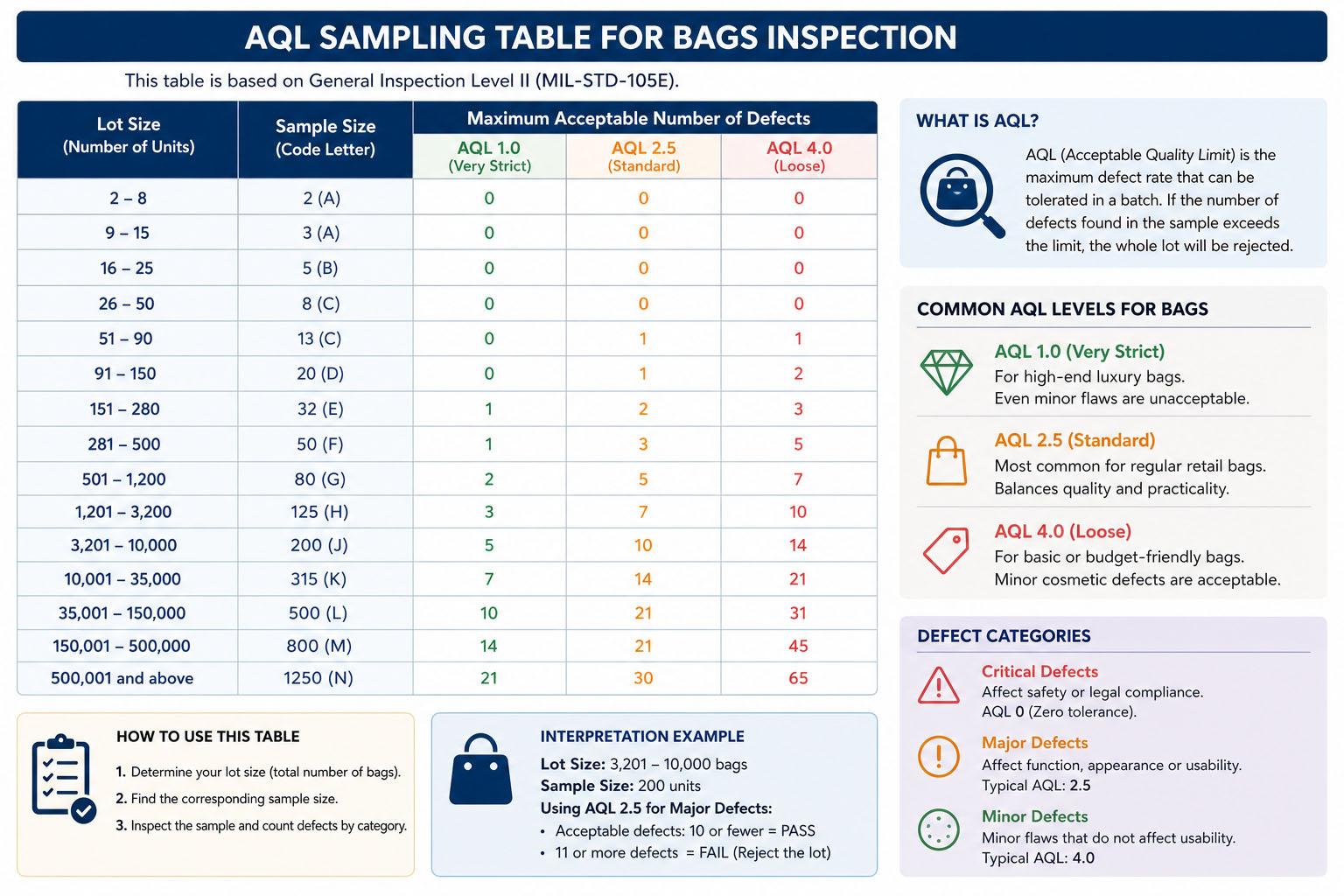
AQL stands for Acceptable Quality Limit (sometimes called Acceptable Quality Level). It’s a statistical tool that defines the maximum percentage of defective items that can be considered acceptable in a random sample inspection. Think of it as a tolerance threshold—if defects exceed this level, the entire lot is rejected.
AQL standards, typically set at 2.5 or 4.0 for bags, define acceptable defect rates and guide inspection sampling sizes. The lower the AQL number, the stricter the quality requirement.
Common AQL Levels for Bag Inspections
AQL 1.0 (Very Strict): Used for high-end luxury bags where even minor imperfections are unacceptable. This level results in smaller acceptance numbers and larger sample sizes.
AQL 2.5 (Standard): The most common standard for general retail bags. It balances quality expectations with practical manufacturing realities.
AQL 4.0 (Lenient): Used for basic, budget-friendly bags where minor cosmetic defects are tolerable. This is less common but may apply to very low-price-point products.
Understanding Defect Categories
For bag inspections, defects typically fall into three categories:
Critical Defects: Issues that render the product unsafe or illegal (e.g., toxic materials, missing safety features, incorrect regulatory labels). Most buyers use AQL 0 for critical defects—meaning zero tolerance.
Major Defects: Issues that would significantly affect usability, appearance, or customer acceptance (e.g., broken zippers, misaligned seams, incorrect dimensions, major color variations). Typical AQL: 2.5
Minor Defects: Small imperfections that don’t significantly affect usability but may be noticeable (e.g., loose threads, slight color variations, minor scuffs). Typical AQL: 4.0
Sampling Table Interpretation
AQL inspections use standardized sampling tables (based on military standard MIL-STD-105E or its successors). The sample size depends on your lot size and chosen inspection level.
General Inspection Level II is most commonly used, providing a balanced approach between thoroughness and cost.
Here’s a simplified example:
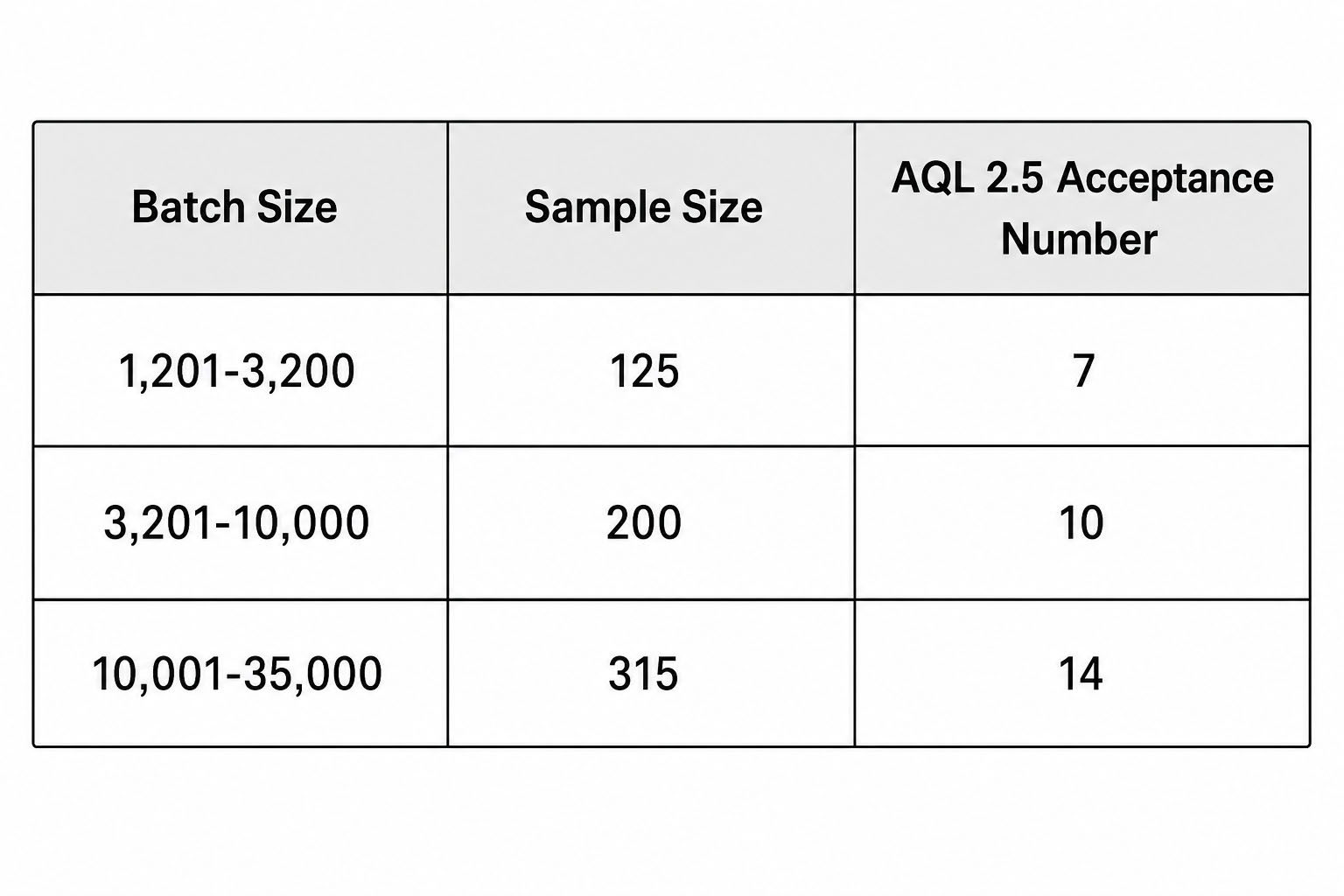
This means that for a lot of 3,201-10,000 bags, if inspectors find 10 or fewer major defects in a sample of 200, the lot passes. Eleven or more major defects would trigger rejection.
Specifying Your AQL Requirements
When setting up your inspection, be explicit about:
Which AQL level applies to each defect category
What constitutes a critical, major, or minor defect for your specific products
How many samples will be drawn from your total order
What happens if defects exceed acceptance numbers
For handcrafted bags, you may need to adjust your expectations. Handcrafted items naturally have more variation than machine-made products. Be realistic about what constitutes acceptable variation versus actual defects.
Section 4: Essential Elements of Pre-Shipment Inspection Reports for Handcrafted Bags
What Comprehensive Inspection Reports Should Include
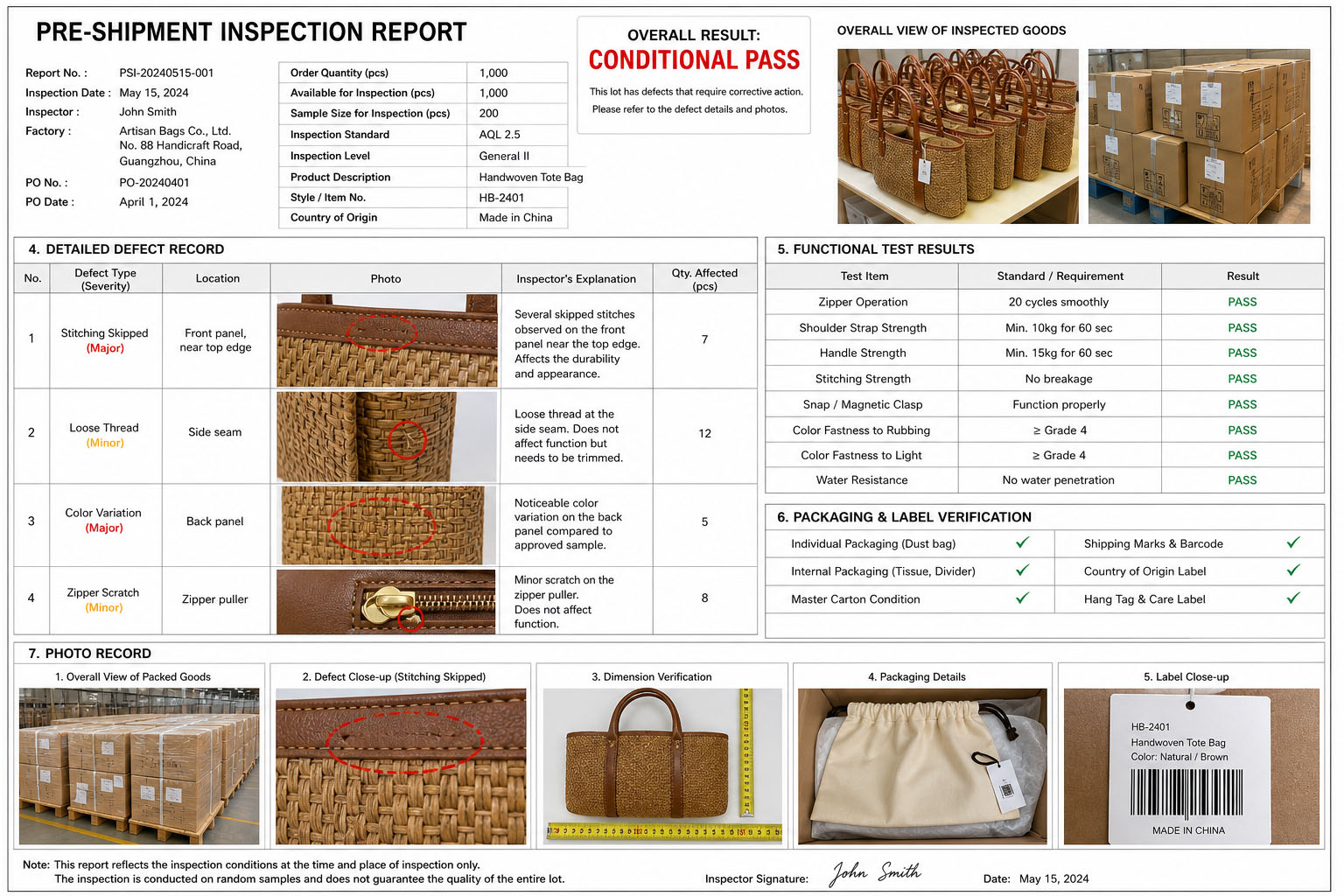
Buyers commonly expect a detailed report with batch quantity inspected, pass/fail results, and defect counts. For handcrafted bags, which often feature unique characteristics and traditional techniques, your inspection report requirements should be particularly thorough.
Report Structure and Required Elements
1. Executive Summary
The report should open with clear pass/fail recommendations based on your specified AQL standards. This summary should immediately tell you whether the shipment is acceptable, conditionally acceptable (with agreed remediation), or rejected.
2. Basic Order Information
Purchase order number and date
Factory name and location
Inspection date and inspector name
Total order quantity vs. quantity available for inspection
Sample size inspected
3. Product Specifications Verification
The inspector should verify that the actual products match your specification sheet in:
Dimensions (length, width, height, handle drop)
Materials (outer fabric, lining, hardware)
Colors (compared against approved reference samples)
Weight
Logo placement and size
4. Detailed Defect Log
Clear photos of defects, packaging, labels, barcodes, and finished products should be included. For each defect found, document:
Defect type and category (critical/major/minor)
Specific location on the bag
Clear photograph showing the defect
Inspector’s notes explaining the issue
5. Functional Testing Results
Functional tests such as zipper cycling, strap strength, seam quality, load-bearing, and waterproof or colorfastness checks when relevant should be documented. For handcrafted bags, specific tests might include:
Zipper operation (minimum 20 open/close cycles)
Strap and handle load testing
Seam strength evaluation
Clasp functionality
Colorfastness to rubbing and light
Water resistance (if applicable)
6. Packaging and Labeling Verification
Packaging integrity inspection ensures proper protection during transit, including check of poly bags, dust bags, boxes, and shipping labels. Verify:
Individual bag packaging (dust bag, protective wrapping)
Inner packing (tissue paper, cardboard dividers)
Master carton condition and labeling
Shipping marks and barcodes
Country of origin labels
7. Photographic Documentation
Photographic documentation of inspected items provides verifiable evidence of product condition, packaging, and labeling accuracy. At minimum, expect:
Overview shots of packed goods
Close-ups of each defect found
Measurement verification photos
Packaging detail shots
Label close-ups showing text clarity
Special Considerations for Handcrafted Bags
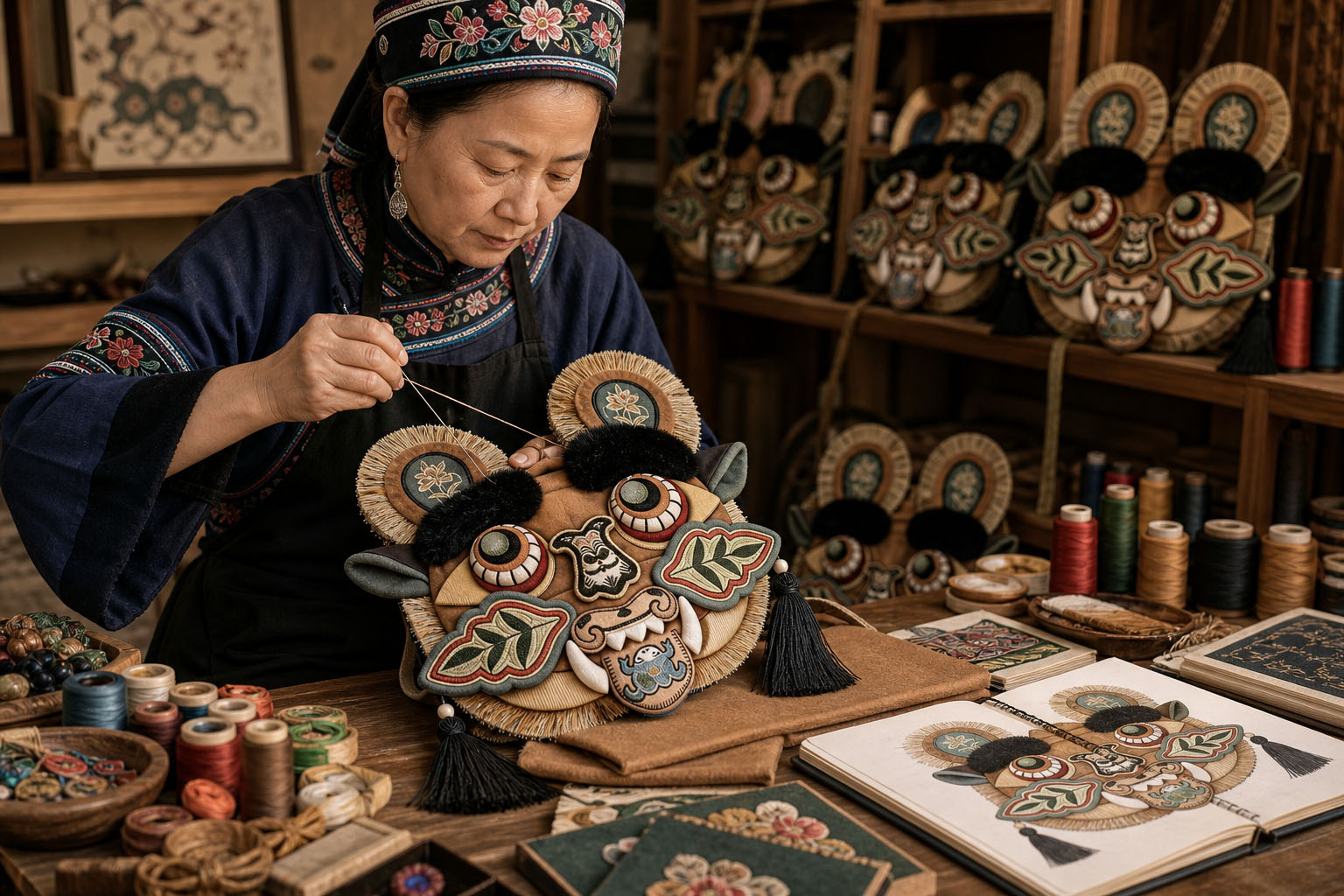
Handcrafted bags present unique inspection challenges. If you’re sourcing traditional Chinese handcrafted bags like Tiger Head Bags (虎头包), your inspection approach must account for the inherent characteristics of artisan production.
Traditional Craftsmanship Variations: Hand embroidery, hand-stitched seams, and natural material variations are part of the authentic handcrafted character. Your inspection should distinguish between intentional artisanal variation and actual defects.
Cultural Authenticity Elements: For traditional items like Tiger Head Bags, which represent Chinese intangible cultural heritage with origins in Guangxi province, inspectors should verify that authentic techniques and materials are used while acknowledging that each piece will have unique characteristics.
Embroidery Quality Assessment: For bags featuring embroidery—the defining characteristic of Tiger Head Bags—inspectors should evaluate:
Stitch density and consistency
Color matching to approved samples
Design accuracy and symmetry
Thread quality and security

Section 5: Your Recourse When Defects Exceed Tolerance Levels
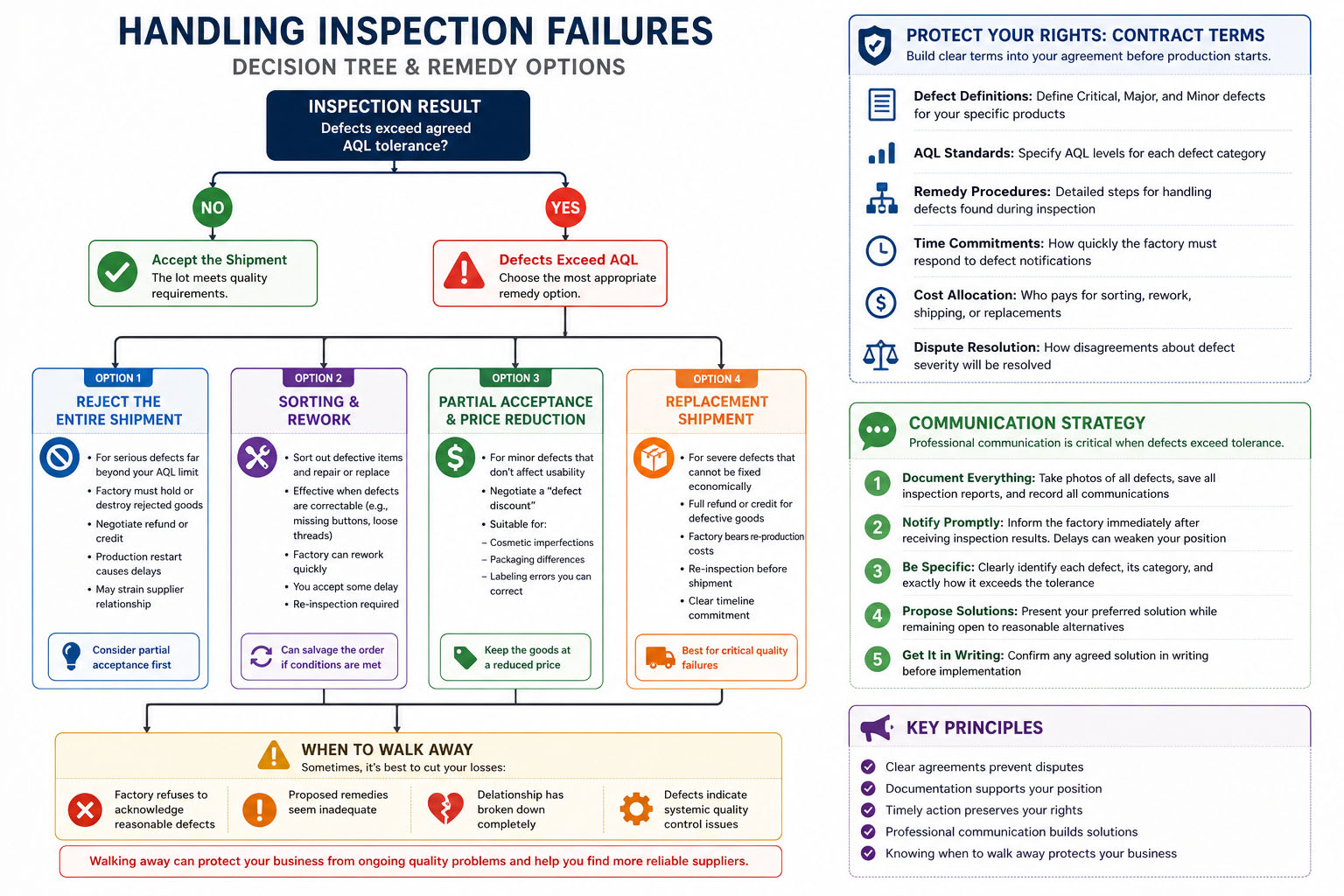
Understanding Your Options
Despite best efforts, sometimes inspections reveal defects that exceed agreed tolerance levels. When this happens, you have several options—but the specific recourse available depends heavily on what was agreed upon before production began.
Option 1: Lot Rejection
If defects significantly exceed your AQL limits, you have the right to reject the entire lot. This is the most straightforward option but also the most disruptive. Rejection means:
The factory must hold or destroy the rejected goods
You’ll need to negotiate a refund or credit
Production must restart, causing delays
Your relationship with the supplier may be strained
Before rejecting, consider whether partial acceptance might be possible.
Option 2: Sorting and Rework
Often, the factory will propose sorting through the goods to remove defective items, then repairing or replacing those items. This process, called sorting and rework, can salvage an order if:
Defects are correctable (missing buttons, loose threads, etc.)
The factory has capacity to complete rework quickly
You’re willing to accept some delay
A re-inspection is guaranteed
Option 3: Partial Acceptance with Price Reduction
For minor defects that don’t significantly impact usability, you might negotiate a price reduction rather than rejection or rework. This “discount for defects” approach is common for:
Cosmetic imperfections that don’t affect function
Packaging variations that don’t impact product protection
Labeling errors that can be corrected at your end
Option 4: Replacement Shipment
For serious defects that can’t be economically corrected, you may require the factory to produce replacement goods. This typically involves:
Full refund or credit for defective goods
New production run at the factory’s expense
Fresh inspection before shipment
Clear timeline commitments
Protecting Your Rights: Contract Provisions
Your best protection is establishing clear terms before production. Your purchase agreement should specify:
Defect Definitions: What constitutes a critical, major, and minor defect for your specific products
AQL Standards: Which AQL levels apply to each defect category
Remediation Procedures: Step-by-step process for addressing defects discovered during inspection
Timeline Commitments: How quickly the factory must respond to defect notifications
Cost Allocation: Who bears the cost of sorting, rework, shipping, or replacement
Dispute Resolution: How disagreements about defect severity will be resolved
Communication Strategy
When defects exceed tolerance levels, professional communication is essential:
1. Document Everything: Photograph all defects, save all inspection reports, maintain detailed records of all communications.
2. Notify Promptly: Inform the factory immediately upon receiving inspection results. Delays in notification can weaken your position.
3. Be Specific: Clearly identify each defect, its category, and how it exceeds your tolerance levels.
4. Propose Solutions: Suggest your preferred resolution while remaining open to alternatives.
5. Get Agreements in Writing: Whatever resolution you reach, confirm it in writing before proceeding.
When to Walk Away
Sometimes the best recourse is to cut your losses:
If the factory refuses to acknowledge legitimate defects
If proposed corrections seem inadequate
If the relationship has fundamentally broken down
If the defects suggest systemic quality control problems at the factory
Knowing when to walk away protects your business from ongoing quality problems and allows you to find more reliable suppliers.
Section 6: Building a Complete Quality Control System for Your Bag Business
A Practical QC Setup for Small Businesses
For a small business, a simple but systematic setup works well. Here’s a practical approach:
1. Approve a Pre-Production Sample First
Never begin bulk production without an approved sample. This sample becomes your reference standard for all subsequent inspections. Request samples of:
Each bag style you’re ordering
Each color variation
Each packaging configuration
2. Create a Detailed Specification Sheet
Set a written specification sheet with materials, dimensions, stitching, logo placement, packaging, and tolerance limits. Include:
Material specifications (fabric weight, hardware type, lining material)
Dimensional tolerances (±5mm or whatever is appropriate)
Stitch specifications (stitch per inch, stitch type)
Color standards (reference numbers or physical samples)
Packaging requirements
Label specifications
3. Require Inline Photos During Production
Don’t wait for formal inspections to see how production is progressing. Require inline photos during production—regular updates showing work in progress, materials being used, and early production samples.
4. Order Professional Pre-Shipment Inspection
Order a third-party pre-shipment inspection with an AQL-style sampling plan if possible. This final checkpoint catches any issues that slipped through earlier stages.
Integrating Traditional Craftsmanship Quality Standards
If you’re sourcing traditional handcrafted bags like Tiger Head Bags, your quality control system must account for the unique characteristics of artisan production while maintaining consistency standards.
Understanding Traditional Craftsmanship: Tiger Head Bags represent a significant tradition in Chinese folk art, particularly associated with Guangxi province. These bags feature distinctive tiger-head embroidery created using traditional techniques passed down through generations. Your QC approach should:
Appreciate the artisanal nature of the products
Distinguish between intentional craft variation and quality failures
Verify authentic materials and techniques are used
Ensure cultural authenticity while maintaining functional standards
Quality Standards for Traditional Bags: While embracing traditional craftsmanship, you should still verify:
Structural integrity of handles and straps
Secure attachment of all components
Functional hardware (zippers, clasps work properly)
Accurate representation of traditional designs
Proper protective packaging for delicate embroidery
Conclusion: Quality Control as a Competitive Advantage
Quality control isn’t just about preventing bad products from reaching your customers—it’s a strategic advantage that sets professional importers apart from casual buyers. When you implement rigorous quality control processes, you:
Protect Your Reputation: Every product that reaches a customer reflects your brand. Quality control ensures that reflection is positive.
Reduce Costs: Returns, refunds, and customer service issues are expensive. Catching problems before shipment costs far less than dealing with them after.
Build Supplier Accountability: When suppliers know you’ll inspect thoroughly, they’re motivated to maintain quality consistently.
Demonstrate Professionalism: Working with inspection companies, using industry-standard AQL protocols, and maintaining detailed specifications shows suppliers you’re a serious buyer worthy of their best effort.
Enable Scaling: As your business grows, a solid QC system allows you to increase order volumes with confidence.
Your Next Steps
1. Document Your Standards: Create a comprehensive specification sheet for every bag style you source
2. Choose an Inspection Partner: Research and select a third-party inspection company that fits your needs and budget
3. Communicate Expectations: Send your QC requirements to current and prospective suppliers
4. Start Small: If you’re new to formal QC, begin with pre-shipment inspections and add earlier-stage checks as you gain experience
5. Review and Improve: After each shipment, evaluate what worked and refine your processes
Remember: The most important thing is to lock the QC requirements into the purchase order or contract so the factory knows photos and reports are mandatory, not optional. When quality control is built into your business processes from the start, you’re not just importing bags—you’re building a sustainable, professional business that customers can trust.
Post time: May-22-2026