
Bag Seam Construction Guide: Overlock (Serged), Double-Needle Stitching & Reinforcement for Durable Bags
Blog for US Bag E-commerce Site | Target Audience: Factory Sourcing Teams, Product Designers, Brand Owners
Introduction
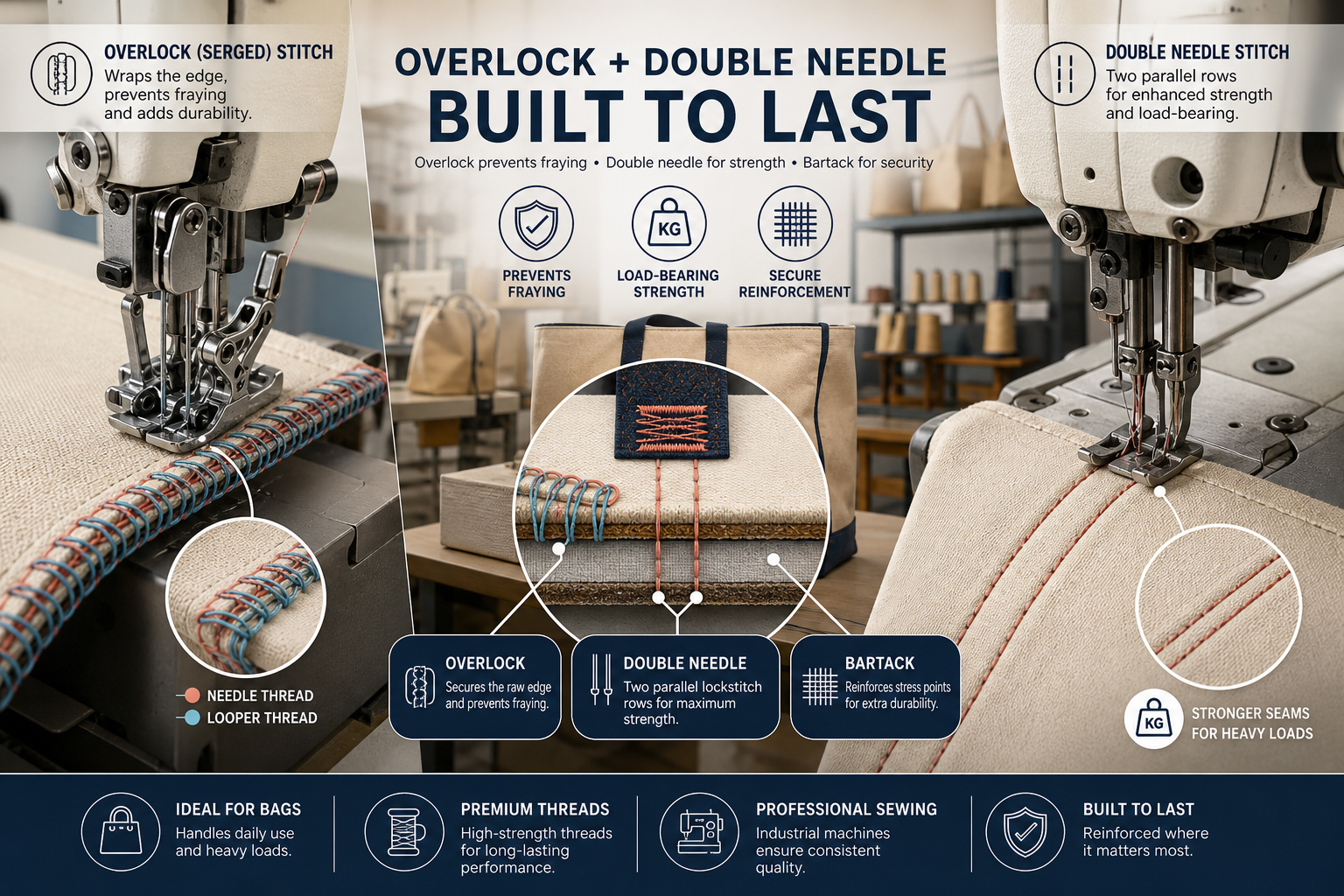
When sourcing tote bags, backpacks, work bags, and outdoor luggage from Chinese OEM manufacturers, many US bag buyers focus heavily on fabric quality, hardware, and pricing while overlooking one critical performance factor: seam construction. Even premium canvas, 600D polyester, or heavy nylon will fail prematurely if the stitching design, thread selection, and seam reinforcement are poorly executed. Two of the most widely used sewing techniques in bag production are overlock (serged) stitching and double-needle stitching. These two seam methods serve different functions, and mixing them incorrectly can lead to fraying, seam splitting, or product returns after only a short period of customer use. This guide breaks down how overlock and double-needle stitching improve tensile strength and seam durability, clarifies when to select each seam style, debunks common misconceptions about double-needle stitching, and outlines the best stitch combinations for high-load bag areas such as shoulder straps and bag bottoms. We also cover thread material limitations, key questions you need to ask your Chinese bag supplier, and testing standards to validate seam performance before bulk production.
What Is Overlock (Serged) Stitching, and How Does It Boost Seam Durability?
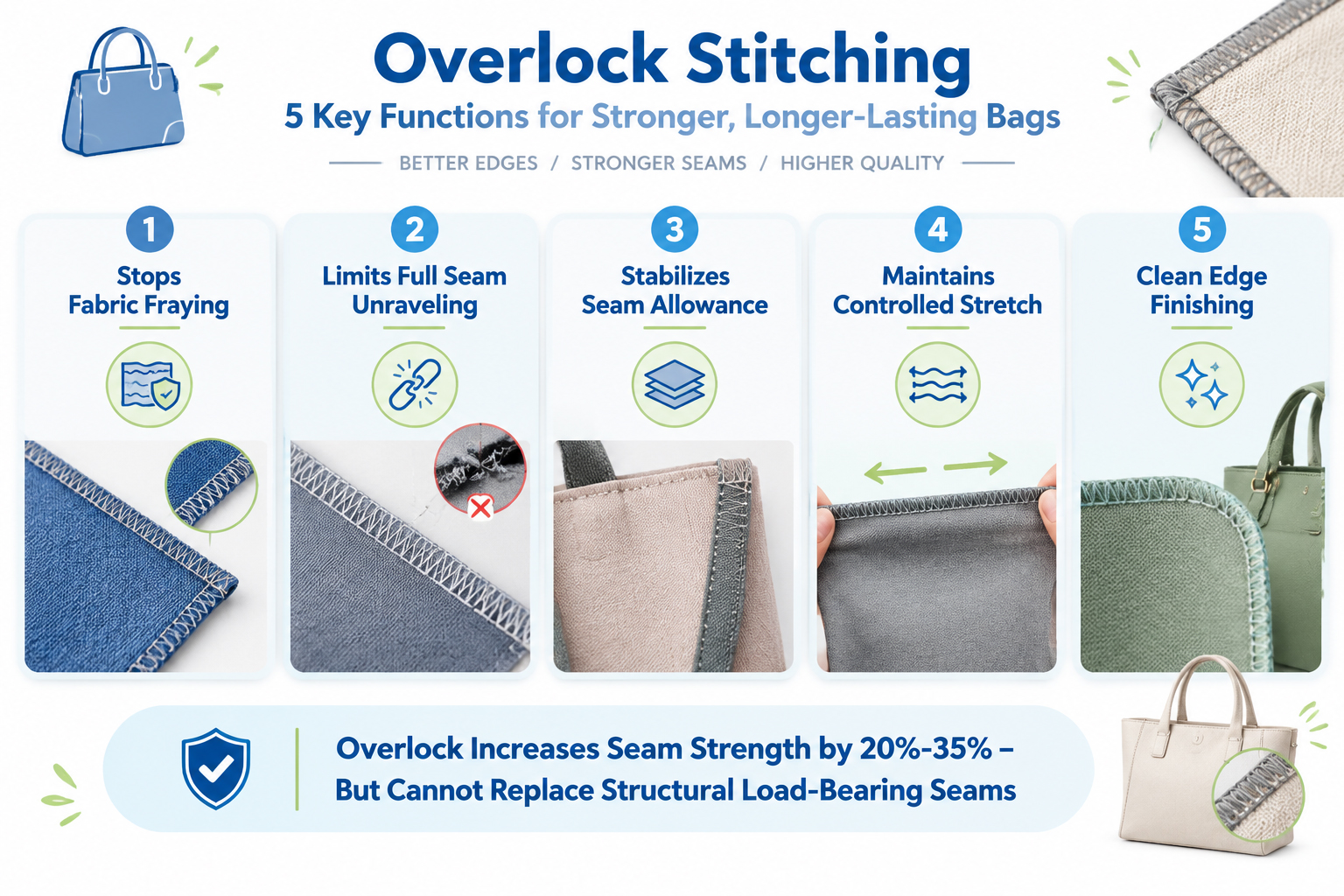
Overlock stitching, also known as serging, uses specialized sewing machines with needle threads and looper threads that wrap fully around raw cut fabric edges. Most overlock machines trim excess fabric while wrapping the edge with thread in one continuous operation. The core value of overlock stitching is edge protection, rather than acting as the primary load-bearing seam. Overlock stitching wraps the raw seam edge with thread, preventing fraying and extending seam life on woven and synthetic fabrics. It improves seam performance in five key ways:
* Stops fabric fraying: Unfinished woven nylon, polyester, and canvas will shed yarns with repeated bending, washing, and abrasion. The wrapped serged thread locks individual yarns in place so they cannot pull loose from the cut edge.
* Limits full seam unraveling: When a small section of seam sustains minor damage, the interlocked looped thread structure prevents the entire seam from splitting open immediately.
* Stabilizes seam allowance: The thread network holds the seam allowance together through repeated flexing, rubbing, and heavy washing cycles, which is essential for bag linings and interior panels.
* Maintains controlled stretch: A properly calibrated overlock seam can flex slightly under sudden impact or overfilling instead of snapping abruptly. Overlock stitches allow fabric to retain natural stretch, making them suitable for spandex blends and elastic panels in bag linings.
* Clean edge finishing: Serging eliminates loose fibers that catch on zippers, hardware, or sharp objects, which can trigger progressive seam failure over time.
Overlock seams typically increase seam strength by 20% to 35% compared to single lockstitch on the same fabric. Another practical advantage: serged seams reduce fabric bulk at the join, which is critical for interior linings where interior volume must be maximized.
Even with these benefits, overlock stitching cannot replace structural load-bearing seams. A basic serged edge is excellent for finishing raw fabric edges, but a standalone overlock seam does not carry the same heavy load as lockstitch, chain stitch, or reinforced double stitching. For high-stress bag locations including handles, shoulder straps, pocket openings, and the seam connecting the bag body to the base, most Chinese bag OEM factories combine overlock edge finishing with an additional lockstitch or topstitch layer. There are multiple overlock configurations available in bag factories: 3-thread, 4-thread, and 5-thread serge. 3-thread overlock is lightweight for thin lining fabrics; 4-thread overlock balances edge finish and moderate strength; 5-thread overlock adds a built-in lockstitch row and delivers the highest strength among serge options for medium-weight woven bag materials.
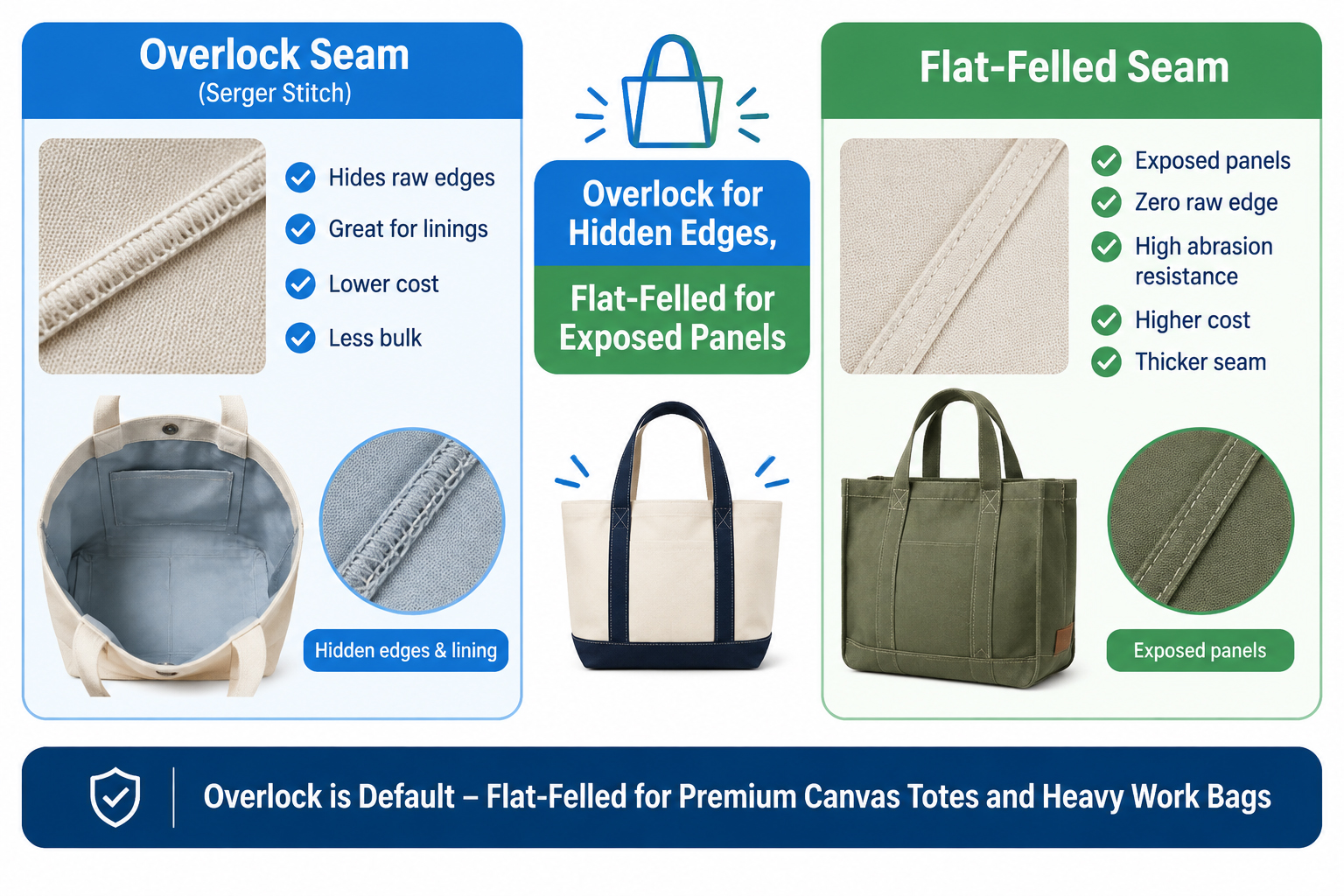
When to use overlock seams on raw fabric edges versus concealed flat-felled seams on visible bag panels
Overlock seams are the default choice for raw internal fabric edges, lining seams, and non-visible panel joins. It is fast, low-cost, prevents fraying, and keeps seam bulk low inside the bag. Concealed flat-felled seams are selected for exterior visible panels where aesthetics and heavy abrasion resistance are prioritized. Flat-felled seams fold and enclose both raw edges within the seam, creating a fully covered, smooth exterior surface. This seam type is common on premium canvas tote bags and heavy work bags. The tradeoff is higher labor cost and thicker seam bulk, so flat-felled seams are not ideal for lining materials or areas where fabric stacking creates stiffness. Rule of thumb: Use overlock for hidden raw edges and linings; use flat-felled seams for exposed exterior panels where you want zero raw edge exposure and a clean finished look.
What Is Double-Needle Stitching, and Does It Only Serve Decoration?
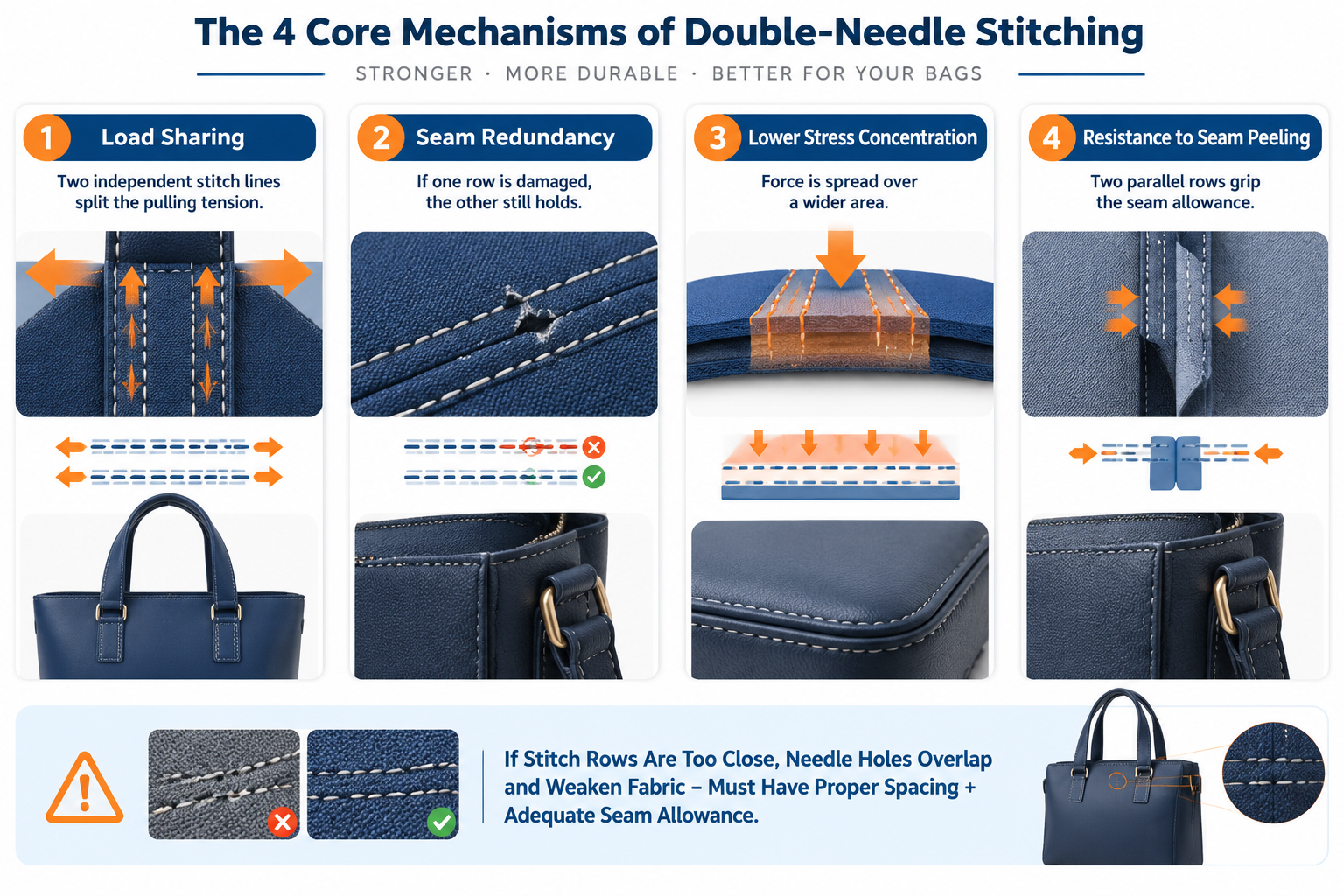
A common misconception among US bag buyers is that double-needle stitching is purely decorative. This is not true. Double-needle stitching creates two parallel lockstitch rows, distributing load across a wider seam area and significantly improving tensile strength. Double-needle machines use two needles and two bobbin threads, producing balanced parallel seams that resist uneven stress distribution. The dual stitch lines improve seam integrity through four core mechanisms:
* Load sharing: Pulling tension is split between two independent stitch lines instead of concentrating all force on one single-needle seam.
* Seam redundancy: If one stitch row gets damaged from abrasion or thread breakage, the second parallel row can continue to hold the seam together.
* Lower stress concentration: Dual rows spread force over a wider fabric area, reducing the risk that fabric tears directly along a single line of needle perforations.
* Resistance to seam peeling and opening: Two parallel rows grip the seam allowance firmly when pulled from opposite directions.
Double-needle topstitching is widely used on straps, gussets, and bottom panels to reinforce high-load areas in backpack production. When paired with bonded nylon thread, double-needle stitching delivers the highest tensile rating used in Chinese OEM bag factories for heavy-duty products.
There are critical caveats to remember: double-needle stitching will not automatically double the seam load-bearing capacity compared to single-needle stitching. The performance depends heavily on stitch spacing, stitch density, seam allowance, thread tension, and fabric integrity. If the two stitch rows are placed too close together, the needle holes overlap and perforate the fabric, weakening the material. Poor thread tension or short stitch length can also reduce seam strength dramatically. When properly spaced with adequate seam allowance, double-needle stitching provides major improvements in seam durability and load capacity for exterior high-wear panels.
Highest Integrity Seam Combination for Weight-Bearing Areas: Overlock, Double-Needle, and Bartack
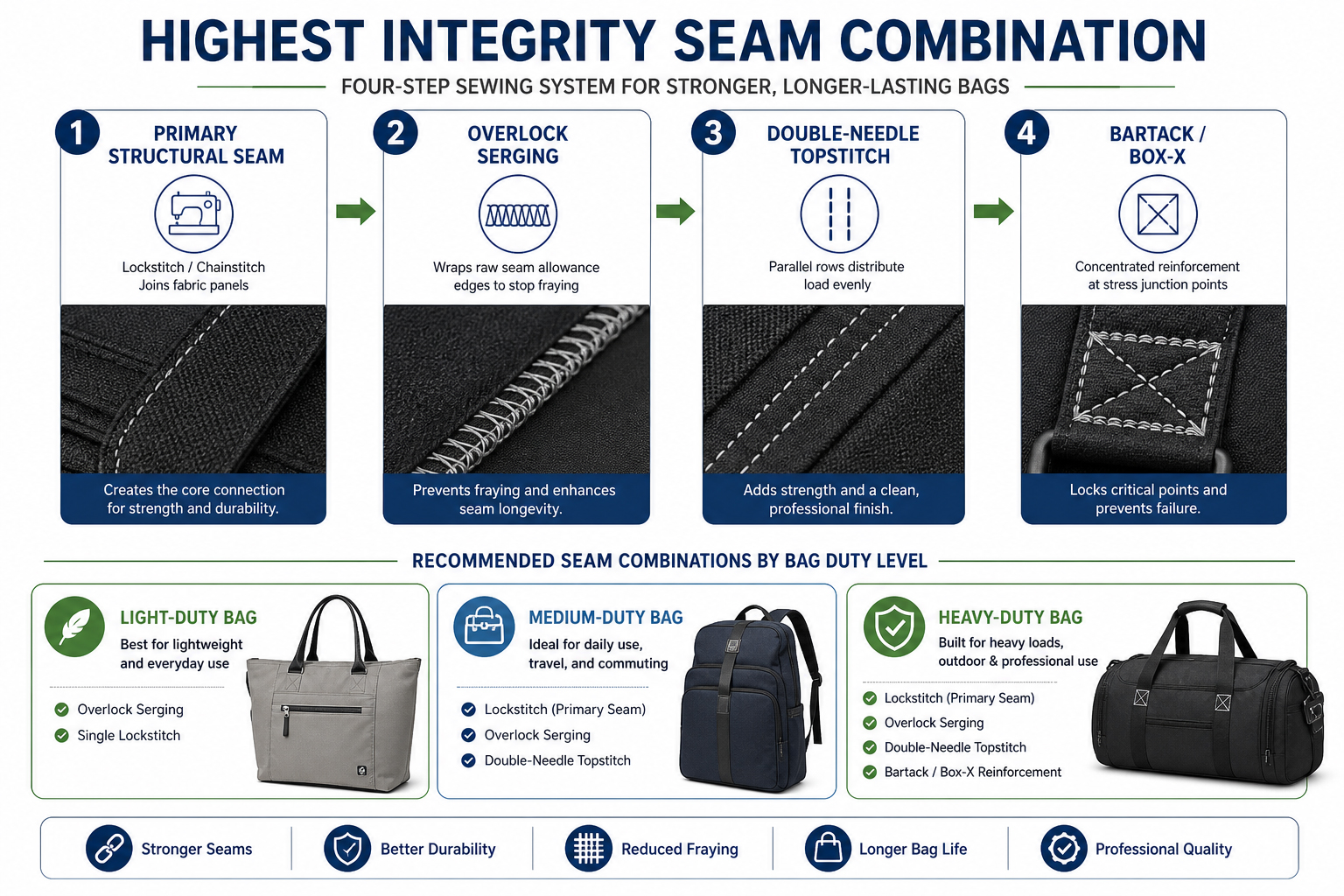
The next question every bag product buyer needs to resolve: which combination of overlock, double-needle, and bartack delivers the strongest overall seam integrity on weight-bearing areas such as bag straps and bottoms? No single stitch type can deliver maximum performance alone. The most robust construction combines all three elements with correct sequencing:
* Primary structural seam: Lockstitch or chain stitch joins the fabric panels together.
* Overlock serging: Finishes the raw seam allowance edges to stop fraying.
* Double-needle topstitch: Runs parallel rows on the exterior surface to distribute load and lock down seam allowance.
* Bartack reinforcement: Dense, short reinforced stitch bars at all stress junction points, where straps, handles, and webbing attach to the bag body. Box-X stitching is another popular alternative to bartacks for handle mounts.
Combining overlock edge finishing with double-needle topstitch creates the strongest seam construction used in export-grade canvas and nylon bags. Overlock seam elasticity prevents thread breakage when bags are overfilled or subject to impact loading. Bartacks are localized reinforcement. They do not run along the full seam length; they concentrate heavy stitching at connection points where stress spikes. Even a well-executed double-needle seam can tear at strap attachment points without bartack or box-X reinforcement.
For product specification:
* Light-duty fashion bags: Overlock edge finish + single lockstitch may be sufficient.
* Medium-duty daily totes and daypacks: Main lockstitch seam + overlock seam allowance + double-needle topstitch.
* Heavy-duty outdoor bags, work gear, and luggage: Main lockstitch seam + overlock + double-needle topstitch + bartack / box-X reinforcement on all strap and handle mounts.
Overlock Thread Performance: UV Resistance and Washing Durability
Most overlock machines use woolly nylon thread for serging. A key sourcing question: Does overlock thread (typically woolly nylon) weaken when exposed to UV rays or heavy washing, affecting long-term durability? Woolly nylon overlock thread has excellent stretch and softness, which is why factories prefer it for serging. However, standard woolly nylon has limitations. Extended UV exposure from sunlight degrades nylon fiber, reducing tensile strength over time. Repeated heavy washing and bleach exposure will also accelerate thread aging. If your bags are marketed for outdoor use, beach use, or frequent wash cycles, you must specify UV-stabilized polyester overlock thread instead of standard woolly nylon. Bonded nylon thread is the preferred option for structural double-needle topstitching because it has superior abrasion resistance and higher tensile strength, though it still requires UV stabilization for outdoor applications. Thread failure is one of the top three root causes of bag seam failure, alongside fabric tearing and yarn slippage at stitch holes. Always confirm thread material, thread size, and UV treatment with your supplier before sampling.
Critical Questions to Ask Your Chinese Bag Manufacturer During Sourcing
When communicating with your Chinese OEM factory, vague requests like “make strong seams” will lead to inconsistent quality. You need to ask targeted technical questions and define measurable specifications. You can send the supplier this formal inquiry:
Please explain how the overlock/serged stitching and double-needle stitching are used in this bag. Is the overlock only for finishing the raw edge, or is it also a load-bearing seam? For the double-needle seams, please confirm the number of stitch rows, spacing, stitch density, thread material and size, seam allowance, and whether the handle and strap attachment points receive additional reinforcement. Please also provide seam-strength test results or a sample for tensile and pull testing.
Require the factory to confirm these technical details:
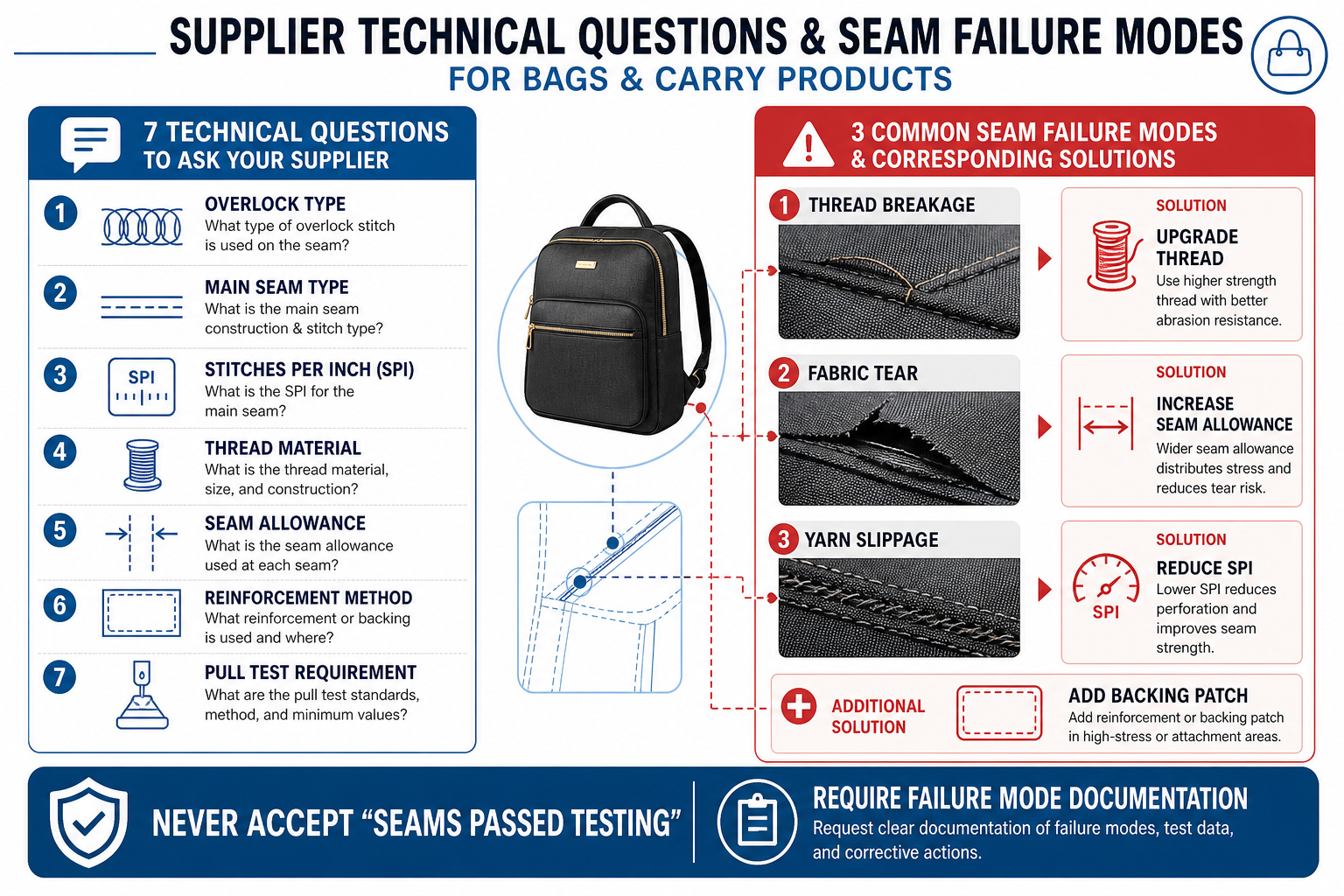
* Overlock type: 3-thread, 4-thread, or 5-thread.
* Whether the main seam uses lockstitch or chain stitch as the structural seam.
* Stitch density in stitches per inch (SPI).
* Thread composition (polyester, woolly nylon, bonded nylon) and thread size.
* Seam allowance width, and whether fabric is trimmed too close to stitch lines.
* Reinforcement type at handles and straps: box-X stitching, bartacks, folded webbing, fabric patches, or multiple stitch rows.
* Seam pull test samples and failure mode documentation.
ASTM standards define fabric type, seam type, stitch type, stitch density, thread tension, and thread characteristics as core variables affecting sewn-seam strength. ASTM D1683 measures sewn-seam strength by applying force perpendicular to a woven seam and can help distinguish stitching failure from fabric failure. ASTM D6193 covers standard practice for seams and stitches used in textile products. Do not accept simple statements such as “the seams passed testing.” Ask for documentation showing exactly how the sample failed: thread breakage, fabric tear, or yarn slippage around stitch holes. This failure mode data tells you which part of your bag design needs improvement.
Practical Buying & QC Recommendations for US Bag Brands
For ordinary fashion bags, overlock paired with a standard structural lockstitch may meet customer expectations. For heavy canvas, nylon backpacks, luggage, and heavy-duty work bags, your technical spec sheet should include these requirements:
* Structural lockstitch or chain stitch on all main body seams.
* Overlock edge finishing on all fray-prun raw fabric edges.
* Double-needle stitching on all visible and high-load exterior seams.
* Box-X stitching or bartack reinforcement at all handle and strap attachment points.
* Pre-production physical samples and seam pull testing before approving mass production.
A common mistake for importers is to judge seam quality only by visual appearance. Neat-looking stitches do not guarantee tensile strength. A seam can fail in three different ways: thread breaks, fabric tears along stitch perforations, or fabric yarn slips beside the stitches. Each failure type requires a different fix: upgrading thread, increasing seam allowance, reducing stitch density, or adding fabric reinforcement patches.
Conclusion
Overlock (serged) and double-needle stitching improve a bag’s seam durability, but they serve completely different functions. Overlock mainly prevents edge fraying and seam unraveling; double-needle stitching adds a second load-bearing stitch line and distributes pulling force. The final seam strength depends not only on stitch style, but also fabric strength, thread quality, stitch density, seam allowance, and thread tension. When you select seam construction for your bag line, match the stitch system to your product use case: fashion bags, everyday totes, heavy work bags, and outdoor backpacks each need a different combination of serging, double-needle topstitch, and bartack reinforcement. Clear technical specifications, pre-production samples, and ASTM seam pull testing will reduce defect rates, limit customer returns, and help your brand deliver durable bags that stand out from low-quality competitors in the US market.
Post time: Sep-29-2026