
Mastering Bag Construction QC: Stress Point Stitching & Seam Verification for US Bag Retailers
Blog Post for USA Bag E-commerce Website | American English
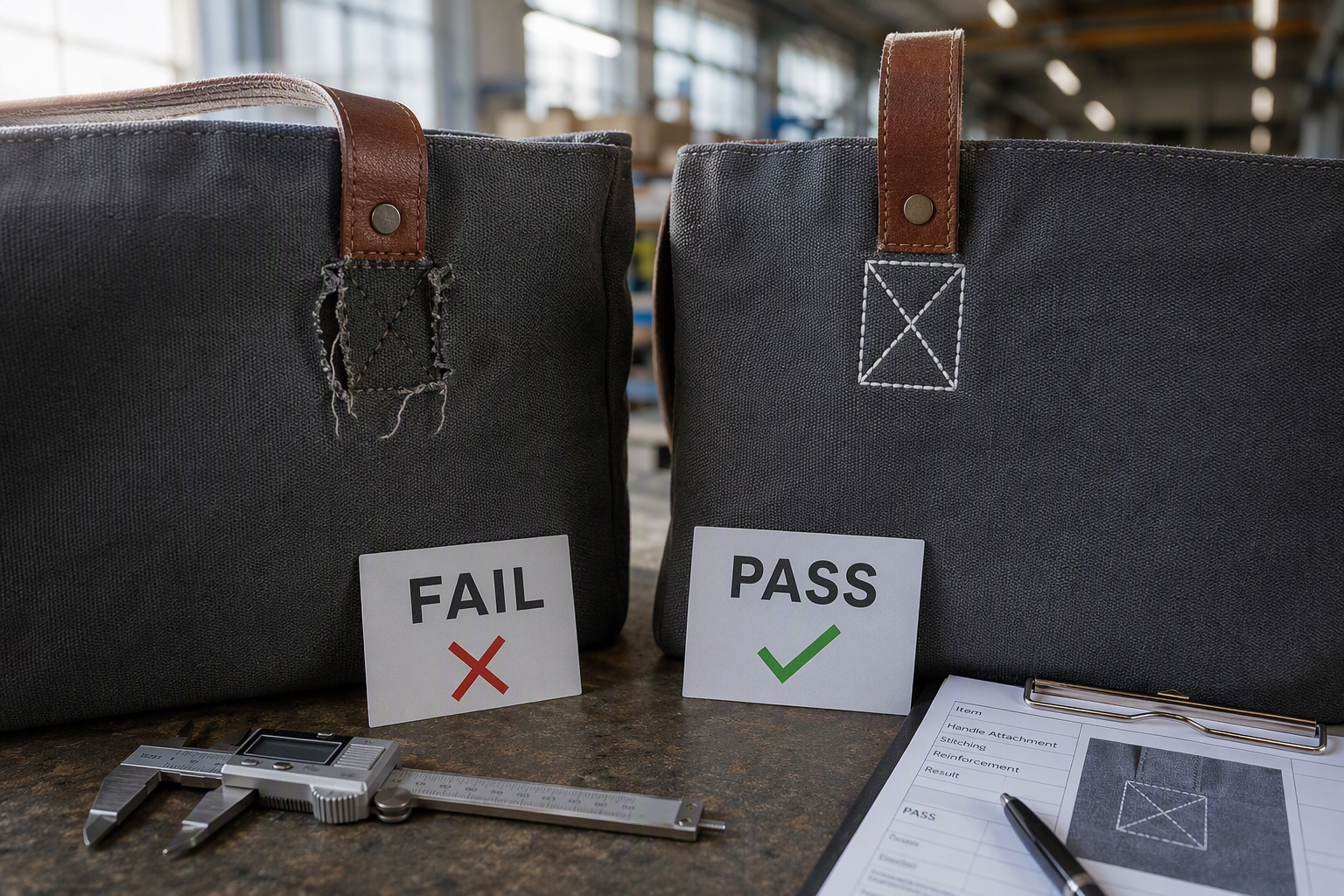
If you run an online bag store selling backpacks, tote bags, utility bags and travel bags to US consumers, product durability is the backbone of your brand reputation. A bag that fails at handle attachments, pocket corners or zipper seams will trigger product returns, negative reviews and damage your website conversion rate. When sourcing bags directly from Chinese OEM factories, verifying stitching, seam construction and reinforcement at high-stress areas is one of the most critical steps before confirming mass production. Many US bag buyers learn this lesson the hard way: a beautiful sales sample may be specially upgraded to win orders, while bulk production units use weaker stitching and thinner reinforcement patches. This article breaks down what you need to inspect, what documentation to request from your factory, and how to validate seam quality at every stress point of your custom bag samples.
Why Stress Point Stitching Defines Your Bag’s Real-World Durability
Most bag failures do not happen on large flat main panels. They occur at concentrated load points: where handles and shoulder straps connect to the bag body, D-ring and webbing loop anchor points, bottom corners, zipper termination ends, and pocket corners. These locations repeatedly bear pulling force, friction and twisting as end users load the bag with laptops, travel gear, books and daily items.
A factory can produce a bag that looks perfect in product photos, yet cut corners on hidden interior reinforcement. As a US direct importer working with Chinese manufacturers, your core quality control goal is to confirm that the stitching pattern, thread specifications, fabric layers and reinforcement hardware shown on your pre-production sample will be exactly replicated in bulk production. You must avoid “show sample” risk: samples upgraded with extra stitching, thicker backing fabric or hand-finished bartacks that are not feasible for mass assembly lines.
Before approving any order, you need to ask your factory targeted technical questions about seam construction, and request supporting visual evidence, including exterior close-ups, interior macro shots, and even destructively deconstructed sample bags for deep inspection. Below is a complete checklist for stress point seam evaluation for custom bag sourcing.
Key Visual Documentation to Request From Your Bag Manufacturer
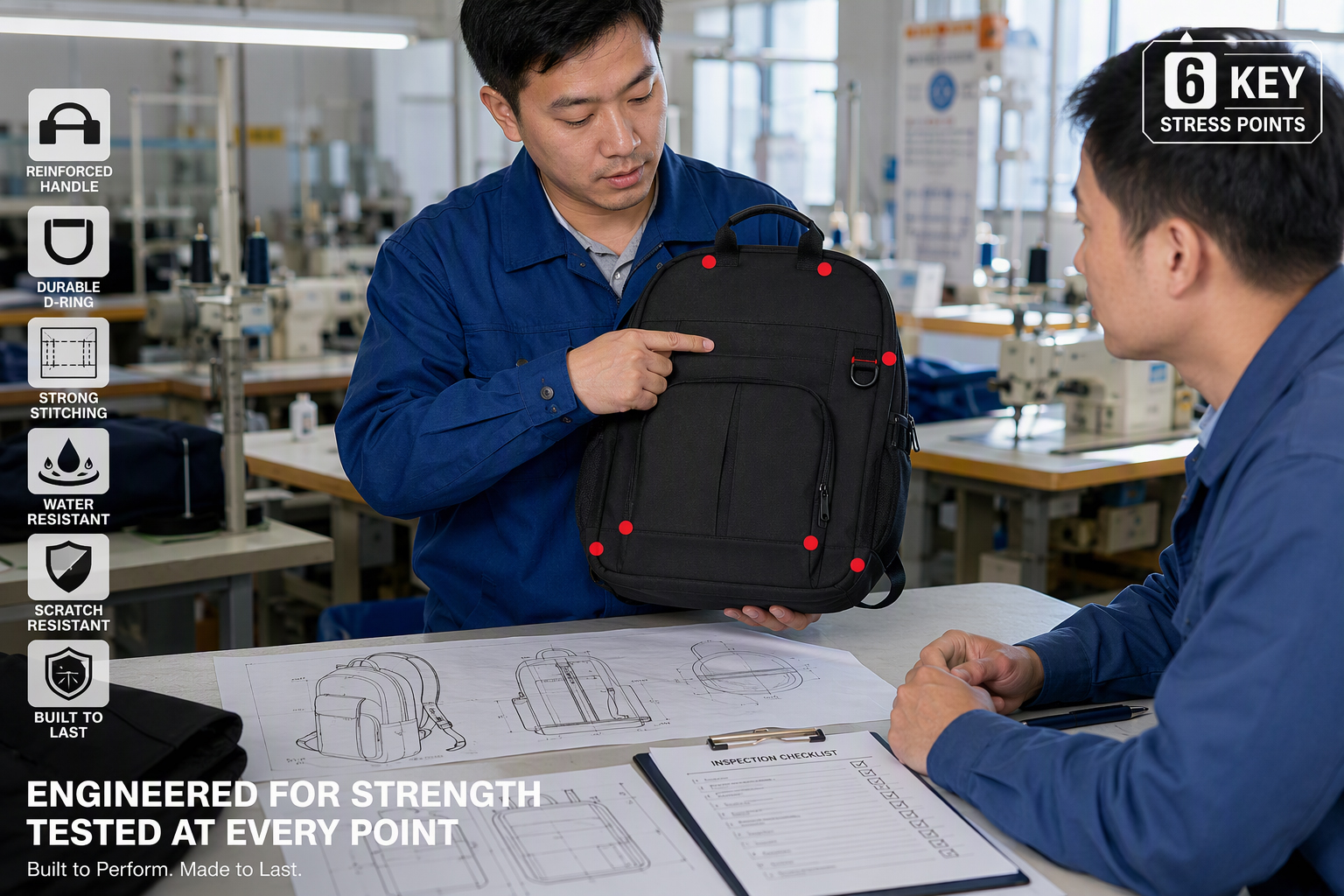
When communicating with your Chinese bag factory, clearly define the visual assets you require for sample review. Standard photos of the full bag are not enough. You need high-resolution close-up and macro imagery focused on stitching details, both from the exterior and hidden interior side of every high-stress zone.
Close-up and macro photos of interior stitching on linings, pockets, and zipper areas
Many buyers only inspect the outside of the bag and overlook lining seams. Lightweight nylon and polyester linings tear easily at pocket openings and zipper edges without proper edge finishing. Your factory must supply macro shots showing how lining seams are finished: either overlock stitching or bound-edge construction. These images should capture pocket corner stitching, zipper seam runs and lining seam allowance.
Destructive deconstructed sample for seam cross-section inspection
Ask your factory if they can cut open or fully deconstruct one sample bag. Disassembling the sample physically exposes the stacked fabric layers, seam cross-section, thread count and thread penetration depth at stress points. This is the most reliable method to confirm the number of material layers the needle passes through, and verify that reinforcement patches are indeed inserted between outer fabric and lining, rather than only applied on the surface. Cross-section photos should record thread type, Tex rating, stitch penetration depth and SPI (stitches per inch) measurement for each stress seam.
Exterior close-up photos for all reinforced stress points
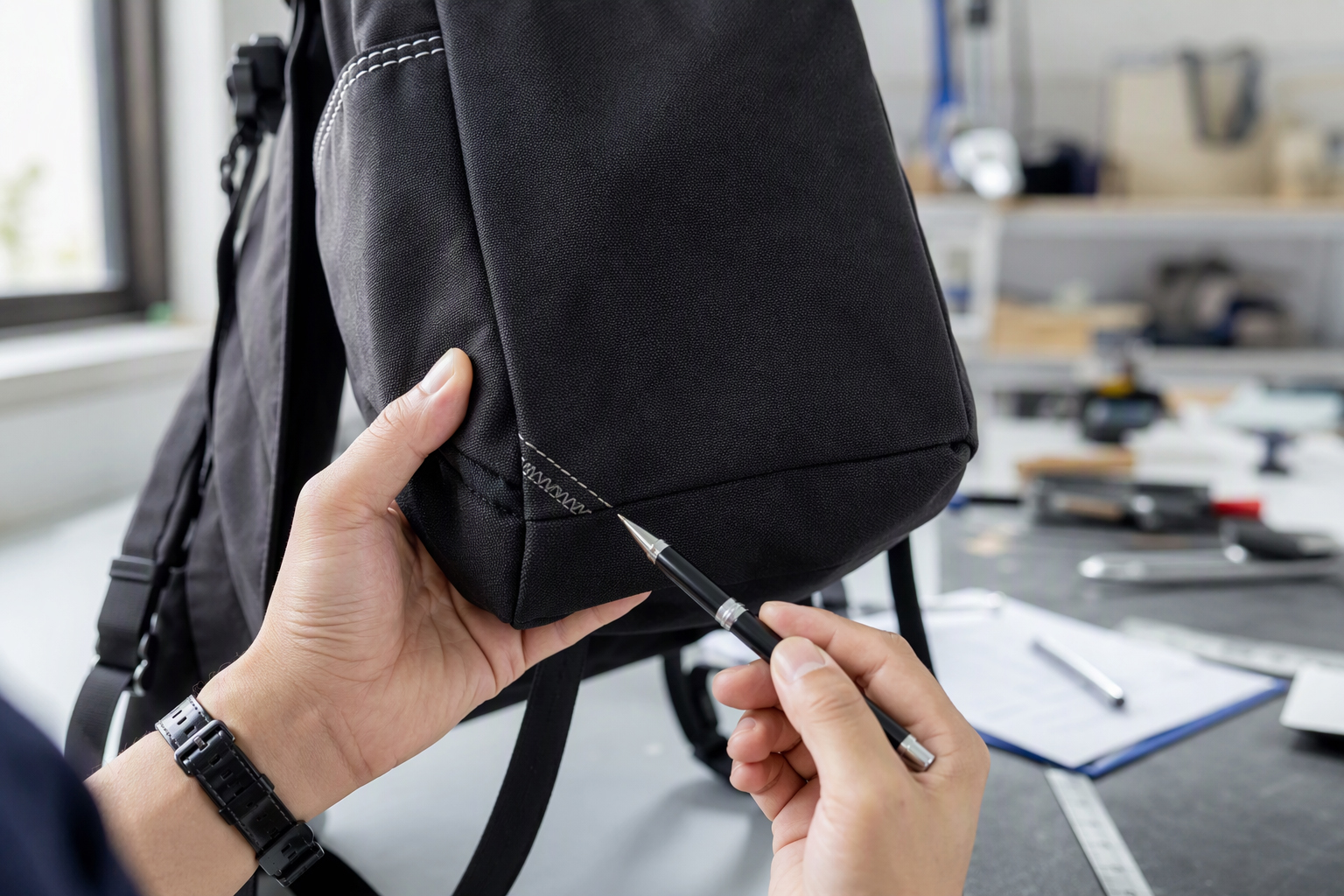
For every load-bearing location, request exterior shots showing the stitch pattern itself: box stitching, box-X patterns, bartack clusters, cross-stitch reinforcement, double or triple topstitch lines. Photos should be labelled clearly to mark the bag location and construction method for easy reference during your internal QC review.
Side-by-side comparison samples: reinforced vs non-reinforced seams
Request two matching sample sections for side-by-side visual comparison. One sample with full approved reinforcement, and one without added bartacks and backing patches. This pair of samples makes it simple for your retail team and quality inspector to visually identify the difference between compliant construction and low-cost weak seams, and helps you set clear standards for bulk inspection.
Critical Confirmation: Sample Construction Must Match Bulk Production
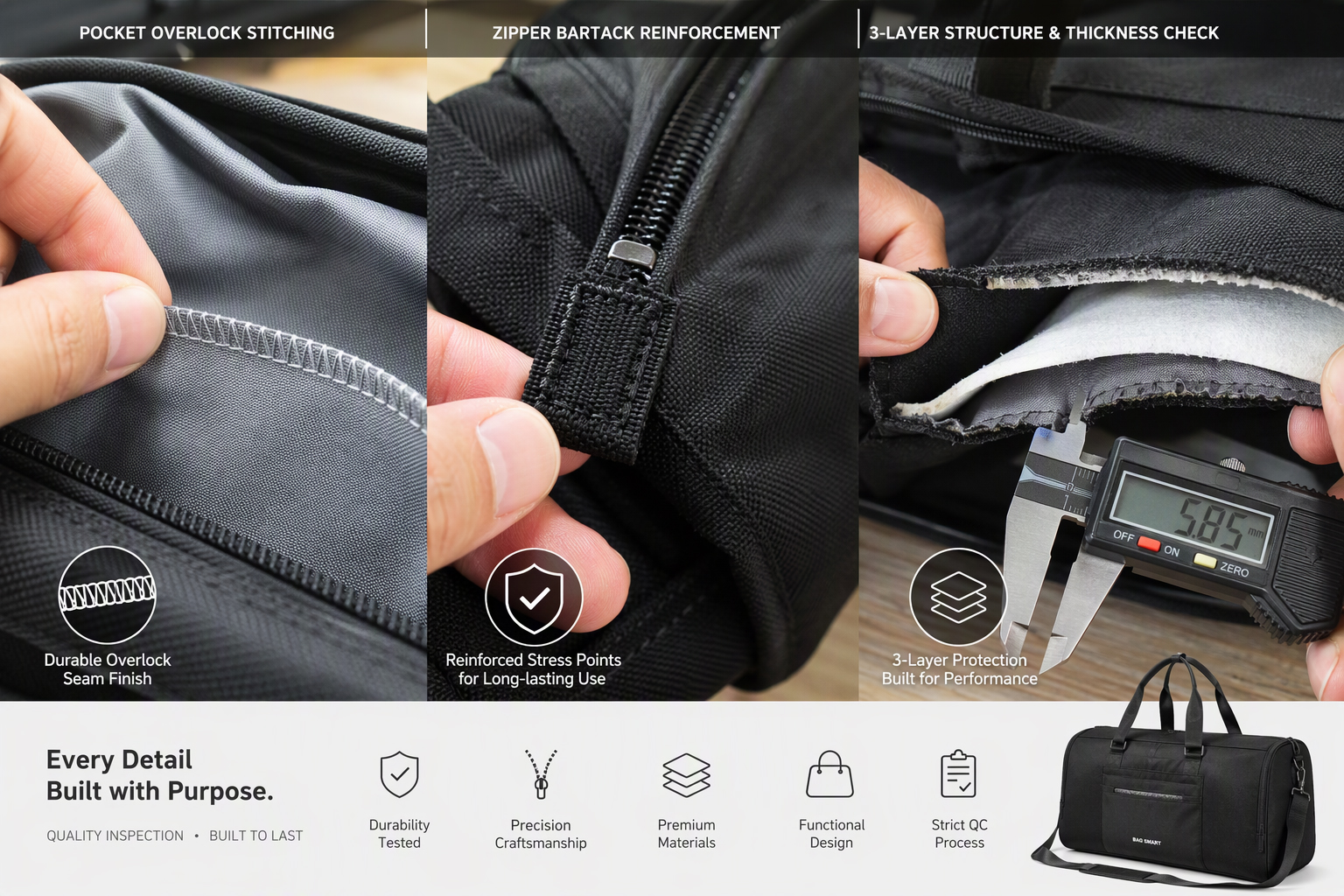
The single biggest risk in overseas bag sourcing is cosmetic samples built with upgraded craftsmanship to win orders. You need explicit written confirmation from your factory that the stress-point seam patterns, thread specifications, reinforcement patches and stitch density used on your approved pre-production sample will be maintained during mass production.
This requirement must be written into your sales contract. If the factory changes thread thickness, removes backing patches, reduces bartack length or lowers stitch density without your written approval, this counts as non-conforming goods and gives you grounds for inspection hold or rejection. Pre-production samples are your legal quality benchmark; bulk goods must mirror this standard.
Detailed Construction Standards for Every Bag Stress Point
Below is the detailed reinforcement specification set you can share directly with your factory for sample development and bulk QC. Each area lists the recommended stitch pattern, reinforcement hardware and construction rules.
Handle & Shoulder Strap Attachment Points
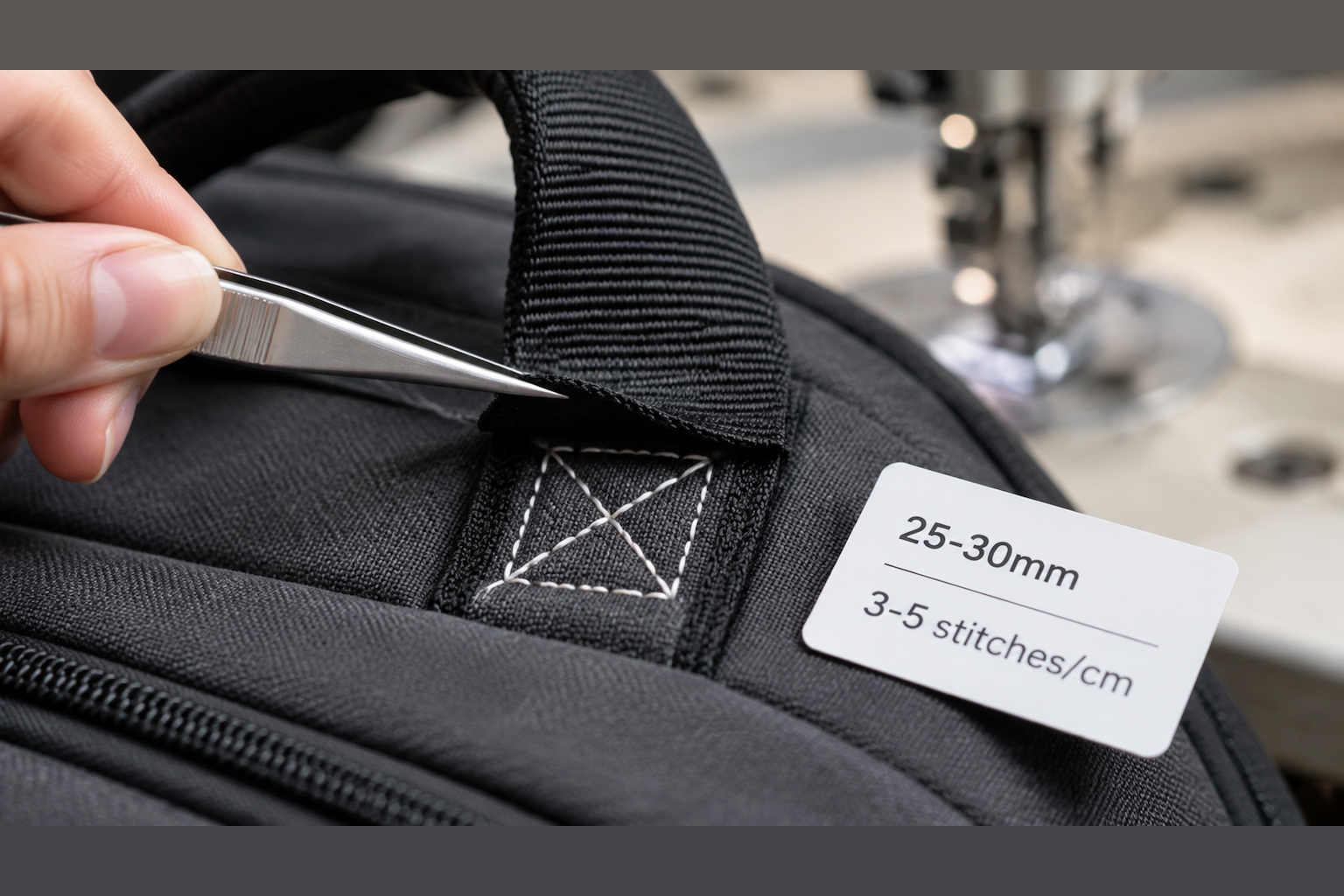
Handle and shoulder strap anchor points are the highest failure risk on almost all bag styles. All handle and strap connection points must use bartack reinforcement. The industry standard construction is box-X stitch at handle bases: a rectangular box outline with an X stitched across the center. A typical box-X reinforcement spans 25mm to 30mm wide, with 3 to 5 stitches per centimeter.
The stitching must penetrate all layers: outer fabric, internal reinforcement backing patch and lining. The factory cannot sew only through the outer layer and skip the backing fabric. Handles should be anchored to a woven backing patch internally to spread pulling force and prevent fabric tear-out. For heavy-duty backpack shoulder straps, the box-X bartack must run through all stacked material layers to handle repeated heavy loads.
Webbing Loops & D-Ring Mount Points
D-rings and webbing loops are common for shoulder strap adjustment, accessory attachment and carry handles. These points require double bartacking with a visible X-pattern reinforcement. The double bartack distributes concentrated pull force so sudden tugging does not rip the webbing free from the bag shell. Check that stitching fully penetrates webbing, outer fabric and internal reinforcement backing.
Bottom Panel & Bottom Corners
Bag bottoms carry the static weight of all contents inside the bag. The bottom panel requires double or triple row topstitch. Bottom corners need triple-step zigzag reinforcement. Additional reinforcement patches, piping or binding can be added for heavy-load bags. Multi-layer seams at bottom corners prevent tearing when the bag is set down on hard surfaces repeatedly.
Gusset Junctions
Gusset junctions are where multiple fabric panels intersect to form the bag’s depth. These multi-panel intersections transfer load across different fabric sections. Samples must use cross-stitch or patterned bartacks at gusset joints to evenly distribute tension across the panel seams. Without this reinforcement, seams will split at the corner intersection points under heavy loading.
Zipper Ends
Zipper start and termination ends are frequent failure spots. Reinforcement here uses bartack clusters combined with backstitching at both ends of the zipper track. The bartack cluster locks the zipper seam and stops fabric from tearing when the zipper is pulled forcefully or twisted. The factory must not only rely on the plastic or metal zipper stop; fabric seam reinforcement is mandatory.
Pocket Corners
Pockets hold phones, wallets and small gear, creating local pulling stress at pocket corners. Every pocket corner needs backstitching or bartack reinforcement clusters. Lightweight lining pockets are especially vulnerable, so lining pocket corners must receive the same seam reinforcement consideration as exterior pockets.
Side Seams
Main side seams run vertically along the bag body. These seams use consistent lockstitch construction with adequate seam allowance. Seam allowance must remain uniform across the full length of the seam. Inspect for skipped stitches, uneven thread tension, fabric puckering and inconsistent stitch length, which all weaken seam integrity over time.
Lining Seams
Interior lining is often overlooked. For lightweight nylon or polyester lining materials, seams require overlock or bound-edge finishing to prevent fraying. Request separate interior macro photos for all lining seams, pocket linings and zipper lining openings. Even if the outer bag construction is strong, a fraying lining creates poor end-user experience and returns.
Stitch & Seam Technical Metrics You Must Collect From Your Factory
Visual photos are powerful, but you also need measurable technical data for your QC checklist. Ask your factory to document these metrics for every stress point seam:
* Stitch type: lockstitch, topstitch, backstitch, zigzag, bartack, box-X stitch
* Stitch density (SPI / stitches per inch): SPI measurement must be recorded separately for every stress-point seam, not only main panel seams
* Seam allowance width: consistent allowance across all seams
* Thread specifications: thread material, Tex rating, thread thickness
* Material layer count: number of fabric, webbing and reinforcement patch layers the stitch passes through
* Edge finishing method: folded, bound, piped, turned or overlocked edge
* Reinforcement materials: backing fabric patch, foam, leather patch, rivets, plastic stiffener sheet or heavy webbing
Bartack and box-X stitches deserve special definition for your supplier. A bartack is a dense grouping of short stitches built to reinforce a small, concentrated stress point. Box-X stitch draws a rectangular box outline, then adds an X crossing inside the rectangle. This construction handles multi-direction pulling force and is the gold standard for handle and webbing anchor points.
Additional Factory Testing & Pre-Shipment Inspection Requirements
Beyond static sample photos and deconstructed samples, you should add mechanical testing and pre-shipment inspection rules to your sourcing workflow.
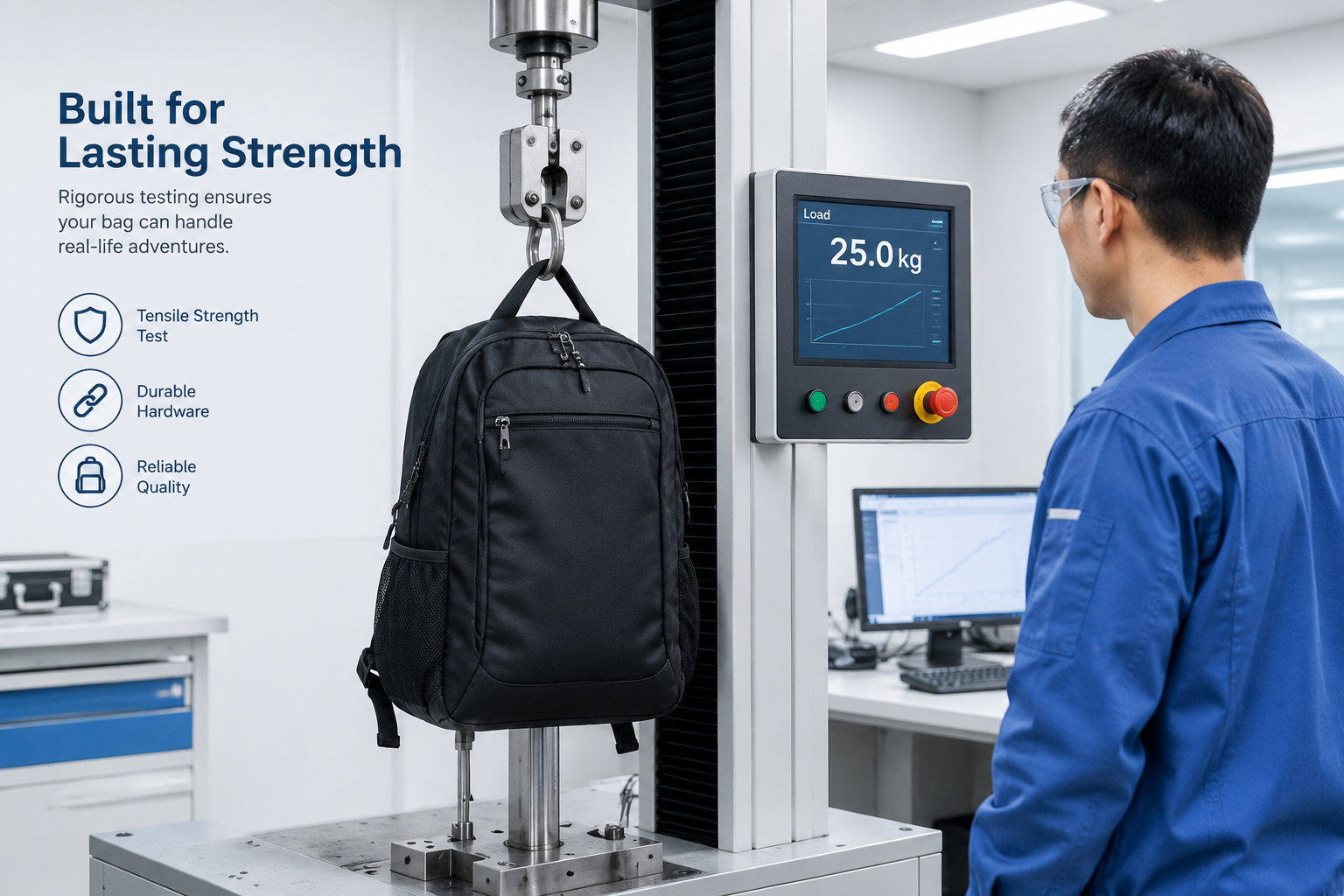
Load & Pull Testing
Ask your factory to perform pull testing on handles and shoulder straps. Record the maximum recommended working load for each carry point. The pull test validates that bartack and box-X seams can sustain rated weight without thread breakage, seam slippage or fabric tear-out. You can reference ASTM D6193, the standard test method for stitches and seams in sewn textile products, to align your QC with US textile testing norms.
Pre-Shipment Video Inspection
It is standard practice to request pre-shipment video inspections for bulk production before goods leave the factory. The inspection video should zoom in on bartacks, handle joints, D-ring attachments and bottom corner reinforcements. Your QC inspector can remotely review stitching consistency, check for missing bartacks, skipped stitches and uneven thread tension across randomly selected bulk units. This step catches bulk production drift, where factory operators gradually reduce stitch quality to speed up production runs.
Pre-Production Sample Approval
Always lock in a signed-off pre-production sample before mass production starts. This approved sample becomes your official construction standard. Any deviations from the sample’s stitch pattern, reinforcement placement, thread specification or fabric layer count are non-conformities. Watch for these common red flags during inspection: skipped stitches, loose thread tension, fabric puckering, inconsistent stitch length, missing bartack reinforcement, and stitching that fails to pass through all required material layers.
Standard Questions to Send to Your Chinese Bag Factory for Sample Review
Use this list of technical questions in your email communication with suppliers to collect complete construction information:
* What is the maximum recommended load rating for handles and shoulder straps?
* Are handles sewn through both the main bag body and an internal reinforcement backing patch?
* Does all reinforcement stitching penetrate through every required material layer?
* Are seam start and end points locked with backstitching to prevent unraveling?
* What is the stitch density for main body seams and separate stitch density for all stress-point seams?
*Can you produce a pre-production sample built exactly to bulk production standards for our sign-off?
* Can you perform pull or load testing on handle and strap stress points and share test results?
* What inspection standard does your factory use to check stitch defects and seam strength during bulk production?
* Will the stitching pattern, reinforcement patches and thread specifications on the approved sample be fully maintained for mass production?
Final Thoughts for US Bag Independent Store Owners
Sourcing bags directly from Chinese factories gives your US website competitive pricing and custom product capability, but durability control cannot be delegated fully to your manufacturer. As the brand seller facing US consumers, you own the responsibility to verify seam and stitch quality at every high-stress location.
Your quality workflow should include requesting interior macro stitching photos, reviewing deconstructed sample cross-sections, confirming sample-to-bulk consistency, conducting pull load tests and performing pre-shipment visual inspections. Focus your QC not just on the outward look of the bag, but on hidden interior reinforcement, bartack placement, box-X stitching and seam penetration at handle anchors, bottom corners, zipper ends and webbing mounts.
When you build this rigorous stitching and seam verification process into your bag sourcing workflow, you reduce returns, protect your brand reviews, and deliver durable bags that match the quality promise on your US independent website. Investing in sample construction inspection is not just a sourcing expense; it is a core investment in your e-commerce brand’s long-term trust and profitability.
Post time: Sep-30-2026