
Importing custom bags from China? Before you place your first bulk order, you need to understand the critical role CAD pattern making plays in product quality, production speed, and cost efficiency. Here’s the insider’s guide most buyers never get.
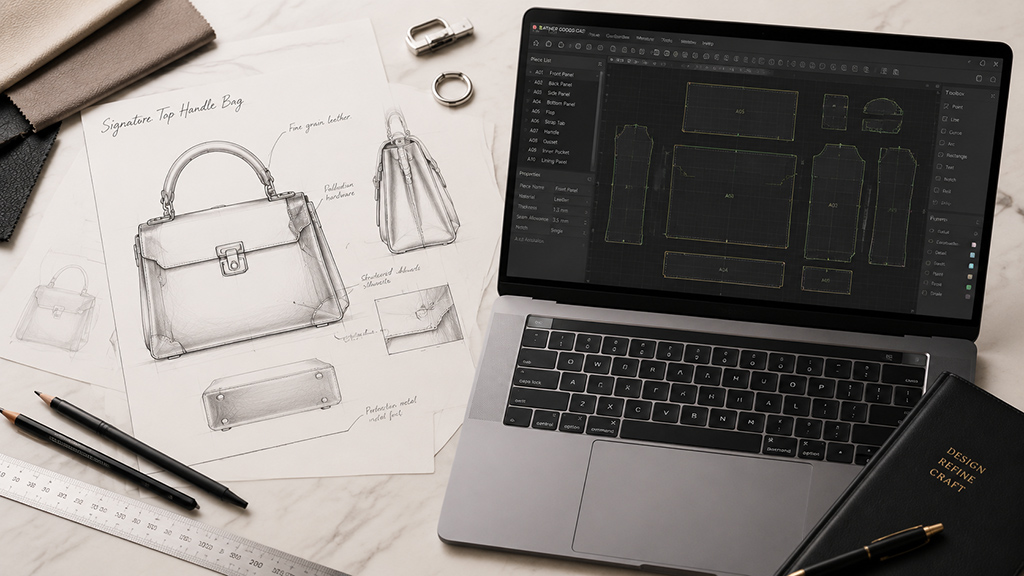
Why This Article Matters for Your Bag Business
As a USA-based bag retailer sourcing directly from Chinese manufacturers, you’ve probably asked one critical question: “How do I make sure the bag I receive actually matches the design I envisioned?”
The answer lies in a process most importers overlook: CAD pattern making. Without accurate digital templates, even the best Chinese factory can produce a bag that’s off by a centimeter — and in the bag industry, a centimeter can mean the difference between a bestselling product and a return disaster.
After working with hundreds of bag factories across Guangzhou, Yiwu, and Quanzhou, our team has compiled everything you need to know about CAD pattern services, file formats, lead times, and what questions to ask your supplier before signing any production contract.
Insight 1: The CAD Approval Gate — Why “Sign Before You Cut” Saves Thousands
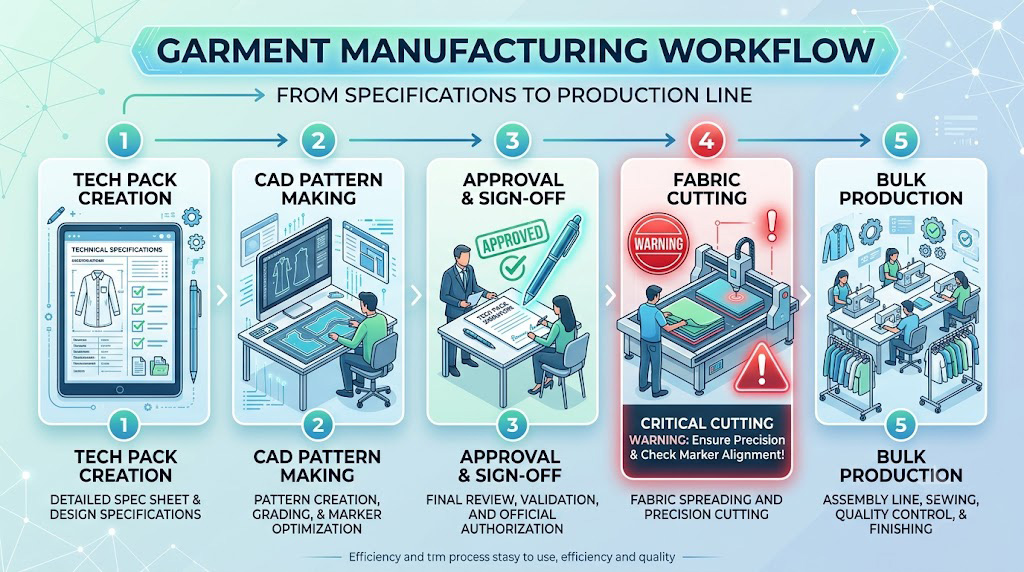
Signed CAD approval should be required before any sample cutting to prevent costly rework.
This is the single most important rule in bag manufacturing, and yet most new importers skip it.
Here’s what typically happens without a formal CAD sign-off: A factory interprets your tech pack, makes a pattern, cuts a sample, ships it to you, and only then do you discover the strap length is 2cm too short. Now you’re paying for:
A second sample (typically $50–$150)
International express shipping ($30–$80)
7–14 additional days of production delay
Potential material waste if fabric was pre-cut
The professional approach: Demand that your Chinese supplier provides a digital CAD pattern for your written approval before any knife touches material. Once you sign off, the factory has legal and operational permission to proceed. This one step can save your business thousands of dollars annually.
Insight 2: The Professional Software Stack — Lectra, Gerber, and Optitex
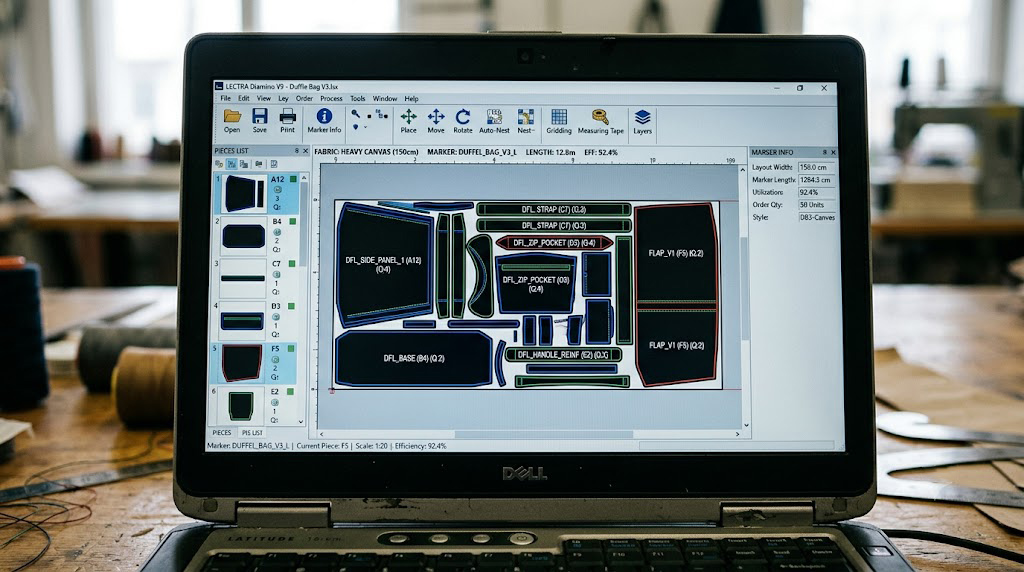
Established Chinese bag factories use professional CAD software (Lectra, Gerber, Optitex) to create digital pattern templates.
Not all CAD systems are created equal. When vetting a Chinese bag factory, the software they use tells you a lot about their technical capabilities:
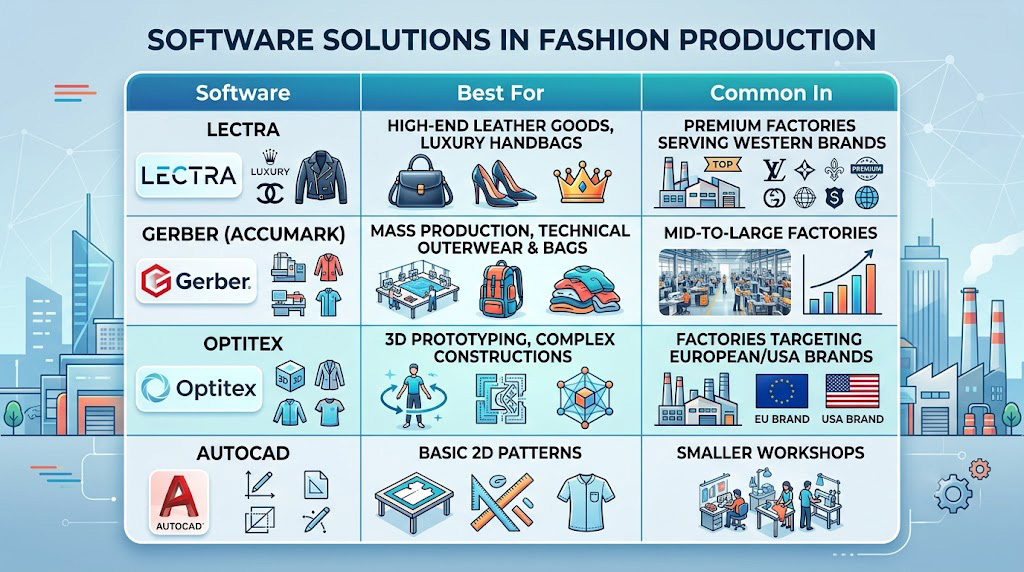
If your potential supplier says they “use CAD” but can’t name the software, that’s a red flag. Professional factories invest $10,000–$50,000+ annually in these licenses. Their willingness to name the platform signals transparency and technical maturity.
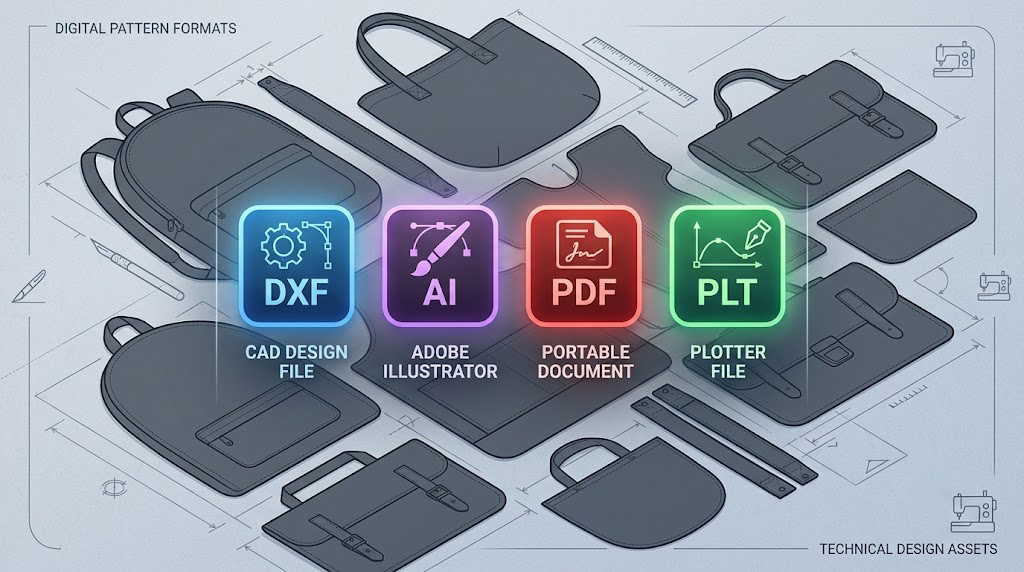
CAD pattern files can be exported in multiple formats (DXF, AI, PDF, PLT) for buyer review and approval.
The file format conversation is where many USA buyers get tripped up. Different formats serve different purposes, and a professional factory should offer you choices:
PDF — For human review and printing (every factory offers this)
AI (Adobe Illustrator) — For graphic designers who want to make adjustments in vector format
DXF (Drawing Exchange Format) — Industry standard for sharing with other CAD systems
PLT (HPGL Plotter File) — For automated cutting machines
SVG — For web-based visualization
Pro tip: Always request at least two formats — a PDF for your records and a DXF or AI file in case you need to work with a different factory in the future or make modifications yourself.
Insight 4: Precision Engineering — Exact Dimensions, Seam Allowances, Notches, and Grain Lines
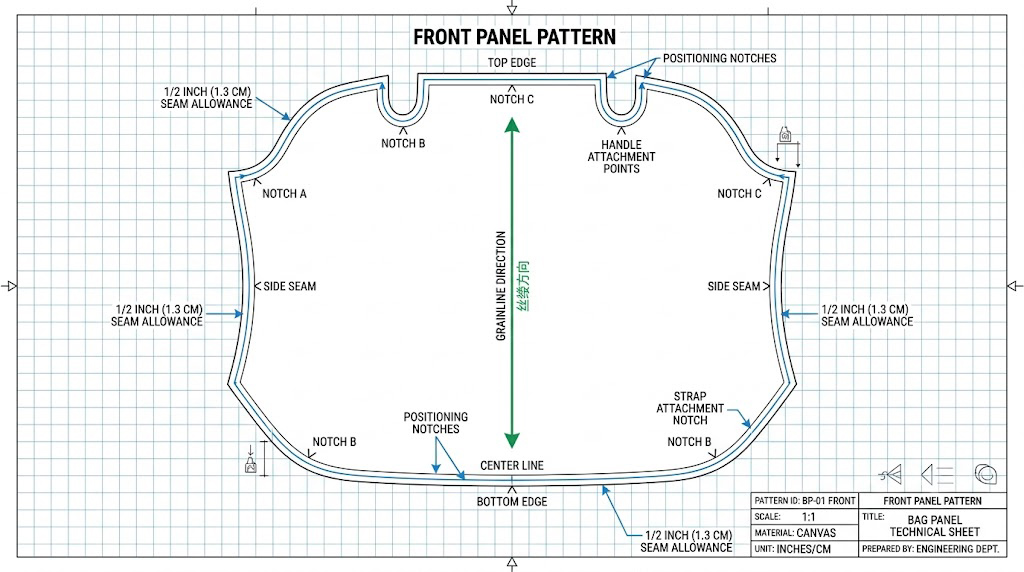
Digital templates are built to exact final product dimensions, including seam allowances, notches, and grain lines.
A CAD pattern isn’t just an outline of a bag. A properly constructed digital template includes critical manufacturing details:
Seam allowances (typically 1cm for bags, but varies by construction)
Notches (markers that align panels during sewing)
Grain lines (showing fabric direction for consistency and strength)
Baste lines and drill holes (for hardware placement)
Fold lines and stitch lines (distinguished from cutting lines)
When reviewing a CAD file, zoom in to verify these elements are present. If they’re missing, your factory is using entry-level software or skipping steps — both of which lead to production errors.
Insight 5: 3D Virtual Prototyping — See Your Bag Before It’s Built
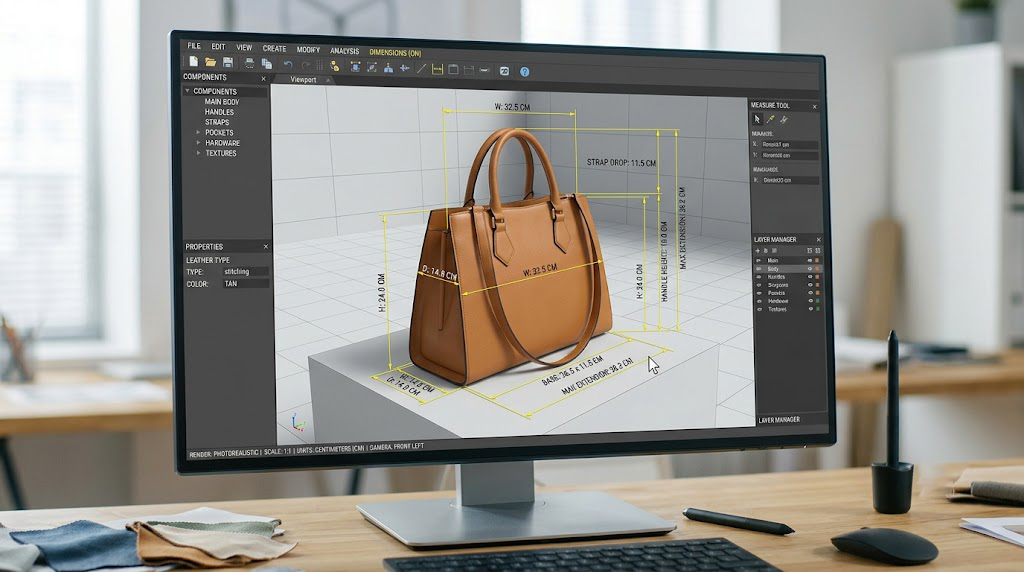
CAD enables 3D virtual prototyping, allowing buyers to visualize the bag structure before physical samples are made.
This is where modern CAD systems truly shine. With software like Optitex 3D or CLO 3D, factories can drape your digital pattern onto a virtual 3D model, allowing you to see:
How the bag actually looks in 3D
Stress points and potential weak areas
How hardware interacts with the body
Color combinations in realistic rendering
For a $200–$500 sampling investment, you can iterate on a 3D prototype 3–5 times before committing to a physical sample. This is a game-changer for small-batch and startup brands working with limited cash flow.
Insight 6: Speed of Revision — Hours, Not Days
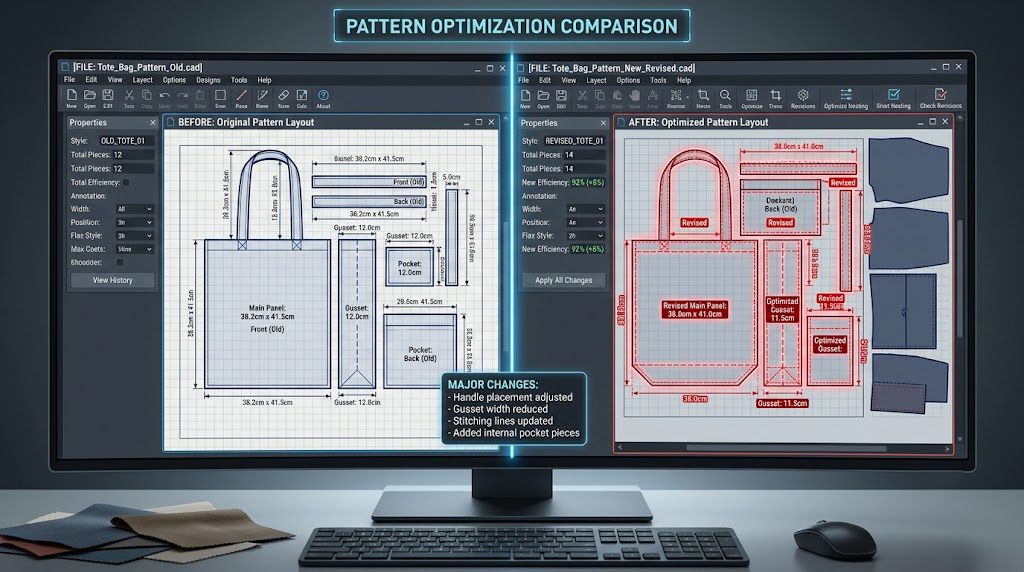
Digital pattern revisions can be completed in hours, reducing overall sampling lead time by 30–50%.
Compare the two workflows:
Traditional Method (No CAD):
Pattern maker manually adjusts paper pattern: 1–2 days
Recuts sample: 1 day
Ships to buyer: 3–5 days
Total: 5–8 days per revision
Digital CAD Method:
Pattern maker adjusts digital file: 1–4 hours
Recuts sample: 1 day (or skips to next physical sample)
Ships to buyer: 3–5 days
Total: 4–6 days per revision
Over 3–4 sample rounds (typical for a new bag), you’re saving 1–2 weeks of total development time. For seasonal products tied to fashion trends, that time savings can be the difference between launching on schedule and missing your sales window.
Insight 7: The Tech Pack — Your Blueprint for Success
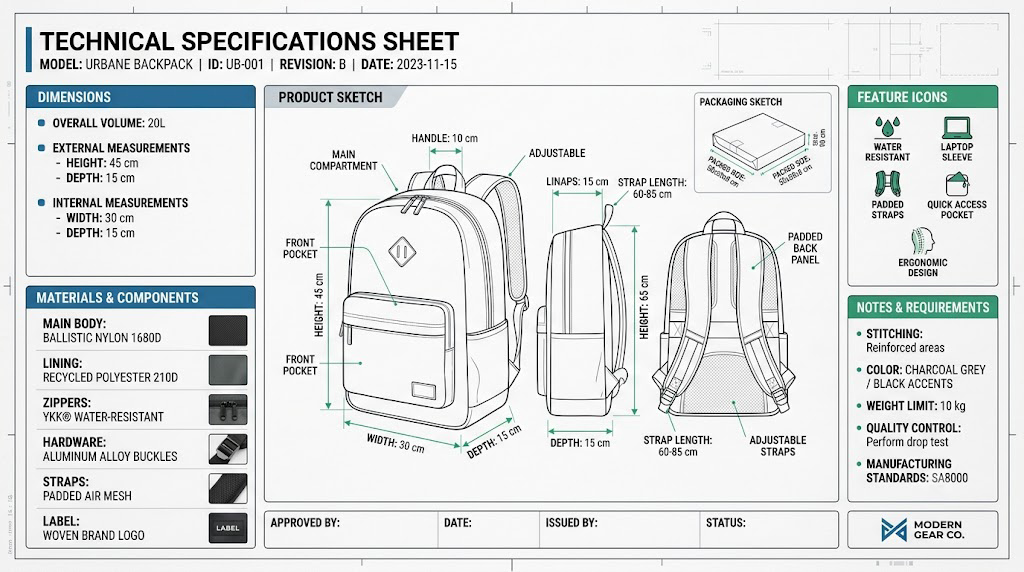
A detailed tech pack with precise measurements (in mm or inches) and material specs is required for accurate CAD pattern creation.
The CAD pattern is only as good as the tech pack you provide. If you hand a factory a single sketch with rough measurements, you cannot blame them for an inaccurate result.
A professional tech pack for bags should include:
1. Overall dimensions (length × height × width in cm or inches)
2. Panel-by-panel measurements (front, back, gusset, strap, etc.)
3. Material specifications (leather type, lining fabric, interfacing)
4. Hardware callouts (zipper size, buckle type, rivet placement)
5. Stitch details (stitch length, thread type, topstitch positions)
6. Logo placement (embossed, printed, metal plate, with coordinates)
7. Reference images (front, back, side, interior views)
8. Construction notes (folded edges, piped seams, binding)
Our recommendation: Invest in a professional tech pack template (or hire a freelance technical designer on platforms like Upwork for $200–$500). The ROI on a clear tech pack is 10x compared to back-and-forth sample revisions.
Insight 8: Material Optimization — 10–20% Waste Reduction Through Nesting
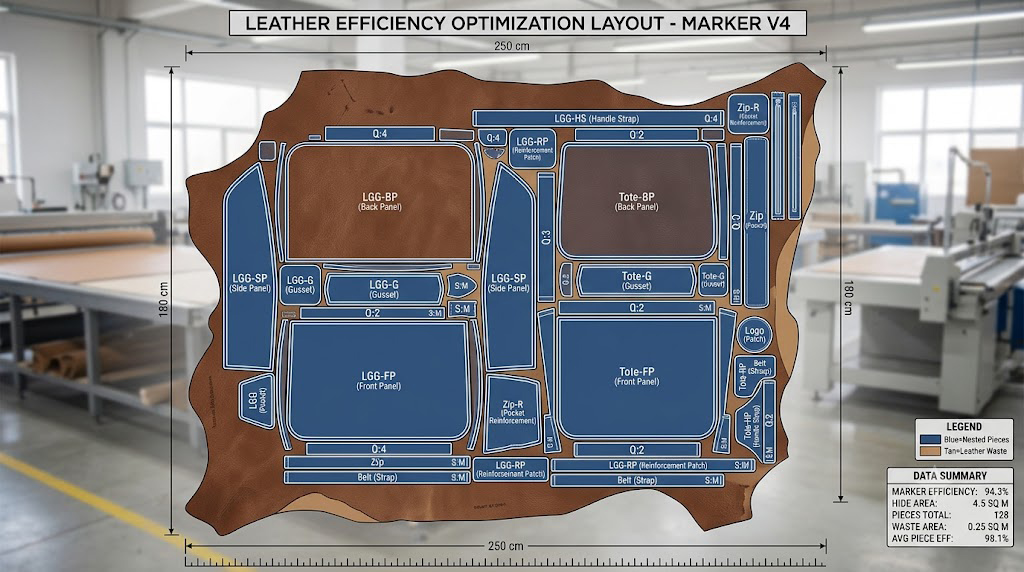
CAD patterns support automated nesting, optimizing material utilization and reducing leather/fabric waste by 10–20%.
Material is the single largest cost in bag production, typically representing 40–60% of the total unit cost. Even small efficiency gains in material usage translate to meaningful margin improvements.
Here’s the math: For a bag using 1.5 square feet of leather per unit:
Without nesting optimization: 1.65 sq ft per unit (10% waste)
With CAD nesting: 1.40 sq ft per unit (7% waste)
On an order of 1,000 units at $8/sq ft leather, that’s a savings of $2,000 per order — money that goes directly to your bottom line.
Insight 9: Reverse Engineering — Digitizing Physical Samples
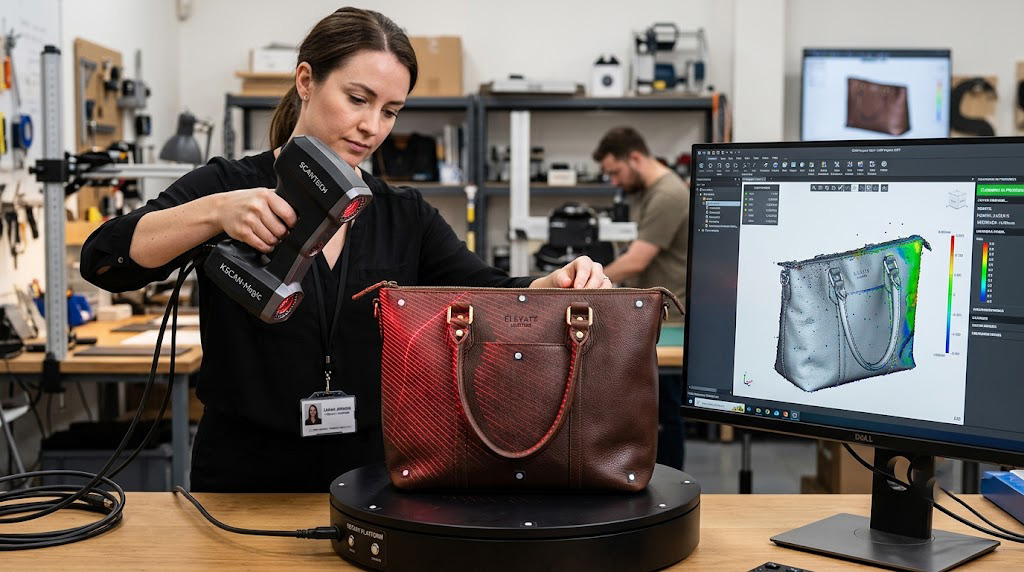
Experienced factories can reverse-engineer existing physical samples into CAD files via 3D scanning or manual digitization.
Maybe you found a competitor’s bag you want to manufacture, or you have a vintage prototype that was never digitized. Modern Chinese factories can:
3D scan the sample to capture exact geometry
Manually digitize by measuring and recreating in CAD
Disassemble the sample to understand construction methods
Reconstruct in 2D pattern form for production
This service typically costs $100–$300 per sample and is invaluable for brands building a product line based on physical references. Always request a “before and after” comparison to verify accuracy.
Insight 10: Your Digital Asset Library — CAD Files as Insurance

Buyers should require CAD files to be delivered alongside pre-production samples for future re-order consistency.
This is one of the most underutilized leverage points in buyer-factory relationships. Always request ownership of the CAD files as part of your development fee or sample cost.
Why? Because:
1. Factory switches become painless — you can take your patterns to a new supplier
2. Re-orders maintain identical specifications (no drift over time)
3. Cost re-negotiations are easier when you have your own patterns
4. Quality control is simpler with a reference file
Add this clause to your purchase order: “All CAD pattern files, tech packs, and digital assets shall be transferred to the buyer upon sample approval, with full rights to use, modify, and reproduce for manufacturing purposes.”
Insight 11: The Written Approval — Lock It Down in Email
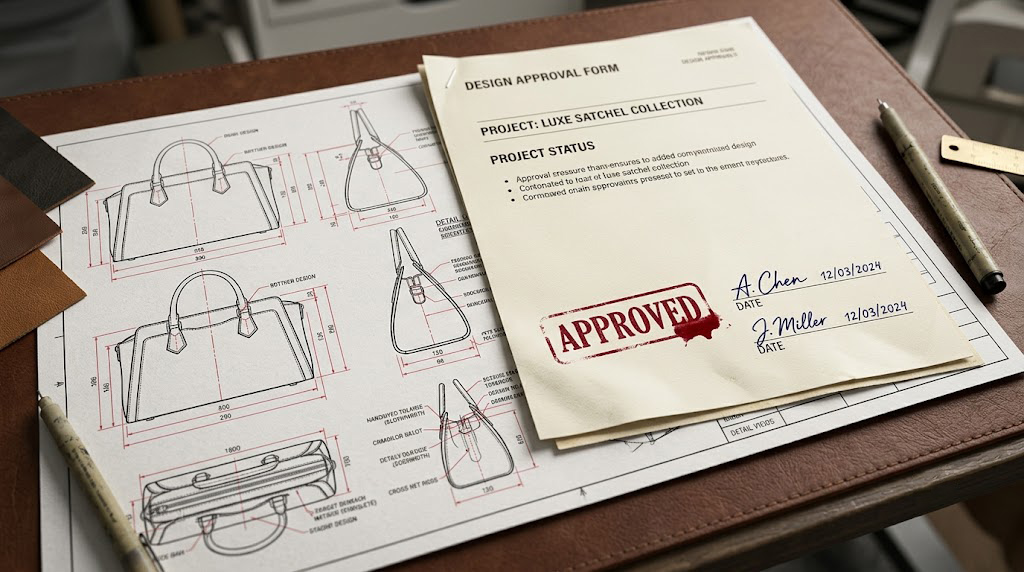
Written CAD approval must be signed off before any material cutting to prevent costly rework and production delays.
Verbal approval over WeChat is not enough. We’ve seen countless cases where a buyer thought they had approved a design, but the factory misunderstood or the message was lost in translation.
Best practices for written CAD approval:
Reply to the factory’s email with explicit language: “CAD pattern v3 approved on [date]. Please proceed to sample production.”
CC all relevant parties (your sourcing agent, quality control team, etc.)
Reference the specific file version (CAD-v3, dated YYYY-MM-DD)
Save the email in a dedicated project folder
This creates a paper trail that protects both parties and is essential if disputes arise.
The Bottom Line: CAD Patterns Are Your Production Insurance
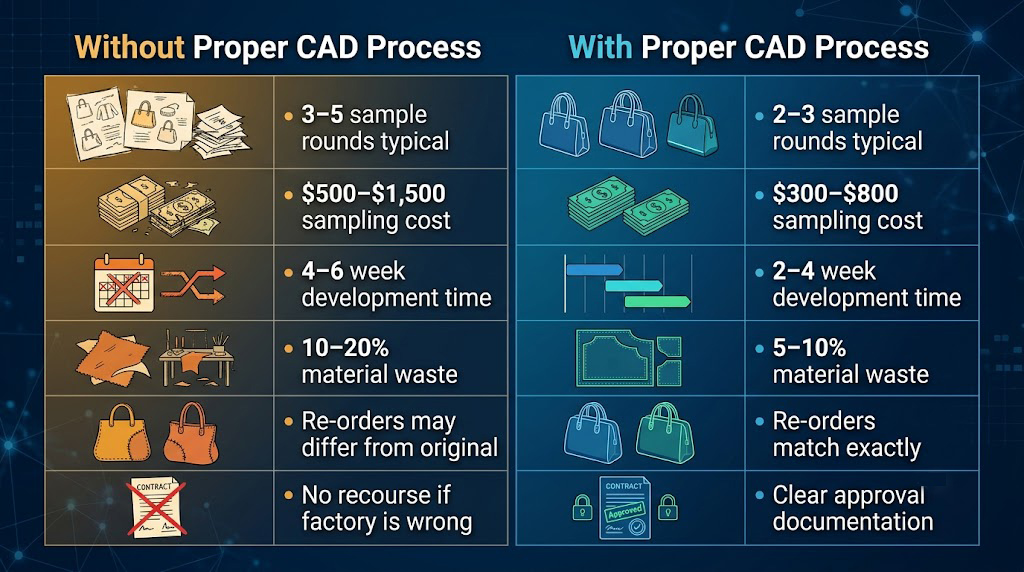
Your Next Steps
If you’re a USA-based bag brand ready to source from China, here’s your action plan:
1. Prepare a detailed tech pack (or hire someone to create one)
2. Contact 3–5 Chinese factories with your tech pack and CAD requirements
3. Ask the specific questions outlined in this article
4. Request sample CAD files in DXF/PDF format before paying for samples
5. Sign a written approval before any cutting begins
6. Retain ownership of all digital files
About the Author
This article was written by the sourcing and product development team at [Your Brand Name], specialists in helping USA-based retailers import high-quality custom bags directly from certified Chinese manufacturers. With over [X] years of experience in the bag industry, we’ve helped hundreds of brands streamline their supply chain, reduce costs, and scale their businesses.
Need help with your next bag sourcing project? Contact us for a free consultation.
Related Articles:
How to Vet a Chinese Bag Factory: The 15-Point Checklist
Tech Pack 101: The Complete Guide for Bag Importers
Understanding Bag Manufacturing Costs: A Breakdown for Importers
Disclaimer: This article is based on industry best practices and our direct experience working with Chinese bag manufacturers. Specific capabilities, lead times, and pricing may vary by factory. Always conduct your own due diligence before entering any manufacturing agreement.
Did you find this guide useful? Share it with another bag entrepreneur who could benefit from professional CAD pattern knowledge!
Post time: Jun-26-2026