
Calibrated Pull-Strength in Bag Hardware: The Complete Quality Control Guide for US Importers
Meta description: A comprehensive guide for US bag buyers sourcing from China — covering calibrated pull-strength testing, load capacity standards, US import safety compliance, third-party certifications, and supplier warranty policies for buckles, D-rings, snaps, and magnetic closures.
Introduction: Why Hardware Quality Defines Your Brand
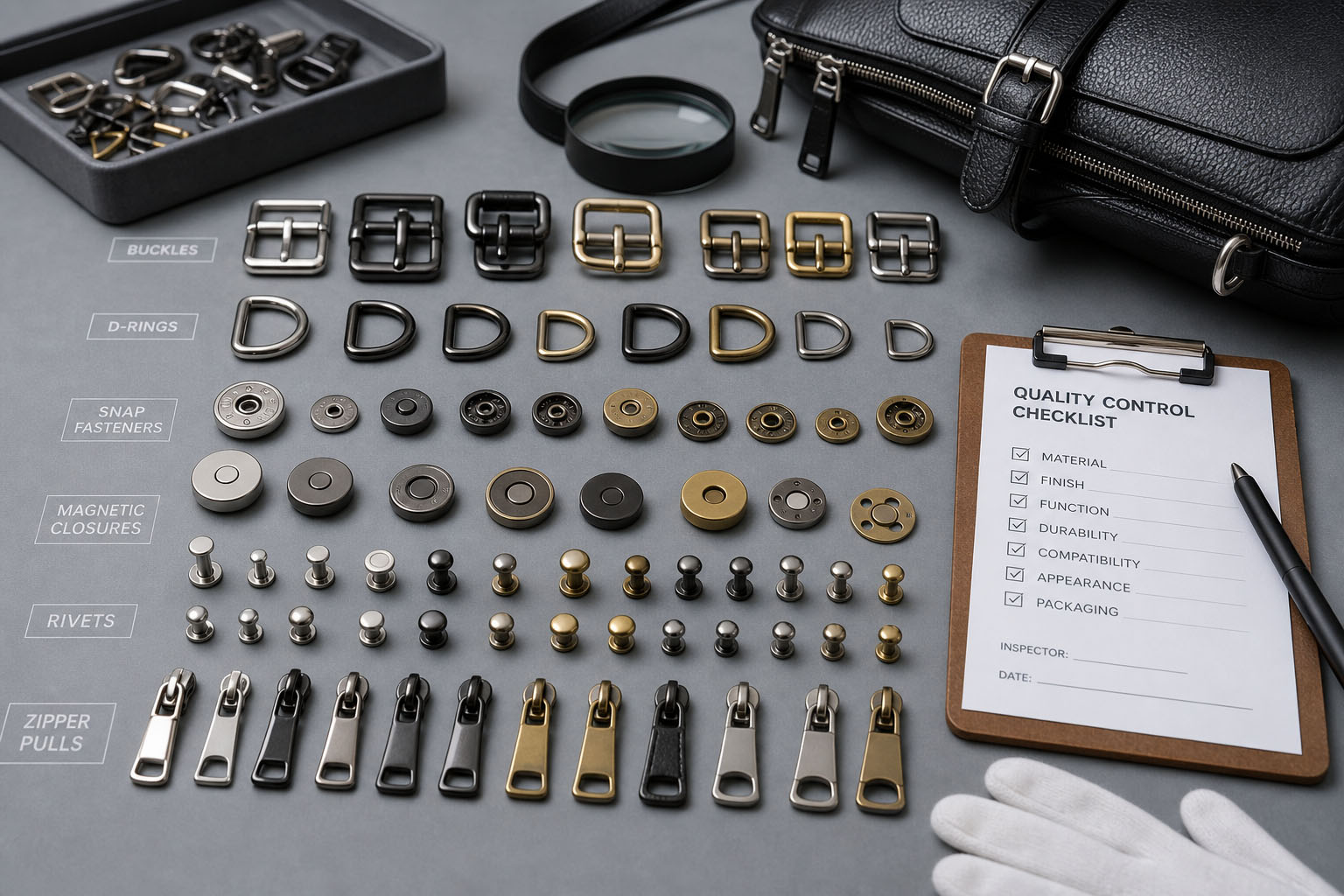
When a US-based bag retailer sources directly from Chinese factories, the conversation almost always begins with price, MOQ, and lead time. But seasoned importers know that the true differentiator — and the greatest risk — lies in the hardware. A buckle that pops under load, a D-ring that snaps after three months of use, or a snap fastener that loosens after a season of open-and-close cycles will generate returns, negative reviews, and ultimately erode the brand equity you’ve spent years building.
At our company, we work with dozens of Chinese factories producing handbags, backpacks, totes, and crossbody bags for the US market. Over the years, we’ve developed a deep understanding of what separates a professional manufacturer from a commodity workshop. This guide distills that knowledge into a single resource — one that you can use as a sourcing checklist, a supplier evaluation framework, and a quality-control reference.
The five questions you’ve identified — covering pull-strength calibration, load capacity, US safety standards, third-party testing, and supplier warranty policies — represent the most important gatekeeping criteria for any hardware component entering the US market. We’ll address each in depth, and we’ll explain the engineering principles behind every answer.
Part One: The Engineering Behind Hardware Attachment
1. Calibrated Pressure: The Foundation of Hardware Integrity
Hardware attachment relies on calibrated pressure from manual, pneumatic, or hydraulic machines to ensure consistent pull-strength across every unit in a production run. This is not a soft standard — it is a mechanical science.
When a factory uses a hand-press without force gauges, the operator’s fatigue, the day’s humidity, or even the hour of the shift can produce wildly inconsistent results. One bag leaves the line with hardware that holds 40 kg; the next leaves with hardware that fails at 12 kg. The customer only sees the failure.
A professional manufacturer will use pneumatic or hydraulic pressing machines equipped with pressure gauges that can be set to a specific tonnage for each hardware type. The setting is locked in, the operator simply feeds the part, and the result is repeatable from unit #1 to unit #10,000.
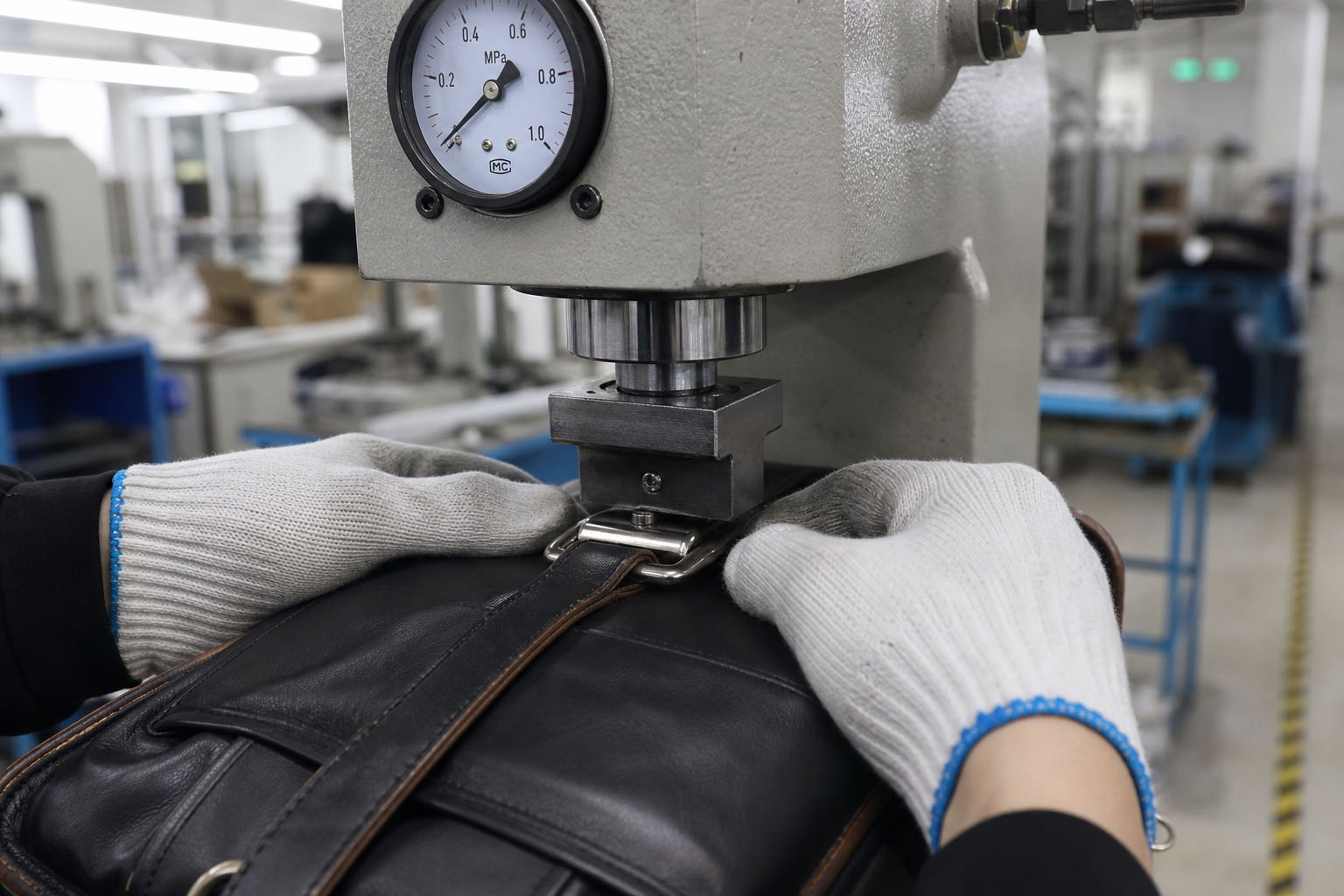
How to verify: Ask for a photo or video of the pressing station with the pressure gauge visible. A factory that takes pride in this process will happily document it.
2. Buckles, D-Rings, and Snaps: The Automatic Pressing Standard
Buckles, D-rings, and snap fasteners are typically set with automatic punching and pressing machines calibrated in tons of force. The specific tonnage varies by material and substrate, but the principle is universal: each hardware component is pressed into or onto the fabric/leather with a measured, repeatable force.
For a zinc-alloy buckle on a 2 mm PU strap, for example, the pressing force might be calibrated to 1.5–2.0 tons. For a heavier iron D-ring on a 3 mm canvas webbing, it could be 3.0–4.0 tons. The factory should be able to tell you — within a range — what force is used for each hardware type on your specific bag.
3. Magnetic Closures: A Precision Game
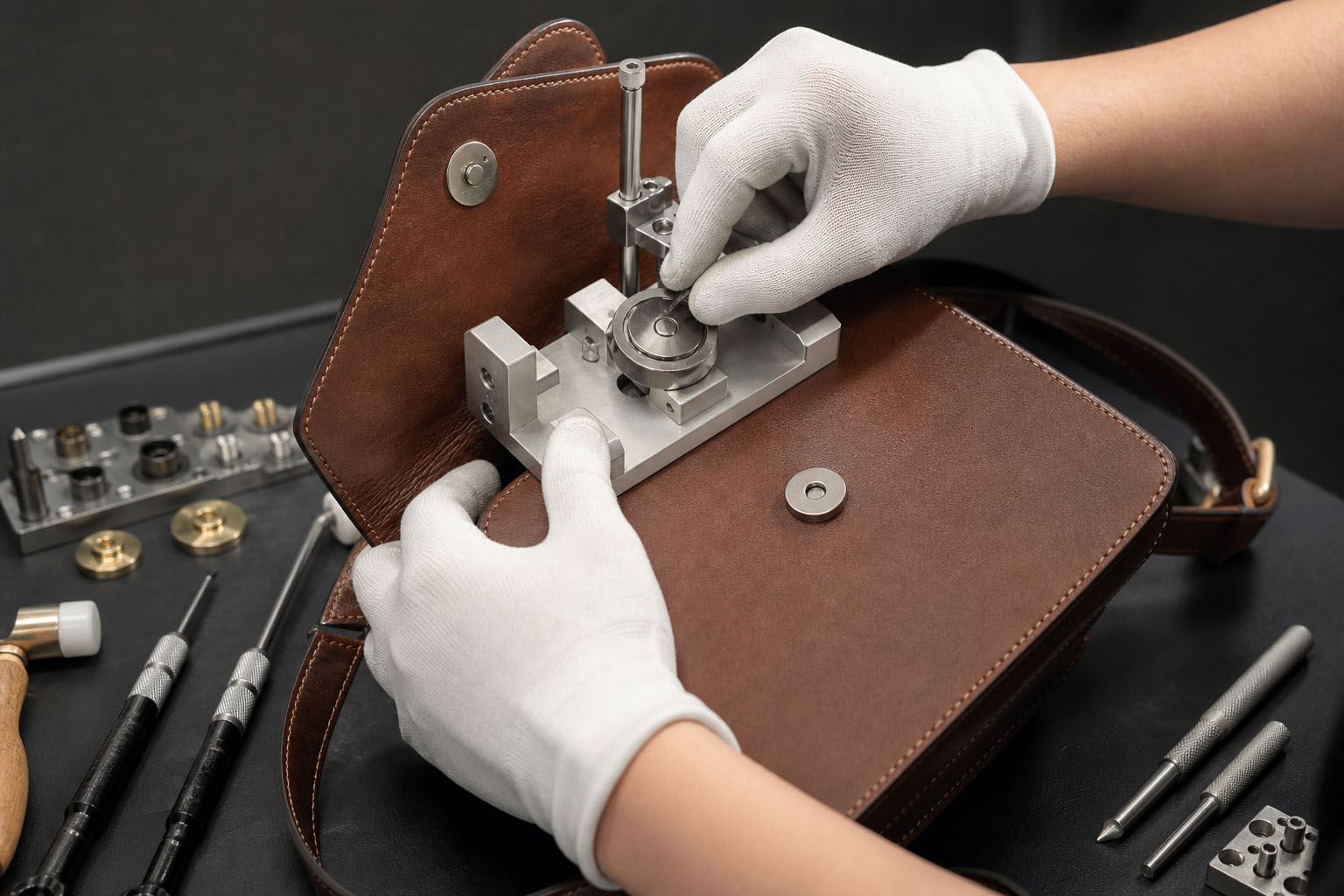
Magnetic closures require precise positioning — too shallow a setting reduces closure strength and the magnet will pop open under lateral stress; too deep a setting can damage the surrounding material, the magnet coating, or even the magnet’s polarity. This is especially critical for flap bags, crossbody bags with magnetic flap closures, and any design where the magnetic snap is also a security feature (the bag stays closed even when the user forgets to zip it).
A quality factory will use a magnet-setting jig that controls both the depth of insertion and the alignment of the polarity. The two magnets (one in the flap, one in the body) must attract in the correct direction; a reversed magnet will push the bag open instead of holding it shut — a defect that’s easy to miss until the customer is walking down the street.
Part Two: Load Capacity, Material Standards, and US Safety Compliance
4. Pull-Strength Testing: The Numerical Benchmark
Pull-strength testing is standard in QC processes, with industrial bag hardware typically required to withstand 10–50 kg of force depending on the application:
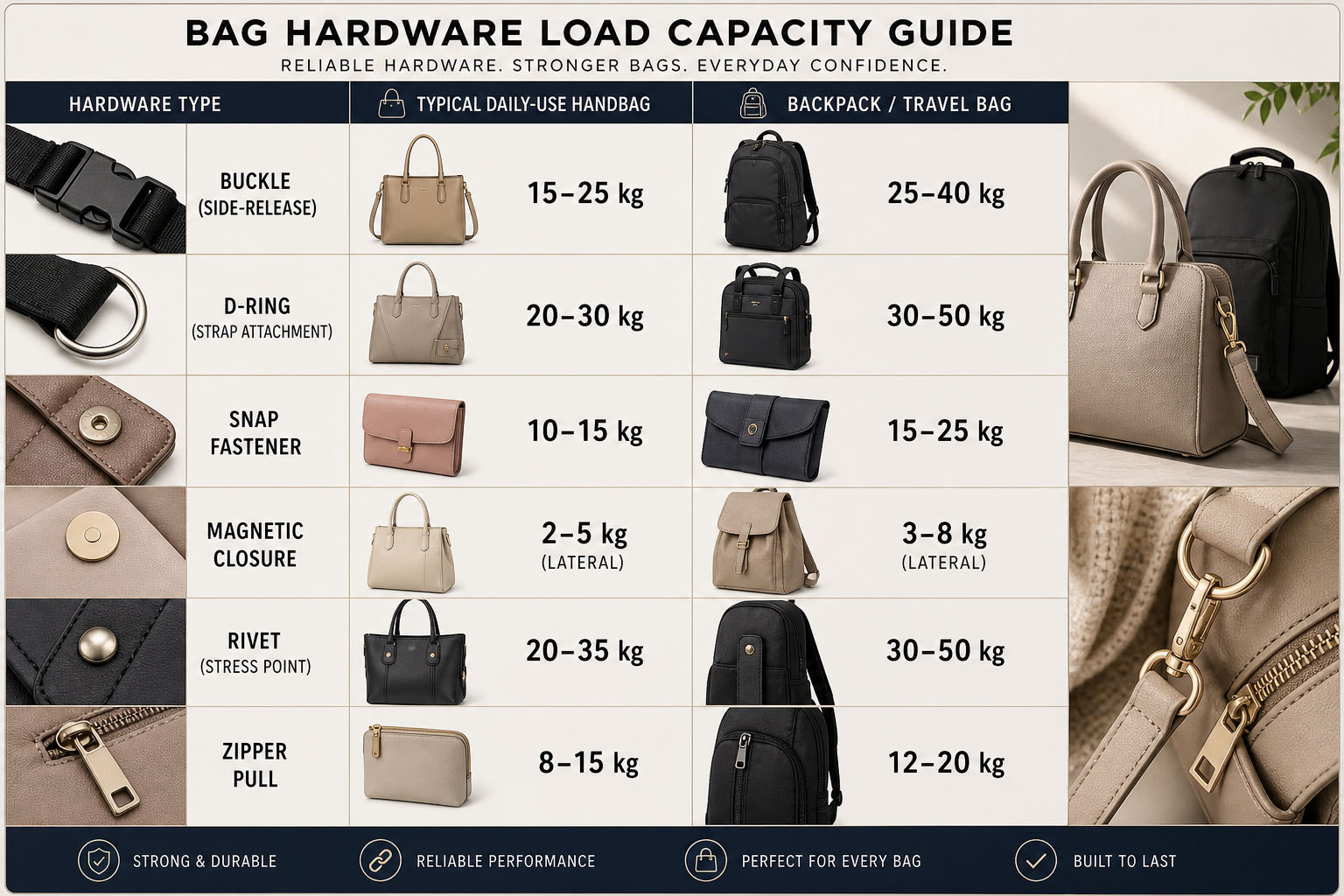
For daily-use handbags and backpacks sold in the US market, we recommend specifying a minimum pull-strength of 20 kg for D-rings and buckles, and 10 kg for snap fasteners. These are conservative numbers that align with what major US brands (and the factories that supply them) typically require.
5. Material Grade: The Hidden Variable
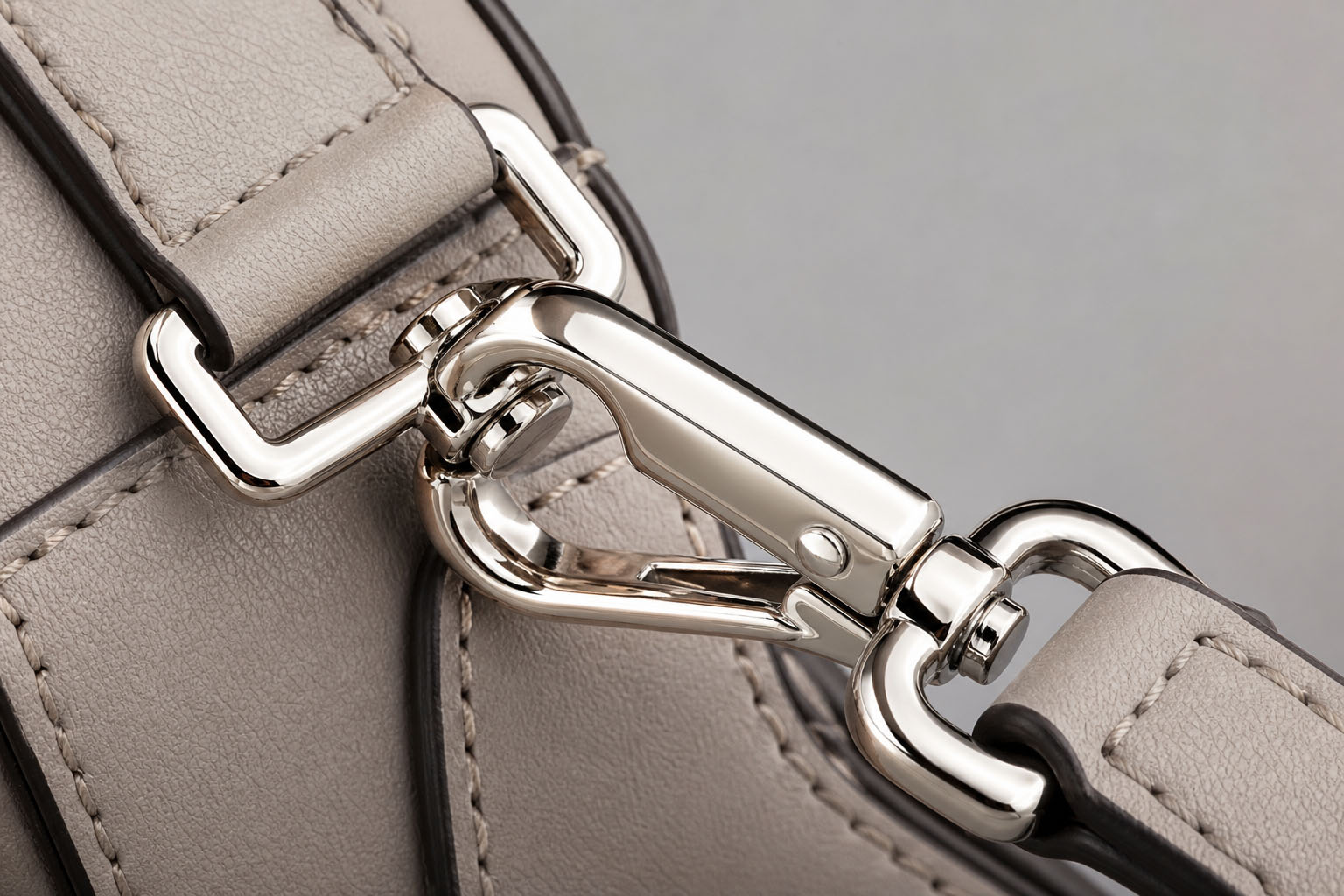
Hardware material — zinc alloy, iron, brass, stainless steel — directly affects both the required setting pressure and the finished pull-strength. Zinc alloy (also called zamak) is the most common choice for fashion handbags because it’s easy to cast into complex shapes, accepts plating well, and is cost-effective. Iron is stronger but heavier and prone to rust. Brass is premium, corrosion-resistant, and has a warm aesthetic. Stainless steel is the ultimate in strength and corrosion resistance but is also the most expensive.
For US import, the most common spec is zinc alloy with nickel or gunmetal plating. The key is not just the base metal — it’s the plating system.
6. US Safety Standards: Lead-Free, Nickel-Free, Anti-Rust
For US import, hardware must comply with several federal and state-level regulations:
CPSIA (Consumer Product Safety Improvement Act): Limits lead content in accessible materials to 100 ppm for children’s products, and 300 ppm for adult products. Most quality factories target 90 ppm or below to be safe.
California Proposition 65: Restricts nickel release (not just content) because nickel is a known skin allergen. The EU has the same standard under REACH (EN 1811: 0.5 µg/cm²/week for prolonged skin contact), and most Chinese factories that export to both markets will meet this.
Salt-spray (anti-rust) testing: ASTM B117 is the US standard. Hardware should withstand 24–48 hours of neutral salt-spray without red rust for daily-use bags, and 72–96 hours for premium or outdoor-use products.
The plating finish matters: a thin layer of electroplated nickel over a copper undercoat on zinc alloy typically passes 48-hour salt-spray. For longer durability, look for electroplated nickel + chrome or PVD (Physical Vapor Deposition) coating, which can extend salt-spray resistance to 96+ hours.
Part Three: Manufacturing Techniques and Quality Control Protocols
7. Material Thickness: The Often-Overlooked Variable
Material thickness must be measured before hardware setting to adjust pressure and prevent fabric damage or loose attachment. A factory that uses the same pressure setting for 1.2 mm PU and 2.5 mm full-grain leather is going to have problems with at least one of them. The professional approach is to measure the substrate at multiple points (corner, center, edge) and set the pressing force accordingly.
This is also why pre-production samples (PPS — pre-production samples) are critical: the factory should run a small batch of 5–10 units, test the pull-strength on each, and confirm the settings before committing to the full production run.
8. Rivets: The Reinforcement Workhorse
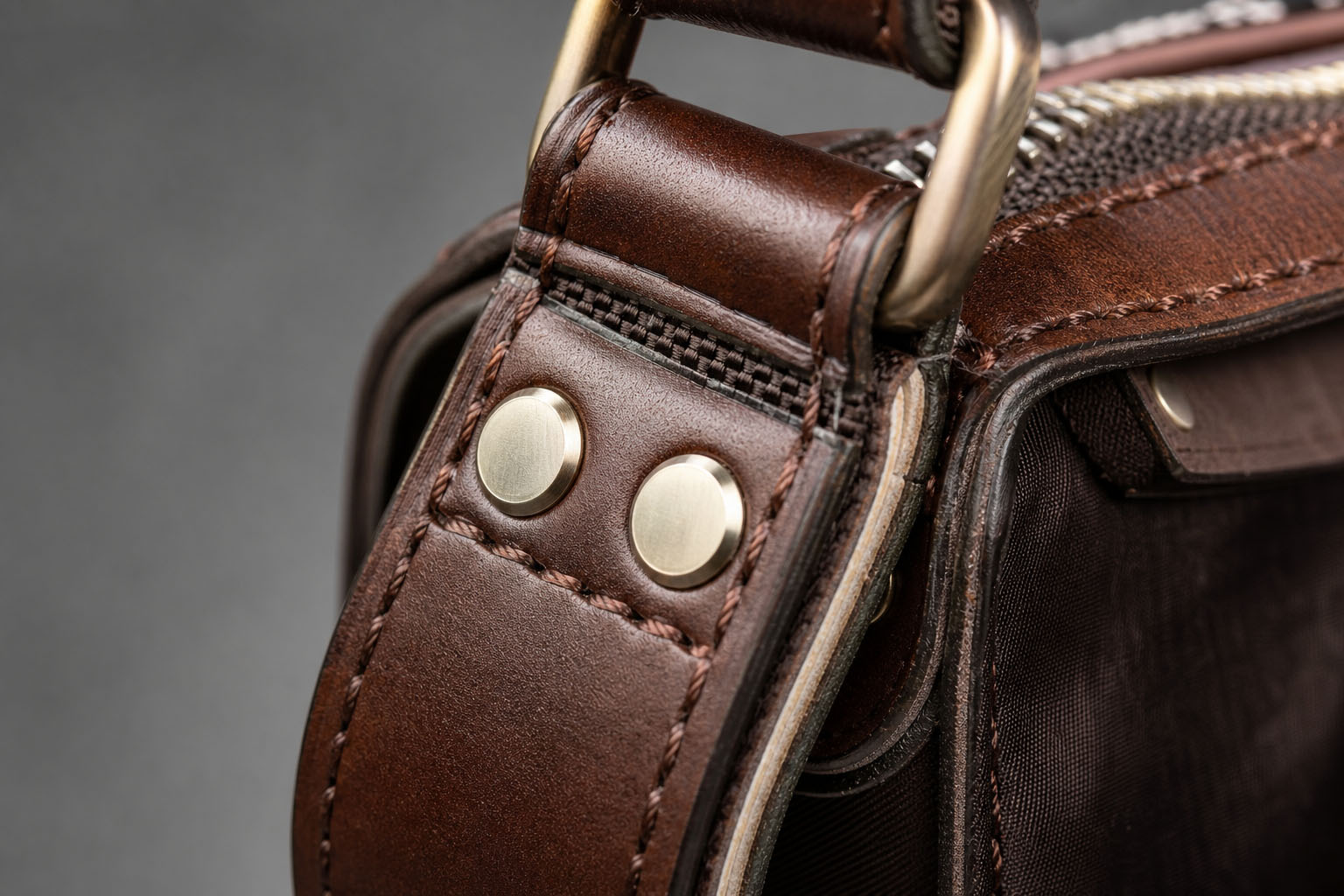
Rivets are the most common reinforcement for stress-point hardware, with both cold-press and hot-press methods available. Cold-press is faster and cheaper but requires precise force control. Hot-press uses a heated die that partially melts the substrate (for plastics) or works with leather’s natural pliability, producing a stronger bond.
For stress points — the base of a strap where it meets the bag body, the corners of a flap, the attachment point of a top handle — double-rivet or bar-rivet reinforcement is the industry standard for any bag that needs to carry more than 3 kg of load.
9. Snap Fastener Alignment: The Detail That Defines Quality
Snap fastener setting must align the cap, socket, and stud precisely; misalignment causes poor closure feel and reduced pull-strength. A snap that requires two hands to close, or that makes a “crunch” sound instead of a clean “click,” is almost always a sign of misalignment or under-pressure setting.
When inspecting samples, open and close every snap 20 times before approving. A well-set snap should feel crisp, close with one hand, and produce a consistent sound across all units.
10. The Final QC Gate: Tensile Testing and Pre-Shipment Inspection
Hardware pull-strength is tested using tensile testing machines, with samples pulled until detachment to record the breaking point. The factory should be pulling at least 5 samples per hardware type per production batch, recording the force at which each fails, and calculating an average. Any batch with an average below spec, or with any single sample below 80% of the minimum, should be reworked or rejected.
Hardware components are often sourced from specialized suppliers (Guanxi Township in Guangdong is the global capital of bag hardware) and verified by pre-shipment inspection reports before assembly. A professional factory will have an incoming-QC process for hardware: every batch of buckles, D-rings, or snaps is checked for dimensions, plating thickness, and salt-spray resistance before it ever reaches the production line.

Part Four: The Five Critical Questions — Expanded for Your Supplier
Now that you understand the engineering behind the answers, here’s how to phrase each question for maximum clarity with your Chinese supplier.
Q1: Is the hardware attachment set with calibrated pressure for pull-strength?
The background: Manual hand-presses produce inconsistent results. A factory that uses pneumatic or hydraulic machines with pressure gauges is operating at a different level of quality control than one that relies on operator feel.
What to ask:
“Are all buckles, D-rings, snaps, and magnetic closures installed using calibrated pneumatic or hydraulic pressing machines with pressure gauges? Can you provide the tonnage setting for each hardware type on this specific bag design?”
What to look for in the response: A specific tonnage number (e.g., “1.8 tons for buckles, 0.5 tons for snaps”), the brand or type of pressing machine, and ideally a photo or video showing the gauge.
Q2: What minimum load capacity should buckles, D-rings, and snaps pass?
The standard: For daily-use handbags and backpacks, we recommend specifying:
Buckles and D-rings: 20 kg minimum (40 lbf)
Snap fasteners: 10 kg minimum (22 lbf)
Magnetic closures: 3 kg minimum lateral force (6.6 lbf)
Rivets at stress points: 30 kg minimum (66 lbf)
What to ask:
“What is your standard pull-strength requirement for buckles, D-rings, snaps, and magnetic closures on this product? Please specify the minimum kg/lbs value for each hardware type.”
Q3: What material grade and plating finish meet US import safety standards?
The requirements:
Lead content: Below 90 ppm (to comfortably meet CPSIA’s 100 ppm children’s standard or 300 ppm adult standard)
Nickel release: Below 0.5 µg/cm²/week (per EN 1811 / REACH / California Prop 65)
Salt-spray resistance: Minimum 24 hours neutral salt-spray per ASTM B117 for daily-use, 48 hours for premium
Plating: Copper undercoat + nickel + chrome (or PVD) for maximum durability
What to ask:
“What is the base material (zinc alloy / iron / brass / stainless steel) and the plating system for each hardware component? Do you have SGS or Intertek test reports confirming CPSIA lead compliance, REACH nickel-release compliance, and ASTM B117 salt-spray results?”
Q4: Do you provide third-party test reports?
The verification chain: First-party testing (the factory’s own QC) is necessary but not sufficient. Third-party testing by SGS, Intertek, Bureau Veritas, or TUV provides independent verification that the factory’s claims are accurate.
What to ask:
“Do you provide third-party test reports from SGS, Intertek, or Bureau Veritas for hardware pull-strength, CPSIA lead content, REACH nickel release, and salt-spray durability? Can you share recent reports for similar products, and will you commission a new report for our order if required?”
What to look for: Recent reports (within the last 12 months) for the same or similar hardware, with the third-party lab’s letterhead, accreditation number, and a clear pass/fail statement.
Q5: What is your policy on replacement or compensation if hardware fails post-shipment?
The risk: Even with rigorous QC, defects can escape the factory. A loose snap, a rusted buckle, a magnetic closure that pops open — these are the defects that show up in customer reviews and product returns.
What to ask:
“If hardware fails the calibrated pull-strength test after bulk shipment arrives in our US warehouse, what is your replacement or compensation policy? Do you offer free replacement of defective units, credit toward future orders, or refund of defective portion? What is the claim process and the time window for filing claims?”
What to look for: A written policy in your purchase order or proforma invoice. Verbal promises are unenforceable. The industry standard is one of the following:
1. Free replacement of defective units (factory pays shipping both ways)
2. Credit memo for defective units, applied to the next order
3. Refund for defective units (less common, but negotiable for serious issues)
The claim window is typically 30–60 days from receipt of goods. Document everything with photos and pull-test videos.
Part Five: Building a Long-Term Quality Partnership
Sourcing bags from China is not a one-time transaction — it’s a partnership built on clear specifications, transparent communication, and aligned expectations. The five questions we’ve covered in this guide are the foundation of that partnership, but they’re just the beginning.
A truly professional bag manufacturer will welcome these questions. They will have answers prepared, reports ready to share, and a quality-control process that they’ve refined over years of working with US and European brands. If a factory balks at providing this information, considers it unreasonable, or tries to substitute verbal assurances for documented evidence — that’s a red flag worth heeding.
At our company, we vet our partner factories against a 47-point hardware quality checklist before we ever place an order. We require pre-production samples tested by third-party labs. We conduct pre-shipment inspections on every batch. And we maintain a 2% AQL (Acceptable Quality Level) for critical defects like hardware failure.
This is the level of rigor that US consumers expect, and it’s the level of rigor that protects your brand from the hidden costs of returns, negative reviews, and warranty claims.
Conclusion: The Hardware Standard Your Brand Deserves
Every bag that leaves a Chinese factory and arrives in a US warehouse carries the weight of your brand promise. The handle that doesn’t break, the buckle that doesn’t pop, the magnetic closure that holds — these are the silent details that turn a one-time buyer into a repeat customer.
By asking the right questions, specifying clear pull-strength standards, requiring third-party test reports, and securing a written replacement policy, you transform sourcing from a price negotiation into a quality partnership. The factories that meet this standard exist in abundance in China — you just need to know how to identify them, and how to hold them accountable.
We’ve made it our business to know. And now, so do you.
Looking for a sourcing partner that already speaks this language? We work with vetted Chinese manufacturers who meet — and exceed — these hardware quality standards. Browse our collection or contact our sourcing team to discuss your custom requirements.
Post time: Jul-15-2026