
How zipper installation standards, quality control, and supplier transparency separate successful bag brands from costly mistakes
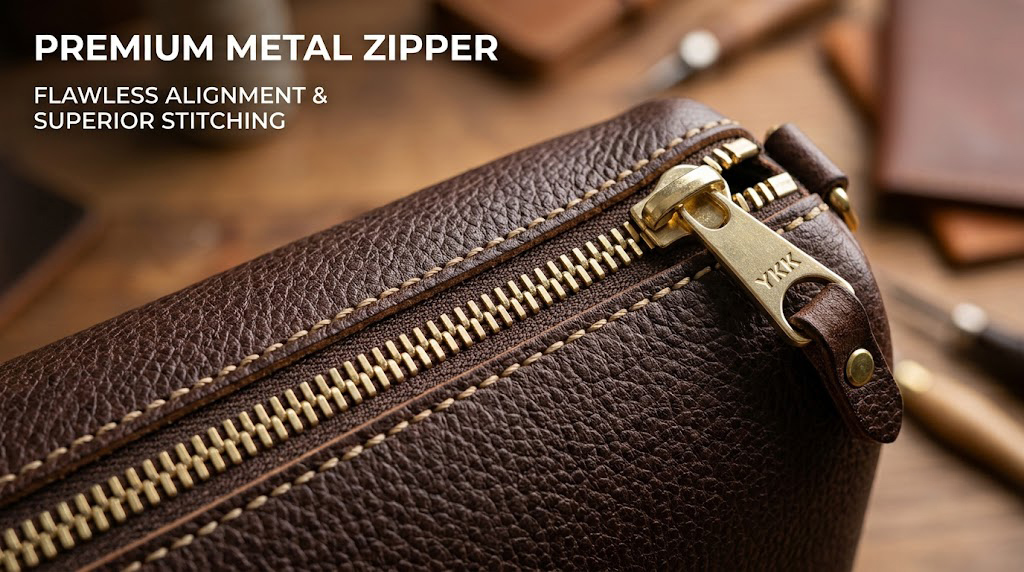
When you’re sourcing bags from Chinese manufacturers, the zipper is the component most likely to fail first — and the issue most likely to generate customer complaints, returns, and negative reviews. Unlike fabric panels or hardware, a zipper is a moving mechanical part. It has to slide thousands of times without skipping, catching, or detaching. It has to stay aligned with the bag opening through years of tension, packing, and travel. It has to look good on day one and on day one thousand.
After working with dozens of bag factories across Guangzhou, Yiwu, and Quanzhou, I’ve learned one fundamental truth: a bag’s zipper is its mechanical signature. If the zipper fails, the bag fails. That’s why zipper installation deserves more scrutiny than almost any other element of your production specification.
This guide covers the 10 most important technical insights about zipper installation, the quality control measures your supplier should have in place, how to evaluate samples before placing bulk orders, what defect rates to expect, and which zipper brands and grades are worth your investment.
Part 1: Why Zipper Installation Standards Matter More Than You Think
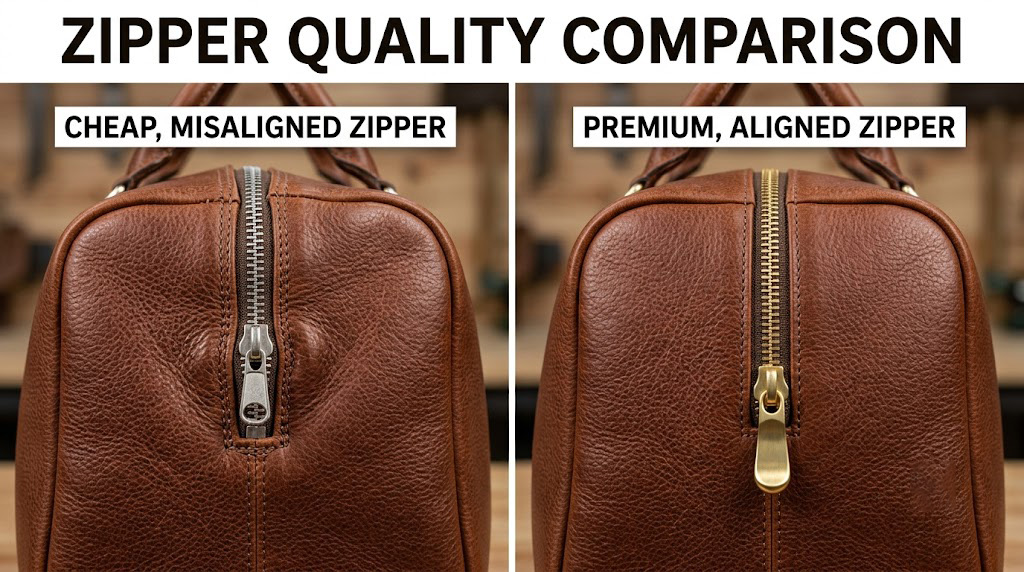
A poorly installed zipper doesn’t just look bad — it actively shortens the lifespan of your product. Misaligned zippers are one of the most common quality complaints in the bag industry, often caused by incorrect seam allowance or tape shifting during sewing. When the zipper tape shifts even 1–2 millimeters during installation, the slider binds, the teeth skip, and the user perceives the entire bag as “cheap.”
The mechanical reality of zippers:
A standard YKK #5 nylon coil zipper is rated for approximately 5,000 open/close cycles
A premium YKK #8 metal zipper can exceed 10,000 cycles
A generic no-brand zipper typically fails between 500–2,000 cycles
The difference between “good enough” and “excellent” zipper performance is almost always determined at the installation stage, not the zipper itself
This is why smart buyers don’t just ask “what zipper do you use?” — they ask “how do you install it?”
Part 2: 10 Technical Insights About Zipper Installation in Professional Bag Production
Insight 1: Dedicated Machines Ensure Uniform Stitch Length and Placement
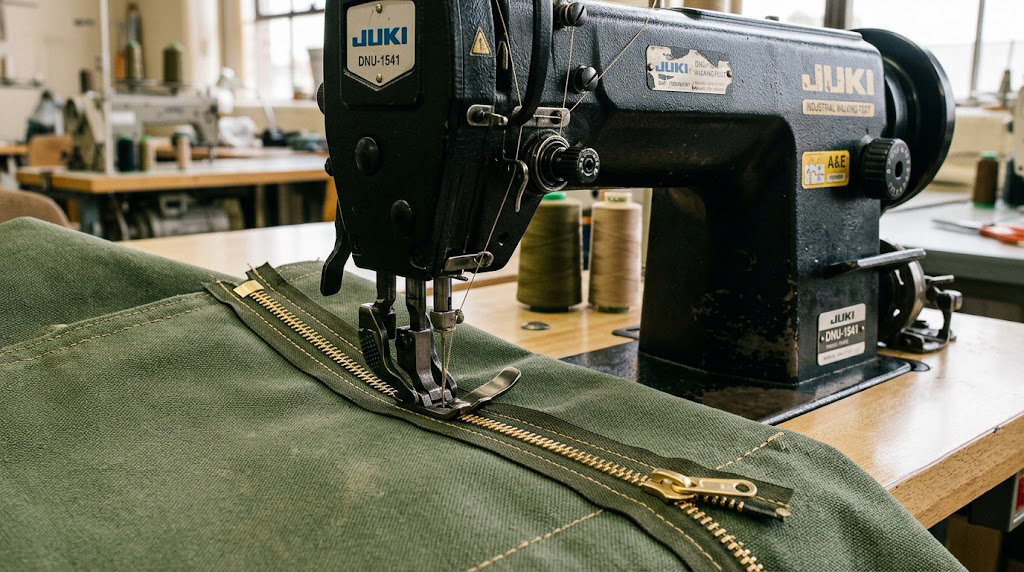
Zipper installation machines are engineered specifically to maintain uniform stitch length, consistent placement, and proper alignment with bag panel edges. Unlike a general-purpose lockstitch machine, a dedicated zipper machine has a narrow presser foot that rides along the zipper teeth, keeping the stitch line parallel to the chain. This eliminates the “wobble” you see when standard machines are used on long zipper runs.
Insight 2: Walking Foot Machines Are Standard for Heavy Materials
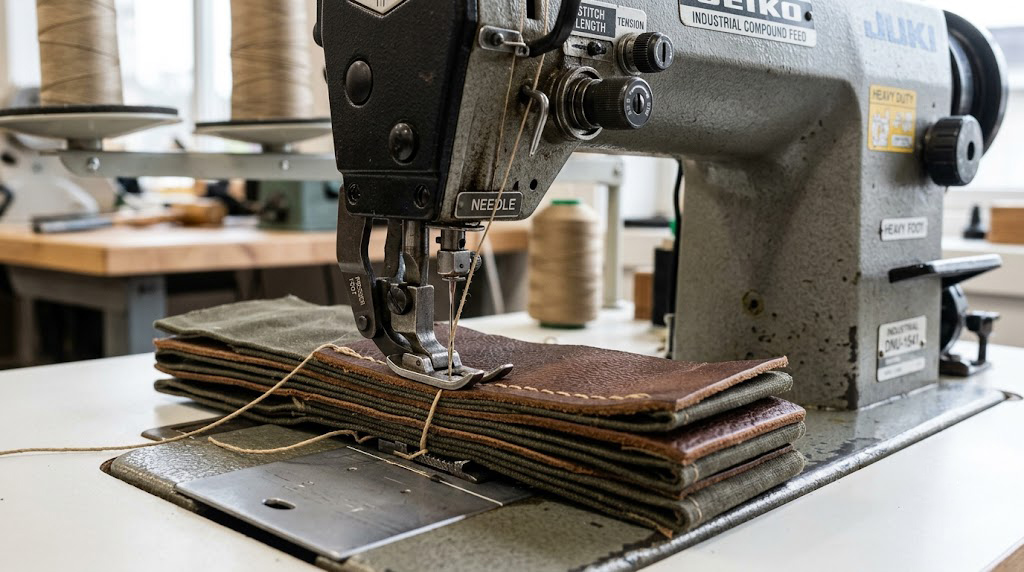
For bags made from canvas, full-grain leather, or multi-layer assemblies, walking foot sewing machines are the industry standard. The walking foot mechanism feeds the top and bottom layers in sync, preventing the slippery zipper tape from shifting as it passes under the needle. This is critical because zipper tape has a lower coefficient of friction than the surrounding fabric, and without synchronized feeding, the tape will pull forward or lag behind — destroying alignment.
Insight 3: Dedicated Zipper Machines Are Faster AND More Accurate
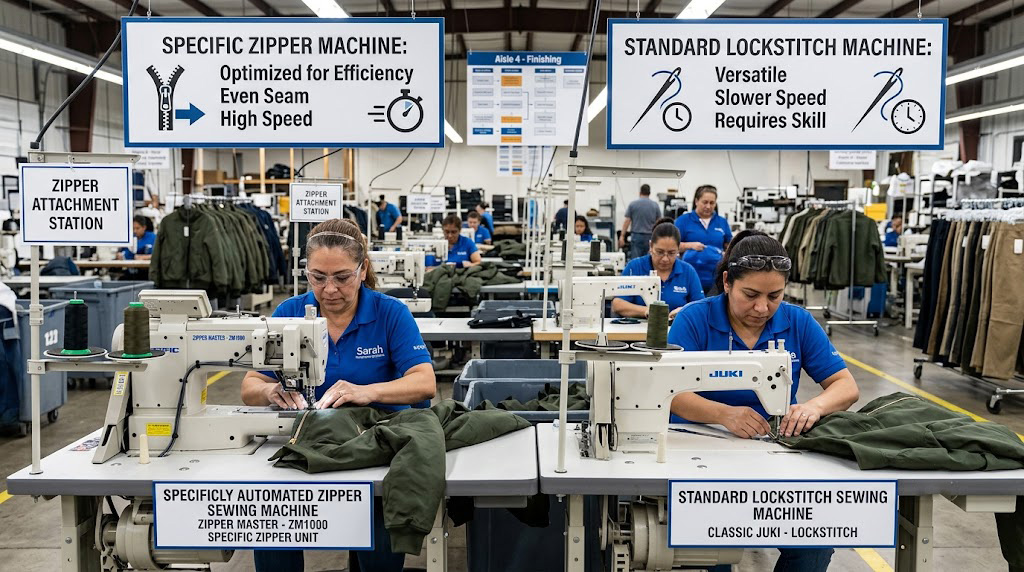
Dedicated zipper machines are not just a quality upgrade — they’re a productivity upgrade. They are faster and more accurate than standard lockstitch machines, especially for long zipper runs. A skilled operator on a standard machine might complete 8–10 bags per hour on a long zipper. A dedicated zipper machine with an experienced operator can hit 18–25 bags per hour with measurably better alignment. Faster cycle times mean lower labor costs, which means better pricing for you — without sacrificing quality.
Insight 4: Top Stops and Bottom Stops Are Critical Structural Elements
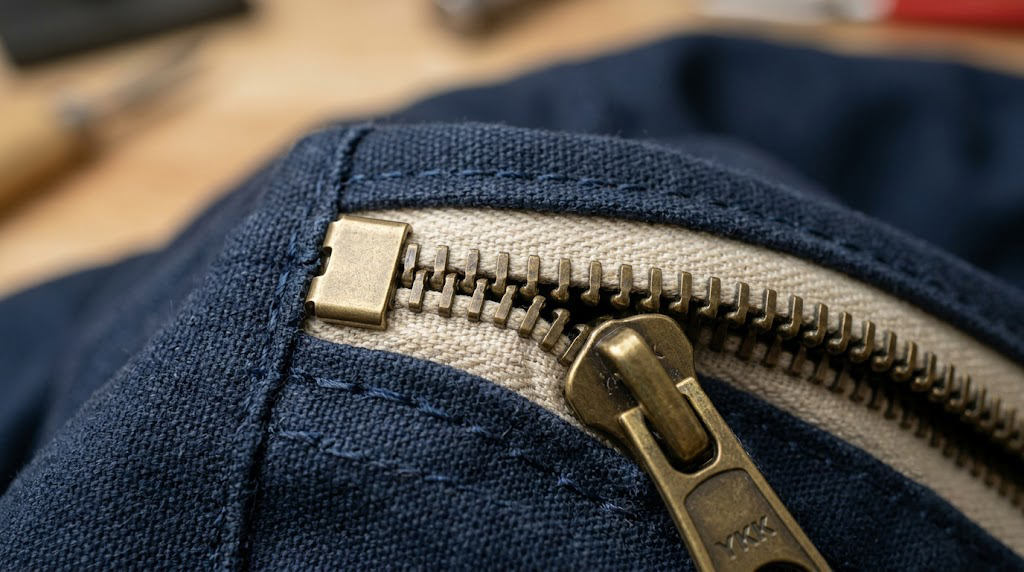
The top stops and bottom stops must be installed securely to prevent the slider from detaching during use. This sounds obvious, but in practice, it’s where many budget factories cut corners. Top stops must be crimped at the correct angle with sufficient pressure to bite into the chain — not just pinched loosely on top. A top stop that falls off in the first week of customer use is a 100% return trigger, regardless of how nice the rest of the bag looks.
Insight 5: Slider Tension Must Match Zipper Chain Type
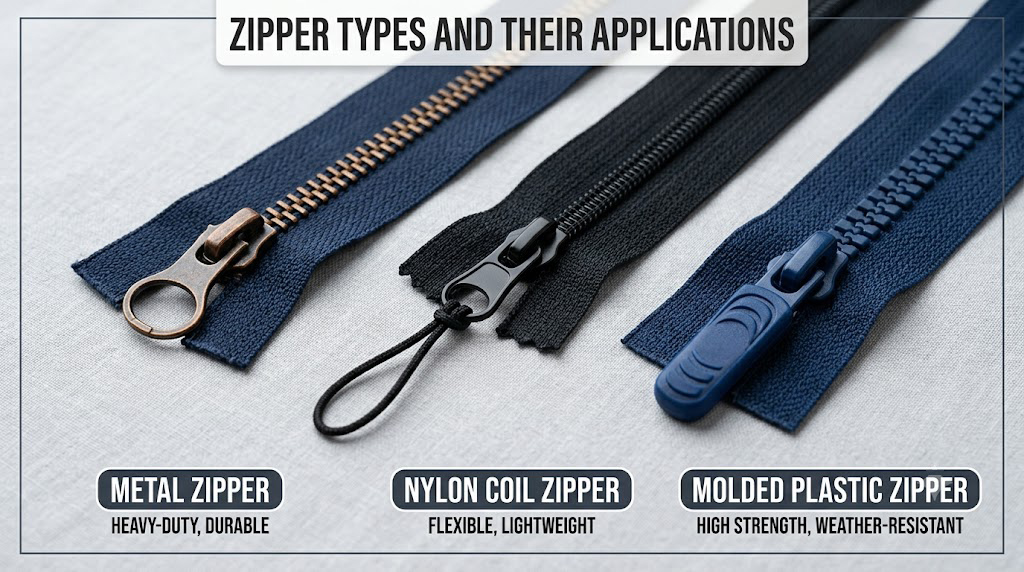
Slider tension must be adjusted to match the zipper chain type for smooth pull performance. Metal zippers, nylon coil zippers, and molded plastic zippers each have different mechanical characteristics:
Metal zippers require firmer slider tension because the metal teeth create more resistance
Nylon coil zippers need lighter tension — too tight and the coil deforms; too loose and the slider ratchets
Molded plastic zippers fall between the two but require precise tension calibration to prevent skipping
A factory that uses the same slider setting for all three chain types is producing defective zippers, period.
Insight 6: Zipper Tape Cut Length Matters More Than You Realize
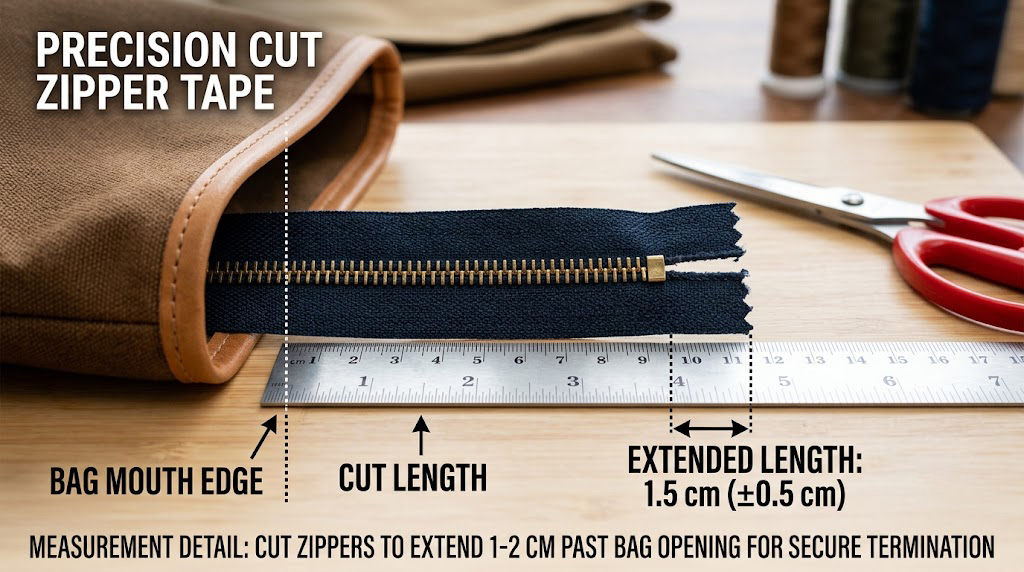
Zipper tape is cut 1–2 cm longer than the bag opening to allow for folding, seam allowance, and final finishing. This is a small detail with big consequences. If the tape is cut too short, the top stop sits below the bag’s top edge, creating a gap where the slider can come off. If the tape is cut too long, the excess bunches inside the seam, creating a visible lump and weakening the attachment point. Professional factories mark cut lengths with templates or laser guides, not freehand.
Insight 7: Nylon Coil Zippers Require Specialized Cutting and Sealing
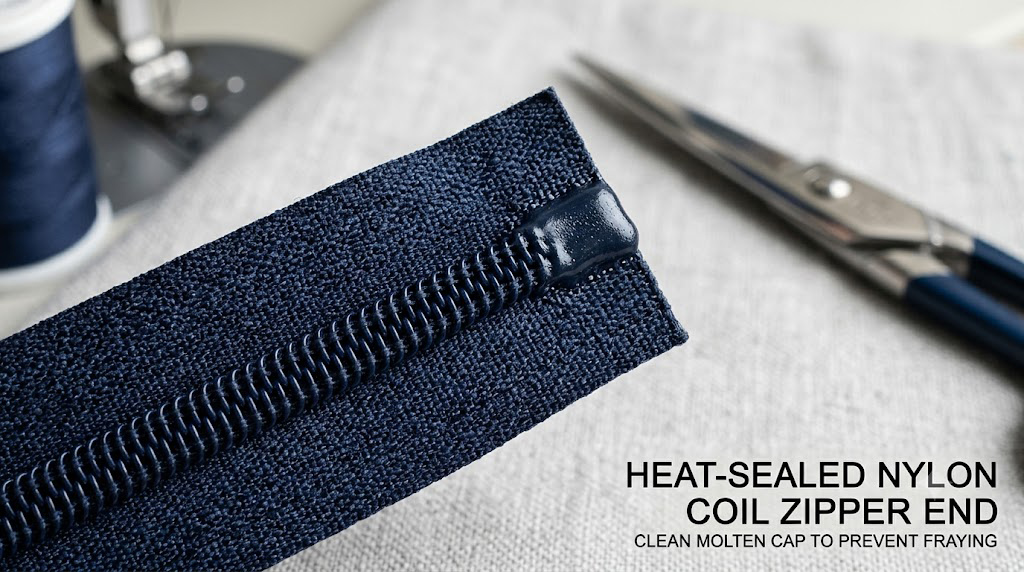
Nylon coil zippers require specialized cutting and sealing to prevent the coil from unraveling at the cut end. Unlike metal zippers, where each tooth is a separate element, nylon coil zippers are a continuous spiral of polyester thread sewn onto the tape. Cut the end cleanly without heat-sealing, and the coil will slowly unravel with use, creating the dreaded “zipper teeth separating” defect. Look for suppliers who use hot-cut tools or ultrasonic cutters for nylon coil zippers.
Insight 8: Pre-Production Zipper Samples Must Be Cycle-Tested
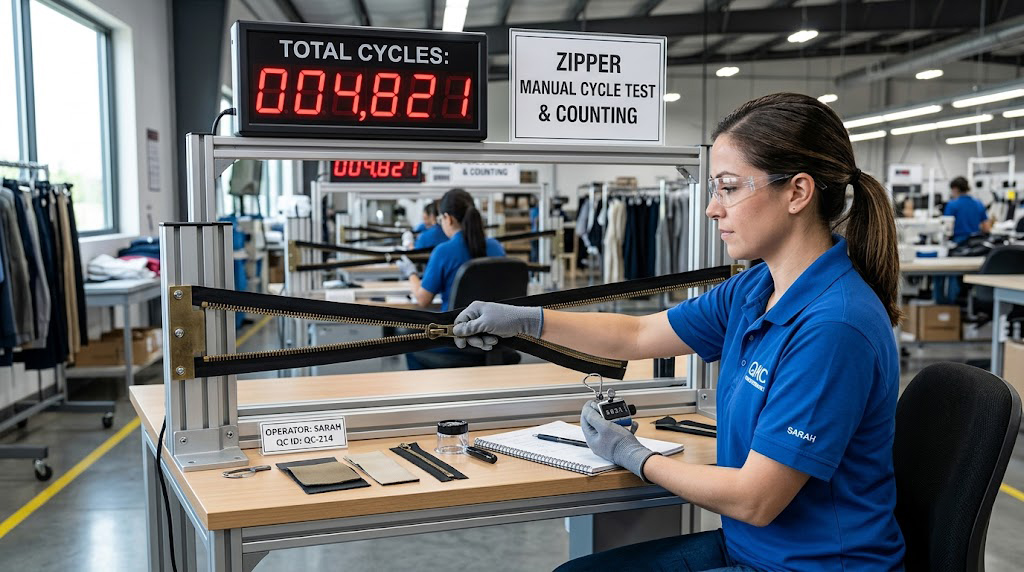
Pre-production zipper samples are pulled through multiple cycles to test smoothness, alignment, and slider security. A serious factory will run at least 50–100 manual cycles on every zipper before approving a sample for production. This is the difference between a sample that “works” and a sample that will work after 3,000 customer uses. If your supplier can’t show you their cycle testing procedure, walk away.
Insight 9: Misalignment Is the #1 Quality Complaint
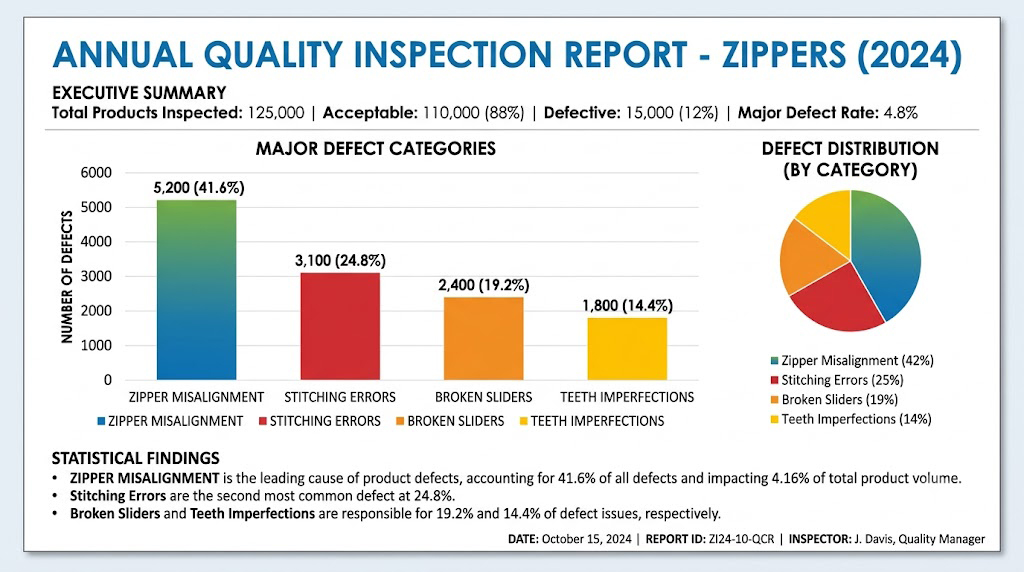
Misaligned zippers are one of the most common quality complaints, often caused by incorrect seam allowance or tape shifting during sewing. In my experience auditing bag factories, zipper misalignment accounts for roughly 35–45% of all zipper-related defects — more than broken sliders, faulty top stops, and chain separation combined. The fix is almost always operator training and machine calibration, not better zippers. This is good news: it means a factory that invests in installation quality can dramatically reduce defects without raising your unit cost.
Insight 10: Programmable Pattern Sewing Is the New Standard for Complex Applications
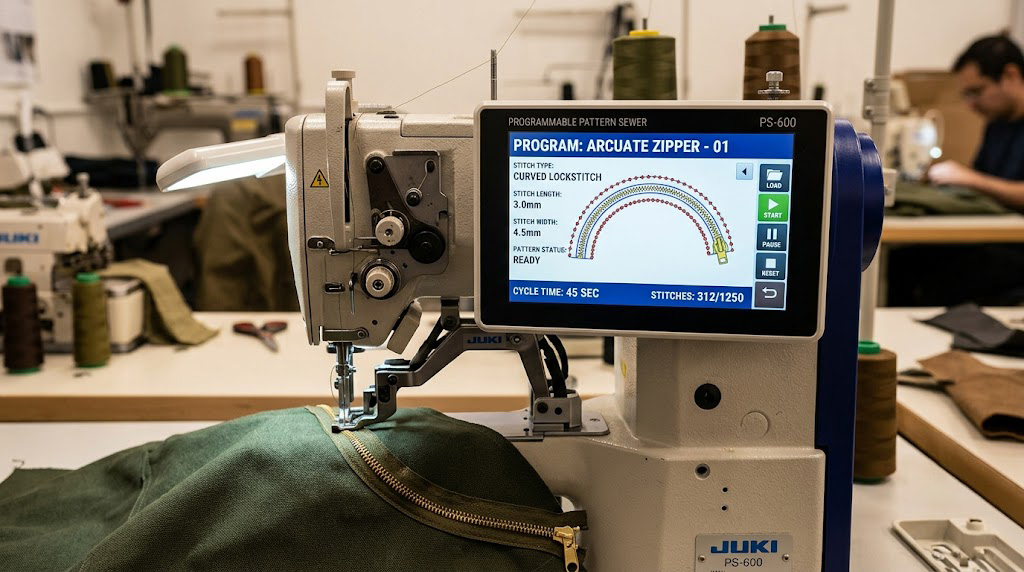
Programmable pattern sewing machines are increasingly used for complex zipper applications — curved zippers, two-way zippers, U-shaped zippers on duffels, and J-shaped zippers on backpacks — to ensure precision. These machines follow digital patterns with sub-millimeter accuracy, eliminating the human error that plagues hand-guided installation of curved zippers. If you’re producing bags with non-straight zipper applications, ask specifically whether your factory has programmable equipment for these operations.
Part 3: What Quality Control Measures Should Your Supplier Have in Place?
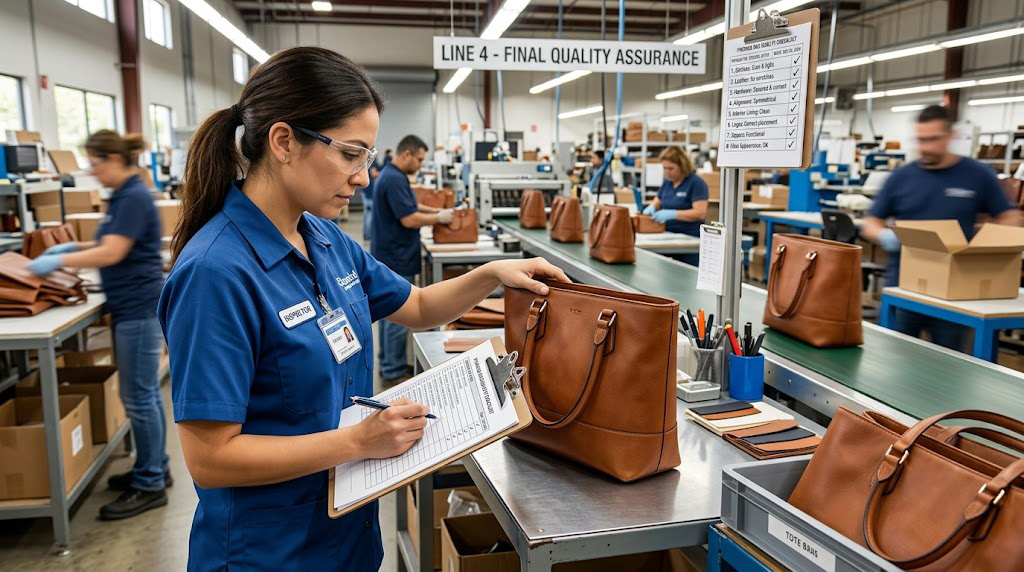
A professional bag factory should have a multi-stage inspection process for finished bags before shipment. Here’s what to look for:
Stage 1: In-line inspection (during production)
Random zipper cycle testing every 30–50 bags
Visual alignment checks against reference samples
Top stop and bottom stop security verification
Stage 2: Final inspection (post-production)
100% zipper function test (open and close fully)
Visual inspection for missed stitches, loose threads, or zipper tape exposure
Slider security check — pull firmly to ensure no detachment
Alignment measurement with template or gauge
Stage 3: Pre-shipment audit (AQL standard)
Industry-standard AQL 2.5 inspection on a random sample
Specific focus on functional defects (zippers, hardware, seams)
Photo documentation of any defects found
The question to ask your supplier:
“What quality control measures are in place to inspect finished bags before shipment, and can you share your most recent AQL inspection report?”
A supplier who can provide detailed QC documentation is a supplier who has nothing to hide. A supplier who gives you vague answers about “we check everything” is a supplier who is checking very little.
Part 4: Can You Order Samples to Evaluate Zipper Quality?
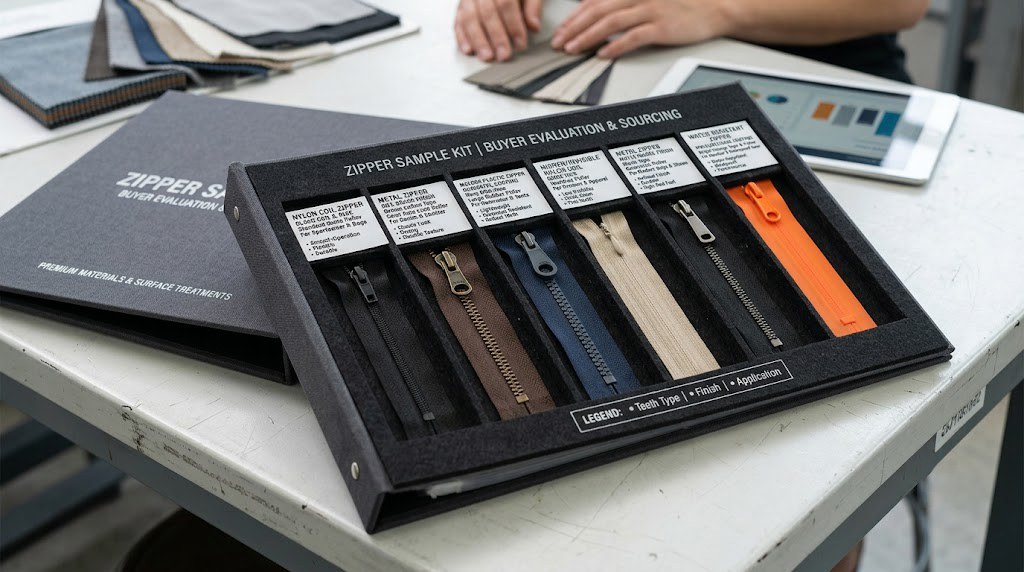
Yes — and you absolutely should.
Any reputable bag manufacturer will provide samples before bulk production, and zipper samples should be a non-negotiable part of your sample evaluation process. Here’s how to structure your sample request:
What to request:
1. A complete sample bag with the exact zipper type, length, and brand specified for production
2. A standalone zipper sample of the same specification, approximately 30–50 cm long, for independent cycle testing
3. Material specification sheet identifying the zipper brand, model, chain type, tape material, and slider type
4. Production reference sample kept at the factory for comparison during bulk production
How to evaluate the sample:
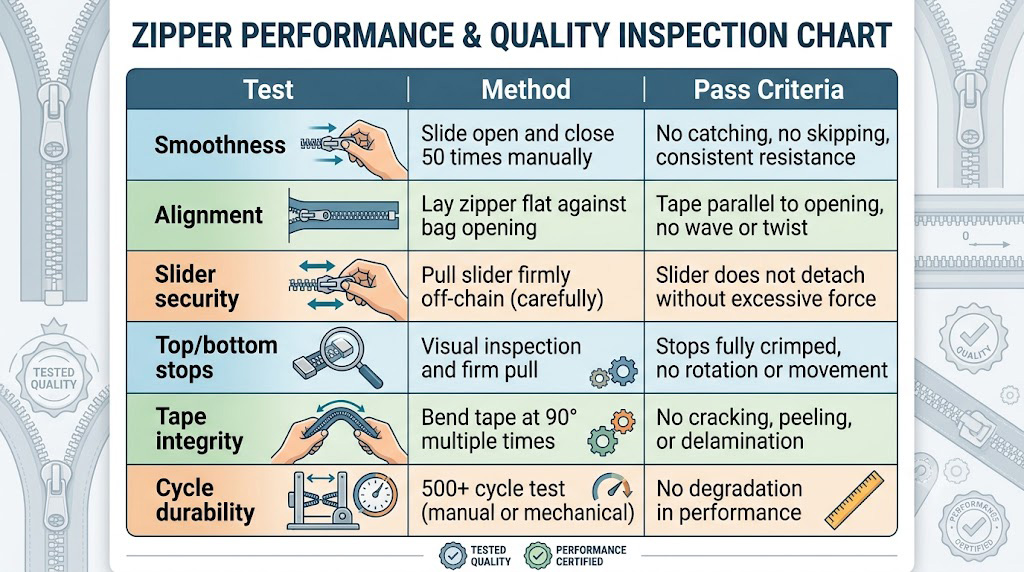
The question to ask your supplier:
“Can I order samples to evaluate zipper quality before placing a bulk order, and will you provide both a complete bag sample and a standalone zipper for testing?”
Part 5: What Is the Defect Rate for Zipper-Related Issues?
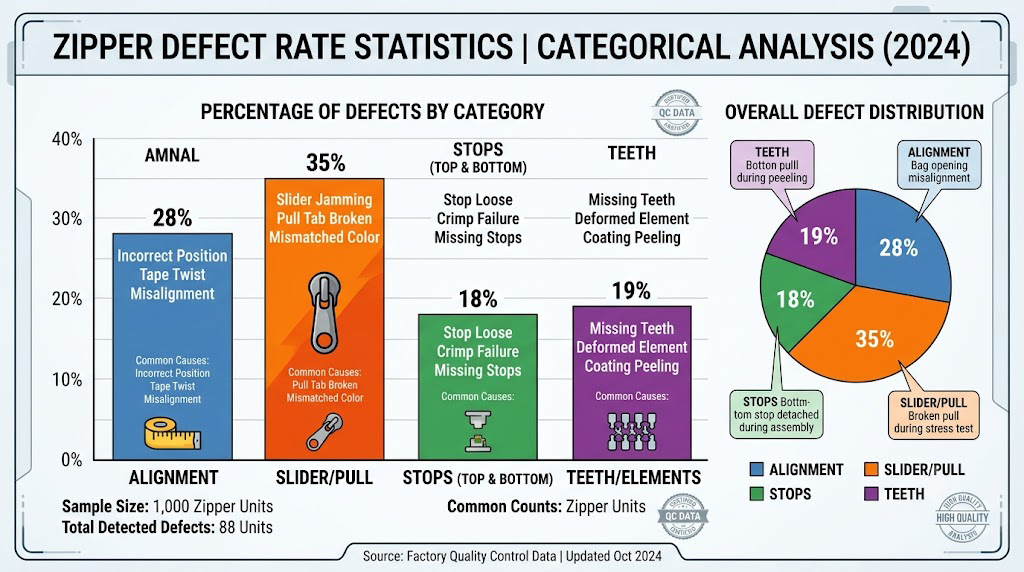
Industry-standard zipper defect rates vary significantly based on factory capability, zipper quality, and bag complexity. Here’s what you should expect:
Realistic defect rate benchmarks:
Premium factories with YKK zippers and dedicated installation: 0.5–1.5% zipper-related defects
Mid-tier factories with branded zippers (YKK, SBS, YCC): 1.5–3.0% zipper-related defects
Budget factories with generic zippers: 3.0–6.0% zipper-related defects
High-complexity applications (curved, two-way, oversized zippers): Add 1–2% to any tier
Replacement and refund policy questions to ask:
1. “What is your defect rate for zipper-related issues across your last three production runs?”
2. “If defects are found in received shipment, what is your replacement policy — full replacement, partial credit, or repair?”
3. “Do you provide defect allowance in the order (e.g., 2% overproduction) to cover in-line defects, or do you ship 100% with claims handled post-shipment?”
4. “What is your response time for zipper-related quality claims?”
5. “Will you cover return shipping for defective zipper units, or is that the buyer’s responsibility?”
A note on defect rates and pricing: If a supplier quotes you a defect rate of “zero” or “less than 0.1%,” they are not being honest. Every factory has defects. The question is not whether defects exist — it’s how the factory handles them when they appear. Look for suppliers with transparent, documented replacement policies and a clear escalation path for disputes.
Part 6: What Brand or Grade of Zippers Should You Use?
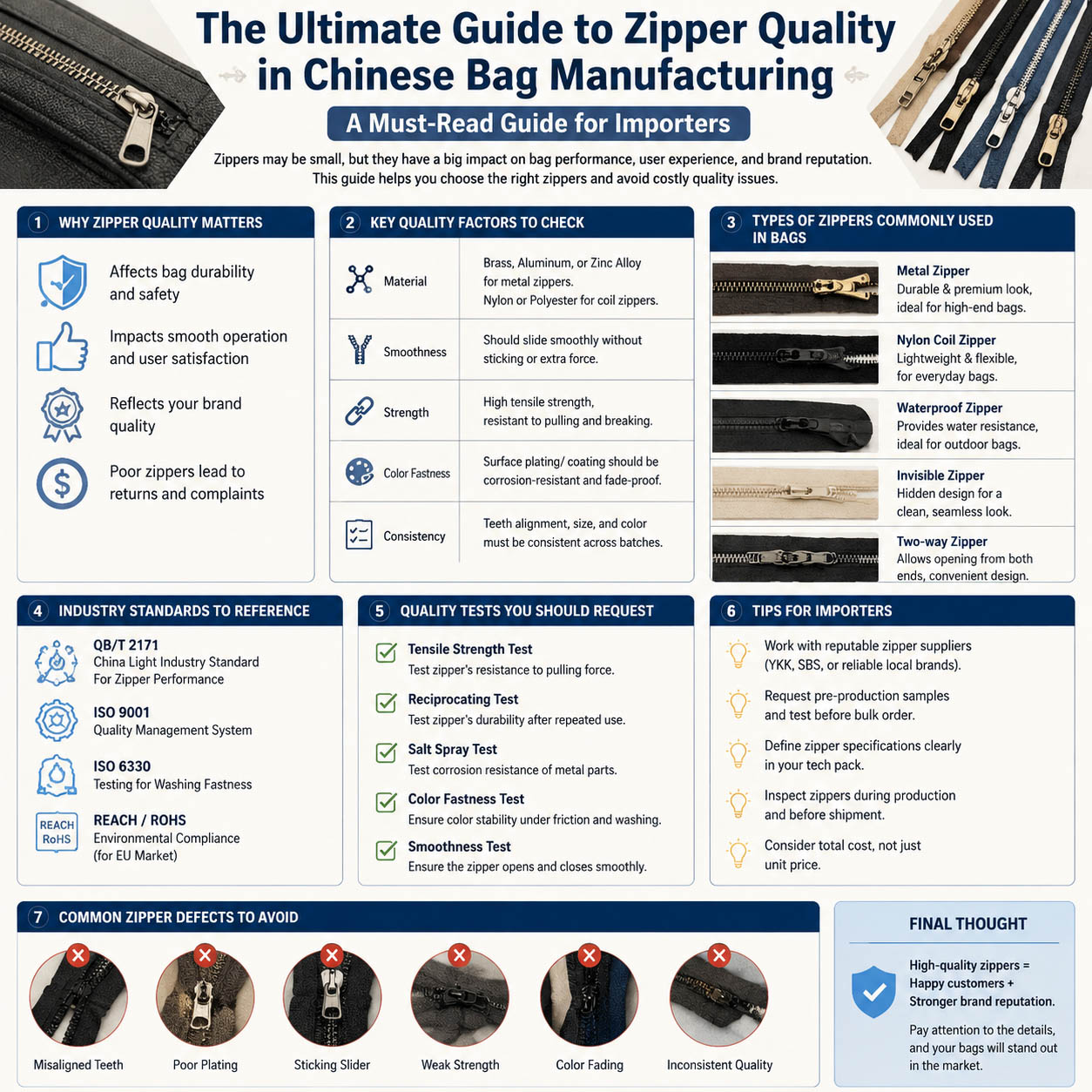
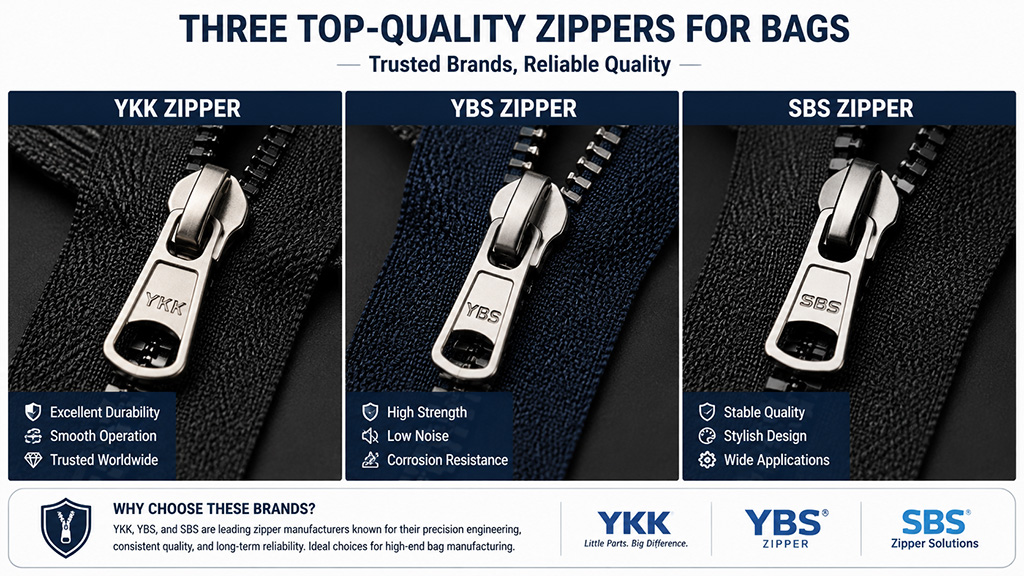
The zipper brand and grade you choose has a direct impact on your bag’s perceived quality, durability, and price point. Here are the most common options in Chinese bag manufacturing:
Tier 1: YKK (Japan)
Industry gold standard, used by premium global brands
Excellent consistency, cycle life, and finish quality
15–25% higher cost than domestic alternatives
Best for: Premium product lines, brand reputation, long-term durability
Tier 2: SBS, YCC, KCC (China — premium domestic)
Strong domestic manufacturers with good quality control
70–85% of YKK performance at 40–60% of the cost
Increasingly used by mid-market and emerging brands
Best for: Mid-tier product lines, cost-conscious quality
Tier 3: HSD, IDEA, generic Chinese brands
Acceptable for budget product lines with limited lifecycle expectations
Significant variation in quality between batches
20–35% of YKK cost
Best for: Promotional products, fashion-fast disposable items, low-cost SKUs
Chain type considerations:
Metal zippers — Premium aesthetic, high durability, heavier weight. Best for jeans, leather goods, premium backpacks.
Nylon coil zippers — Flexible, lightweight, corrosion-resistant. Best for luggage, outdoor bags, waterproof applications.
Molded plastic zippers — Economical, color-matched, good for casual bags and children’s products.
The question to ask your supplier:
“What brand and grade of zippers do you use in your bag production, and can you provide brand certification or traceability documentation?”
A factory that uses authentic YKK zippers will be able to show you YKK-branded zipper spools, branded slider boxes, and chain tags. If they claim to use YKK but can’t show you the branded packaging, they may be using counterfeit zippers — which is a major issue in the industry.
Part 7: The Complete Supplier Screening Checklist
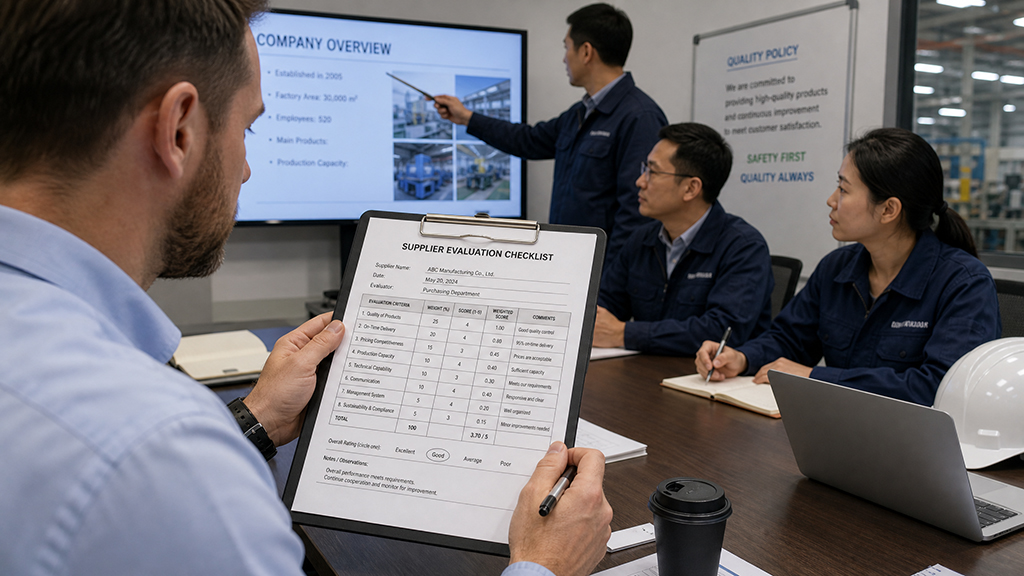
Before placing your bulk order, walk through this complete screening checklist with your Chinese bag supplier:
A. Installation Process
Do you use dedicated zipper installation machines?
Are walking foot machines used for heavy materials?
Do you have programmable machines for curved or complex zippers?
How do you control seam allowance and tape shifting?
B. Quality Control
What QC measures are in place for finished bags before shipment?
Do you perform AQL inspections on every batch?
Can you share your most recent inspection report?
Do you have dedicated QC staff or is it operator self-inspection?
C. Sampling
Can I order samples before bulk production?
Will you provide a standalone zipper sample for independent testing?
How long does sample production take?
Are sample costs refundable against bulk orders?
D. Defect Management
What is your zipper defect rate across recent production runs?
What is your replacement/refund policy for defective units?
Do you provide defect allowance (overproduction)?
What is your response time for quality claims?
E. Zipper Sourcing
What brand and grade of zippers do you use?
Can you provide branded packaging or certification?
Are zippers sourced directly from the manufacturer or through a distributor?
Do you offer zipper upgrade options (e.g., YKK) and at what price differential?
Conclusion: Zipper Quality Is Brand Quality
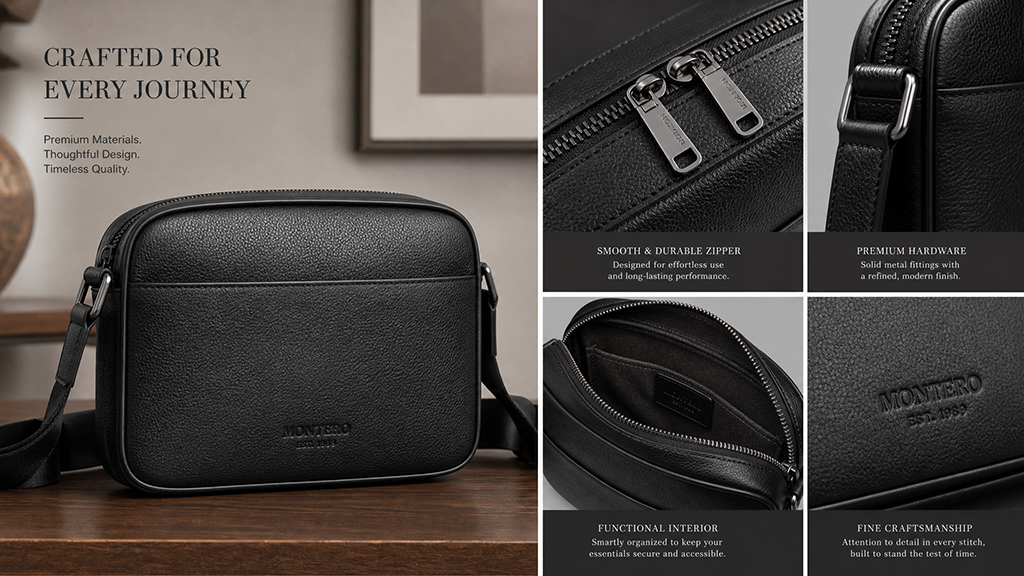
Every time a customer zips open your bag, they’re testing your brand. A smooth, aligned, durable zipper says “this brand cares about details.” A sticky, misaligned, or failing zipper says “this brand cut corners.”
As a bag buyer sourcing from China, you have enormous leverage to demand better zipper quality — but only if you know what to ask for. Dedicated zipper installation machines, walking foot sewing for heavy materials, proper top and bottom stop crimping, calibrated slider tension, accurate tape cutting, heat-sealed nylon coils, cycle testing, alignment verification, and programmable pattern sewing are not luxuries. They are the baseline of professional bag production.
The factories that invest in these standards are the factories that will build your brand’s reputation. The factories that don’t are the factories that will fill your warehouse with returns.
Your next step: Take the screening checklist in this guide, send it to three to five potential suppliers, and evaluate their responses. The supplier who gives you the most detailed, transparent, and technically accurate answers is the supplier who will give you the best zippers — and the best bags.
Post time: Jul-14-2026