
Edge Finishing for Leather & PU Handbag Panels: A Complete Buyer’s Guide for Importing from China
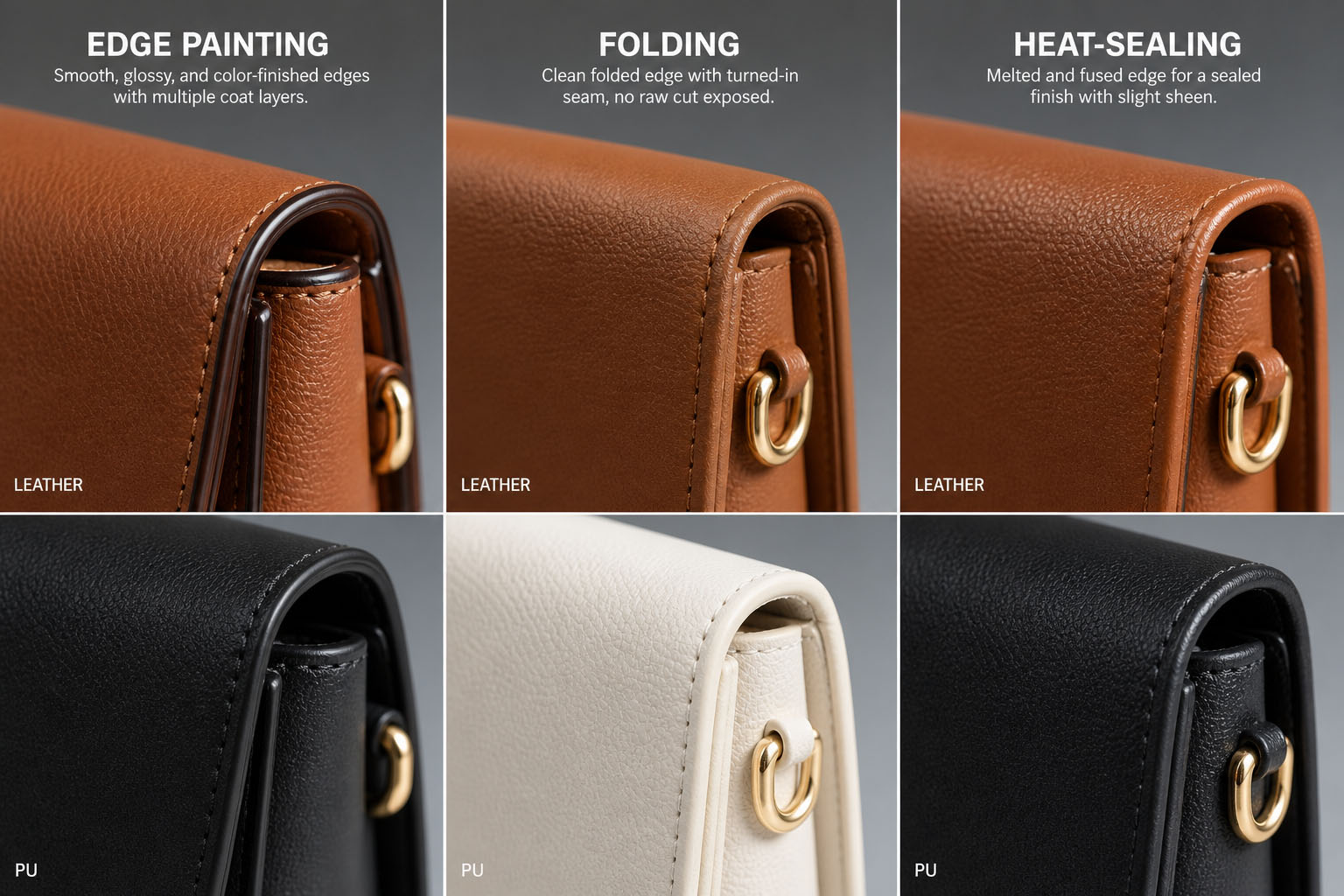
When you’re sourcing handbags from Chinese manufacturers, the conversation rarely stops at “what’s your FOB price?” and “what’s your MOQ?” The real differentiators — the details that separate a $12 commodity tote from a $48 premium handbag — live in the finishing. And among all finishing techniques, edge finishing is the one most first-time buyers overlook, and the one most likely to cause quality complaints six months after shipment.
A poorly finished edge on a leather or PU panel will crack, peel, flake, or fray. Customers notice. Returns pile up. Your brand reputation suffers. Conversely, a properly executed edge finish signals craftsmanship, justifies a higher retail price, and extends product lifespan.
This guide breaks down the three primary edge finishing methods used in Chinese bag factories — edge painting, folding, and heat-sealing — so you can specify exactly what you need, evaluate samples with confidence, and protect your margins.
Why Edge Finishing Matters More Than You Think
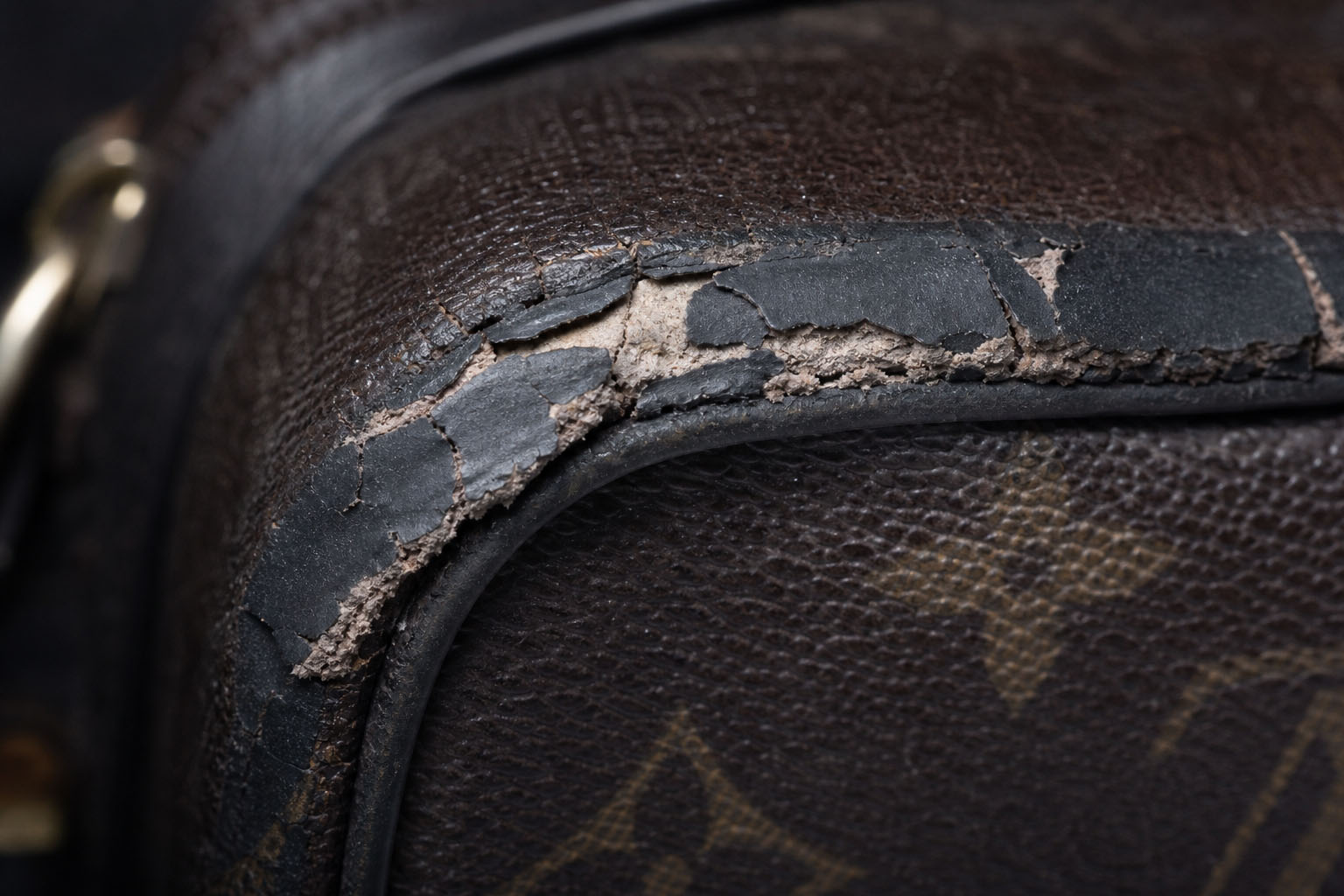
The edges of cut leather or PU panels are the most vulnerable part of any handbag. Unlike woven fabric, these materials have exposed fibers, raw cut surfaces, and unfinished sides that absorb moisture, fray with use, and show wear first. Edge finishing solves three problems simultaneously:
1. Structural integrity — sealing or hiding the raw edge so it doesn’t unravel
2. Aesthetic appeal — creating a clean, polished line consistent with the rest of the panel
3. Longevity — protecting the edge from humidity, friction, and flexing stress
In short: the edge finish is the difference between a bag that looks “finished” and one that looks homemade.
The Three Edge Finishing Methods Explained
1. Edge Painting (Edge Coating)
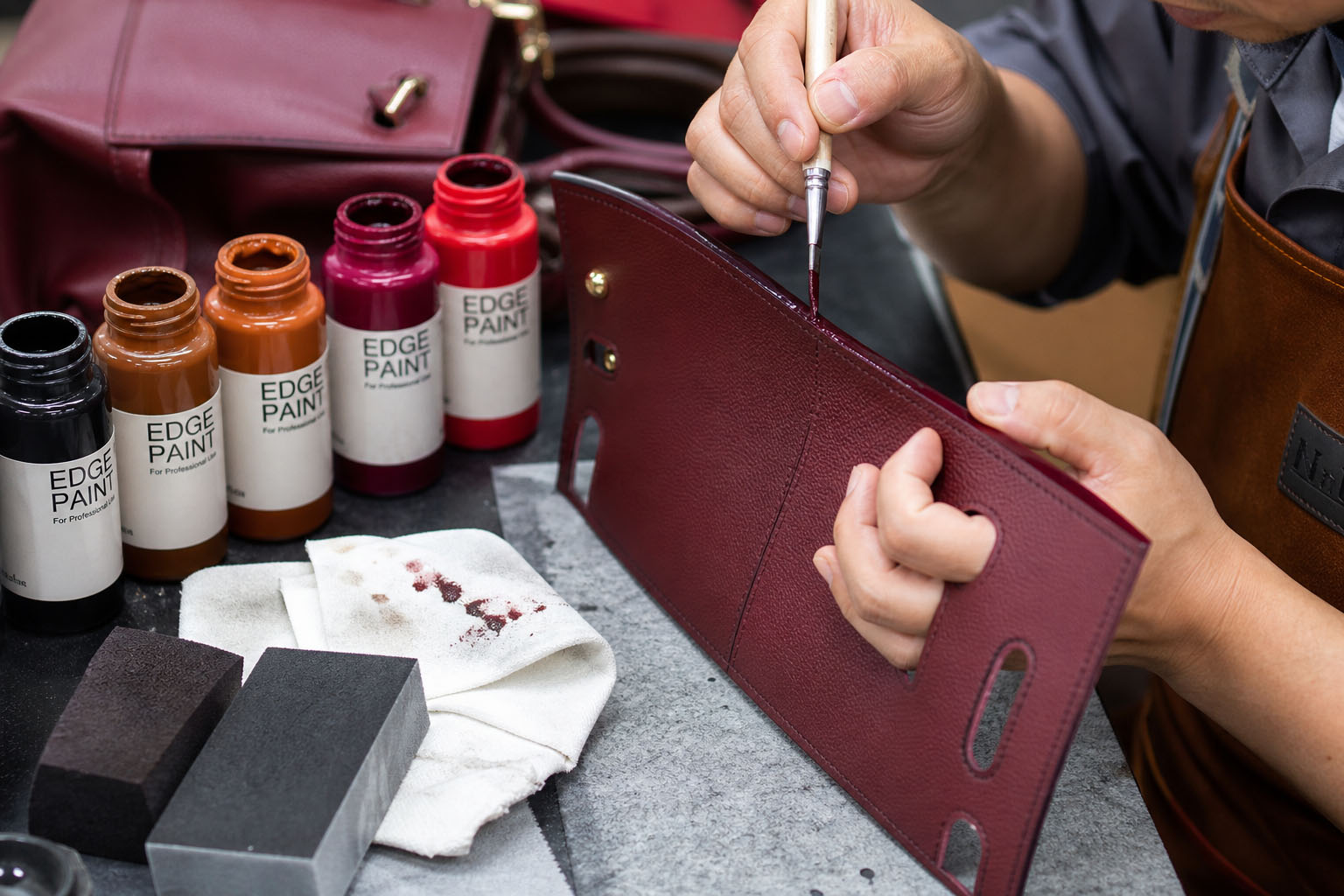
Edge painting is the process of applying multiple thin coats of specialized edge paint to seal and color the raw cut edge of a leather or PU panel. In professional Chinese factories, this is a multi-step operation:
Coat 1 (sealer/primer): closes the porous edge
Sanding: smooths the surface between coats
Coats 2–5 (color coats): build up color depth and durability
Final sanding and buffing: produces a glass-smooth, almost “molded” feel
Each coat must be fully dried before the next application. Rushing this step is the #1 cause of edge paint failure. Water-based edge paints are increasingly preferred over solvent-based options because of lower VOC emissions, better workplace safety, and compliance with international environmental standards (especially important for US-bound shipments under California’s Prop 65 and EU REACH).
Best for: Genuine leather panels, premium PU panels, exposed edges on luxury handbags, belt straps, and top handles.
2. Folding (Folded Edge)
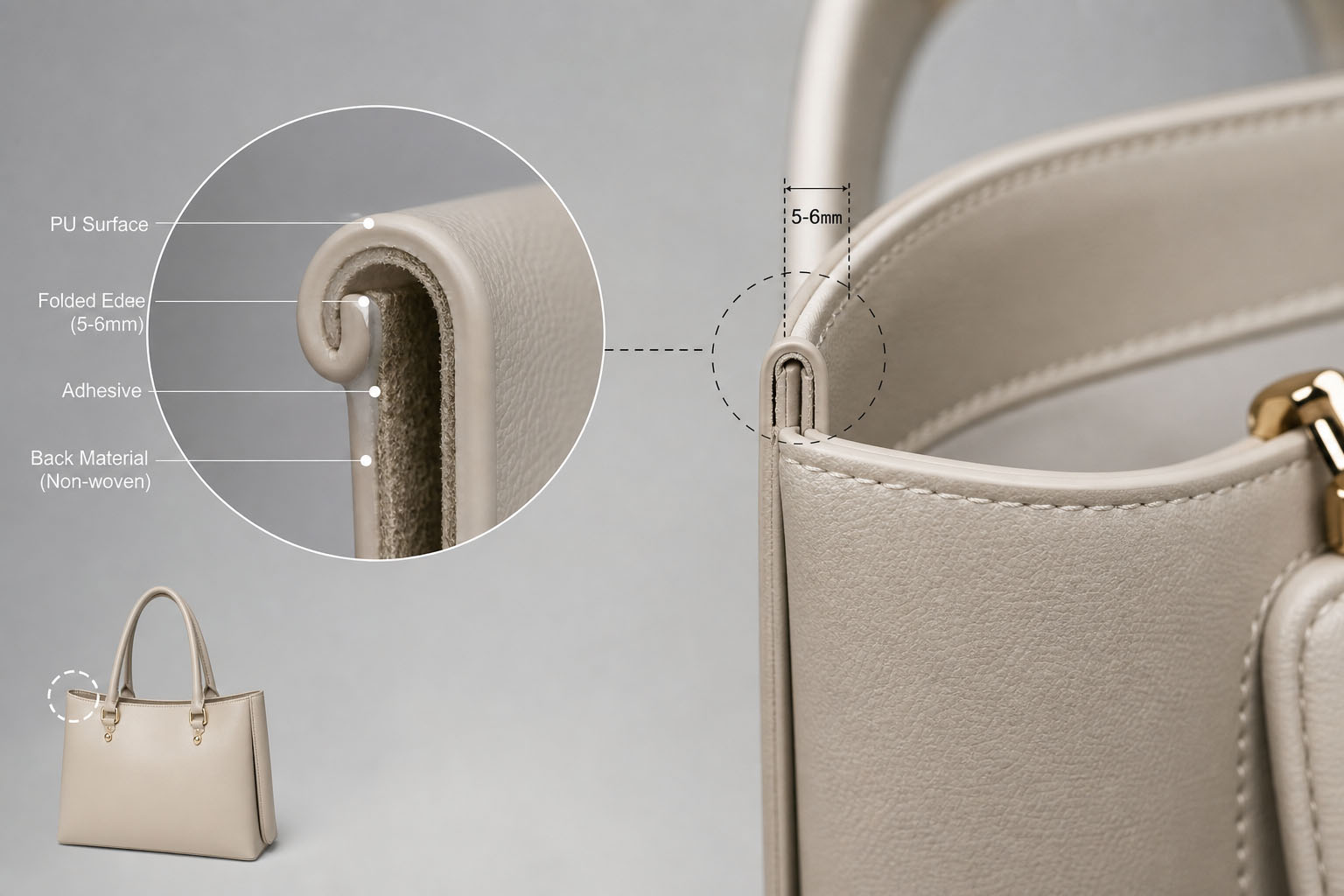
Folding is a mechanical finishing method where the raw edge is turned inward and hidden inside a fold, typically 3–8mm wide. The fold is then glued, stitched, or both. Because the cut edge is never visible, there’s no need for paint or sealant.
This technique is most common on PU and synthetic leather because:
PU has a uniform thickness that folds cleanly
The backing of PU holds a crease well
Folding creates a “cleaner” aesthetic popular in minimalist designs
Folding is faster and cheaper than edge painting, but it changes the panel’s external dimensions slightly and requires careful pattern grading.
Best for: PU panels, minimalist designs, internal seams, low-cost fashion bags.
3. Heat-Sealing
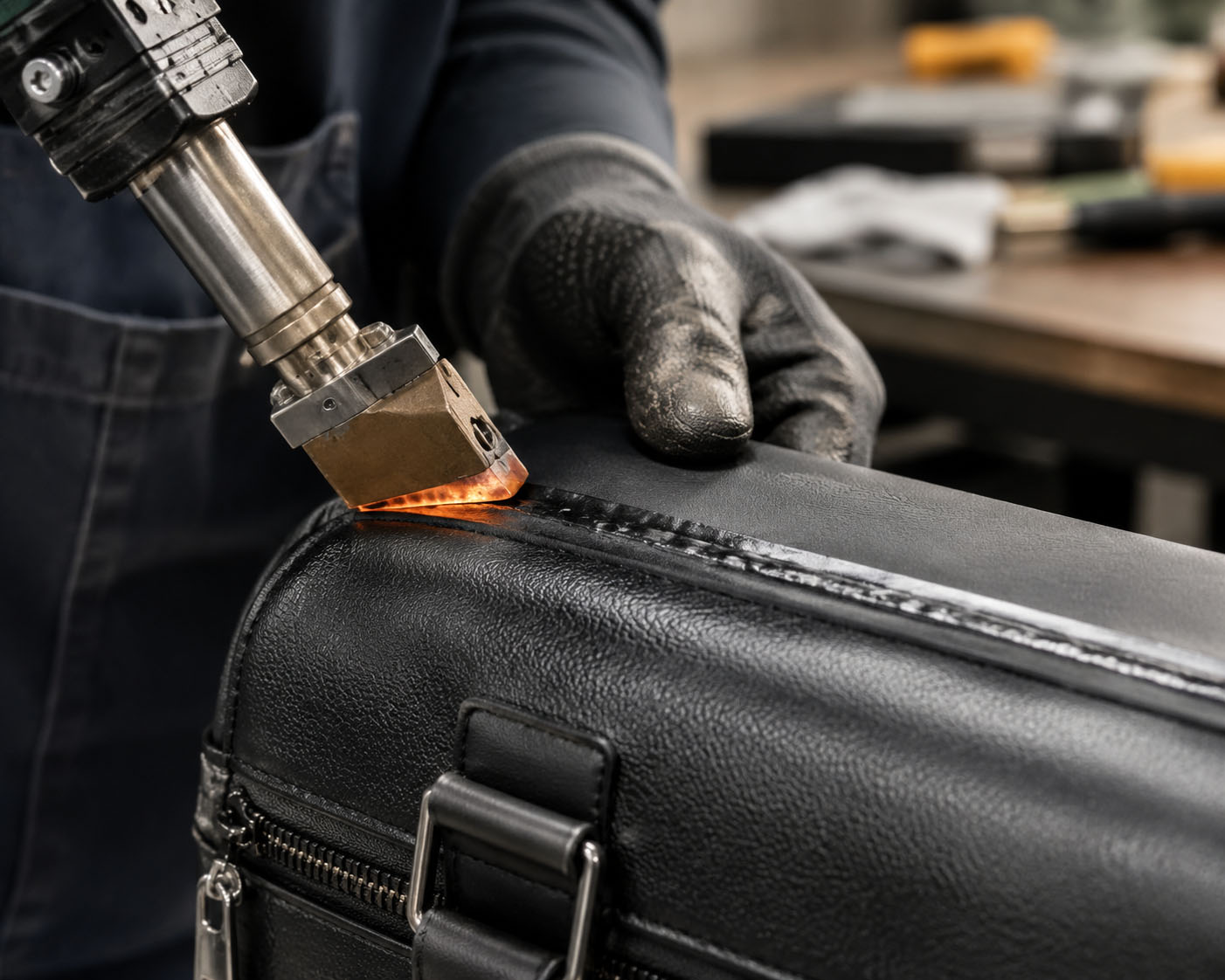
Heat-sealing uses controlled heat (typically 180–220°C) to melt the synthetic fibers at the cut edge, fusing them into a single sealed surface. This is a thermoplastic process that works exclusively on PU, microfiber, microfiber leather, and PVC-coated materials.
For genuine leather, heat-sealing is not suitable — high temperatures scorch, harden, discolor, and damage the natural collagen fibers. Any factory suggesting heat-sealing for full-grain or top-grain leather should be a red flag.
Best for: PU panels, microfiber leather, technical fabrics, sport bags, backpack straps.
Material Compatibility: Leather vs PU
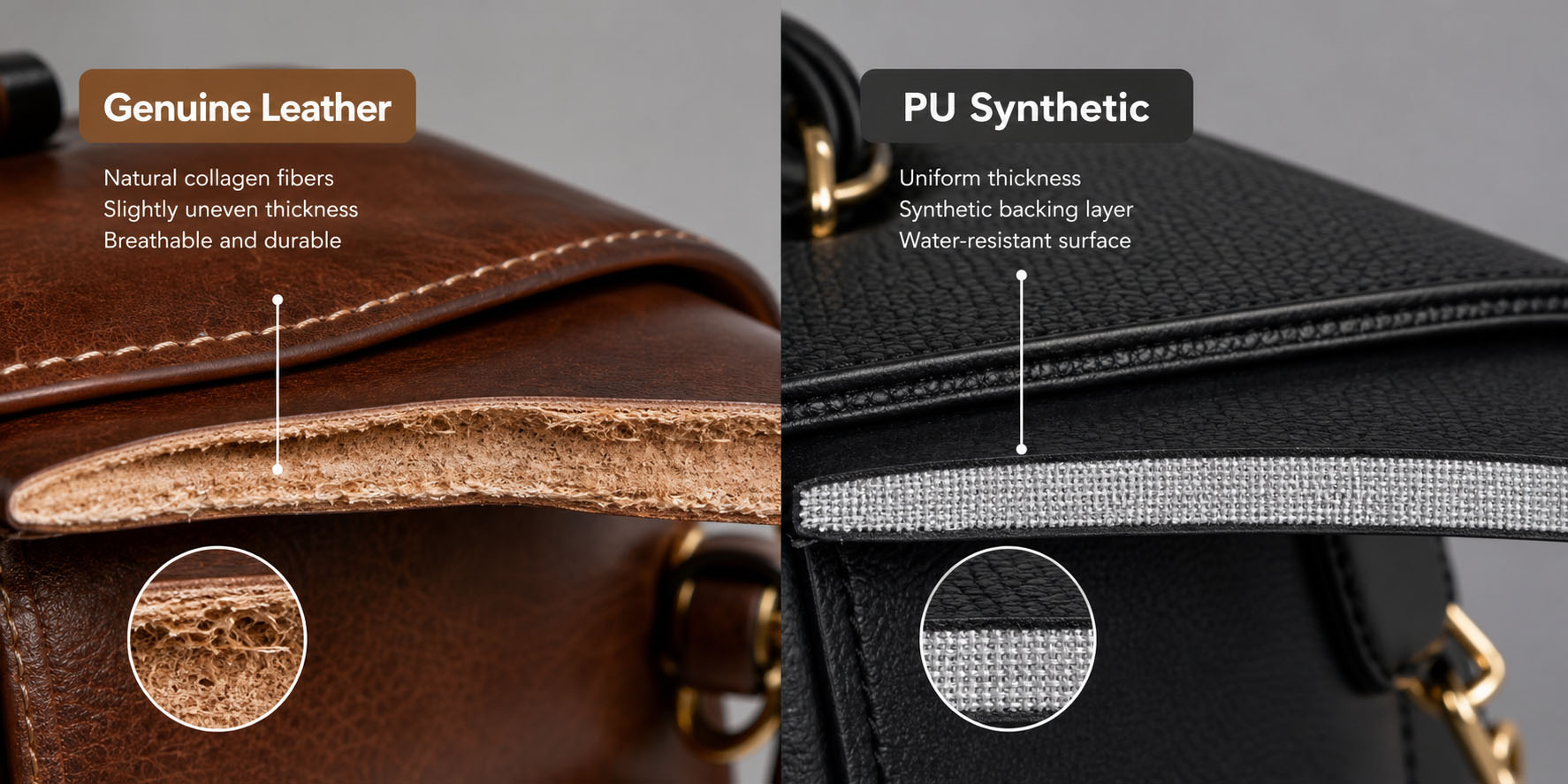
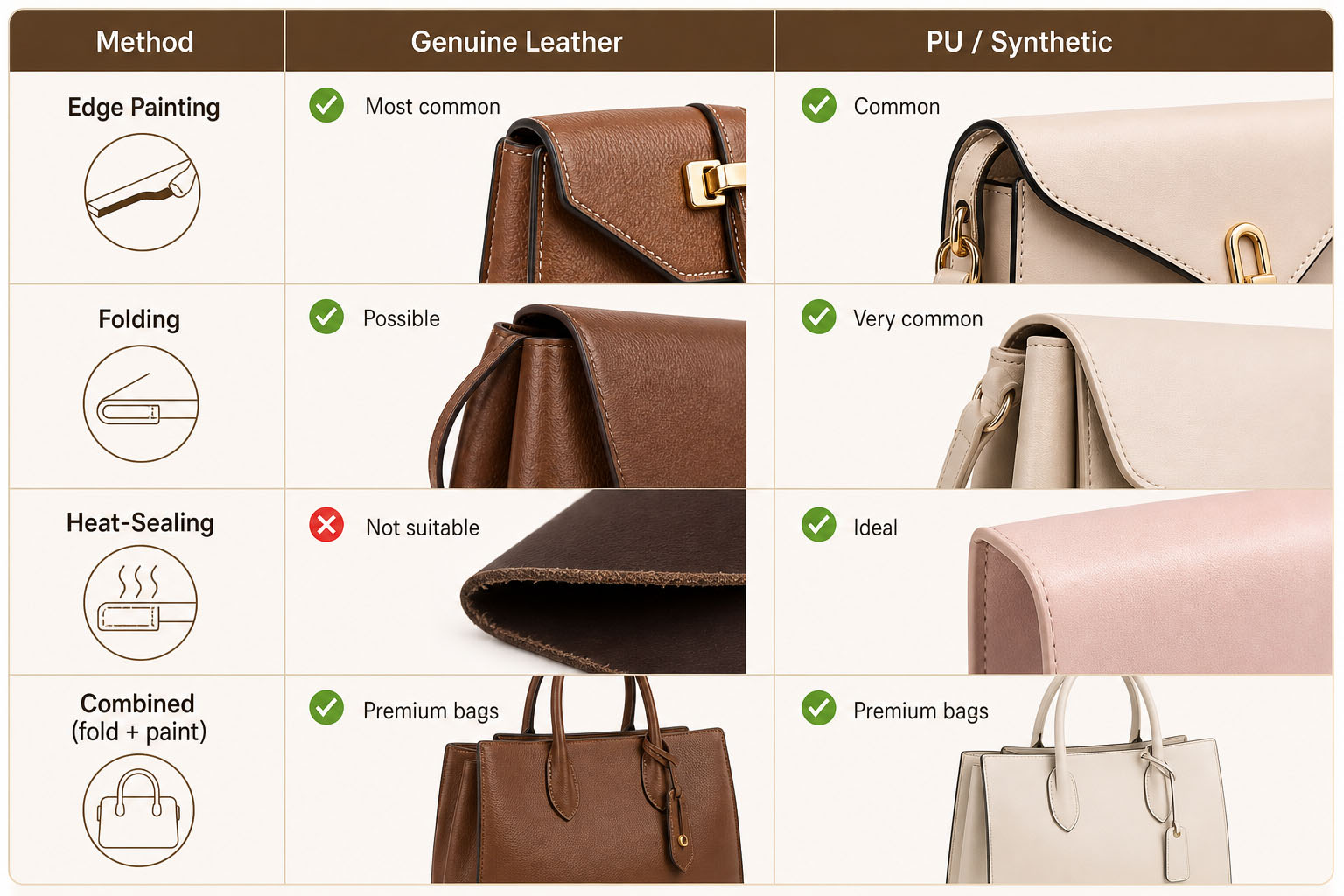
Key insight: The right method depends on material thickness, backing construction, whether the edge is visible in the final design, and your target retail price point. Always specify the method per material type — never assume the factory will choose correctly.
Question 1: Which Edge Finishing Method Offers the Best Durability?
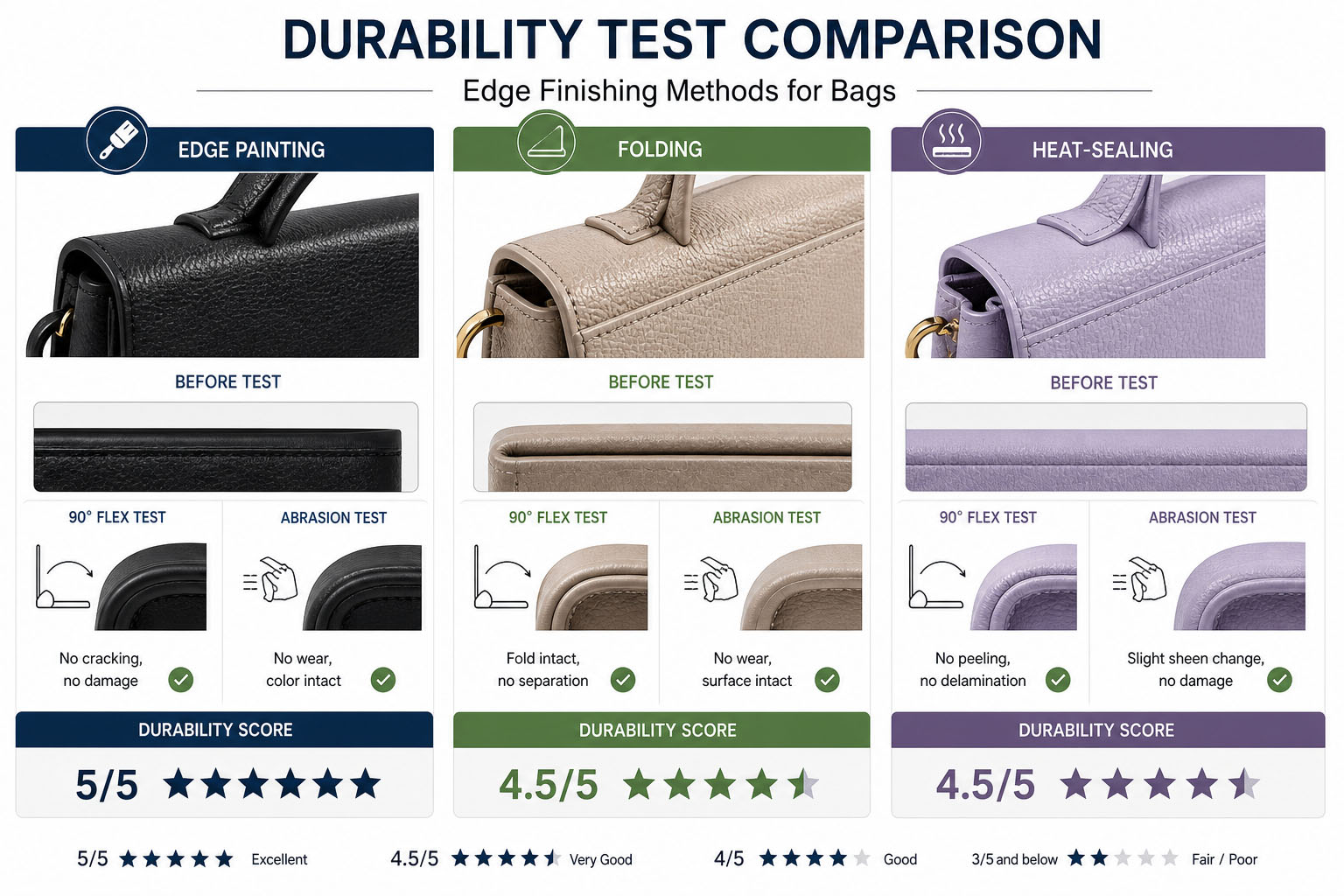
Short answer: For genuine leather, edge painting (properly applied) offers the best durability. For PU panels, heat-sealing offers superior structural durability, but folded edges often win on aesthetic longevity because there’s no paint to crack.
Long answer with context:
Durability isn’t a single metric. You need to evaluate:
Crack resistance at flex points (handle attachments, gusset folds)
Peel resistance under humidity and temperature changes
Color stability under UV exposure
Adhesion between the finish and the substrate
Edge paint performance depends heavily on:
1. Number of coats — 2 coats is economy, 5+ coats is premium
2. Cure time between coats — rushed production = early failure
3. Paint quality — Italian and German edge paints (Fenice, Stahl) outperform generic Chinese paints
4. Operator skill — hand application varies; automated edge painting machines offer higher uniformity
Field data from our sourcing experience: Handbags with properly applied 4–5 coat edge paint routinely last 3–5 years under normal use. Bags with rushed 2-coat application often show cracking within 6–12 months, especially at handle bases.
Question 2: How Should Edge Finishing Requirements Be Specified?
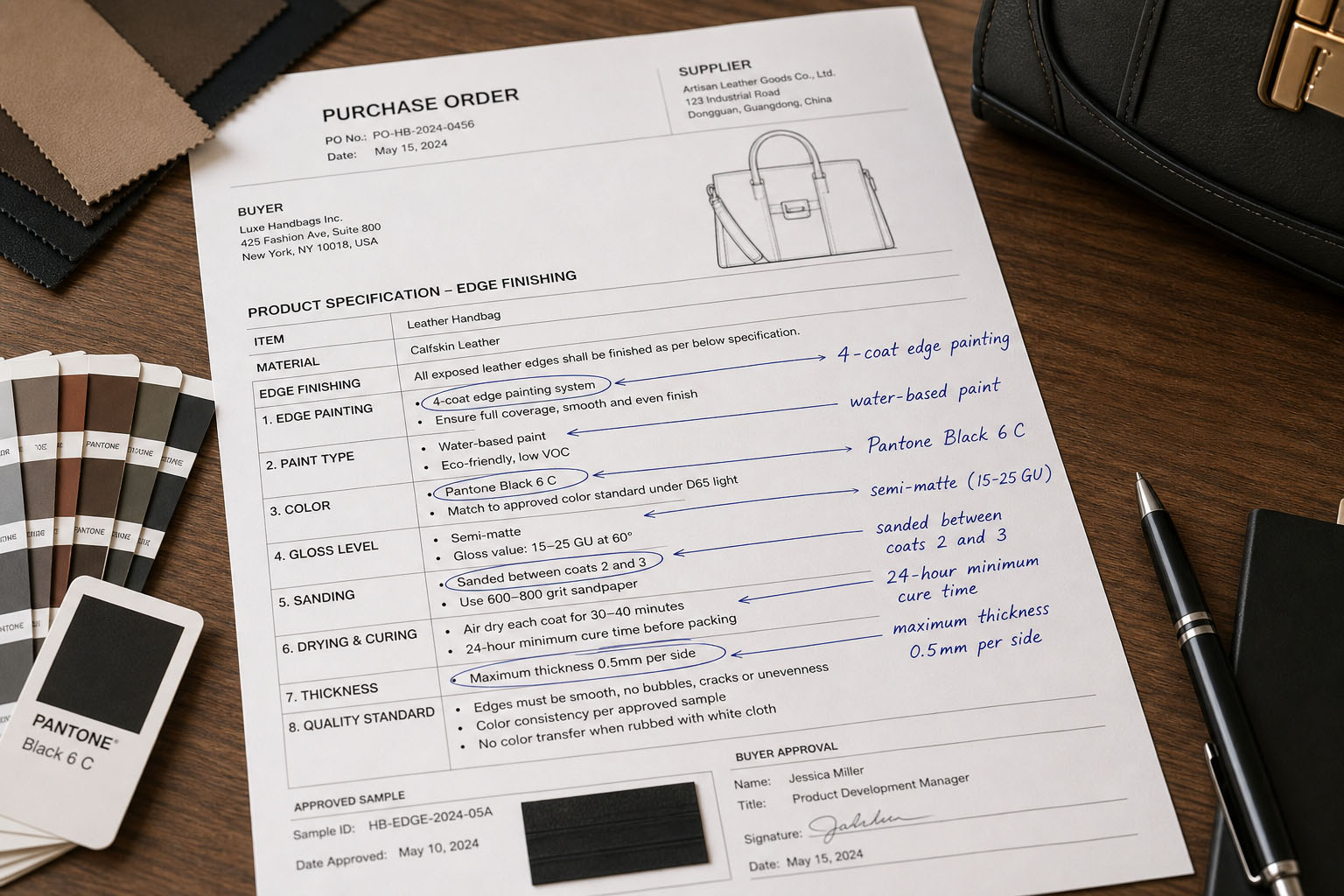
A vague request like “please finish the edges well” guarantees disappointment. Here’s exactly how to specify edge finishing in your purchase order:
For Edge Painting, Specify:
Number of coats (recommend minimum 3 for PU, 4–5 for leather)
Paint type (water-based preferred; specify brand if possible)
Color reference (provide Pantone code or physical swatch)
Gloss level (matte, satin, or high-gloss)
Sanding between coats (yes/no)
Final thickness tolerance (typically 0.3–0.8mm added to panel)
Cure time minimum (request 24 hours between coats for production schedule)
For Folding, Specify:
Fold width (typically 4–8mm)
Adhesive type (water-based contact cement vs hot-melt)
Stitching requirement (topstitch, edge stitch, or unstitched glued fold)
Edge paint over fold (yes/no — for premium look)
For Heat-Sealing, Specify:
Temperature range (180–220°C depending on PU type)
Seal width (typically 2–5mm)
Visual quality standard (no discoloration, no hardening)
Post-seal paint or coating (optional, for color match)
Sample Wording to Send Your Factory:
“All leather panels must receive 4-coat edge painting with water-based paint, sanded between coats 2 and 3, finished in semi-matte black (Pantone Black 6 C). Minimum 24-hour cure time between coats. Edge paint thickness not to exceed 0.5mm per side.”
Question 3: What Is the Cost Difference Between Edge Painting and Heat-Sealing for PU Panels?
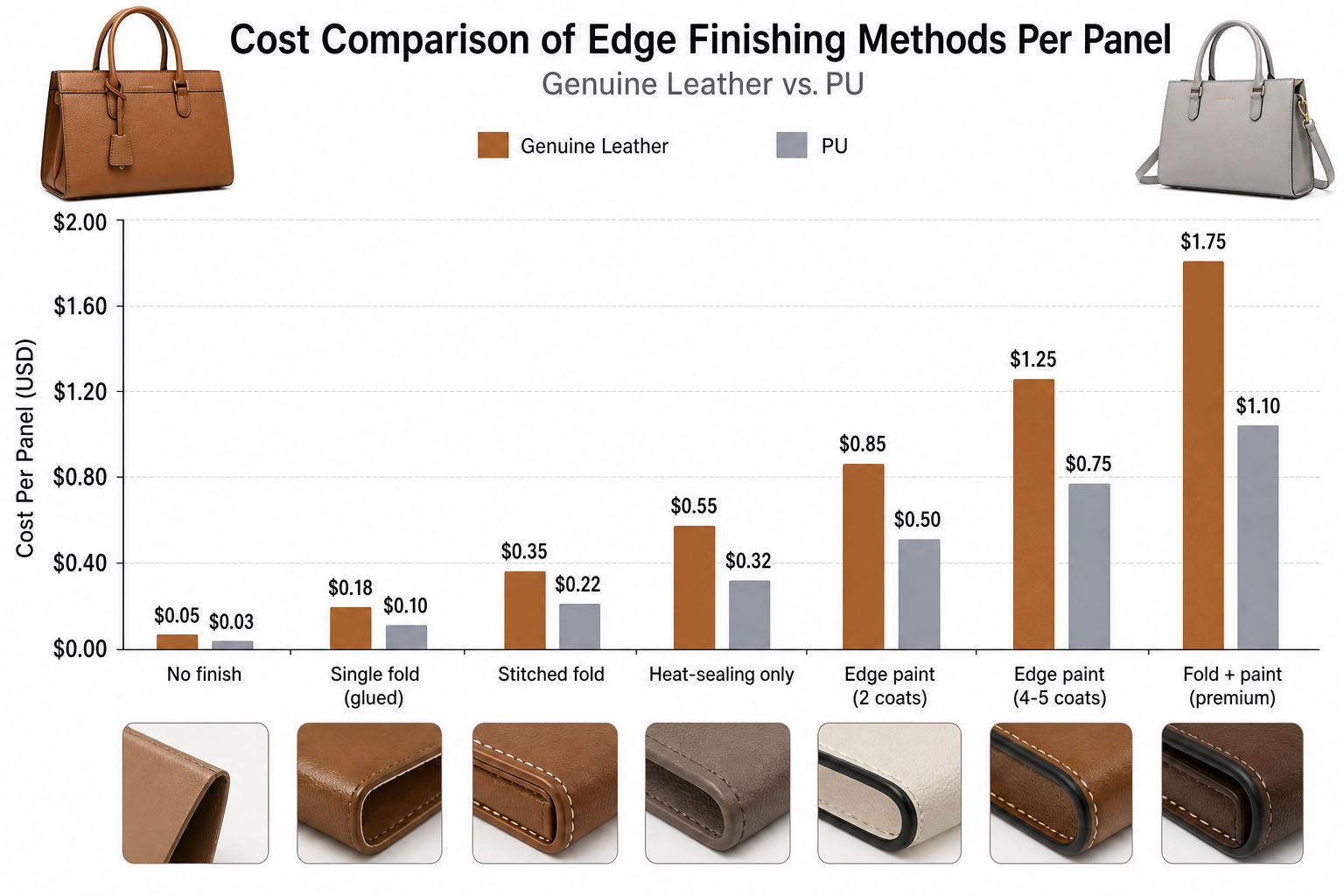
Based on typical 2024–2025 pricing from mid-tier Chinese bag factories (Guangzhou, Yiwu, Quanzhou regions):
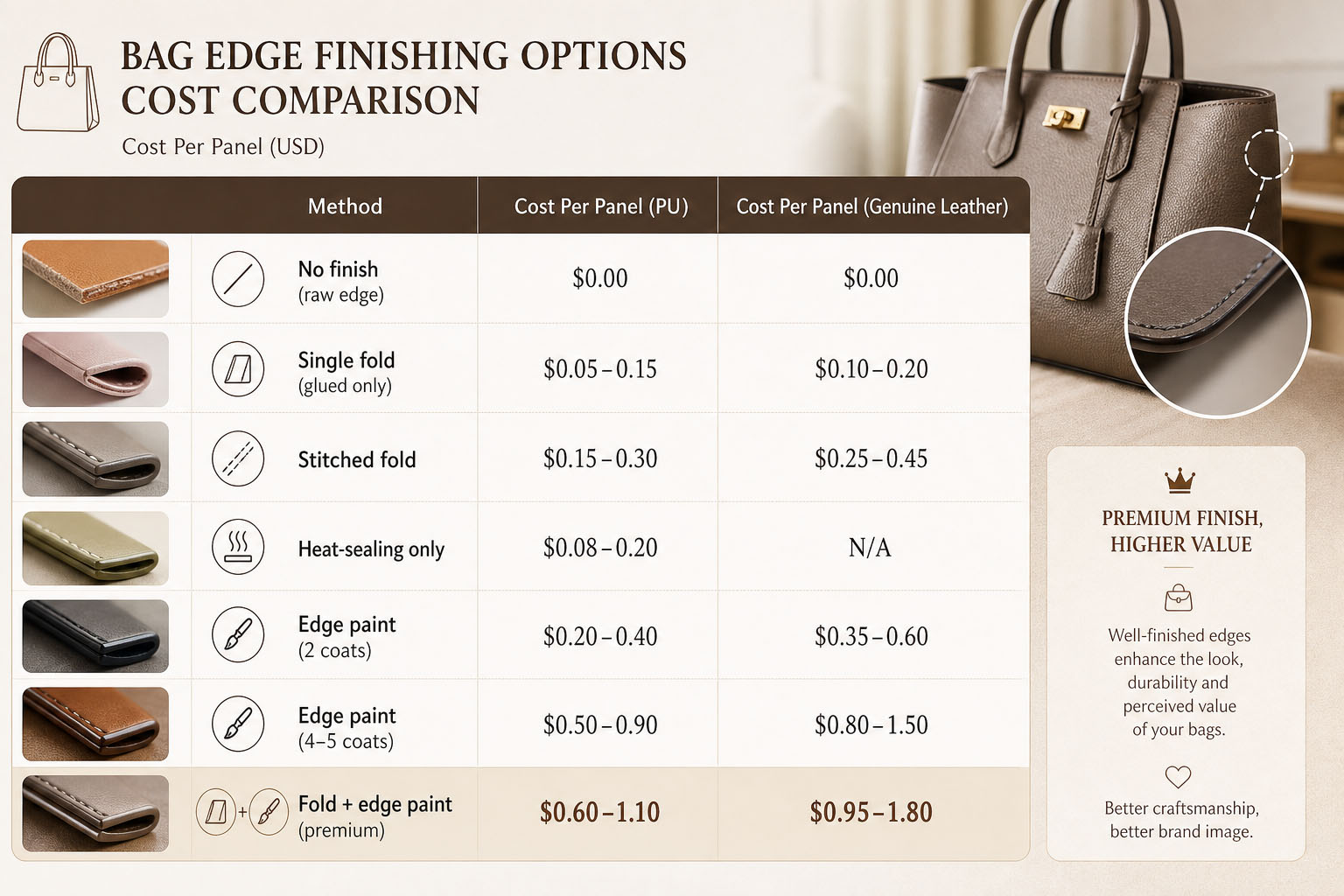
Key takeaways:
Heat-sealing is the cheapest PU finishing method but isn’t always appropriate
Edge painting on leather is the most expensive option, often adding 8–15% to panel cost
Premium combinations (fold + paint) push a panel from $0.80 to $2.00+ but justify retail price points of $80–200+
MOQ matters: Some factories charge setup fees below 500 pieces; negotiate these out at 1,000+ piece orders
For a typical medium-sized handbag with 6–8 finished edges, you’re looking at $1.50–$6.00 in finishing labor and materials per bag, which is significant when your FOB is $8–15.
Question 4: How Can I Inspect Edge-Finished Panels Before Accepting Bulk Shipments?
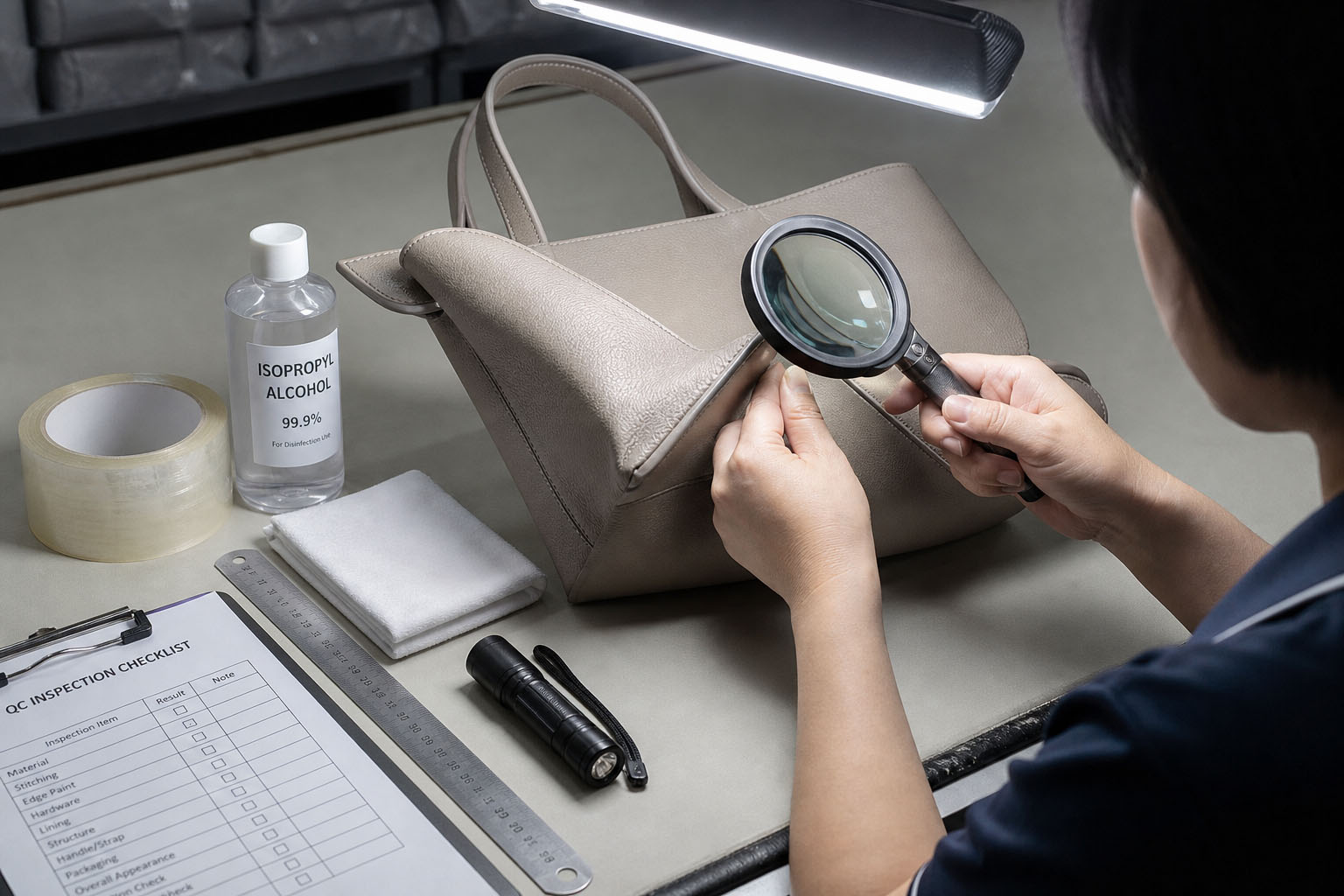
Never accept bulk shipments based on pre-shipment photos alone. Edge finishing defects are tactile, not just visual. Here’s a proper inspection protocol:
Step 1: Pre-Shipment Sample Request
Always order a golden sample (your approved reference) and a pre-production sample (PPS) before bulk production. Sign off on these physically — not just on screen.
Step 2: Random AQL Inspection
Hire a third-party QC service (QIMA, AsiaInspection, SGS) or use your own agent. Standard AQL 2.5 for general inspection, AQL 1.5 for premium lines. Sample 10–20 units per shipment.
Step 3: Physical Tests on the Edge Itself
For each sampled bag:
1. Visual inspection — check for color consistency, gloss level, and smoothness under bright LED light at multiple angles
2. Touch test — run your thumbnail across the edge. It should feel smooth, not gritty, ridged, or tacky
3. Flex test — bend the edge 90° ten times. No cracking, peeling, or whitening should appear
4. Tape test — apply strong clear tape, press firmly, peel quickly. No paint should transfer
5. Solvent test — rub lightly with isopropyl alcohol on a white cloth. No color transfer (indicates under-cured paint)
6. Heat/cold test (optional) — leave in a car at 50°C for 2 hours, then at -5°C for 2 hours. Check for cracking
7. Cross-section cut — on one sample, slice through the edge with a sharp blade to confirm paint has penetrated the leather/PU, not just coated the surface
Step 4: Documentation
Photograph every defect with a ruler in frame. Categorize as critical (cracking, peeling, color mismatch), major (visible inconsistency), or minor (slight orange peel texture). Reject the lot if critical defects exceed 2% or major defects exceed 4%.
10 Expert Insights for Importers
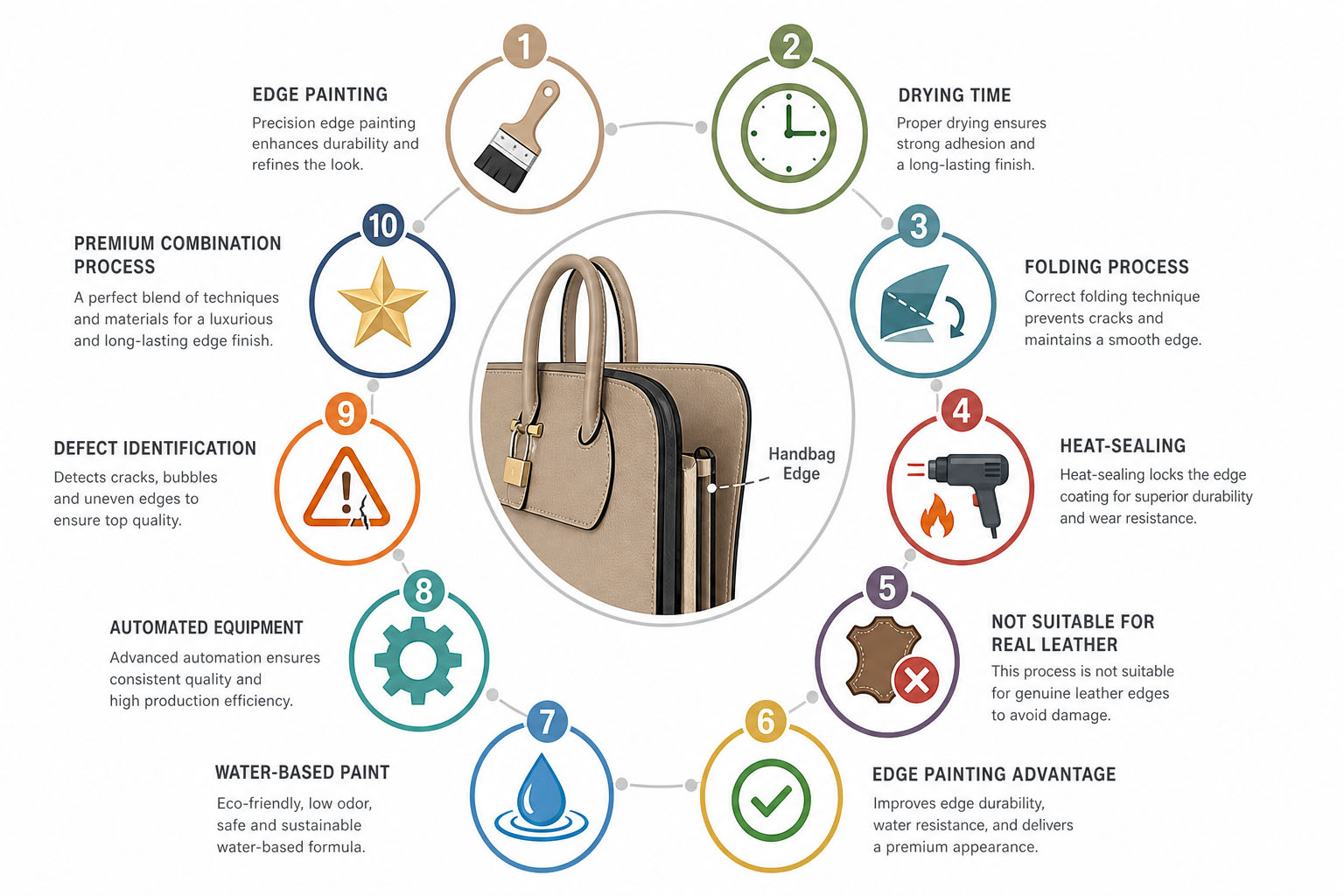
1. Edge painting involves applying multiple thin coats (typically 2–5 layers) of specialized edge paint to seal and color raw leather or PU edges. The thinner each coat, the better the final result.
2. Each coat of edge paint must be fully dried before sanding and the next application to ensure a smooth, durable finish. Factories that skip this step are producing inventory that will fail within months.
Application of multiple thin edge paint coats on leather
3. Folding hides raw edges by turning them inward, commonly used on PU and synthetic leather to create a clean, paint-free edge. It’s mechanically simple but requires precision cutting and consistent adhesive application.
4. Heat-sealing melts synthetic fibers to fuse the edge, preventing fraying exclusively on PU, microfiber, and thermoplastic-coated materials. The process is fast (1–2 seconds per edge) but temperature-sensitive.
Heat-sealing fusion process on synthetic panel
5. Heat-sealing is not suitable for genuine leather — high temperatures can scorch, harden, or discolor the natural material. This is non-negotiable.
6. Edge painting is the most common finishing method for genuine leather bags, offering both color consistency and surface protection. It also allows creative two-tone effects.
7. Water-based edge paints are increasingly preferred over solvent-based options due to lower VOC emissions and environmental compliance — critical for California, New York, and EU customers.
Water-based edge paint application in modern factory
8. Consistent edge paint thickness depends on operator skill; automated edge painting machines offer higher uniformity for large orders (typically 1,000+ pieces per SKU).
9. Poor edge paint application can lead to cracking, peeling, or flaking within months, especially at folding or bending points. Always inspect handle bases and gusset folds carefully.
Visible cracking on poorly finished handbag edge
10. Combining folding with edge painting is possible for premium bags, creating a smooth visible edge while hiding the raw cut inside the fold — a hallmark of $200+ handbag construction.
How to Communicate with Chinese Manufacturers
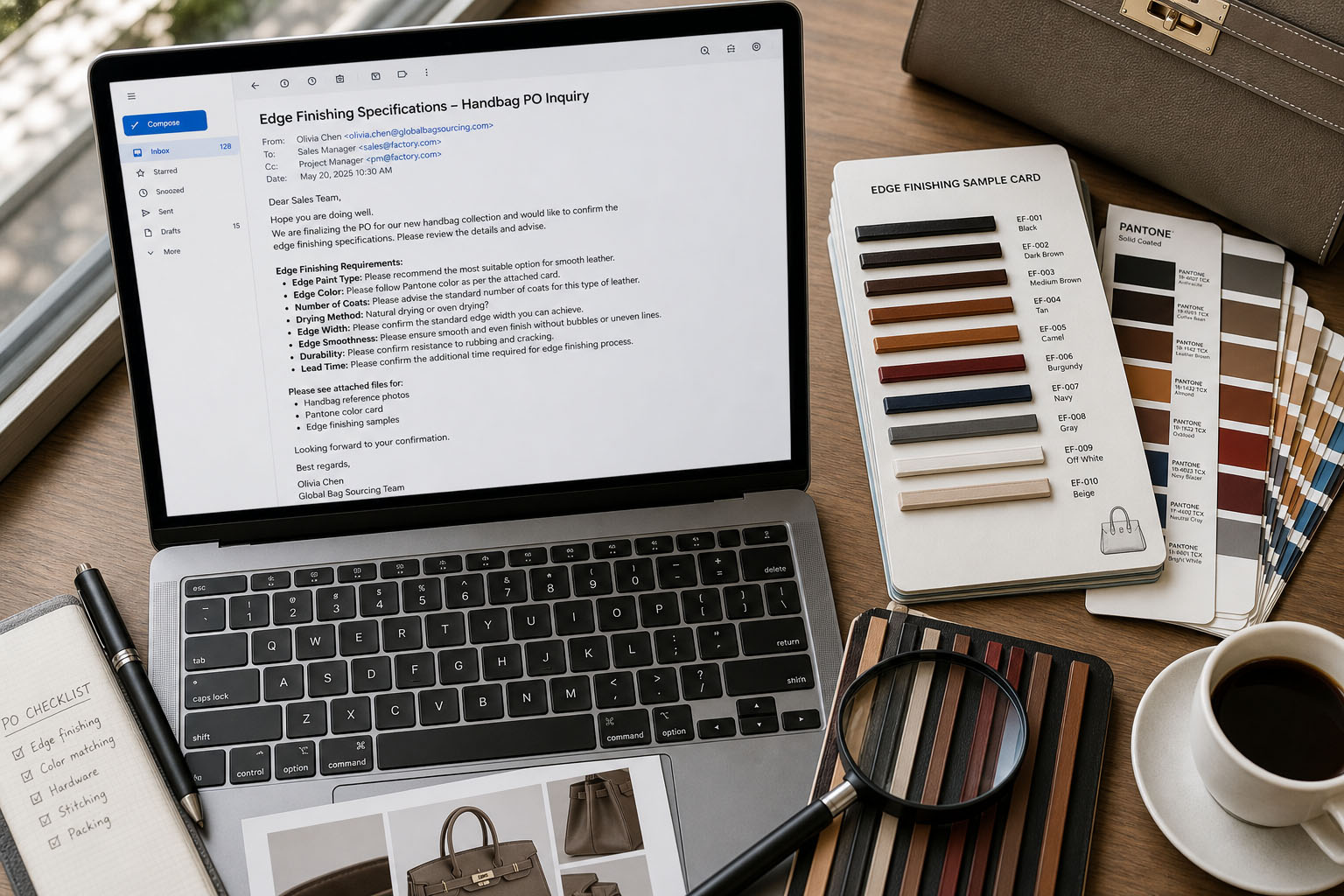
Language precision matters. Here’s professional wording you can copy-paste into your supplier email (in English; the factory will respond in Chinese and your sourcing agent can translate):
Initial Inquiry:
“Hello, we are sourcing handbags for our US e-commerce website. We need edge finishing on leather and PU panels. Please confirm the following:
1. Do you offer edge painting, edge folding, and heat-sealing for both genuine leather and PU panels?
2. Which finishing method do you recommend for each material type we are using?
3. Can you provide edge finish samples with photos showing the smooth, painted, sealed result?
4. What is the unit cost difference between these three methods?
5. Is your edge paint water-based or solvent-based? Do you have MSDS documentation?
6. What is your MOQ for custom edge finishing?
Please also share your edge finishing sample card or physical sample if possible.”
What to Confirm Before Placing the Order:
✅ Edge finish method by material type (PU vs leather)
✅ Whether the finish cracks, peels, or turns sticky over time (request a 6-month test report if available)
✅ Sample photos AND a physical sample shipped via DHL
✅ MOQ for each finishing method
✅ Extra cost and lead time impact
✅ Edge paint brand (ask specifically — Italian Fenice or German Stahl are premium)
Common Mistakes to Avoid
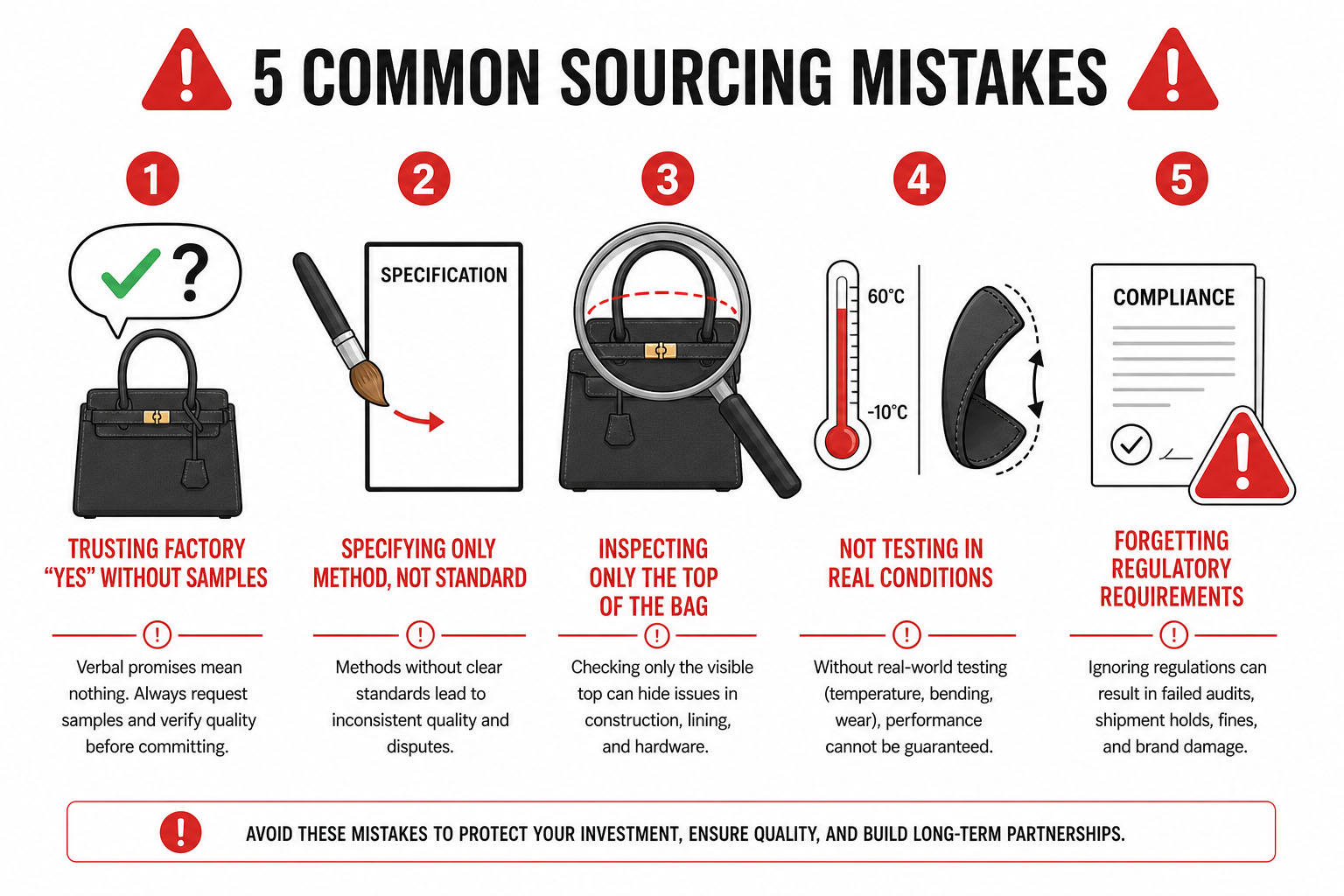
Mistake 1: Trusting factory “yes” without samples.
Any factory will say “yes we can do edge paint.” Without a physical sample showing the actual finish quality, you have zero information.
Mistake 2: Specifying only the method, not the standard.
“Do edge painting” is meaningless. “4-coat edge painting, sanded between coats 2 and 3, water-based, semi-matte finish, maximum 0.5mm thickness per side” is actionable.
Mistake 3: Inspecting only the top of the bag.
Handles, gussets, zipper edges, and bottom corners are where edge paint failure shows first. Inspect systematically.
Mistake 4: Not testing in real conditions.
A sample that passes your office inspection may fail in a customer’s daily use. Flex test, tape test, and heat/cold exposure before approval.
Mistake 5: Forgetting regulatory requirements.
If you sell in California, your edge paint must comply with Prop 65. In the EU, REACH compliance is mandatory. Ask for MSDS sheets.
Final Pre-Order Checklist
✅ Material type confirmed (genuine leather, PU, microfiber, or PVC)
✅ Edge finishing method specified per material
✅ Number of coats / fold width / heat-seal temperature documented
✅ Paint type, brand, and color reference confirmed
✅ Physical golden sample received and approved
✅ Pre-production sample (PPS) received and approved
✅ Third-party QC inspection scheduled
✅ MSDS / compliance documents collected
✅ Edge finishing cost added to landed cost calculation
✅ Defect rate agreement signed (typically <2%)
Conclusion
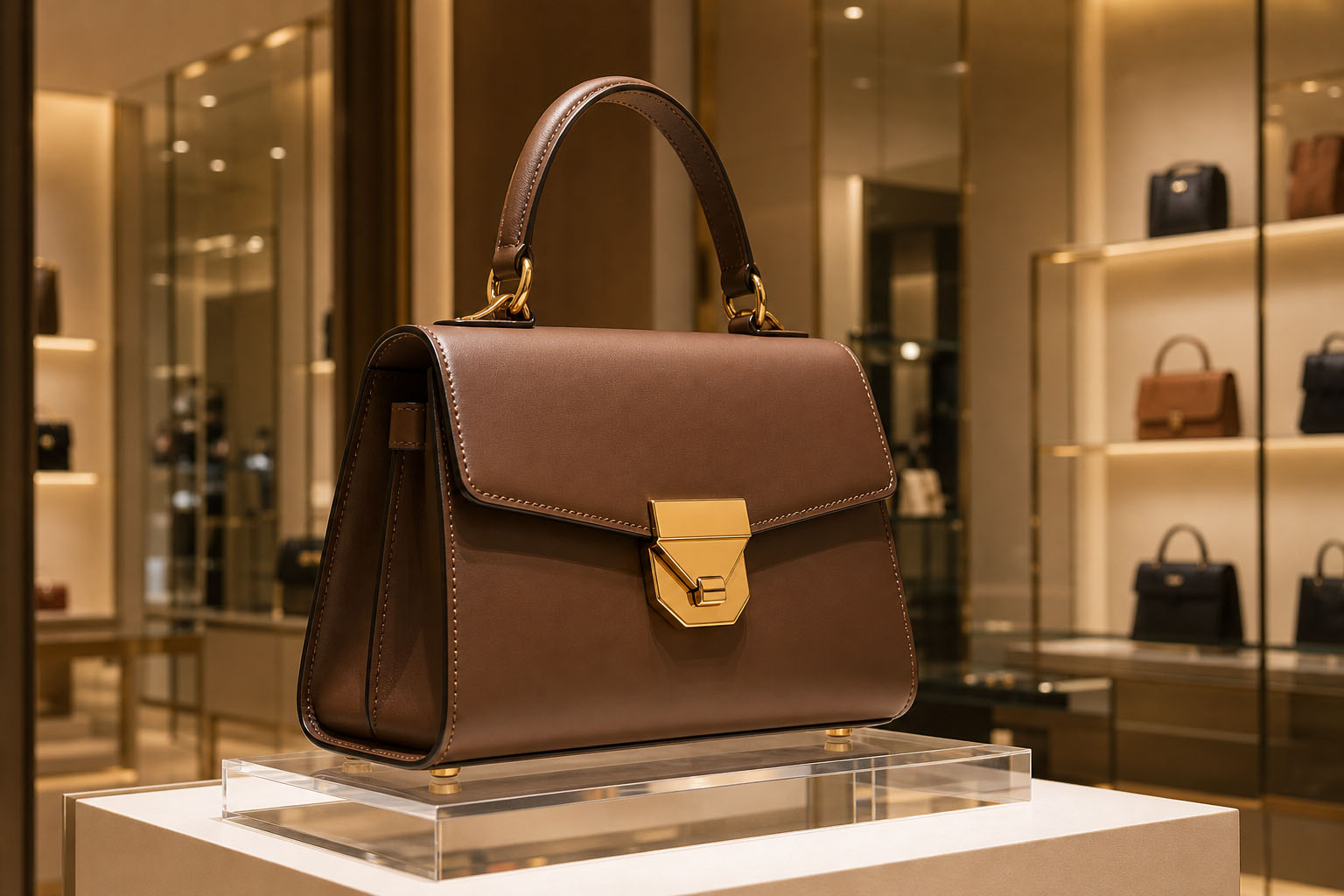
When sourcing from China, your job is to specify precisely, sample thoroughly, and inspect rigorously. Don’t leave edge finishing to the factory’s default. The 30 minutes you spend writing a clear edge finishing specification will save you thousands of dollars in returns and protect your brand reputation for years to come.
Looking for a reliable Chinese manufacturing partner who understands premium edge finishing? [Contact our sourcing team] for vetted factory introductions, sample coordination, and pre-shipment inspection services. We help US bag brands source smarter.
Post time: Jul-13-2026