
How to evaluate, specify, and verify the hidden reinforcement work that determines whether a bag lasts one season—or ten.
When you’re sourcing bags from a Chinese factory—whether you’re stocking tote bags, backpacks, crossbody purses, or weekenders for your U.S. e-commerce store—the most important durability feature is also the one buyers rarely see: stress-point reinforcement. A bag can look gorgeous in a product photo, use premium leather or high-denier nylon, and feature a designer-level zipper, but if the handle bases are held by a few weak stitches, the entire product fails within weeks of real-world use.
This guide breaks down exactly what stress-point reinforcement means, what Chinese factories typically do, how to specify it in your purchase order, and—most importantly—how to verify the quality before you accept a bulk shipment. Use it as your reference document whenever you’re evaluating samples or negotiating specs with suppliers on Alibaba, Made-in-China, or through a sourcing agent.
1. What Exactly Is a “Stress Point” on a Bag?
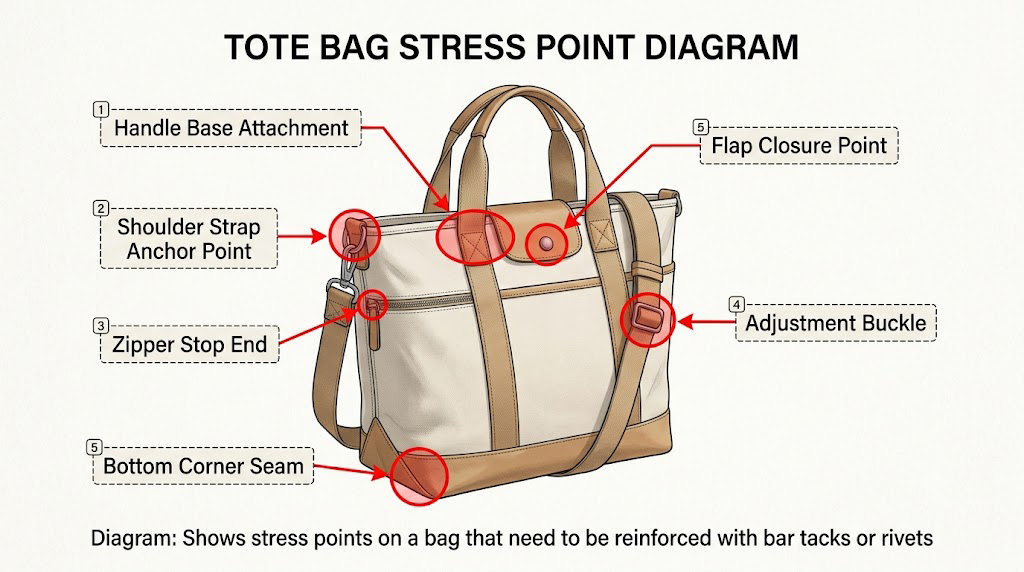
A stress point is any location on a bag that bears concentrated load, repeated pulling, or abrasion during normal use. These are the failure zones—the spots where seams rip, fabric tears, or hardware pulls through the material first.
The most critical stress points on virtually every bag style include:
Handle base attachments (where the handle meets the bag body)
Shoulder strap anchor points (D-rings, swivel hooks, or sewn loops)
Zipper top and bottom stops (where the slider meets the end of the tape)
Strap adjustment buckles (sliders and ladder locks)
Bottom corners (where the bag rests on surfaces and bears weight)
Flap closures with magnetic snaps or buckles
A bag without reinforcement at these points may survive a photoshoot, but it will fail under a laptop, a water bottle, or a child’s school books.
2. Bar Tacks Explained: The Zigzag Stitch That Saves the Bag
A bar tack is a tight, dense cluster of zigzag stitches—typically 1 to 1.5 inches wide—sewn over a high-stress seam to lock the threads in place and prevent the seam from unraveling or pulling apart. Bar tacks are the workhorse of stress-point reinforcement in soft-sided bags, and you’ll find them on everything from $5 promotional totes to $500 premium backpacks.
Key technical details:
Thread type: Bonded nylon or polyester (Tex 40 to Tex 70) for abrasion resistance and tensile strength
Stitch density: Usually 8–12 stitches per inch within the bar tack
Stitch length: Very short, often 1.5–2 mm, to maximize thread count in a small area
Standard width: 1 inch is common; 1.5 inches is used for heavier loads (e.g., tool bags, travel duffels)
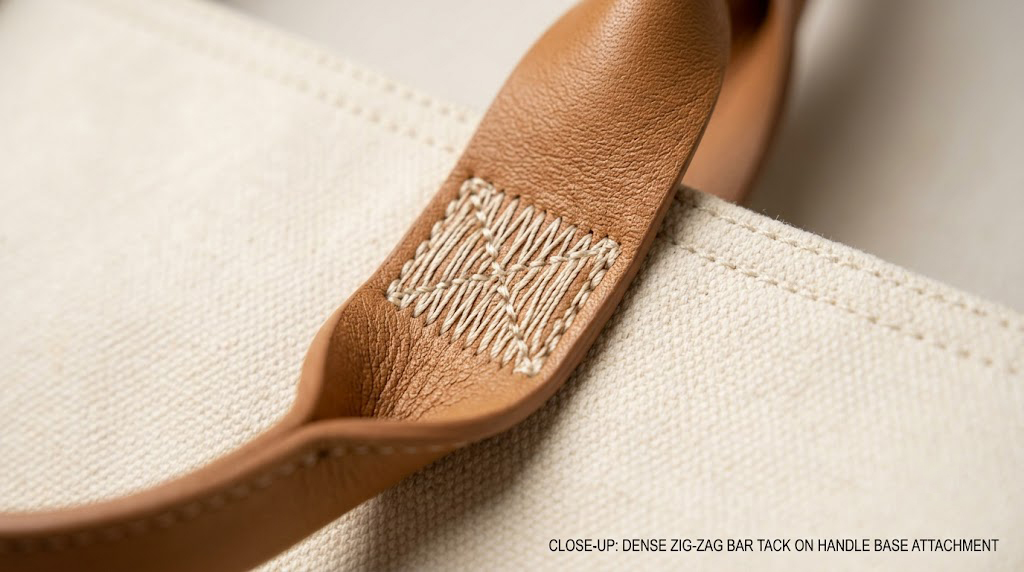
Bar tacks are inexpensive to add but dramatically extend the functional life of a bag. If a factory tries to cut costs by skipping them, you’ll see it in the return rate within 60–90 days of customer use.
3. Rivets, Snap Fasteners & Metal Hardware: Compressing the Stress
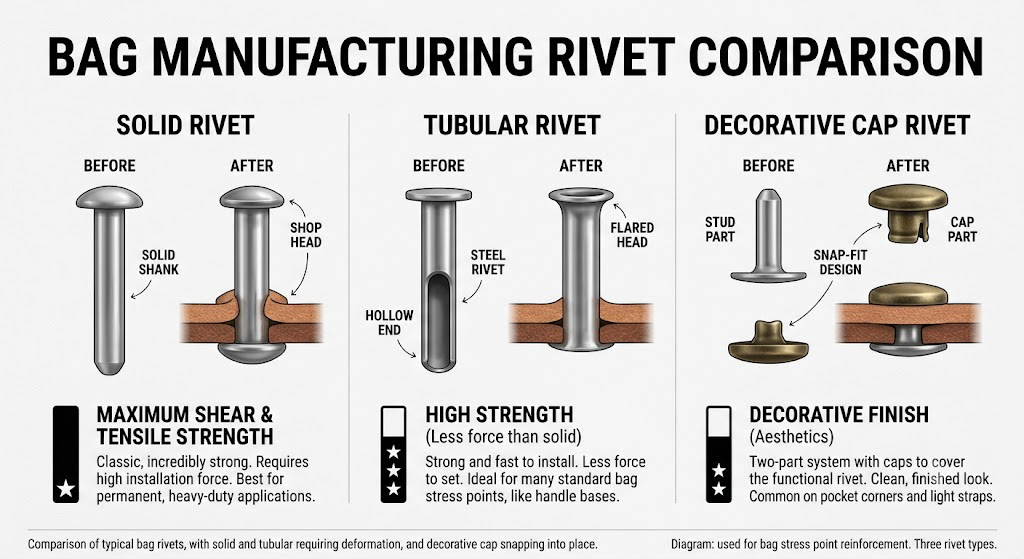
Rivets are metal fasteners that physically compress layers of fabric, leather, or webbing together, distributing load across a wider area and creating a permanent mechanical bond. Unlike stitching, rivets don’t rely on thread tension—they work through compression.
Common uses:
Leather bag handle attachments (where stitching alone is risky)
D-ring and O-ring anchor points (preventing the ring from tearing through the webbing)
Belt-loop style strap adjusters
Decorative and functional reinforcement on denim, waxed canvas, and full-grain leather bags
There are several types of rivets used in bag manufacturing:
Solid rivets – strongest, require setting with a press
Tubular rivets – common on leather goods, set with a hand press or hammer
Decorative/cap rivets – used on denim and Western-style bags
Magnetic snap rivets – combine closure and reinforcement in one
4. The Standard Stress Points That Always Need Reinforcement
Regardless of bag style, certain reinforcement zones are non-negotiable for a quality product. Here’s a checklist you can copy directly into your RFQ (Request for Quotation) or purchase order:
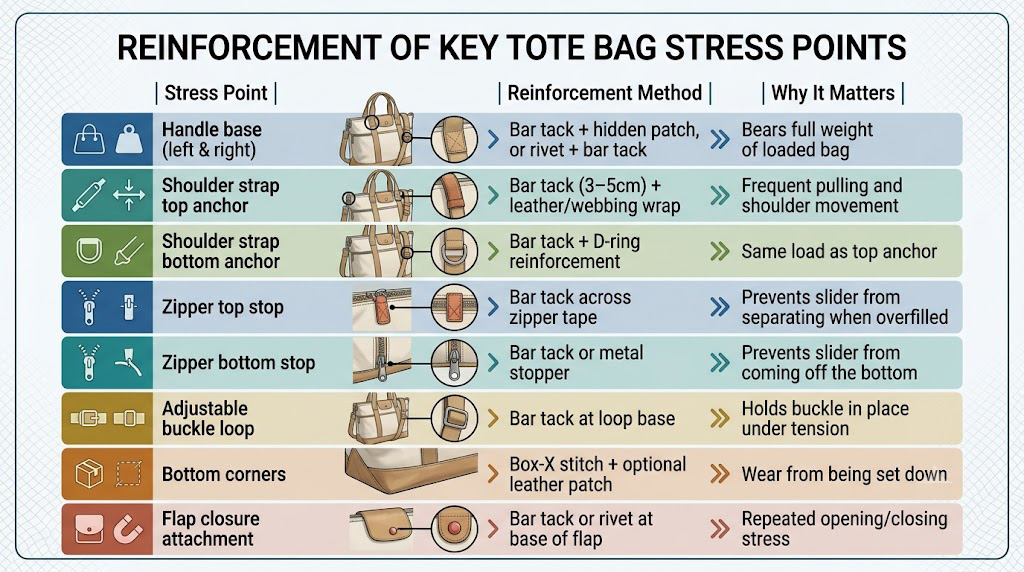
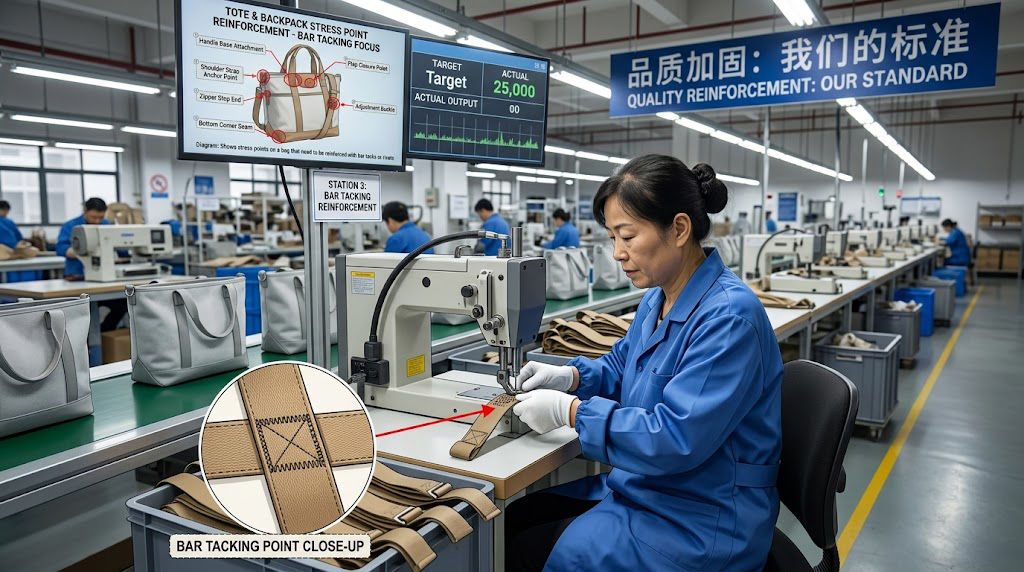
A bag that skips reinforcement on even one of these zones is a bag that will generate customer complaints, returns, and negative reviews on your e-commerce site.
5. How Many Bar Tacks or Rivets Do Chinese Factories Typically Use?
The honest answer: it varies widely by factory, by bag style, and by price point. Here’s what you’ll commonly see in production:
Bar tack count per stress point:
Budget promotional bags ($3–$8 wholesale): 1 bar tack per handle base, often just 0.5 inch wide
Mid-range retail bags ($10–$25 wholesale): 2 bar tacks per handle base, 1 inch wide, with hidden backing patch
Premium bags ($25–$60+ wholesale): 2 bar tacks + leather reinforcement patch + optional rivet, sometimes with Box-X cross-stitching
Industrial/heavy-duty bags: 3+ bar tacks with webbing wrap and metal rivet
Rivet count per attachment:
D-ring anchor points: 1–2 rivets, often paired with a bar tack on the webbing
Leather handle attachments: 2–4 rivets depending on handle width
Decorative stress points: 1 rivet for visual appeal, additional bar tack for strength
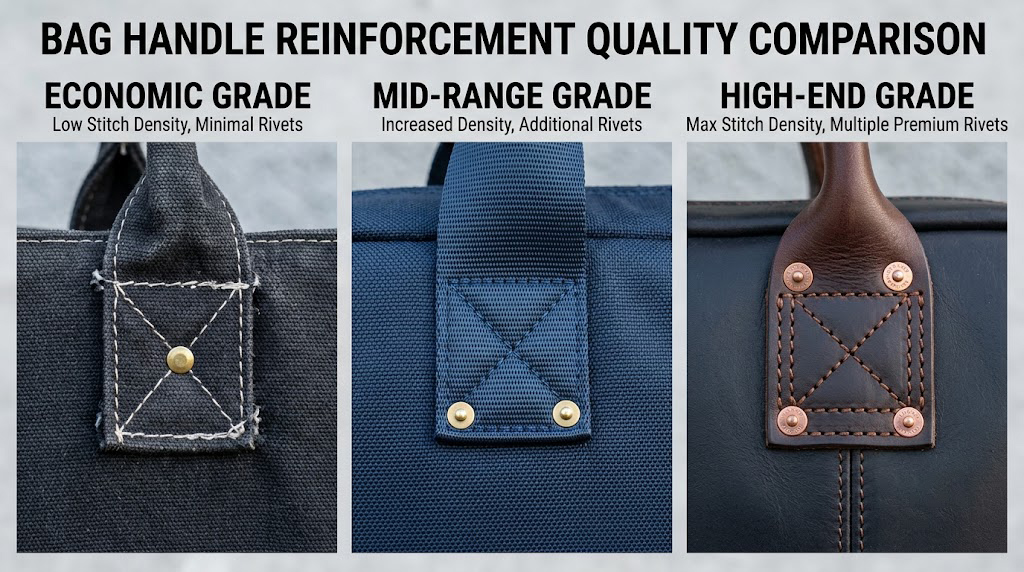
Pro tip: When you receive samples, count the bar tacks and check whether there’s a hidden backing patch. If a factory can only show you a sample with 1 thin bar tack and no patch, that’s the quality you’ll receive in production—factories rarely “upgrade” reinforcement after sampling.
6. Does Stress-Point Reinforcement Add Cost or Production Time?
Yes—but the cost is small relative to the value it adds. Here’s a realistic breakdown:
Cost impact per bag:
Adding 2 extra bar tacks per handle (from 1 to 3 total per bag): approximately $0.05–$0.15 per bag in thread and labor
Adding a hidden leather or synthetic reinforcement patch: approximately $0.10–$0.30 per bag
Adding 2 metal rivets per handle: approximately $0.08–$0.20 per bag
Upgrading from Tex 40 to Tex 70 bonded nylon thread: approximately $0.03–$0.08 per bag
Time impact:
Each bar tack takes roughly 5–10 seconds to sew on an industrial machine. Adding 4–6 extra bar tacks per bag adds about 30–60 seconds per unit, or roughly 15–30 minutes per 100-unit batch. In a 1,000-unit production run, that’s 5–10 extra hours—immaterial to the factory’s overall timeline.
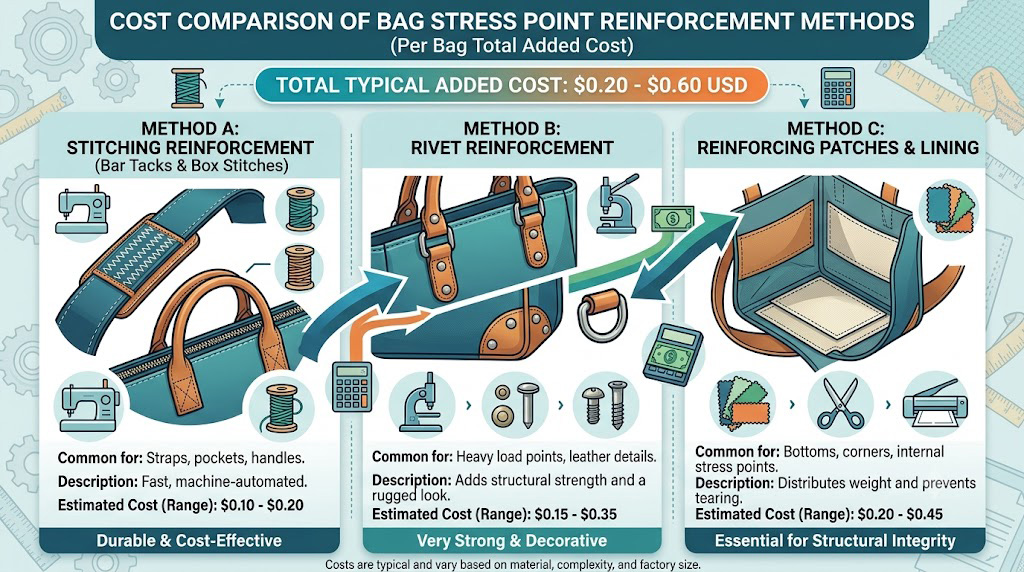
The real cost isn’t financial—it’s communication. If you don’t specify reinforcement clearly in your purchase order, the factory will default to the cheapest acceptable method for your quoted price.
7. Material-Specific Reinforcement: Leather vs. Canvas vs. Nylon
Different bag materials require different reinforcement strategies. A good factory will adjust their methods based on what they’re sewing:
Full-grain or top-grain leather bags:
Rivets are heavily used, often as the primary reinforcement
Stitching is done with bonded nylon or polyester thread, Tex 70+
Bar tacks are less common on premium leather goods; saddle stitching is preferred
Edge paint or burnishing protects the cut edges from stress
Canvas and waxed canvas bags:
Bar tacks are the workhorse, often paired with leather reinforcement patches
Webbing wrap around the handle base adds strength
Box-X stitching at handle bases is a hallmark of quality canvas bags
Thread is typically Tex 40–Tex 60 bonded polyester
Nylon and polyester bags (backpacks, duffels):
Bar tacks are essential because synthetic fabric can tear at stitch points
Reinforcement panels (often Hypalon or heavy TPU) are sewn or welded behind stress points
Webbing loops are folded and bar-tacked, not just sewn flat
Stitching is typically Tex 40–Tex 70 bonded nylon
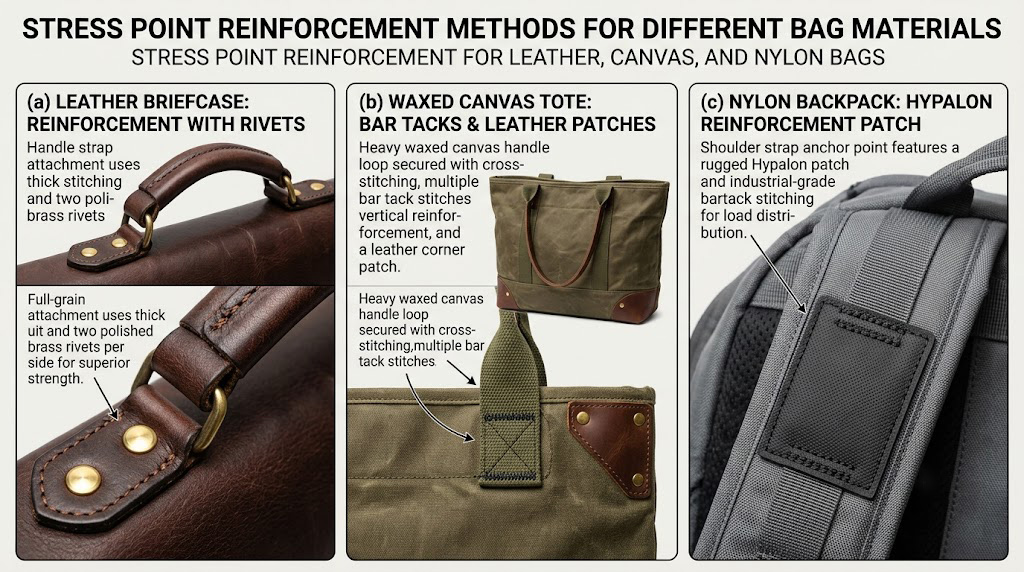
If your supplier sources canvas bags but uses the same reinforcement approach as a nylon bag manufacturer, they’re probably not specialists—keep shopping.
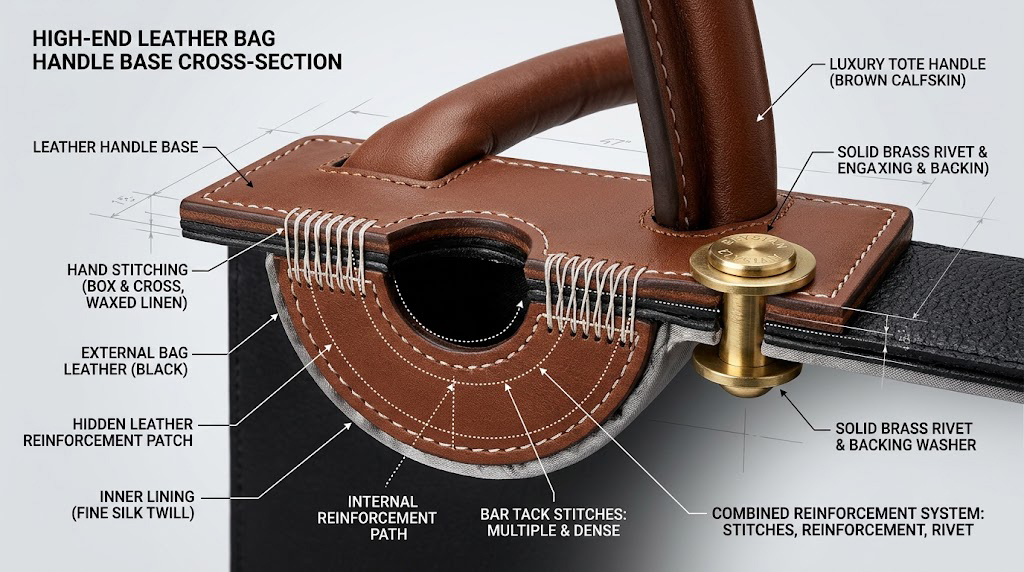
8. Premium Techniques: Box-X Stitching, Hidden Patches & Combined Methods
For higher-end bags, factories often layer multiple reinforcement methods to create a stress point that can handle 50+ pounds of static load and years of daily use:
The Box-X (or cross-stitch) pattern:
Two diagonal lines of stitching forming an “X” within a rectangle. This pattern distributes force in multiple directions, making it stronger than a single straight bar tack. Common on Filson-style tote bags and heritage briefcases.
Hidden reinforcement patches:
A piece of leather, synthetic suede, heavy canvas, or Hypalon is sewn invisibly behind the outer fabric at stress points. The patch spreads the load over a larger area and prevents the outer material from tearing under tension. Most customers never see these patches, but they’re often the difference between a 2-year bag and a 10-year bag.
Combined reinforcement:
Premium bags often use rivet + bar tack + patch together. The rivet compresses the layers, the bar tack locks the threads, and the patch distributes the load. This is the gold standard for handle attachments on $40+ wholesale bags.
9. How to Verify Strength Before Accepting a Bulk Shipment
This is the most important section of this guide. You have four practical verification methods—use at least two of them before paying the final balance:
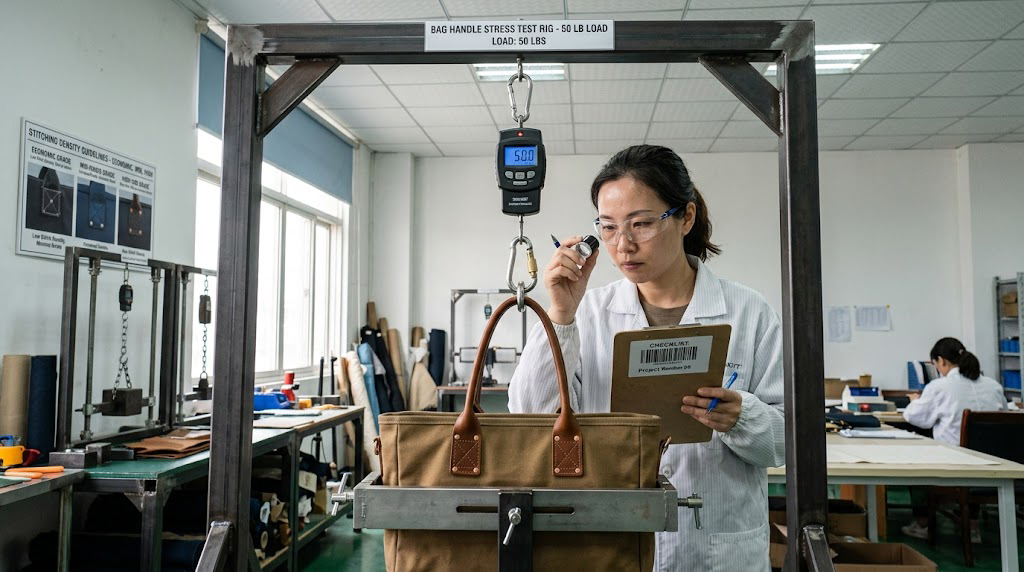
Method 1: Sample stress testing (do this before production)
Take 3–5 pre-production samples and perform these tests:
Handle pull test: Hang 50 lbs of weight from the handle for 60 seconds. Check for stitch elongation, fabric stretching, or bar tack failure.
Strap pull test: Apply 30 lbs of force perpendicular to a shoulder strap anchor.
Zipper separation test: Fill the bag to overcapacity, then zip closed. Pull the slider against the bottom stop with 10 lbs of force. The bar tack should hold.
Drop test: Drop a loaded sample (10 lbs inside) from waist height onto concrete, 5 times. Inspect all stress points for damage.
Method 2: Third-party inspection (AQL sampling)
Hire a third-party QC company (like QIMA, AsiaInspection, or V-Trust) to inspect finished goods before shipment. Specify in the inspection protocol:
“Count bar tacks at all stress points. Reject if less than [X] per location.”
“Verify hidden reinforcement patch is present at handle base.”
“Conduct pull test on 5 units per AQL 2.5 sample size.”
“Photograph stress-point reinforcement for buyer approval.”
Method 3: In-house inspection checklist
If you fly to the factory yourself (or send a sourcing agent), inspect at least 5 random units from finished stock using this checklist:
[ ] 2 bar tacks visible at each handle base
[ ] Bar tacks are 1 inch minimum width
[ ] No loose threads at stress points
[ ] Rivets are flush and not bent
[ ] Hidden patch present (feel through the fabric)
[ ] Zipper stops are reinforced with bar tack
[ ] No visible skipped stitches within 2 inches of any stress point
Method 4: Pull-test documentation from factory
Ask the factory to provide a factory pull-test report showing load capacity for your specific bag model. Reputable factories test their own products and can provide documentation. If the factory refuses or has no data, that’s a red flag.
10. Red Flags: When a Factory Is Cutting Corners on Reinforcement
Watch for these warning signs during sampling and production:
1. Single bar tack instead of 2+ at handle bases – indicates cost-cutting on labor and thread
2. No hidden reinforcement patch – the bag will fail at the stitch line within months
3. Loose or uneven bar tack stitches – the machine wasn’t calibrated properly
4. Rivets that wobble or don’t sit flush – low-quality hardware or improper setting
5. Skipped stitches within 3 inches of a stress point – quality control failure
6. Thread ends not back-tacked or trimmed – the seam will unravel
7. No AQL inspection report offered – the factory isn’t running final QC
8. Refusal to provide pull-test data – they don’t test their own products
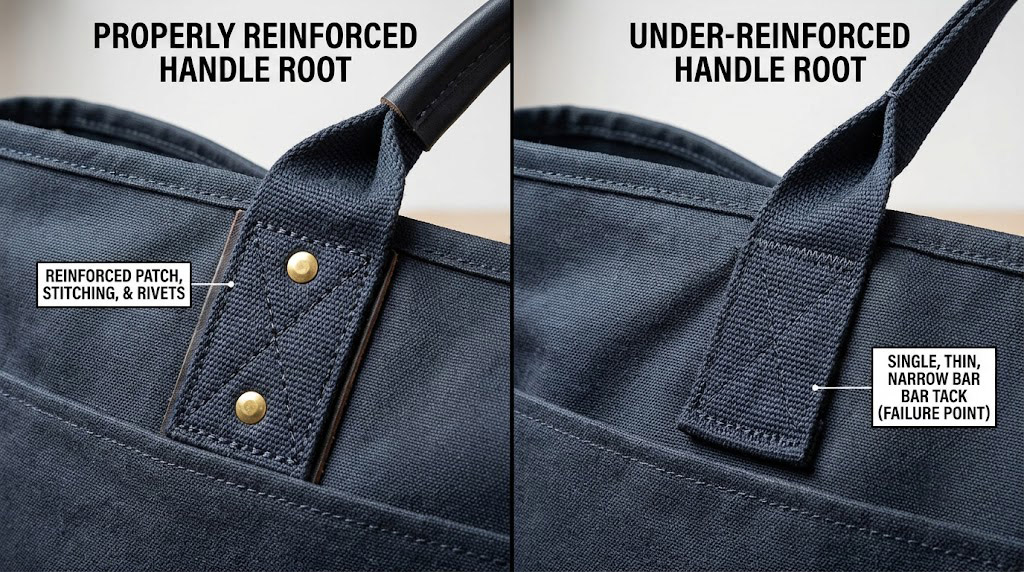
If you spot two or more of these issues on a pre-production sample, do not approve production—the bulk shipment will be worse, not better.
11. Specification Language to Use in Your Purchase Order
Copy and paste this directly into your supplier’s purchase order or RFQ:
“All stress points must be reinforced with bar tacks, rivets, or additional stitching. This includes but is not limited to: handle bases (minimum 2 bar tacks per side, 1 inch width, with hidden backing patch), shoulder strap anchors (bar tack + D-ring reinforcement), zipper top and bottom stops (bar tack across tape), adjustable buckle loops, and bottom corners. Thread must be bonded nylon or polyester, Tex 40 minimum. Bar tacks must have a minimum of 8 stitches per inch within the reinforcement zone. Pull-test documentation showing 30 lb minimum handle load capacity is required prior to shipment.”
This is the level of detail that separates professional bag buyers from amateur resellers. A serious factory will respond with confirmation and possibly a slight price adjustment; a corner-cutting factory will try to negotiate the spec down—which tells you everything you need to know.
12. The Business Case: Why Reinforcement Quality Affects Your Bottom Line
Let’s talk ROI. A typical U.S. e-commerce bag buyer faces these costs:
Average return shipping cost: $7–$12 per return
Customer service time per return: 15–20 minutes
Refund amount: Full product price
Lost customer lifetime value: $80–$200 (one disappointed customer rarely returns)
Negative review impact: Studies show one bad review deters 30+ potential customers
Now compare that to the $0.20–$0.60 per bag cost of proper stress-point reinforcement. If reinforcement prevents just 1 return per 100 bags sold, you’ve already broken even—and prevented a negative review that could cost you dozens of future sales.
Stress-point reinforcement is the cheapest insurance policy in the bag business. Skipping it is gambling with your brand reputation.
Final Thoughts: Make Reinforcement a Written Spec, Not a Verbal Promise
When communicating with Chinese bag factories, never rely on verbal confirmation of stress-point reinforcement. Verbal promises don’t survive the gap between sales and production—and they certainly don’t survive when production pressure mounts. Always:
1. Specify reinforcement in writing in your RFQ and purchase order
2. Inspect pre-production samples with a checklist
3. Conduct pull tests on at least 3 units before approving bulk production
4. Hire third-party QC for AQL inspection before shipment
5. Document everything with photos, videos, and written reports
A bag is only as strong as its weakest stress point. The factories that understand this—and build their products accordingly—are the ones that will help you build a sustainable bag brand. The ones that don’t will leave you with warehouses full of returns and a trail of angry customer emails.
Choose your suppliers carefully. Specify your reinforcement requirements clearly. Verify before you pay. That’s how you build a bag business that lasts.
Looking for a factory that already understands stress-point reinforcement as a baseline quality requirement, not an optional upgrade? Browse our vetted bag supplier directory or request a sample evaluation from our sourcing team.
Post time: Jul-10-2026