
CNC & Laser Cutting in Chinese Bag Factories: A Complete Buyer’s Guide to Precision, Tolerance & Quality
Last updated: [Date] · Category: Manufacturing & Sourcing · Reading time: 12 minutes
A modern Chinese bag factory floor showing rows of CNC cutting machines processing leather panels with precision
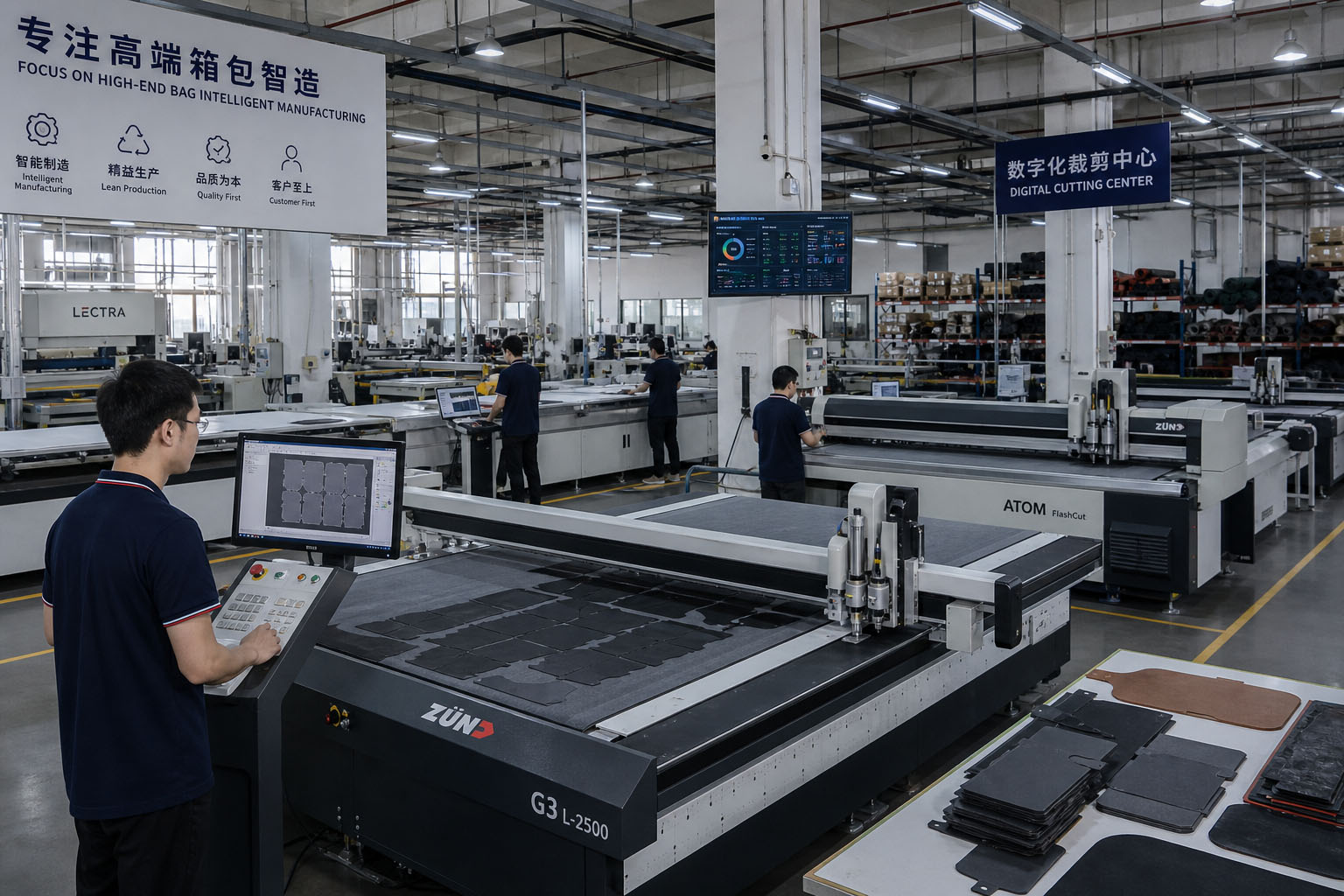
When you sell bags online to American customers, every seam, every curve, and every cut panel has to be right. A 2mm deviation in a tote bag handle or a backpack panel doesn’t just look unprofessional — it triggers returns, negative reviews, and lost lifetime value. That’s why, before placing a bulk order with any overseas supplier, one of the smartest questions a bag seller can ask is:
“Do you use CNC or laser cutting — and what tolerance can you actually guarantee?”
This is not a “nice-to-have” technical detail. It’s the difference between a product that arrives looking like a million-dollar brand and one that arrives looking like a craft fair reject. After working with dozens of Chinese bag manufacturers over the past several years, I’ve learned that the factories that invest in computer-controlled cutting are almost always the same factories that invest in quality control, pattern grading, and consistent production. The cutting method is, in many ways, a proxy for the entire manufacturing standard.
In this guide, I’ll walk you through exactly what to expect from Chinese bag factories when it comes to CNC and laser cutting — including realistic tolerances, hidden cost differences, material capabilities, and the specific questions you should ask every supplier before you wire a single dollar. Whether you’re sourcing genuine leather handbags, vegan leather totes, nylon backpacks, or technical PVC travel bags, this is the inside scoop.
1. Do Chinese Bag Factories Actually Offer CNC and Laser Cutting?
The short answer is yes — but only at the right factories. Not every bag workshop in Guangzhou or Yiwu runs computer-controlled cutting. Many smaller factories still rely on manual die cutting, hand-held rotary cutters, or clicker presses that have been around for decades. These methods work fine for simple shapes and lower-end products, but they introduce human error and inconsistent pressure that can warp your dimensions.
The factories worth working with — the ones producing for established brands, Amazon FBA sellers, and Shopify stores shipping to the US — typically use one or more of these three industry-standard cutting systems:
Atom (Italy) — Common in mid-to-high-end leather goods factories
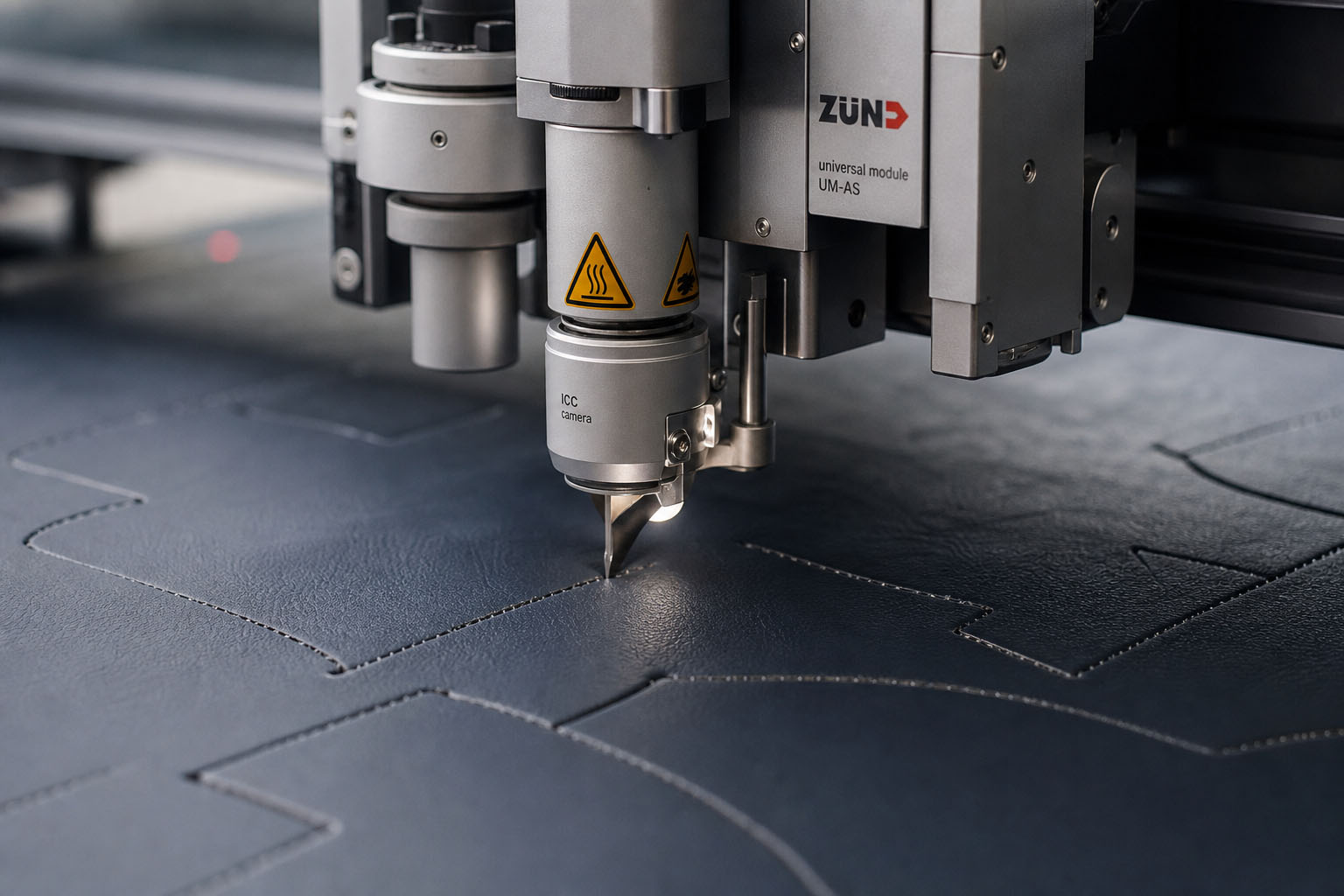
Zünd (Switzerland) — A favorite for technical fabrics, synthetics, and laminated materials
Lectra (France) — Widely used for fashion leather goods and high-volume production
These machines are not cheap. A single Zünd digital cutter can run $150,000–$300,000 USD. When you see a Chinese factory with multiple Atom or Zünd machines in their production line, that’s a strong signal they’ve made a serious capital investment in precision manufacturing.
Pro tip for US sellers: Ask the supplier to send a short factory tour video or photos of their cutting department. If you see rows of digital cutting tables, you can usually trust the rest of their production standards. If you see workers cutting panels with hand shears on a wooden table, walk away — no matter how good their price looks.
Close-up of a Zünd digital cutter head cutting synthetic fabric with vacuum hold-down table visible
2. What Dimensional Tolerance Can You Realistically Expect?
This is the question that separates serious buyers from amateurs. When a Chinese factory says “high precision” or “very accurate” without giving you numbers, that’s a red flag. Precision in manufacturing is always a number, and that number depends on the cutting method, the material, and the machine’s calibration.
Here’s what you can realistically expect from a well-equipped Chinese bag factory:
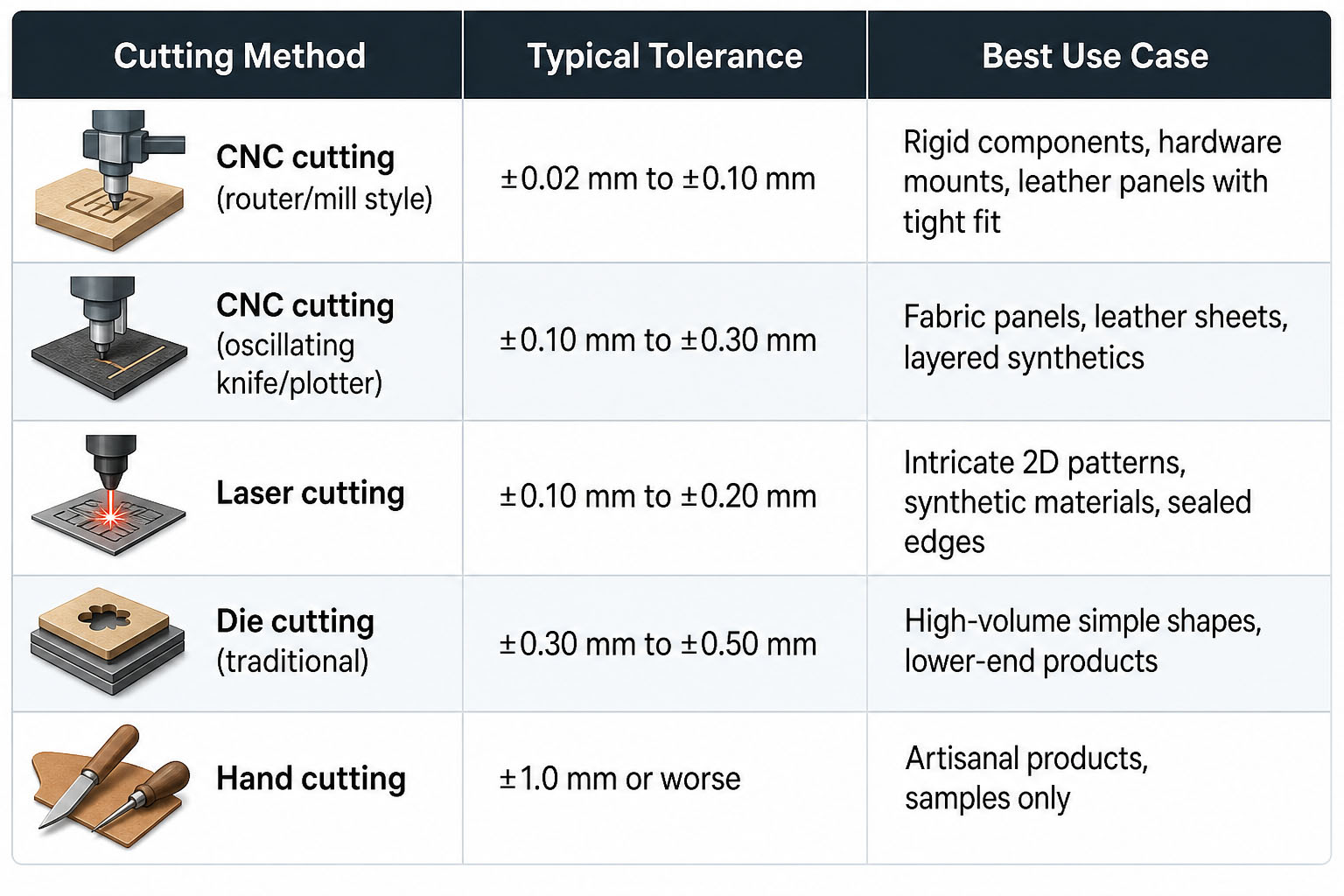
For most bag panel applications — meaning the body pieces, gussets, straps, and flaps that get sewn together — laser cutting or oscillating-knife CNC at ±0.10 to ±0.30 mm is the industry standard and is more than sufficient to ensure your finished bags match your tech-pack specifications.
CNC machining (the mill/router type) hits tighter tolerances (down to ±0.02 mm), but that’s typically reserved for rigid components like plastic or aluminum hardware, buckles, or molded inserts — not flexible bag panels. When a supplier says “we use CNC” without clarifying, ask them which type.
Why this matters for your brand: Imagine you spec a tote bag body panel at 380mm × 420mm. A factory cutting at ±0.5mm tolerance could deliver panels ranging from 379.5mm to 380.5mm. That might sound tiny, but multiply that variance across 4–6 panels per bag, and your seam alignment can drift by 2–3mm. Over a 500-unit run, you could end up with 50+ bags where the side seams don’t quite line up. That’s the kind of issue that creates returns and one-star reviews.
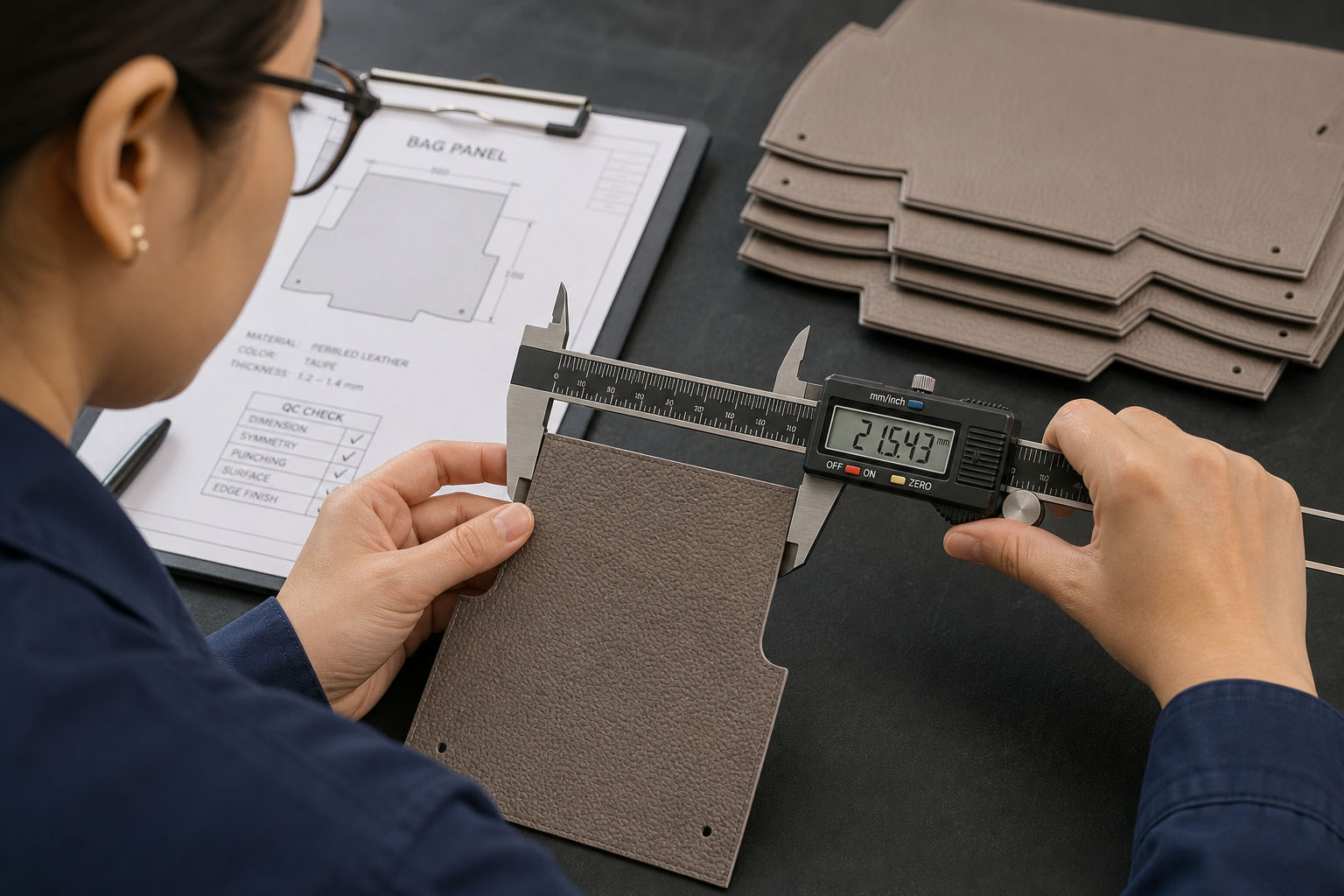
A quality control inspector measuring a cut bag panel with digital calipers showing precise dimensions
3. Do Factories Charge Extra for Laser Cutting?
This is one of the most common questions US bag sellers ask, and the answer is it depends — but usually not as much as you’d think.
Here’s the reality: most established Chinese bag factories have already invested in laser cutting equipment. The machines are paid off, and laser cutting is faster and more labor-efficient than hand cutting. For them, laser cutting is actually a cost-saver, not a premium service. Many factories will quote laser cutting at the same unit price as die cutting for standard orders.
However, there are a few situations where you might see an upcharge:
Low MOQ orders (under 100–200 units): The factory has to program the cutting file, calibrate the machine, and run a small batch. The setup cost gets spread across fewer units, so per-piece price goes up.
Highly intricate designs: If your panel has 50+ cutouts, perforations, or complex curves, the laser machine runs slower, which increases machine time cost.
Very thick materials: Cutting 5mm+ leather or dense composite panels with laser takes longer and may require multiple passes.
Mixed materials in one cut: Some factories charge a setup fee when switching between different materials (e.g., leather for the body, webbing for the straps) in the same production run.
Realistic pricing context: For a standard 500-unit bag order, the difference between laser cutting and traditional die cutting is typically $0.10–$0.30 per unit. That’s peanuts compared to the value of getting consistent, accurate panels. Don’t optimize for the wrong cost.
The bigger pricing factor is usually tooling and setup, not the cutting method itself. If your design requires a custom die (a metal cutting blade shaped to your pattern), that die might cost $200–$500 to produce. With laser cutting, there’s no physical die — the pattern is a digital file — so you save on tooling. This is one of the under-appreciated benefits of laser cutting for small to medium production runs.
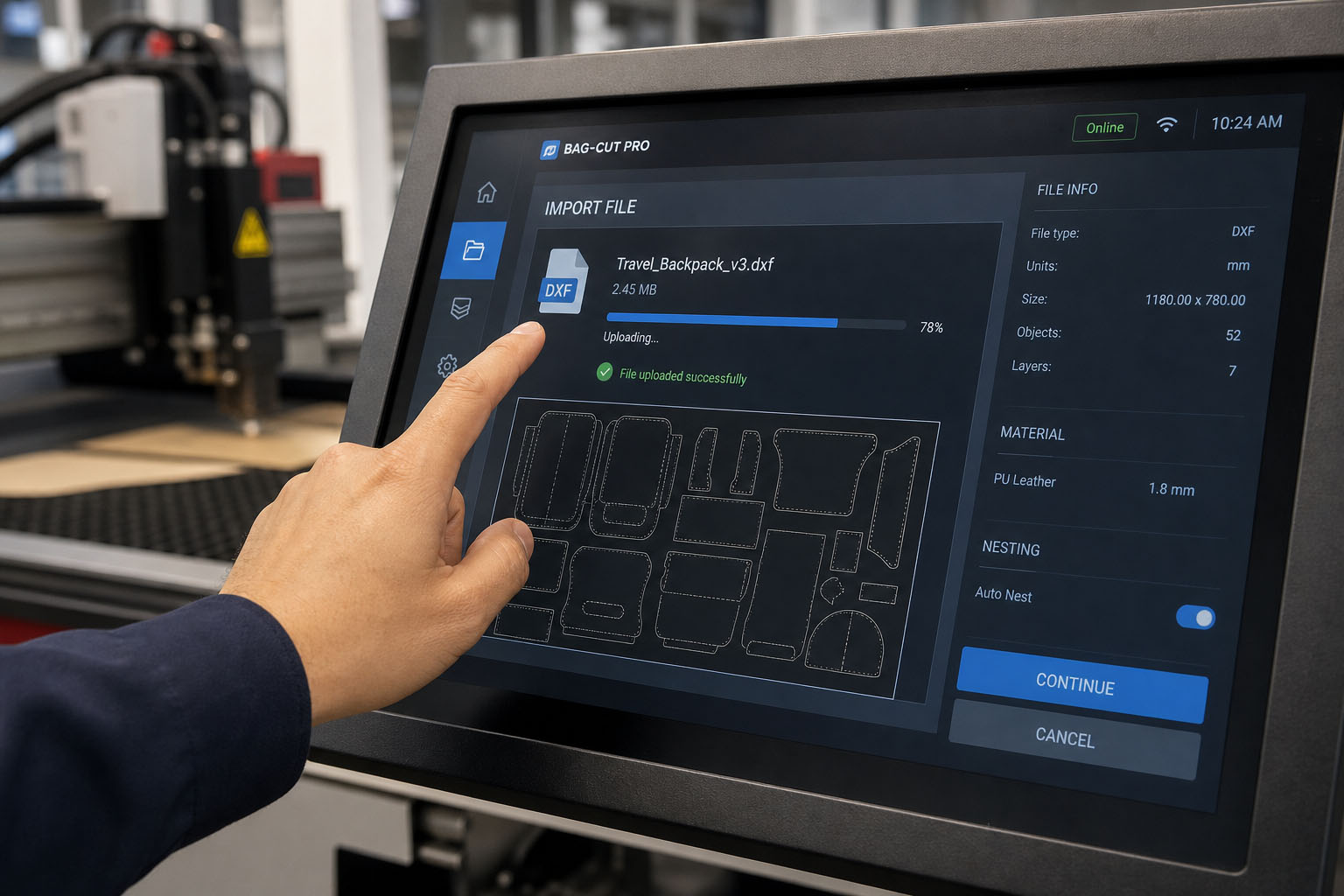
A factory technician loading a digital cutting file into the CNC machine control panel
4. Can CNC and Laser Cutting Handle Layered or Laminated Materials?
Yes — and this is where computer-controlled cutting really shines.
Bag production often involves layered materials, such as:
Genuine leather + foam padding + lining fabric (3-layer composite for handbag bodies)
PU/PVC + scrim backing + adhesive (for vegan leather)
Nylon + TPU coating (for waterproof bags)
Canvas + batting + cotton lining (for totes and travel bags)
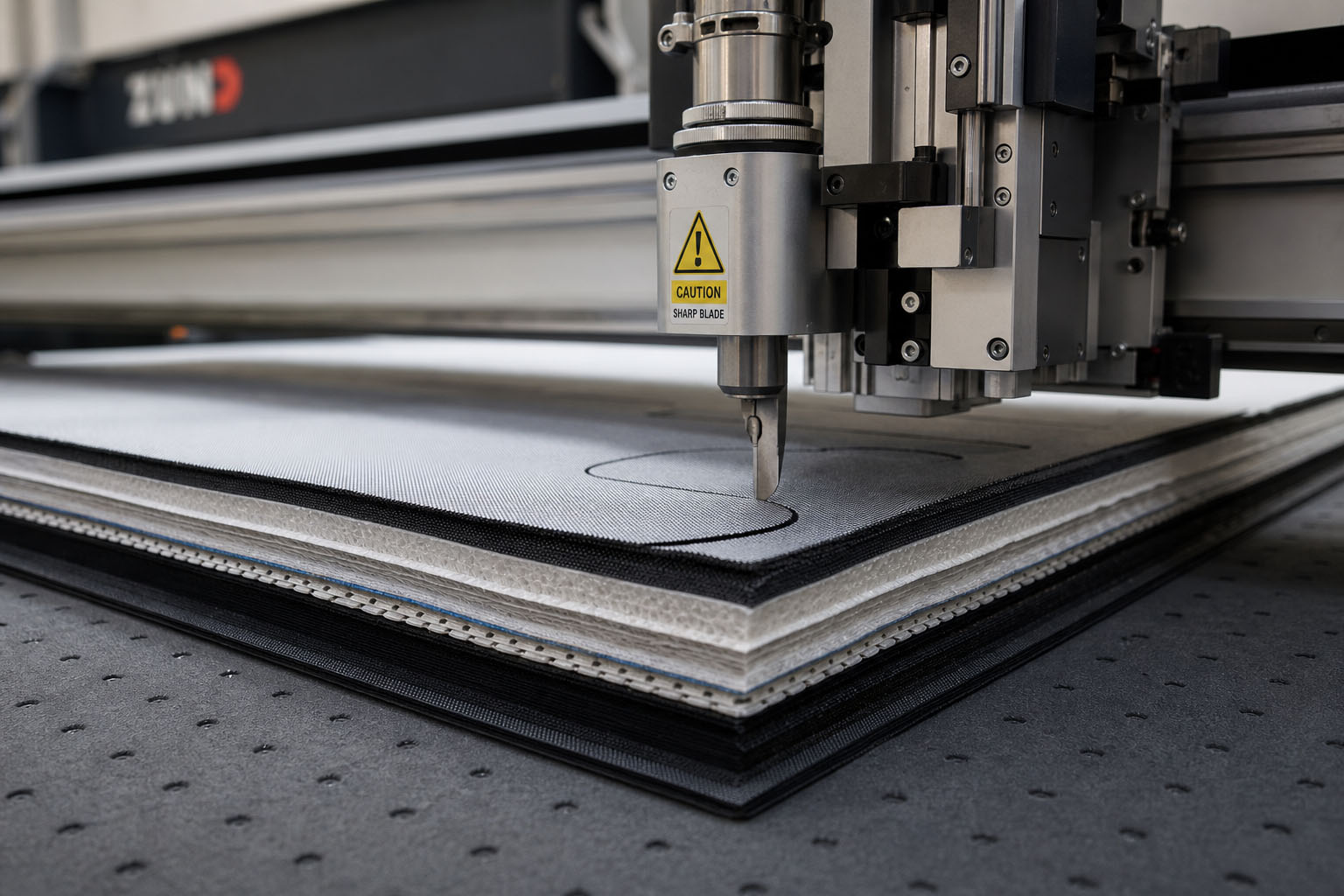
Cutting these layered materials by hand is brutal. The layers shift, the dimensions drift, and the bottom layer often comes out larger than the top layer. With CNC oscillating-knife cutting or laser cutting, the machine applies consistent pressure across the entire material stack, and many CNC systems use vacuum hold-down tables that keep everything flat and stable.
Here’s how the two methods compare on layered materials:
CNC Oscillating Knife Cutting
✅ Excellent for 3–6 layer stacks of fabric, leather, and foam
✅ Maintains dimensional consistency across layers
✅ No heat-affected zone (safe for synthetics that melt)
❌ Slower than laser for very intricate patterns
❌ Limited to relatively soft materials (can’t cut hard plastic or metal)
Laser Cutting
✅ Creates a heat-sealed edge that prevents fraying in synthetics
✅ Perfect for delicate, intricate patterns in thin materials
✅ Handles up to 2–3 layers of thin synthetic material
❌ Not suitable for PVC (releases chlorine gas when laser-cut)
❌ Can scorch or discolor natural leather edges
❌ Limited layer count — struggles with thick stacks
Material warning for laser cutting: Avoid laser cutting PVC/vinyl materials. The chlorine in PVC releases toxic fumes and corrodes the laser machine optics. Most reputable Chinese factories know this and will refuse to laser-cut PVC. If a supplier says “yes, we can laser-cut PVC,” that’s a sign they don’t know what they’re doing — find another factory.
For the most common bag material combinations (leather + lining, nylon + foam, canvas + batting), CNC oscillating-knife cutting is the workhorse method and is what I’d recommend for most US sellers sourcing mid-to-high volume production.
A stack of layered materials — leather, foam, lining — being cut on a CNC table with vacuum hold-down
5. What’s the Maximum Thickness Chinese Factories Can Laser Cut?
This is a question that catches a lot of first-time importers off guard. Laser cutting is fantastic for thin materials, but it has real physical limits. The thicker the material, the more laser power and slower cutting speed are required, and at some point, the laser simply can’t penetrate cleanly.
Here’s the realistic thickness range for laser cutting in Chinese bag factories:
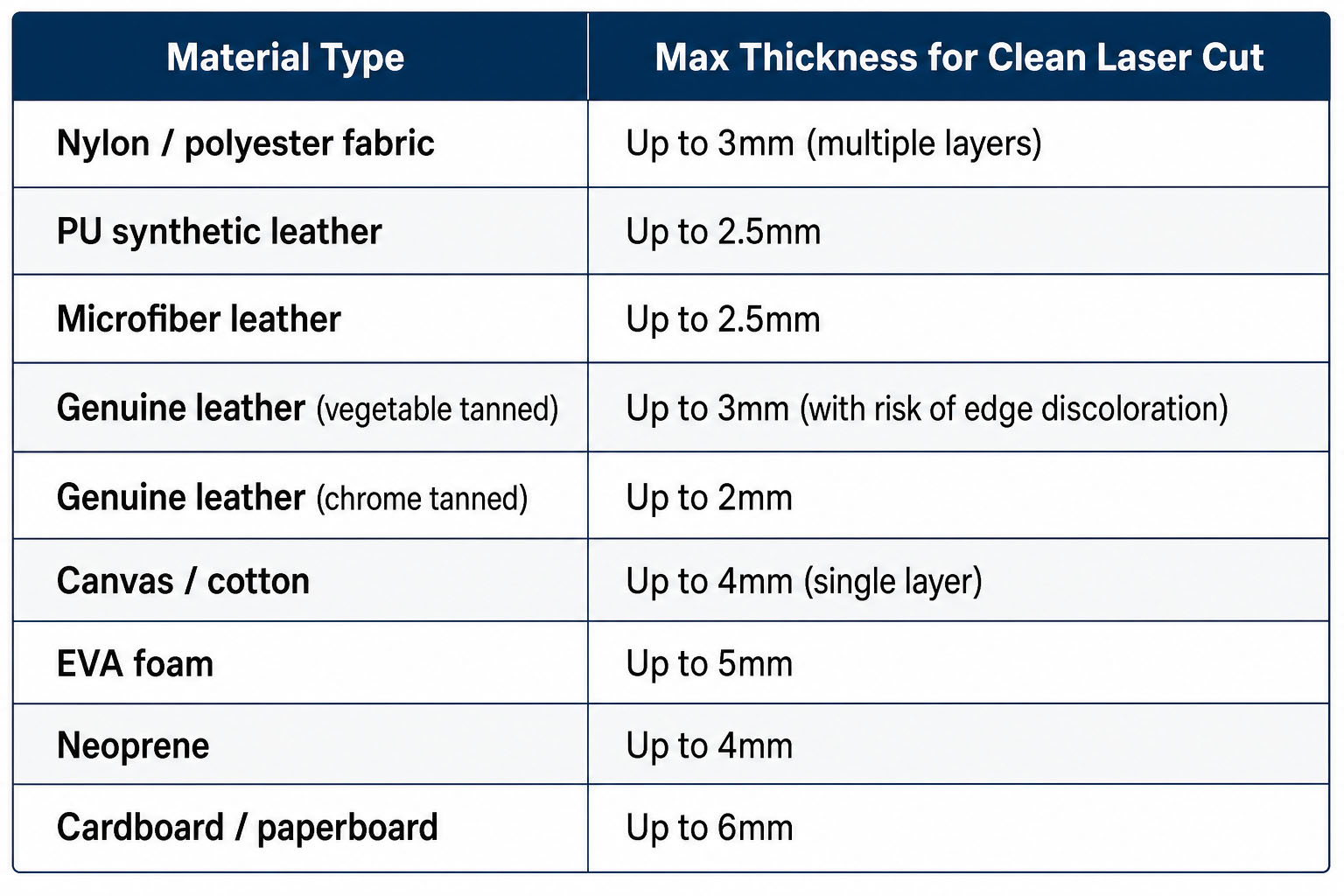
For most bag panel applications, you’re typically working with materials in the 1mm to 3mm range, which is well within laser cutting’s sweet spot. If your bag design requires thicker material — say, a 4mm+ structured tote bag base or a heavy-duty waxed canvas backpack panel — you’ll need to switch to CNC oscillating knife cutting or die cutting, which can handle much thicker materials with no problem.
A practical example: If you’re making a leather messenger bag with 2.2mm full-grain leather body panels, laser cutting will work beautifully. But if you’re making a structured leather briefcase with 4mm reinforced panels, you’ll want the factory to use their CNC oscillating knife for those pieces. Ask in advance which method they’ll use for each part of your bag.
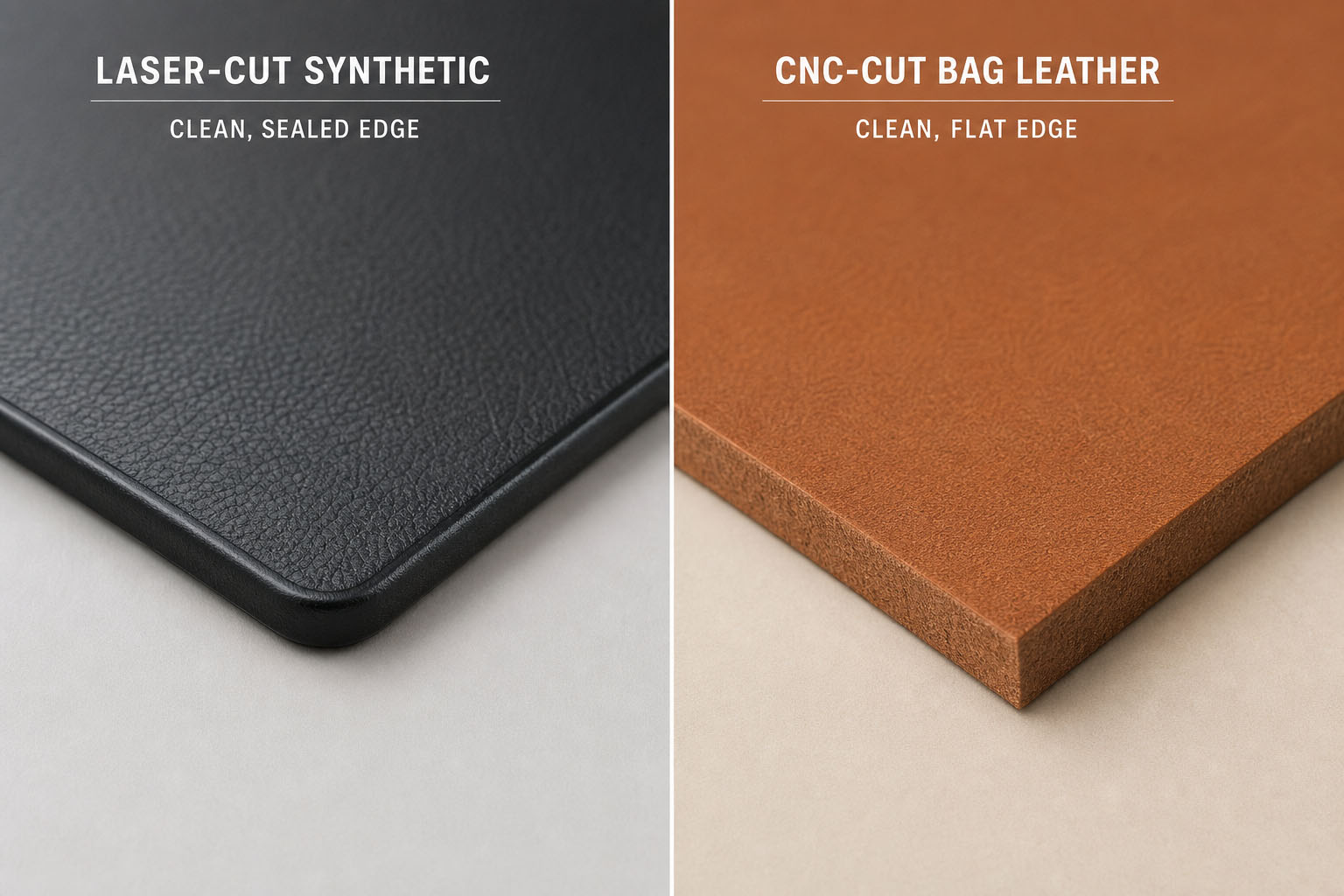
A side-by-side comparison of laser-cut thin material edge vs CNC-cut thick material edge
6. Why CNC and Laser Cutting Beat Manual Cutting Every Time
Let’s talk about the business case for a moment, because the cost difference between manual and computer-controlled cutting is often much smaller than US buyers expect, while the quality difference is massive.
6.1 Repeatability Across Thousands of Units
A skilled hand cutter can produce beautiful panels — for the first 50 pieces. By piece 500, fatigue sets in. By piece 1,000, the dimensions start drifting. By piece 5,000, the human eye simply cannot maintain ±0.5mm accuracy across an entire production run.
A CNC or laser cutting machine, on the other hand, will cut piece #1 and piece #10,000 with identical precision, as long as the material is loaded consistently. The machine doesn’t get tired, doesn’t get distracted, and doesn’t have a bad day.
For a US seller running ongoing production runs of 500–5,000 units, this consistency is everything. It means:
Your pattern grading is honored
Your seam allowances stay consistent
Your assembly is faster (panels fit together without adjustment)
Your QC pass rate is higher
Your returns are lower
6.2 Material Waste Reduction
Because the cutting patterns are designed digitally and laid out using nesting software (programs that optimize pattern placement to minimize waste), computer-controlled cutting typically reduces material waste by 10% to 20% compared to hand cutting or traditional die cutting. For expensive materials like full-grain leather, that can mean real money — sometimes $1–$3 per bag in material savings.
6.3 Sealed Edges from Laser Cutting
For synthetic materials (PU, PVC, nylon, polyester), laser cutting has a unique advantage: the heat of the laser seals the cut edge, preventing fraying and unraveling. This can eliminate the need for edge painting, binding, or heat-sealing in many applications, which saves labor time and improves durability.
For natural leather, however, laser cutting can sometimes leave a slightly darkened or “burnt” edge that some brands find unattractive. If you want clean, natural leather edges, you may want to specify CNC oscillating-knife cutting for leather panels and laser cutting only for synthetic components.
6.4 Direct Digital File Transfer
With modern CNC systems, your CAD pattern files go directly from your design software (Adobe Illustrator, CorelDRAW, Optitex, Lectra Modaris) into the cutting machine’s software. There’s no manual re-marking, no template tracing, no chance of human transcription error. This dramatically reduces the risk of pattern mistakes, especially for complex designs with many curved pieces.
A nesting software screenshot showing optimized pattern layout on a digital material sheet
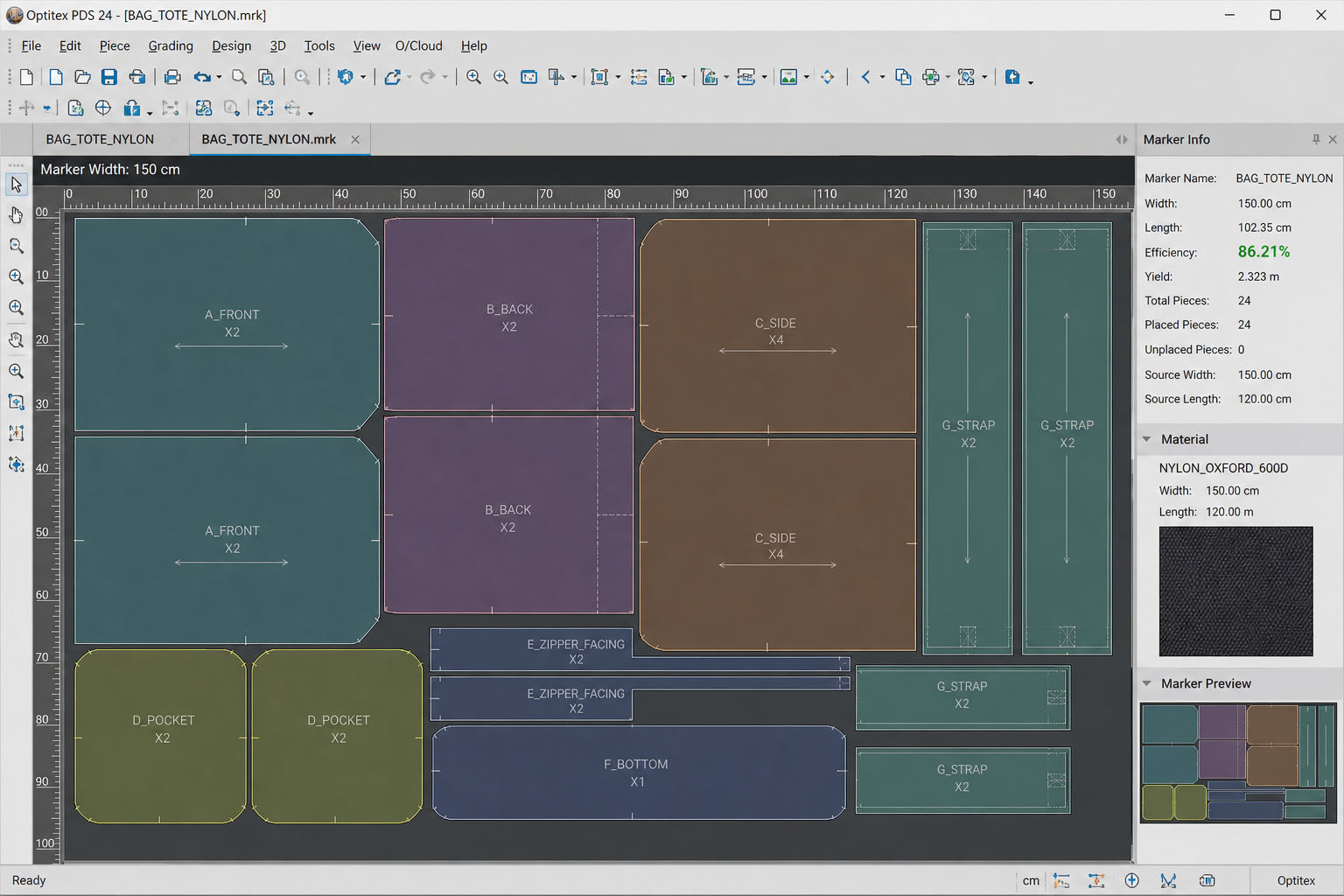
7. The 5 Questions You MUST Ask Every Chinese Bag Supplier
After running my own bag brand and sourcing from China for years, I’ve developed a short list of questions that cut through the marketing fluff and reveal whether a factory actually has the technical capability to deliver consistent quality. Send these to every supplier before you place a sample order:
Question 1: “What cutting equipment do you use — Atom, Zünd, Lectra, or other? Can you send photos?”
A factory that names specific machines and can show them in their production line is signaling real investment in precision manufacturing. Vague answers like “we use advanced cutting machines” or “high-precision equipment” are warning signs.
Question 2: “What dimensional tolerance can you guarantee for my panel dimensions, and is that ±0.1mm, ±0.2mm, or ±0.5mm?”
If they can’t give you a number, they can’t give you consistent quality. Period. The answer should be a specific tolerance range tied to your material type and panel size.
Question 3: “How do you measure and verify dimensional accuracy during production — spot checks, 100% inspection, or AQL sampling?”
This tells you about their QC process. The best factories inspect every panel for critical dimensions, or use AQL 2.5 sampling for large production runs.
Question 4: “Can you provide a pre-production sample with measured dimensions before I approve bulk production?”
Any reputable factory will agree to this. If they push back, find another supplier. This sample is your chance to verify the tolerance claim in the real world.
Question 5: “What is your recommended material thickness for stable cutting, and is there an extra charge for laser cutting vs. die cutting?”
This question does two things: it confirms their material expertise and it forces them to be transparent about pricing. A confident supplier will answer both parts directly.
Bonus tip: Ask for a measurement report (a spreadsheet showing actual measured dimensions of 5–10 sample panels) along with your pre-production sample. The best factories do this automatically. If you have to ask, it might be a sign that the factory isn’t as rigorous as you’d like.
A factory QC report showing measured dimensions of multiple cut panels in a spreadsheet format
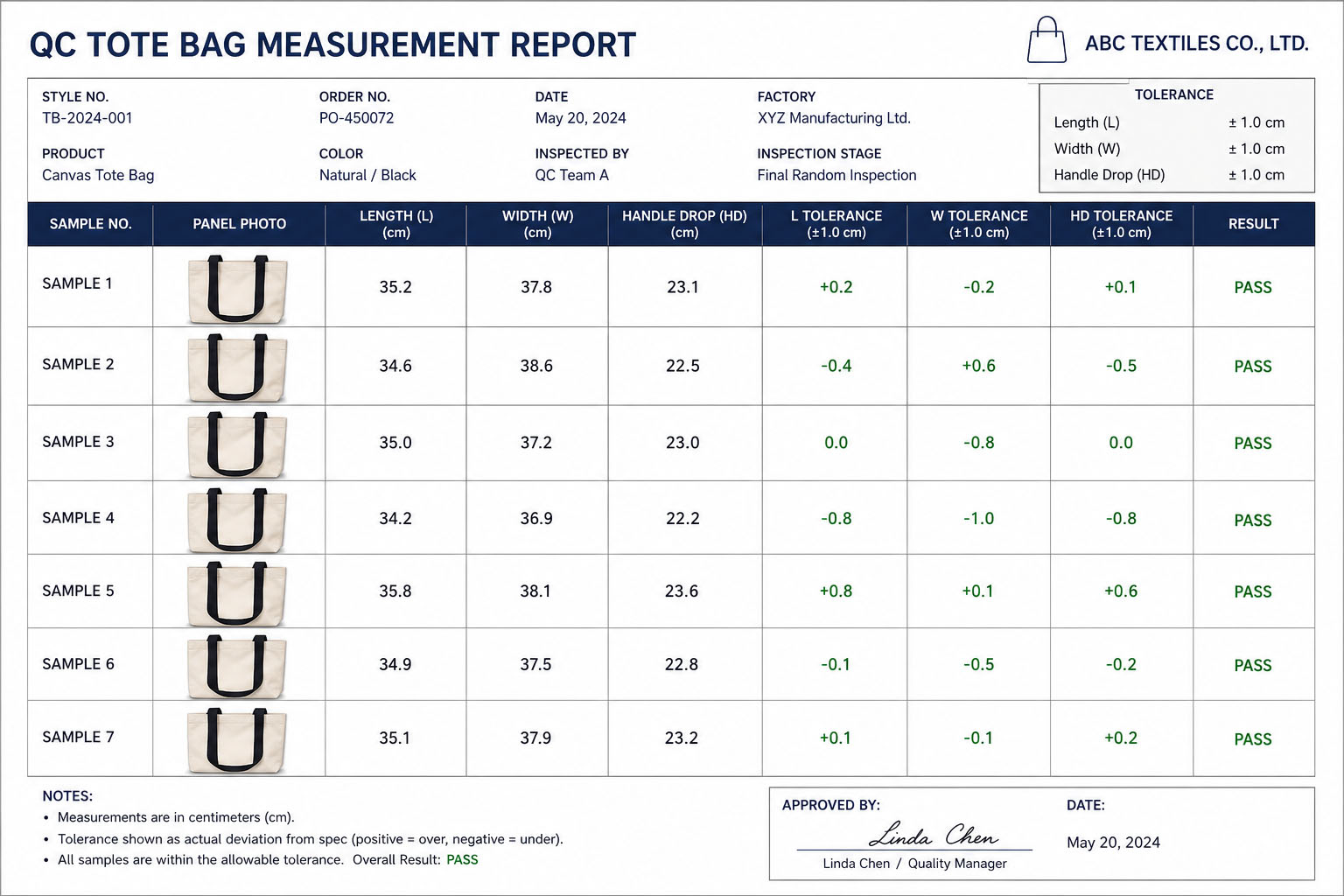
8. The First-Cut Sample: Your Most Important Quality Check
I cannot stress this enough: always, always, always approve a first-cut sample before going into bulk production.
A first-cut sample is exactly what it sounds like — the factory cuts a small batch (usually 5–10 pieces) of your actual panels using your actual material on their actual production machines, before committing to the full production run. This is your chance to:
Verify the dimensional accuracy with your own digital calipers
Check the edge quality (clean cut vs. frayed vs. burnt)
Test the panel fit by assembling a complete bag
Confirm the material behaves the way the supplier claimed
Identify any pattern or grading errors before they get baked into 1,000 units
The cost of a first-cut sample is typically $30–$80 USD including DHL shipping, and it takes about 3–5 business days. That tiny investment can save you from a $10,000 disaster on a bulk order.
Real story from a fellow US bag seller: A friend of mine skipped the first-cut sample on a 1,000-unit vegan leather tote order to save time. The bulk production came back with all the side panels cut 2mm too wide. The bags technically looked fine, but the gussets wouldn’t fold flat and the corners wouldn’t align. He ended up with 1,000 unsellable bags and lost about $18,000. A $50 sample would have caught it.
A pre-production first-cut sample of bag panels laid out on a white background with a ruler for scale
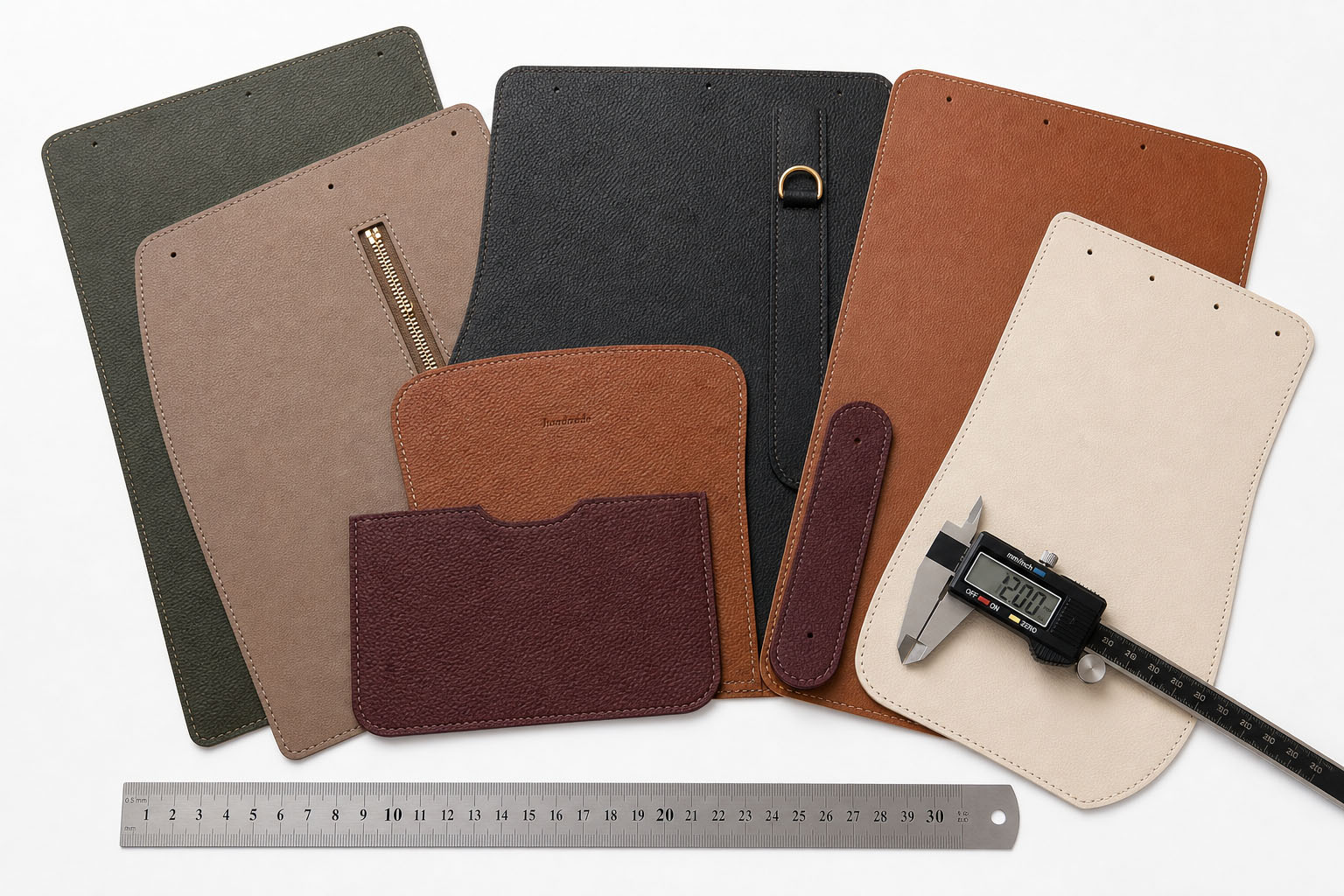
9. CNC vs. Laser Cutting: Which Should You Choose for Your Bag?
Here’s a quick decision framework based on what I’ve seen work best:
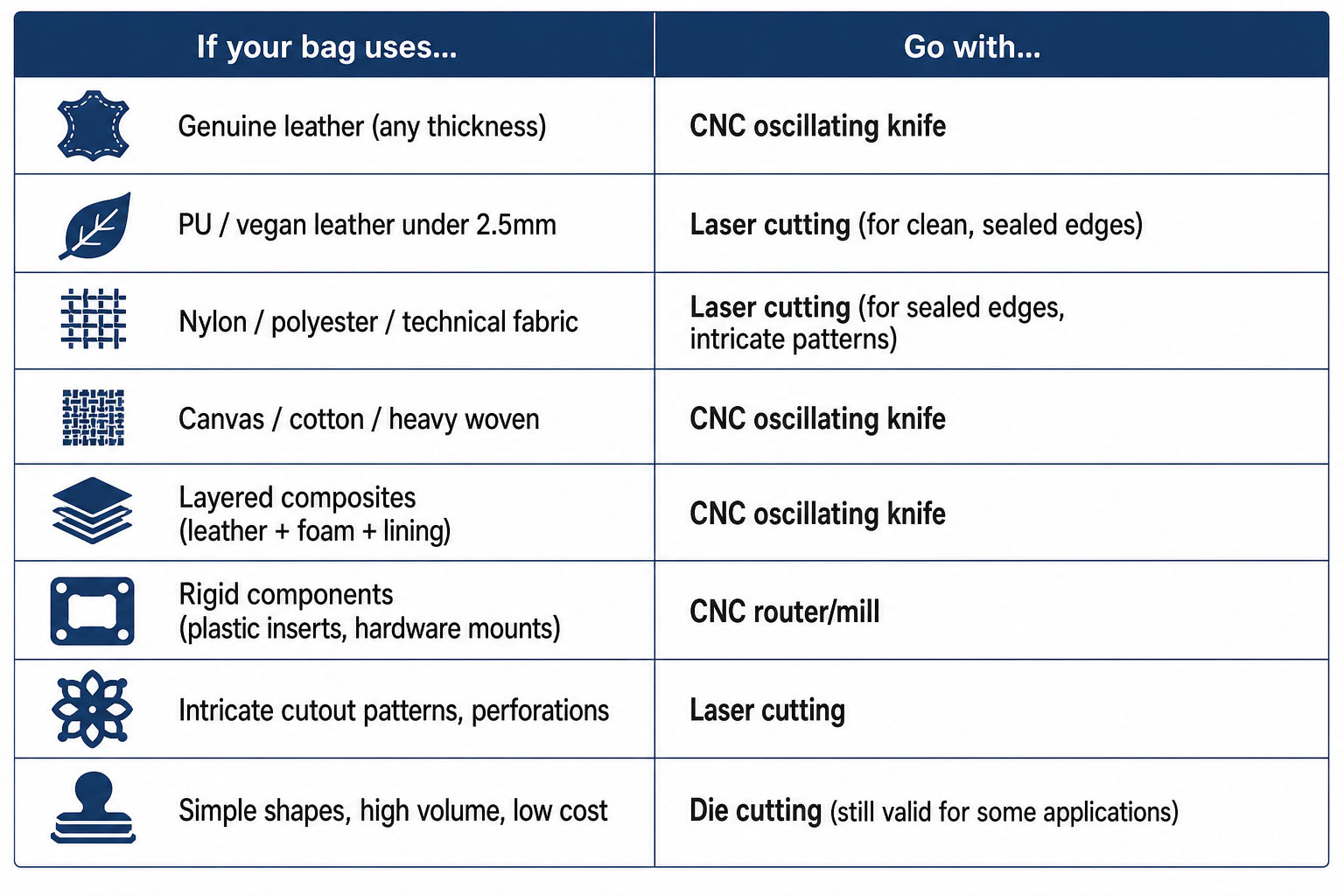
For most US bag sellers working with a mix of materials, the factory will likely use multiple cutting methods within a single bag — laser cutting for the decorative synthetic panels, CNC knife for the leather body pieces, and CNC router for any rigid structural components. This is normal and expected at a well-equipped factory.
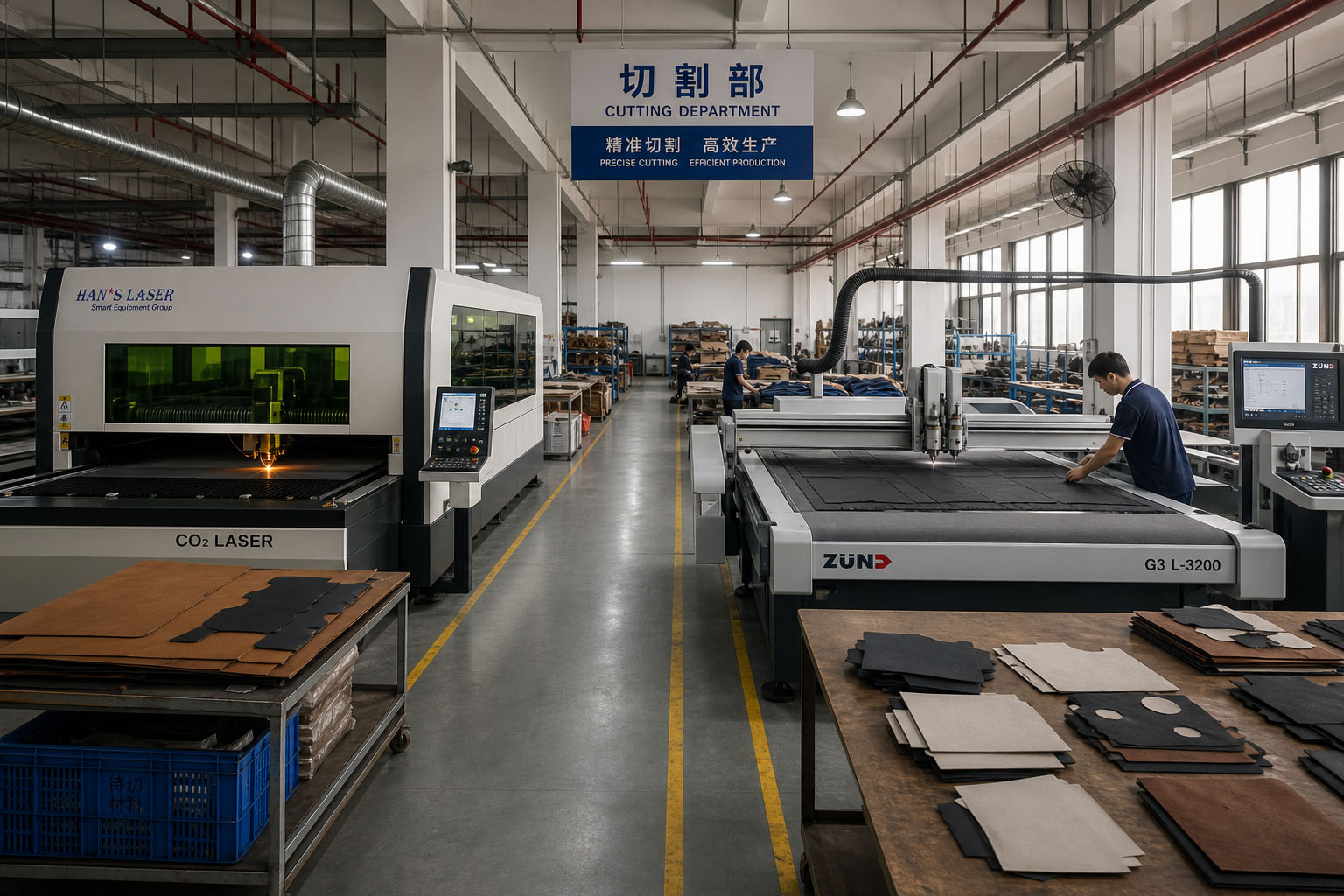
A bag factory cutting department showing both laser cutter and CNC knife cutter side by side in production
10. Red Flags: When to Walk Away from a Supplier
Not every Chinese factory that claims to offer CNC and laser cutting actually does it well. Here are the warning signs that should make you pause:
❌ They can’t name the cutting machines they use (Atom, Zünd, Lectra, etc.)
❌ They won’t give you a numeric tolerance — just vague phrases like “high precision” or “very accurate”
❌ They refuse to send a pre-production sample before bulk production
❌ They say “yes” to laser-cutting PVC (this is a safety and equipment damage issue)
❌ They quote a tolerance better than ±0.02mm for fabric or leather (this is physically unrealistic and suggests they’re just telling you what you want to hear)
❌ They don’t have any QC measurement process — no calipers, no measurement reports, no inspection
❌ They’re significantly cheaper than every other quote (precision cutting equipment is expensive; if their price is way below market, they’re probably cutting corners somewhere)
A trustworthy factory will answer all your technical questions patiently, send photos and videos of their equipment, and proactively offer samples and measurement reports. If you feel like you’re pulling teeth to get basic information, trust your gut and find another supplier.
Final Thoughts: Precision Is a Process, Not a Number
CNC and laser cutting are powerful tools, but they’re only as good as the engineer programming them, the operator loading the material, and the QC team verifying the output. When you evaluate a Chinese bag factory, don’t just ask about the machines — ask about the people and the process.
A factory with a $300,000 Zünd cutter and a lazy QC team will produce inconsistent bags. A factory with a $50,000 machine and a meticulous engineer who programs every file by hand and measures every batch will produce excellent bags. The machine matters, but the discipline matters more.
For US bag sellers, the takeaway is simple: invest in the technical conversation upfront. Ask the right questions, request the right samples, verify the right tolerances, and you’ll build a supply chain that delivers consistent, brand-quality bags — without ever having to fly to Guangzhou.
Need help talking to suppliers? I can help you draft a professional inquiry message in English or Chinese to send to Chinese bag factories, asking all the right questions about CNC/laser cutting, tolerances, and QC. Just reach out via [contact page link] or drop a comment below.
About the Author: Wen is the founder of Trust-U Bag, a US-based direct-to-consumer bag company sourcing premium bags from vettedChinese manufacturing partners since 2016. ISPBAG has served over 100 customers and works with audited factories in Guangdong and Fujian provinces.
Post time: Jul-01-2026