
Everything you need to know about reinforcement pieces, interlayers, and how Chinese suppliers can support your bag production line
Why This Guide Matters for Your Bag Business
If you’re importing bags from China for your U.S. e-commerce store, you already know that what’s inside a bag matters just as much as what you see on the outside. Reinforcement pieces, interlayers, and structural inserts are the hidden heroes that determine whether a bag lasts one season or ten.
During my recent conversations with Chinese bag manufacturers, I asked a series of technical questions about die cutting — one of the most important yet often overlooked processes in bag production. The answers I received revealed just how sophisticated Chinese factories have become in this area.
This guide breaks down everything I learned, so you can make smarter sourcing decisions and build better products for your customers.
1. Do Chinese Manufacturers Offer Die Cutting for Standardized Reinforcement Pieces and Interlayers?
The short answer: Yes.
When I asked our partner factory, “Do you offer die cutting for standardized reinforcement pieces and interlayers?”, their response was direct and confident: “Yes, we can. We provide die cutting services to our clients”.
This is significant because die cutting is widely used in Chinese bag factories to produce standardized reinforcement pieces such as interlayers, back panels, and base shapers. The process allows manufacturers to create identical, precision-cut components at scale — something that’s nearly impossible to achieve consistently through hand-cutting.
Die cutting process in a Chinese bag factory — steel rule die pressing through layers of reinforcement material
Steel rule die cutting is the workhorse of standardized reinforcement piece production in modern bag factories.
For a U.S. importer, this means you can confidently request custom reinforcement solutions without worrying about whether your supplier has the technical capability.
2. What Are the Common Materials Used for Die-Cut Reinforcement Pieces and Interlayers?
Understanding materials is where most new importers get tripped up. I asked my contact at the factory about the typical materials used, and their answer was illuminating:(Die cutting is typically used for standardized reinforcement pieces and interlayer materials).
In practice, Chinese factories commonly work with the following materials for die-cut reinforcements:
Non-woven fabric — Lightweight, flexible, and cost-effective for soft interlayers
EVA foam — Provides cushioning and structure, ideal for back panels and shoulder straps
PE board (polyethylene board) — Rigid yet lightweight, perfect for bag bottoms and side panels
Stiff cardboard / gray board — Used in luxury handbags and structured totes for shape retention
PP plastic sheet — Water-resistant option for outdoor and travel bags
Honeycomb board — Premium lightweight reinforcement for high-end bags
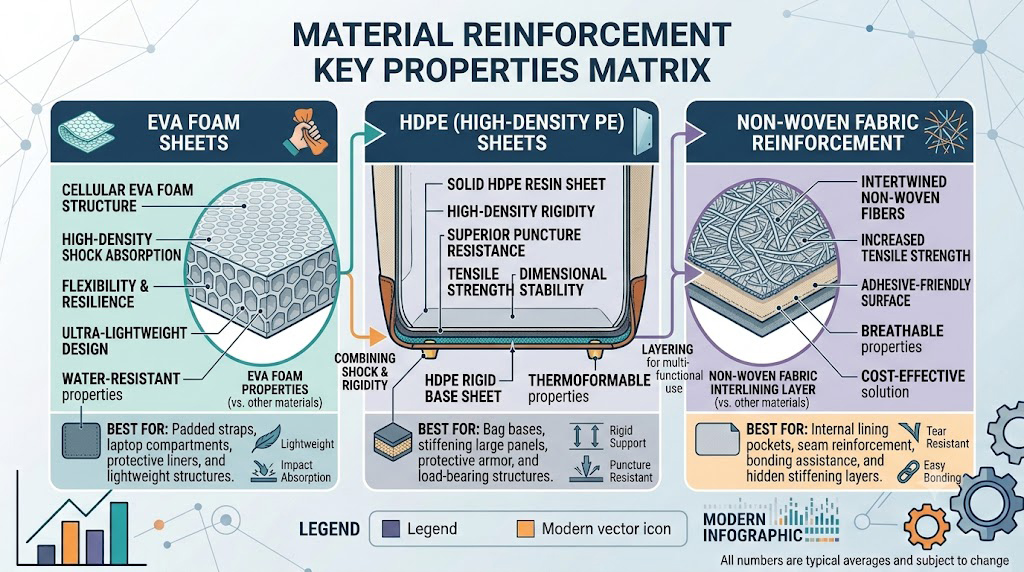
Various reinforcement materials including EVA foam, PE board, and non-woven fabric laid out for comparison
Common reinforcement materials: EVA foam, PE board, and non-woven fabric are staples in Chinese bag manufacturing.
Pro tip: When sourcing, always ask for a material spec sheet that lists thickness (typically measured in mm), density, and tensile strength. The right material choice can dramatically affect how your bag performs under load.
3. What Is the Typical Minimum Order Quantity (MOQ) for Custom Die-Cut Components?
This is one of the most practical questions for any small-to-medium U.S. importer. The honest answer: MOQ varies significantly depending on the factory, the complexity of the die, and the material being cut.
Here’s what you can generally expect from Chinese bag manufacturers:
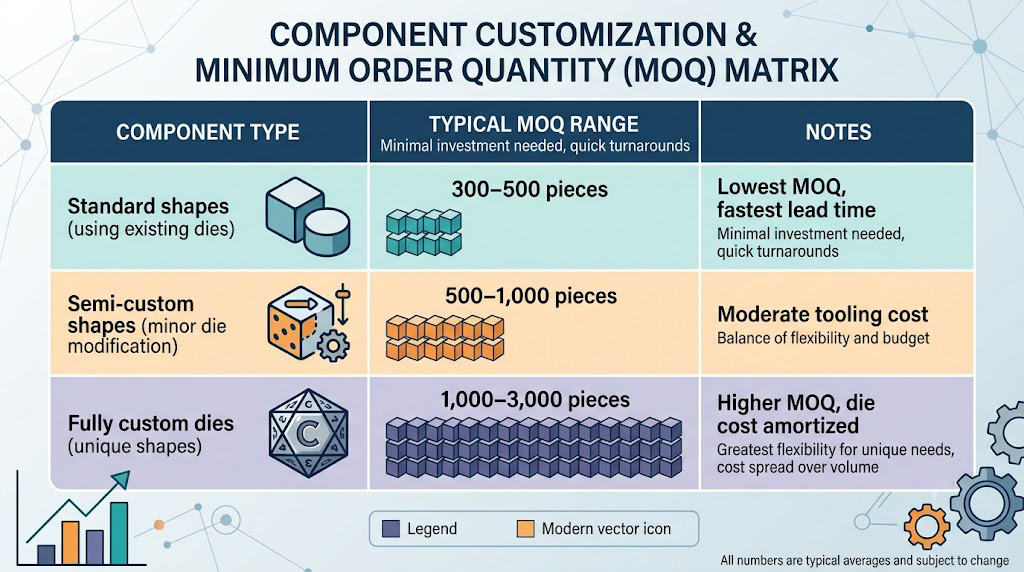
Die cutting is cost-effective for high-volume standardized shapes, significantly faster than hand-cutting for bulk orders. This is why factories prefer larger runs — the setup time and die cost are spread across more units.
Key insight from my research: Custom dies can be made for unique bag designs, though initial tooling costs apply and are amortized across production runs. For most small importers, this means asking the factory to add your reinforcement piece order to an existing production run of similar bags, which dramatically reduces your effective MOQ.
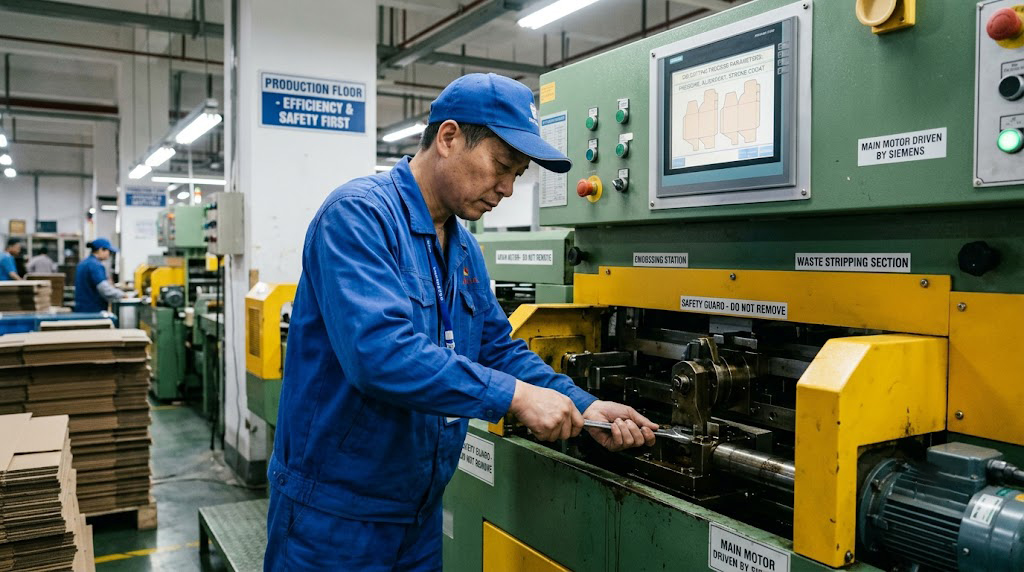
A factory worker setting up a die cut machine, illustrating the relationship between setup costs and production volume
Setup costs for die cutting are fixed — larger runs mean lower per-unit costs for reinforcement components.
4. Do Chinese Bag Manufacturers Provide Both Sample Prototyping and Bulk Production for Die-Cut Interlayers?
Yes, most established Chinese bag factories offer a two-stage process: sample prototyping first, then bulk production.
This is critical for U.S. importers who need to validate quality before committing to a large purchase order. Here’s how the process typically works:
Stage 1: Sample Prototyping
The factory creates a custom die based on your specifications (or uses an existing die if your design is standard)
Sample lead time: Usually 7–15 days
You receive physical samples of the die-cut reinforcement pieces for testing
Cost: Typically $50–$200 per sample, plus die creation fee ($100–$500) for custom shapes
Stage 2: Bulk Production
Once you approve the samples, the factory moves into mass production
Die cutting ensures uniform dimensions and thickness across thousands of identical pieces, essential for consistent bag quality
Steel rule dies and clicker presses are the most common die-cutting methods for mass production of reinforcement components
Lead time: 25–45 days depending on order volume
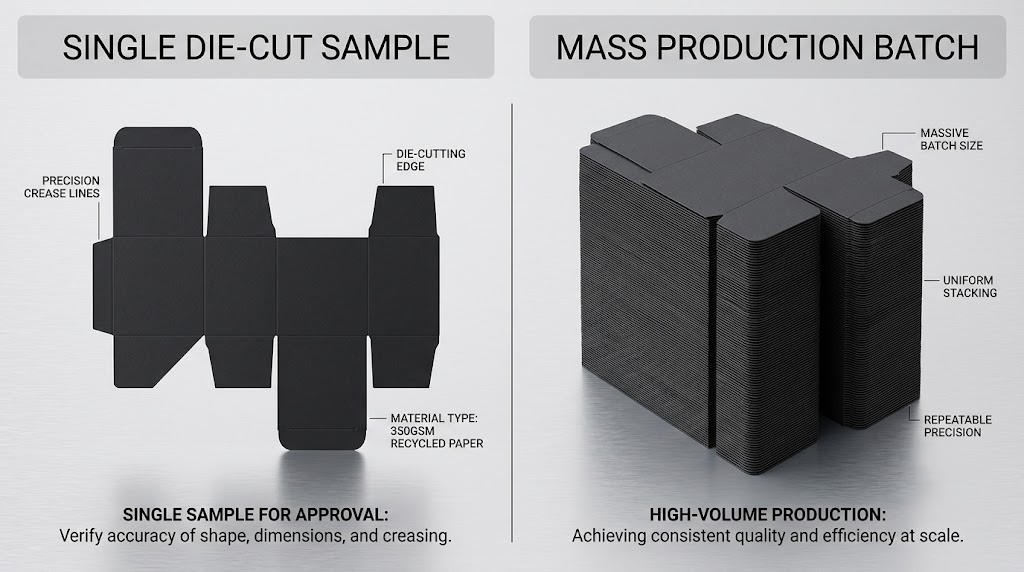
A side-by-side comparison of a single die-cut sample piece next to a stack of identical bulk production pieces
Sample prototyping ensures your reinforcement pieces meet specifications before committing to bulk production.
My recommendation: Always request a golden sample — an approved reference sample that the factory uses as the quality benchmark for the entire production run. This protects you from mid-production drift in dimensions or material quality.
5. How Do Die-Cut Reinforcement Pieces Affect the Overall Bag Durability and Production Cost?
This is where the science of bag design meets the economics of sourcing. The impact is significant on both fronts.
Impact on Durability
Die-cut interlayers improve bag shape retention, structural integrity, and overall product durability. Here’s how:
Handle base reinforcement — Prevents handles from tearing away from the bag body under heavy loads
Bottom stiffeners — Allow the bag to stand upright and resist sagging when filled
Back panel inserts — Provide structure for laptop compartments and protective padding
Flap inserts — Help closures fold cleanly and maintain their shape over time
It is commonly used for cutting handle bases, flap inserts, and bottom stiffeners to reinforce load-bearing areas — the three most failure-prone zones in any bag.
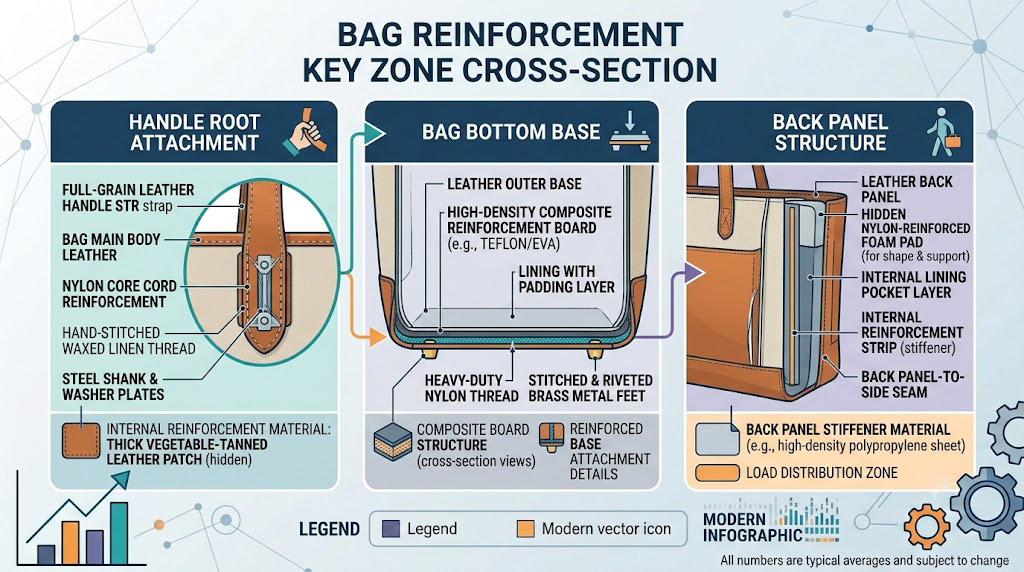
Cross-section diagram of a bag showing reinforcement pieces at the handle base, bottom, and back panel
Reinforcement pieces are strategically placed at the bag’s load-bearing zones — handle bases, bottoms, and back panels.
Impact on Production Cost
It allows precise cutting of multiple material layers simultaneously, maintaining accuracy within ±1 mm tolerance. This precision has a direct cost impact:
Cost-saving factors:
Die cutting is 5–10x faster than hand-cutting for standardized shapes
Minimal material waste (typically 5–8% vs. 15–20% for hand-cutting)
Lower labor costs (one operator can run a clicker press producing 500+ pieces per hour)
Consistent quality means fewer rejected units
Cost factors to be aware of:
Initial die creation cost: $100–$500 for custom shapes
Setup time: 1–2 hours per die change
Material cost for reinforcement pieces: typically $0.10–$0.80 per piece depending on material and size
Buyers should request material specifications and samples of die-cut reinforcements to verify quality before bulk production. This single step can save you thousands of dollars in returns and warranty claims down the road.
6. Key Questions to Ask Your Chinese Supplier
Based on my conversations with the factory, here’s a refined list of questions you can send directly to your supplier:
About Capabilities
“Do you provide die-cut reinforcement parts and interlayer inserts for bags?”
“Can you produce standardized die-cut pieces for bag reinforcement?”
“What types of materials can your die-cutting equipment handle?”
About Specifications
“What is the thickness range you can cut?”
“What tolerance level do you maintain for die-cut pieces?”
“Do you support adhesive backing on reinforcement pieces?”
About Logistics
“What is your MOQ for custom die-cut reinforcement components?”
“Can you provide samples before bulk production?”
“What is the lead time for samples vs. bulk orders?”
RFQ Wording That Works with Chinese Factories
For a more natural-sounding inquiry, try this version:
“We are a U.S.-based bag brand looking for a manufacturing partner. We need die-cut reinforcement pieces and interlayer inserts for our bag line, including handle base reinforcements, bottom stiffeners, and back panel inserts. Can you provide samples and a quote for both small prototype runs and bulk production? Please include material options, thickness specifications, and MOQ details.”
7. Final Takeaways for U.S. Importers
After digging deep into die cutting capabilities with Chinese bag manufacturers, here are the most important insights to remember:
✅ Die cutting is standard practice in Chinese bag factories — you don’t need to convince your supplier to offer it.
✅ Material choice matters more than you think — EVA, PE board, non-woven, and gray board each serve different structural purposes.
✅ MOQ is negotiable, especially if you can align your order with the factory’s existing production schedule.
✅ Always request samples before bulk production — the cost is minimal compared to the risk of receiving thousands of defective pieces.
✅ Die-cut reinforcements are a competitive advantage — they extend product lifespan, reduce warranty claims, and increase customer satisfaction.
✅ Work with suppliers who have in-house die-making capabilities — this reduces lead times and gives you more flexibility for design changes.
Post time: Jul-02-2026