
Importing Bags with Metal Nameplates from China to the US: Tariffs, HTS Codes & Compliance Guide
Target Audience: US-based bag e-commerce sellers, independent website merchants, wholesale importers. Word count: ~2750 | American English | Blog article for your bag brand website
Introduction
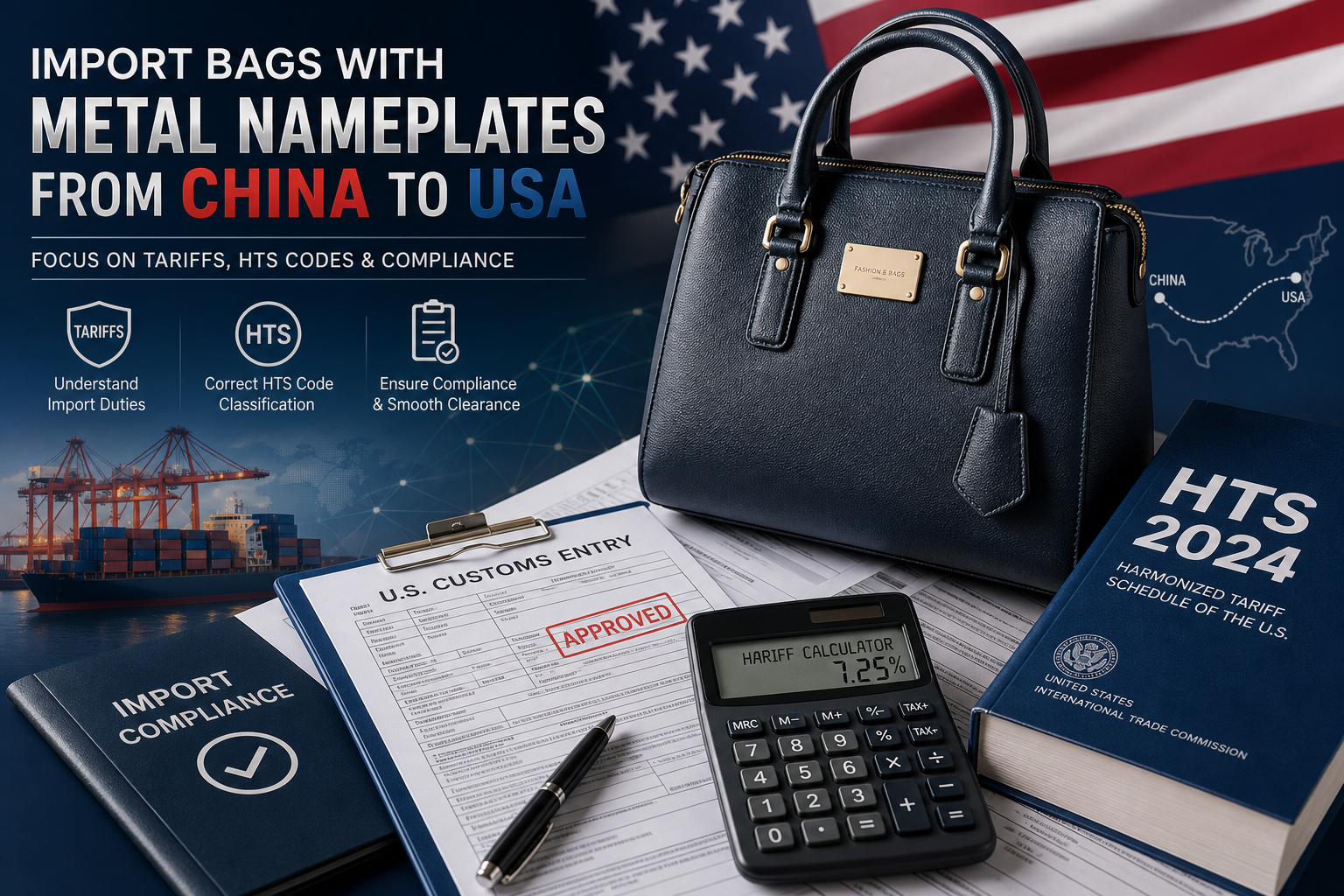
If you run an online bag store in the United States and source handbags, backpacks, tote bags and luggage directly from Chinese manufacturers, metal nameplates and metal logos are one of the most common decorative hardware choices for your bag products. While metal branding elevates product texture and brand recognition, many importers overlook how these metal components affect customs classification, tariff costs, and US product compliance rules. A small mistake on HTS code selection, tariff assessment, or chemical compliance can lead to shipment detention, unexpected duty surcharges, product recalls, or even financial losses for your cross-border bag business.
This complete guide covers core questions most US bag importers ask before placing orders with Chinese factories: import restrictions, Section 301 tariff rates, correct HTSUS customs codes, de minimis exemption rules, and mandatory compliance standards including Proposition 65, CPSIA and heavy metal limits for metal nameplates. This article also explains country of origin marking, UFLPA forced labor requirements, Incoterm selection and key information you need to collect from your Chinese bag supplier before mass production.
1.Do Import Restrictions, Tariffs or Extra Duties Apply to China-Sourced Bags with Metal Nameplates?
Bags manufactured in China and imported into the United States are subject to standard import duties, China-specific additional tariffs, customs administrative fees, and US product compliance regulations. The metal nameplate or metal logo attached to the bag will not create standalone import restrictions on its own. US Customs and Border Protection (CBP) classifies the whole finished bag as one imported commodity, and classification is determined primarily by the bag’s construction and outer surface material, not the decorative metal hardware.
The metal nameplate is treated as a secondary accessory part of the finished bag. It does not turn your shipment into a separate metal goods import. That said, incomplete documentation describing metal components on your commercial invoice may trigger CBP inspection. Customs officers can hold your cargo for supplementary verification if metal content and hardware details are missing.
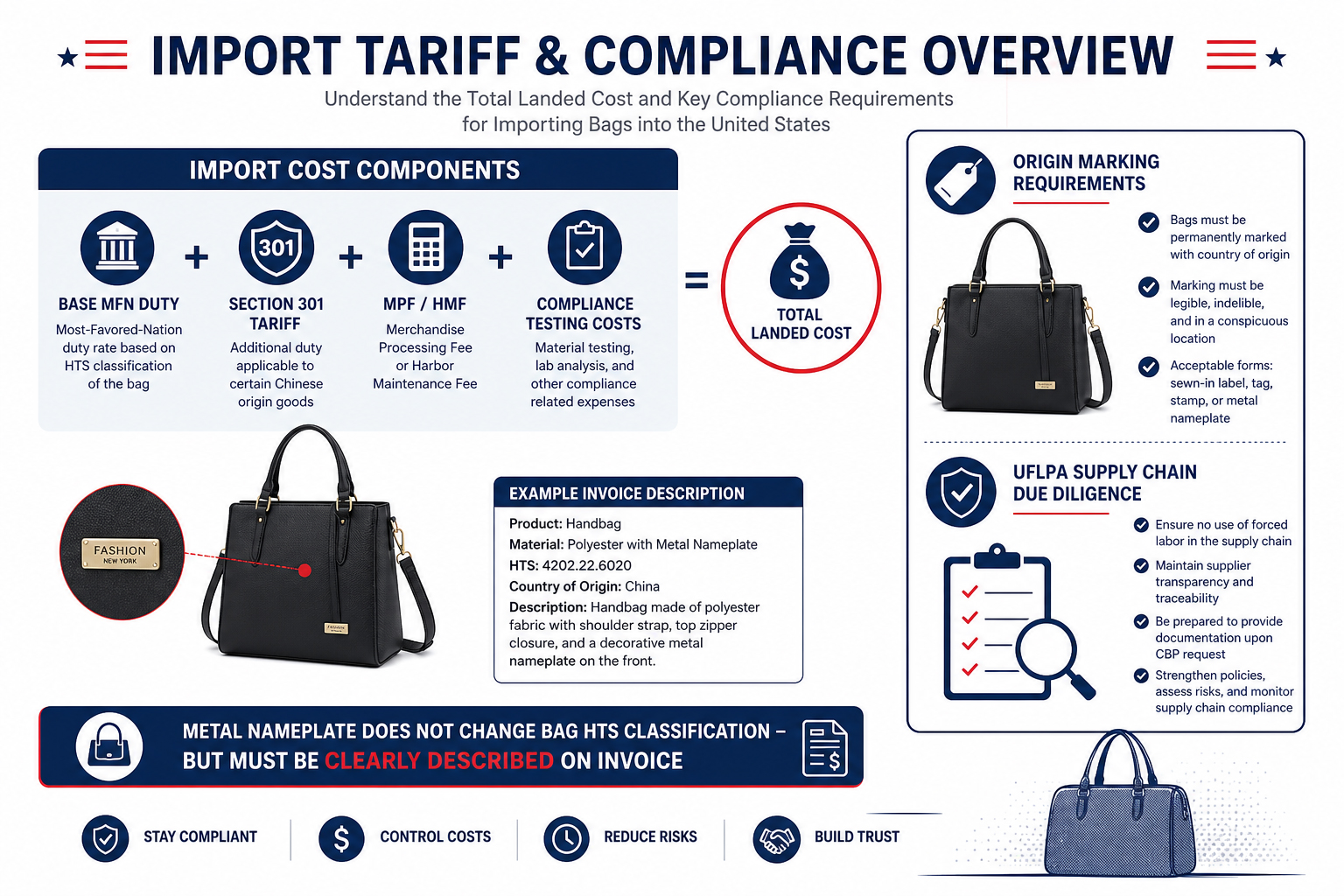
Additional costs you may encounter during import include base MFN (Most Favored Nation) customs duty, Section 301 punitive tariffs, Merchandise Processing Fee (MPF), and Harbor Maintenance Fee (HMF) for ocean freight shipments. Bonded warehouse storage is a widely used strategy for US bag importers. You can store imported bags inside a US bonded warehouse and defer duty payments until you pull inventory out for distribution and sale. Another legal valuation method is First Sale for Export, which can reduce your dutiable value for China-origin bag shipments and lower overall tariff expenses when properly documented by your customs broker.
One critical rule you cannot ignore is country of origin marking, enforced by both CBP and the Federal Trade Commission (FTC). Every imported bag must carry clear, permanent English marking stating “Made in China”. Your metal brand logo or metal nameplate cannot replace this mandatory origin label. The origin marking can be printed on sewn interior labels, permanent hang tags, or other CBP-approved locations, and it must remain visible to end buyers. Improper origin marking will result in cargo holds or fines.
Another mandatory regulation is the Uyghur Forced Labor Prevention Act (UFLPA). US importers must conduct due diligence to verify all bag components, including metal nameplates and metal hardware, are not manufactured with restricted inputs linked to forced labor. CBP can seize shipments that lack adequate supply chain traceability records.
2.Section 301 Tariff Rate for Bags with Metal Accessories from China
Section 301 tariffs are additional duties applied to goods originating in China, stacked on top of the standard base customs duty. Most bag products under HTSUS Chapter 4202 fall under Section 301 tariff coverage. The common rate for many bag categories is 25%. Some subcategories carry lower rates from 7.5% up to 25%, depending on the exact 10-digit HTSUS code assigned to your bag.
Important to clarify: IEEPA tariffs and Section 232 metal tariffs do not apply to finished imported bags, even if your bags include attached metal nameplates. Section 232 metal tariffs target raw metal and metal mill products, not finished consumer goods assembled with small metal decorative parts. The metal nameplate alone will not trigger separate metal tariffs.
The tariff landscape between the US and China continues to evolve. As of the latest 2026 updates, US tariff frameworks also include a temporary 10% tariff under Section 122, while older IEEPA tariffs have been lifted. The final applicable tariff rate is determined by your shipment entry date and the active presidential and CBP rules at the time of customs filing.
A simple example for textile bags can be calculated as:
Base HTSUS customs duty + Section 301 tariff + applicable temporary surcharge + customs processing fees
Never rely on your Chinese supplier’s verbal claim such as “bags have zero duty”. Suppliers often do not understand US customs rulings. Always confirm your 10-digit HTSUS classification and total landed duty cost with a licensed US customs broker before confirming purchase orders. CBP publishes official tariff rulings; for reference, one CBP ruling assigned man-made fiber bags a base general duty rate of 17.6% plus an extra 25% Section 301 tariff. A separate ruling classified nylon backpacks under HTSUS 4202.92.1500.
Tariff calculation directly impacts your product pricing strategy on your independent website. Many US bag sellers underestimate landed costs and end up with slim profit margins after customs clearance. Work with your broker to build a full landed cost model covering product cost, ocean/air freight, insurance, duties, customs fees, warehousing and last-mile delivery.
3.Correct HTSUS Code for Bags with Attached Metal Nameplates at US Customs
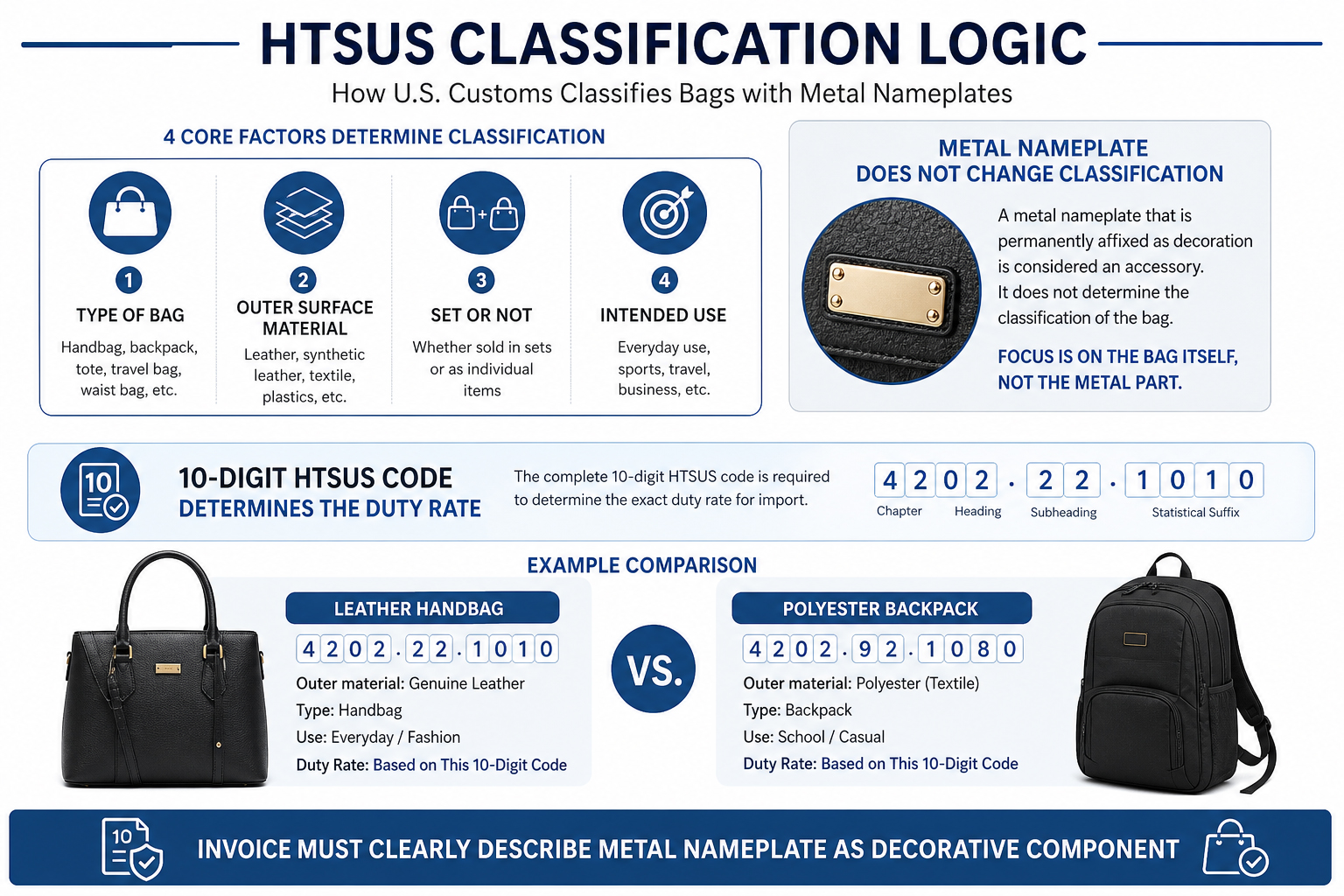
Nearly all handbags, backpacks, tote bags, luggage cases and wallets fall under HTSUS heading 4202. The metal nameplate does not change the HTS classification of your finished bag. CBP classifies the complete bag as one product, based on four core factors:
* Bag type: handbag, backpack, travel luggage, wallet, crossbody bag, tote
* Outer surface material: genuine leather, PU, PVC, nylon, polyester, cotton or other textile
* Whether the item is sold as a matched set with extra accessories
* Product construction and intended consumer use
You, as the US importer of record, are responsible for declaring the correct 10-digit HTSUS code to US Customs. Your Chinese supplier can provide recommended HS codes and supporting product information, but the final classification liability sits with the US importer. Customs brokers will validate the code against CBP rulings to reduce audit risk.
Do not use a generic 4202 heading. The 10-digit subheading determines your exact base duty rate and whether Section 301 duties apply. Two bags under the same 4202 chapter can have different tariff rates if their outer materials differ. For example, leather handbags and polyester backpacks use different 10-digit codes.
When preparing commercial invoices for customs filing, clearly describe the metal nameplate. Write details such as “finished polyester backpack with attached engraved zinc alloy metal nameplate (decorative branding only)”. This description tells CBP officers the metal piece is a decorative component, not standalone metal merchandise, preventing misclassification during inspection.
4.De Minimis $800 Shipment Exemption: No Longer Available for China Shipments
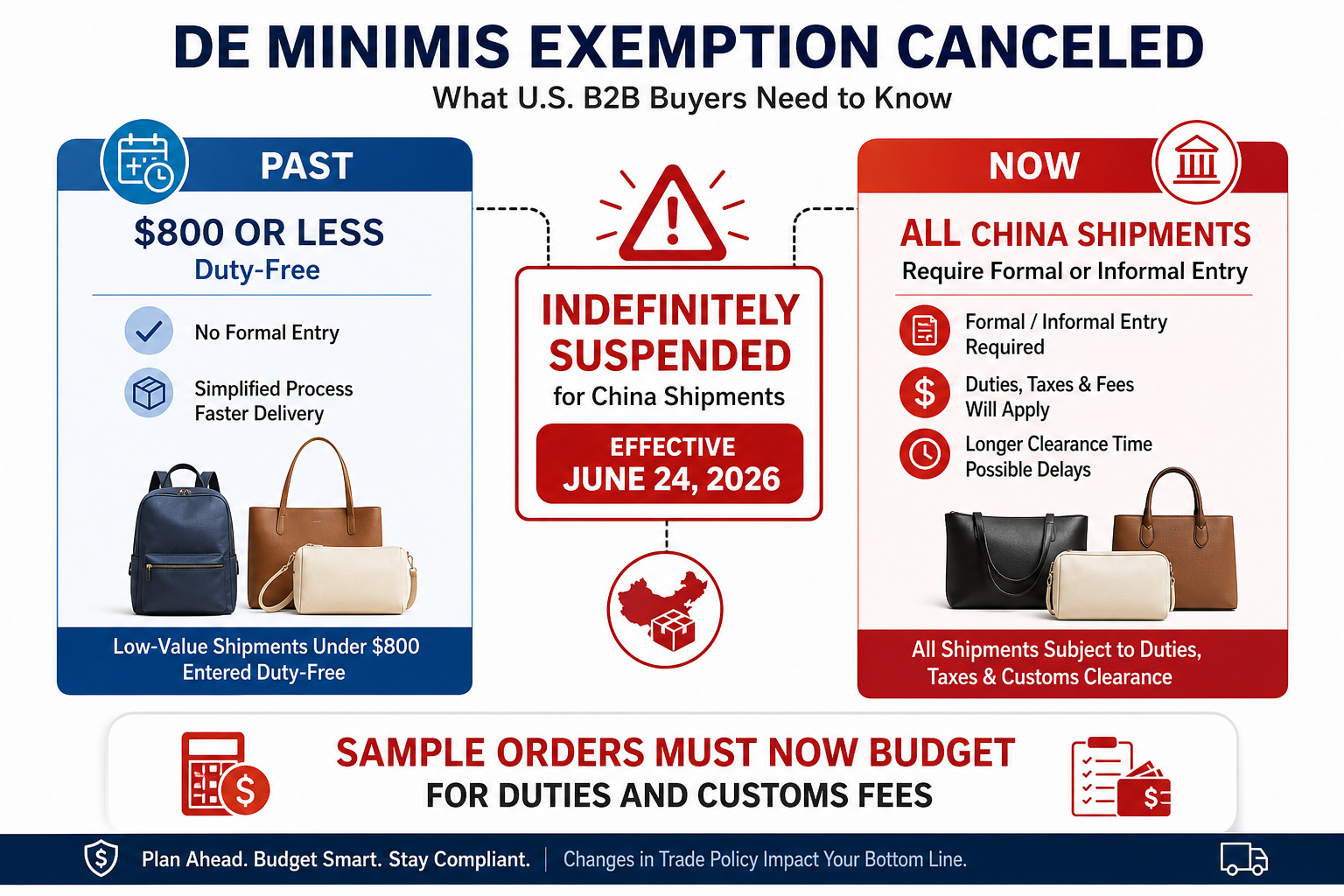
The Section 321 de minimis exemption previously allowed shipments valued at $800 or less to enter the US duty-free, without formal customs entry. This exemption has been indefinitely suspended for goods shipped from China, effective June 24, 2026.
This rule change is extremely important for independent website sellers who order small sample batches, trial inventory and low-volume test shipments from Chinese factories. Even small shipments of sample bags fitted with metal nameplates no longer qualify for duty and tax exemption. All shipments from China, regardless of value, require formal or informal customs entry, applicable duties, tariffs and associated customs processing charges.
Many US bag merchants used to leverage low-value sample shipments to test new styles before bulk orders. That strategy no longer works. When planning sample orders, budget for customs entry fees and duties, just as you would for full container shipments. Discuss sample shipping plans with your freight forwarder and customs broker to avoid unexpected delivery holds.
5.US Compliance Rules for Metal Nameplates on Imported Bags: Prop 65, CPSIA & Heavy Metal Restrictions
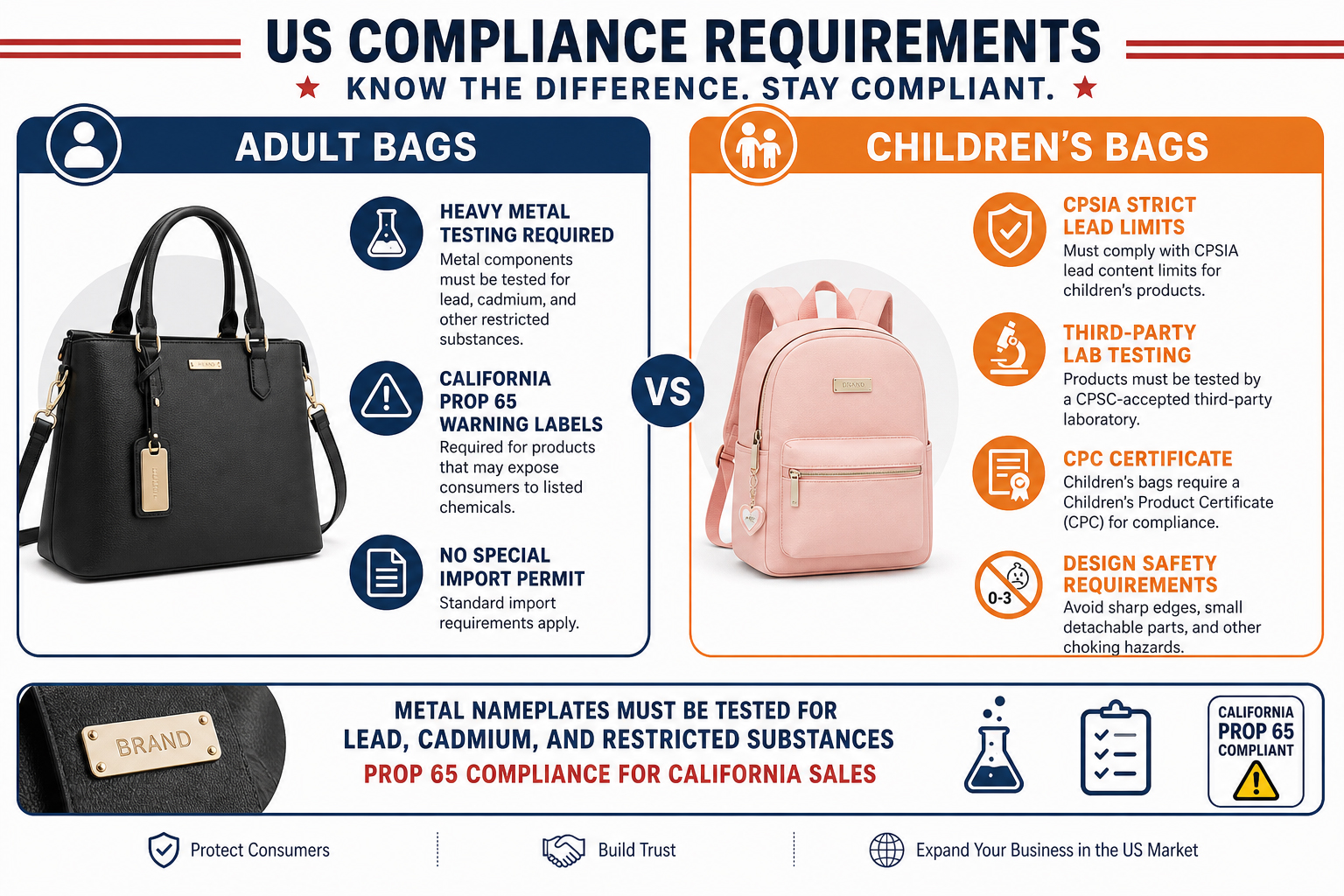
For adult-use bags, permanently attached metal nameplates do not require special import permits. However, US compliance rules vary widely depending on whether your product targets adult consumers or children. State-level requirements also differ, with California Proposition 65 being one of the most widely known regulations for imported consumer goods.
Adult Bags
Metal nameplates must meet heavy metal limits for lead, cadmium and other restricted substances. If your metal plate contains hazardous chemicals above threshold levels, you may need to add warning labels, especially for California sales under Prop 65. Prop 65 is a California state law, not a federal rule. It requires businesses to provide clear warnings to California consumers if products expose users to listed chemicals above safe harbor thresholds. Many online stores ship nationwide, including California, so most US bag brands choose to test metal hardware and add compliant warning labels to avoid lawsuits.
Children’s Bags
If your bags are marketed for children, CPSIA (Consumer Product Safety Improvement Act) applies. CPSIA enforces strict lead content limits for all accessible components of children’s products, including metal nameplates and metal hardware. You need third-party laboratory testing and a Children’s Product Certificate (CPC) before importing and selling kids’ bags. Non-compliant children’s bags can be detained at the port, recalled, or banned from US sales.
Additional safety checks for metal nameplates: avoid sharp edges and easily detachable small metal parts. Detachable small metal pieces create choking hazards, especially for children’s merchandise. Trademark compliance is another key point. If your metal nameplate uses third-party brand logos without authorization, CBP can seize your entire shipment of counterfeit or infringing goods.
6.Information to Request from Your Chinese Bag Supplier Before Production & Shipment
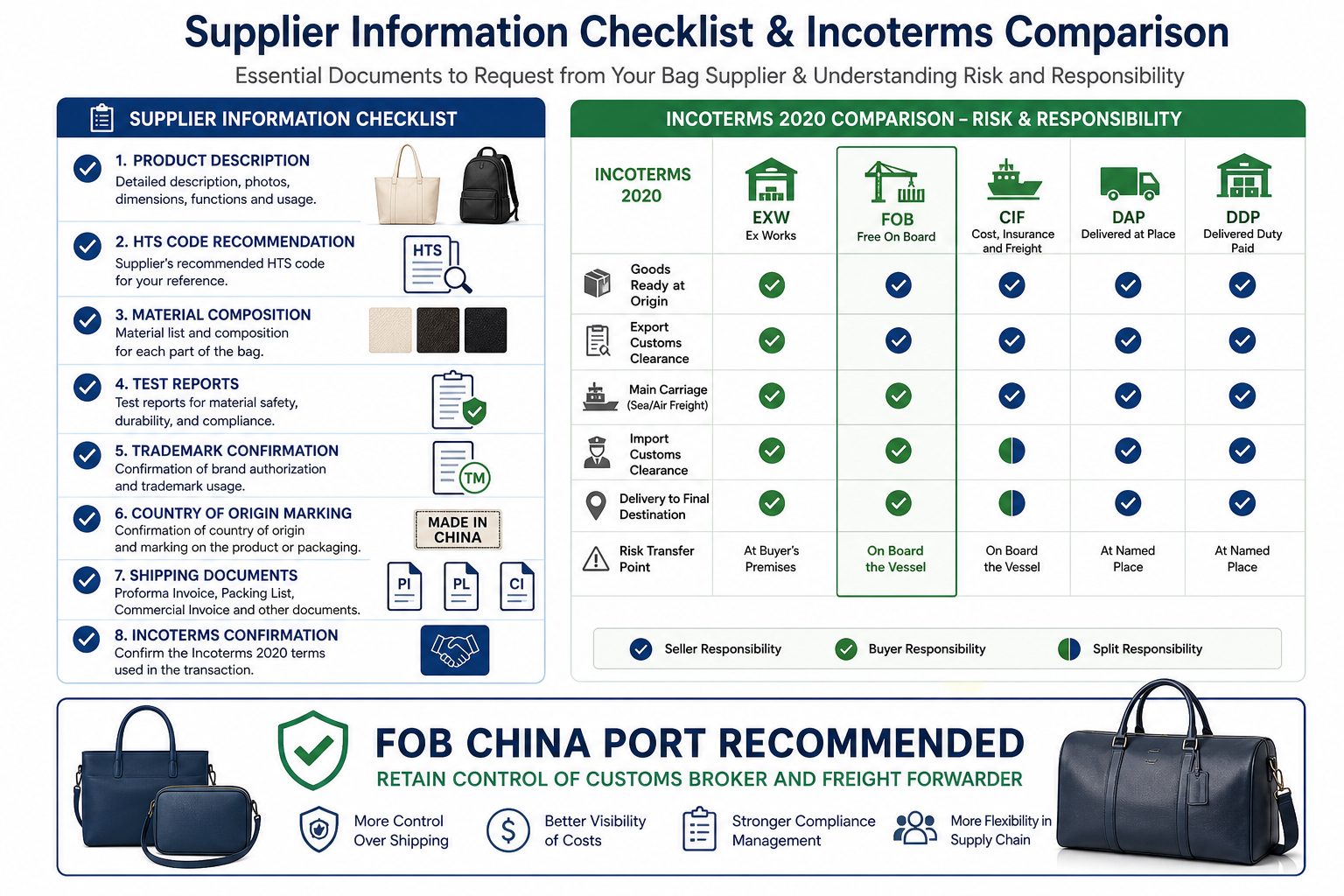
Before confirming mass production with your Chinese factory, collect the following data for every bag style. This information supports customs filing, tariff review and compliance testing:
* Full product description and intended end user (adult / child)
* Outer material type and material percentage composition (PU, nylon, polyester, genuine leather etc.)
* Recommended 10-digit US HTSUS classification code for customs review
* Country of origin confirmation: Made in China
* Material composition of the metal nameplate (zinc alloy, stainless steel, aluminum etc.)
* Test report confirmation that metal nameplates do not contain lead, cadmium or restricted substances exceeding US limits
* Trademark confirmation: no unauthorized third-party logos on metal nameplates or bag bodies
* Confirmation that bags can carry permanent “Made in China” origin marking
* Full shipping documents: commercial invoice, packing list, carton dimensions, net weight, gross weight and accurate customs value
* Agreed Incoterm: EXW, FOB, CIF, DAP or DDP
Discuss Incoterms clearly in your purchase contract, because Incoterms define who bears transportation, customs clearance and duty risk:
* EXW: US buyer covers nearly all costs and risks starting from the Chinese factory gate
* FOB China port: Supplier completes export procedures; US buyer pays ocean/air freight, US customs clearance and all duties
* CIF: Supplier pays ocean freight and insurance to US port; US buyer manages import clearance and duties
* DAP: Supplier delivers goods to your US destination address; US buyer is responsible for import duties and taxes
* DDP: Supplier takes responsibility for duties and delivery to your warehouse. Warning: verify the importer of record carefully; DDP arrangements carry legal and compliance risks for US importers.
For most US independent website bag sellers, FOB China port is the most transparent and low-risk option. You retain control over your US customs broker and freight forwarder. Be cautious of DDP quotes, as some overseas suppliers cut corners on customs declarations or compliance documentation.
Conclusion
Sourcing bags with metal nameplates from China can create excellent profit potential for your US independent website store, but success depends on solid customs planning and product compliance. Remember these core takeaways:
* The finished bag uses HTSUS 4202 series codes; metal nameplates do not create separate classification.
* Section 301 tariffs apply to most China-origin bags, stacked on base customs duty.
The $800 Section 321 de minimis exemption is no longer available for shipments from China.
* Metal nameplates require heavy metal testing. California Prop 65 applies for sales into California, and CPSIA is mandatory for children’s bags.
* “Made in China” permanent origin marking and UFLPA supply chain due diligence are mandatory.
* Always partner with a licensed US customs broker to confirm HTS codes and calculate full landed cost before placing bulk orders.
By asking your Chinese supplier for complete material, testing and customs documentation, and working with a trusted US customs broker, you can avoid shipment delays, unexpected tariff bills and compliance penalties. This process protects your e-commerce brand reputation and keeps your bag inventory moving smoothly from Chinese factories to your US warehouse and online customers.
Post time: Sep-17-2026