
Custom Bag Logo Printing: Choose The Right Branding Method For Trial & Bulk Orders
Published for US bag e-commerce merchants sourcing custom bags from China manufacturers
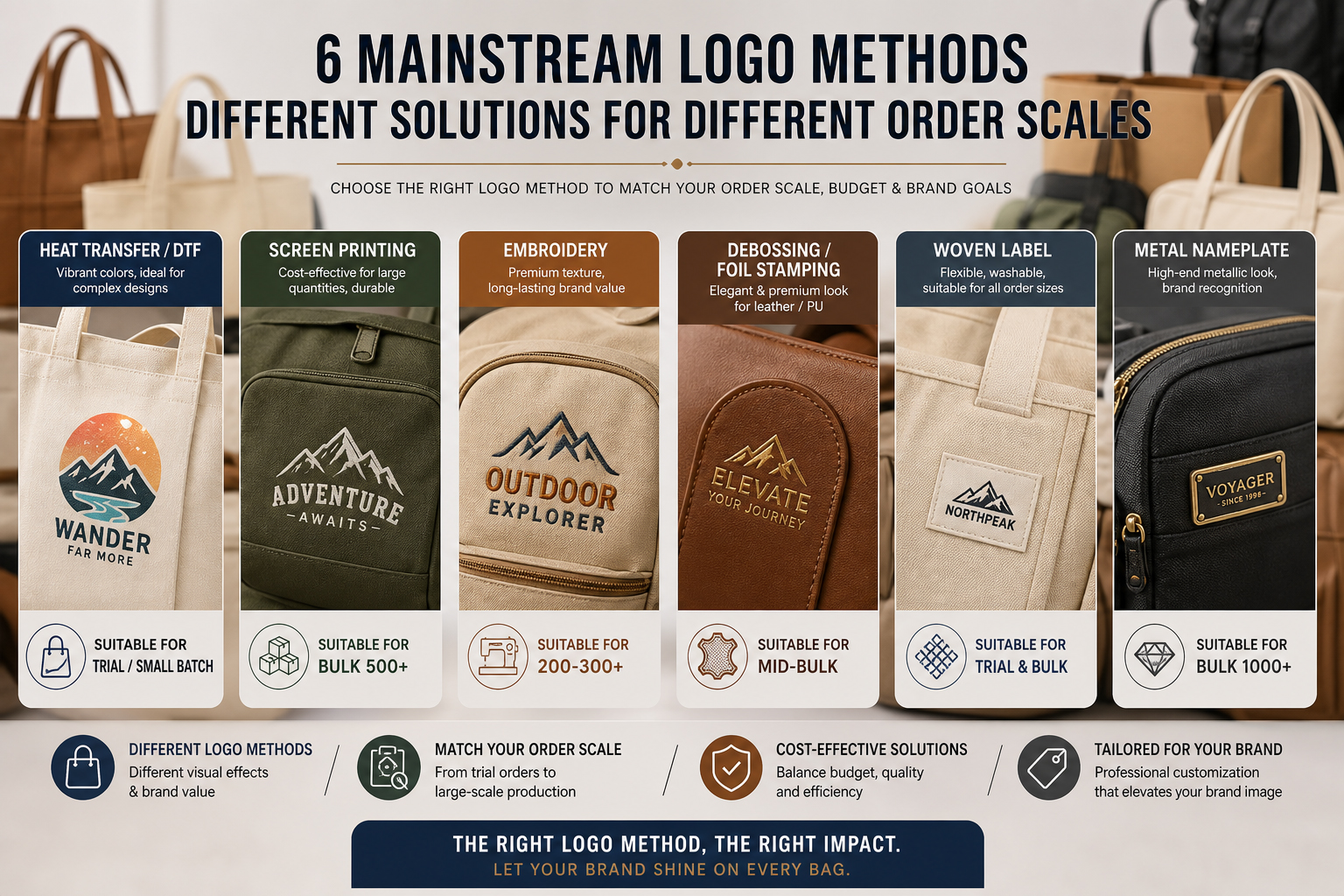
When you run an online bag store, custom branding is what turns blank stock bags into sellable products that build customer loyalty. Every bag style, from canvas totes and backpacks to PU leather handbags, relies on well-executed logos to communicate your brand identity. One of the most common pain points for US bag buyers sourcing directly from Chinese factories is selecting the proper logo application method. The branding solution that works perfectly for a small trial run may not remain cost-effective once you scale into large bulk production.
Many new importers make the costly mistake of locking into a logo technique before fully understanding tooling fees, minimum order quantities, lead times, color consistency, and durability performance. Choosing incorrectly can lead to inflated sampling costs, mismatched logo colors between pre-production samples and bulk shipments, peeling graphics, delayed delivery, or wasted inventory when your branding fails to meet market expectations.
This guide breaks down all major logo application options for custom bags, compares performance for small trial orders and large bulk production, answers critical sourcing questions, and shares a practical buying strategy for US independent website sellers importing bags from China.
Core Questions Every US Bag Importer Must Ask Chinese Suppliers
Before diving into each logo technology, let’s review the key questions you need to clarify with every potential factory partner. These are the exact concerns that will come up during your sourcing negotiations and pre-production approval process.
* Which logo application method is most suitable for small trial orders versus large bulk production runs?
* How long does production take for small trial samples versus full bulk orders using each logo method?
* Will the logo color, finish, and placement on the bulk order match exactly what was approved on the trial sample?
* Can the same Chinese supplier handle both small trial orders and large bulk production runs with consistent quality?
* Should the logo method be locked in before the trial run, or can it be switched between the sample and bulk production to reduce cost?
All these points tie back to setup costs, tooling requirements, production workflow, and quality control systems inside Chinese bag factories. No single logo technique is universally best. Your decision depends on order volume, bag material, logo complexity, color count, brand positioning, and your budget.
Overview of Logo Application Methods: Trial Order vs Bulk Run Suitability
Let’s start with a high-level summary of each branding method and where it fits within your product roadmap.
Sublimation and heat transfer are the most suitable methods for small trial orders because of low setup costs and no mandatory tooling fees. Screen printing becomes the most economical option for bulk runs above 500 units on canvas and cotton bags. Embroidery works well for both small and bulk orders but scales efficiently only above 200 to 300 units. Debossing and metal nameplates are poorly suited for small trials due to high tooling and die costs. Woven labels and printed labels are practical for both trial and bulk, with MOQ flexibility around 100 pieces.
Stock blank bags can be sourced at very low MOQ and customized with low-cost branding methods for test marketing. Combination branding (printed logo plus woven label) is often used in bulk runs to balance cost and durability. Silk screen printing mixed with sublimation is commonly offered by Chinese factories for flexible small-batch orders. Metal nameplates remain reserved for premium collections and bulk runs exceeding 1,000 units.
Recommended Logo Method by Order Size
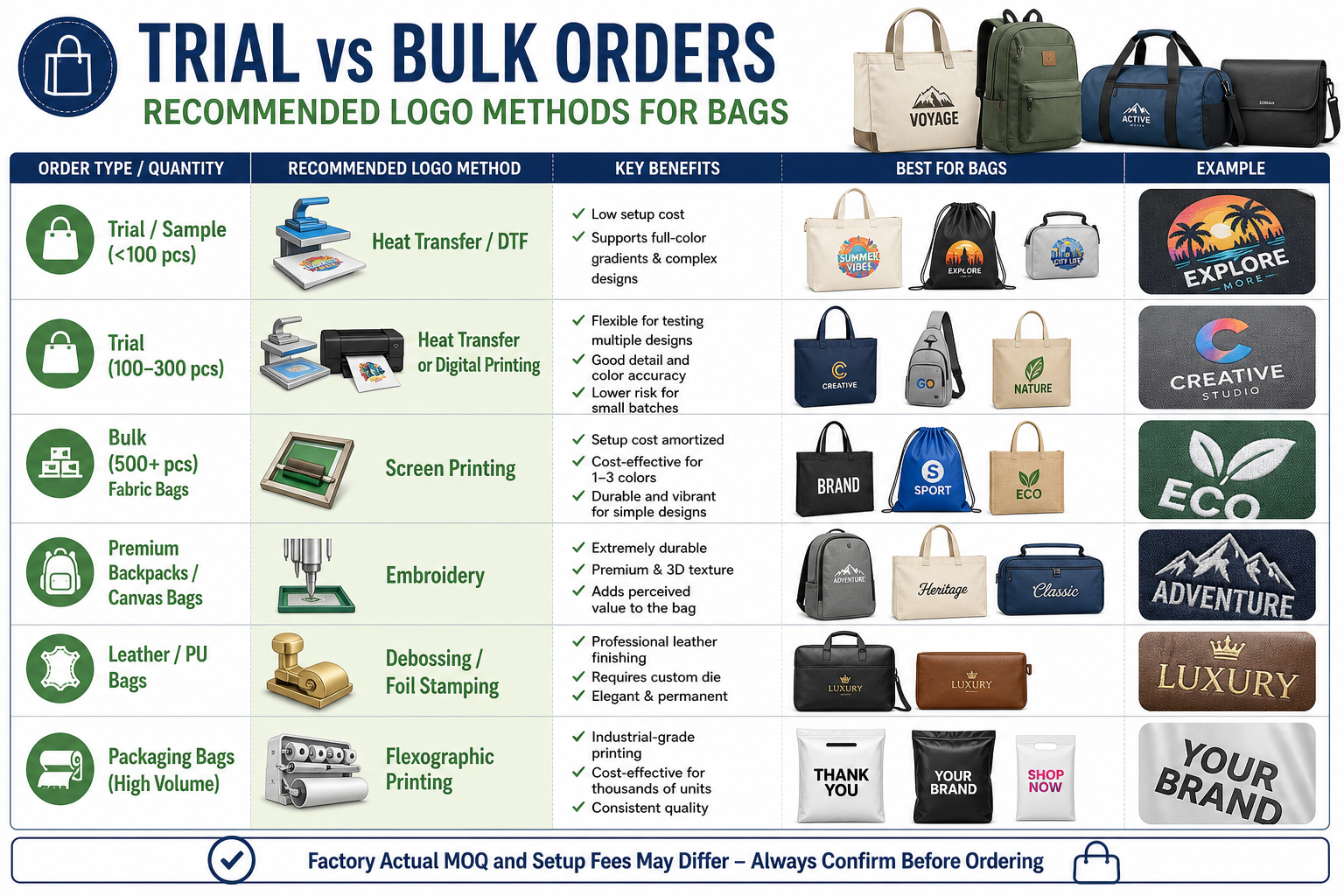
These are general guidelines; the Chinese factory’s actual MOQ and setup charges may differ. Always confirm setup fees, artwork requirements, and lead times before committing to a sample.
Deep Dive Into Each Logo Application Technology
Heat Transfer / DTF (Direct-to-Film) Printing
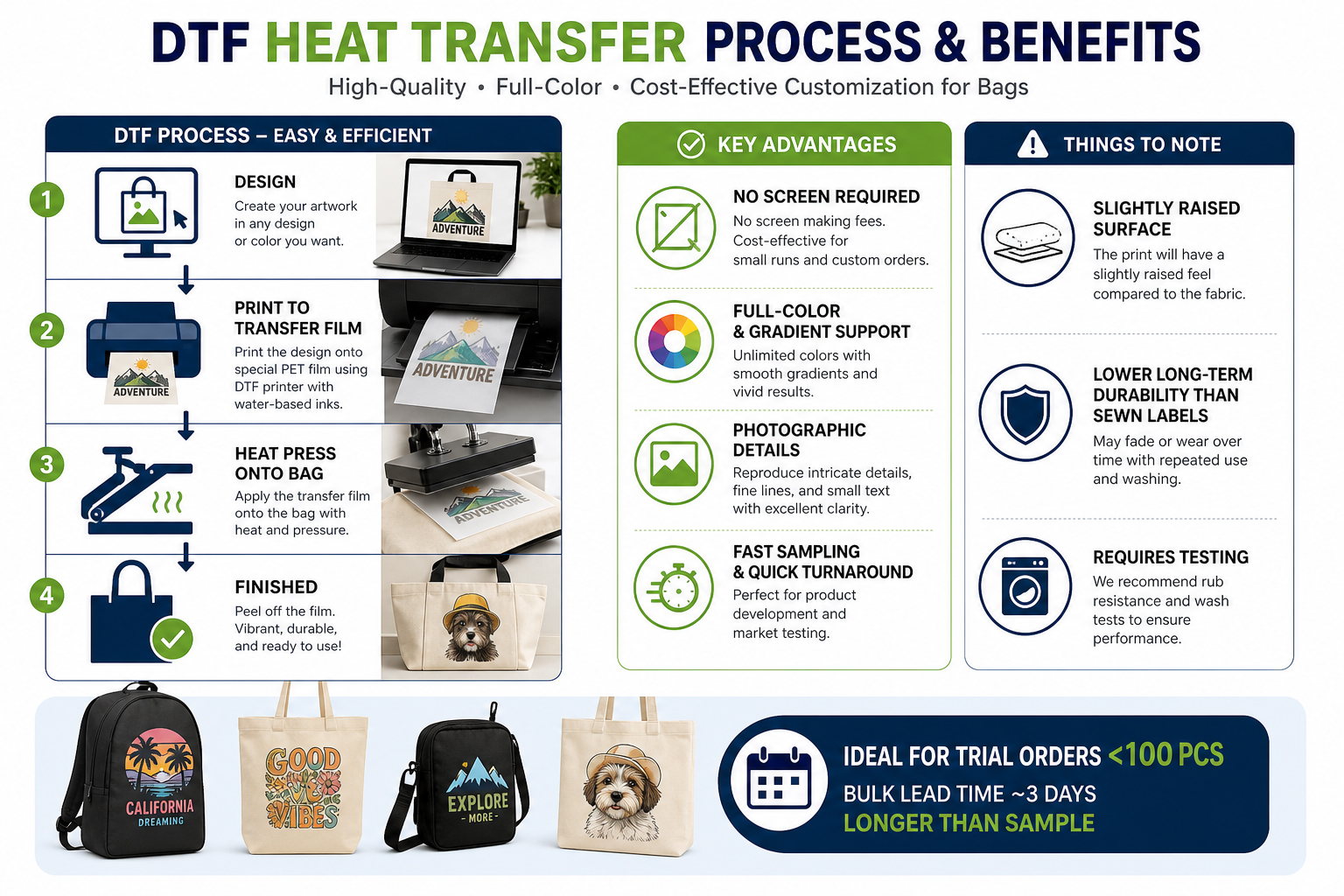
For most US merchants launching a new bag line, heat transfer or DTF is usually the safest choice for your first trial order. The logo is printed onto a special film and then applied to the bag surface using heat and pressure. The supplier does not need to create a separate screen for each color, which eliminates expensive screen setup charges. This method works extremely well for photographs, color gradients, fine small text, and complex multi-color logos that cannot be reproduced cleanly with traditional screen printing.
Possible disadvantages are a slightly raised or plastic-like hand feel on the fabric surface and lower long-term durability than sewn labels or embossed branding. Before approving mass production, you must ask the factory to complete rub tests and washing tests. These quality checks verify that the printed logo will not peel, crack, or fade after repeated customer use.
Lead time note: Small trial samples with DTF branding have very fast turnaround. Bulk production lead time will typically differ from sample lead time by around 3 days, as factories adjust workflow and quality checks for larger quantities.
Screen Printing
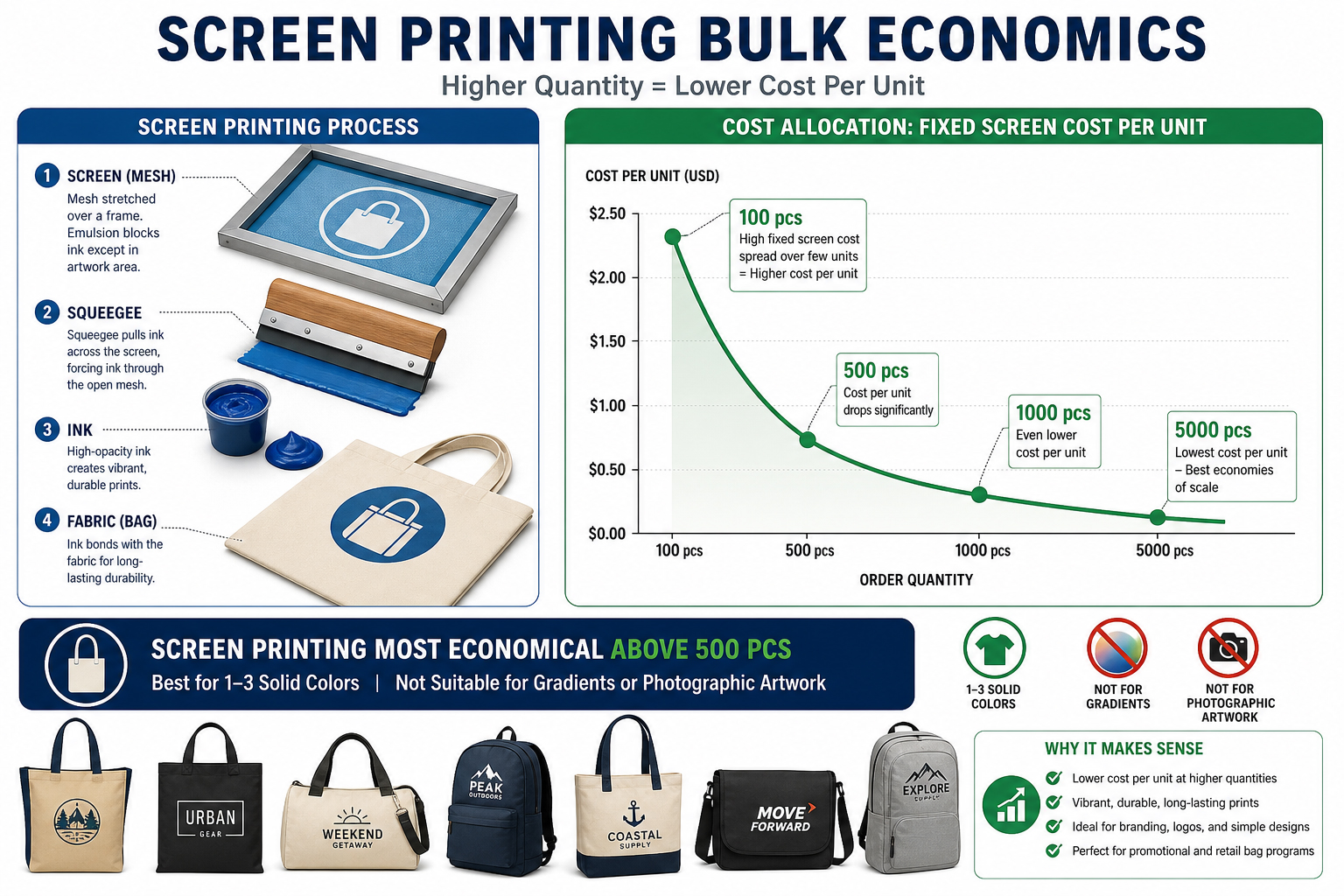
Screen printing is normally the best value for large quantities of canvas, cotton, non-woven, or polyester bags when your logo uses solid colors and simple shapes. Each separate color in your logo requires an individual screen. Multiple-color artwork will increase your one-time setup charges.
A perfect use case is a one-color white logo printed on 1,000 black canvas tote bags. This keeps screen costs low and unit pricing attractive. Photographic logos with shadows and smooth gradients are not ideal candidates for screen printing.
Screen printing shines in bulk because fixed screen costs get amortized over hundreds or thousands of units. For small trial orders under 300 units, screen printing becomes expensive because you still pay screen fees for only a small number of finished bags.
Embroidery
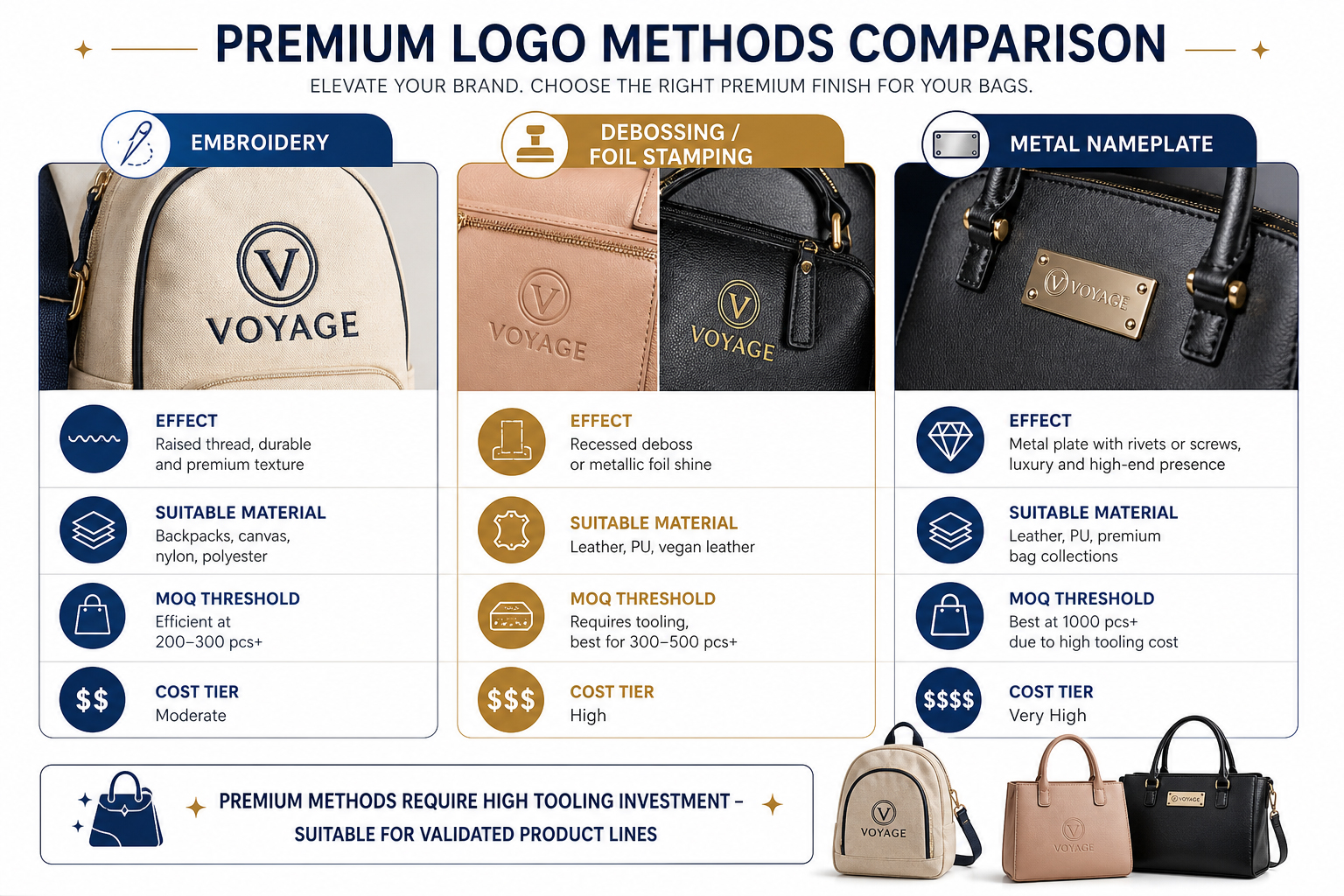
Embroidery is appropriate for backpacks, duffel bags, canvas bags, and premium corporate merchandise. It delivers outstanding durability and a premium raised texture that many consumers associate with high-quality bags. However, highly detailed logos and tiny lettering may not reproduce clearly in embroidery. Heavy embroidery can also add weight and stiffness to thin fabrics.
If you select embroidery, always request the factory’s embroidery digitizing proof before production. Digitizing converts your vector artwork into stitch files, and errors here create distorted logos on finished bags. Embroidery works for small trials, but cost efficiency improves significantly at order sizes of 200–300 pieces and above.
Debossing, Embossing & Foil Stamping
For leather or PU handbags, wallets, and premium accessories, debossing or embossing often looks more luxurious than printing. The logo is pressed into the material surface without adding ink or thread, creating a subtle high-end finish. The downside is that the supplier must manufacture a custom metal die for your logo. This tooling cost makes debossing and embossing poor options for small test orders.
Foil stamping adds metallic gold or silver color onto leather and PU, but foil can wear away quickly on high-contact areas of a bag that customers grip and handle daily.
Woven & Printed Fabric Labels
Woven labels and printed sew-in labels are flexible branding options that fit both trial and bulk production, with MOQ starting around 100 pieces. Many bag brands combine a printed exterior logo with a woven label sewn inside the bag. This combination branding strategy balances production cost, brand presentation, and long-term durability for bulk orders. Woven labels stay popular because they hold up well to wear and washing, and they add a professional finished look to any bag.
Metal Nameplates
Metal nameplates are reserved for premium product lines and large bulk orders, usually over 1,000 units. Custom metal stamping requires expensive tooling, which makes small trial runs financially impractical. Metal plates are screwed or riveted onto bags and deliver a strong luxury aesthetic, but they add cost and production complexity.
Sublimation
Sublimation infuses dye directly into polyester fabric fibers. The logo becomes part of the material itself instead of sitting on top. Sublimation has no raised texture and excellent fade resistance. It works best on polyester tote bags and drawstring backpacks. It is a good choice for small trials because setup costs are low, but it cannot work on cotton, canvas, PU, or leather materials.
Flexographic Printing
Flexographic printing is an industrial high-volume process used mainly for paper and plastic packaging bags. It only becomes cost-effective at volumes of thousands of pieces, so it is rarely selected for custom fabric bag projects for US independent website sellers.
Production Lead Time: Trial Samples vs Bulk Orders
One of the most frequent questions from US buyers concerns production timelines. Factories generally quote separate lead times for pre-production samples and full bulk orders. For most logo application methods, production lead time for small trial samples and full bulk orders will differ by roughly 3 days.
The small sample run moves quickly because the factory only needs to prepare your logo file and produce a limited number of units for approval. Bulk production requires material preparation, mass cutting, assembly, logo application across the full batch, full inspection, and packing. This extra workflow explains the typical 3-day difference between sample lead time and bulk lead time.
This timeline rule applies to DTF, screen printing, embroidery, and label branding. Processes requiring custom metal dies, such as debossing and metal nameplates, will have longer sample lead times because die fabrication itself takes extra days.
Color, Finish & Placement Consistency Between Sample & Bulk
Color matching and logo positioning are top risks when importing custom bags from overseas manufacturers. Reputable Chinese bag factories can guarantee that the logo color, surface finish, and placement on bulk orders will match exactly what you approved on the trial sample.
To lock in consistency, you must complete these steps:
* Approve a physical pre-production sample before bulk manufacturing starts. Do not rely only on digital renderings.
* Confirm Pantone color codes for every logo color and note required finish (matte, glossy, raised, recessed).
* Mark precise logo placement measurements on your technical drawing, including distances from seams, edges, and zippers.
* Request colorfastness, rub test, and peel test reports for your selected logo method.
* Include sample matching requirements inside your sales contract with the factory.
Even with strong controls, minor variations can occur. Defined quality tolerance rules should be agreed before production begins so both parties understand acceptable deviations.
Maintaining Consistent Quality Across Small Trials & Large Bulk Orders
Another key concern: can the same Chinese supplier handle both small trial orders and large bulk production runs with consistent quality?
The answer depends on factory setup. Many bag manufacturers support both small sampling/trial orders and mass bulk production while maintaining stable quality standards. Factories with dedicated sample rooms, standardized QC checklists, fixed logo application SOPs, and trained production teams can replicate the same quality level whether producing 50 pieces or 5,000 pieces.
However, not all factories are structured this way. Some workshops only focus on huge bulk orders and treat small trial runs as low-priority side work. Others specialize in small-batch custom bags and lack the capacity or equipment to scale smoothly into large bulk production. This is why supplier vetting is critical.
When interviewing suppliers, ask for references from other US online bag sellers who scaled from trial orders to bulk reorders. Confirm whether the factory uses the same logo application equipment and QC team for both sample room and mass production lines.
Switching Logo Methods Between Trial & Bulk
Should the logo method be locked in before the trial run, or can it be switched between the sample and bulk production to reduce cost?
You are allowed to change logo techniques after successful trial sales, and this is a very common cost-saving strategy for independent website merchants. For example, you may launch a 50-piece trial order using DTF heat transfer because the setup cost is minimal. Once the bag design sells well on your website and you place a 600-piece reorder, you can switch to screen printing for lower per-unit branding cost.
There is one important caveat: if you switch logo methods, you will need a new pre-production sample for bulk approval. DTF and screen printing reproduce artwork differently, so color, texture, and detail may change. You cannot assume the DTF sample will perfectly represent the screen printed bulk product. Plan for this extra sampling step when changing branding technology.
Essential Checklist to Send to Chinese Bag Factories
When you contact suppliers, send this set of questions to every factory quotation request. This eliminates ambiguity and prevents unexpected fees or quality issues.
* “For my quantity of ___ pieces, which logo method do you recommend and why?”
* “What is the setup, screen, digitizing, or mold fee?”
* “Is the setup fee paid once per design or once per color?”
* “What is the MOQ for each logo method?”
* “Can you provide a physical pre-production sample?”
* “What are the rub, wash, peel, and colorfastness test results?”
* “What artwork format do you need—AI, PDF, EPS, or vector file?”
* “Will the logo color be matched to Pantone ___?”
* “What happens if the logo is misaligned, peeling, cracked, or the color is incorrect?”
* “Can the same screen, embroidery file, or mold be reused for my repeat order?”
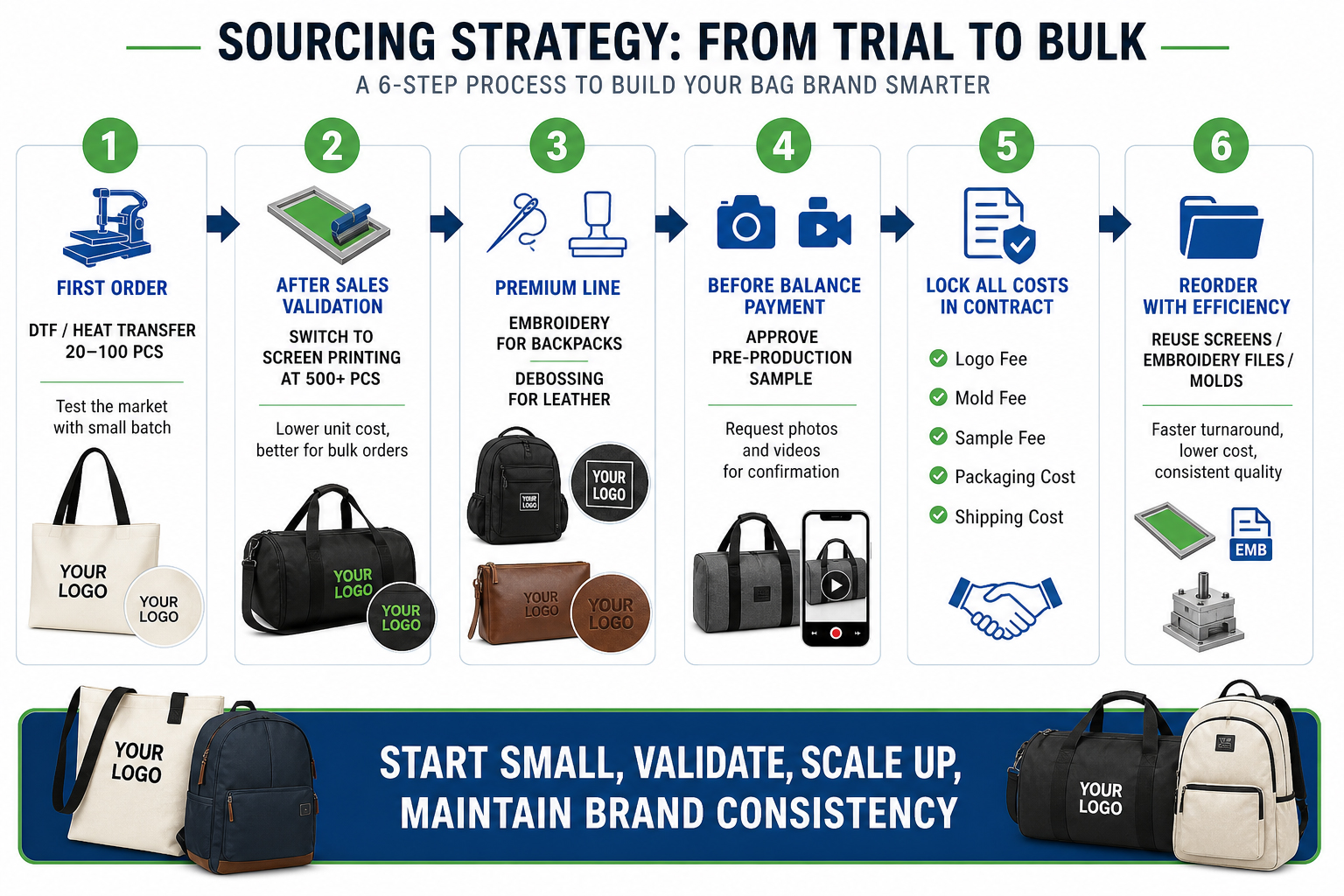
Practical Sourcing Strategy For US Independent Website Bag Sellers
For your website bag business, use this step-by-step approach to test products and scale profitably.
First order: choose heat transfer/DTF for 20–100 pieces, unless the factory requires a higher minimum. This low-risk trial lets you test market demand without heavy upfront tooling investment. You can test multiple logo designs and bag styles with limited capital.
After the design sells: change to screen printing for simple logos when ordering roughly 500 pieces or more. At this volume, screen printing reduces per-unit branding cost for solid-color logos.
Premium product line: use embroidery for backpacks and debossing for leather or PU products. These premium branding techniques support higher retail price points on your website.
Before paying the balance: approve a pre-production sample and require photos or video showing logo placement and quality. Never authorize full bulk production without signed sample approval.
Do not compare only the unit price of blank bags. Ask for the complete landed quotation: bag price, logo fee, tooling fee, sampling fee, packaging, inspection, shipping, and any applicable import costs. Many new importers overlook hidden fees, which can destroy profit margins on your online store.
Final Thoughts
Custom logo branding is one of the most impactful decisions when sourcing bags from China for your US website store. DTF / heat transfer is the flexible, low-risk option for small trial orders to validate product demand. Screen printing delivers the best value for large bulk fabric orders with simple solid-color logos. Embroidery creates a premium durable finish suitable for backpacks and canvas goods. Debossing and metal nameplates serve luxury product lines but require high tooling investment.
Work closely with your factory to confirm lead times, color matching rules, QC standards, and all associated fees before starting production. With careful selection of your logo application method, you can launch small test batches efficiently and scale smoothly into large bulk orders while keeping consistent brand quality across your entire catalog.
Post time: Sep-16-2026