
Introduction: Why the Stitch Type on Your Bag Matters More Than You Think
When you browse a bag supplier’s catalog on Alibaba or a Chinese B2B platform, almost every listing will claim “high quality” and “durable construction.” But what does that actually mean? Behind the marketing language, the difference between a bag that lasts five years and one that falls apart after five months usually comes down to one thing: the sewing.
As a U.S.-based bag buyer sourcing directly from Chinese factories, understanding the technical side of bag construction isn’t just a “nice to have” — it’s the foundation of your brand reputation, your return rate, and your customer reviews. After years of importing bags and working with dozens of factories across Guangzhou, Yiwu, and Quanzhou, I’ve learned that the most overlooked quality indicator isn’t the leather grade, the zipper brand, or the hardware finish. It’s the stitch type, stitch density, and reinforcement at stress points.
In this guide, I’ll walk you through everything you need to know about industrial lockstitch sewing for bags — the same questions I ask every new factory before placing a production order. By the end, you’ll be able to evaluate any supplier’s sewing capability, communicate your requirements clearly, and avoid the most common quality disasters that plague imported bags.
Let’s dive in.
1. What Is Industrial Lockstitch Sewing (And Why Is It the Gold Standard for Bag Production)?
Industrial lockstitch sewing machine stitching leather bag panels in a Chinese factory workshop
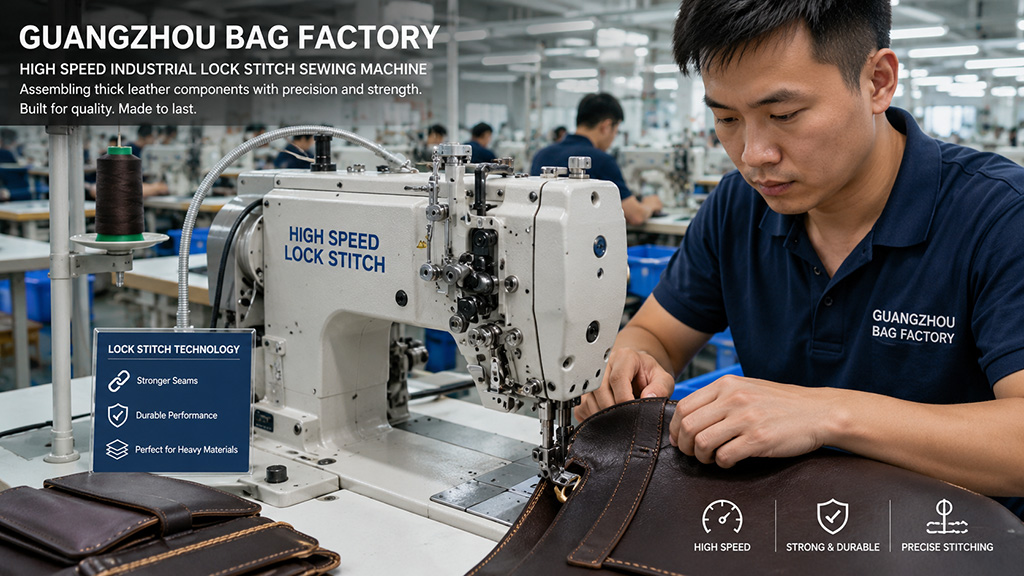
Industrial lockstitch sewing is the most common stitching method used in professional bag manufacturing. It uses two threads — one from the top (needle thread) and one from the bottom (bobbin thread) — that interlock inside the fabric layers. This creates a tight, balanced stitch that looks identical on both sides of the seam.
Unlike hand stitching or simpler machine stitches, the lockstitch produces a clean, straight, and extremely strong seam that holds up under daily stress, weight load, and repeated use. This is why nearly every premium bag brand — from heritage leather goods to modern nylon backpacks — relies on lockstitch construction.
Where Is Lockstitch Used in Bag Assembly?
In a typical bag production line, lockstitch machines are responsible for:
Sewing main body panels together (front to back, side gussets, bottom panels)
Attaching pockets (interior slip pockets, exterior zip pockets, patch pockets)
Joining linings to the outer shell (around the top opening and at seam intersections)
Setting zippers (most quality bags use lockstitch for zipper tape attachment)
Securing straps, handles, and base reinforcements
If a Chinese factory tells you they use lockstitch for these applications, that’s generally a good sign — it means they’re using professional equipment rather than relying on cheaper overlock or chainstitch-only construction.
Walking Foot vs. Post Bed Lockstitch Machines
Not all lockstitch machines are the same. Two types dominate bag production:
1. Walking Foot Lockstitch Machines — These have a special feed mechanism that grips and pulls thick materials (canvas, leather, PVC, multi-layer assemblies) through the machine evenly. They’re the workhorse of any serious bag factory.
2. Post Bed Lockstitch Machines — These have a vertical post that allows the sewist to maneuver small, curved, or 3D areas like bag corners, gusset folds, and zipper ends. Essential for detailed work.
A factory that has both types on its production floor is far more capable of handling complex bag designs.
2. What Is the Standard Stitch Per Inch (SPI) for Industrial Lockstitch on Bags?
Close-up of lockstitch seam on canvas tote bag showing 8 SPI density
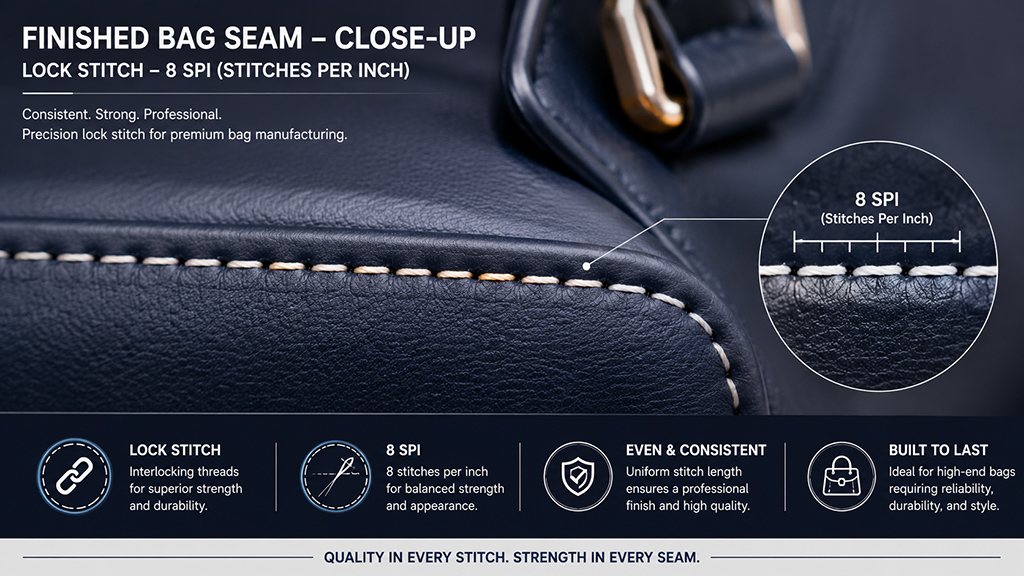
SPI (Stitches Per Inch) is one of the most important quality metrics you can specify when ordering bags. It refers to the number of individual stitches packed into one linear inch of seam. Higher SPI = tighter, stronger, more refined stitching. Lower SPI = looser, faster (and cheaper) sewing.
For bag production, the industry-standard SPI for lockstitch falls in these ranges:
The sweet spot for most quality bags is 7–9 SPI. Below 6 SPI, seams start to look loose and can allow fabric to shift under stress. Above 10 SPI on heavy materials, you risk perforating the material and creating weak points.
How to Verify SPI from a Sample
When a factory sends you a sample bag, count the stitches in one inch with a magnifying glass or ruler. Don’t trust the spec sheet — measure it yourself. Consistency matters just as much as the number. A seam that varies from 6 SPI to 10 SPI along its length is a red flag for poor machine maintenance or inexperienced operators.
3. What Type of Thread Do Chinese Factories Use for Lockstitch Sewing on Bags?
Spools of bonded nylon and polyester thread in a bag factory sewing department
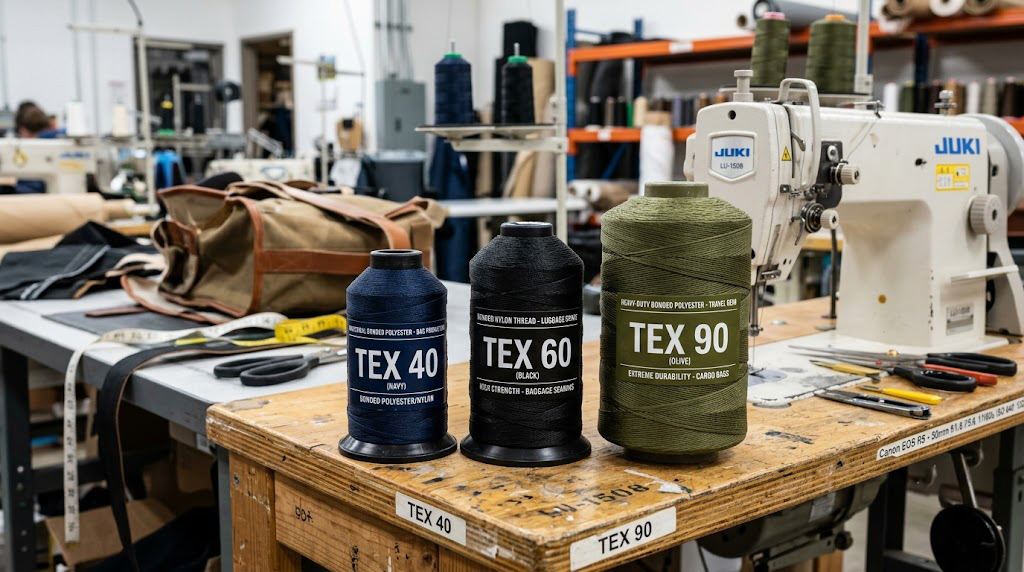
The thread is the “skeleton” of your seam. If you use cheap thread, even the best lockstitch machine will produce a bag that fails prematurely. Most reputable Chinese bag factories use bonded nylon or bonded polyester thread, which is specifically engineered for industrial sewing.
Common Thread Specifications for Bags:
Tex 40 (V69, ~Tex 40 weight) — Used for light linings, thin nylon, and detail work
Tex 60 (V92, ~Tex 60 weight) — The most common choice for medium-weight bags, canvas, and polyester
Tex 90 (V138, ~Tex 90 weight) — Used for heavy-duty bags, leather, and stress-point reinforcement
Bonded thread has a special coating that reduces friction, prevents fraying, and resists heat from high-speed sewing. Cotton-wrapped polyester is also common for fashion bags where a softer thread appearance is desired, though it’s less durable than bonded synthetic thread.
Matching Thread to Material
A professional factory will match the thread weight to the bag material:
Light nylon → Tex 40–50
Canvas or PU leather → Tex 60–70
Genuine leather or heavy canvas → Tex 80–90
Reinforcement bar-tacks → Tex 90+ or even Tex 135
If a factory tries to use the same thread weight for everything, that’s a sign they’re cutting costs. Always ask for thread specifications in writing.
4. How Does Lockstitch Compare to Chain Stitch for Bag Seam Strength and Durability?
Side-by-side comparison of lockstitch seam vs chain stitch seam under stress test
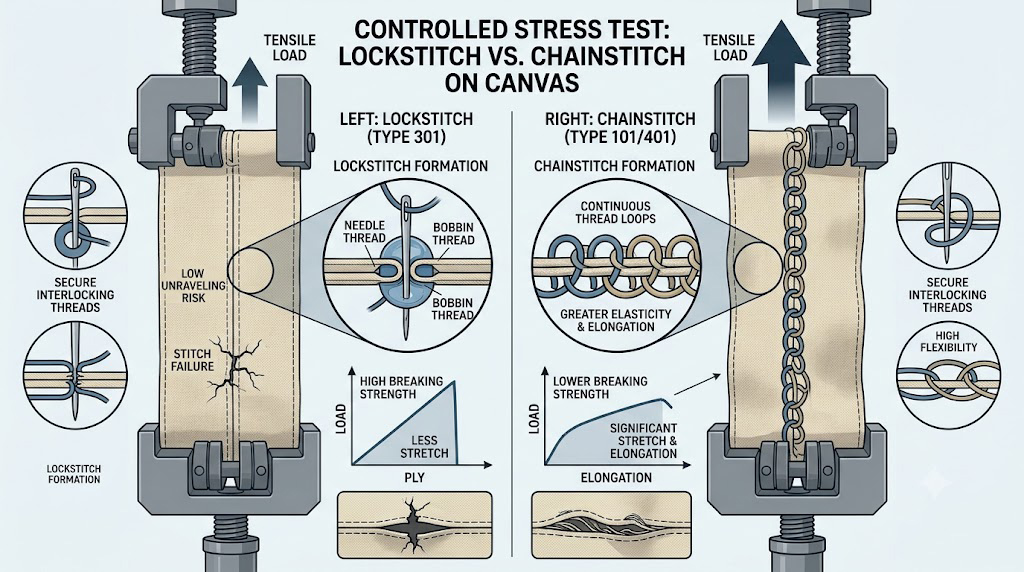
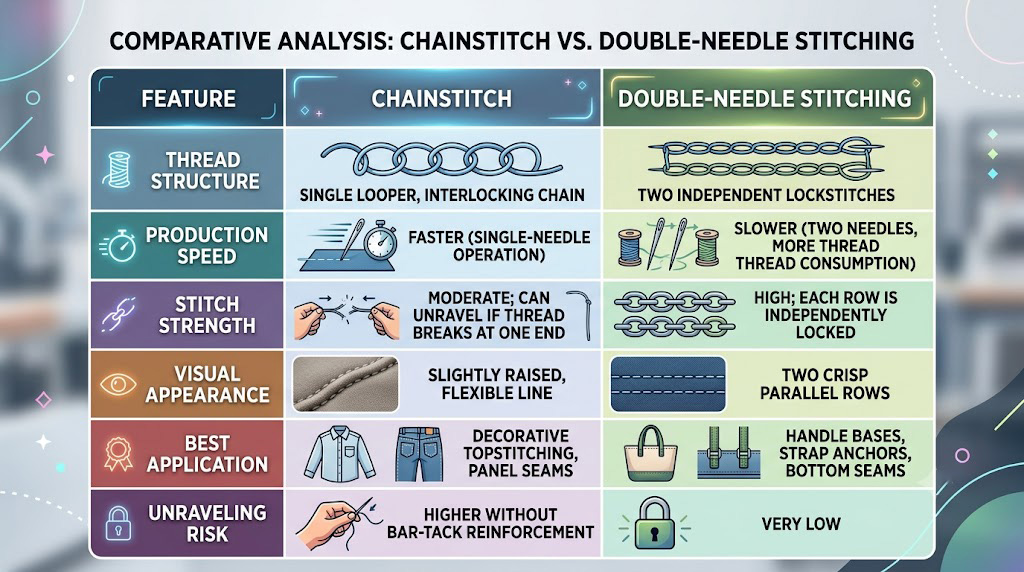
This is one of the most common questions I get from new bag importers: Should I require lockstitch or is chain stitch good enough? The answer depends on the application — but for most quality bags, lockstitch is the superior choice. Here’s why:
Lockstitch Advantages
1. Doesn’t unravel when cut — If a thread breaks or gets snipped, the lockstitch stays in place. The two threads interlock inside the fabric, so there’s no “chain” to pull.
2. Higher tensile strength — Lockstitch seams typically withstand 20–30% more pull force than equivalent chain stitches.
3. Cleaner appearance on both sides — Lockstitch looks identical on the front and back of the seam, which matters for bags with visible interior linings.
4. Better for topstitching and decorative work — The stitch lays flat and produces a professional finish.
Chain Stitch Advantages
1. Faster sewing speed — Chain stitch machines can run 30–50% faster, reducing labor cost
2. More elastic and flexible — Good for stretchy materials or applications requiring give
3. Slightly softer hand feel — Preferred for some garment applications
The Critical Difference: Unraveling
Here’s the test that matters most: take a finished bag, cut one thread in the middle of a seam, and pull. With lockstitch, nothing happens. With chain stitch, the entire seam can unravel like a zipper. For a bag that will carry weight, get pulled, snagged, and stuffed into overhead bins, this is a deal-breaker.
My recommendation: Require lockstitch for all structural seams (body panels, strap attachments, pocket attachment, zipper setting). Chain stitch is acceptable for non-structural decorative seams or temporary basting.
5. Can I Request Reinforced Stitching at Stress Points Such as Handles, Straps, and Corners?
Close-up of bar-tack reinforcement at handle base of a leather handbag
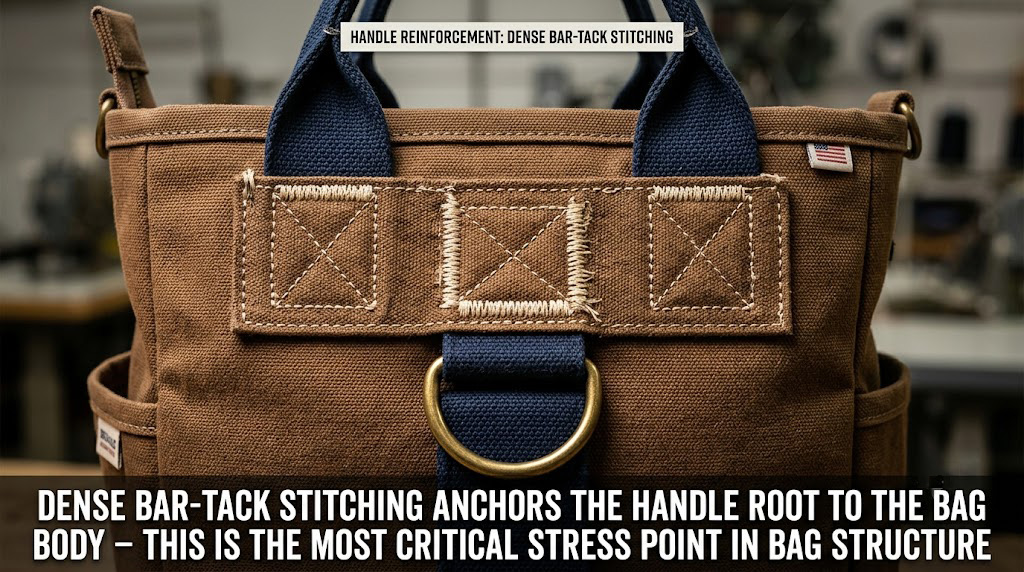
Absolutely yes — and you should always specify this in your purchase order.
Reinforcement at stress points is the single biggest differentiator between a bag that lasts years and one that fails after a few months of use. The stress points that require special attention are:
Handle and strap bases (where handles meet the bag body)
Strap D-rings and O-rings (where hardware connects to fabric/leather)
Zipper ends (the corners where zippers start and stop)
Bottom corners (where the bag carries the most weight)
Pocket tops (where items get pulled in and out repeatedly)
Types of Reinforcement Stitching
Factories use several methods to reinforce these areas:
1. Bar-tacks — Dense, zig-zag patterns of 8–12 SPI stitching over a small area (typically 0.5–1 inch). The most common reinforcement method.
2. Back-tacks — Reverse stitching at the beginning and end of a seam to “lock” the threads.
3. Box stitching — A rectangular pattern of stitching used for handle bases, often with rivets in the corners.
4. Cross stitching (X-box) — Two overlapping rectangular patterns creating an X-shape, used for heavy-duty stress points.
5. Rivets + stitching — Combining metal rivets with reinforced stitching for ultimate strength.
How to Specify Reinforcement in Your Order
Don’t assume the factory will add reinforcement automatically. Spell it out in your tech pack or purchase order:
“Bar-tack reinforcement required at all handle bases (minimum 0.75 inch length, 8+ SPI density). Box stitch with metal rivets at all D-ring attachments. Reverse back-tack at beginning and end of all stress seams.”
A good factory will know exactly what this means. A factory that pushes back or seems confused is one to avoid.
6. The 10 Professional Insights Every Bag Buyer Should Know
Factory quality control inspector checking lockstitch seam on finished bag
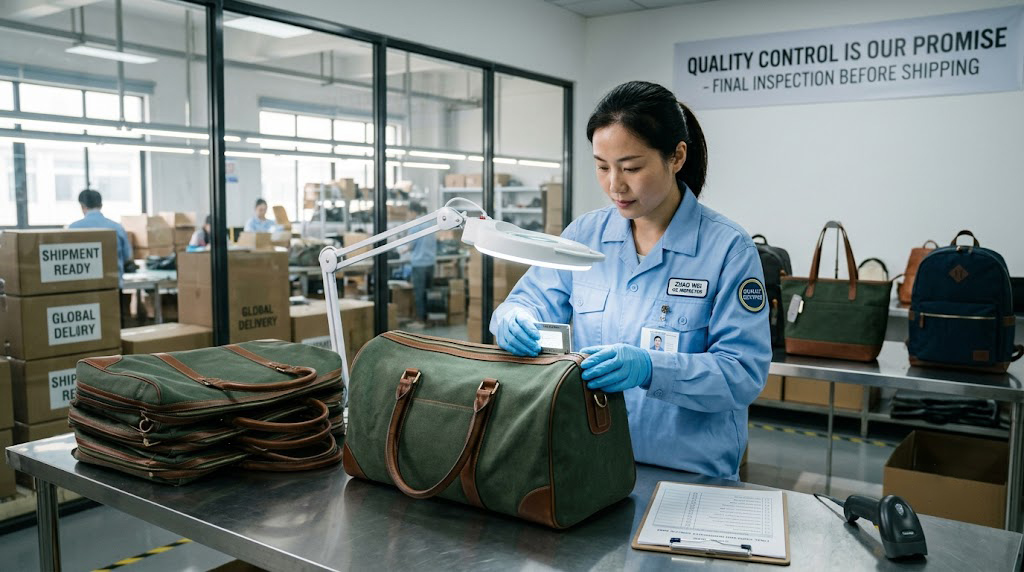
After importing bags from China for years, here are the 10 hard-won insights I share with every new buyer. These will save you from costly mistakes and quality disasters.
1. Industrial lockstitch sewing is the standard method for joining main bag panels, attaching pockets, and securing linings in factory production. If a factory can’t confirm they use lockstitch for these applications, find another factory.
2. Walking foot lockstitch machines are essential for thick materials like canvas, leather, and multi-layer assemblies. A factory that only has standard flatbed lockstitch machines will struggle with heavyweight bag construction.
3. Post bed lockstitch machines are required for small, curved, or 3D bag areas such as corners, gussets, and zipper ends. Without post bed machines, factories can’t produce professional-quality detailed work.
4. SPI typically ranges from 6 to 10 for bag production. Higher SPI means stronger seams but requires slower production and better operator skill. Aim for 7–9 SPI for most quality bags.
5. Lockstitch seams resist unraveling when cut, making them dramatically more durable than chain stitches for bag construction. This is the single most important reason to require lockstitch over chain stitch.
6. Bonded nylon or polyester threads (Tex 40–Tex 90) are the industry standard. Specify the thread weight in your PO to prevent factories from substituting cheaper alternatives.
7. Lining assembly is usually done separately and then attached to the outer shell using lockstitch around the top opening. This is a two-step process that requires skill — ask the factory about their lining attachment method.
8. Reinforcement bar-tacks or back-tacks at stress points (strap bases, zipper ends, D-rings) are non-negotiable for quality bags. Specify reinforcement locations and stitch patterns in writing.
9. Needle size and thread type must match material weight. Mismatched combinations cause skipped stitches, thread breakage, puckering, and material damage. A professional factory will have multiple needle and thread options ready.
10. Consistent seam allowance and alignment are critical for a professional finish and even load distribution. Inconsistent seam allowances (varying by 2–3mm) are a sign of poor quality control and will affect the bag’s structural integrity.
7. How to Evaluate a Chinese Factory’s Sewing Capability
Bag factory sewing floor showing multiple industrial lockstitch machines in production
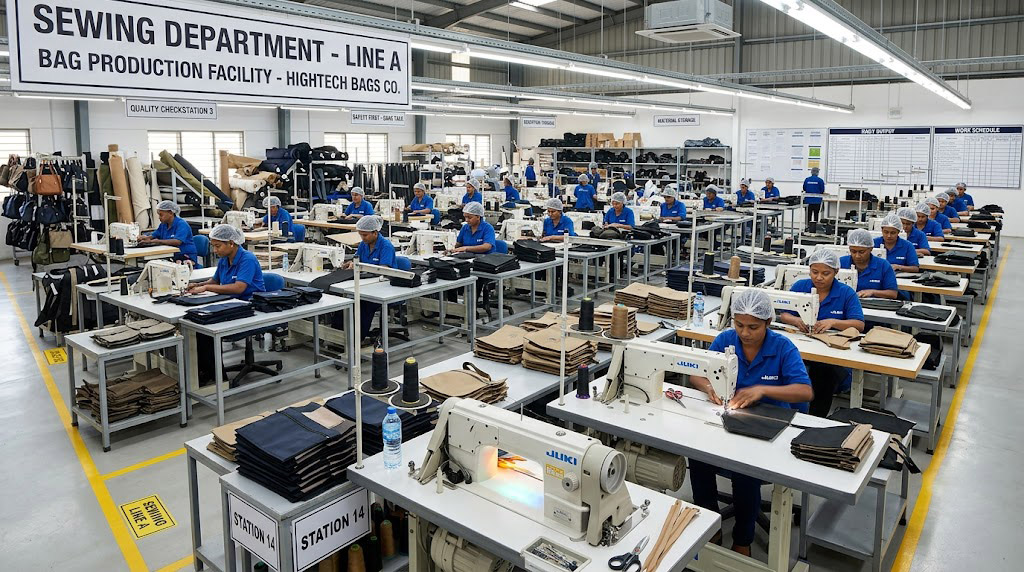
Before placing your first order, here’s a practical checklist for evaluating a Chinese factory’s sewing capability:
Questions to Ask
✅ What types of industrial lockstitch machines do you have? (Walking foot, post bed, flatbed)
✅ What is your standard SPI for [your specific bag type]?
✅ What thread brand and weight do you use? (Ask for the actual thread label photo)
✅ Can you send close-up photos of finished seams on sample bags?
✅ Do you add bar-tack reinforcement at stress points? Where exactly?
✅ Can you provide a seam strength test report or sample?
✅ What is your seam allowance tolerance? (Should be ±1mm)
✅ Do you perform in-line QC checks on stitching consistency?
Red Flags to Watch For
Factory can’t name the thread brand or weight they’re using
Sample bags have inconsistent SPI (visible variation along seams)
No reinforcement at handle bases or strap attachments
Visible loose threads, puckering, or skipped stitches on samples
Factory resists sending close-up seam photos
Lead times are suspiciously short (may indicate rushed work)
A Polite but Professional Message to Send to Suppliers
Hello, I am a bag buyer from the USA and I sell bags on my website. I’m looking for a long-term factory partner. Could you please confirm:
1. Do you use industrial lockstitch sewing for main panels, pockets, and lining assembly?
2. What SPI do you typically use for [my bag type]?
3. What thread brand and weight do you use?
4. Do you add bar-tack reinforcement at handle bases and stress points?
5. Can you send me close-up photos of finished seams on a sample bag?
Thank you for your time. I look forward to your response.
This message signals to the factory that you’re a serious, knowledgeable buyer — not someone who will accept the lowest quote without asking questions.
8. Common Bag Construction Mistakes (And How to Avoid Them)
Diagram of proper vs improper seam construction on a bag panel
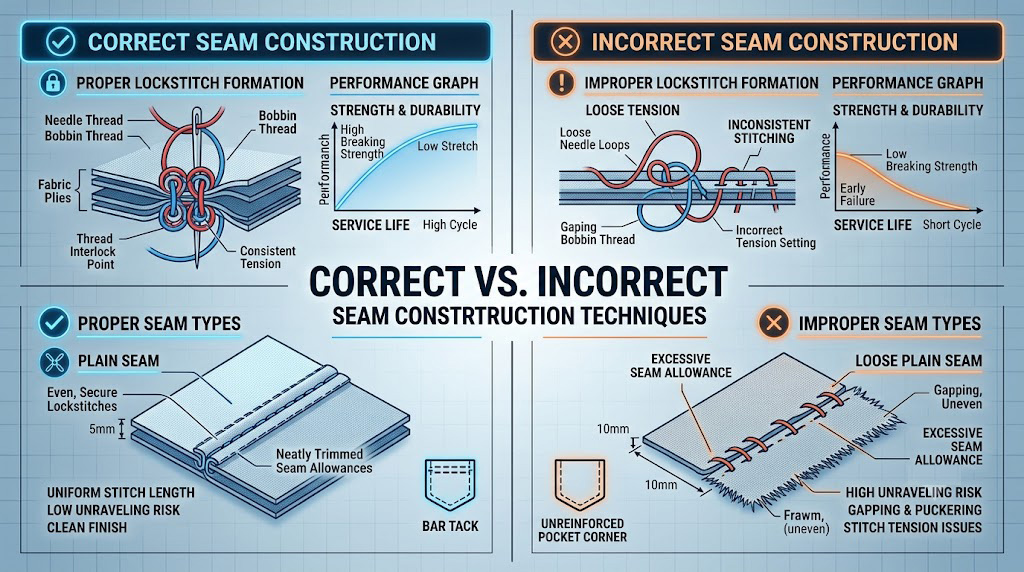
Even with lockstitch sewing, several common mistakes can compromise bag quality:
Mistake #1: Wrong Thread Weight
Using Tex 40 thread on a heavy leather bag will result in seam failure under normal use. Always specify thread weight in your PO.
Mistake #2: Skipping Reinforcement
Factories under pricing pressure may eliminate bar-tacks to save 30 seconds per bag. Across an order of 1,000 bags, that adds up. Specify reinforcement locations and inspect samples carefully.
Mistake #3: Inconsistent Seam Allowances
Seam allowances that vary by 2–3mm create weak points and make the bag look unprofessional. Specify ±1mm tolerance and inspect production samples.
Mistake #4: Wrong Needle Type
Using a sharp needle on leather (instead of a wedge or leather point needle) will cause skipped stitches and material damage. Ask the factory what needle types they use for different materials.
Mistake #5: Lining Attached with Overlock Only
Some factories attach linings using overlock (serger) seams only, which can unravel. Require lockstitch for lining-to-shell attachment at the top opening.
9. Building a Long-Term Relationship with Your Factory
Business handshake between bag buyer and Chinese factory owner in showroom
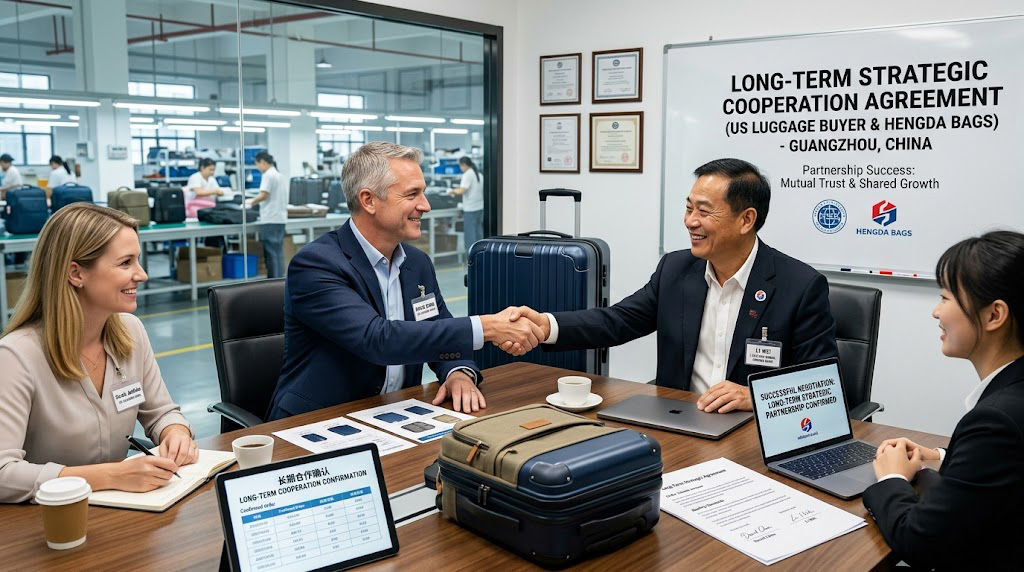
Sourcing bags from China isn’t a one-time transaction — it’s a relationship. The factories that produce the best work are the ones where you’ve invested time in:
1. Clear communication — Detailed tech packs, photos, and reference samples
2. Realistic timelines — Building in 15–20% buffer time for revisions
3. Consistent orders — Factories prioritize buyers who order regularly
4. Fair pricing — Paying enough to allow the factory to use quality materials
5. Respectful collaboration — Acknowledging cultural differences and showing respect for their expertise
The best factories I’ve worked with started as suppliers and became partners. They proactively suggest improvements, warn me about potential issues, and treat my brand as an extension of their own reputation.
Conclusion: Quality Starts with the Stitch
If you’ve read this far, you now know more about industrial lockstitch sewing for bags than 95% of the buyers placing orders on Chinese B2B platforms. That knowledge is your competitive advantage.
The bag market is crowded. Consumers have endless choices. The brands that succeed long-term are the ones that deliver consistent quality — and consistent quality starts with the fundamentals: proper stitch type, correct SPI, appropriate thread, and reinforcement at stress points.
When you communicate with Chinese factories, you now have the vocabulary, the questions, and the standards to hold suppliers accountable. You can evaluate samples with confidence, spot red flags early, and build products that customers will trust and recommend.
Lockstitch sewing isn’t just a manufacturing detail — it’s the foundation of your brand’s reputation. Treat it that way, and your bags will stand the test of time.
Post time: Jul-08-2026