
Navigating REACH, CPSIA, and California Prop 65 Compliance When Sourcing Bags From Chinese Manufacturers
Understanding What Each Global Compliance Rule Means for Bag Importers
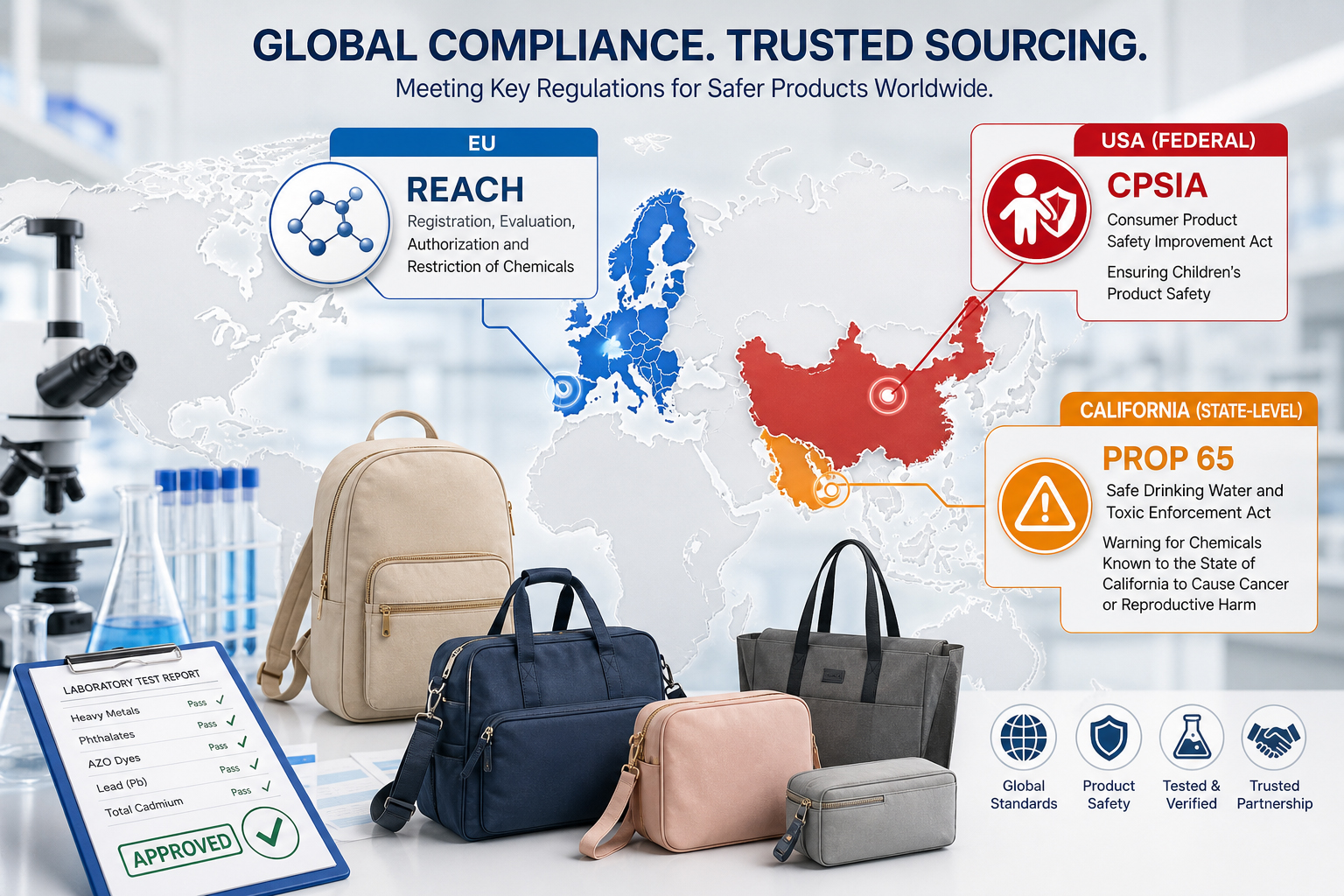
Before evaluating Chinese suppliers, you must fully grasp the purpose and legal boundaries of each regulation. Many new overseas buyers mistakenly treat these frameworks as interchangeable certifications, but each rule targets different markets, product types and chemical hazards.
REACH (Registration, Evaluation, Authorization and Restriction of Chemicals) applies to all finished articles sold within the European Union. It restricts dangerous substances found in leather, textile dyes, PU coatings, plastic hardware, adhesives and printing inks used to manufacture bags. EU importers bear legal obligations to track substances of very high concern (SVHC) and maintain accurate material composition records. A valid REACH package does not equal a generic CE stamp; a CE marking alone offers no proof that a bag meets REACH chemical limits.
CPSIA (Consumer Product Safety Improvement Act) is United States federal legislation, primarily governing children’s products intended for boys and girls aged 12 and younger. Backpacks, crossbody bags and pencil cases marketed to kids require accredited third‑party laboratory testing for lead and phthalates on every accessible component. Qualifying children’s products also demand a formal Children’s Product Certificate (CPC) and permanent tracking labels on finished goods. Non‑children’s adult bags may still fall under CPSC oversight. When a product is covered by an enforced CPSC safety rule, the US importer must create a General Certificate of Conformity (GCC). It is vital to note that Chinese factories cannot issue a legally binding GCC or CPC for US customs purposes; the American importer holds final legal responsibility for these documents.
California Proposition 65 is a state‑level regulation unique to California, not a simple pass‑or‑fail certification. The law requires businesses to warn consumers when a product exposes users to any listed toxic chemical above defined safe‑harbor thresholds. There is no universal “Prop 65 certified” document. Suppliers can complete chemical risk assessments and recommend proper warning wording and label placement, but the US brand selling into California must decide if warnings are mandatory. Businesses with ten or more employees operating inside California must follow these warning rules strictly.
Do Chinese Bag Factories Hold REACH, CPSIA, and California Prop 65 Compliance Certifications?
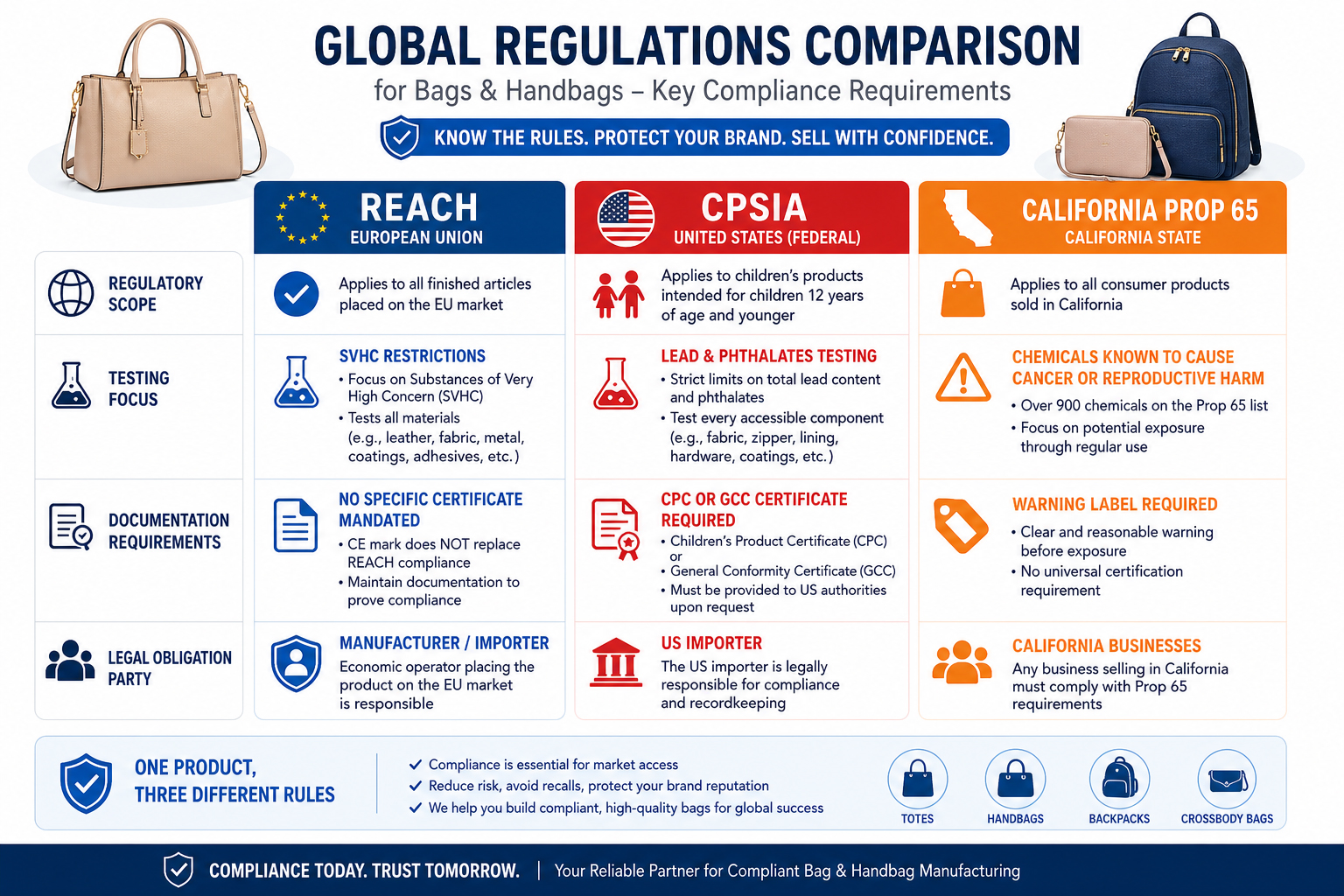
The short answer requires nuance. Experienced export‑focused Chinese bag factories do maintain the capability to produce goods that satisfy REACH, CPSIA and Prop 65 requirements, but most suppliers do not own a single universal “compliance certificate” covering all three standards at once.
Factories that ship large volumes to European clients routinely prepare REACH compliance documentation. Their files include lab test results verifying restricted chemical levels in leather, fabric dyes and metal hardware, plus official SVHC declarations and detailed material breakdown sheets. Manufacturers serving US family and children’s bag brands are familiar with CPSIA lead and phthalate testing protocols. They source pre‑tested raw materials and arrange third‑party testing for kid‑oriented backpacks and handbags.
Suppliers targeting the broader US market commonly provide documentation addressing California Prop 65 hazards. They identify carcinogenic or reproductively toxic substances present in fabrics, coatings, plastic fittings and packaging, and share written chemical disclosures with overseas buyers.
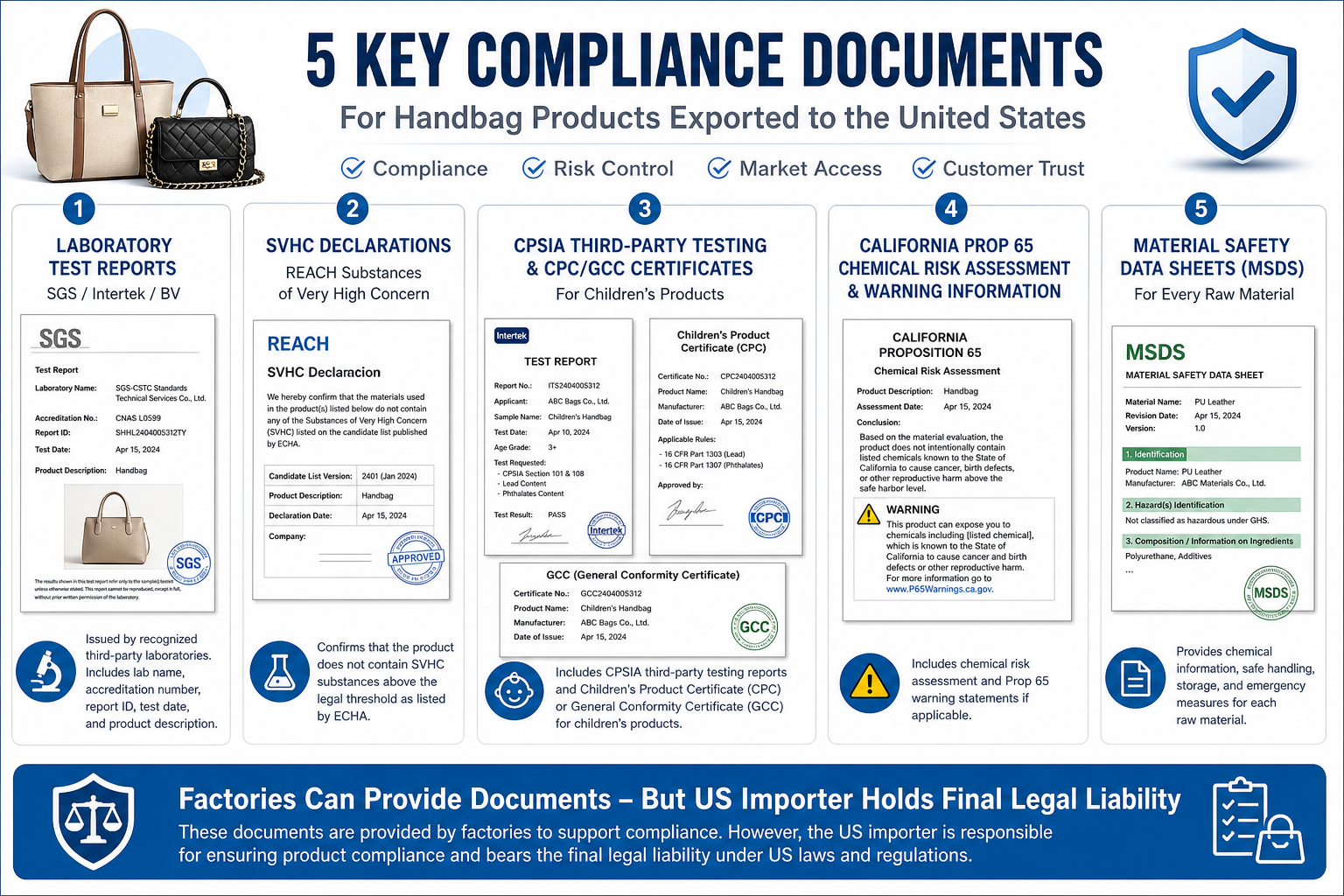
Trusted export factories rely on globally recognized independent testing laboratories, including SGS, Intertek and Bureau Veritas. Accredited labs generate verified test reports instead of self‑written compliance letters. Many premium manufacturers also keep Material Safety Data Sheets (MSDS) for every raw material they purchase. Some suppliers bundle all relevant paperwork together, delivering one consolidated compliance dossier covering REACH, CPSIA and Prop 65 for each production run.
A small number of high‑end Chinese bag makers go beyond basic mandatory rules. They adopt voluntary textile safety certifications such as OEKO‑TEX Standard 100 to strengthen product safety credentials and appeal to quality‑focused Western buyers. Several factories also offer technical support for US labeling rules, drafting compliant warning text, care instructions and permanent tracking information required by CPSIA and Prop 65.
Even with these strengths, one critical limitation remains. A factory can source compliant materials, organize independent testing and supply complete paperwork, yet it cannot transfer full legal liability to the buyer. As the US‑based importer and website seller, your business stays accountable for meeting all market regulations. A supplier’s test reports serve as supporting evidence, not legal immunity.
How Do Chinese Suppliers Provide Testing Reports for US and EU Market Compliance?
Not all compliance paperwork carries equal value, and many new B2B buyers fall victim to useless or outdated documents from unreliable factories. Professional suppliers follow a clear process to deliver valid testing records.
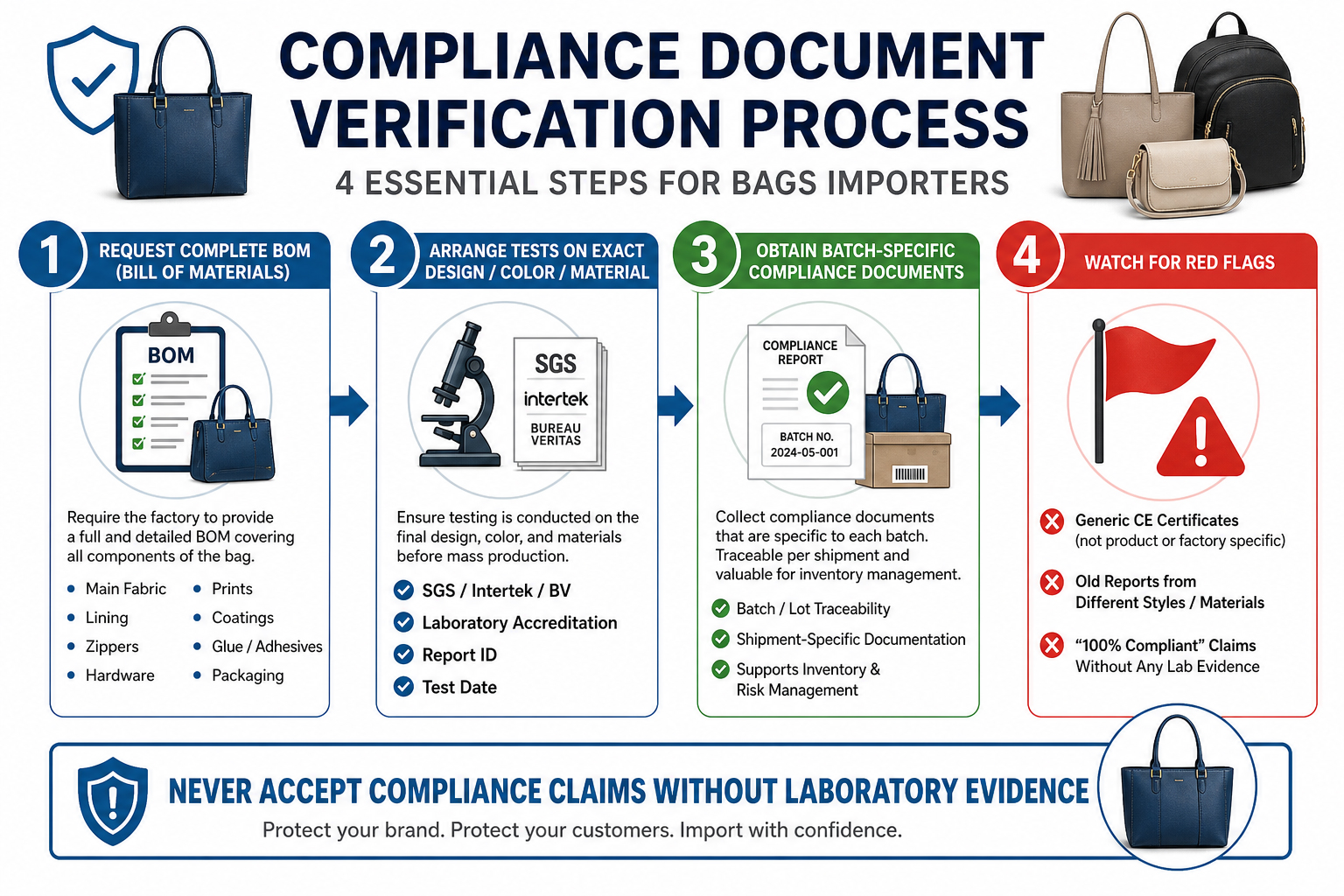
First, reputable factories share a full component breakdown before production begins. This inventory lists every single raw material of the finished bag: primary fabric, lining, zippers, snaps, magnetic clasps, printed graphics, surface coatings, glue and packaging materials. Chemical risks often hide in small accessories and adhesives, even when the main fabric passes safety testing.
Next, suppliers arrange tests on the exact finished sample matching your approved design, colorway and material specification. Reliable reports include the laboratory name, accreditation number, unique report ID, testing date and a precise product description. Testing covers restricted heavy metals, phthalates, formaldehyde and azo dyes, matching US and EU regulatory limits. Some experienced factories provide batch‑specific compliance documents. Lot‑tied reports allow you to trace safety verification to each shipment, which is extremely valuable for long‑term inventory control and marketplace audits.
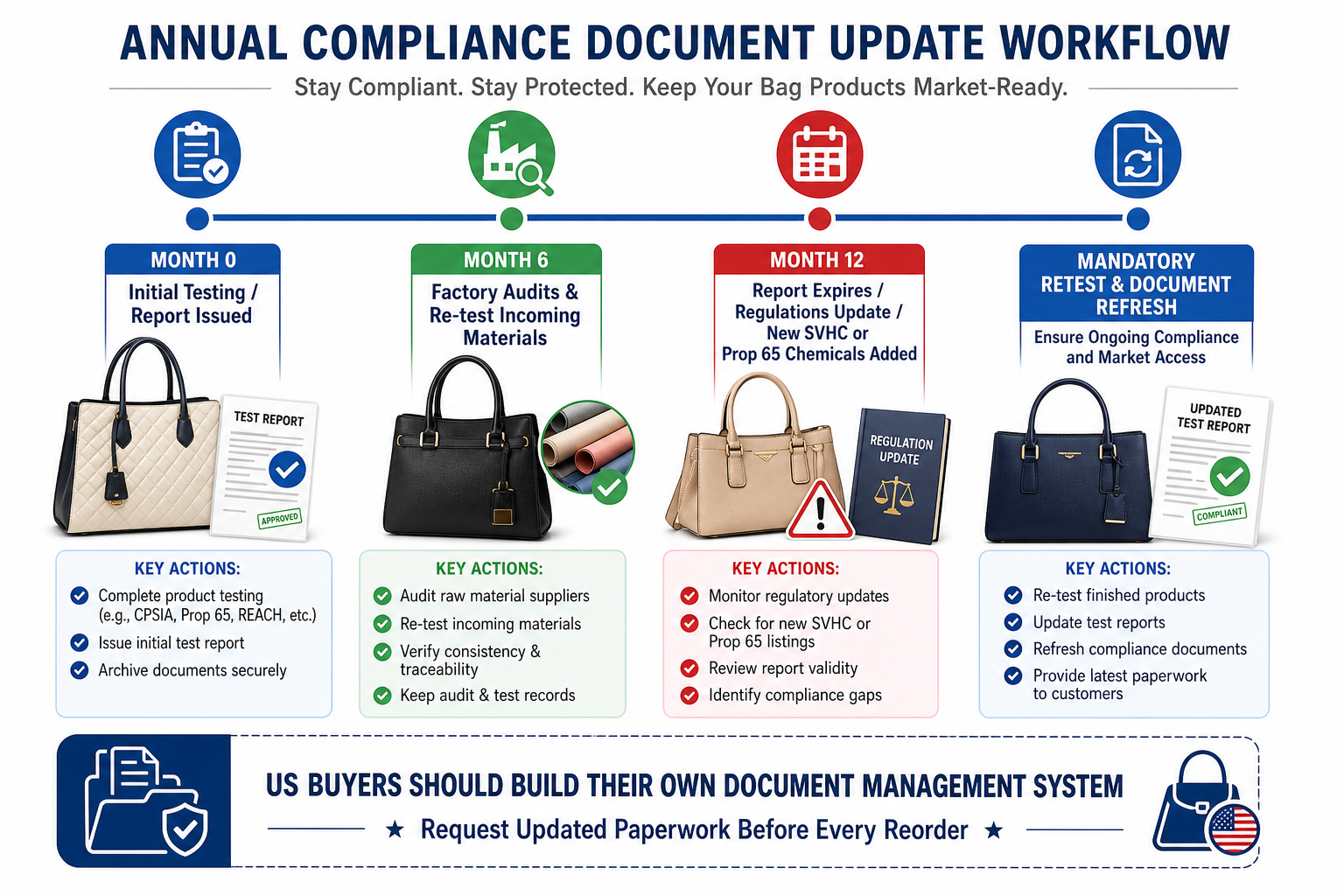
Many factories maintain annual supply‑chain compliance audits. They regularly audit raw‑material vendors and re‑test incoming fabrics and hardware to confirm chemical levels stay within legal thresholds as rules update. Buyers must watch for red flags during document review. Avoid suppliers that only provide generic CE certificates, reuse reports from unrelated bag styles or different colors, or claim “100% compliant” without laboratory evidence. Vague marketing phrases such as “FDA approved bags” do not constitute safety proof. A trustworthy supplier will openly share laboratory accreditation details and explain which regulations apply to your specific product.
Are Compliance‑Certified Bags Available with Low MOQ for Small B2B Buyers?
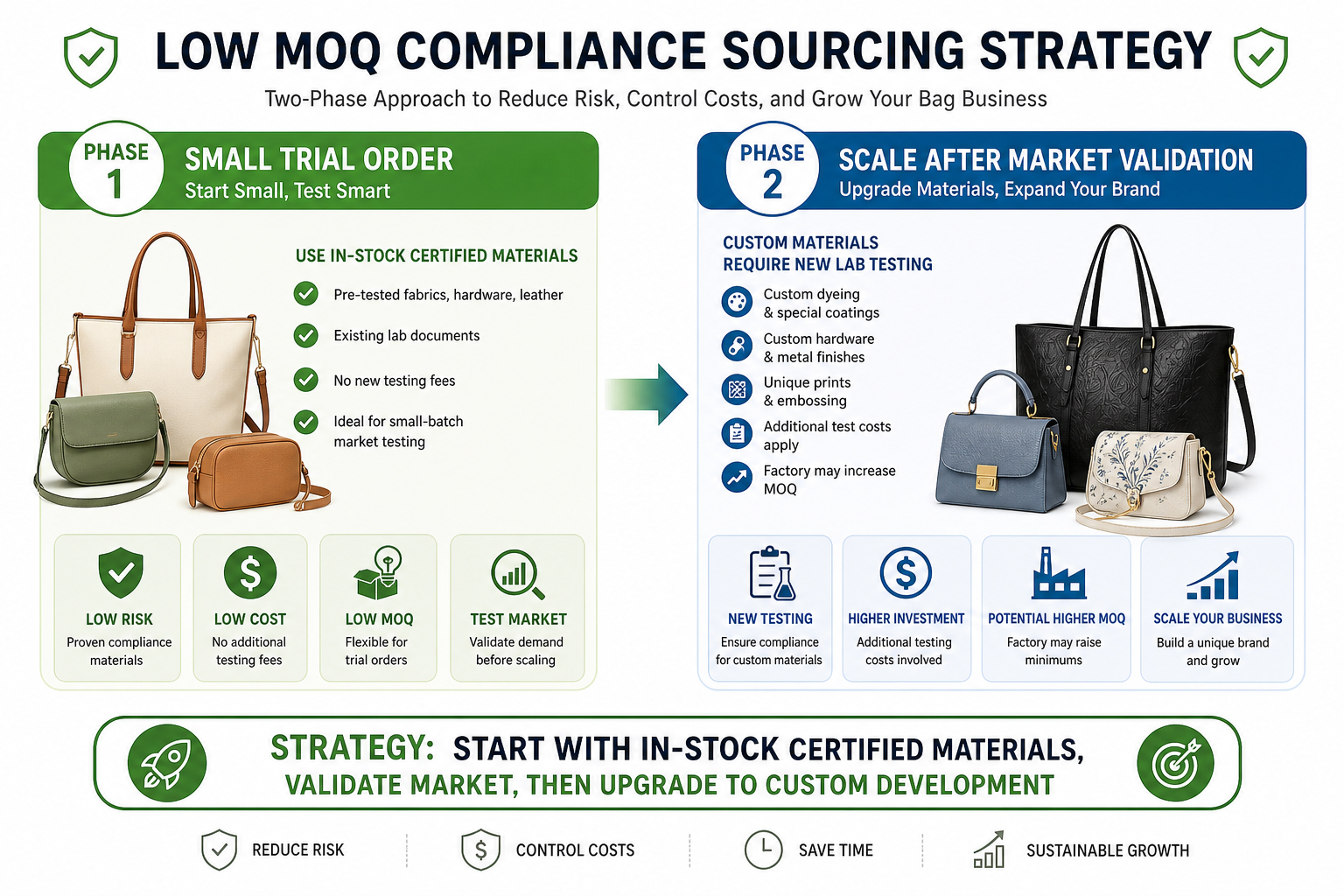
This question is extremely important for independent US store owners who cannot commit to huge minimum order sizes. The possibility of low‑MOQ compliant orders depends mainly on whether the factory uses pre‑certified stock materials or custom‑formulated components.
If the factory keeps compliant fabrics, certified metal hardware and pre‑tested faux leather in existing inventory, low‑minimum orders are entirely feasible. The raw materials already carry valid laboratory documentation, so the supplier avoids expensive new testing fees for small batches. This arrangement works perfectly for small‑scale B2B buyers launching new lines or testing market demand on independent websites.
Difficulties appear when your design requires custom‑developed materials. Custom dyed textiles, special surface coatings, bespoke plastic fittings or unique printed patterns demand new laboratory testing. Additional inspection costs often force factories to raise MOQs. In these situations, professional suppliers will communicate openly and negotiate realistic order volumes with you. They may suggest combining multiple small styles into one testing cycle to reduce per‑unit compliance expenses.
Small US sellers should adopt a practical two‑phase sourcing strategy. Start by ordering samples made from in‑stock certified materials to verify quality and compliance. After confirming market feedback, place slightly larger production runs for custom designs and schedule targeted testing. This approach balances low‑risk testing and regulatory security without overextending your startup budget.
Do Chinese Factories Update Compliance Documentation Annually to Reflect Regulatory Changes?
Regulatory limits for restricted chemicals change frequently in both the EU and California. Static, permanent certificates do not exist. Reliable suppliers do not simply reuse old reports indefinitely. They manage paperwork according to official validity timelines and refresh documentation when laws or raw‑material formulas shift.
When a laboratory report reaches its expiry date, or when a supplier switches fabric vendors, ink formulas or hardware manufacturers, responsible factories initiate new testing and issue updated files. Many export‑oriented operators schedule yearly supply‑chain audits to track evolving REACH SVHC candidate lists and new Prop 65 chemical additions. They also agree contractually to notify overseas buyers immediately if any component material changes without prior written approval. This clause prevents unexpected non‑compliance issues on repeat orders.
That said, you cannot rely entirely on the factory’s internal update schedule. As the US seller, build your own document management system. Save purchase orders, material specifications, supplier declarations, lab reports and label samples for every bag model. Require updated paperwork before each repeat production run, especially if more than one year has passed since the last test.
A Standard Written Request You Can Send Directly to Suppliers
To eliminate miscommunication, submit a formal written compliance request to every potential factory partner. Use this professionally phrased message for all negotiation stages:
We sell bags in the United States and may also sell in the European Union. Please confirm whether you can manufacture this exact bag in compliance with applicable REACH requirements, U.S. CPSC/CPSIA requirements where applicable, and California Proposition 65.
Please provide:
* Full material and component composition;
* Recent test reports for the exact model, colors, and materials;
* REACH restricted‑substance and SVHC declarations;
* CPSIA third‑party testing and CPC documents if the product is intended for children;
* Information needed for a U.S. GCC where applicable;
* California Proposition 65 chemical assessment and warning information;
* Laboratory accreditation details;
* Confirmation that no material or component will be changed without written approval.
This message sets clear expectations and filters out suppliers that cannot deliver adequate compliance records.
Final Practical Sourcing Recommendations for US Independent Bag Sellers
Compliance management is not a one‑time task before your first shipment. It forms an ongoing operational system for sustainable cross‑border bag sourcing. Always order finished samples and arrange independent third‑party testing before approving large‑scale mass production. Test the final production version, including high‑risk colors and all metal or plastic accessories.
Keep complete organized records for every SKU. Preserve purchase contracts, material specification sheets, supplier declarations, laboratory reports, factory inspection logs and final label artwork. If you sell into California, review Prop 65 warning placement and wording carefully, and update warnings whenever newly listed chemicals appear in your supply chain.
Avoid common pitfalls: never accept verbal compliance promises, never trust certificates from unrelated products, and never assume a factory’s paperwork removes your legal obligations as an American importer and retailer. By asking targeted questions, verifying laboratory accreditation, negotiating low‑MOQ certified stock materials, and scheduling regular document refreshes, you can safely source compliant bags from China while protecting your independent website brand, avoiding fines and building long‑term trust with US and EU customers.
Post time: Sep-09-2026