
Thread Type and Stitch Density: Critical Sewing Specs When Sourcing Bags From Chinese Manufacturers
What Thread Types Do Chinese Bag Factories Commonly Use for Production?
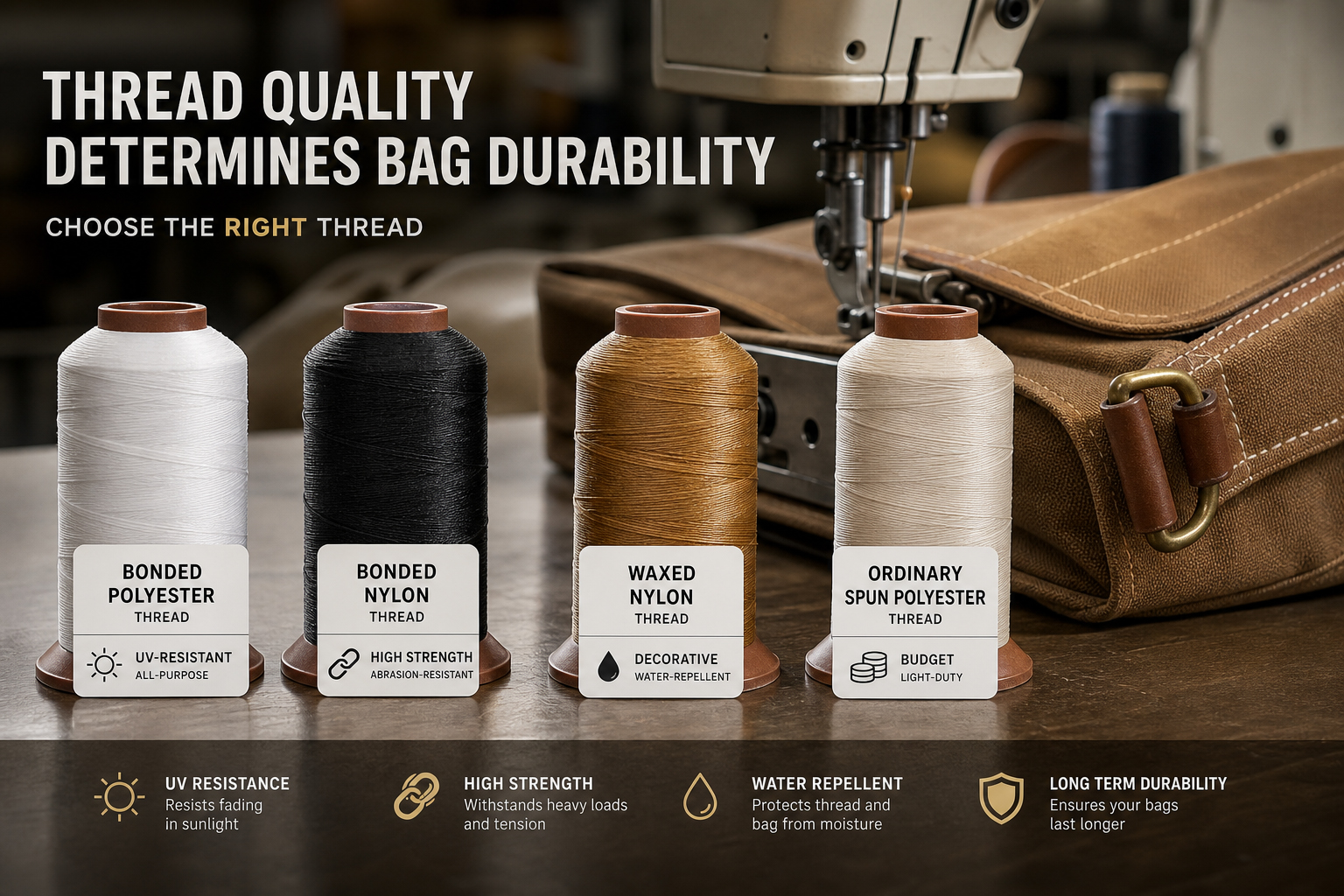
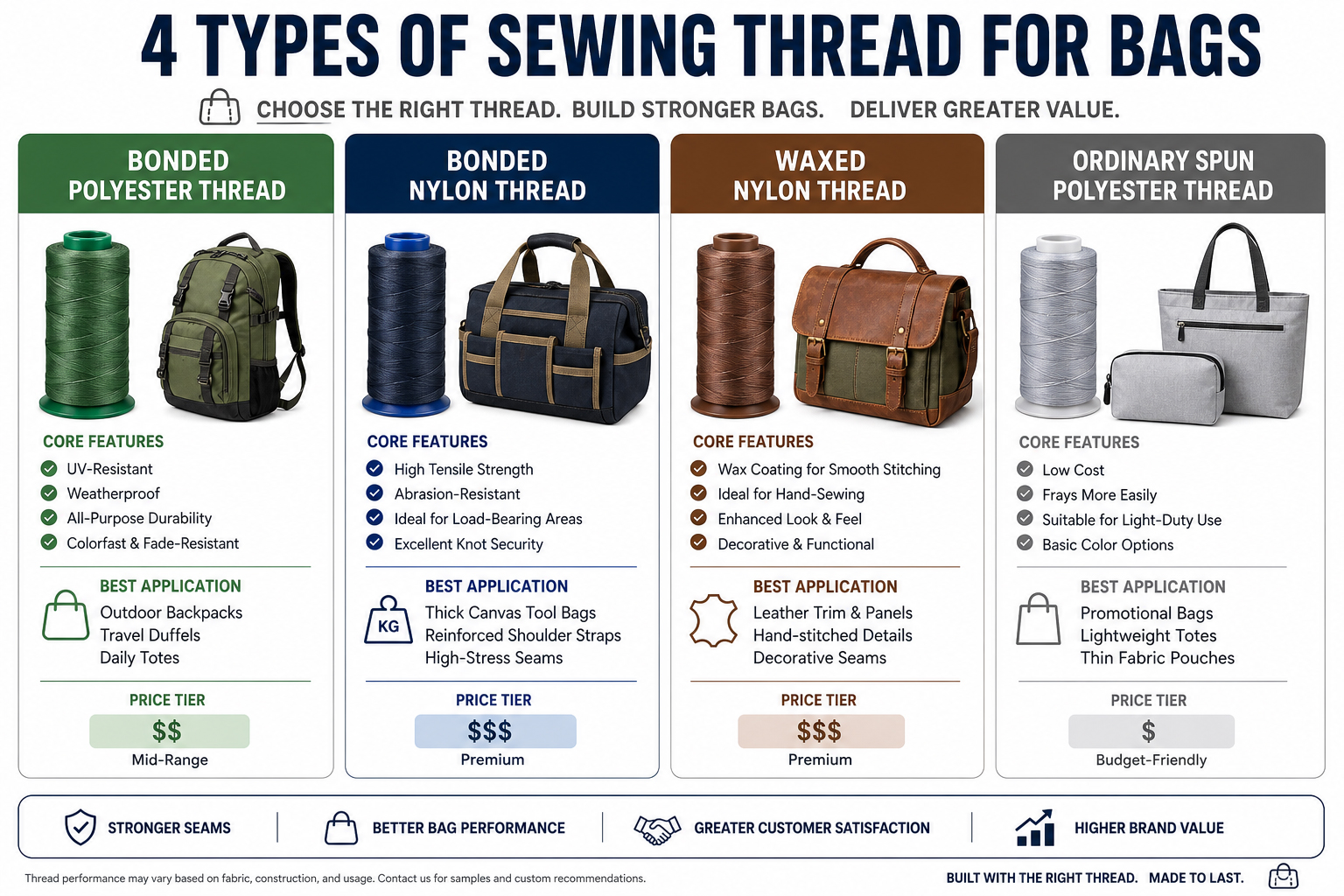
Chinese bag manufacturers rely on four mainstream thread grades for export‑oriented bag production: bonded polyester thread, bonded nylon thread, waxed nylon thread and ordinary spun polyester thread. Each thread has unique tensile performance, weather resistance and cost positioning, and factories match thread selection according to fabric thickness, intended bag load and target market positioning.
Bonded polyester thread ranks as the most popular option for export bags. Bonding treatment fuses loose fiber filaments tightly together, minimizing fraying during high‑speed machine sewing. Its biggest advantages include stable tensile strength, low stretch rate, excellent mildew resistance, chemical tolerance and outstanding UV degradation resistance. Unlike nylon threads, polyester will not weaken noticeably after long‑time exposure to direct sunlight. This makes bonded polyester the universal workhorse for outdoor backpacks, travel duffels, daily‑use tote bags and all merchandise that consumers may carry outside for extended hours. For most multi‑category bag listings on US independent websites, bonded polyester is the safest all‑around specification for everyday retail‑grade products.
Bonded nylon thread is the factory’s first choice for heavy‑duty load‑bearing sections. It delivers superior raw tensile strength and remarkable abrasion resistance, with softer flexibility compared with polyester. Mid‑range Chinese suppliers often offer bonded nylon as an economical upgrade choice for buyers targeting mid‑tier pricing. Factories deploy bonded nylon on thick canvas tool bags, luggage body seams, reinforced shoulder straps and genuine leather bags. The obvious downside of nylon is weaker UV stability and higher moisture absorption. In humid or sunny environments, nylon threads will slowly lose strength over months, so it is not ideal for outdoor bags that stay exposed to sunlight continuously.
Waxed nylon thread serves a niche purpose in bag production. A surface wax coating improves hand‑sewing smoothness and adds basic water repellency. Chinese factories rarely use waxed nylon for continuous machine stitching on main load‑bearing seams. Instead, it appears mainly on leather decorative panels, hand‑stitched accents and ornamental detailing. You should never accept waxed nylon as a substitute for industrial bonded thread on stress‑carrying seams.
Ordinary spun polyester thread is the budget‑level solution for low‑cost promotional bags. It costs far less than bonded polyester, but loose short fibers fray easily. Its tensile performance and anti‑aging capability cannot meet daily heavy‑use requirements. Reputable export factories reserve spun polyester only for lightweight giveaway pouches and simple thin fabric cosmetic bags, not backpacks or travel totes that require reliable seam durability.
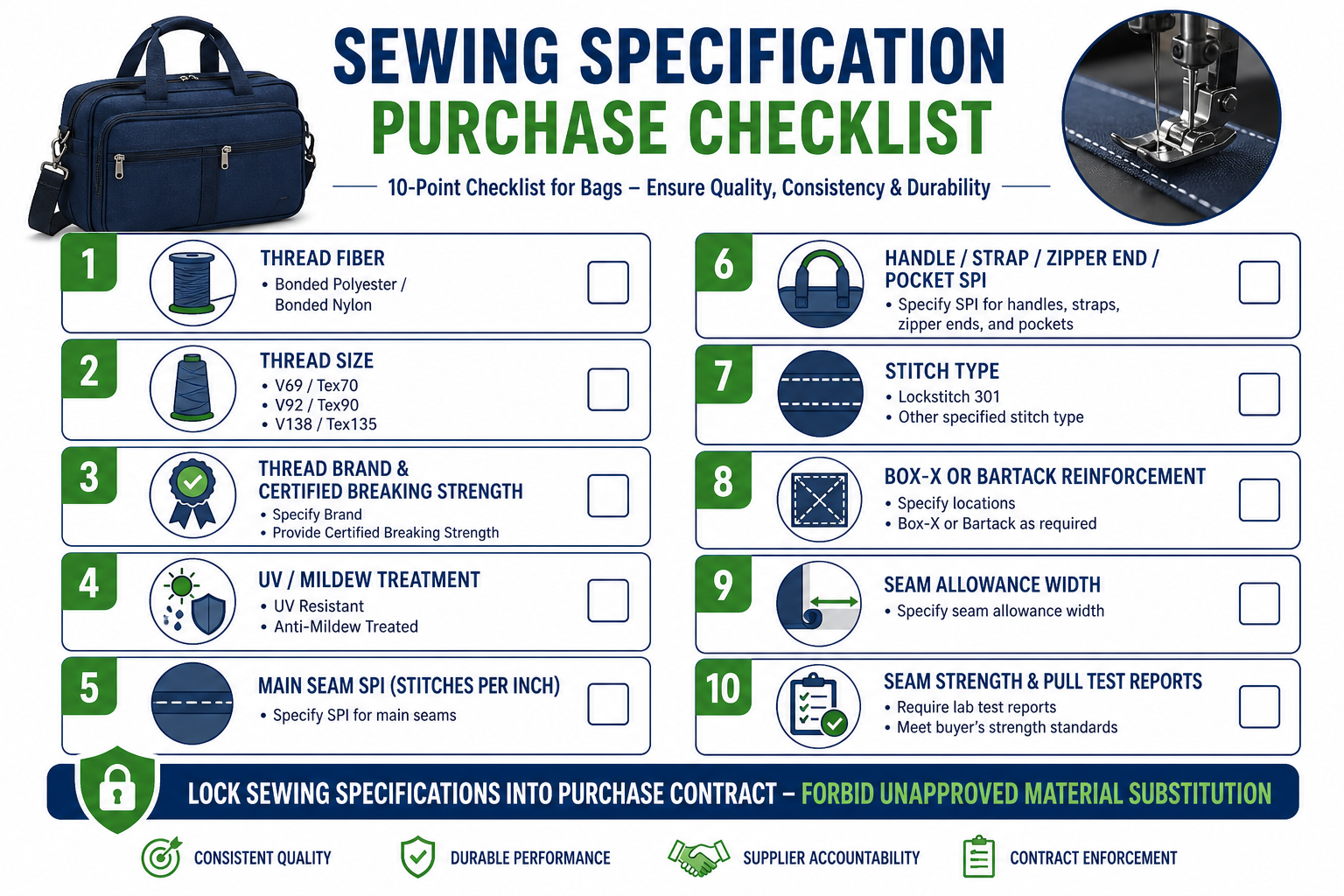
When requesting thread specifications from suppliers, never settle for generic replies such as “premium polyester”. Qualified technical requirements must cover fiber type, thread size, brand origin, upper and bobbin thread differences, UV or mildew treatment and certified breaking strength measured in pounds or newtons. The industry widely uses V‑size and Tex marking systems. V69 / Tex70 works for light‑medium weight bags; V92 / Tex90 fits most standard backpack and tote seams; V138 / Tex135 is reserved for heavy canvas, leather and high‑stress strap joints. Thread size directly defines thickness and load capacity, and “polyester” alone gives zero actionable quality information.
How Does Stitch Density Affect the Durability and Lifespan of Bags from Chinese Suppliers?
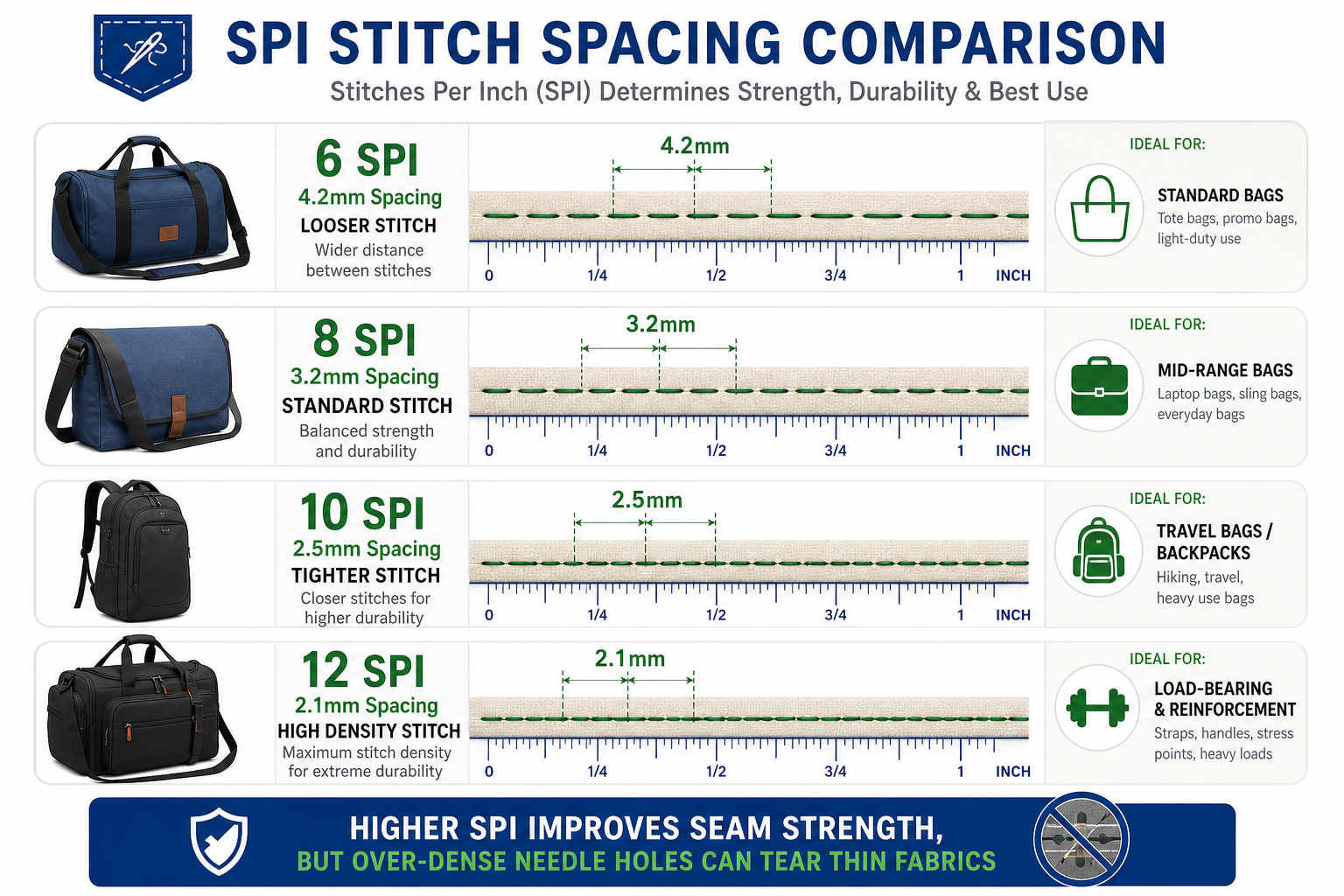
Stitch density is measured in SPI, stitches per inch, meaning how many stitches the machine makes along one linear inch of a finished seam. Most Chinese bag factories follow a standard production window of 6 SPI to 10 SPI for regular consumer bags, and raise the density to 10–12 SPI on critical stress zones. Many new importers hold a mistaken belief that more stitches automatically equal stronger bags. The reality is far more nuanced. Increasing stitch density improves seam strength only within a reasonable range. Over‑dense stitching creates excessive needle perforations, which tear thin fabric, trigger seam puckering, raise production costs and form a perforation line where fabric splits easily under pulling force.
We can convert SPI into clear stitch spacing for practical factory communication: 6 SPI leaves roughly 4.2 millimeters between stitches; 8 SPI equals 3.2 millimeters; 10 SPI creates 2.5‑millimeter gaps; 12 SPI shortens spacing to only 2.1 millimeters. This conversion helps you visualize seam tightness and explain your requirements clearly to Chinese sewing workshops.
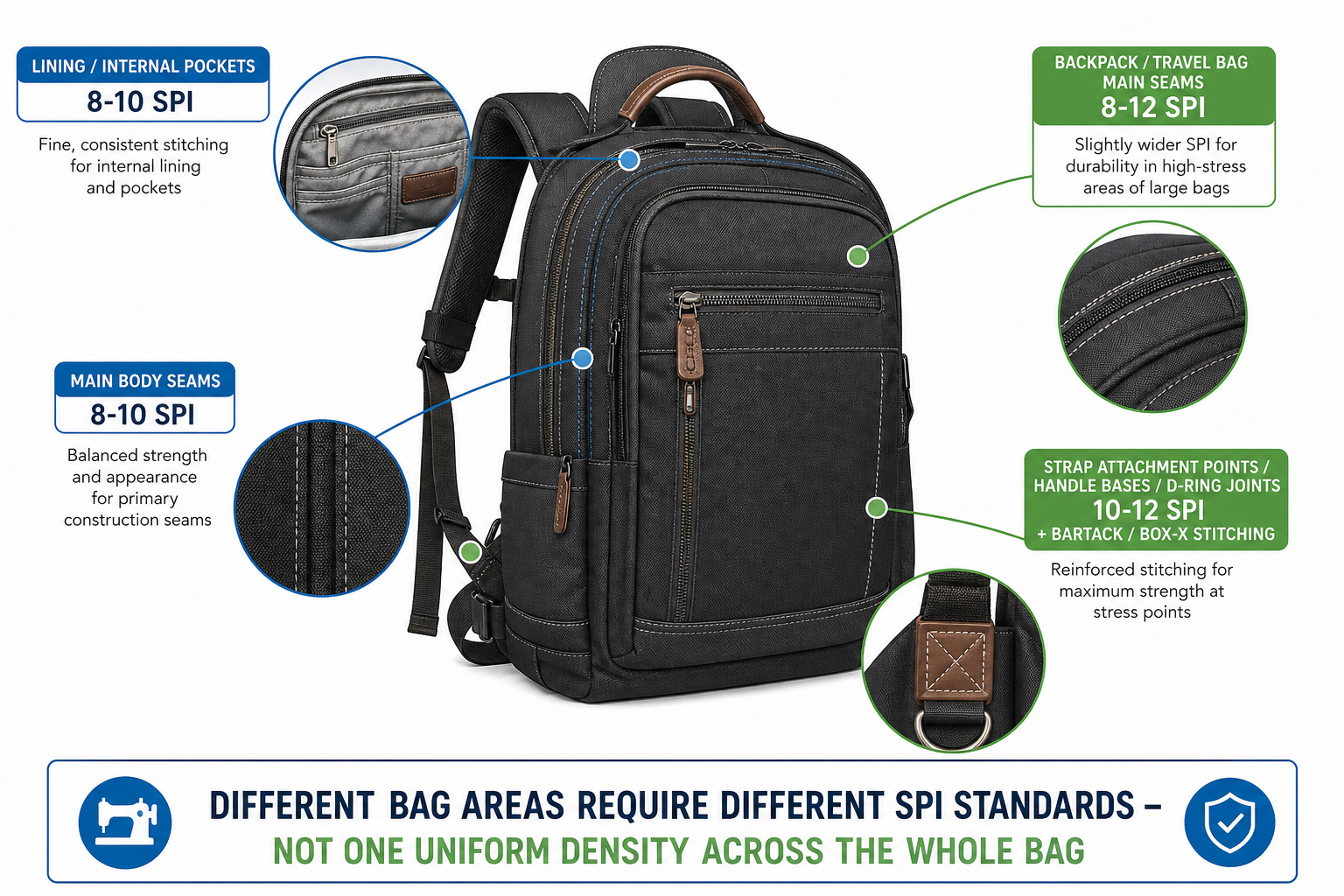
Different positions on a finished bag demand different SPI targets, and experienced export factories apply segmented stitching standards rather than a single uniform density across the whole product. Lightweight lining fabric and simple internal pockets perform well at 8–10 SPI without over‑puncturing the thin material. Main body seams of normal‑weight tote bags and cosmetic pouches also adopt 8–10 SPI as the baseline specification. Backpacks and multi‑day travel duffels upgrade main seams to 8–12 SPI for improved long‑term reliability. The highest standard belongs to strap attachment points, handle bases and D‑ring joints, where factories set 10–12 SPI plus extra reinforcement stitching. If your bags use ultra‑thin lightweight fabric, you must warn suppliers against pushing SPI too high, because dense needle holes become the weakest failure point long before the thread snaps.
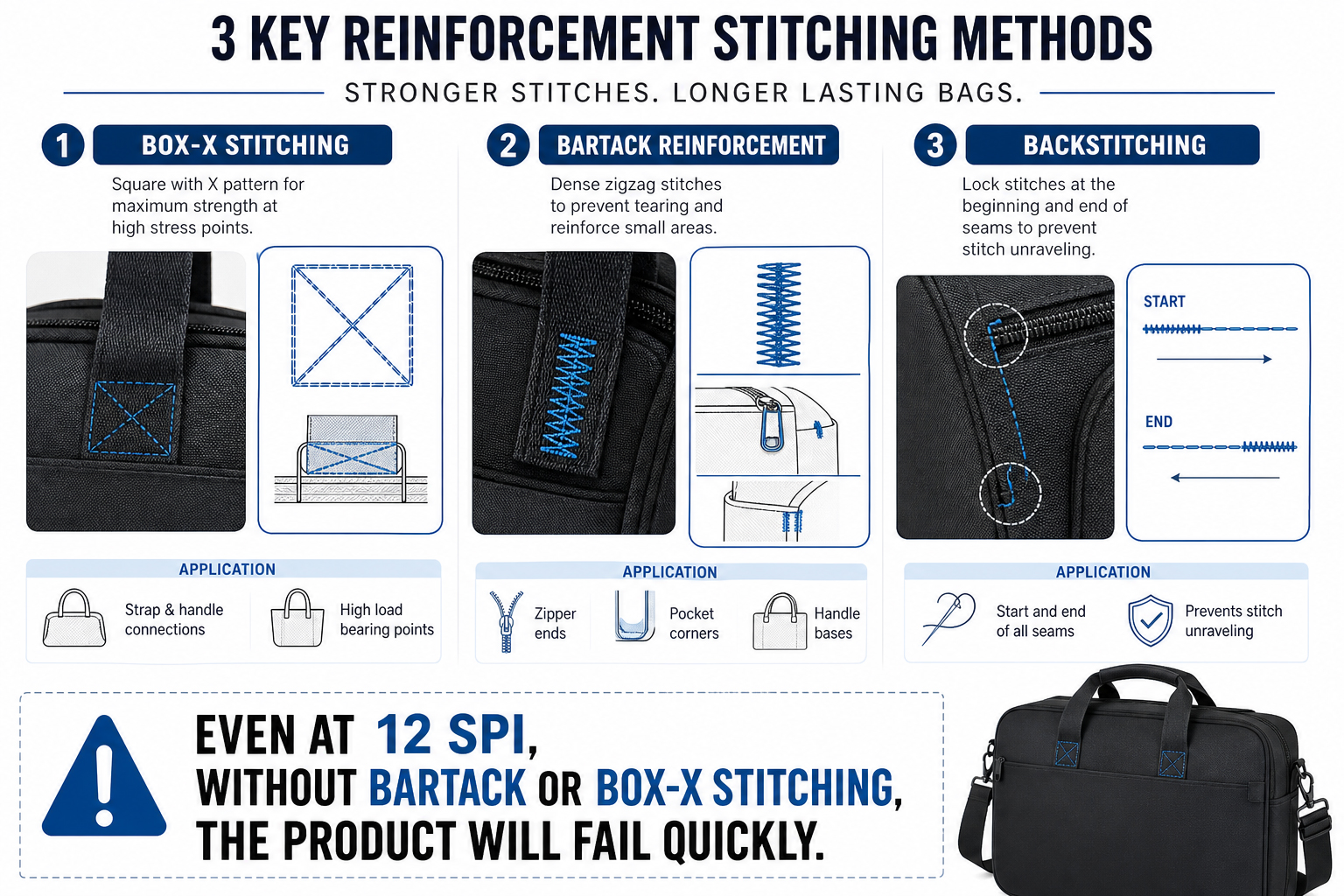
Thread and stitch density remain incomplete without proper seam construction design. Chinese factories mainly use lockstitch and chain stitch for bag assembly, and lockstitch becomes the default choice for most export consumer bags. A high‑quality finished seam relies on a full set of structural details beyond SPI: single‑needle or double‑needle layout, folded seam binding, French seams, seam allowance width, balanced top and bobbin thread tension, backstitching at seam start and finish, and reinforcement stitching at vulnerable joints.
For shoulder straps and handles, box‑X stitching or bartack reinforcement delivers more durability gains than simply raising stitch density. Even if a factory uses 12 SPI on strap connections, the product will fail quickly without bartacks or box‑X stitching. Reliable factories set seam allowance at 10–15 millimeters on load‑bearing seams, prevent skipped stitches and loose thread loops, and lock thread ends firmly. A seam may break at fabric perforations, seam allowance edges or bartack joints instead of snapping the thread itself, so you cannot judge durability merely by thread grade and SPI numbers.
Do Chinese Factories Allow Buyers to Specify Thread Type and Stitch Density for Custom Orders?
Yes. Factories with rich US and European export experience fully accept custom thread and stitch density requirements for private‑label orders. Small local domestic workshops may follow fixed in‑house sewing standards and refuse complicated adjustments, but professional export‑focused manufacturers routinely adjust sewing parameters to match buyer durability targets and brand positioning.
Customization flexibility usually comes with two caveats. First, special thread brands, UV‑treated filament or non‑standard heavy thread sizes may raise raw‑material costs and extend lead times, especially when the factory does not keep that exact thread in stock. Second, extreme SPI requirements can slow down sewing line speed and increase labor expenses. You should define specifications during sampling, not after mass production starts.
The correct workflow is to submit all sewing technical sheets before sample making, require the pre‑production prototype to adopt exactly the same thread grade, thread size, SPI, reinforcement design and seam allowance planned for bulk goods, and forbid any factory material substitution without prior written approval. Many quality disputes arise when factories use cheaper spun thread or reduce stitch density for mass orders while sending samples made with premium bonded thread. Independent store owners should lock every sewing detail into purchase contracts to protect brand consistency.
How Do Chinese Factories Test Seam Strength and Stitch Quality Before Shipping?
Not every Chinese factory runs standardized seam testing automatically. Basic workshops only rely on visual inspection, checking loose threads and skipped stitches by eyes. High‑grade export suppliers maintain internal quality laboratories and can execute targeted durability tests when buyers submit formal testing requests. As a US independent‑site retailer, you should proactively ask for test documentation instead of waiting for factories to offer reports voluntarily.
The core verification items include seam tensile strength testing on main body seams, static pull tests for handles and shoulder straps, zipper cycle durability tests, fabric and seam abrasion resistance tests, color fastness and rubbing resistance checks, and water‑repellent performance tests if your product is marketed as water‑resistant or washable. You can also request inspection photos or short videos showing close‑ups of stitching density, bartack reinforcements and finished seam ends for preliminary confirmation.
A theoretical calculation method estimates seam strength by multiplying individual thread breaking strength by SPI and a loop efficiency factor, yet this formula only provides rough reference data. Real‑world bag damage rarely occurs due to thread breakage alone. Most failures originate from fabric tearing along needle holes, insufficient seam allowance, weak bartack stitching or defective strap hardware. Physical pull tests on complete assembled bags reflect true service performance far better than paper‑based theoretical calculations.
Ready‑Made Technical Checklist to Send to Your Chinese Bag Suppliers
You may forward this questionnaire directly during factory communication for clear specification alignment: Please confirm the complete sewing specifications for this bag:
* Thread fiber: bonded polyester or bonded nylon?
* Thread size: V69/Tex70, V92/Tex90, V138/Tex135, or another size?
* Thread brand and certified breaking strength?
* Is the thread UV‑resistant and mildew‑resistant?
* Stitch density of the main seams: how many SPI?
* Stitch density of handles, shoulder straps, zipper ends, and pockets?
* What stitch type is used for the main seams?
* Are handles reinforced with box‑X stitching or bartacks?
* What is the seam allowance width?
* Can you provide a seam‑strength test and handle pull‑test report?
* Please send close‑up photos showing the stitching, thread, reinforcement, and seam ends.
Add one critical sampling clause for purchase agreements: Please manufacture one pre‑production sample using the identical thread size, SPI, fabric, lining, reinforcement and sewing method scheduled for mass production. No material or sewing modification is permitted without written buyer approval before bulk manufacturing begins.
Practical Starting Sewing Specification Template for US Independent‑Store Bag Lines
These settings serve as reliable starting benchmarks rather than rigid universal rules. Final specifications must adapt to fabric weight, maximum carrying load, strap width, seam layout and outdoor exposure level of each product line. For standard backpacks, everyday totes and travel duffels sold on US independent websites:
* Main body seams: bonded polyester thread, V69 or V92 grade
* High‑load seams and handle attachments: bonded polyester or bonded nylon, V92 or V138 grade
* Main seams: 8–10 SPI
* Strap and D‑ring connection points:10–12 SPI plus box‑X stitching or bartack reinforcement
* Mandatory backstitching at the start and end of every seam
* Zero skipped stitches, balanced thread tension, no open seams or exposed loose knots
* Final quality confirmation depends on qualified pre‑production samples and completed pull testing
Final Thoughts for US Bag Importers
Online shoppers on your independent website cannot touch or inspect stitching before checkout, and negative reviews about broken straps and splitting seams hurt brand credibility permanently. Fabric, zippers and metal hardware attract most buyer attention, but thread and stitch density quietly decide long‑term customer satisfaction. When sourcing bags from Chinese manufacturers, stop accepting vague quality descriptions. Collect complete technical parameters, set customized sewing standards at the sampling phase, demand physical durability tests and compare factory samples against your written specification sheet.
Mastering these sewing details separates professional importers from casual buyers. Precise thread selection and properly calibrated stitch density extend bag service life, lower return rates, build consumer trust and create a clear competitive advantage for your US bag‑selling website in a crowded online marketplace.
Post time: Sep-08-2026