
Reinforcement Materials in Bag Manufacturing: A Complete Guide for U.S. Bag Sellers Sourcing from China
Everything you need to know about interfacing, foam padding, and backing materials to build better, longer-lasting bags
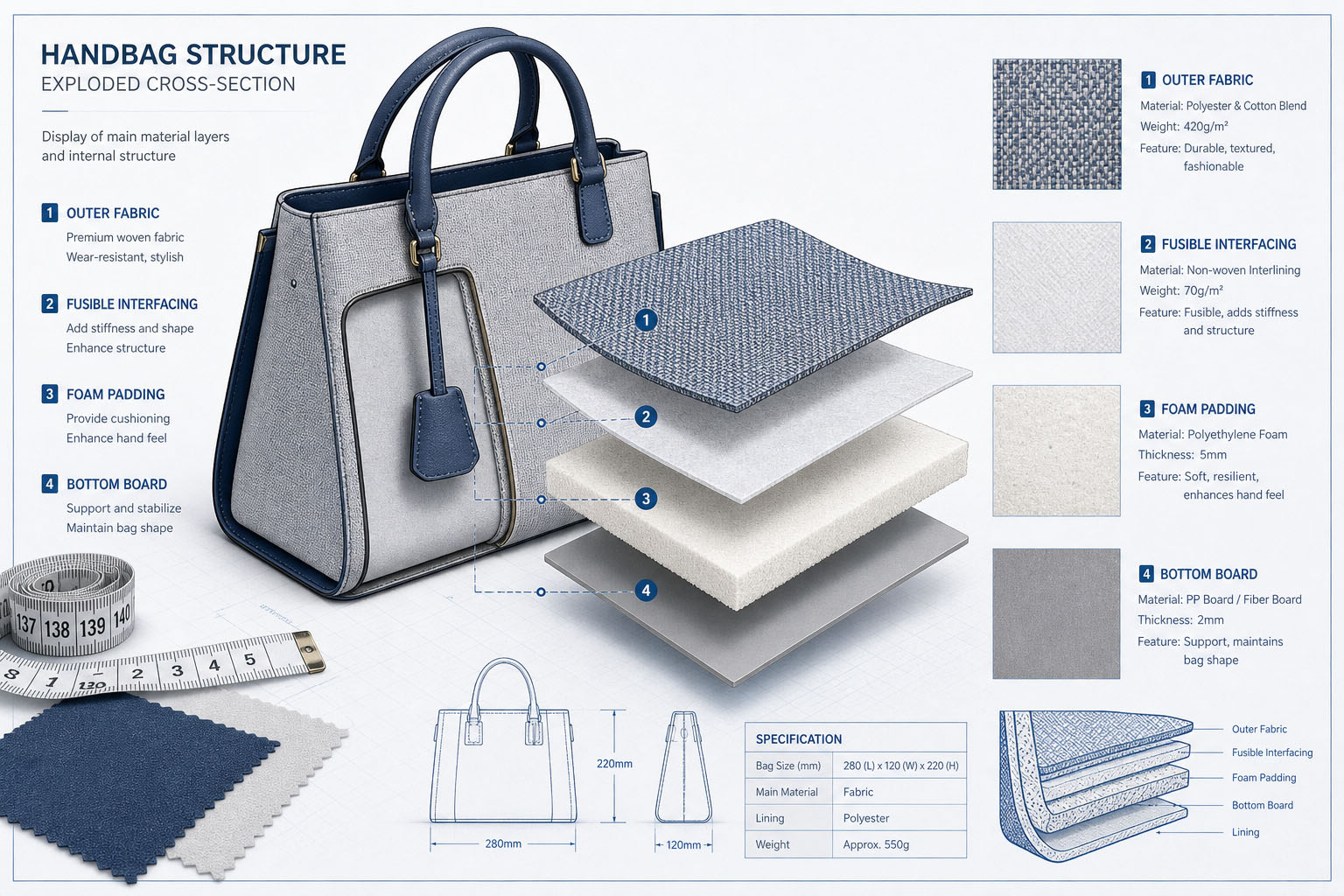
When you’re sourcing bags from Chinese manufacturers, the difference between a premium product and a mediocre one often comes down to what you can’t see. Reinforcement materials — the interfacing, foam, and backing layers hidden inside panels, handles, and bases — are what separate a bag that holds its shape for years from one that sags, warps, or collapses after a few months of use.
As a U.S.-based bag seller, understanding these construction details isn’t just helpful — it’s essential. It’s how you write accurate tech packs, evaluate samples intelligently, and communicate confidently with suppliers. In this guide, we’ll break down exactly what Chinese bag factories offer, how customization works, and how reinforcement choices affect everything from shipping costs to eco-certification.
1. Do Chinese Manufacturers Offer Interfacing, Foam Padding, and Backing Materials?
Yes — and you should always confirm this in writing before placing an order. Most established Chinese bag factories have full access to the three primary reinforcement categories used in modern bag construction:
Interfacing — adds stiffness and body to fabric panels
Foam padding — provides cushioning, softness, and structure
Backing materials — reinforce bases, flaps, and high-stress areas
These materials are typically fused (bonded with heat-activated adhesive), sewn (stitched between layers), or combined (both methods used in different parts of the same bag). The right method depends on your bag style, target price point, and intended use.
Pro tip for your tech pack: Never assume reinforcement is included. Specify it explicitly — material type, GSM/thickness, and application method. Otherwise, factories may default to the cheapest option (or skip it entirely).
2. What Types of Interfacing, Foam, and Backing Materials Are Typically Available?
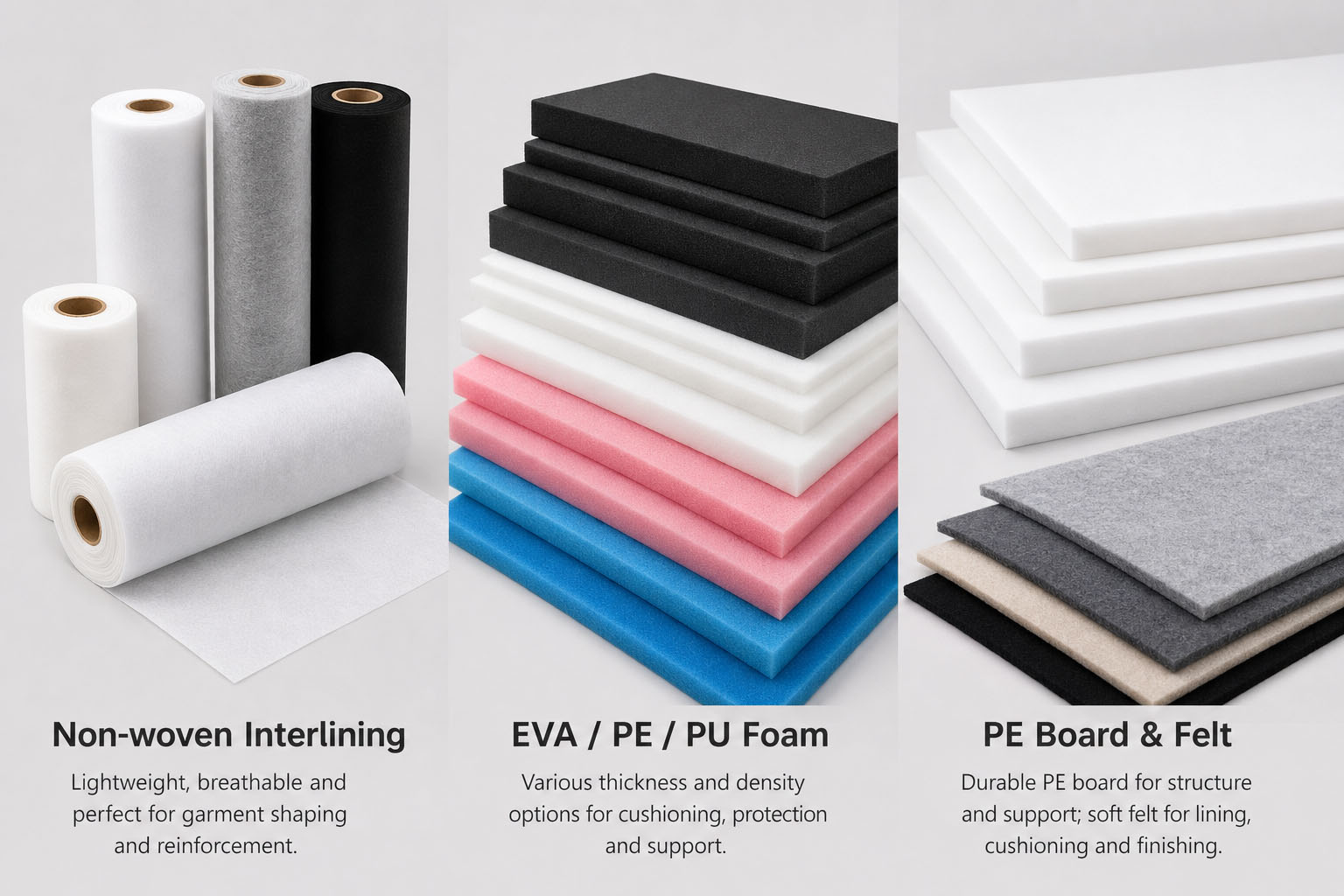
Chinese suppliers typically work with a standardized range of reinforcement materials. Here’s what you’ll encounter most often:
Interfacing Options
Non-woven interfacing (30–50 gsm) — lightweight, used for soft totes and linings
Woven interfacing (60–100 gsm) — medium weight, ideal for structured handbags
Heavy-weight interfacing (150+ gsm) — used in briefcases, laptop bags, and luggage
Foam Padding Options
EVA foam — most common, available in densities from soft (Shore 15) to firm (Shore 45)
PE foam — lightweight and budget-friendly
PU foam — premium feel, used in luxury and fashion bags
Backing Materials
Non-woven fabric backing — flexible reinforcement for curved panels
PE board / plastic sheet — rigid base reinforcement
Cardboard insert — used in structured flaps and lids
Felt or fleece backing — adds softness to back panels and straps
The exact inventory varies by factory, but virtually all mid-to-large Chinese bag manufacturers source these materials from specialized textile suppliers, so customization is rarely limited by raw material availability.
3. Can Thickness, Density, and Color Be Customized?
In most cases, yes — and you should request customization to match your brand standards.
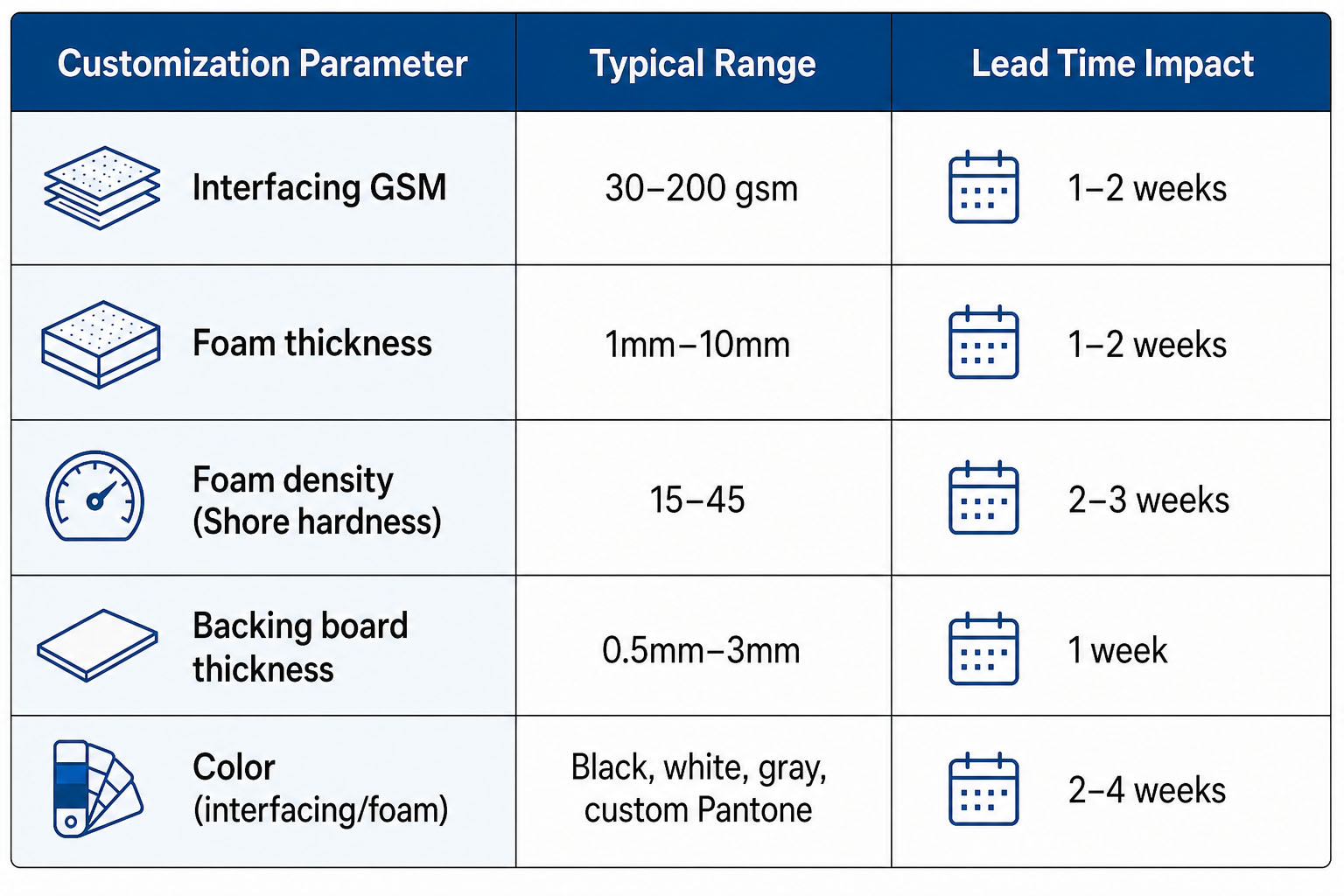
Key considerations for U.S. sellers:
Color matching matters more than you’d think. If your bag lining is light-colored and your interfacing is black, you may see shadow-through on the exterior. Always request a color swatch before production.
Density affects hand-feel dramatically. A Shore 20 foam feels like a luxury pillow; a Shore 40 feels like a rigid insert. Order density samples before committing.
Thickness affects both perceived quality and shipping cost. A 5mm foam layer adds noticeable dimensional weight to every unit shipped overseas.
Insider tip: Many factories will give you free material swatches if you ask. Collect 8–10 samples from different suppliers and create your own “reinforcement library” — it’ll save you thousands in sampling costs over time.
4. Fusible vs. Sew-In Reinforcement: Which Performs Better?
This is one of the most important construction decisions you’ll make, and the answer depends entirely on the bag type and intended use.
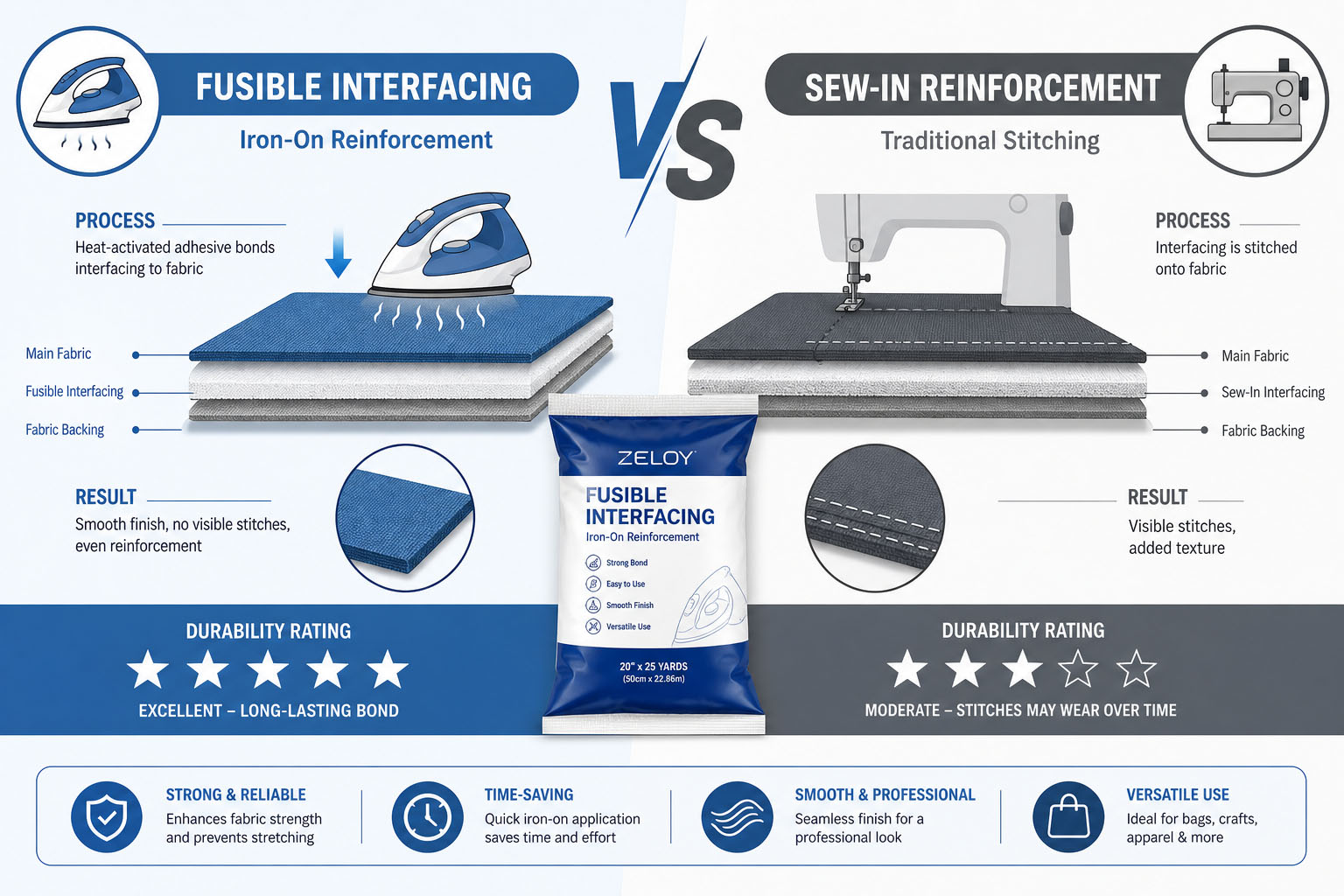
Fusible (Heat-Bonded) Reinforcement
✅ Faster production, lower labor cost
✅ Smoother, cleaner exterior appearance
✅ Better for lightweight, fashion-forward bags
❌ Can delaminate after repeated washing or extreme heat
❌ Less effective for load-bearing applications
Sew-In Reinforcement
✅ Far more durable and long-lasting
✅ Withstands heavy loads (10+ lbs)
✅ Better for backpacks, totes, work bags, and travel bags
❌ Higher labor cost (15–25% more than fusible)
❌ Visible stitch lines may show through thin fabrics
Hybrid Approach (Most Common in Premium Bags)
Fusible interfacing on main body panels for clean aesthetics
Sewn-in foam in handle bases and straps for load-bearing strength
Sewn-in board in bottom panels for structural integrity
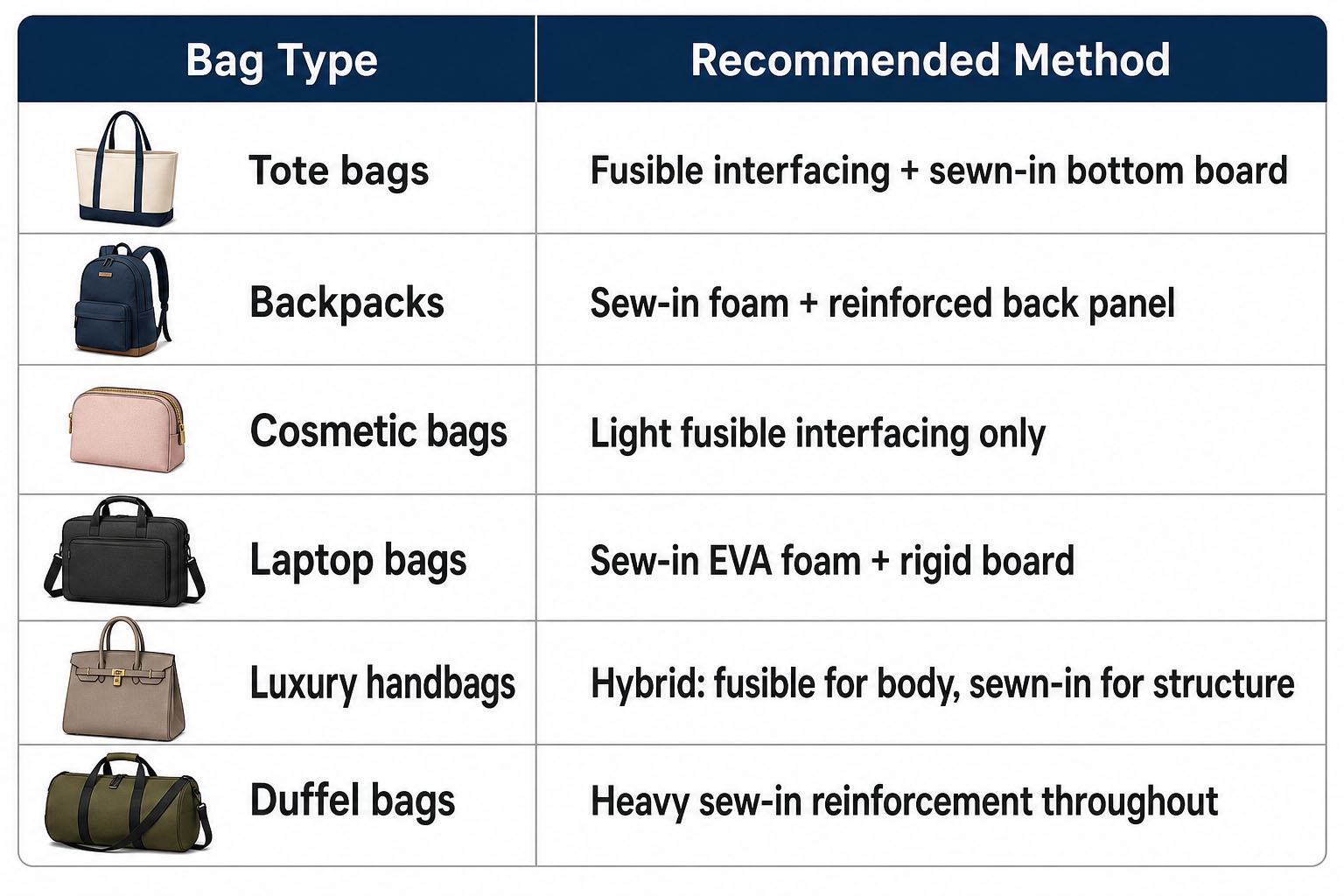
Best Applications by Bag Type:
5. How Do Reinforcement Choices Impact Weight, Shipping Cost, and Eco-Certification?
This is where the conversation gets strategic — and where many U.S. sellers leave money on the table.
Weight Impact
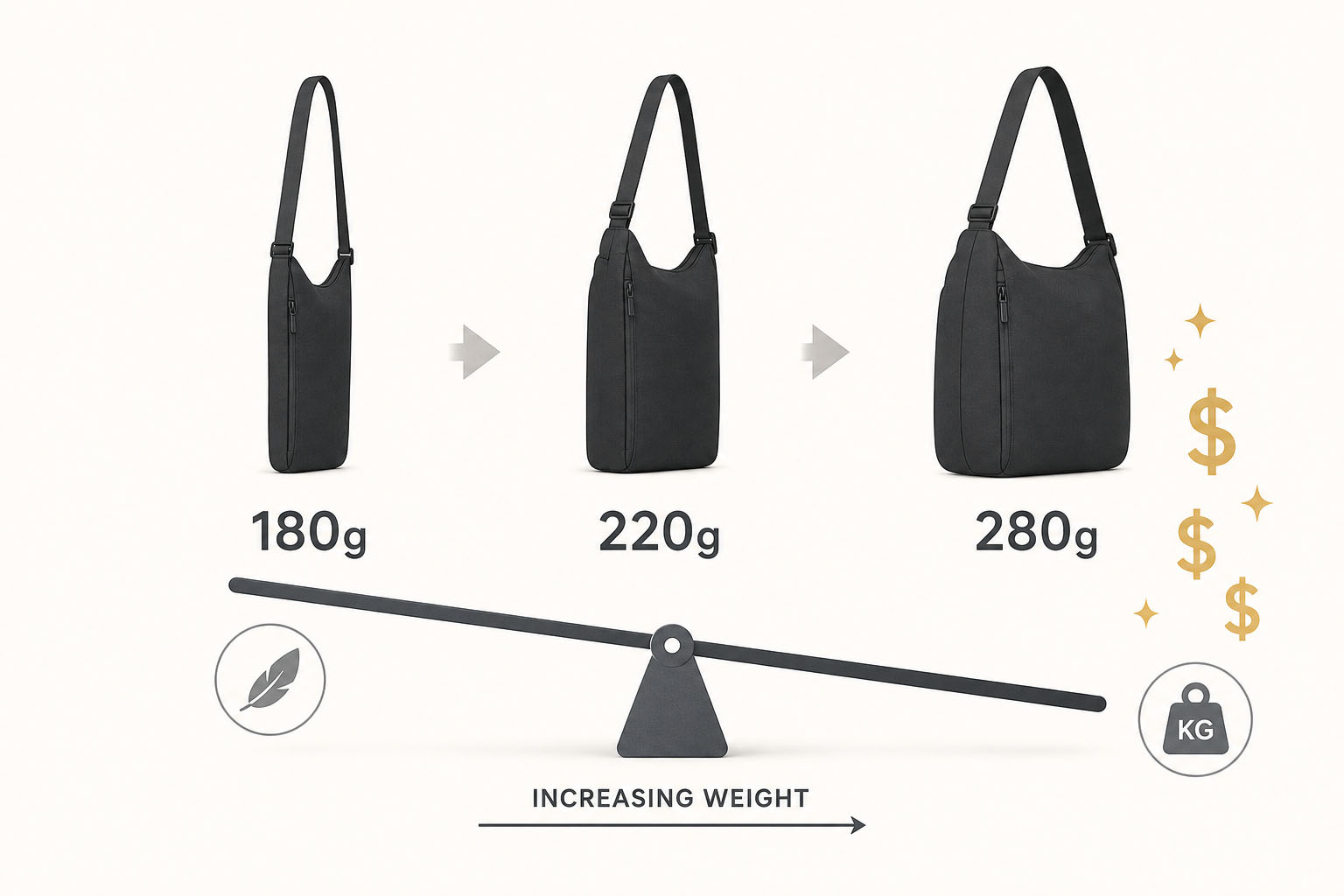
Reinforcement materials can add 15–40% to a bag’s total weight. Here’s a realistic example:
A standard canvas tote with no reinforcement: 180g
Same tote with fusible interfacing: 220g (+22%)
Same tote with fusible + 3mm foam + bottom board: 280g (+56%)
Shipping Cost Implications
For ocean freight (FCL/LCL), this matters less. But for air freight or expedited shipping, a 100g weight increase across 5,000 units = 1,100 lbs of additional dimensional weight — which can add $2,000–$4,000 to a single shipment.
Cost optimization strategy: Consider whether every panel truly needs heavy reinforcement. A cosmetic pouch doesn’t need 5mm EVA foam. A grocery tote doesn’t need a rigid bottom board. Match reinforcement to function.
Eco-Certification Considerations
If you’re pursuing GRS (Global Recycled Standard), OEKO-TEX, or B-Corp certification — increasingly important to U.S. consumers — reinforcement materials must meet the same standards as your outer fabric.
What to ask your supplier:
Is the interfacing made from recycled PET (rPET)?
Is the foam CertiPUR-US or OEKO-TEX certified?
Can the backing board be biodegradable or FSC-certified?
Is the adhesive used in fusible reinforcement water-based and low-VOC?
Chinese factories are increasingly offering eco-friendly reinforcement options, but availability varies. Larger manufacturers in Guangdong and Zhejiang provinces typically have the most robust sustainable material supply chains.
6. Best Practices for Specifying Reinforcement in Your Tech Pack
Now that you understand the materials, let’s talk about how to communicate your requirements clearly. A vague tech pack leads to vague samples — and lost money.
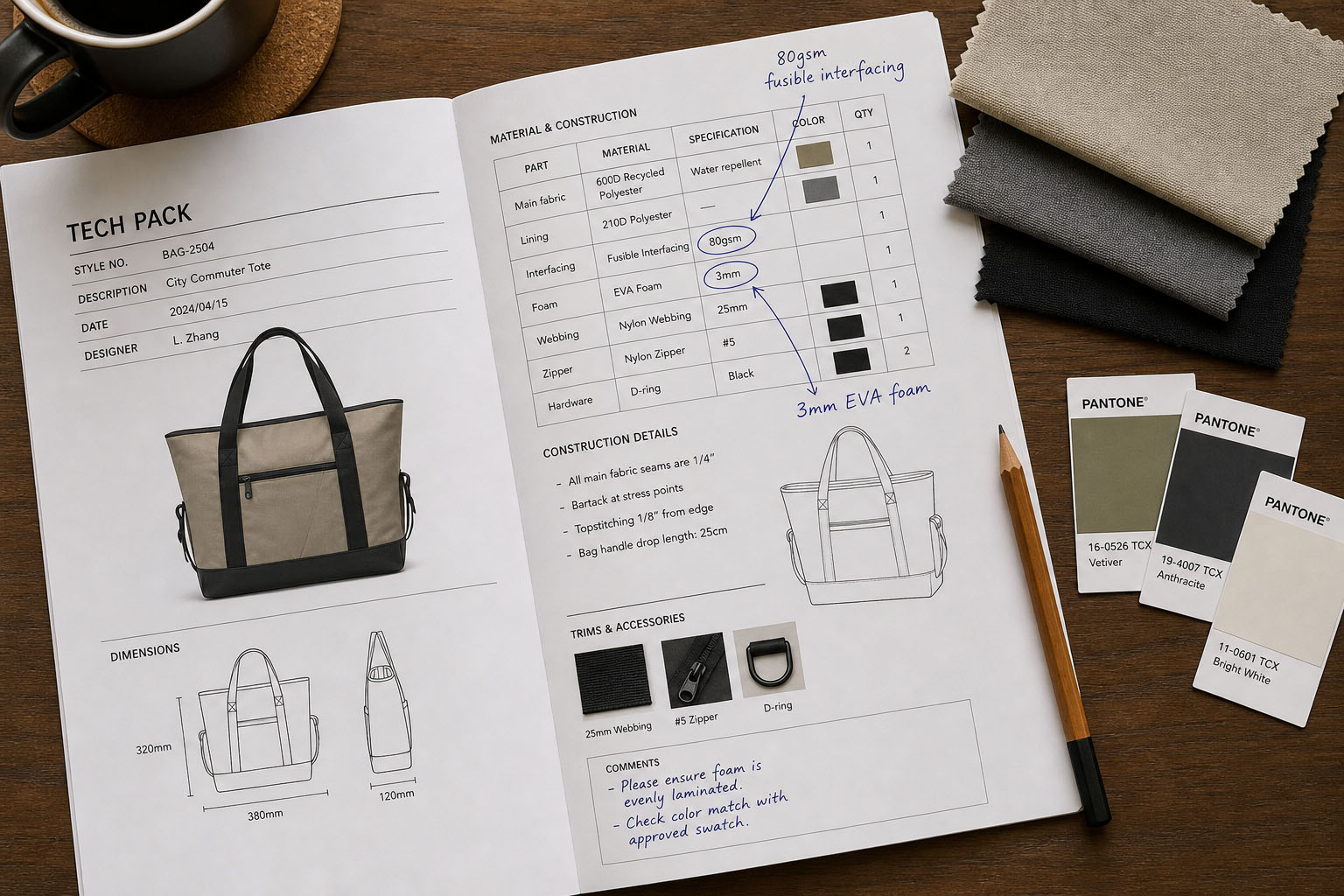
Sample Tech Pack Language for Reinforcement:
Main body panels: 80 gsm non-woven fusible interfacing, bonded to back of outer fabric at 140°C for 12 seconds.
Handle base: 3mm EVA foam, Shore 25, sewn-in between outer fabric and lining, with additional reinforcement stitching at attachment points.
Bottom panel: 1.5mm grey PE board, sewn into bottom seam, extends 2cm up side walls for added structure.
Back panel (backpack only): 5mm PE foam, sewn-in, with vertical quilting lines every 4cm for cushioning and airflow.
Supplier Questions Checklist:
Before confirming any order, ask your Chinese manufacturer these 10 questions:
1. What reinforcement materials are standard in your production line?
2. Can you source custom GSM/thickness interfacing?
3. Is your foam CertiPUR-US or OEKO-TEX certified?
4. Do you offer both fusible and sew-in options?
5. What’s the additional cost per unit for sew-in vs. fusible?
6. Can you provide material swatches before sampling?
7. Will reinforcement materials appear on my quote line-by-line?
8. Are eco-friendly alternatives available at comparable pricing?
9. How do you test reinforcement durability (wash tests, load tests)?
10. Can you include reinforcement specifications in my QC inspection report?
Final Thoughts: Build Better Bags by Specifying the Invisible
The most successful U.S. bag brands don’t just source bags — they engineer them. And reinforcement is where engineering meets craftsmanship.
When you walk into a trade show, attend a brand meeting, or present a new collection, the buyers, retailers, and influencers evaluating your products will feel the difference between a reinforced panel and a flimsy one, even if they can’t articulate it. Shape retention, hand-feel, load capacity, and long-term durability — these are the silent selling points that drive repeat purchases and 5-star reviews.
The takeaway: Don’t treat reinforcement as a commodity detail. Treat it as a design feature.
Work with your Chinese manufacturing partner to:
✅ Specify materials clearly in your tech pack
✅ Test multiple reinforcement options during sampling
✅ Consider the full cost impact (production + shipping + certification)
✅ Build reinforcement specs into your QC process
That’s how you move from being a bag reseller to being a bag brand.
Ready to Source Smarter?
If you’re evaluating Chinese bag manufacturers for your U.S. e-commerce brand and want help developing a reinforcement specification sheet, sample request template, or supplier audit checklist, get in touch. We’ve built hundreds of bags for U.S. sellers and can help you avoid the most common (and expensive) mistakes.
Have questions about a specific bag style or reinforcement challenge? Drop them in the comments below — we read every one.
Post time: Jul-03-2026