
Sewing Thread & Lockstitch Seam Specification Guide for Canvas & Leather Bags: For US E-Commerce Bag Brands
Word count: ~2700 | Blog post for independent bag brand website | American English
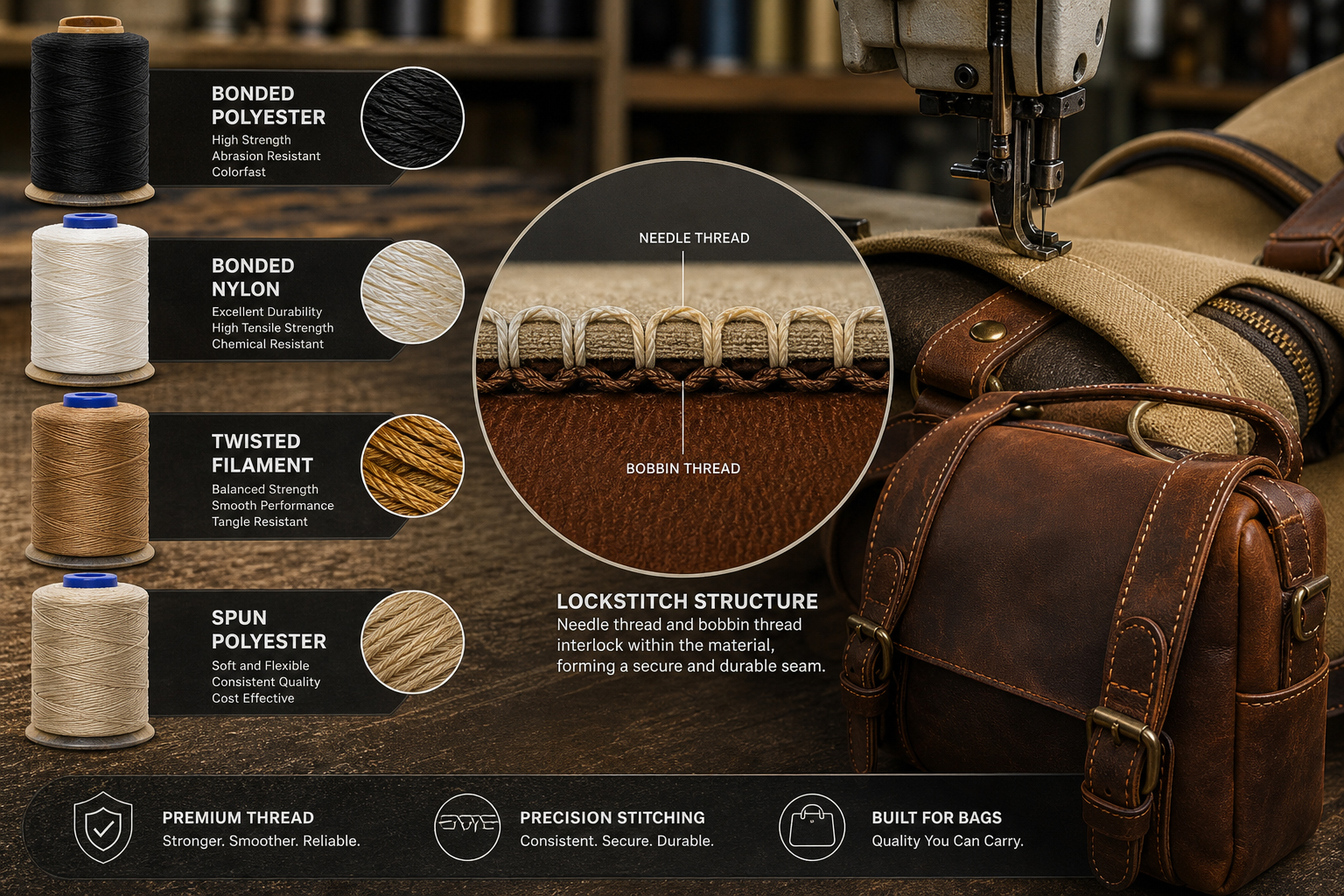
For US bag brands selling backpacks, totes, luggage, leather crossbodies, and outdoor gear direct-to-consumer, sewing thread is one of the most overlooked yet critical components of product quality. Many importers only specify “strong polyester thread” on purchase orders, leaving Chinese factories to select thread weight, fiber construction, stitch density, and seam allowance based on lowest cost rather than long-term field performance. When bags fail in consumer use, the root cause is rarely defective fabric — it is almost always poorly specified thread, incorrect lockstitch setup, or mismatched stitch parameters for canvas and leather panels.
This guide is written for independent website bag buyers sourcing production from Chinese factories. It answers the core technical questions you will raise with your sewing vendors: optimal thread types and tensile strength for lockstitch seams on main panels, pockets, and linings; stitch length, SPI and seam allowance for canvas and leather; UV, moisture and abrasion performance of bonded, twisted and filament polyester; recommended thread sizing (Tex, Denier, ticket) for straps and load-bearing zones; and warranty/liability risks when thread weight is improperly specified. We will also include a ready-to-use supplier specification template you can paste directly into your production PO and quality control documents.
1. Thread Types and Tensile Strength for Industrial Lockstitch Seams: Main Panels, Pockets and Linings
Industrial lockstitch remains the standard seam construction for bag production because the upper and bobbin threads interlock inside the fabric stack, resisting unraveling far better than chain stitch for carry goods. But lockstitch performance lives or dies by thread fiber and construction.
Bonded nylon thread (Tex 70 to Tex 90) is the most widely used traditional option for lockstitch seams on main bag panels, delivering high tensile strength and excellent abrasion resistance. Bonded nylon typically offers 15% to 25% higher knot strength than bonded polyester at the same Tex rating, which makes it appealing for thick, flexing seams on leather and heavy canvas. However, bonded nylon’s major weakness is UV degradation. For bags sold to US consumers for outdoor use, beach travel, hiking, or everyday sun exposure, bonded nylon will yellow and lose tensile strength over months of sunlight.
Bonded polyester thread is the preferred specification for UV-exposed and outdoor bags because it resists sunlight degradation better than nylon. Polyester also has lower stretch and superior dimensional stability, which is critical for structured bag panels that must hold shape after repeated loading. Linen thread is a premium traditional option for hand-stitched leather bags but is rarely specified for high-volume industrial lockstitch production. Cotton thread has the lowest tensile strength of all common options and should never be used for load-bearing seams on modern commercial bags.
For secondary seams such as pockets and linings, you do not need heavy high-tensile thread. Tex 40 to Tex 60 polyester thread delivers sufficient strength without adding bulk, puckering thin lining fabrics, or creating oversized needle holes that weaken the material. Kevlar or aramid threads are specialty materials only for tactical, cut-resistant ballistic bags; they are overkill, expensive, and unnecessary for standard tote, backpack, and fashion luggage lines.
Thread elasticity directly affects seam recovery. Nylon stretches more than polyester. That stretch can create seam relaxation over time: after repeated load cycles, nylon seams may loosen and cause bag panels to sag. Polyester’s low elongation preserves seam geometry, making polyester the better default for structured bags. Regardless of fiber, proper needle and thread size matching prevents thread breakage during high-speed factory sewing. Always follow the metric thread-to-needle ratio, and require factory pre-production sewing trials on your exact fabric stack.
Bonded polyester also outperforms bonded nylon in humid and wet conditions, making bonded polyester the industry standard for marine, sports, and water-resistant outdoor bags sold in the US market.
Practical Rule of Thumb for Your Product Line
For industrial lockstitch seams, specify bonded polyester thread for most commercial bags. Select thread size by fabric weight and seam stress, not simply by ordering the strongest available thread. Use bonded nylon only when maximum flexibility and raw abrasion resistance are higher priorities than UV durability.
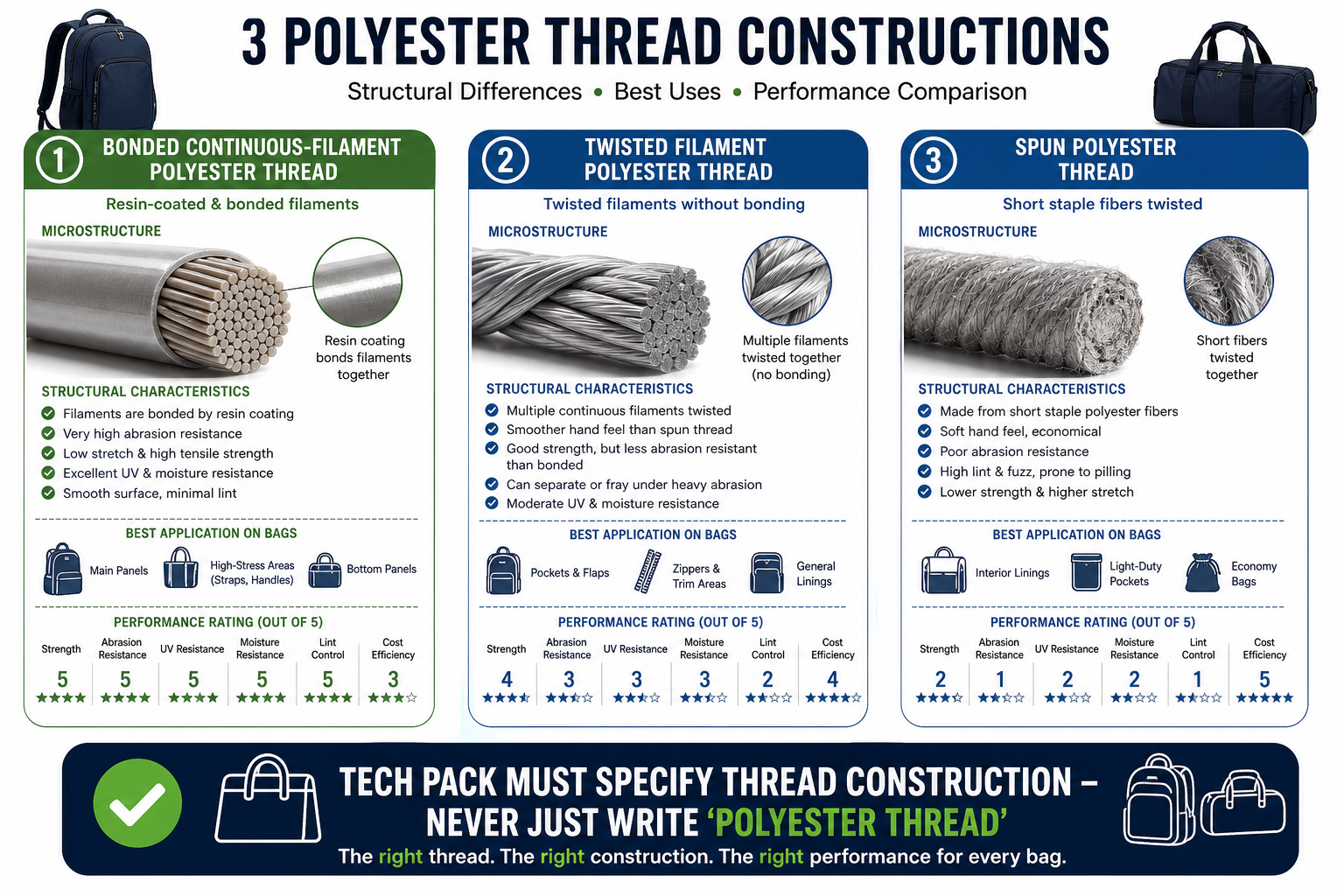
2. Recommended Thread Specification Table for All Bag Zones
This table provides practical starting specifications for factory sourcing. These values are not universal pass/fail test thresholds. Published thread performance data varies by fiber, coating, finish, color dye lot, and testing methodology. For reference: a common Tex 70 / V-69 polyester thread delivers approximately 11 lbf tensile strength, while Tex 90 and Tex 135 are used for progressively heavier, high-load applications.
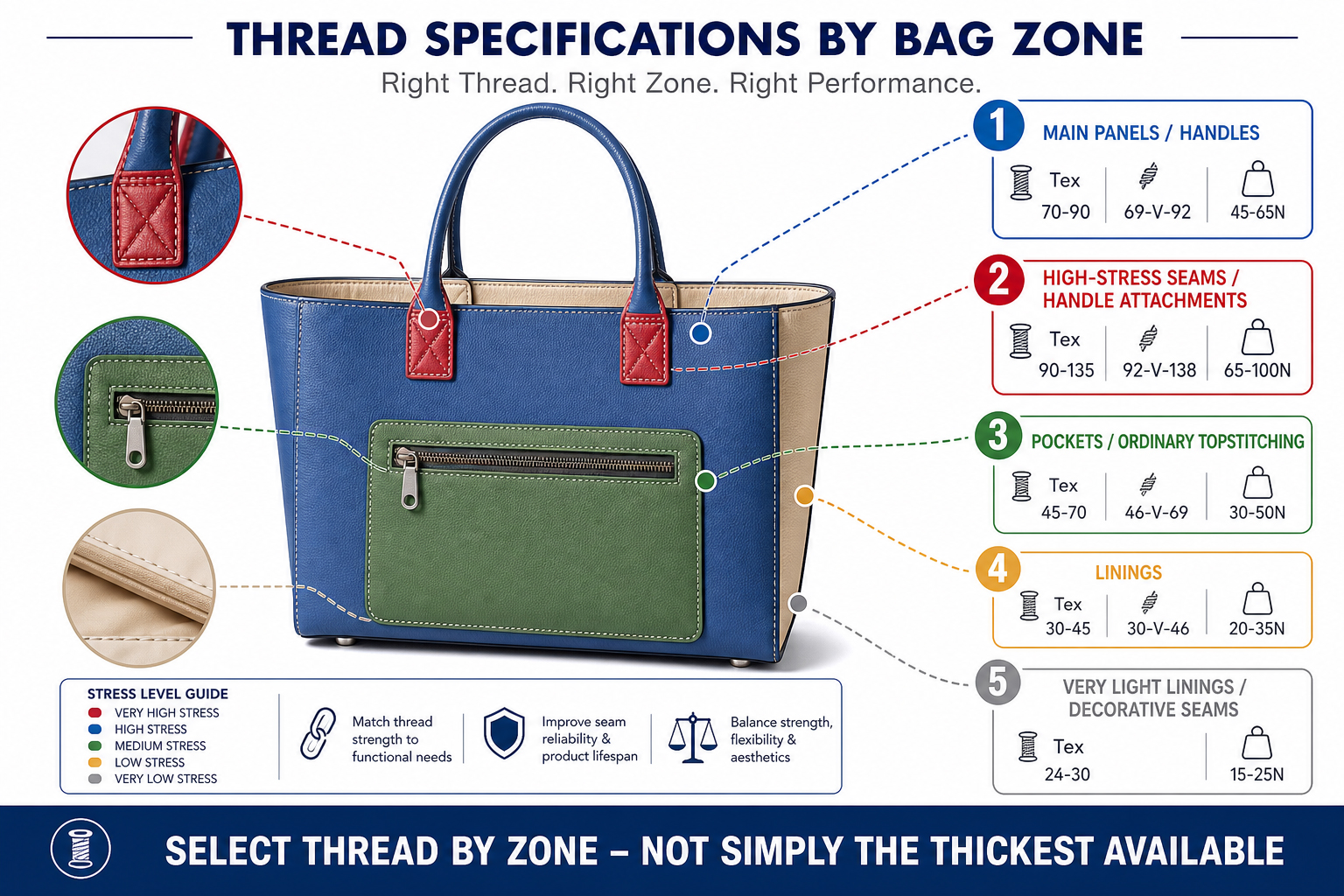
3. Stitch Length, Stitches Per Inch (SPI), and Seam Allowance for Canvas and Leather Lockstitch Seams
This is one of the most frequently misconfigured parameters in overseas bag manufacturing. For industrial lockstitch seams on canvas and leather bag panels, the stitch setup directly controls seam strength, fabric tearing risk, and long-term durability for US consumers.
A stitch length of 3 stitches per centimeter (approximately 7–8 SPI) is a solid baseline for main canvas panel lockstitch seams. For thick multi-layer canvas and heavy luggage fabrics, factories sometimes use 6 SPI, while high-stress handle and strap attachment points should increase density to 8–10 SPI. Denser stitches distribute load better, but excessively tight SPI creates too many needle perforations in canvas or leather, cutting the fabric and causing panel tear-out before the thread itself breaks. This is a common factory shortcut: sewing very dense stitches thinking it equals stronger seams, when the opposite occurs on leather and coated canvas.
For leather panels specifically, slightly longer stitch lengths are preferred. Leather cannot recover from needle holes like woven fabric; too many closely spaced needle punches create crack lines along seams, especially on genuine leather and PU leather under repeated flexing. For leather bag panels, use 6–7 SPI for main seams, with bar-tack reinforcement at all handle attachment points rather than cramming extra stitches into the leather.
Seam allowance must also be defined clearly in your specification sheet. For canvas main panels, a minimum seam allowance of 10 mm (3/8 inch) is recommended for lockstitch seams. For leather and heavy multi-layer luggage panels, increase seam allowance to 12 mm (1/2 inch). The extra allowance spreads load and reduces seam slippage. Factories under cost pressure will cut seam allowance to save material, which creates weak seams prone to splitting when the bag is loaded. Always specify seam allowance tolerance ±1 mm on your tech pack.
Critical reminder: stitch strength is a balance. The strongest lockstitch seam comes from matching SPI, seam allowance, thread size, fabric tear strength, and reinforcement bar tacks together, not maximizing stitch density alone.
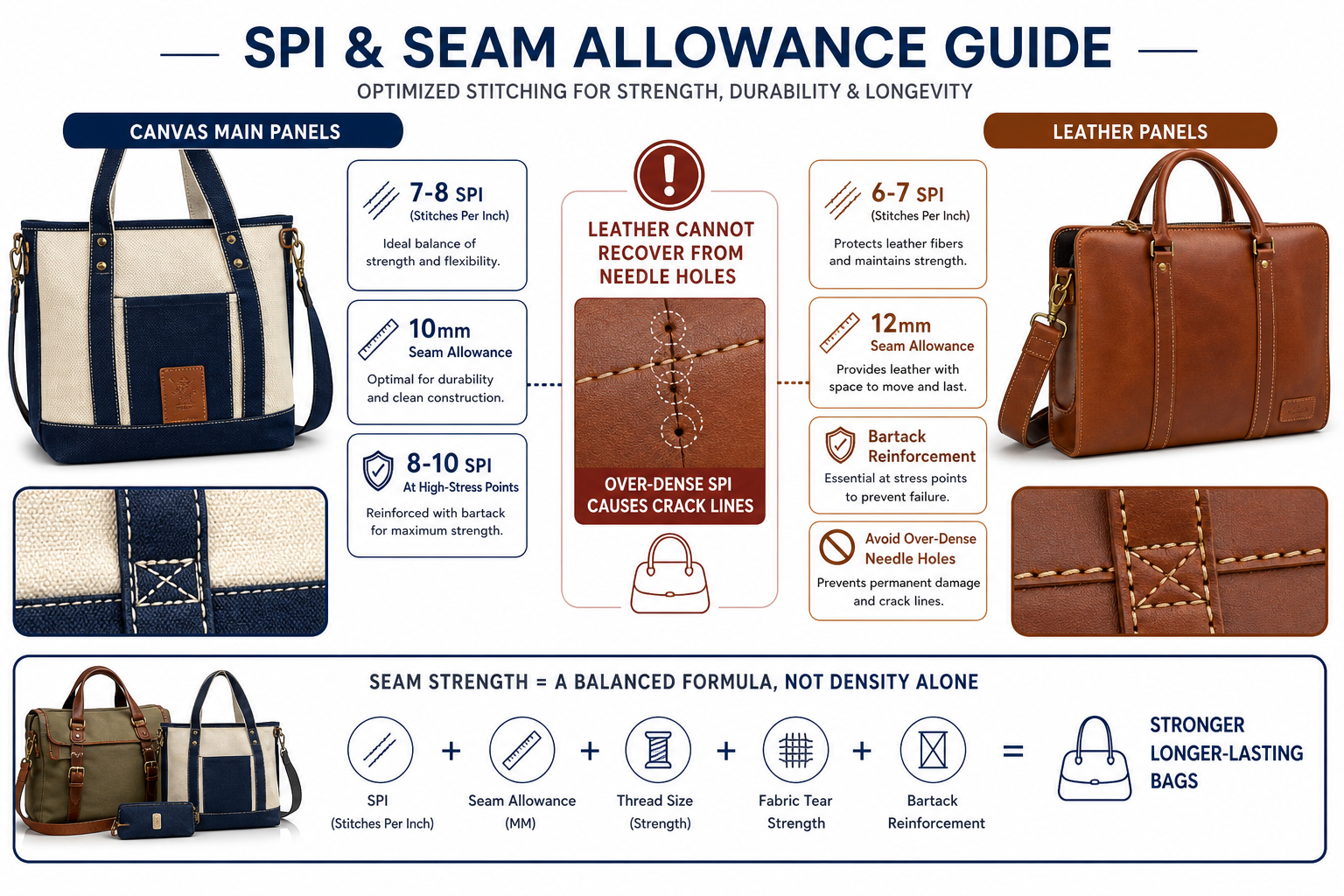
4. Bonded, Twisted, or Filament Polyester: UV, Moisture and Abrasion Resistance for Long-Term Bag Use
When selecting polyester thread, buyers must distinguish three common constructions: bonded continuous-filament polyester, twisted filament polyester, and spun polyester. Their performance under UV exposure, moisture, and abrasion differs dramatically.
Bonded continuous-filament polyester is the top choice for most US-market bags. Bonded thread is coated with a resin binder that fuses filaments together, reducing fraying, needle cutting, and lint buildup during high-speed industrial sewing. It delivers excellent abrasion resistance, low stretch, and superior UV and moisture stability. In outdoor, sunny, humid, or coastal environments, bonded polyester retains tensile strength far longer than bonded nylon, twisted filament, or spun polyester. This is why marine bags, outdoor backpacks, and travel totes rely on bonded polyester.
Twisted (plied) filament polyester is made by twisting multiple continuous filament yarns together without bonding resin. It is smoother than spun polyester but lacks the anti-fray bonding coating. It can work for pocket and lining seams, but during high-speed sewing, twisted filament can separate, fray, and cause skipped stitches or thread breakage. Its abrasion performance is inferior to bonded polyester for load-bearing seams.
Spun polyester is constructed from short staple fibers twisted together. Spun polyester is economical and soft, making it suitable for linings, pockets, and non-load-bearing apparel-style seams. However, spun polyester has poorer abrasion resistance and higher lint. For bag main panels, handles, and stress points, continuous-filament bonded polyester delivers better abrasion resistance and more consistent sewing performance.
A common sourcing mistake is writing only “polyester thread” in your tech pack. This phrase is ambiguous to Chinese factories. You must explicitly specify whether the thread is spun polyester, continuous-filament polyester, bonded polyester, or core-spun polyester, because these constructions do not share identical tensile strength, UV resistance, or abrasion life.
5. Thread Size Selection (Tex, Denier, Metric Ticket) for Straps, Handles and Load-Bearing Areas
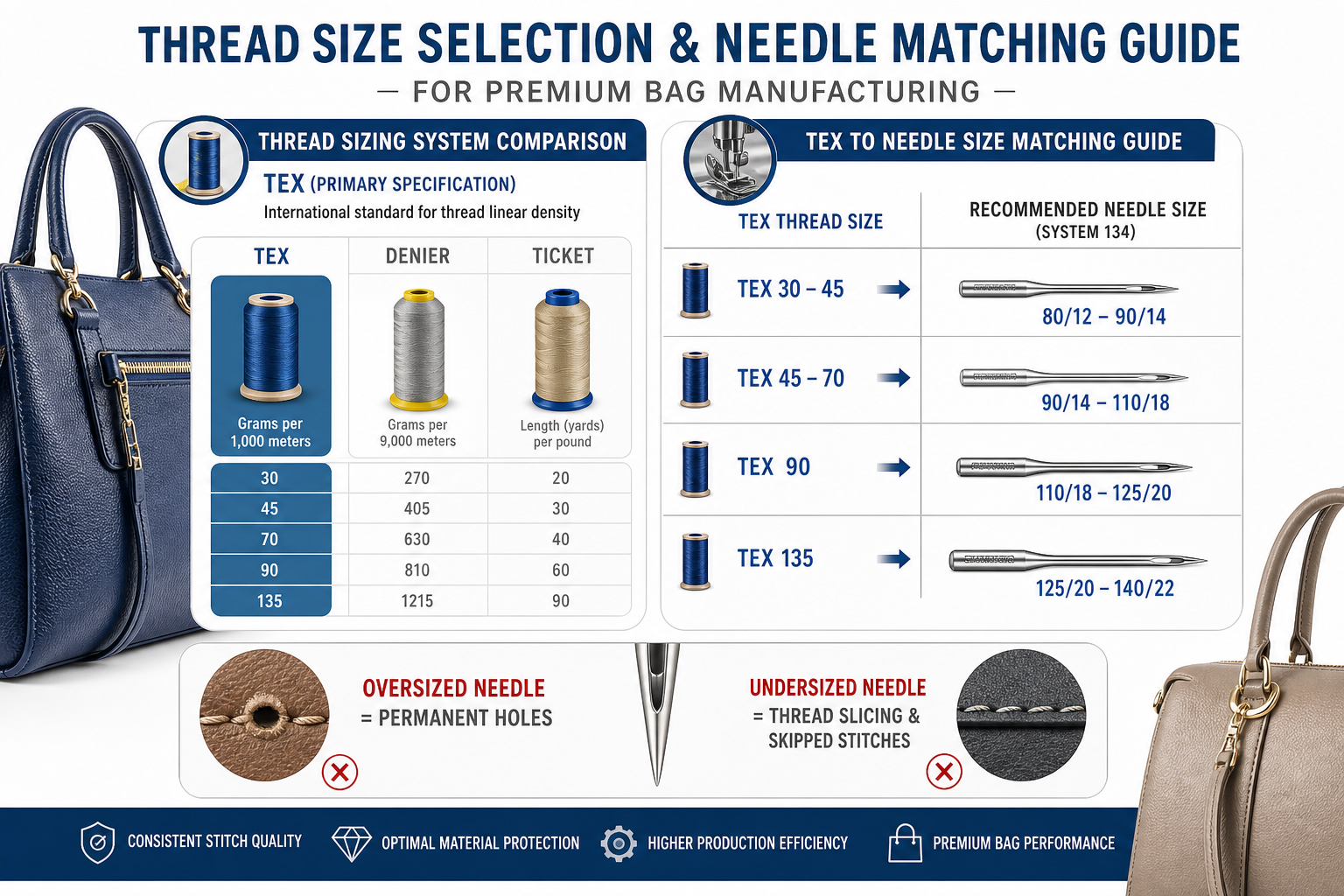
Three sizing systems appear on industrial thread documentation: Tex, Denier, and ticket / metric commercial size. Tex is the most reliable international standard and the primary unit you should use on your purchase orders. Tex measures the weight in grams of 1000 meters of thread; higher Tex numbers mean thicker, stronger thread. Denier measures filament yarn weight in grams per 9000 meters, mostly used for raw filament polyester and nylon. Ticket numbers (V-size / commercial ticket) are convenient factory labels, but they vary slightly by thread manufacturer, so always reference Tex as your primary specification.
For heavy-duty seams on straps, handles, and load-bearing attachment points, use Tex 90 to Tex 135 bonded polyester or bonded nylon. These thicker threads handle dynamic shock loads when users lift filled bags, set luggage down, or pull backpack straps. For standard tote and backpack main panels (non-extreme load), Tex 70–90 is sufficient. Lighter pockets use Tex 45–70, linings Tex 30–45.
A matching needle size table is essential for your factory QC. Incorrect needle size will damage thread or punch oversized holes into leather and canvas:
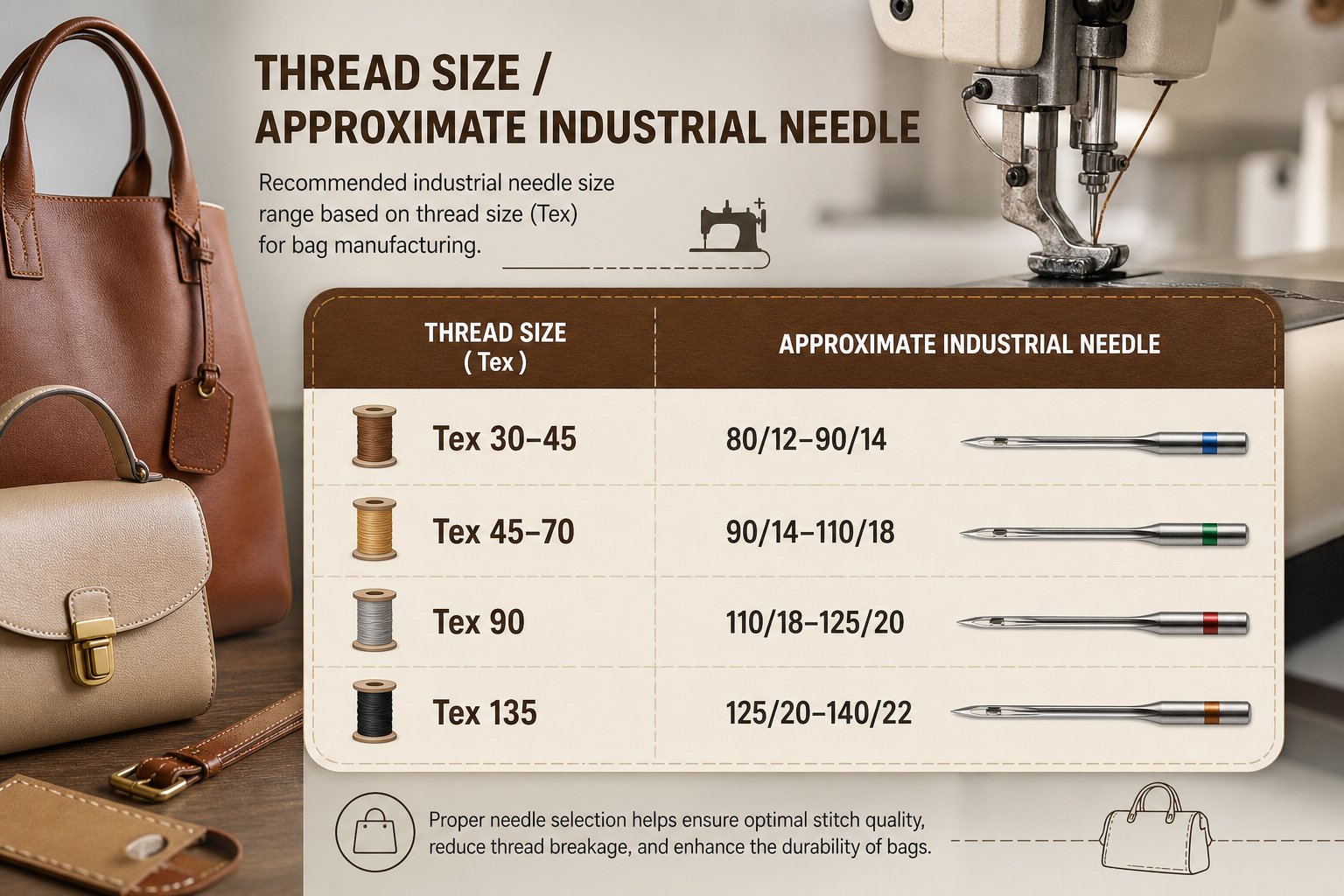
For example, Tex 70 / V-69 polyester commonly pairs with 100/16–110/18 industrial needles. Require the factory to adjust needle size based on your actual material stack. An oversized needle creates permanent holes; an undersized needle slices thread and causes skipped stitches.
6. Tensile Strength Testing Requirements: How to Write Valid, Comparable Specifications
Do not ask your Chinese factory simply for “high tensile strength thread.” This vague wording leads to inconsistent, non-comparable test reports. For every thread size, request these data points for the production lot:
* Fiber: 100% bonded polyester or 100% bonded nylon
* Thread size: Tex plus American commercial V-size (example: Tex 70 / V-69)
* Single-end breaking force, reported in both Newtons (N) and pounds-force (lbf)
* Elongation at break, expressed as percentage
* Test standard: ASTM D2256 or ISO 2062
* Sample conditioning parameters and sample count for repeatability
* Thread color and dye lot number, as dye chemistry can alter measured strength
* Sewing trial report, tested on your actual fabric stack, seam construction, needle type, and machine speed
ASTM D2256 is the US standard test method for breaking force and elongation of monofilament, multifilament, spun, plied, and cabled yarns. ISO 2062 is the equivalent international standard for single-end breaking force and elongation. Both standards are widely accepted by Chinese thread mills and third-party test labs.
When writing your specification, define a minimum breaking force value, not only an average. Example specification language:
“Bonded polyester, Tex 70 / V-69, minimum single-end breaking force 45 N, average target 50 N or higher, tested according to ISO 2062 or ASTM D2256.”
Thread mill catalog ratings are estimates. Always confirm final performance by lab testing pre-production samples, because thread labels and manufacturer ratings are not perfectly interchangeable between suppliers.
7. Thread Strength ≠ Seam Strength: The Most Common Misconception for US Bag Brands
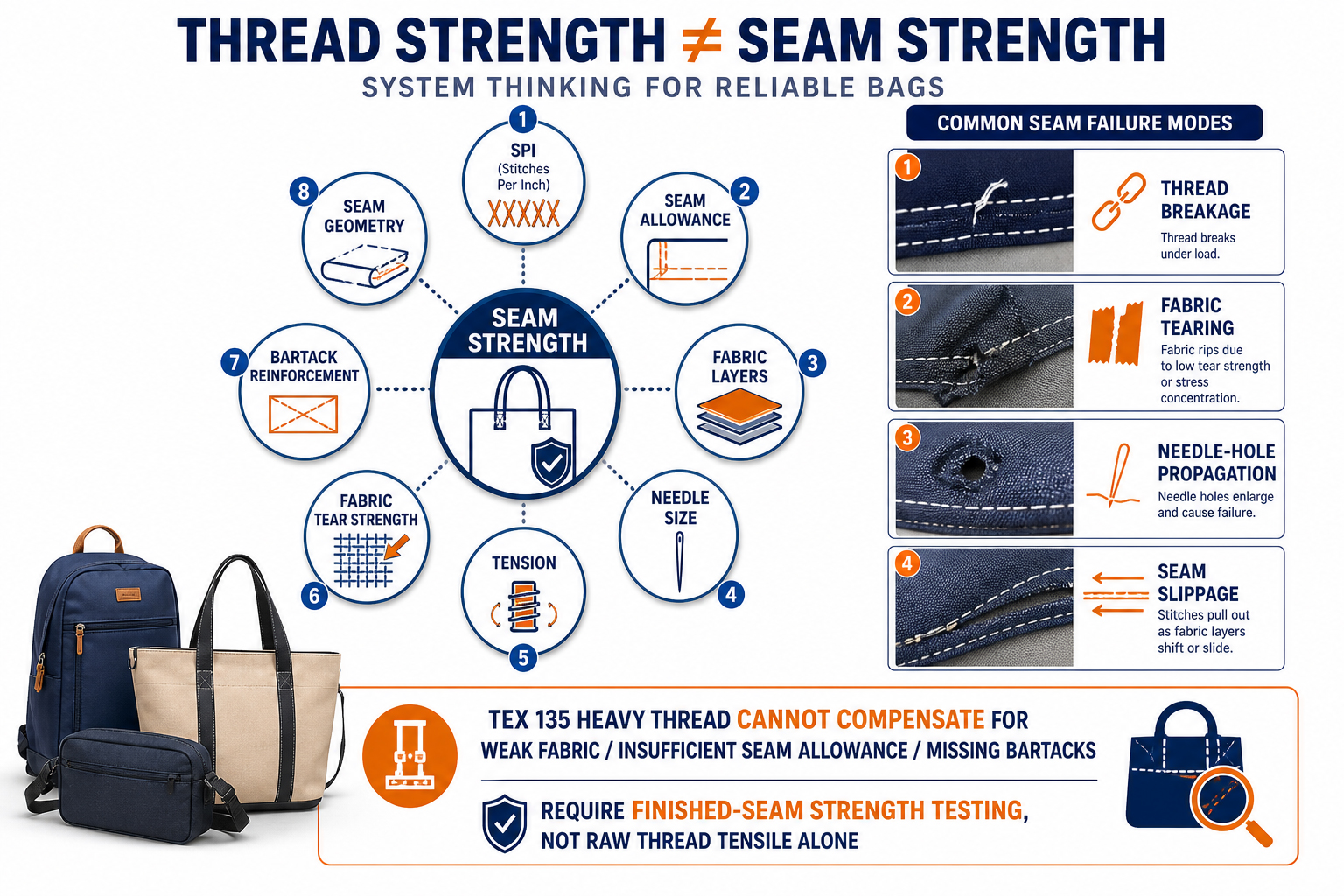
A strong thread does not automatically produce a strong bag seam. This mistake causes many US brands to approve thread tensile reports only to discover field failures once products reach consumers. Seam performance depends on a full system of variables: stitch density / SPI, seam allowance, number of fabric layers, needle size and needle damage, upper and bobbin thread tension, stitch balance, base fabric tear strength, bar-tack reinforcement at handles, and seam geometry (straight seam, box stitch, zig-zag reinforcement).
A finished lockstitch seam can fail in four distinct ways: thread breakage, fabric tearing along the stitch line, needle-hole propagation, or seam slippage. For load-bearing handles and straps, test the complete handle assembly, not just raw thread. Test fabric, webbing, stitching pattern, and reinforcement together. A Tex 135 heavy thread cannot compensate for weak base fabric, insufficient seam allowance, or missing bar-tacks at handle mount points.
Therefore, require the factory to perform finished-seam strength testing on your actual bag material stack, not only raw thread tensile testing. This step is non-negotiable for luggage, backpacks, and work bags sold to US consumers.
8. Warranty and Product Liability Risk: Can Wrong Thread Weight Void Warranty or Cause Load Failure?
This is the most commercially important question for independent website sellers in the United States. Using incorrect thread weight will not automatically void your manufacturer’s factory warranty in every contract, but it will create two serious business risks: seam failure under load and liability exposure from defective product performance.
If you specify too fine thread for load-bearing areas, seams will fail under normal consumer use. This triggers returns, negative product reviews, warranty claims, and expensive replacements on your US website. If your factory substitutes lighter thread than your tech pack specifies, the factory may refuse warranty coverage because they can argue the sample approval used a different thread specification. To protect your brand, lock thread specs, SPI, seam allowance and seam testing requirements into your signed production agreement and pre-production sample approval form.
For US consumer goods, product liability risk increases when bags fail during normal intended use. If a handle seam breaks while a consumer carries heavy items and property damage or injury results, inadequate seam construction becomes a product defect. Proper thread specification, third-party seam load testing, and documented QC checks reduce this risk substantially.
Using oversize thread is also problematic: overly heavy thread on thin linings or lightweight panels creates excessive needle holes, fabric puckering, and panel weakening, which can also lead to premature seam failure. Thread selection is a balancing act, not simply “thicker is safer.”
9.Supplier Specification Template: Ready to Send to Chinese Bag Factories
Use this text directly in your tech pack and purchase order to eliminate misinterpretation:
Please confirm the sewing thread specification for each bag component:
* Main panel seams: 100% high-tenacity bonded polyester, Tex 70–90, minimum single-end breaking force 45–65 N.
* Handle and high-stress seams: bonded polyester or bonded nylon, Tex 90–135, minimum breaking force 65–100 N.
* Pocket seams: bonded polyester, Tex 45–70, minimum breaking force 30–50 N.
* Lining seams: polyester, Tex 30–45, minimum breaking force 20–35 N.
Please provide the fiber type, thread construction, Tex size, commercial V-size, elongation at break, breaking force in N and lbf, recommended needle size, and test method. Testing shall follow ASTM D2256 or ISO 2062. Please also provide finished-seam strength results using the actual production fabric and stitch construction.
For most product ranges, use bonded polyester Tex 70 for lighter fashion bags, Tex 90 for standard backpacks and totes, and Tex 135 for heavy luggage and high-stress seams. Reserve finer polyester thread for linings and pockets so fabric is not perforated or puckered.
Final Takeaways for Your Independent Bag Business
Sewing thread is not a trivial detail on your bill of materials. It defines durability, customer satisfaction, warranty expense, and brand reputation for US consumers purchasing bags from your website. For most commercial bag lines, default specification should be high-tenacity bonded continuous-filament polyester, selected by zone, fabric thickness, and expected UV/moisture exposure. Use bonded nylon selectively only for high-abrasion, low-UV applications.
Always define Tex size, minimum breaking force, test standards, SPI, seam allowance, and needle matching in your tech pack. Require finished seam testing on your actual fabric stack, not raw thread certificates alone. With clear specifications, pre-production sewing trials, and lot test reports, you can drastically reduce seam failures, returns, and product liability risk for your bag brand.
Post time: Sep-18-2026