
Sourcing Bags from China: The Complete Buyer’s Guide to Quality, Compliance & Smart Partnerships
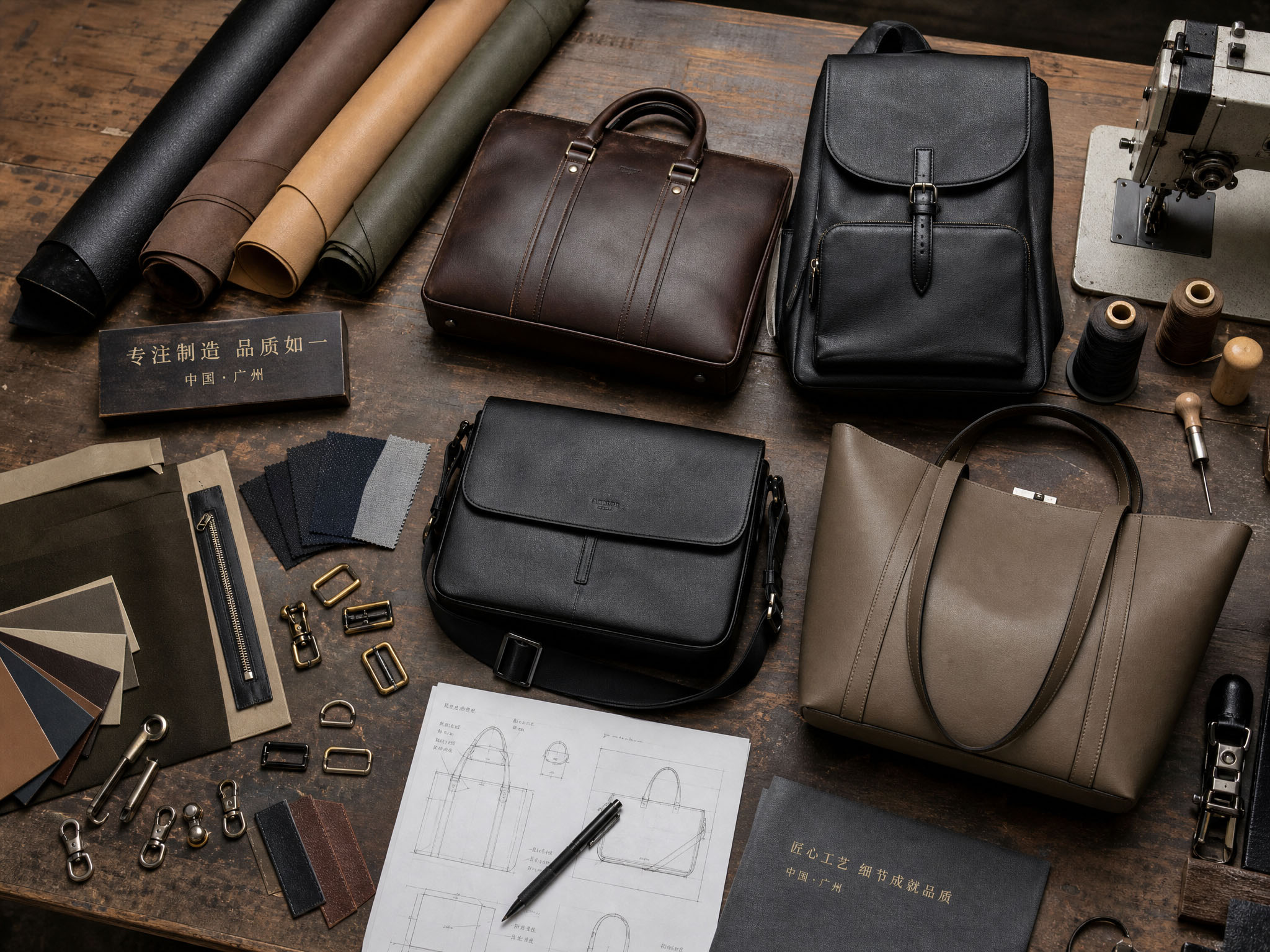
When I first started buying bags directly from Chinese manufacturers back in 2018, I made every rookie mistake in the book. I trusted verbal promises, skipped the paperwork, and ended up with a container of bags that failed Prop 65 testing within three months of hitting U.S. shelves. That container cost me $47,000 — and it taught me a lesson I now share with every new buyer who asks me how to source bags from China the right way.
Six years and dozens of successful production runs later, I want to walk you through the exact vetting framework I use for every Chinese bag supplier I consider working with. This isn’t theoretical advice from a Google search. These are the questions I send, the documents I request, and the red flags that send me running. Whether you’re sourcing backpacks, handbags, totes, or technical outdoor bags, this guide will help you protect your business, your customers, and your brand reputation.
Why Sourcing from China Still Makes Sense (Even in 2024)
Let’s address the elephant in the room: with rising labor costs, trade tensions, and supply chain diversification trends, is China still the right place to source bags? For most independent bag brands selling in the USA, the answer is still yes — but with caveats.
China remains the world’s largest hub for bag manufacturing because of its mature supply chain ecosystem. Within a 50-mile radius of cities like Guangzhou, Quanzhou, and Yiwu, you can find every component you need: certified fabrics, OEKO-TEX certified linings, YKK zippers, recycled hardware, and finishing facilities. No other country offers this level of vertical integration at competitive price points.
The key is knowing how to identify the right partners and how to verify what they claim. That’s exactly what we’re going to cover.
1. Material Sourcing: The Foundation of Every Quality Bag
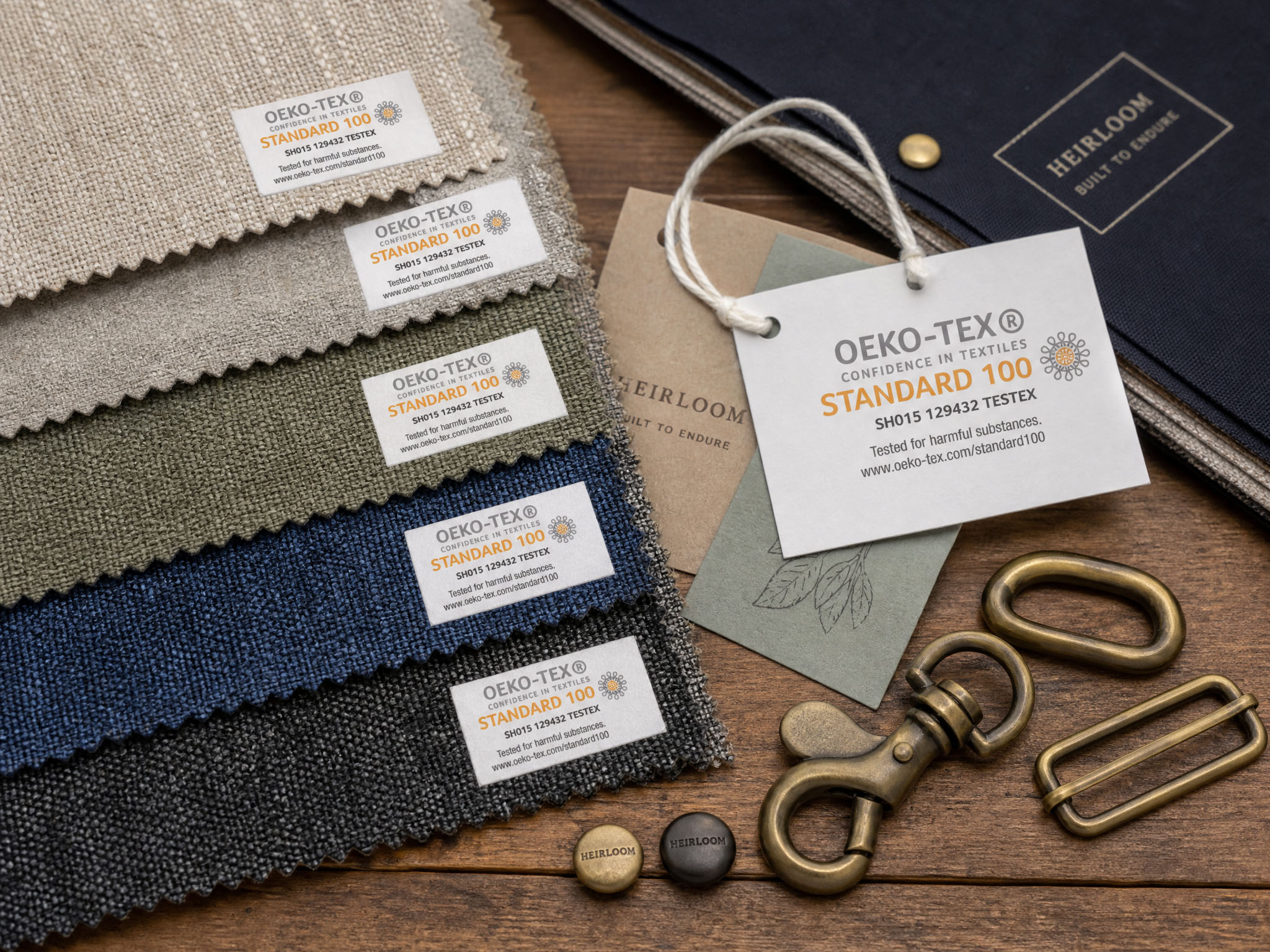
The first question I ask any potential supplier is deceptively simple: “Where do your materials come from, and can you prove it?” A quality bag starts long before the cutting table — it starts in the mills, tanneries, and hardware factories that supply your manufacturer.
What to Look For in Material Sourcing
Reputable Chinese bag manufacturers source OEKO-TEX Standard 100 certified fabrics and linings as their baseline for international safety compliance. This certification tests for harmful substances at every stage of textile processing and is widely accepted in U.S. and EU markets. If a supplier tells you they use “eco-friendly” materials but can’t name a certification, that’s an immediate red flag.
For hardware — zippers, buckles, snaps, D-rings, magnetic closures — premium brands like YKK, SBS, SBS zipper, and YBS are the industry gold standard. These brands are widely available from Chinese suppliers either as standard inclusions or as upgrade options. Lesser-known hardware from uncertified sources is where many bag failures originate: zippers that break after 200 cycles, buckles that crack under stress, or coatings that contain excessive lead or phthalates.
The 10-Point Material Vetting Checklist
After vetting dozens of suppliers, I’ve developed a comprehensive checklist that I share with every new brand I consult:
1. OEKO-TEX Standard 100 certified fabrics and linings should be the baseline, not the premium option.
2. REACH and RoHS compliant materials are widely available — any supplier claiming they can’t source these isn’t trying hard enough.
3. Premium hardware brands (YKK, SBS, or equivalent) should be offered as either standard or upgrade options.
4. CPSIA compliance for lead content, phthalates, and heavy metals must be addressed through certified hardware and coated materials from day one.
5. Incoming material inspections using AQL (Acceptable Quality Level) standards and pre-production sample approvals should be standard practice — not an “extra service” they charge for.
6. Standard fabric choices should include PU, PVC, nylon, polyester, canvas, and microfiber with various weights, coatings, and finishes to match your product specs.
7. GRS-certified recycled materials (Global Recycled Standard) — including rPET linings and recycled nylon — are increasingly available for sustainability-focused brands.
8. Third-party lab test reports from SGS, Intertek, or Bureau Veritas should be arranged on request to verify any compliance claims.
9. Material traceability documentation — mill certificates, country-of-origin declarations, compliance sheets — must be available for your audits and customs clearance.
10. Dual-sourcing strategies for critical hardware and trims are a smart way to mitigate supply chain disruption and ensure production continuity.
Pro tip from our warehouse: We lost a $180,000 order in 2022 because a single YKK zipper color was backordered for 14 weeks. Since then, we require every supplier to identify at least one backup source for every critical hardware component. It has saved us three times over.
What “Good Evidence” Actually Looks Like
A trustworthy supplier won’t just say “our materials are high quality” or “eco-friendly.” They will produce actual documentation:
A bill of materials (BOM) for each bag style with exact material descriptions — not vague terms like “polyester” or “metal hardware”
Material datasheets showing composition, coating, backing, GSM, and finish
Compliance certificates with verifiable certificate numbers
Test reports that are current (within the last 12 months) and traceable to specific lab batches
Physical samples you can test in your own lab or third-party facility
If a supplier hesitates to provide any of these documents before sampling, walk away. The best suppliers expect these requests and have documentation systems already in place.
2. Factory Certifications: BSCI, Sedex & ISO 9001 Explained
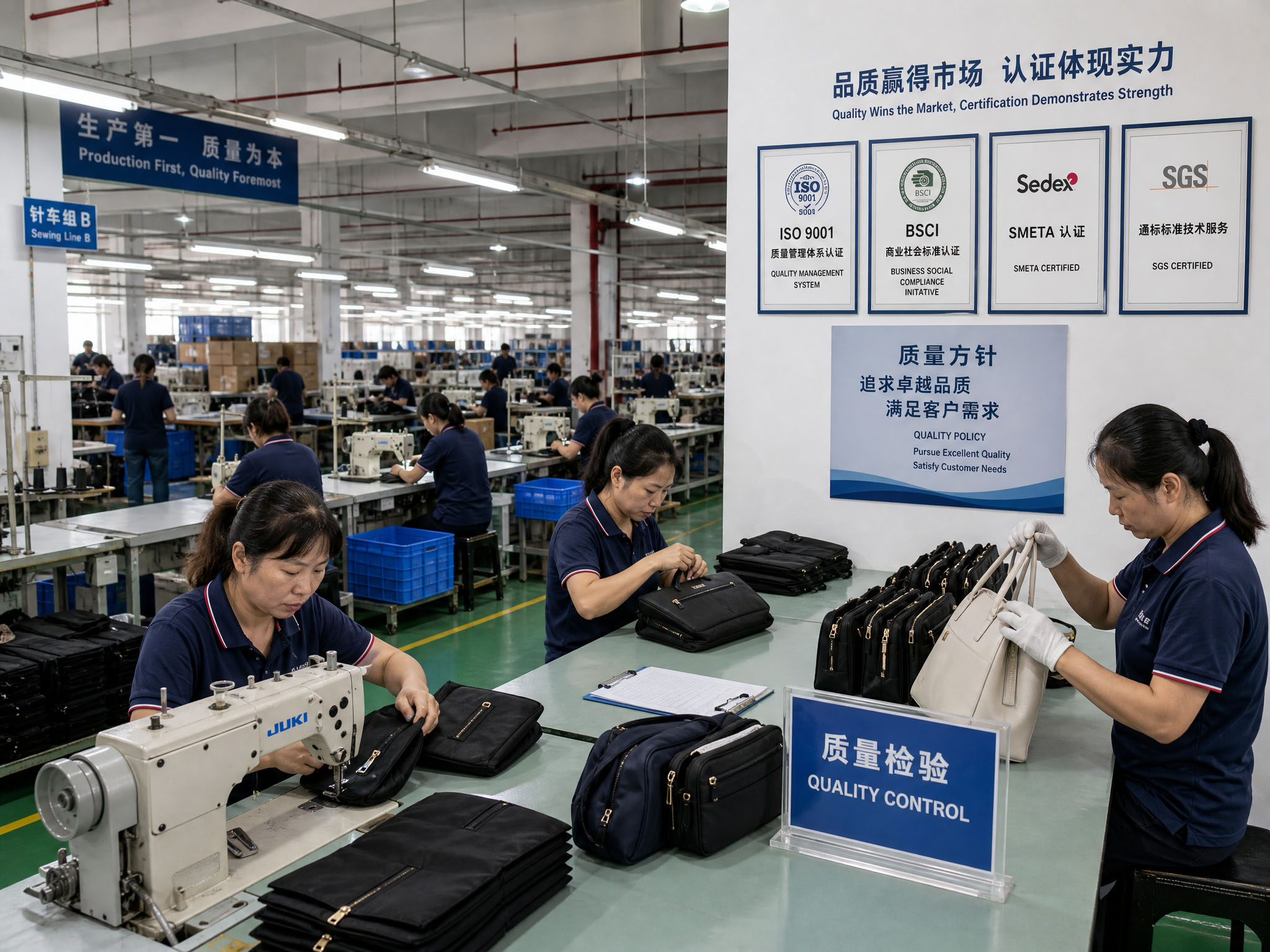
Beyond material certifications, you need to evaluate the factory itself. Three certifications matter most for bag buyers sourcing from China:
BSCI (Business Social Compliance Initiative)
BSCI certification indicates the factory has been audited against a code of conduct covering fair wages, working hours, health and safety, and freedom of association. For U.S. brands selling to retailers like Target, Walmart, or Costco, BSCI is often a non-negotiable requirement. It also protects your brand from the reputational risk of being associated with poor labor practices.
Sedex (Supplier Ethical Data Exchange)
Sedex is similar to BSCI but uses the SMETA (Sedex Members Ethical Trade Audit) framework. Many U.K. and European retailers prefer Sedex, but it’s increasingly accepted by U.S. buyers as well. Sedex membership gives you access to the factory’s audit reports through the Sedex platform.
ISO 9001
ISO 9001 is the quality management system standard. A factory with ISO 9001 certification has documented processes for quality control, corrective actions, and continuous improvement. While it doesn’t guarantee perfect products, it indicates a factory that takes systematic quality seriously rather than relying on individual worker skill alone.
How to Verify These Certifications
Don’t just ask “do you have BSCI?” — ask for:
The certificate number
The issuing body (BSCI is administered by amfori; specific audit companies conduct the audits)
The issue date and expiration date
A copy of the most recent audit report (or at least the summary page)
Cross-reference the certificate number with the issuing body’s database when possible. We’ve caught two suppliers in the past three years presenting expired or fraudulent certificates — which would have been a disaster if we hadn’t verified.
3. Third-Party Lab Testing: The Only Way to Be Sure
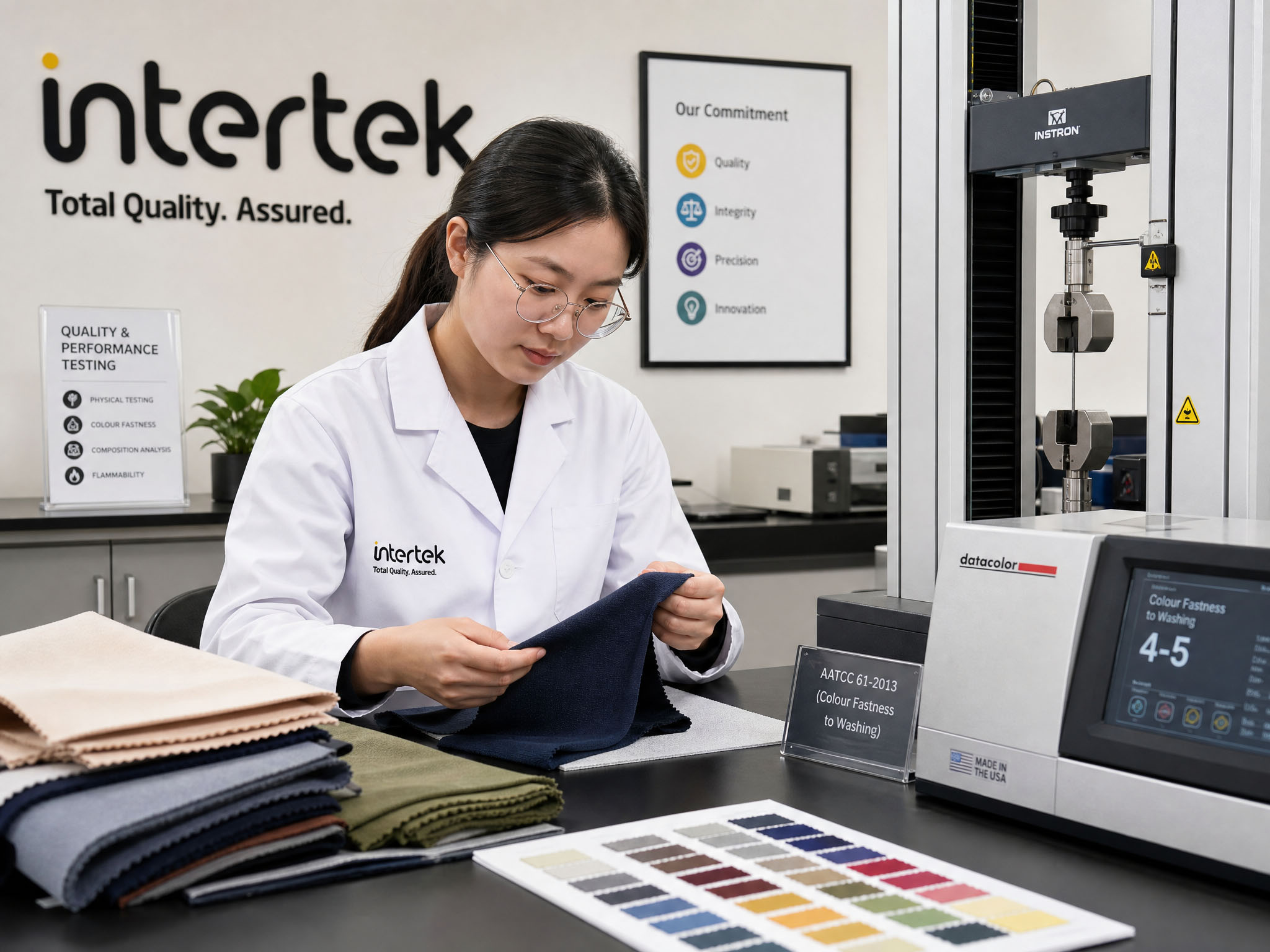
Here’s an uncomfortable truth: supplier self-declarations are not enough. Every major compliance issue I’ve ever encountered came from trusting what a supplier said rather than what an independent lab confirmed.
Third-party lab testing from recognized institutions like SGS, Intertek, Bureau Veritas, or TÜV is the only way to verify that your materials and finished products actually meet regulatory requirements. These tests typically cover:
Heavy metals (lead, cadmium, mercury, etc.)
Phthalates in PVC and coated materials
AZO dyes in colored fabrics
Formaldehyde in textiles
Tensile strength and seam slippage
Color fastness to washing, light, and rubbing
Zipper cycle testing (typically 5,000+ cycles for premium bags)
Hardware pull strength
When to Test
I recommend testing at three stages:
1. Material stage — test raw fabrics and hardware before production
2. Pre-production sample stage — test the complete prototype
3. Pre-shipment stage — random AQL sampling of finished goods
The cost of testing is typically $300–$800 per style depending on the number of tests. Compared to a $50,000 production run, this is cheap insurance. Many suppliers will absorb testing costs as part of their service if you negotiate upfront; others will pass it through. Either way, you should always retain control of which lab is used and receive the reports directly.
4. Minimum Order Quantity (MOQ) & Sampling: The Reality Check

One of the biggest mistakes new buyers make is not clarifying MOQ and sampling terms upfront. Every supplier has different policies, and the differences can make or break your launch.
Typical MOQ for Bags from China
Canvas/cotton totes and basic backpacks: 300–500 units per style/color
PU/PVC handbags: 200–500 units per style/color
Technical outdoor bags: 500–1,000 units per style/color
Custom hardware (molds for zippers, buckles, snaps): Usually requires 1,000+ units minimum
These are general ranges — your specific MOQ will depend on the supplier, material complexity, and customization level. Always ask: “What is the MOQ for [specific bag style] in [specific material/color]?”
Sample Production: What to Expect
Most reputable suppliers offer a 3-stage sampling process:
1. Prototype sample (7–15 days, typically $50–$200 per sample) — basic construction to evaluate design
2. Pre-production sample (10–20 days, often free if you proceed to bulk order) — exact materials, hardware, and finishing
3. Gold sample / sealing sample (7–10 days, free) — the reference sample for production quality control
Always insist on a pre-production sample before bulk production begins. This is your last chance to catch errors in materials, dimensions, stitching, hardware placement, and overall construction. The cost of catching a mistake at this stage is $200–$500. The cost of catching it after 2,000 units are produced is $20,000+.
The Sampling Clause to Include in Every PO
Here’s a clause I include in every purchase order:
“Bulk production shall not commence until Buyer has approved pre-production samples in writing. Samples shall be shipped via [DHL/FedEx] at Supplier’s cost. Any modifications to materials, dimensions, hardware, or construction methods during bulk production require written Buyer approval. Unauthorized modifications void the right of the Supplier to claim non-conformity disputes.”
5. USA-Specific Compliance: CPSIA, California Prop 65 & REACH
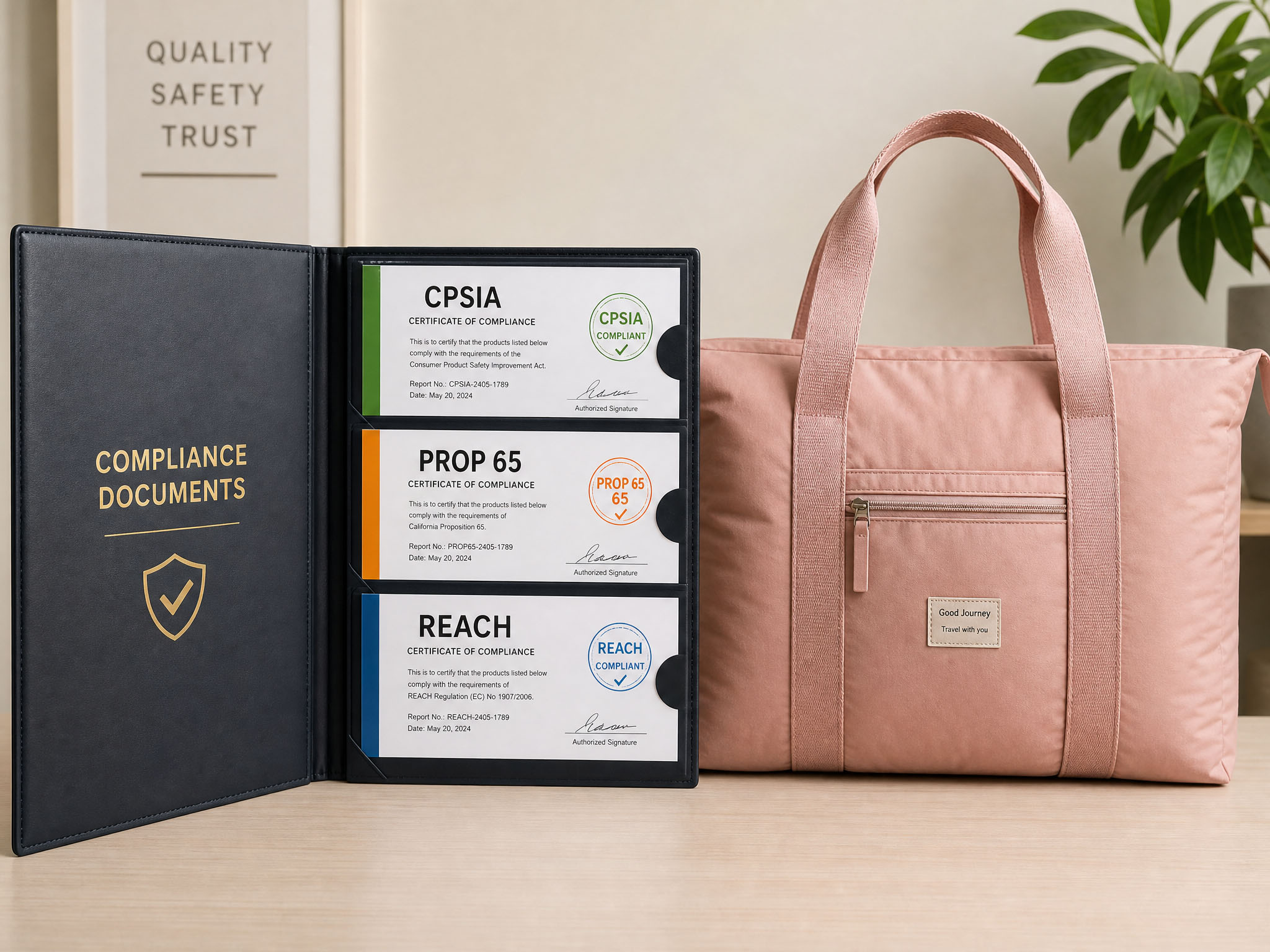
This is where many Chinese suppliers — and many U.S. importers — get into serious trouble. The U.S. has its own set of regulations that differ from EU REACH and Chinese domestic standards. If you’re selling bags in the United States, you need to understand three key regulations:
CPSIA (Consumer Product Safety Improvement Act)
CPSIA applies to all products designed for children under 12, but its testing and material requirements have become a de facto standard for the entire U.S. bag market. Key requirements include:
Lead content limits in accessible materials (100 ppm for children’s products)
Phthalate limits in plasticized components (1,000 ppm for several phthalates)
Tracking labels on products and packaging
Third-party testing by an accredited lab for children’s products
If your bags are designed for kids’ school, baby diaper bags, or any children’s use, CPSIA compliance is mandatory and strictly enforced by the CPSC.
California Proposition 65
Prop 65 is unique to California but has national implications because most U.S. distributors and retailers won’t accept products that violate it. Prop 65 requires warnings for products that expose Californians to chemicals known to cause cancer or reproductive harm. For bags, the relevant chemicals include:
Lead and lead compounds in metal hardware, zippers, and coated materials
DEHP, BBP, DBP, and DIDP phthalates in PVC and plastic components
Cadmium in metal hardware and zippers
Formaldehyde in some textile finishes
A Prop 65-compliant bag requires either (a) lab testing showing all listed chemicals are below safe harbor levels, or (b) a clear and reasonable warning label. Most U.S. retailers prefer testing over labeling because warning labels can deter customers.
REACH (EU Regulation, But U.S. Implications)
REACH is technically an EU regulation, but it affects Chinese suppliers because they typically use REACH-compliant materials for their European customers. U.S. brands benefit from this because REACH covers more chemicals (over 200 SVHCs — Substances of Very High Concern) than most U.S. regulations. If your supplier’s materials pass REACH, they will almost certainly pass CPSIA and Prop 65 as well.
The “Yes” Conversation with Chinese Suppliers
When you ask Chinese suppliers about CPSIA, Prop 65, and REACH compliance, here’s what a good response looks like:
“Yes, our materials are sourced based on customer requirements. We select certified fabrics, linings, trims, and hardware that meet quality and compliance standards. Please communicate your specific compliance needs in advance so we can ensure samples and bulk production meet your expectations.”
This is a positive but qualified response. They’re confirming they can do it, but they’re also rightly asking you to specify what you need. A supplier who claims universal compliance without asking for specifics is either lying or doesn’t understand the regulations. Either way, that’s a problem.
The Compliance Documentation Package
Before any shipment leaves China, I require this documentation package:
✅ CPSIA compliance certificate for children’s products (or statement of non-applicability)
✅ Prop 65 test report from SGS, Intertek, or Bureau Veritas (within last 12 months)
✅ REACH SVHC test report or declaration
✅ Bill of materials with material safety data sheets (MSDS) where applicable
✅ Country of origin declaration for customs
✅ Tracking labels per CPSIA Section 103
Keep these documents for at least 5 years after the last shipment. The CPSC and California Attorney General can — and do — request documentation years after products reach the market.
6. The Supplier Vetting Process: A 7-Step Framework
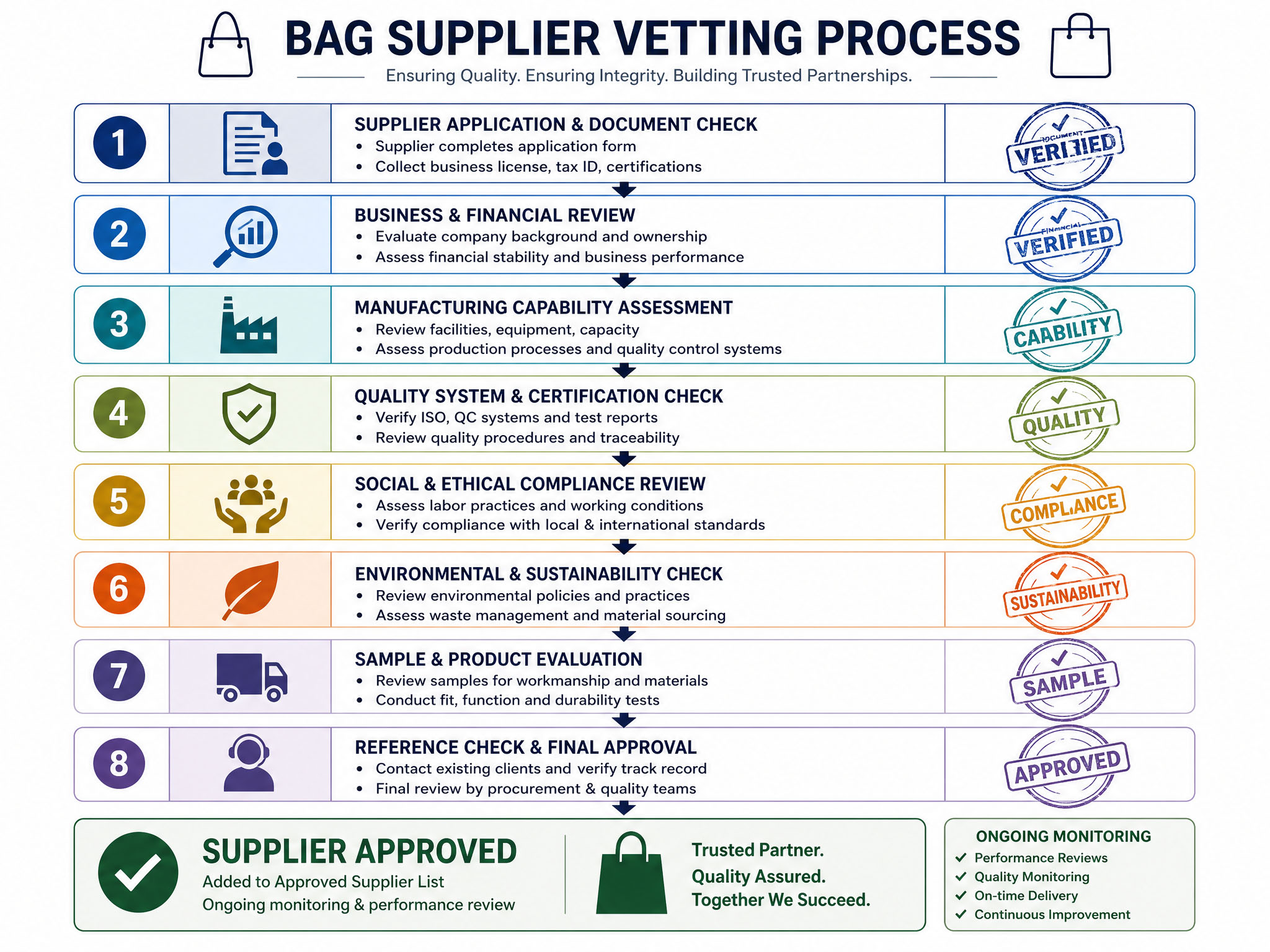
After years of refining my process, here’s the exact framework I use for every new Chinese bag supplier:
Step 1: Initial Screening
Verify business license and export credentials
Check Alibaba or Global Sources history and reviews
Confirm they are the actual manufacturer, not a trading company (unless you specifically want a trading company)
Step 2: Capability Assessment
Request a factory tour video or live video call
Confirm production capacity, machine list, and worker count
Ask for references from U.S. or EU customers
Step 3: Documentation Request
Send the comprehensive question list (see below)
Request copies of BSCI/Sedex/ISO certificates
Ask for material certifications and sample test reports
Step 4: Sample Order
Place a sample order for 2–3 styles
Pay for samples and shipping (don’t ask for free samples at this stage — it signals inexperience)
Evaluate construction quality, finishing, and material feel
Step 5: Independent Lab Testing
Send samples to a third-party lab (SGS, Intertek, Bureau Veritas)
Test for CPSIA, Prop 65, and any specific concerns based on materials
Wait for results before proceeding to bulk order
Step 6: Trial Order
Place a small bulk order (typically 300–500 units)
Visit the factory or hire a third-party inspector for pre-shipment inspection
Use AQL 2.5 sampling for general inspection, AQL 1.0 for critical defects
Step 7: Scale Up
After successful trial order, negotiate better pricing for larger volumes
Establish quality control protocols and communication cadence
Build a 12–18 month relationship before considering them a “core supplier”
7. The Complete Supplier Questionnaire (Copy & Paste Ready)
Here’s the exact message I send to every potential supplier. Feel free to copy and customize it for your brand:
Subject: New Bag Sourcing Inquiry — Materials, Compliance & Capacity
Hi [Supplier Name],
We’re a U.S.-based bag brand looking to establish a long-term manufacturing partnership. Before we proceed with sampling, we’d like to verify your capabilities and material sourcing practices. Please answer the following questions thoroughly:
1. Material Sourcing & Certifications
Do you source certified fabrics, linings, trims, and hardware? Please share certificate names, certificate numbers, scope, and exact materials used.
Are your materials OEKO-TEX Standard 100 certified?
Can you provide GRS or GOTS certification for recycled/organic materials (if applicable)?
2. Hardware
Which hardware brands do you typically use (YKK, SBS, YBS, or others)?
Can you provide test reports for hardware components (lead content, durability, cycle testing)?
3. Factory Certifications
Do you hold BSCI, Sedex, or ISO 9001 certification?
Please provide certificate numbers, issuing bodies, and expiration dates.
4. Lab Testing
Can you provide third-party lab test reports from SGS, Intertek, or Bureau Veritas for fabric, hardware, and finished products?
Can we arrange independent testing on samples before bulk production?
5. MOQ & Sampling
What is the MOQ for [specific bag styles] in [specific materials]?
What is your sample development timeline and cost?
Do you provide pre-production samples for approval before bulk production?
6. U.S. Compliance
Can your materials and finished bags comply with CPSIA, California Prop 65, and REACH?
Please provide compliance documentation examples from previous U.S. customers.
7. Production Capacity & Lead Times
What is your monthly production capacity for bags?
What is the typical lead time from order confirmation to shipment?
8. Quality Control
What quality control procedures do you have in place?
Do you use AQL standards for inspections?
Can we arrange third-party pre-shipment inspections?
Please respond with as much detail as possible, including supporting documents. We are evaluating multiple suppliers and will make our decision based on the quality and completeness of your response.
Best regards,
8. Red Flags I’ve Learned to Spot
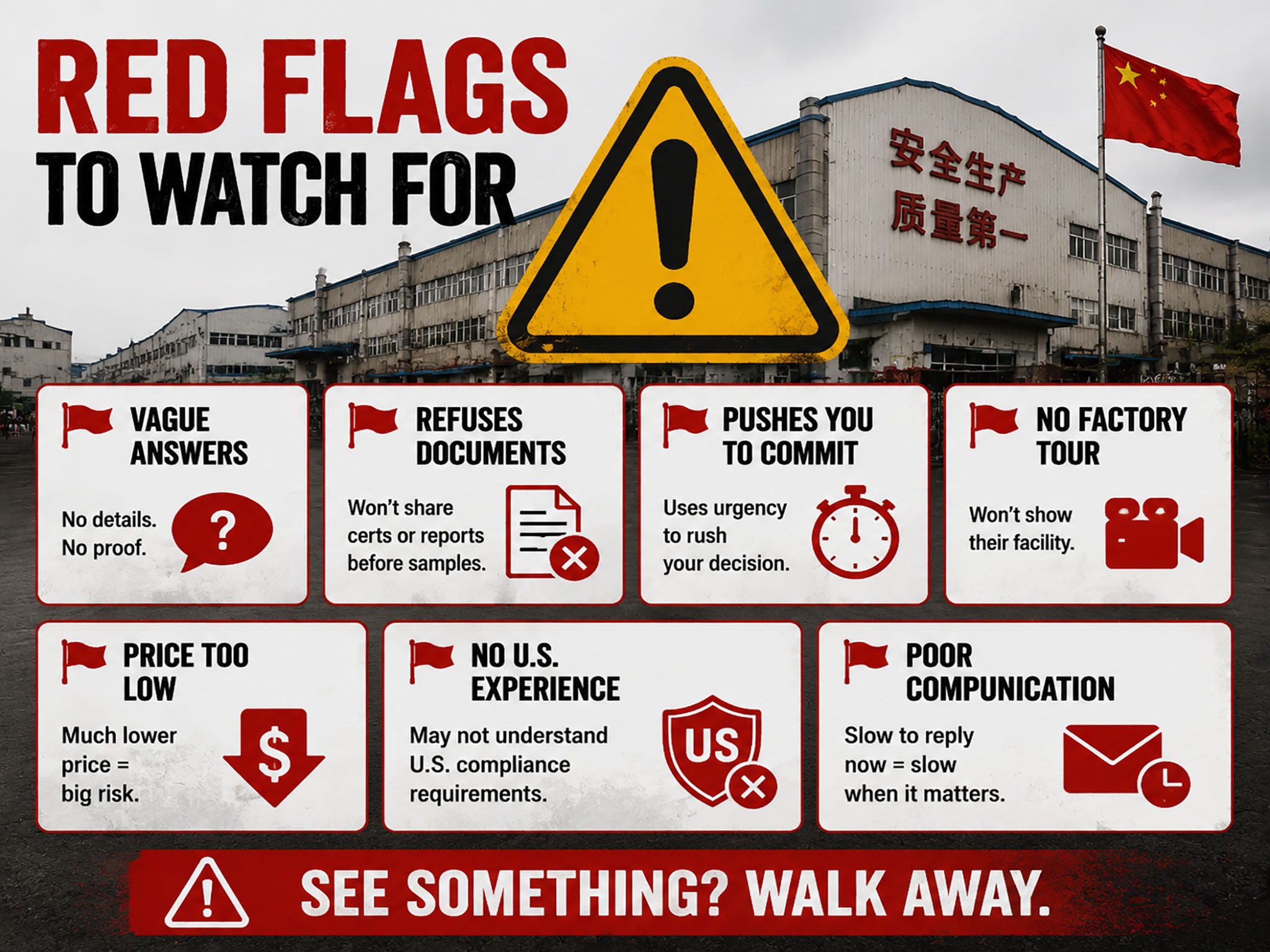
After years of working with Chinese suppliers, I’ve learned that most problems are visible long before they become disasters. Here are the red flags that send me looking elsewhere:
Vague answers to specific questions. If a supplier says “our materials are high quality, no problem” without naming certifications, lab reports, or specific brands, they’re either hiding something or don’t know their own supply chain.
Refusal to provide documentation before sampling. Legitimate suppliers expect these requests and have systems in place to fulfill them. Suppliers who say “let’s start with samples first” are often hoping you’ll commit money before discovering their shortcomings.
Pressure to commit before due diligence. “We have other buyers interested” or “this price is only valid for 7 days” tactics are designed to short-circuit your vetting process. Walk away.
No factory tour or video available. Reputable manufacturers are proud of their facilities. If they can’t or won’t show you their production floor, what are they hiding?
Significantly lower prices than competitors. If one supplier’s pricing is 20%+ below the average for the same specs, something is off — usually materials, labor standards, or both.
No U.S. compliance experience. If a supplier’s only previous customers are domestic Chinese or developing markets, they may not understand CPSIA, Prop 65, or FTC labeling requirements.
Communication problems during sales. If a supplier takes 3 days to respond to your initial inquiry, imagine how they’ll respond when you have a production emergency. Slow communication during the sales process rarely improves after you commit.
9. Building a Long-Term Partnership (Not Just a Transaction)
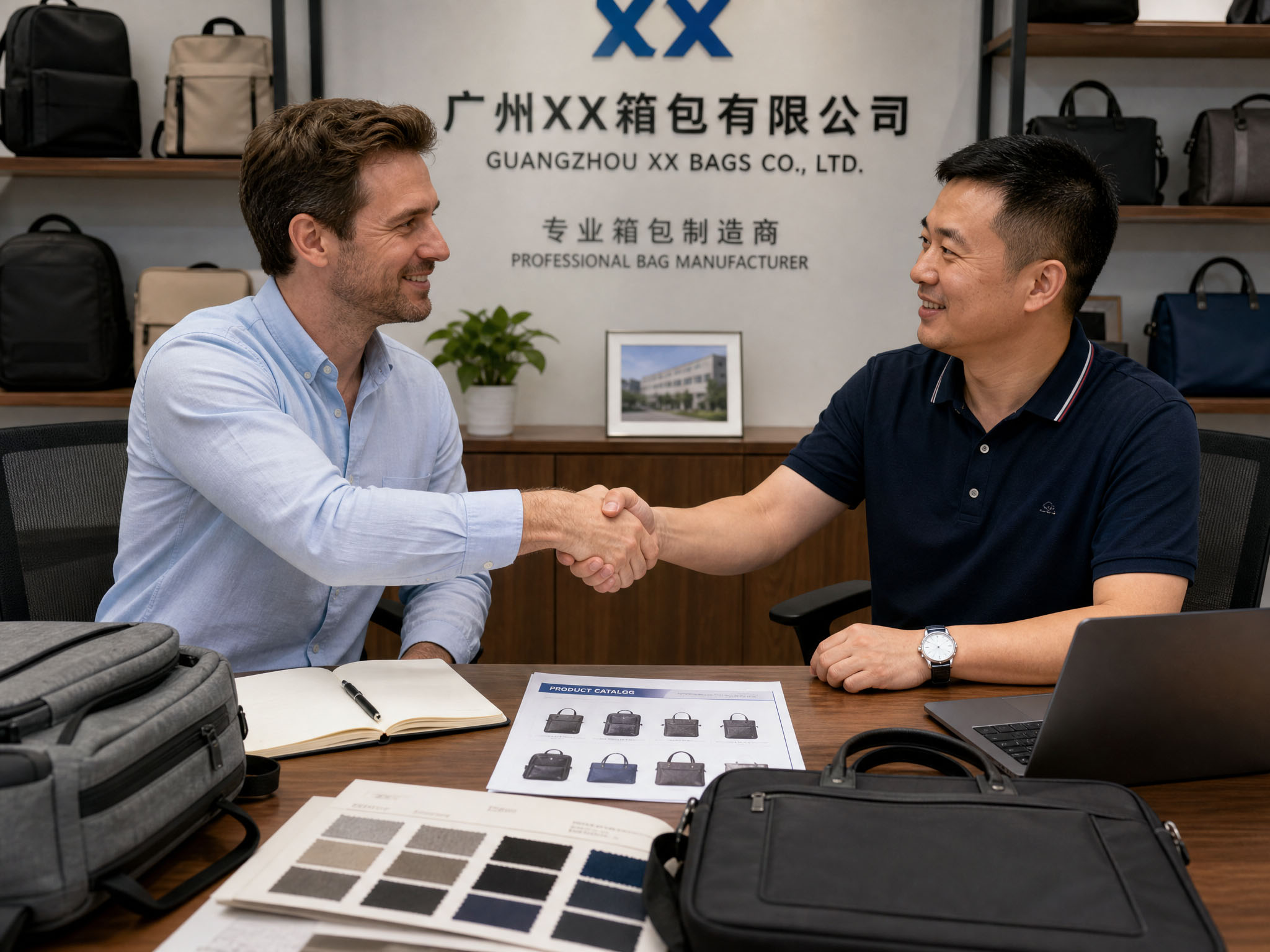
The cheapest supplier is rarely the best supplier. The best supplier is the one who consistently delivers quality bags on time, communicates proactively, and treats your business as a partnership rather than a transaction.
In my experience, the most successful bag brands that source from China share three characteristics:
1. They invest in the relationship. They visit the factory (or send a representative) at least once a year, send holiday gifts, and treat suppliers as partners, not adversaries.
2. They are organized and clear. They provide detailed tech packs, respond to questions quickly, and pay invoices on time. Suppliers prioritize buyers who make their jobs easier.
3. They plan ahead. They share forecasts, lock in materials early, and don’t place emergency orders at the last minute. This gives suppliers time to source quality materials at reasonable prices.
The Chinese bag manufacturing industry is filled with skilled, hardworking people who take enormous pride in their craft. The key is finding the ones who share your standards — and then building a relationship that benefits both sides for years to come.
Final Thoughts: Your Brand’s Reputation Is in Every Bag
Every bag you sell carries your brand name. When a customer finds a broken zipper, a chemical smell, or a strap that fails after three months, they don’t blame the Chinese factory — they blame you. And they’re right to.
That’s why this entire vetting process isn’t about being difficult or paranoid. It’s about respecting your customers enough to make sure every product you put your name on meets the standards you promise.
Use the checklist, send the questionnaire, demand the documentation, and never — never — skip the pre-production samples. Do this consistently, and you’ll build a sourcing operation that scales with your brand and protects your reputation for years to come.
Welcome to the world of bag sourcing from China. It can be challenging, but with the right framework, it’s also one of the most rewarding aspects of building a global bag brand.
About the Author
Wen is the founder of ISPBAG, a U.S.-based direct-to-consumer bag company. With over 15 years of experience sourcing bags from China and selling to American consumers, she shares practical insights on bag materials, manufacturing, and compliance to help fellow entrepreneurs build better bag brands. Connect on [LinkedIn/Instagram] for more bag industry insights.
Have questions about sourcing bags from China? Drop them in the comments below, and we’ll answer the most common ones in a follow-up post. If you found this guide helpful, share it with another bag entrepreneur who needs to read it.
Post time: Jun-23-2026