
Running an independent bag brand in the United States today means balancing creativity, cost, and speed. After years of working with manufacturers across Guangzhou, Yiwu, and Quanzhou, I can tell you that the difference between a successful private label launch and a costly mistake usually comes down to one thing: how well you understand your supplier’s design, sampling, and IP protection capabilities before you place an order.
This guide is a transparent, behind-the-scenes look at what U.S. bag importers should expect when sourcing custom bags directly from China — and the exact questions you need to ask to protect your brand.
Why U.S. Bag Sellers Are Turning to Chinese Manufacturers
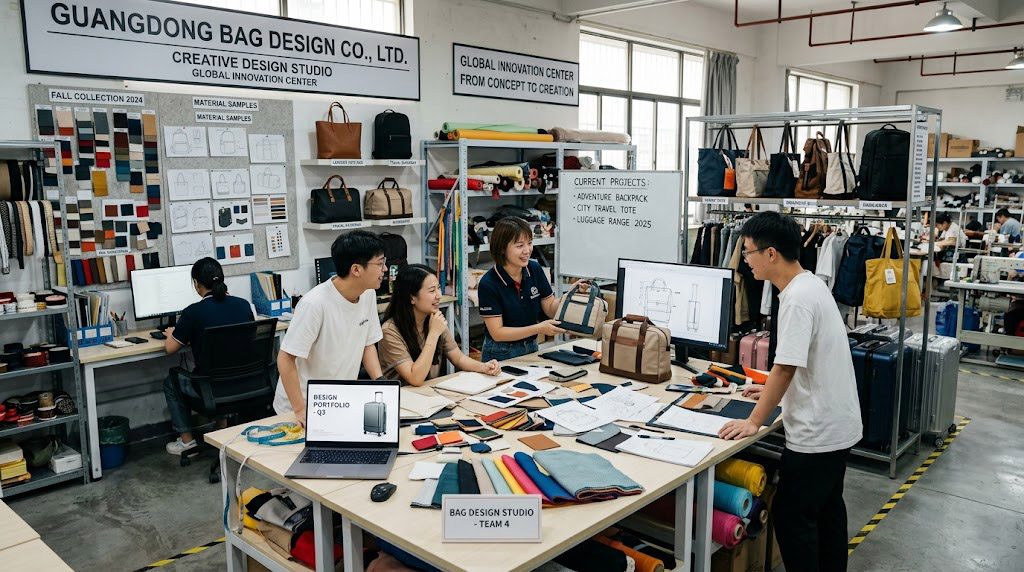
The appeal is obvious: lower production costs, mature supply chains, and decades of manufacturing expertise. But the real advantage — and the one most beginners overlook — is the depth of design and product development infrastructure that has built up around China’s bag industry.
If you’re launching a tote line, building a backpack brand, or developing a luxury leather collection, the right Chinese supplier isn’t just a factory. They are a full design and engineering partner. The trick is knowing which suppliers can actually deliver on that promise — and which ones are simply trading on it.
1. Do Their Design Teams Actually Turn Briefs Into Products?
This is the single most important question you’ll ask any Chinese bag supplier, and the answer will tell you almost everything about whether they can serve your brand.
What a Capable Design Team Looks Like
The most established Chinese bag manufacturers maintain in-house design studios staffed with industrial designers, pattern makers, and trend researchers. Their job is to take your client brief — whether that’s a hand-drawn sketch, a Pinterest mood board, a competitor sample, or a written product concept — and translate it into a manufacturable product.
A serious supplier will not just “copy” your reference image. They will analyze the structure, function, materials, hardware, and branding before producing a prototype. They will ask questions like: Who is the end consumer? What price point are you targeting? Will this bag be used daily or occasionally? Those questions are a sign that the factory is thinking about product development, not just assembly.
OEM vs. ODM: Know Which Service You’re Getting
Before signing with any factory, clarify whether you need OEM (Original Equipment Manufacturing) or ODM (Original Design Manufacturing) services.
- OEM means the factory builds to your design specifications. You provide the tech pack, sketches, and materials list; they execute.
- ODM means the factory offers their in-house designs, which you can customize with your logo, colors, and minor modifications.
For independent U.S. brands building a unique identity, OEM is almost always the right path. For sellers testing the market with a faster turnaround, ODM can be a smart launchpad.
The Trend Forecasting Advantage
Here’s something most buyers don’t realize: leading Chinese bag hubs maintain active trend forecasting teams that track European, American, and Asian fashion markets. Manufacturers in Guangzhou, Yiwu, and Quanzhou subscribe to the same WGSN, Pantone, and Lineapelle trend reports that Western brands use. When you share a “trend reference” image, these teams can often tell you whether the silhouette is two seasons old, what’s about to peak, and what hardware finishes are gaining traction in your target market.
This isn’t a small perk. It means your supplier can flag design dead-ends before you spend money on a prototype that won’t sell.
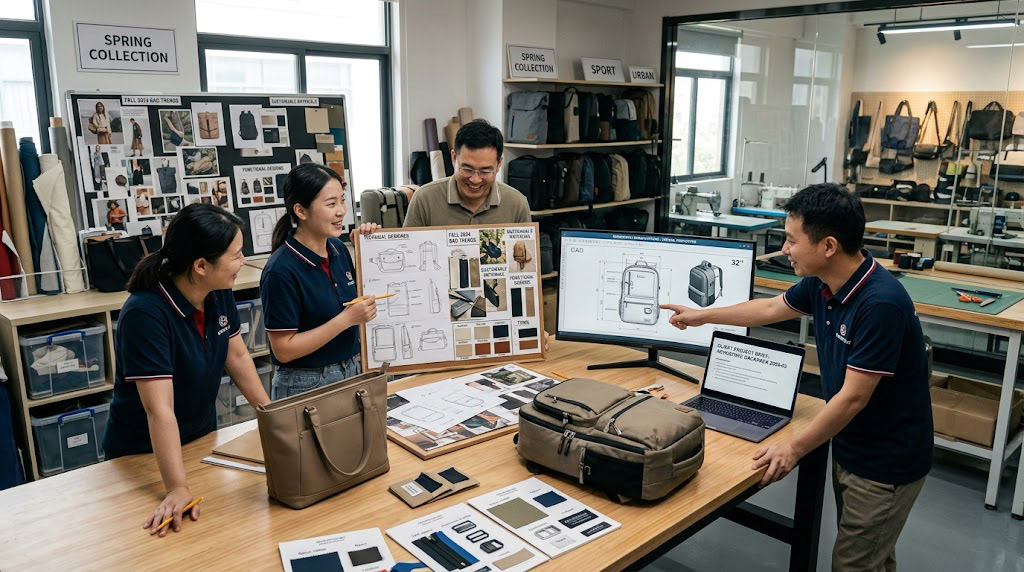
In-house design teams in Guangzhou and Quanzhou convert client briefs, hand sketches, and trend references into manufacturable product concepts using CAD software and physical sampling.
2. The Tech Pack: Your Non-Negotiable Design Brief
Even with a brilliant design team on the factory side, no Chinese manufacturer can bring your vision to life without a clear tech pack.
What Goes Into a Complete Tech Pack
A tech pack is the engineering document that tells the factory exactly how to build your bag. At minimum, it should include:
- Dimensions — width, height, depth, strap drop, gusset width
- Materials — main body fabric, lining, reinforcement, padding
- Hardware — zippers (YKK? SBS? generic?), buckles, rivets, D-rings, magnetic snaps
- Stitching details — stitch type (saddle stitch, lock stitch), stitch length, thread color, topstitching
- Pantone color codes — for both fabric and thread
- Construction notes — folded seams, bound seams, piping, edge paint
- Branding placement — logo position, embossing, debossing, screen print, or metal plate
- Packaging — poly bag, hangtag, care label, box
If you don’t have a tech pack yet, don’t panic. Most professional Chinese bag factories will help you build one from rough sketches and reference photos — but expect this service to be more thorough (and more expensive) than working from a finished document.
Why the Tech Pack Matters More Than the Sketch
A pretty sketch is just the starting point. The tech pack is what eliminates ambiguity. Without it, you’ll find yourself approving samples based on guesswork and discovering — three production rounds too late — that the strap length is wrong or the zipper pull is the wrong shape.
Pro tip: Before placing a bulk order, ask the factory to send back a counter-sample tech pack showing how they interpreted your brief. If their interpretation matches yours, you’ve found a strong partner. If it doesn’t, you’ve saved yourself a costly misunderstanding.
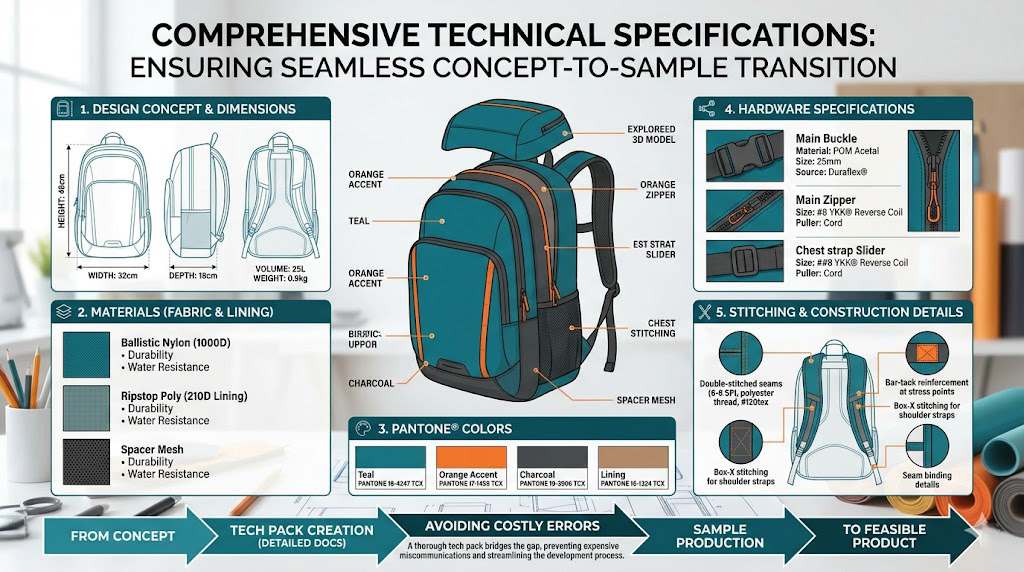
A complete tech pack — including dimensions, materials, hardware, stitching details, and Pantone color codes — is essential to move from concept to a workable sample without costly miscommunication.
3. Sample Development: Cost, Lead Time, and Revisions
This is where most first-time importers either build a great relationship or burn their budget. Understanding the sample development process upfront is critical.
Typical Sample Costs
Custom bag samples from Chinese manufacturers typically range from
50to300+ per sample, depending on:
- Material complexity — A simple canvas tote will be far cheaper to sample than a structured leather handbag with multiple compartments.
- Hardware count — Custom zippers, engraved buckles, and unique metal feet add cost fast.
- Embossing or printing — Logo tooling (especially for metal hardware) is often a one-time charge but adds to the per-sample cost.
- Pattern making — If you’re creating a brand-new silhouette, expect to pay for the pattern itself, which is usually a one-time fee.
Many factories waive or discount the first sample if a serious bulk order is on the horizon. Always ask.
Sample Lead Time: What to Realistically Expect
For a custom bag prototype, expect 15 to 30 days from approved tech pack to first sample in hand. This includes:
- Material sourcing (3–7 days)
- Pattern making (2–5 days)
- Cutting and sewing (3–7 days)
- Hardware installation and finishing (2–4 days)
- Quality control and shipping prep (1–3 days)
If a factory promises a custom sample in under 10 days, be skeptical. Either they’re working with stock components (which may not match your design), or they’re cutting corners on QC.
Revision Rounds: How Many Are Included?
The industry standard is 2 to 3 revision rounds before a final approved sample. Some factories will absorb the cost of revisions into the sample fee; others will charge for each round. Always clarify this in writing before paying your first sample invoice.
What counts as a “revision” matters too:
- ✅ Included — adjusting strap length, changing pocket placement, swapping zipper color
- ❌ Typically extra — completely changing the silhouette, switching from nylon to leather, redesigning hardware
Smart tip: Provide consolidated, written feedback on each sample. Don’t approve a sample with verbal “yeah, looks great” and then change your mind a week later. The more organized your feedback, the faster the revision cycle.
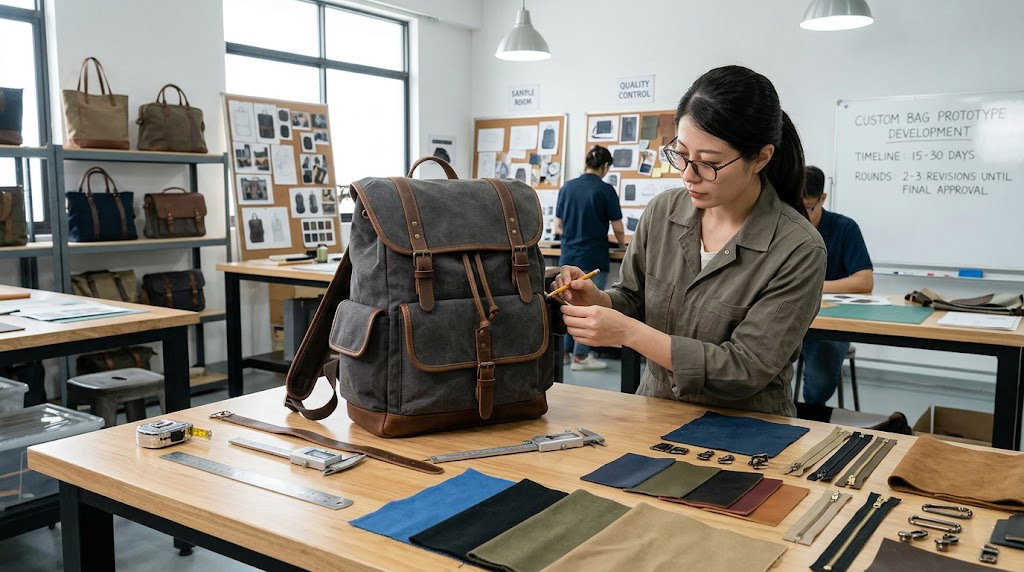
Sample development for a custom bag typically takes 15–30 days, with 2–3 revision rounds included before a final approved sample is produced.
4. CAD, 3D Modeling, and the Future of Bag Design
One of the most underrated capabilities of modern Chinese bag manufacturers is their investment in digital design tools.
How CAD Software Reduces Sampling Costs
Leading factories use industry-standard CAD platforms like Lectra, CLO 3D, and Adobe Illustrator to:
- Create flat technical drawings from sketches
- Build 3D renderings of the bag from multiple angles
- Simulate how different materials will drape and fold
- Test hardware placement before physical production
- Share visual previews with buyers before committing to a sample
This isn’t just fancy tech for the sake of it. A 3D mock-up can save you
200to500 in physical sample costs during the early concept phase. You can iterate on color combinations, pocket configurations, and strap styles in days rather than weeks.
When evaluating suppliers, ask if they offer 3D rendering services. If they do, it’s a strong signal that they’re investing in modern production workflows — exactly the kind of partner you want for a long-term relationship.
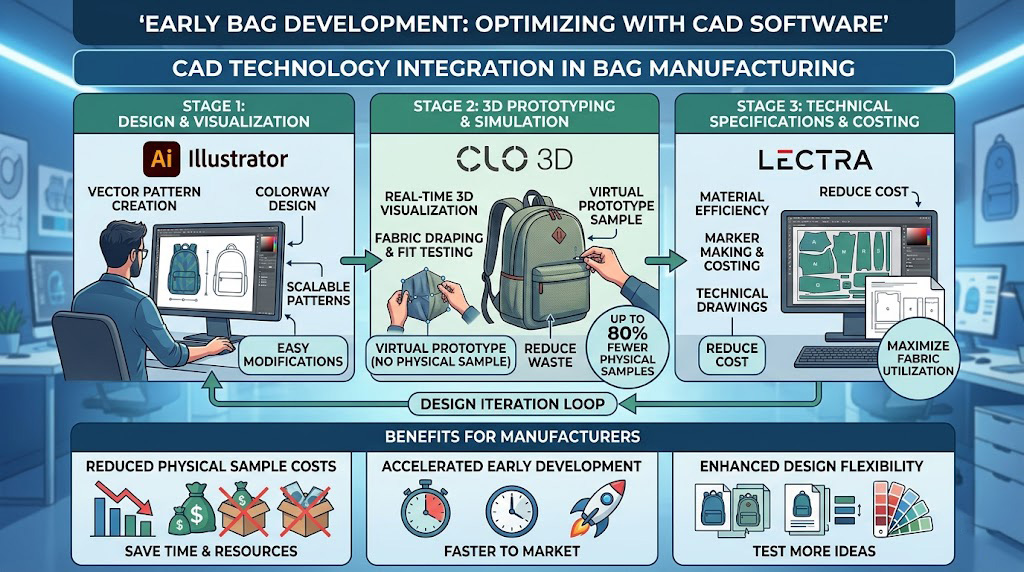
Many Chinese bag manufacturers use CAD software like Lectra, CLO 3D, and Illustrator to visualize designs and reduce physical sample costs during early development stages.
5. Communication: The Make-or-Break Factor
Even the most technically advanced factory can fail your project if communication breaks down. And in cross-border bag sourcing, the communication gap is the #1 reason projects run over budget.
The Bilingual Project Manager Advantage
The best Chinese bag manufacturers assign bilingual project managers or merchandisers to overseas buyers. These professionals do far more than translate — they:
- Bridge cultural and design vocabulary differences (e.g., “tote” vs. “shopping bag”)
- Coordinate between the design team, the pattern makers, and the production floor
- Provide weekly written updates with photos and videos
- Flag potential issues before they become production problems
- Manage sample shipping logistics
If a factory assigns you a single point of contact who speaks fluent English and responds within 24 hours, you’ve likely found a strong partner. If you’re emailing a generic sales@ address and getting bounced between reps, run.
Material Sourcing During the Design Phase
A skilled merchandiser will also help you navigate the material library most established factories maintain. Top manufacturers carry hundreds of fabric, leather, and synthetic options in-house, organized by:
- Price tier
- Application (handbag, backpack, luggage, etc.)
- Sustainability certifications (GRS, OEKO-TEX, LWG)
- Color and finish
This is a major time-saver. Instead of waiting weeks for the factory to source materials from third parties, you can review swatches and place material orders during the design phase itself.
Communication tip: Establish a single point of contact, agree on a weekly update cadence, and use visual communication (annotated photos, screen recordings) wherever possible. Text-based email is the slowest and most error-prone channel for bag design.
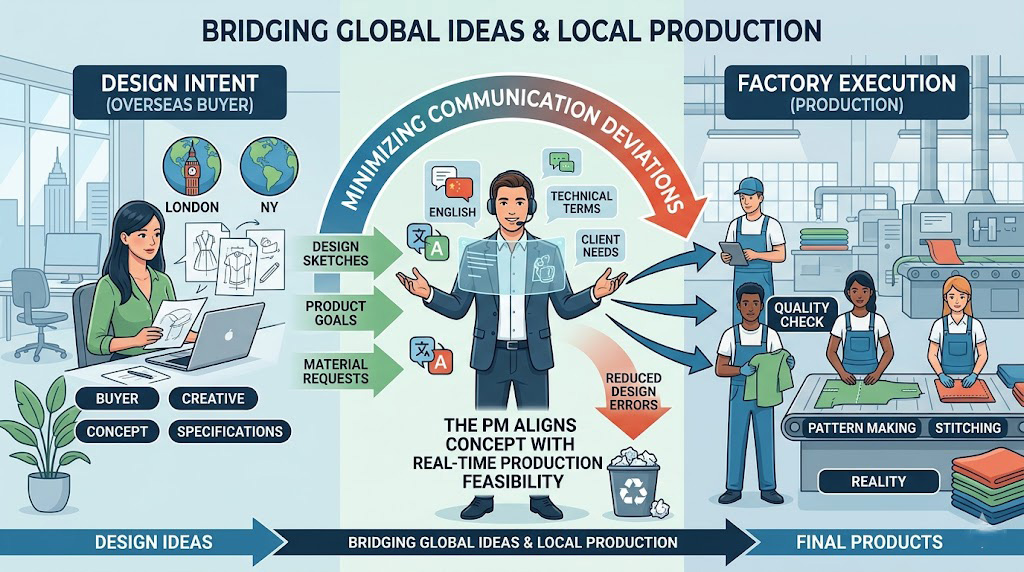
Bilingual project managers are commonly assigned to overseas buyers to bridge design intent and factory execution, dramatically reducing miscommunication during the design phase.
6. Material Libraries and Sourcing Speed
A great factory doesn’t just make bags — they help you source and validate the right materials for your brand.
What a Strong Material Library Looks Like
Established Chinese bag manufacturers maintain extensive in-house material libraries that include:
- Fabrics — canvas, nylon, polyester, recycled PET, oxford, twill, denim
- Leathers — PU, PVC, microfiber, genuine cowhide, top-grain, full-grain, split leather
- Synthetics — vegan leather alternatives, cactus leather, mushroom leather, apple leather
- Linings — polyester taffeta, cotton, suede-like microfiber
- Hardware — zippers, buckles, magnetic snaps, D-rings, chain straps, custom metal logos
This means when you say “I want an eco-friendly tote with a leather-look finish,” the merchandiser can pull five swatches in 24 hours instead of placing a sourcing order that takes three weeks.
Sustainability: The Growing U.S. Buyer Demand
If your brand targets the U.S. market, sustainability isn’t optional — it’s table stakes. The good news is that Chinese suppliers have invested heavily in this space. Many now offer:
- GRS-certified recycled nylon and polyester
- OEKO-TEX Standard 100 certified fabrics
- LWG-certified leather
- Bio-based and plant-derived vegan leathers
Ask your supplier for their sustainability catalog upfront. It will save weeks of back-and-forth later.
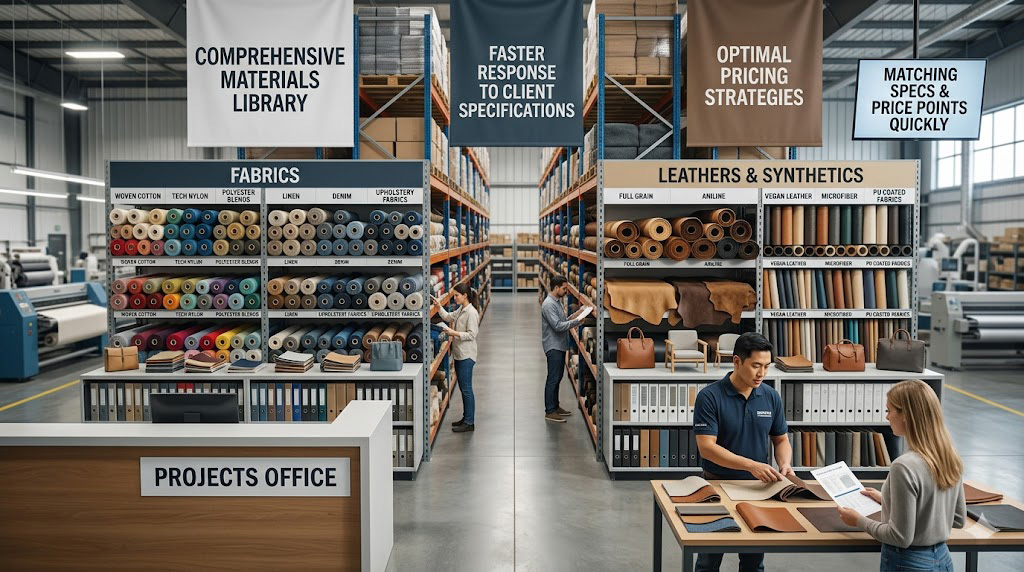
Material libraries maintained by manufacturers often include hundreds of fabrics, leathers, and synthetic alternatives, allowing faster alignment with client specifications and price points.
7. The Hidden Risk: Smaller Workshops
Not every Chinese bag supplier is a 50,000-square-foot facility with an in-house design studio. Many are small workshops with 10 to 30 employees, and that’s not inherently bad — but you need to know what you’re getting.
What Smaller Workshops Typically Can’t Do
- They often lack dedicated designers and rely entirely on the buyer’s tech pack
- Material sourcing may be done on an ad-hoc basis
- Sample revision rounds are usually limited to 1, sometimes at extra cost
- Quality control can vary dramatically from order to order
- They may not have bilingual staff
This doesn’t mean you should avoid them. Many small workshops produce excellent work, especially for simple designs or lower-volume runs. But you need to verify their design capability before placing orders to avoid delays, miscommunication, and quality surprises.
How to Vet a Smaller Supplier
- Ask for a portfolio of similar products they’ve made
- Request a paid sample before committing to bulk
- Visit the facility (in person or via live video) to see their equipment
- Check references from other U.S. or European buyers
- Start with a small test order (200–500 units) before scaling up
If the supplier hesitates on any of these points, that’s a red flag worth heeding.
Smaller workshops may lack dedicated designers and rely on the buyer’s tech pack, so verifying design capability before placing orders is essential to avoid delays.
8. IP Protection: The Most Overlooked Piece of the Puzzle
If there’s one section of this guide you should screenshot, it’s this one. IP theft is a real risk when sharing original designs with overseas manufacturers, and it can destroy an independent brand before it even gets off the ground.
Why an NDA Is Non-Negotiable
Before you share any original sketches, reference images, or proprietary product concepts with a Chinese supplier, you should have a signed Non-Disclosure Agreement (NDA) in place. A proper NDA should:
- Define what counts as confidential information (sketches, tech packs, materials, branding)
- Specify the duration of confidentiality (typically 2–5 years)
- Outline penalties for breach
- Be governed by a clear legal jurisdiction
Equally important is a clear IP assignment clause in your manufacturing agreement. This should specify that:
- All designs you provide remain your exclusive property
- The factory cannot use your designs to make products for other buyers
- The factory cannot register your design, logo, or brand as their own
- You retain the right to pursue legal remedies in case of breach
Practical IP Protection Tips
Beyond the legal paperwork, here are practical steps every U.S. bag brand should take:
- File your designs with the U.S. Copyright Office and, if budget allows, register them with China’s National Intellectual Property Administration (CNIPA)
- Register your trademark in China before you start production — this is critical for any brand serious about the Chinese market or worried about counterfeits
- Use watermarked images when sharing early-stage concepts
- Limit access to your most sensitive design files within the factory
- Use unique hardware with your logo — custom-engraved buckles, branded zipper pulls, and embossed metal feet are hard to copy and easy to trace
- Split production across multiple factories for different product lines if you’re worried about leaks
Understanding the Reality of Chinese IP Enforcement
I won’t sugarcoat it: Chinese IP enforcement has improved dramatically in the past decade, but it’s still not at the level of U.S. or EU protection. If a factory is determined to copy your design, they probably can. This is why trust and verification matter more than legal paperwork alone.
Build relationships with suppliers who have long-term reputations to protect. Visit them. Meet the owners. Treat them as partners, not vendors. The strongest IP protection comes from a relationship where both sides have more to lose from betrayal than from honest collaboration.
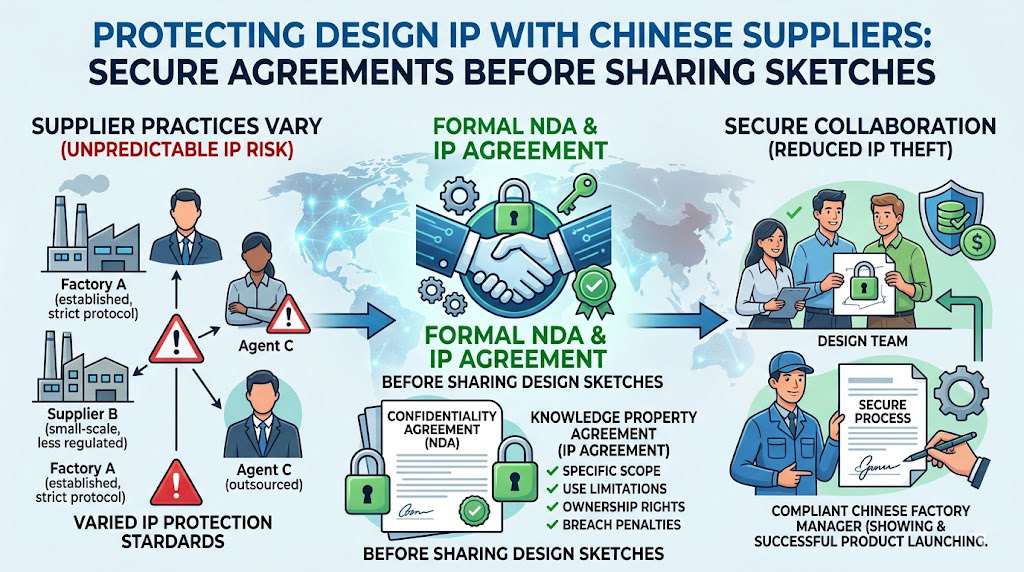
A formal NDA and clear IP agreement should be signed before sharing original sketches, as design protection practices vary across Chinese suppliers.
9. The Exact Questions to Ask Any Chinese Bag Supplier
To save you time on your next sourcing call, here’s a vetted list of questions that will tell you almost everything you need to know about a supplier’s design and development capabilities:
About Design Development
- Can your design team work from client briefs, hand sketches, and trend reference images?
- What’s your typical process from concept to approved sample?
- Do you offer 3D mock-ups or digital renderings before physical samples?
- Will you help build a tech pack if I only have rough ideas?
About Sampling
- What does a custom sample cost, and what’s included?
- How many revision rounds are included in the sample fee?
- What’s the typical lead time for a first sample?
- Will I receive a counter-sample tech pack showing how you interpreted my brief?
About Communication
- Will I have a dedicated bilingual project manager?
- What’s your typical response time for emails and messages?
- Can you provide weekly updates with photos and videos?
- How do you handle time zone differences?
About IP Protection
- Are you willing to sign an NDA and a clear IP assignment agreement?
- Can you provide references from other U.S. or European private label clients?
- What measures do you take to protect buyer designs within your facility?
- Have you ever had an IP dispute with a previous client? If so, how was it resolved?
About Materials and Sustainability
- Do you maintain an in-house material library?
- Can you source GRS-certified, OEKO-TEX-certified, or vegan materials?
- Do you offer custom hardware with our logo?
- What’s your MOQ for custom materials?
A strong supplier will answer these questions confidently and with specifics. A weak supplier will give vague responses, deflect to “we can do anything,” or pressure you to start sampling without proper documentation.
10. Final Thoughts: Building a Sourcing Partnership That Lasts
Sourcing custom bags from China isn’t just a transaction — it’s the foundation of your brand. The right supplier will become a long-term partner who helps you iterate, scale, and stay ahead of trends. The wrong one will cost you months of delays, thousands of dollars in wasted samples, and potentially your most original designs.
The independent bag brands that succeed in the U.S. market are the ones that approach Chinese manufacturing with respect, preparation, and clarity. They bring organized tech packs, ask the right questions, protect their IP from day one, and treat their factory relationships as true partnerships.
If you’re starting your own bag brand or scaling an existing one, take the time to vet your suppliers carefully, invest in proper documentation, and never skip the NDA. The few extra weeks you spend on the front end will save you years of headaches on the back end.
Your bags deserve a manufacturer that treats your designs as carefully as you do.
Looking for a trusted bag manufacturing partner for your U.S. brand? Explore our to see how we help independent brands bring original designs to life — with full IP protection, dedicated project management, and a 15–30 day sample turnaround.
About the Author A U.S.-based bag industry professional with years of experience sourcing private label and OEM bags from leading Chinese manufacturers. Passionate about helping independent brands navigate the global supply chain with confidence.
Post time: Jun-22-2026