
Sourcing Bags from China: The Complete Guide to Lining Construction, Internal Pockets, and Custom Features
Why Lining Construction Matters More Than Most Buyers Realize
When American buyers evaluate a handbag, backpack, or travel bag for their e-commerce store, the first things they look at are almost always exterior: the leather grain, the hardware finish, the silhouette, the zipper pull. What rarely gets the same level of attention is the interior of the bag — the lining, the internal pockets, the organizer panels, the zipper compartments, and the label plate. And yet, in our decade of working directly with Chinese bag manufacturers on OEM and private-label programs, we can tell you with complete confidence: the lining is where most quality complaints are born and where most customer returns are generated.
The original question we receive from buyers every week is straightforward: “Does the lining construction include internal pockets, organizers, zippers, and label plates?” The honest answer is: it depends entirely on how clearly you specify it. Chinese bag factories are extremely capable, but they are not mind readers. If you don’t itemize the lining features in your spec sheet, you will receive whatever the factory’s stock template uses, which may or may not match what your U.S. customers expect.
This guide is built from real production-floor experience. It answers the four most important follow-up questions American buyers ask about lining construction when sourcing from China, and it gives you the exact language, dimensions, MOQ thresholds, and inspection checkpoints you need to avoid costly sampling mistakes.
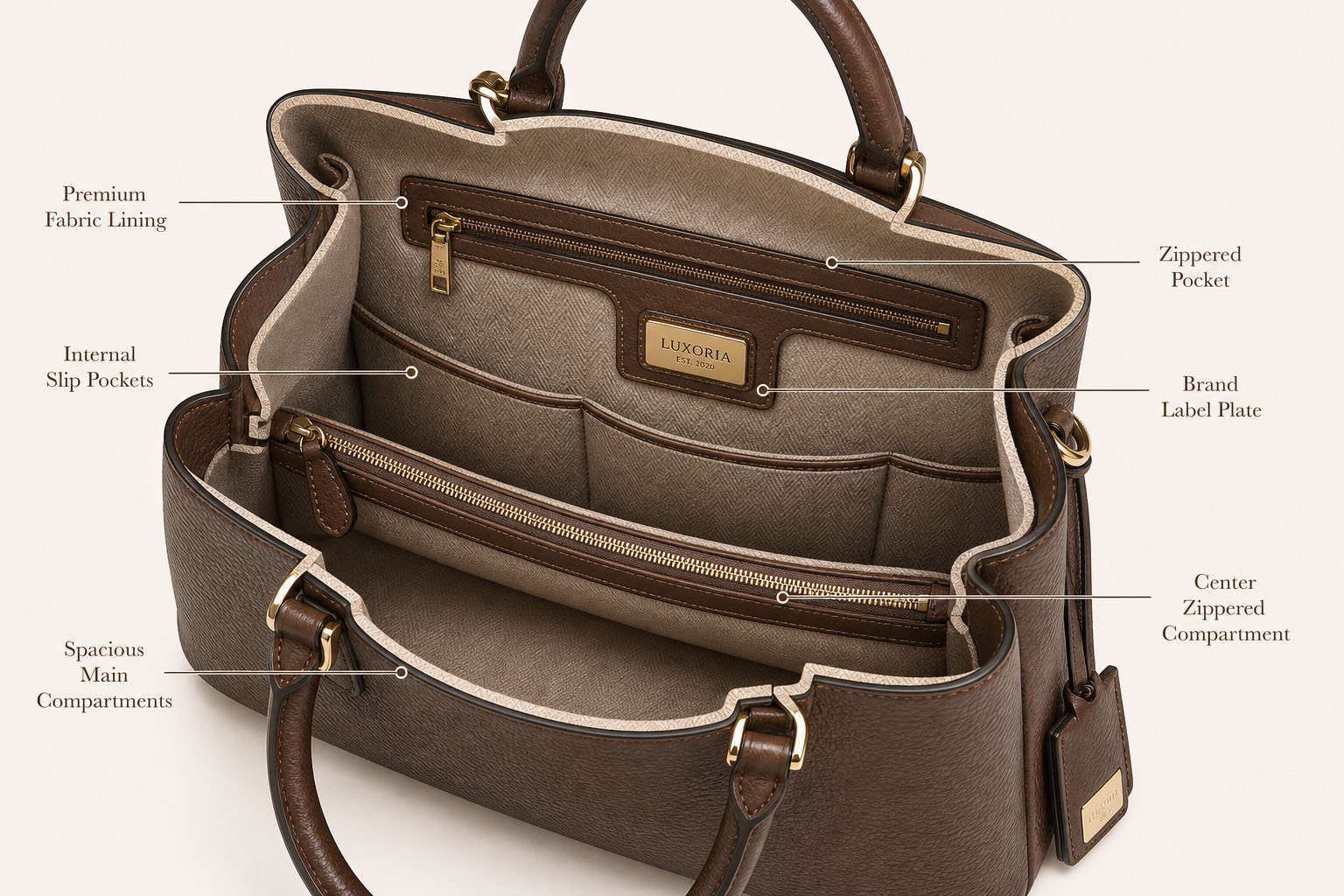
Caption: The lining is the foundation of every functional interior feature. Every pocket, zipper, and label plate depends on how the lining panel itself is constructed.
What Lining Fabrics Do Chinese Bag Suppliers Typically Offer?
The first decision you need to make before sending any spec sheet to a Chinese factory is the lining material itself. The fabric choice drives everything else: the weight of the bag, the durability of the stitched pockets, the way the organizer panels drape, and even how the brand label plate sits flat against the inside wall.
In our sourcing experience, Chinese bag suppliers typically offer four categories of lining fabric:
1. Polyester (Pongee / 190T / 210D). This is the default for roughly 70% of the bags we source. It is inexpensive, lightweight, accepts dye well for custom colors, and prints cleanly for branded patterns. Polyester linings work for fast-fashion handbags, promotional totes, and entry-level backpacks. They do not, however, hold the weight of heavy internal organizers very well.
2. Nylon (210D / 420D / 600D). Nylon linings are noticeably stronger than polyester at the same denier rating. They are the standard choice for tactical backpacks, laptop bags, and travel luggage, where the lining is expected to carry weight without tearing at the seams. Nylon also has a smoother hand-feel, which U.S. consumers tend to associate with premium products.
3. Cotton Twill or Cotton-Poly Blend. For heritage-style messenger bags, canvas totes, and fashion-forward handbags targeting the $80–$200 retail tier, a brushed cotton twill lining is the most common upgrade. It looks refined, feels substantial, and is easy to embroider with brand logos. The trade-off is weight: cotton twill adds 30–60 grams per bag compared to polyester.
4. Microfiber or Suede-Look Synthetics. This is the top-tier option, used in handbags retailing above $250. Microfiber linings feel luxurious, accept heat-pressed logo plates cleanly, and photograph beautifully for e-commerce listings. They are also the most expensive lining option and usually add 8–15% to the unit cost.
Why the Lining Fabric Choice Drives the Whole Construction
Here is the insight most buyers miss: the lining is typically the first interior component installed and serves as the foundation for attaching all internal pockets, organizers, zippers, and label plates. This is not a small detail. If the lining fabric is too thin or loosely woven, the seams that hold internal pockets will eventually tear under the weight of a wallet, phone, or laptop. If the fabric is too thick, the needle perforations from stitching organizer panels can weaken the panel over time.
Premium bags almost always use reinforced lining fabrics — polyester at 210D or higher, nylon at 420D or higher, or a cotton twill with a tight weave — specifically because the lining has to support the load of every internal component. When you see a $300 designer handbag that holds its shape after five years of use, the lining fabric is doing more work than the exterior.
Our recommendation for U.S. e-commerce sellers: specify the lining material by name, denier, and weight per square meter in your purchase order. Saying “good quality lining” means nothing to a factory. Saying “210D polyester pongee, 95 gsm, color PMS 19-4052 TCX” is something a production manager can act on immediately.
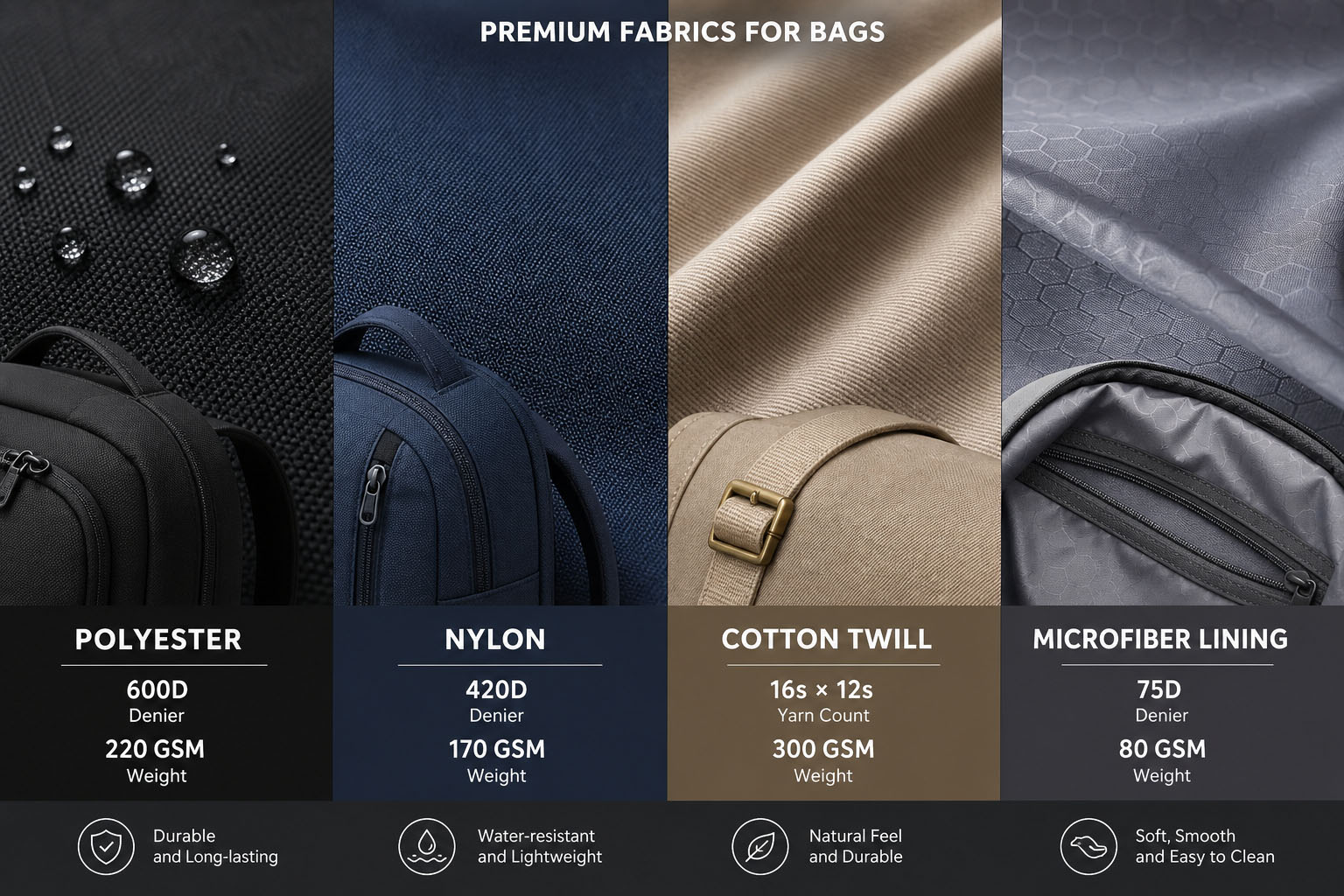
Caption: Always specify lining fabric by denier, weight, and color code. Vague requests produce vague results.
How Can Buyers Inspect Lining and Pocket Stitching During Production?
Once the lining fabric is locked in, the next critical checkpoint is how the internal pockets, organizers, and zipper compartments are actually attached to the lining panel. This is where most quality failures happen, and it is also the area where U.S. buyers are least likely to inspect because the pockets are hidden inside a finished bag.
Here is the production sequence that a properly run Chinese bag factory will follow:
Step 1 — Pocket panels are sewn into the lining seams before the lining is attached to the bag shell. Internal pockets are not added as an afterthought. They are integrated into the side seams of the lining panel during the initial sewing operation. This is the only construction method that gives the pockets real structural integrity. If a pocket is added after the lining is already installed inside the bag shell, the pocket will be stitched into a single layer of lining fabric, which is too weak to hold weight.
Step 2 — Zippered compartments are constructed separately and then stitched onto the lining panel during assembly. The zipper pocket is built as its own sub-assembly — pocket face, zipper tape, pocket backing — and then this sub-assembly is edge-stitched or top-stitched onto the main lining panel. Look for double rows of stitching around the zipper pocket, which is the standard reinforcement pattern.
Step 3 — Brand label plates are heat-pressed, sewn, or riveted onto the lining after the lining is fully assembled inside the bag. This is the most common attachment method, and you need to decide which one you want before sampling. Heat-pressed plates are the most cost-effective but can peel over time. Sewn plates are the most durable. Riveted plates are the most premium but require additional hardware and labor.
What to Look For When Inspecting
The quality of lining stitching directly determines the load-bearing capacity of internal pockets and organizers. This is a non-negotiable inspection point. Specifically, look for:
Stitch density: 8–10 stitches per inch (SPI) is the industry standard for lining seams. Anything below 7 SPI will fail under weight.
Thread type: Bonded nylon or polyester thread, Tex 40 or Tex 50, depending on the lining weight.
Back-tacking at pocket corners: Every internal pocket should have reinforced back-tacks at the top corners, where the pocket meets the side seam. This is the highest-stress point.
No loose threads or skipped stitches: Run your finger along the pocket edges. Any snag means a skipped stitch that will unravel under use.
How to Inspect From the U.S. Without Flying to China
You do not need to be on the factory floor to verify this. Request the following from your supplier at three production stages:
1. Pre-production sample (PPS): A fully constructed sample with all lining features, including pockets, zipper compartments, and label plate. Inspect this in person.
2. Top-of-production (TOP) sample: Sent at 10–15% completion. Inspect stitching density and pocket reinforcement.
3. Pre-shipment inspection (PSI): Hire a third-party QC company (we recommend QIMA, AsiaInspection, or V-Trust) to conduct a random AQL 2.5 inspection focused specifically on lining stitching and pocket integrity.
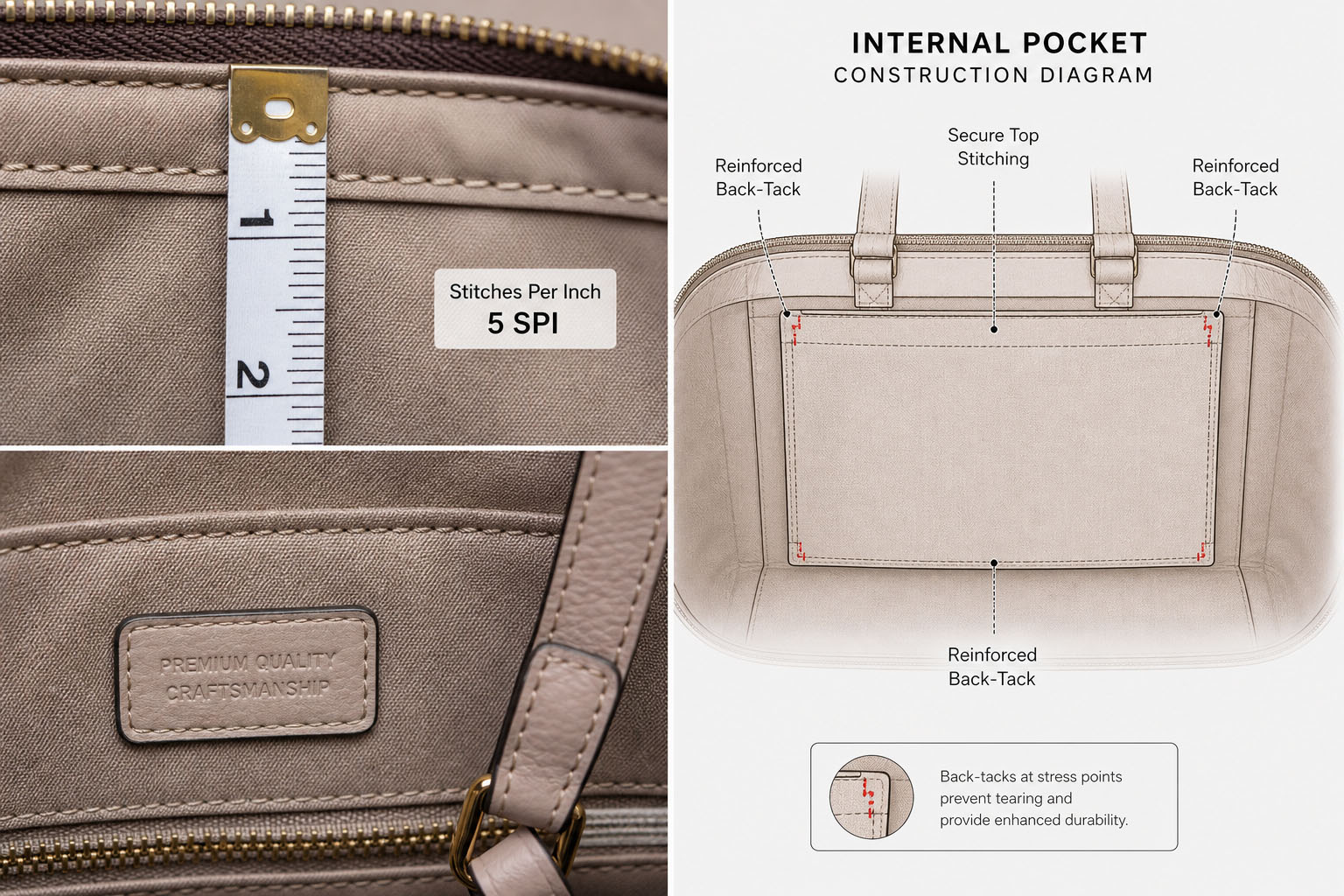
Caption: A stitch density of 8–10 SPI and reinforced back-tacks at the pocket corners are the two non-negotiable quality markers for interior pocket construction.
What Are the Standard Dimensions for Internal Organizers and Label Plates?
This is a question that almost no U.S. buyer asks until it is too late, and it is the source of a surprising number of sampling rejections in our OEM programs. The reason: there is no universal standard for internal organizer dimensions, and Chinese factories each have their own house dimensions that may be smaller or larger than what your U.S. customers expect.
That said, here are the dimensional norms we see most often in the Chinese bag industry:
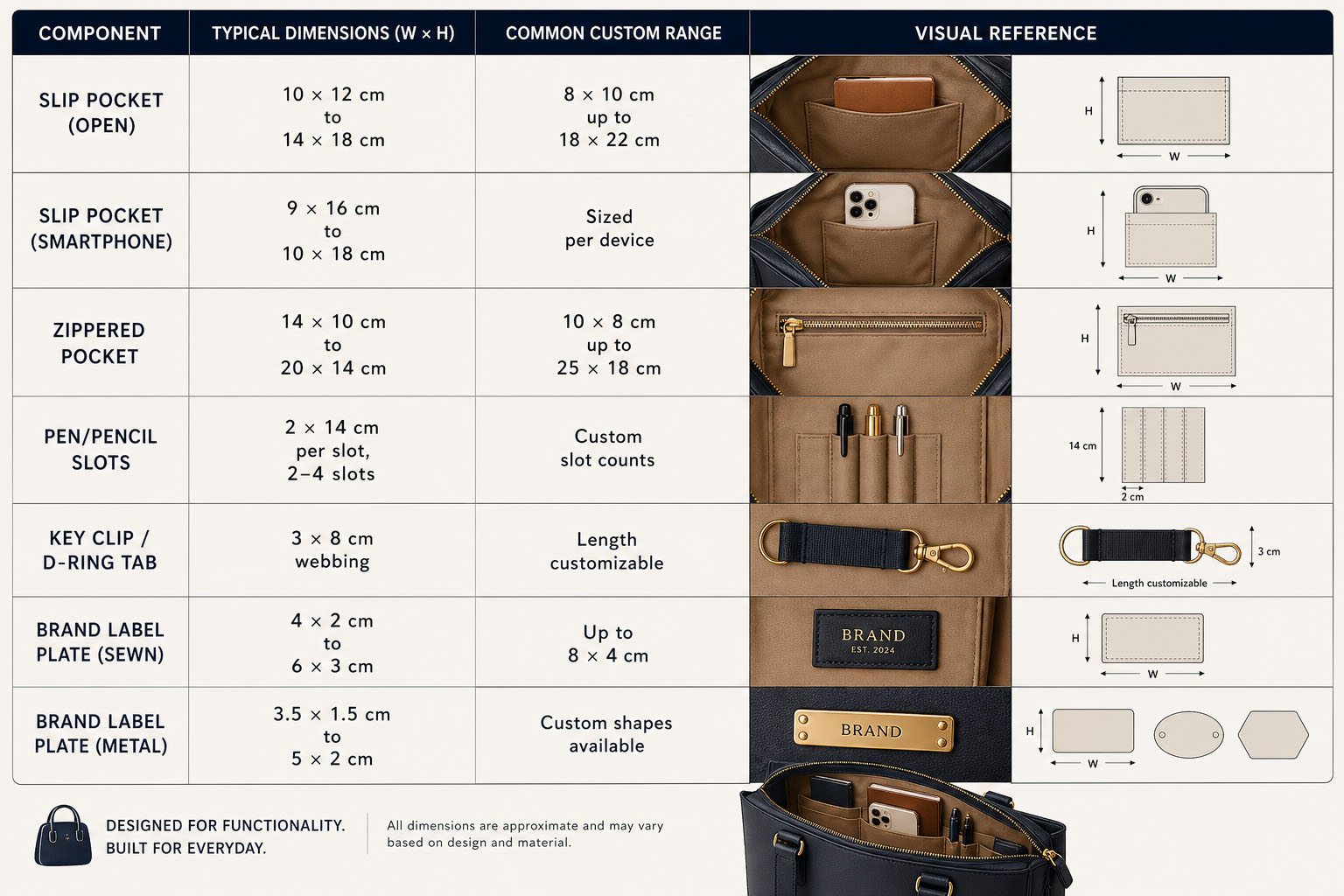
Removable vs. Permanent Organizers
One decision that will affect both function and pricing: removable organizers are usually attached via Velcro, snaps, or buttons rather than being permanently sewn into the lining. This is important for U.S. consumers who increasingly expect modular bag systems — they want to be able to pull the organizer out and use the bag as a tote, or swap organizers between bags.
If you want a permanent organizer (sewn-in), specify it clearly. If you want it removable, specify the attachment method — Velcro is the most common, but snaps feel more premium and buttons offer a heritage aesthetic.
Label Plate Sizing and Attachment
For label plates specifically, the two most common attachment methods in Chinese factories are:
Sewn-in woven or printed label: Stitched directly into the lining seam, usually at the top interior of the bag, near the zipper opening. Standard placement.
Metal or leather plate: Riveted, heat-pressed, or stitched onto the lining as a separate step. Adds 0.15–0.40 USD per unit depending on material.
Pro tip from our sourcing desk: Always request a lining construction diagram from the factory showing the exact placement of every pocket, zipper, and label plate. A photo of a previous production run is helpful, but a diagram is enforceable. The best suppliers will provide both.
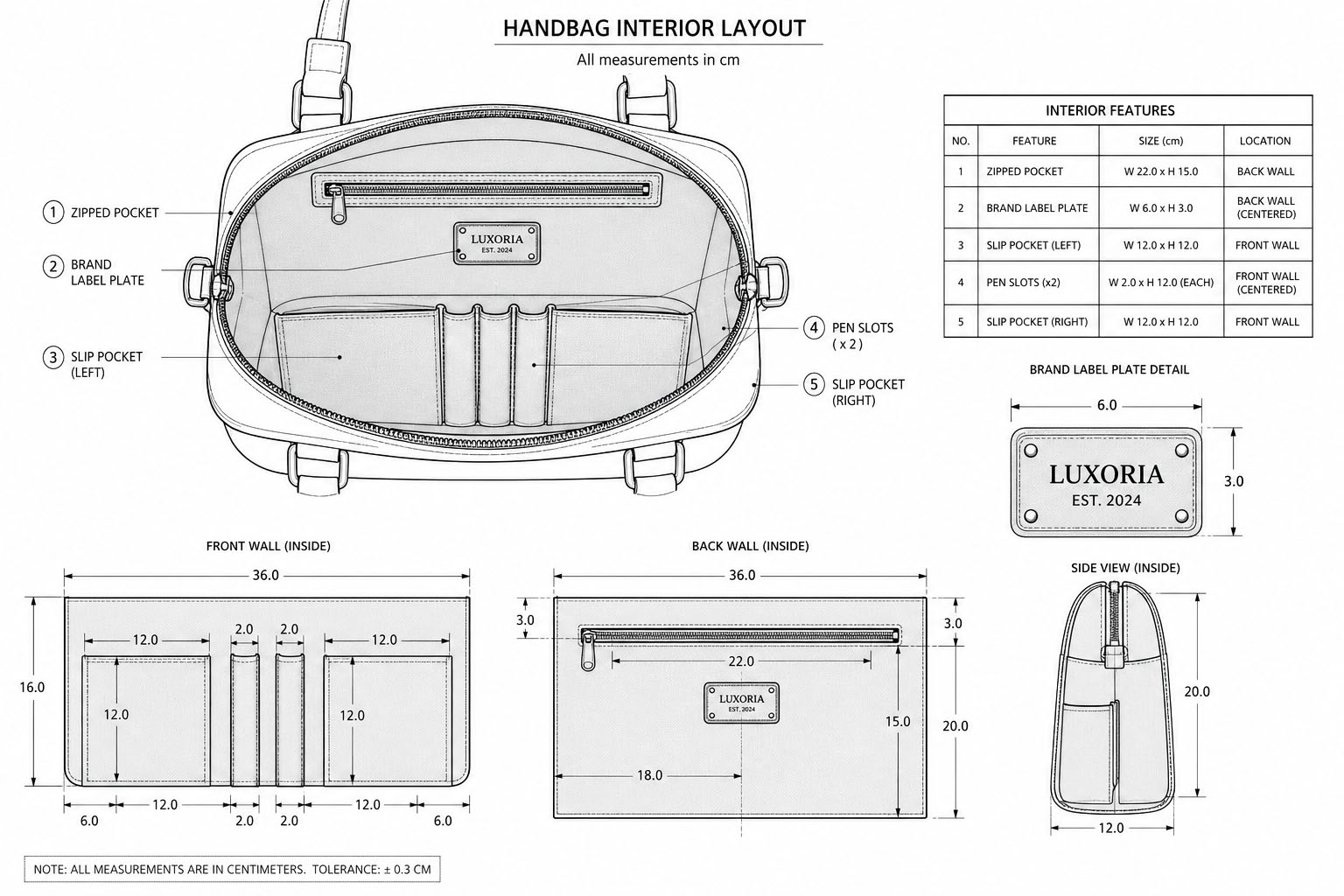
Caption: Always request a CAD-style lining construction diagram from your supplier. A diagram is enforceable in a contract; a verbal description is not.
Do Custom Lining Features Affect Minimum Order Quantity or Pricing?
This is the question that determines whether your private-label program is profitable, so let’s be very direct.
The short answer: yes, custom lining features almost always affect both MOQ and unit price. Here is how:
Minimum Order Quantity (MOQ)
For standard lining configurations — meaning the factory’s stock layout of pockets, a single zippered compartment, and a sewn-in brand label — most Chinese bag suppliers will accept MOQs in the range of 50–100 pieces per style per color. This is the baseline for OEM production.
For custom internal pocket layouts — meaning you want a specific number of pockets, specific placement, custom dimensions, or a custom organizer panel — the MOQ jumps significantly. In our experience, Chinese manufacturers typically require a minimum order quantity of 100–300 pieces per design for custom internal pocket layouts. Some premium factories in Guangzhou and Quanzhou will go down to 50 pieces, but you will pay a 15–25% surcharge for breaking the production batch.
For fully custom lining fabric (custom weave, custom print, custom Pantone color), the MOQ is usually 300–500 pieces minimum, because the factory has to order a fabric production run from the mill.
Pricing Impact
The cost drivers for custom lining features, in order of magnitude:
1. Custom lining fabric (color, print, weave): +8–18% to unit cost.
2. Custom pocket layout (more pockets, different placement): +5–12% to unit cost, depending on stitch count and labor time.
3. Removable organizer with hardware (Velcro, snaps, D-rings): +0.30–0.80 USD per unit.
4. Metal or leather brand label plate (vs. sewn woven label): +0.15–0.40 USD per unit.
5. Heat-pressed logo on lining fabric: +0.10–0.25 USD per unit, plus a one-time plate fee of 50–100 USD.
When to Confirm Custom Lining Specs
Customization requests for internal pocket placement should be confirmed in the pre-production sample stage, as altering pocket positions after lining construction is costly. Once the lining panels are cut and sewn, changing the pocket placement means re-cutting the lining fabric — which is waste the factory will charge you for.
The workflow we recommend:
Week 1–2: Send your lining spec sheet (fabric, pocket count, dimensions, placement diagram, label plate method).
Week 3–4: Receive and approve a pre-production sample.
Week 5: Lock the spec sheet. No changes after this point.
Week 6+: Mass production begins.
Country-of-Origin Labeling (Critical for U.S. Importers)
One final but absolutely critical point: label plates with country-of-origin markings are often placed on the lining in compliance with U.S. CBP import labeling requirements, and should be discussed with the supplier before production. U.S. Customs and Border Protection requires that all imported goods be marked with their country of origin in a visible location. For bags, this is almost always the interior lining.
The wording must read “Made in China” (or the actual country of origin) and must be permanent — sewn-in woven labels or stamped leather plates are accepted; stickers are not. If you forget to specify this, your shipment can be held at the port, fined, or rejected. We have seen U.S. Customs seize entire containers for missing country-of-origin labels.
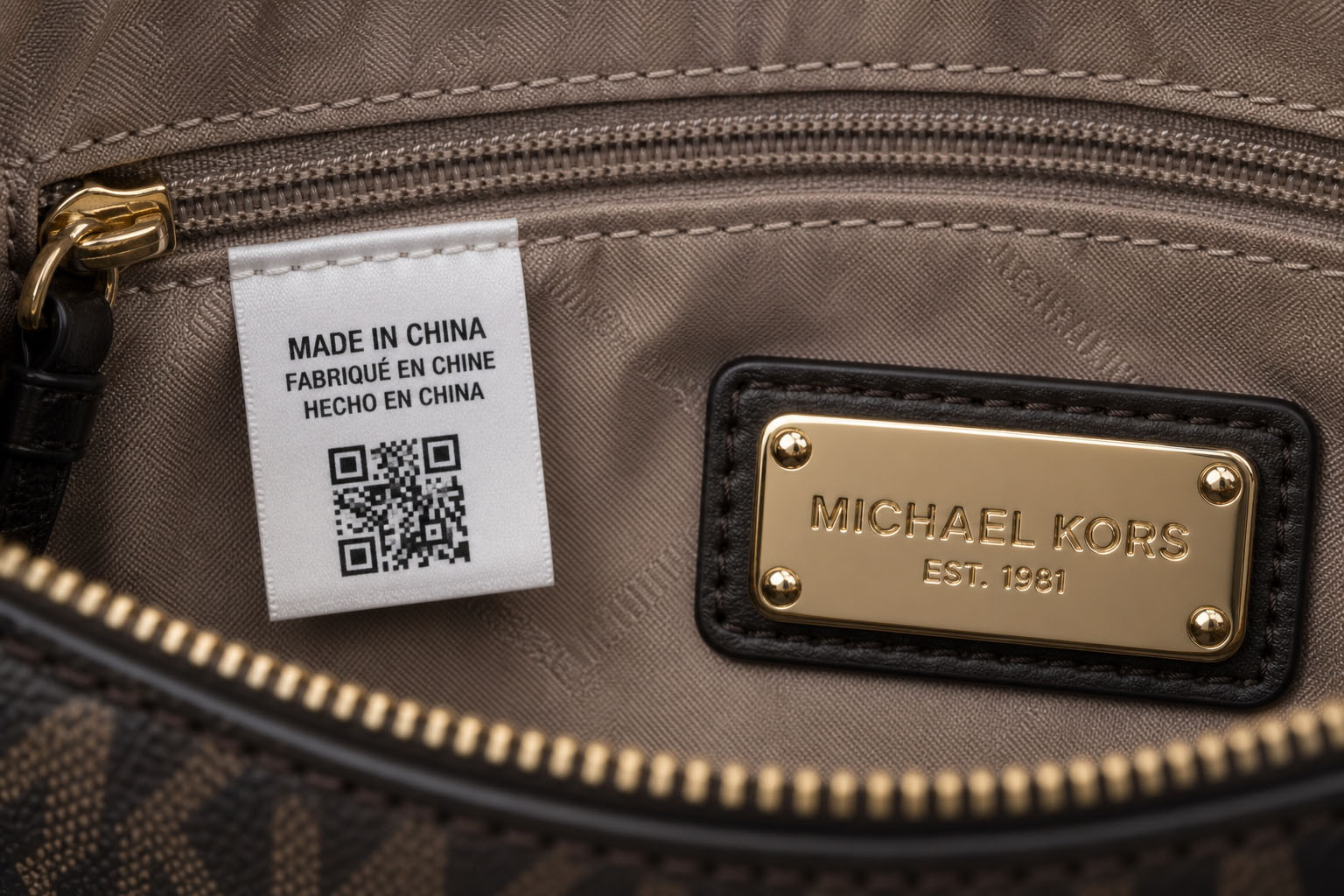
Caption: Country-of-origin labeling on the lining is not optional for U.S. imports. It is a CBP requirement and must be specified in the lining construction spec sheet.
Your Pre-Sourcing Checklist Before Contacting Chinese Bag Suppliers
To wrap this up, here is the consolidated checklist we give every U.S. e-commerce bag buyer before they send their first inquiry to a Chinese factory. Use this verbatim in your supplier communication:
“Hi, please confirm the bag’s lining construction. Does it include internal pockets, organizer sections, zipper pockets, and a label plate or brand label attachment? Please share the material spec (denier, weight, composition), pocket dimensions and placement diagram, label plate attachment method, country-of-origin marking, and sample cost. Also confirm the MOQ for custom pocket layout and any tooling or setup fees.”
A professional supplier will respond to this within 24–48 hours with a detailed spec sheet, lining construction photos from previous production, a quoted sample cost, and a clear MOQ breakdown. If they do not, find a different supplier.
Final Thoughts: The Lining Is the Product
In the U.S. handbag and backpack market, the lining has moved from a hidden cost line to a primary selling point. Consumers expect interior organization. They expect pen slots for work bags, padded laptop sleeves for commuter backpacks, RFID-blocking pockets for travel bags, and removable organizers for totes. None of this is possible without getting the lining construction right at the specification stage — long before the first sample ships.
By asking the right questions, specifying the right fabrics, inspecting the right stitching points, and locking in the right MOQ and pricing structure, you can source bags from China that meet U.S. quality expectations at a price point that supports healthy margins for your e-commerce store. The lining is not a finishing detail. The lining is the product.
Looking for a vetted list of Chinese bag manufacturers with proven lining construction capabilities? [Browse our supplier directory] or [contact our sourcing team] for a free consultation on your next private-label bag program.
Post time: Jul-17-2026