

Meta Description: As a US-based bag retailer sourcing directly from China, verifying Life Cycle Assessment (LCA) data and carbon-footprint disclosures is no longer optional. This in-depth guide explains what to ask, what to expect, and how to turn sustainability due diligence into a competitive advantage.
Introduction: Why Sustainability Data Has Become a Procurement Requirement
Over the past five years, I have watched sustainability evolve from a marketing buzzword into a hard procurement criterion. As a bag buyer operating an independent e-commerce site in the United States, my inbox is now filled with inquiries not just about price, MOQ, and lead time, but also about carbon footprint, recycled content, packaging waste, and factory-level emissions. Major marketplaces — Amazon, Walmart, and Target — have all introduced sustainability questionnaires. The EU’s CBAM is forcing non-European suppliers to disclose embedded carbon. And the SEC’s climate-disclosure rules are slowly reshaping how US retailers report Scope 3 emissions from their supply chains.
When I first started importing bags from China, the only “green” question I asked was whether the factory could ship in recycled cartons. Today, the conversation runs much deeper. The single most important question I now ask every potential supplier is:
“Can you provide a cradle-to-gate LCA report, third-party verified, with a carbon-footprint figure per bag style?”
This article is the long-form answer I wish I had when I started asking that question. It consolidates the key data points, common methodologies, practical pitfalls, and a step-by-step supplier questionnaire — all tailored to the realities of sourcing bags from Chinese factories for the US B2B market.
Part 1: The Four Questions Every Bag Buyer Should Ask (and What Answers to Expect)
Question 1 — Can the factory provide a full cradle-to-gate LCA report?
A cradle-to-gate LCA covers the entire upstream footprint of a product — from raw-material extraction, through manufacturing, to the moment the finished bag leaves the factory gate. It does not include the use phase or end-of-life. For B2B procurement, this is the most commonly requested scope, and the answer from a credible Chinese bag factory should be “yes” — provided the factory is large enough, export-oriented, and serves sustainability-conscious brands.
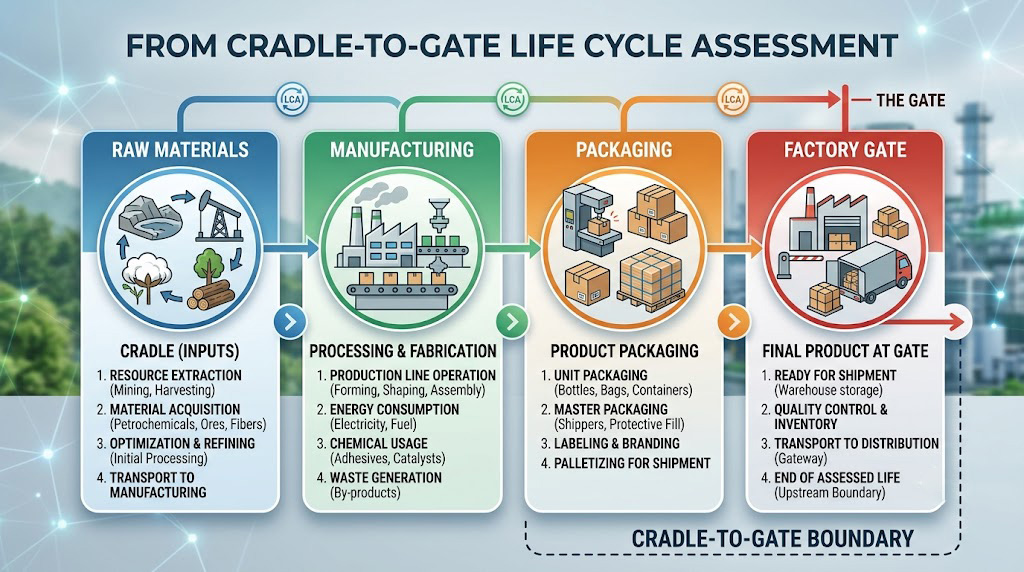
Diagram showing cradle-to-gate life cycle stages: raw materials → manufacturing → packaging → factory gate
Most established Chinese bag factories can deliver cradle-to-gate LCA data covering raw-material extraction, manufacturing, and packaging. This is the standard scope in B2B procurement due diligence. However, smaller workshops may not have the internal capability and will need to outsource the study to a consultancy or verifier.
Insider tip: If a factory tells you it has an LCA but cannot name the verifier or the standards used, treat that as a red flag.
Question 2 — What is the carbon-footprint figure, and which methodology is used?
The two methodologies you will see most often in China are ISO 14067 (Product Carbon Footprint) and the GHG Protocol Product Standard. PAS 2050 is occasionally referenced, especially for factories that historically served UK retailers, but it is becoming less common as ISO 14067 takes the lead. The methodology matters because it determines what is included and how allocations are handled.
As a rule of thumb, a typical polyester or nylon backpack has a cradle-to-gate carbon footprint of approximately 5–15 kgCO₂e, while a small handbag or tote usually falls within 2–6 kgCO₂e. These figures vary widely with material weight, recycled content, and the regional electricity mix used in the calculation.
Insider tip: Always ask which methodology was applied. ISO 14067 and the GHG Protocol Product Standard are the two most frequently used frameworks among Chinese bag exporters serving US and EU markets. If the factory cannot name the standard, the numbers are not defensible.
Question 3 — Is the LCA data per style, or an average across the factory?
This is a question I used to skip, and I paid the price. An “average factory footprint” is essentially useless for your own reporting — you cannot allocate a generic 8 kgCO₂e figure to a specific tote bag you are selling under your private label. The data you need is per style, per material, per production batch if possible.
Carbon-footprint data is generally disclosed per bag style rather than per unit weight, with breakdowns by life-cycle stage — materials, manufacturing, transport, and packaging — available on request. The more granular the data, the more useful it becomes for your own CDP Scope 3 disclosure and any retailer questionnaires you are asked to complete.
Insider tip: When comparing two factories, always normalize the data by asking for kgCO₂e per kg of finished bag and kgCO₂e per unit. This is the only way to make a fair comparison.
Question 4 — Can the factory supply supporting primary data?
LCA reports are only as good as the inputs. If a factory claims a footprint of 4 kgCO₂e per tote but cannot tell you how many kWh of electricity the production line consumed, how many liters of water were used in dyeing, or how much scrap fabric went to landfill, the report is essentially decorative. The most defensible reports always come with primary activity data behind them.
Primary data inputs — including kWh consumption per bag, water usage, and waste output — can be requested to validate the disclosed figures and improve comparability between competing suppliers. Ask for these in spreadsheet form; the willingness of a factory to share raw activity data is, in my experience, one of the best indicators of credibility.
Insider tip: Cross-check the disclosed footprint by multiplying kWh per bag by the regional grid emission factor. If the math does not roughly work out, dig deeper.
Part 2: Ten Key Insights That Will Reshape How You Source Bags from China
Insight 1 — Cradle-to-gate is the default, not cradle-to-grave
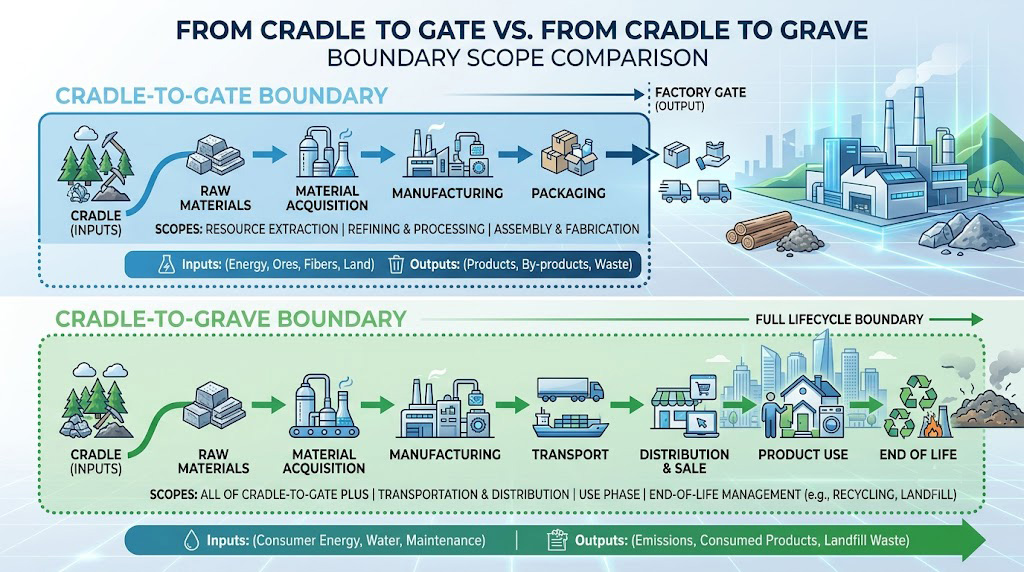
Most established Chinese bag factories can provide cradle-to-gate LCA data covering raw-material extraction, manufacturing, and packaging, which is the most common scope in B2B procurement due diligence. Cradle-to-grave studies (which add use phase and end-of-life) are rarer and more expensive because they require consumer-behavior assumptions.
Insight 2 — ISO 14067 and the GHG Protocol dominate
ISO 14067 and the GHG Protocol Product Standard are the two most frequently used methodologies for carbon-footprint calculation among Chinese bag exporters serving US and EU markets. When in doubt, ask for the report’s “Methodology” section — it should be on page two or three of any credible study.
Insight 3 — Third-party verification is now the baseline
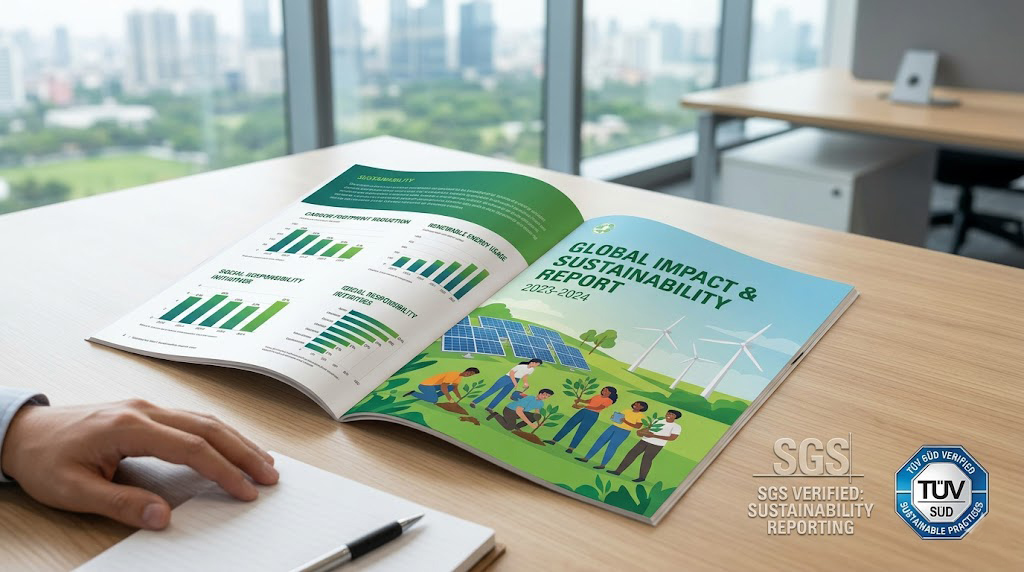
Third-party verification by SGS, Intertek, Bureau Veritas, or TÜV is now the standard expectation for credible LCA disclosure in B2B transactions, with verification certificates typically valid for 12 months. A “self-declared” carbon footprint is not enough for US retailers — and it is certainly not enough for any marketing claim on your independent site.
Insight 4 — Footprint ranges are real and material-dependent
A typical polyester or nylon backpack has a cradle-to-gate carbon footprint of approximately 5–15 kgCO₂e, while a small handbag or tote usually falls within 2–6 kgCO₂e. Leather bags sit higher (often 10–30 kgCO₂e) due to the energy-intensive tanning process. Knowing these ranges helps you sanity-check any supplier claim.
Insight 5 — Data is per style, not per unit weight
Carbon-footprint data is generally disclosed per bag style rather than per unit weight, with breakdowns by life-cycle stage — materials, manufacturing, transport, and packaging — available on request. Always ask for the LCA to be re-run if you significantly change materials, lining, or hardware — even a 20% shift in material weight can move the footprint by 15–25%.
Insight 6 — EPD is the gold standard, but not yet common
EPD (Environmental Product Declaration) certification under ISO 14025 is offered by a small but growing number of Chinese bag factories and is the most rigorous publicly verifiable format available. EPDs are registered in public databases, which means your downstream customers and even consumers can verify your claim directly. If your supplier has an EPD, treat it as a major competitive advantage.
Insight 7 — China’s grid mix is a hidden variable
Most Chinese factories rely on regional grid-average electricity factors in their calculations, which can result in higher reported Scope 2 emissions than factories located in the EU or the US. If your supplier is in Inner Mongolia (coal-heavy grid) versus Yunnan (hydro-heavy grid), the same bag can have a meaningfully different reported footprint. This is a real issue when comparing factories, and I have learned to ask for the exact grid factor used.
Insight 8 — Primary data is the credibility test
Primary data inputs — including kWh consumption per bag, water usage, and waste output — can be requested to validate the disclosed figures and improve comparability between competing suppliers. A factory that hands you a polished PDF but balks at sharing the underlying spreadsheet is signaling that the report was bought off the shelf, not built on real shop-floor data.
Insight 9 — Recycled content uses mass-balance allocation
The mass-balance approach is widely used for recycled-content materials, allowing environmental burdens to be allocated between virgin and recycled streams within the same production site. This means a bag made from “50% recycled polyester” may not have a 50% lower material footprint — the credit is shared across the entire production output. Make sure your marketing language reflects this nuance.
Insight 10 — Verified LCA data has downstream business value
Verified LCA data supports US buyers’ downstream needs — including SEC climate-disclosure compliance, CDP Scope 3 supplier reporting, and the sustainability questionnaires required by major retail and e-commerce partners. The 2–5 days you spend collecting and verifying this data upfront can save you weeks of work when a major retailer’s vendor compliance team comes knocking.
Part 3: What Documents to Request from a Chinese Bag Factory
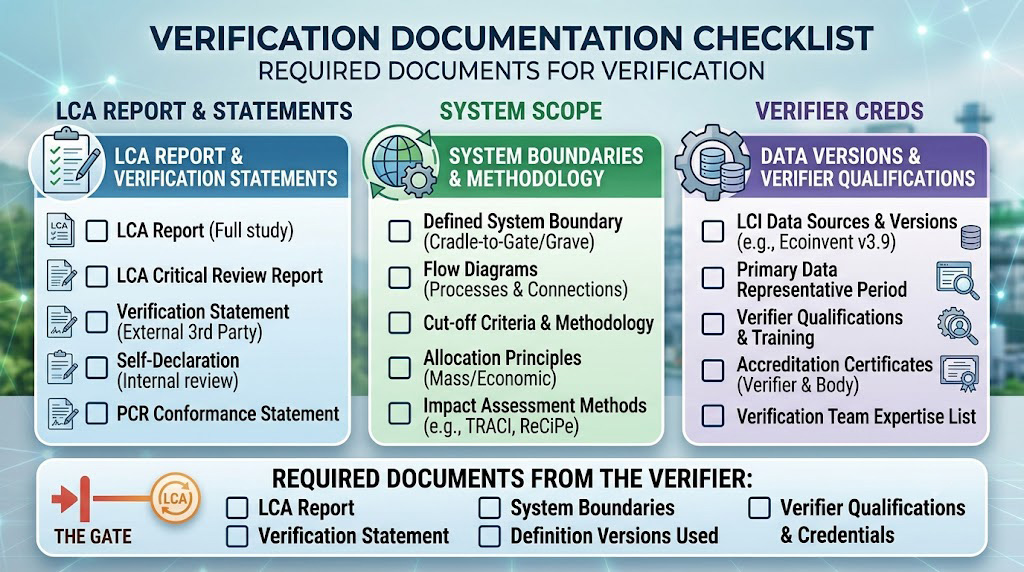
For B2B due diligence, ask suppliers for these specific documents:
A product LCA report based on ISO 14040/14044, or a product carbon-footprint study based on ISO 14067.
An independent verification statement or third-party review, ideally to ISO 14064-3 or equivalent verification standards.
The system boundary used, such as cradle-to-gate or cradle-to-grave, plus assumptions and emission factors.
The version/date of the data, because carbon factors and calculations change over time.
Evidence of the lab, auditor, or verifier that checked the claim — name, accreditation number, and scope of accreditation.
Part 4: How Common Is This Among Chinese Bag Factories?
Large, export-oriented, or sustainability-focused factories are more likely to have this material ready, especially if they sell into Europe, work with multinational brands, or already participate in carbon-label pilots. Smaller factories may only have basic energy or compliance records, and may need a third party to produce a proper LCA or verified footprint.
For bags specifically, public datasets show handbag footprints can vary widely by materials and process, which means supplier-specific data matters a lot. A canvas tote from one factory and a canvas tote from another factory can have footprints that differ by 40% or more, even when the bill of materials looks identical on paper.
Insider tip: China’s national product carbon-footprint system — including standards, emission-factor databases, labeling/certification pilots, and information-disclosure mechanisms — is expanding fast. Availability is improving year by year, but the maturity of any given factory’s sustainability documentation still varies enormously.
Part 5: A Practical Supplier Questionnaire You Can Send Today
A good supplier questionnaire would ask:
1. Do you have a product LCA or product carbon-footprint report for this bag style?
2. Is it based on ISO 14040/14044 and/or ISO 14067?
3. Has it been independently verified — and by whom?
4. Can you share the report, verification statement, and calculation boundary?
5. Can you provide material-level and factory-level activity data used in the calculation?
6. What is the grid emission factor used in the calculation, and which province is your factory located in?
7. Can you provide an EPD if requested by our retail partners?
8. How do you allocate environmental burdens for recycled-content materials — cut-off, mass-balance, or avoided burden?
If the supplier cannot provide verified data, you can still buy from them, but you should treat any carbon claims as unverified and consider requiring a third-party assessment before making sustainability claims on your website. From a legal-risk standpoint, making a public carbon claim without supporting documentation is increasingly dangerous in the US market.
Part 6: My Bottom Line for Procurement
Your safest position is this: Chinese factories may supply LCA and verified carbon-footprint disclosures, and the availability is improving in China’s current policy environment, but you should require documentary proof in the RFQ or supplier onboarding process. For a US website seller, the key is to demand the report and the verification statement before relying on any carbon claim in marketing.
Conclusion image: a US buyer shaking hands with a Chinese factory representative, both holding a verified LCA report
Three rules I now follow on every order:
1. No report, no claim. If a supplier cannot produce a verified LCA, I do not put any carbon number on the product page.
2. Re-verify every 12 months. Verification certificates expire. The grid factor in China changes. Renewable energy purchases change the math.
3. Treat the data as a procurement asset. The same LCA data that helps you win a Target vendor compliance form also helps you win the next Amazon Climate Pledge Friendly badge — and that is real revenue, not just ESG optics.
Frequently Asked Questions
Q: Is it true that some Chinese factories can supply LCA and carbon-footprint data?
A: Yes — some can, and the number is growing. But it is not yet universal, so it should be treated as a procurement requirement, not an assumption.
Q: How do I know if a carbon claim from a Chinese factory is real?
A: Ask for the underlying LCA report, the verification statement, and the verifier’s credentials. If any of these are missing, the claim should be considered unverified.
Q: What’s the typical carbon footprint of a bag from China?
A: For a polyester or nylon backpack, 5–15 kgCO₂e cradle-to-gate is typical. For a small handbag or tote, 2–6 kgCO₂e is typical. Leather bags run higher.
Q: Do I need an EPD, or is an LCA enough?
A: For most independent e-commerce sellers, a verified LCA is enough. EPDs are more important if you are pitching to large retailers that explicitly require ISO 14025 declarations.
Closing Note
Sustainability due diligence is no longer a “nice to have” in the bag industry — it is a procurement filter that separates serious brands from the rest of the catalog. As an independent US seller sourcing from China, the factories that can hand you a credible, verified, third-party-reviewed LCA report on demand are the factories that will still be supplying the major marketplaces three years from now. The rest will increasingly be screened out.
If you would like a ready-to-send supplier questionnaire template — in both English and simplified Chinese — that you can copy directly into your next RFQ email, just leave a comment below or reach out via our contact form. I am happy to share the version I use with my own factory partners.
About the Author: A US-based B2B bag buyer and independent e-commerce seller with 8+ years of experience sourcing backpacks, totes, handbags, and travel bags directly from Chinese manufacturers. Focused on building a transparent, sustainability-credible supply chain for the American market.
Post time: Jun-18-2026