
Backpack & Bag Seam Reinforcement: Stitching Standards for US Retail Durability
Blog Post for US Bag E-commerce Website | American English Target Audience: Factory Sourcing Managers, Bag Product Developers, Importers, Quality Control Specialists
Meta description: Learn critical stitching techniques, bartack specs, box-X vs bartack performance, pull test standards and production cost tradeoffs for high-stress seams on backpacks, tote bags and travel bags sold in US retail.
High-stress seam failure remains one of the top quality complaints for backpacks, tote bags, laptop bags and travel luggage sold into the US retail market. Consumers will quickly return a bag if shoulder straps tear away from the main body, handles pull loose, or bottom seams split under regular load. For US-based bag importers sourcing directly from Chinese manufacturers, understanding sewing reinforcement specifications, stitch patterns, load testing rules and production workflow tradeoffs is essential to reduce return rates, maintain brand reputation and meet US retail durability expectations.
Many overseas factories can produce clean-looking bags with neat surface stitching, but cosmetic appearance does not guarantee long-term performance. Durability lives in the hidden details: stitch pattern selection, stitch density, reinforcement backing layers, thread material, pull testing protocols and proper placement of bartacks and box-X stitching. This guide breaks down industry-standard reinforcement solutions for backpack straps, handles, bag bottoms and other critical stress points, so you can create clear technical specifications for your Chinese suppliers before sampling and mass production.
Core Reinforcement Stitching Techniques for Bag High-Stress Areas
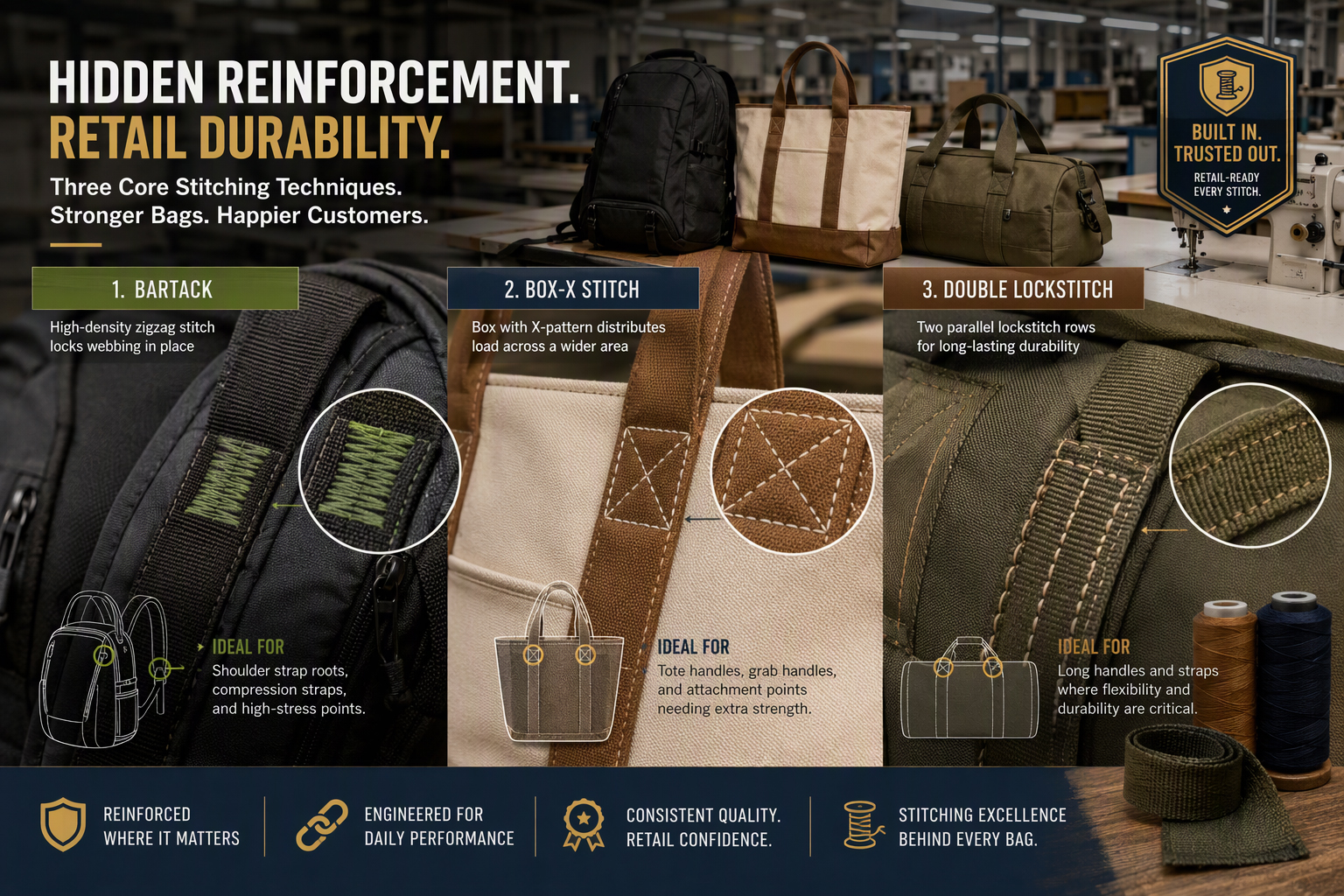
Bag stitching reinforcement diagram showing bartack, box-X and double lockstitch on backpack strap and handle attachments Image: Visual comparison of bartack, box-X box-and-X stitch and double lockstitch applied on backpack shoulder strap roots and tote handle anchor points
Bartack Stitching
Bartacking is the most widely used reinforcement technique for backpack strap ends, narrow webbing terminations, buckle attachments, zipper ends and pocket corners. A bartack consists of tightly packed short zigzag stitches sewn perpendicular to the direction of pulling force. It concentrates high stitch density on a small, localized stress zone to stop webbing or fabric from tearing away at connection points.
Bartacks are not a standalone fix. A bartack cannot compensate for insufficient fabric overlap or missing internal reinforcement backing patches. The attachment base must be properly engineered first; the bartack then adds concentrated stitch strength to guard against point failure. For standard daily-use backpack webbing handle bases, factories typically target 6–8 stitches per centimeter. Each bartack reinforcement zone usually contains 28 to 42 individual stitches, though final stitch counts should always be validated by pull testing, because fabric thickness, webbing weight and thread size will change the actual breaking load.
Bartacks work best for narrow load points: strap ends, D-ring mounts, buckle webbing loops and zipper tape terminals. Hidden bartacks wrapped under webbing are a premium construction choice. This method preserves a clean exterior aesthetic while still reinforcing critical seams, making it ideal for high-end leather bags and premium outdoor backpacks. Patterned bartacks at gusset intersections spread stress across a wider stitch zone, lowering the risk of catastrophic single-point seam rupture.
Box-X (Box-and-X) Stitching
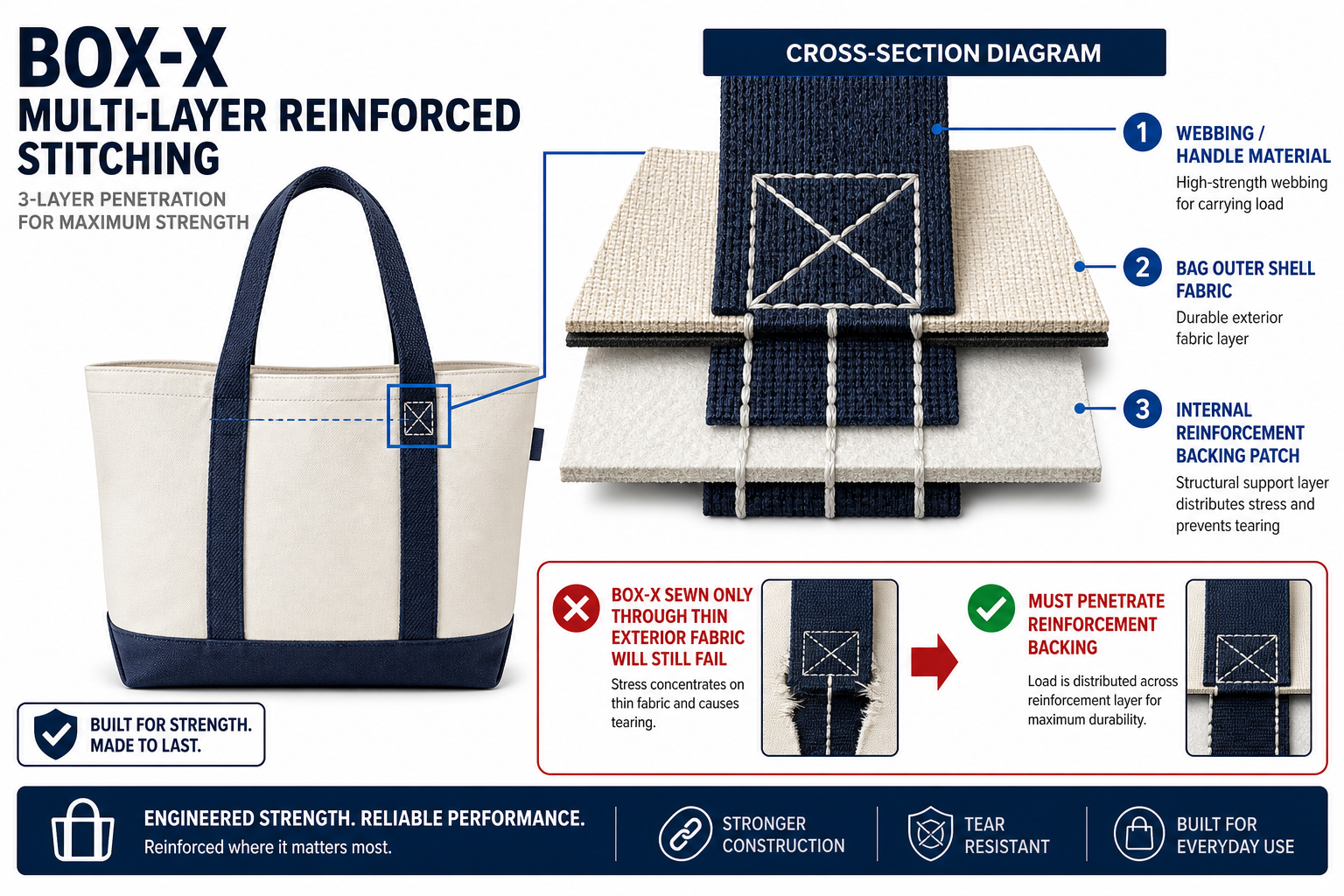
Box-X stitching creates a rectangular stitch perimeter with a diagonal X stitched inside the box outline. Unlike bartacks that focus strength on a tiny spot, box-X distributes pulling force over a much wider attachment footprint. This is the preferred reinforcement pattern for wide webbing shoulder strap anchors, tote bag top handles, grab handles and luggage handle mounts.
For heavy-duty bags, box-X stitches must penetrate three layers: the webbing or handle material, the bag outer shell fabric, and an internal reinforcement backing patch. A box-X sewn only through thin exterior fabric will still fail easily. The fabric around the stitch holes will tear before the stitches themselves break. For heavy load requirements, multi-row box-X patterns can be specified to further increase the connection strength.
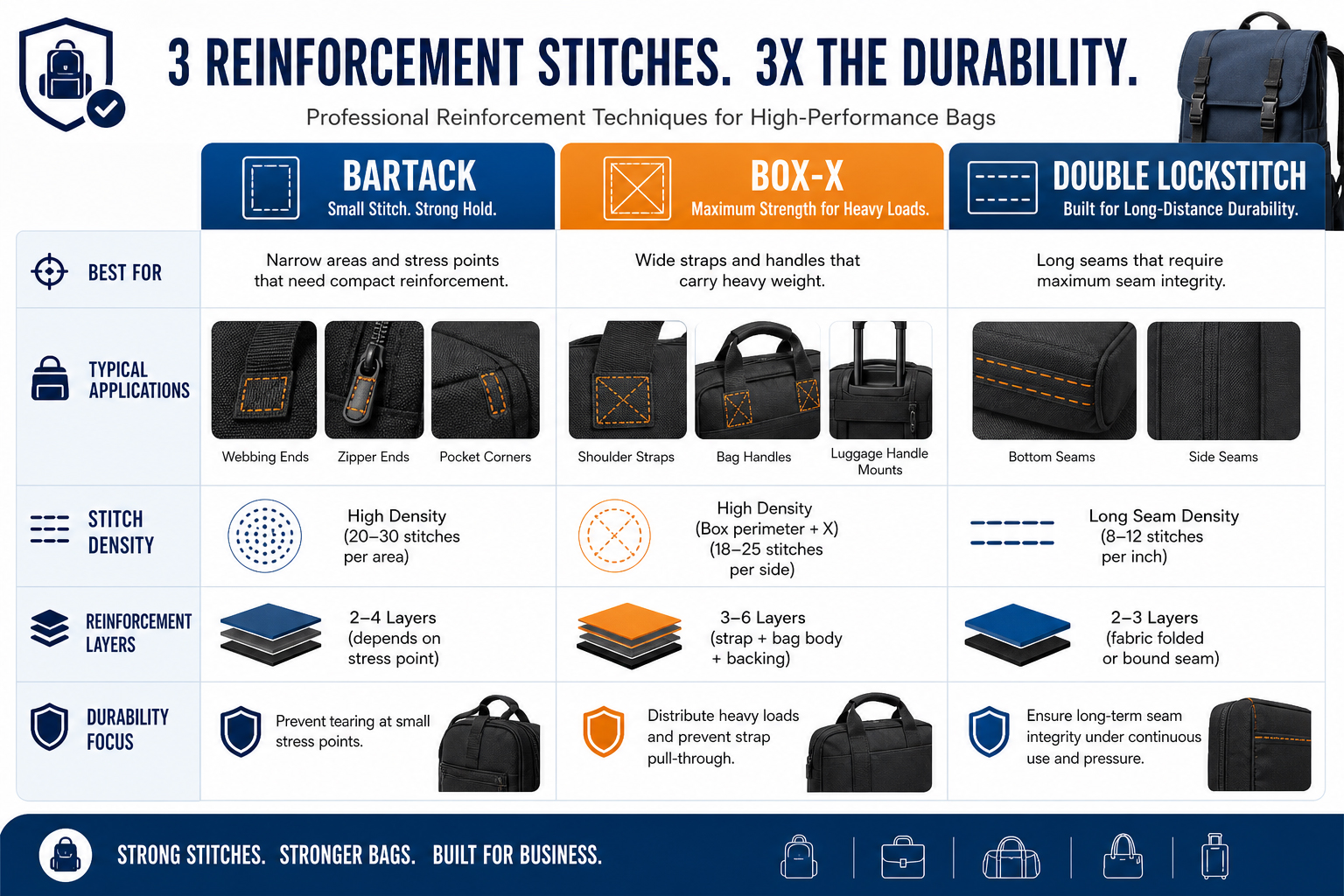
A common technical question from US buyers is whether box-X outperforms standard bartacking at handle and shoulder strap joints. The answer depends on the attachment geometry. Box-X provides superior load distribution for wide handle and strap mounting bases. Standard bartacks are better suited for narrow webbing endpoints. In many high-performance backpack designs, engineers combine both patterns: box-X for the main strap anchor plate, plus bartacks at the extreme ends of the strap webbing. This hybrid design balances wide-area load spread and localized anti-tear protection.
Multi-Row Lockstitch: Double & Triple Row Stitching
Double-row and triple-row lockstitch is the standard reinforcement method for long continuous seams, including bag bottom panels, side seams and strap edge seams. Two parallel lockstitch rows create redundancy: if one stitch line fails, the second line still holds the assembly together. This is called safety stitching in bag manufacturing.
However, more rows are not always better. Over-stitching on lightweight fabrics creates excessive needle holes, which turn into built-in tear lines. Factories must match needle size, thread thickness and stitch spacing to the base material instead of blindly adding extra stitch rows. When side seams connect directly to shoulder straps, add a reinforcement fabric tape or backing patch. This prevents the base fabric from tearing adjacent to the seam line, a frequent hidden failure mode.
Bottom Seam & Corner Reinforcement
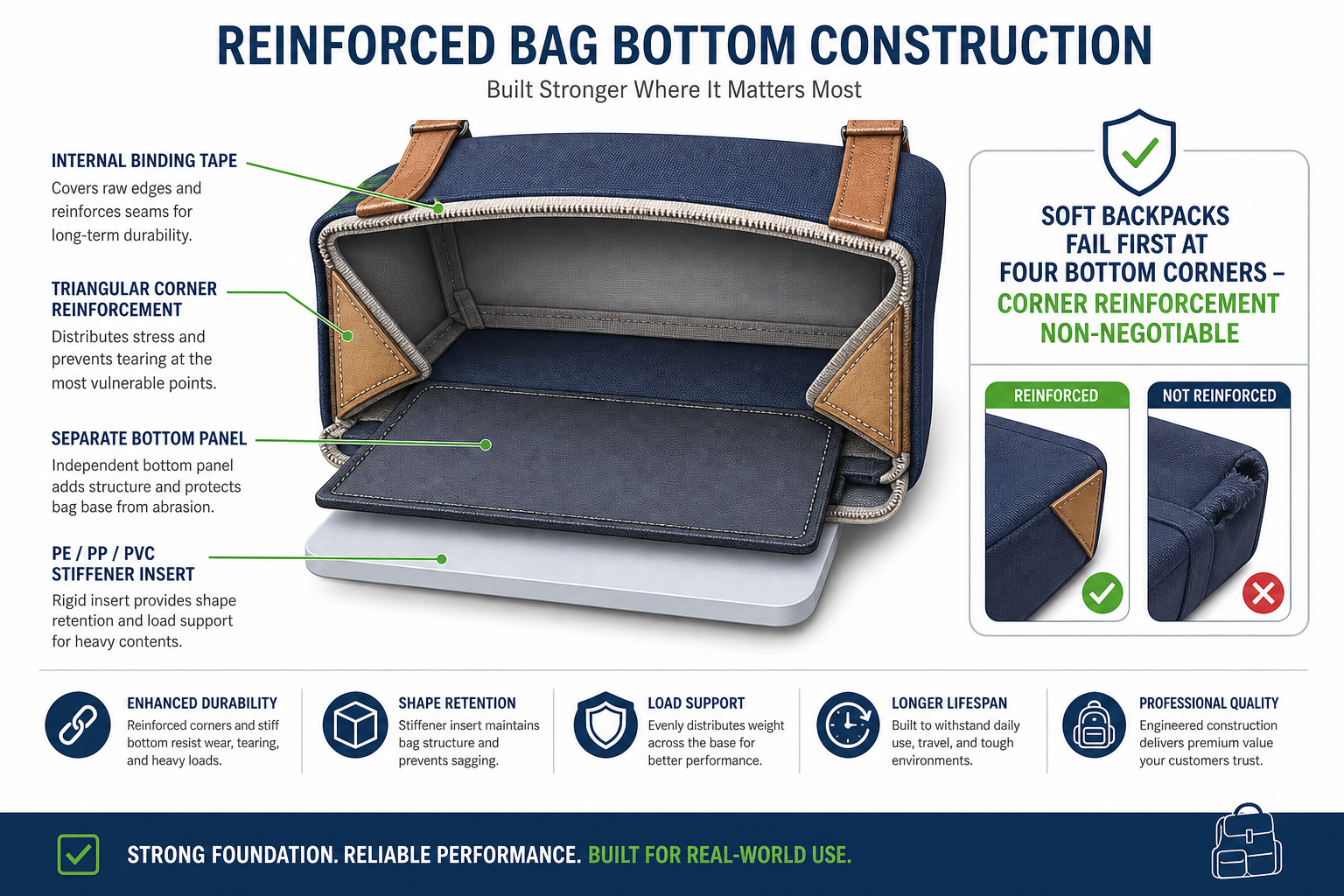
Bag bottom reinforcement cross-section showing separate bottom panel, corner stay patches, binding tape and PE stiffener Image: Cross-section diagram of reinforced bag bottom construction with corner triangular stays, internal binding tape and stiffener insert
The bag bottom faces unique combined stress: constant abrasion, impact when set down, repeated bending and concentrated static weight. A durable bottom assembly cannot rely only on a single seam. Robust construction includes a dedicated separate bottom panel or expanded gusset, double lockstitch seams around the bottom perimeter, triangular reinforcement stays at the four bottom corners, and internal binding tape to control raw edge fraying.
For structured bags, an internal stiffener plate made of PE, PP or PVC can be inserted to maintain shape and spread weight across the panel. Soft-sided backpacks often fail first at the four bottom corners, not the middle of the bottom seam, so corner reinforcement patches are non-negotiable for US retail quality standards. Any webbing loops or tie-down tabs attached to the bottom panel also need bartacks at both ends of their connection points.
Hybrid Reinforcement: Bartack + Rivet Combination
For heavy canvas and leather bags, combining rivets with bartacks delivers the highest available attachment strength. Rivets mechanically clamp fabric and webbing layers together, while bartack stitches stop fabric creep and prevent rivet holes from tearing open over repeated load cycles. Reinforced X-style cross stitching is also popular for leather tote handles, blending decorative visual appeal with structural strength.
Critical Material Rules: Thread, Backing & Webbing
Stitch pattern alone cannot guarantee seam durability. The entire assembly must use matching reinforcement materials. Many low-cost factory samples look well-sewn but fail pull tests because they select incorrect thread or skip backing patches.
Always specify bonded nylon or bonded polyester thread for all high-stress attachment seams. Never accept spun thread or cotton thread for load-bearing points. Bonded thread resists abrasion and keeps twisted filaments locked together, so the thread does not unravel after repeated stress cycles.
* Internal reinforcement components include:
* Internal load-transfer webbing: routes pulling force away from the outer shell fabric.
* Heavy nylon, PVC or Hypalon backing patches: prevent outer fabric tear-out around stitch holes.
* Seam binding tape: covers raw cut edges internally and stops fabric fraying.
Thread tensile strength must be matched to fabric tensile strength. A very high-strength heavy thread paired with thin shell fabric creates a common failure scenario: the thread remains intact, but the fabric rips around the needle perforations. The whole load path must be balanced, not just the stitches.
US Retail Durability Specifications: Bartack Count, Stitch Density & Load Testing
Pull test setup for backpack strap seam, static load test machine pulling strap anchor Image: Lab static pull test machine performing seam strength test on backpack shoulder strap attachment point
US retail buyers must define clear measurable standards for suppliers instead of vague requests like “make it strong.” Two frequently asked questions are bartack quantity and stitch density at strap and handle bases. For US retail backpacks, strap and handle attachment bases commonly use bartack zones with approximately 6–8 stitches per centimeter. The total stitch count inside each bartack zone ranges from 28 to 42 stitches, and this must be verified by pull testing.
Before bulk shipment from China, load testing and pull-strength validation are mandatory for high-stress seams. Visual inspection of stitching is not sufficient. Two types of testing are relevant for US market bags: static load testing and cyclic repeated load testing. Static testing applies a constant hanging weight to the bag or strap assembly. Cyclic testing repeatedly applies and releases load, simulating real-world dynamic movement such as walking, running, lifting and setting the bag down. Cyclic testing is more realistic for backpacks and travel bags, as dynamic shock loads cause more failures than static hanging weight alone.
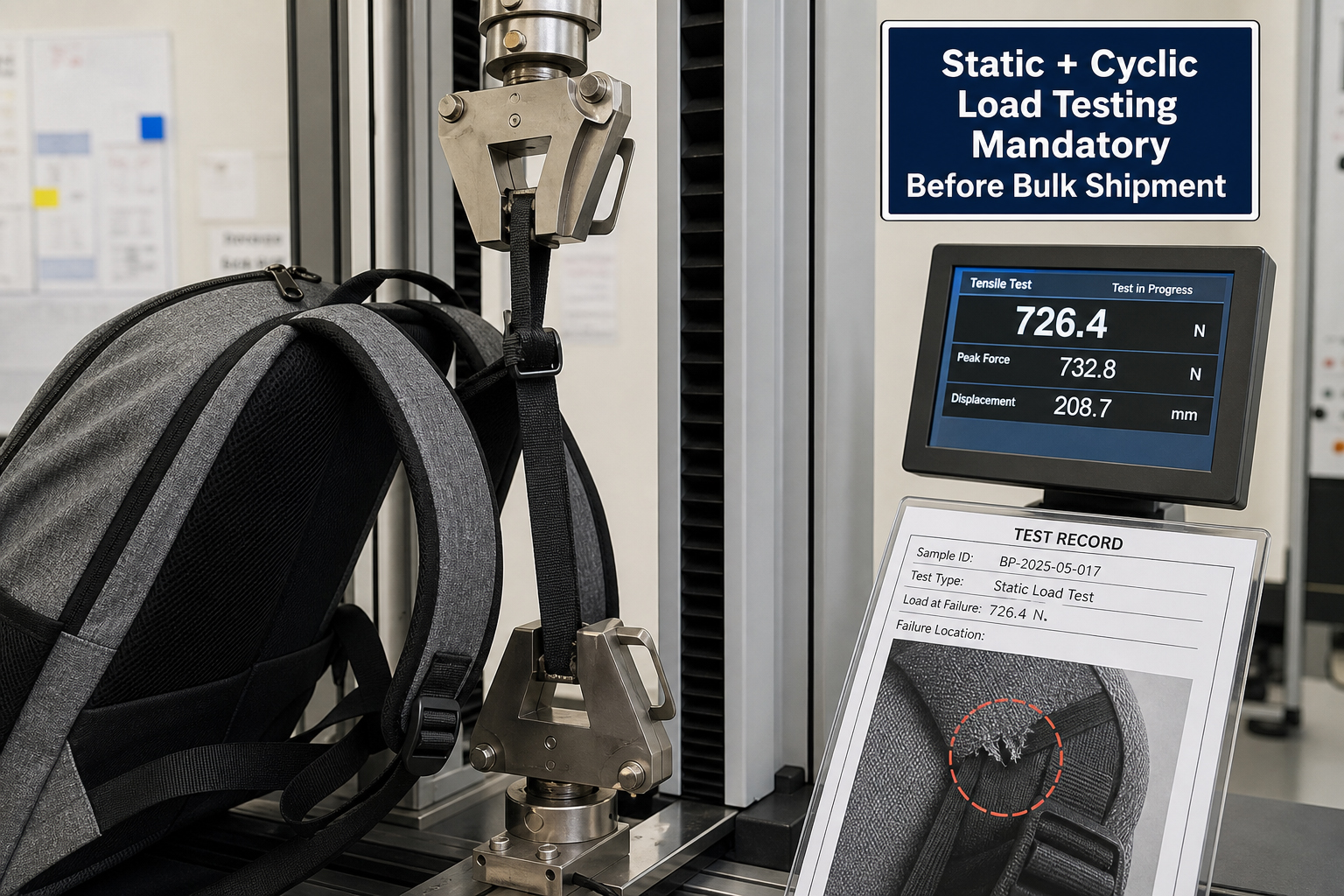
For pre-production samples, perform progressive load testing. Load the bag up to the rated maximum working weight plus a safety margin. Inspect for these failure modes after testing: strap stitch rupture, fabric tear around reinforcement patches, thread breakage, bartack separation, webbing pull-out, seam opening and skipped stitches. Document all test photos and record the exact failure location and breaking load value.
For fashion lightweight bags, visual QC plus moderate static load testing may be adequate. For backpacks, laptop cases and outdoor travel bags, always require written documented static and cyclic test reports from the factory or third-party lab. Confirm the test sample uses identical fabric, webbing, thread, needle size and sewing machine settings planned for mass production. A sample made with upgraded materials will not represent bulk quality.
Production Workflow: Reinforcement During Panel Assembly vs Separate Step
A practical commercial consideration is production cost and workflow. Factories can sew bartacks and box-X reinforcement either during panel assembly, or as a separate dedicated operation after panel cutting and basic sewing.
Adding reinforcement bartacks directly during panel assembly is generally faster and lowers labor cost. The operator sews the reinforcement pattern while assembling the component part before the bag is fully constructed. This workflow reduces handling time and streamlines the production line.
The alternative approach is to run reinforcement stitching as a standalone dedicated production step. This method delivers more consistent precision, especially for complex box-X patterns, because specialized sewing stations can be set up only for reinforcement work. But separate processing increases material handling, labor cost and total production lead time.
The most cost-effective choice depends on your product category, order volume and quality tolerance. For large-volume standard backpacks, integrating reinforcement during panel assembly is usually the better value. For low-volume premium bags requiring highly consistent, clean-looking box-X stitching, a separate dedicated reinforcement station may be justified. US buyers should discuss both options with their Chinese factory partner and select the workflow matching product requirements, balancing cost and quality consistency.
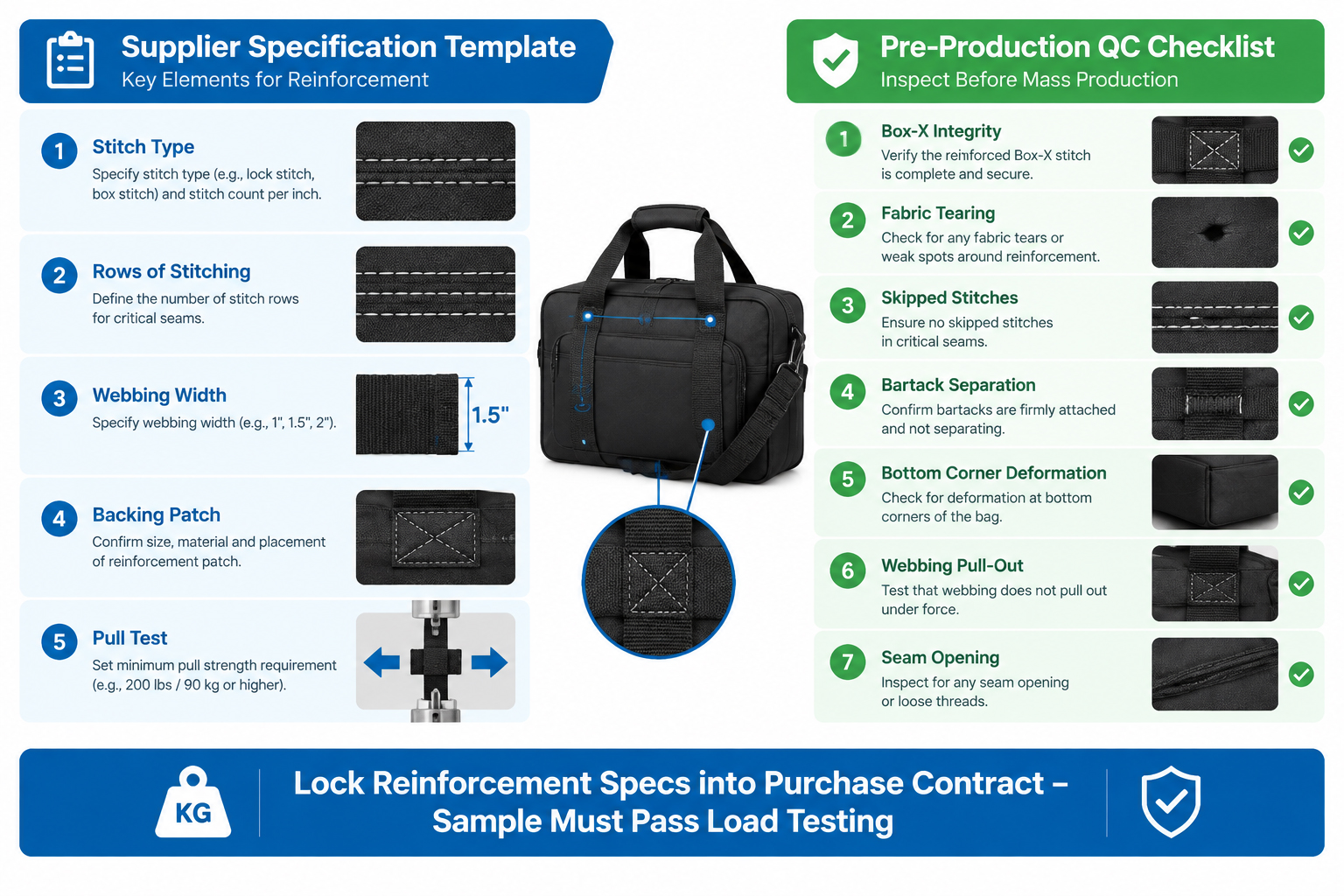
Standard Technical Specification Template to Send to Chinese Bag Suppliers
Use this formal specification paragraph in your tech pack and supplier purchase order:
Please reinforce all load-bearing areas. Use box-X stitching for shoulder-strap and handle attachments, with bar tacks at the strap ends and webbing termination points. Stitch through the webbing, outer shell, and internal reinforcement patch. Use double-row lockstitch construction for the bottom and side seams, reinforced bottom corners, and internal seam binding. Please use bonded nylon or bonded polyester thread suitable for the fabric and provide a finished-sample pull test and seam inspection photos.
Add this checklist for factory confirmation:
* Stitch type: lockstitch, chainstitch, bar tack, or box-X
* Number of stitch rows and stitch length
* Webbing width and raw material specification
* Internal reinforcement patch material and dimensions
* Webbing extension length inside the bag shell
* Pull test load value, test method and failure location documentation
* Confirmation that sample thread, fabric, needle and machine settings match bulk production
Buyer Quality Control Checklist for Pre-Production Samples
Do not approve samples based only on neat surface stitching. Run this QC checklist:
* Inspect shoulder strap anchor box-X and bartack stitch integrity
* Check for fabric tearing around reinforcement backing patches
* Look for broken thread or skipped stitches
* Verify bartack separation risk
* Check bottom corner deformation after load application
* Confirm no webbing pull-out from attachment points
* Inspect seam opening after load cycling
Final Summary
Backpack and bag seam reinforcement is a system, not just decorative stitching. Box-X stitching distributes load widely for shoulder strap and handle anchor points. Dense bartacks protect narrow webbing endpoints, buckle tabs and zipper corners. Double lockstitch seams with triangular corner stays protect bag bottoms, where abrasion and concentrated weight cause frequent failures. Always combine proper stitch patterns with internal backing patches, bonded thread and matched webbing. Validate performance with static pull tests and cyclic load testing before bulk shipment.
When sourcing bags from Chinese manufacturers, clearly define stitch patterns, stitch density, reinforcement layers and test requirements inside your tech pack. Communicate that you need engineered load-bearing construction, not only attractive surface stitching. This technical rigor will reduce defect rates, lower US retail customer returns and build a more reliable bag brand.
Post time: Sep-28-2026