
Bag Construction Guide: Lockstitch vs Chainstitch & Thread Options for US Bag Importers
Published for US online bag retailers sourcing directly from Chinese bag manufacturers
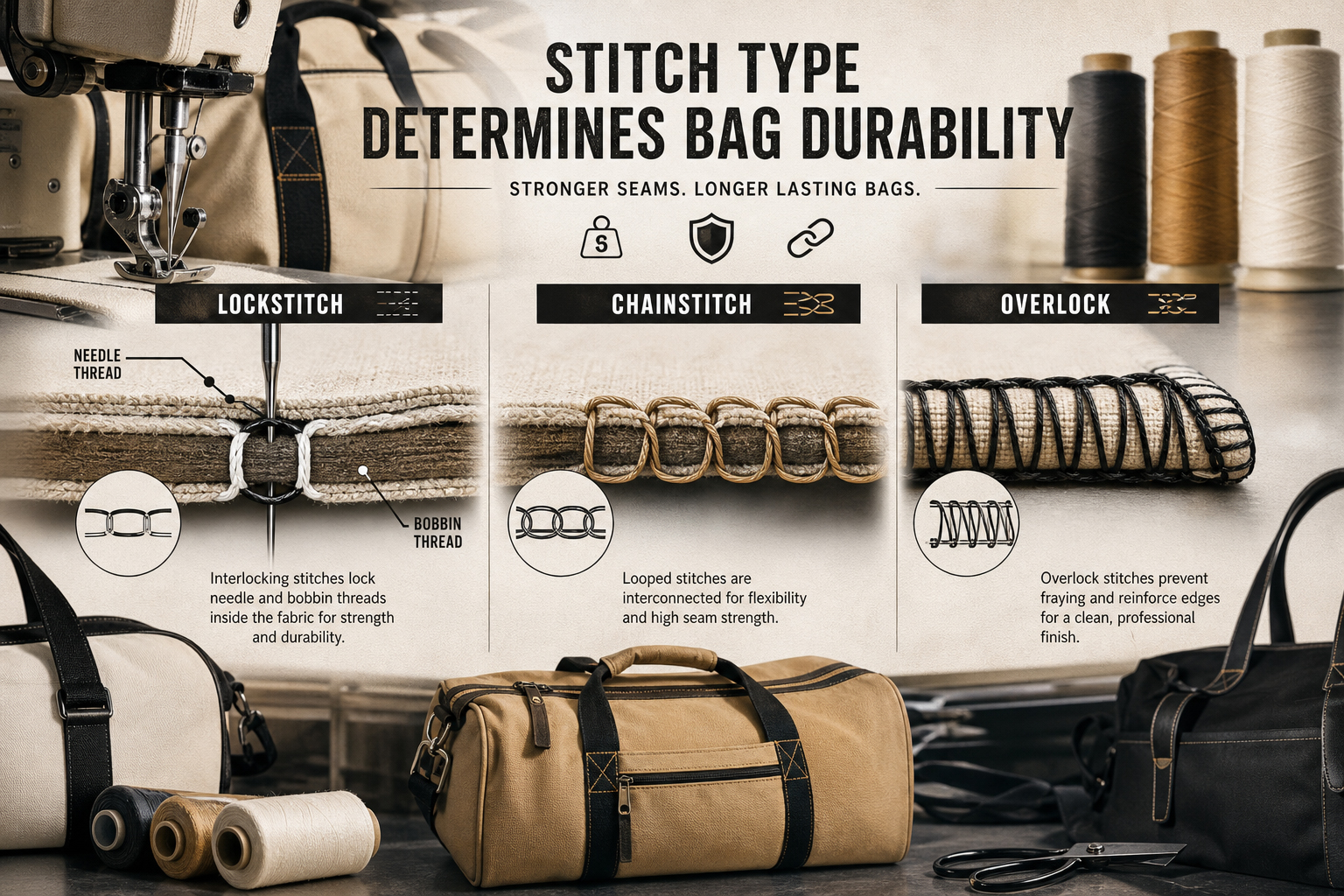
Key takeaway: Stitch type and thread selection are not trivial cosmetic choices. They directly impact tensile strength, defect rates, customer returns, warranty claims, landed cost, and long-term brand reputation for your bag website. Many US bag buyers only compare per-unit FOB pricing without understanding how stitch construction drives hidden costs in retail. This guide breaks down lockstitch, chainstitch, overlock seams, bonded nylon thread, labor cost differences, production speed, and custom specification flexibility when sourcing bulk bags from China.
Introduction
When importing handbags, backpacks, totes, luggage, and utility bags from Chinese factories, most buyers focus heavily on fabric, hardware, color, and MOQ. However, seam construction and thread specification are often the silent failure points for retail bags. Handles tearing, strap seams unraveling, and split stitching are top customer complaints that lead to product returns, negative reviews, and increased warranty expenses for your online store.
US bag sellers often ask Chinese manufacturers these core technical questions:
* How does the per-unit cost of lockstitch construction compare to chainstitch or bonded nylon thread alternatives in Chinese bag factories?
* Which seam construction type delivers the highest tensile strength per linear inch on high-stress bag locations, such as handles and shoulder straps?
* Does per-unit labor cost differ meaningfully between lockstitch, chainstitch, and overlock seams during mass production?
* How much faster can chainstitch sewing machines run compared to lockstitch machines, and does this speed advantage translate to lower factory pricing?
* Can importers request upgraded seam construction and premium thread on selected bags within the same bulk order without raising the full order MOQ?
This article unpacks these questions using real-world Chinese factory costing models, industrial thread consumption data, and practical sourcing advice tailored for US-based bag brands selling on independent websites.
Lockstitch, Chainstitch, and Overlock: Core Stitch Mechanics & Strength Performance
The foundation of all bag seam decisions is tensile strength, especially on load-bearing stress points. For bag handles, strap attachments, backpack shoulder straps, and luggage carry points, seam strength directly determines product durability.
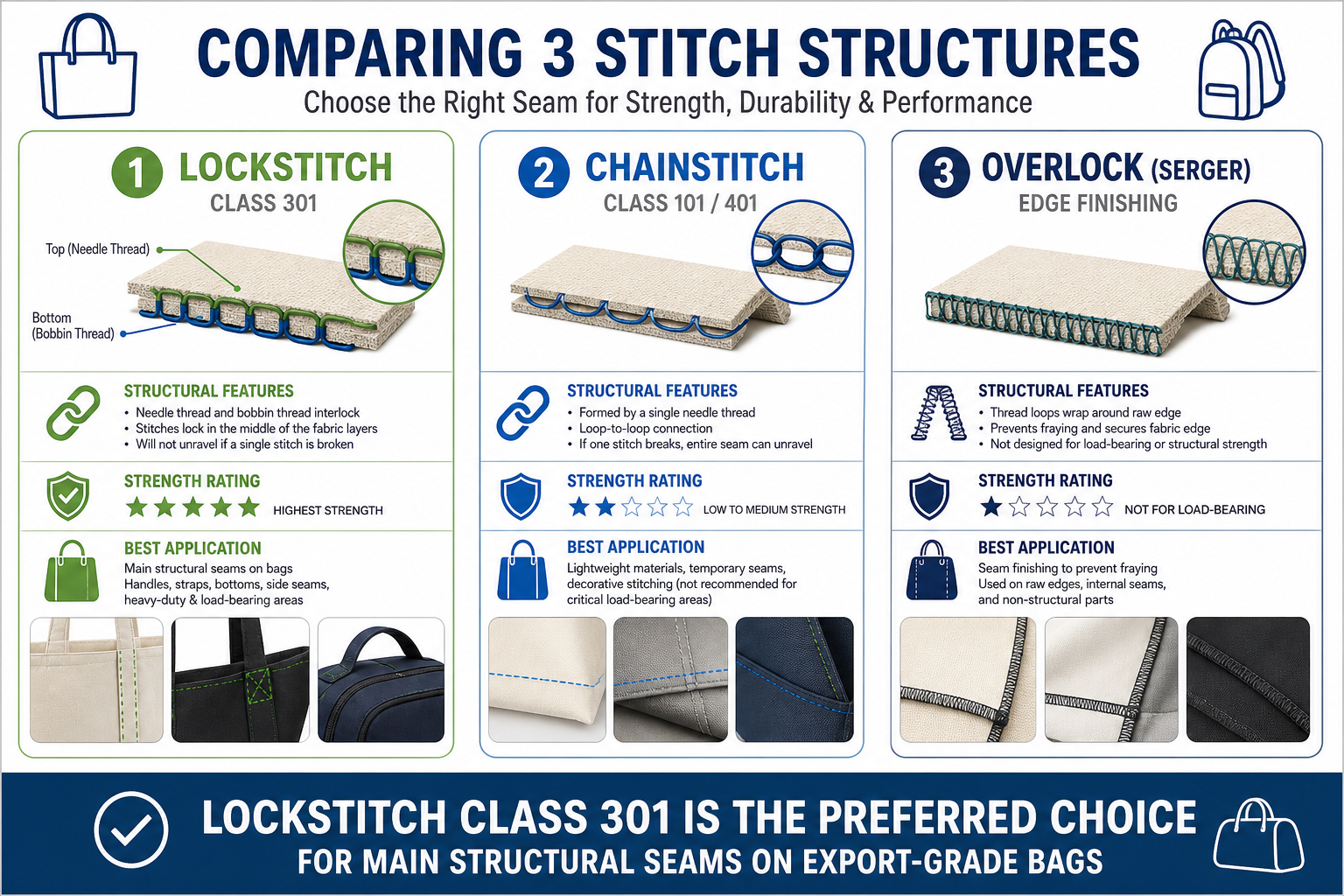
Lockstitch (Class 301) uses two thread systems: a top thread and a bobbin thread that lock together between fabric layers. This creates a stable, non-unraveling seam. If one stitch breaks, the seam will not continue to unravel across the full length. When paired with bonded nylon thread, lockstitch delivers the strongest seam performance. Industry benchmarks show lockstitch with bonded nylon typically achieves 30% to 50% higher tensile strength per linear inch than equivalent chainstitch seams.
Chainstitch includes Class 101 single-thread chainstitch and Class 401 two-thread chainstitch. It forms connected loops rather than locked top and bobbin threads. The major weakness of chainstitch is that a single broken stitch can cause the entire seam to unravel quickly. This flaw makes chainstitch a high-risk option for retail bags sold to US consumers, even though the machine runs faster. While chainstitch can be used for long straight decorative seams, it is rarely selected for main structural panels on export-grade bags.
Overlock seams (serger seams) serve a different purpose: they wrap thread around raw fabric edges to prevent fraying. Overlock is used for seam finishing, not primary load-bearing seams. It is not a direct replacement for lockstitch or chainstitch on handle and strap stress points.
Cost Breakdown: Stitch Type, Thread Material, and Factory Pricing Logic
Many US buyers assume faster sewing machines automatically equal cheaper finished bags. In Chinese bag factories, the full costing model combines labor time, machine amortization, thread consumption, setup cost, rework risk, and quality control overhead. Raw thread material cost is only a small fraction of total sewing expense.
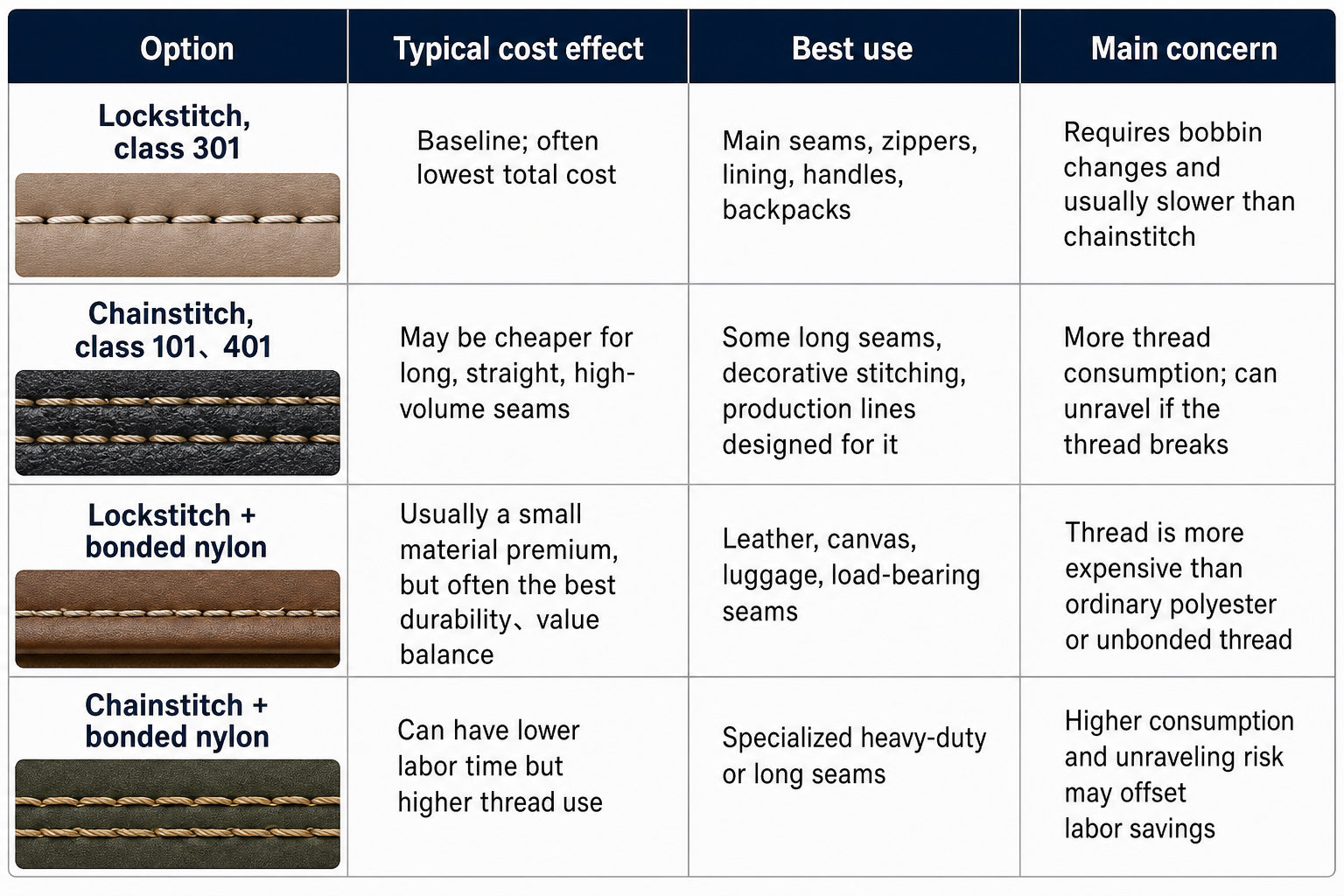
Lockstitch construction generally costs 5% to 15% more per unit than chainstitch in direct sewing labor cost. The premium comes from slower machine operation and periodic bobbin changes required for lockstitch equipment. Chinese factories typically bill lockstitch work by stitch count, while chainstitch is often quoted by linear seam meter, which can create confusion during side-by-side price comparisons. Two-needle lockstitch machines carry higher machine amortization costs, adding a small extra per-unit price increase.
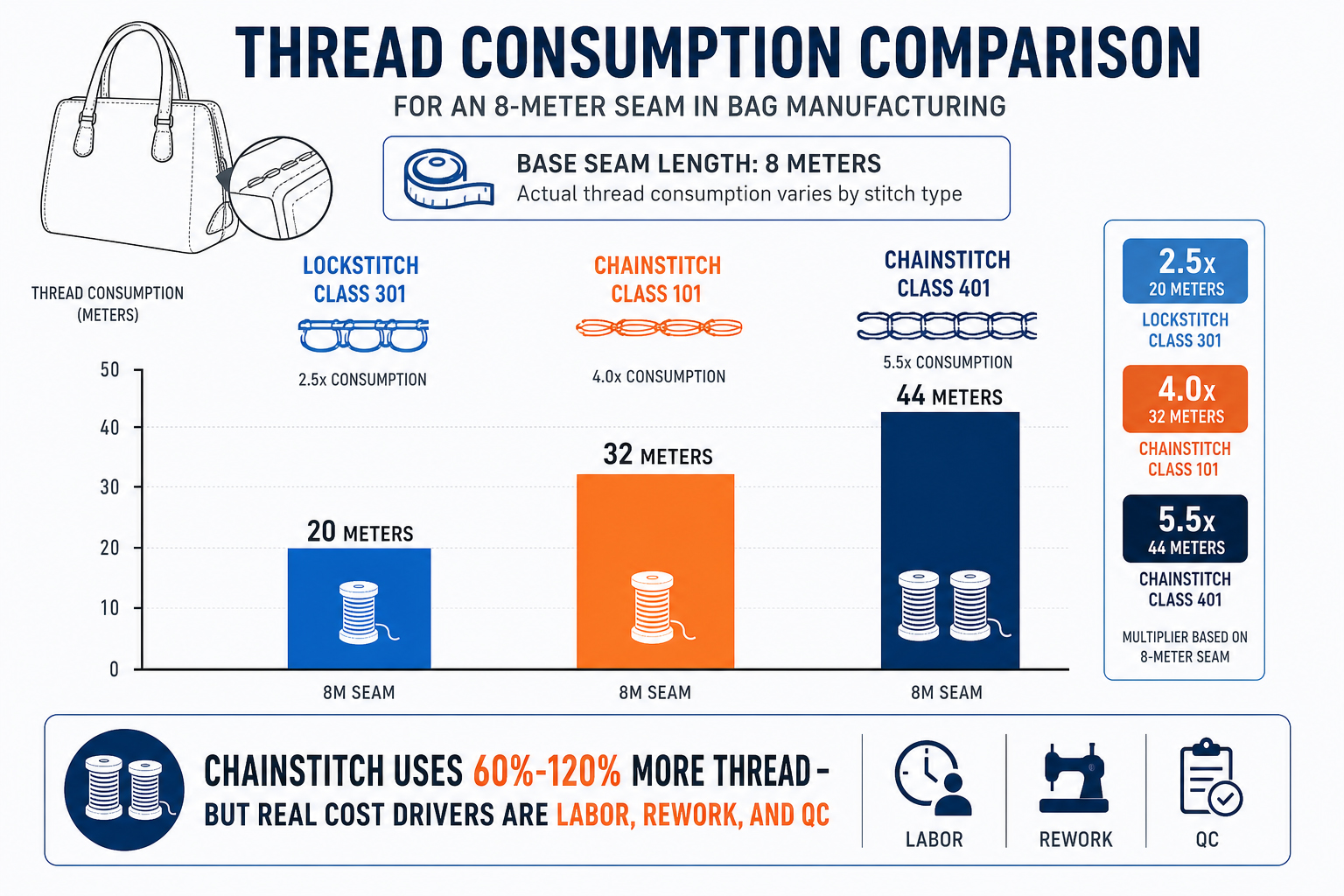
Chainstitch machines operate at higher speeds, which reduces direct labor minutes per seam. However, this labor savings is frequently offset by dramatically higher thread consumption. Coats industrial thread data provides reliable thread consumption ratios:
* Class 301 lockstitch: ~2.5 units of thread per unit of seam length
* Class 101 single-thread chainstitch: ~4.0 units of thread per unit of seam length
* Class 401 two-thread chainstitch: ~5.5 units of thread per unit of seam length
In practical terms, Class 101 chainstitch uses approximately 60% more thread than lockstitch, while Class 401 chainstitch uses about 120% more thread. For a tote bag with 8 meters of total seams:
* Lockstitch thread consumption = 8 × 2.5 = 20 meters
* Chainstitch thread consumption = 8 × 4.0 = 32 meters
Standard industrial polyester thread costs roughly US$1–US$3 per kilogram. Bonded nylon thread carries a material premium of 10% to 20% above standard spun polyester. Bonded polyester is a middle-ground alternative: switching from bonded nylon to bonded polyester for canvas bags can cut thread material cost by 8% to 12% with only minor losses in tensile and abrasion performance when UV resistance and moderate strength meet your product requirements.
Even with these thread consumption differences, the raw thread cost difference per finished bag often equals only fractions of one US cent. The real cost drivers are sewing labor, machine setup, rework, defect rates, and quality inspection. For simple pouches or lightweight totes, switching stitch types may barely change the final FOB price. For complex backpacks and luggage, sewing labor dominates total production cost. Chinese bag factory labor estimates typically fall between US$0.80–US$2.50 per unit, calculated using the standard apparel labor formula:
Labor cost per unit = (sewing minutes ÷ 60) × hourly labor rate ÷ production efficiency
Total cost savings gained by switching to chainstitch are usually erased by higher defect rates, returns, and warranty claims in retail markets. For this reason, lockstitch Class 301 remains the lowest total cost and most widely adopted stitch type for general bag seams in export production.
Labor Cost Differences Between Lockstitch, Chainstitch and Overlock in Mass Production
Unit labor cost varies noticeably between stitch types during mass bag production in China, but the gap depends heavily on factory equipment setup and worker proficiency.
Chainstitch machines run faster, cutting down sewing minutes for long continuous seams. However, not every factory maintains a full fleet of chainstitch machines. Switching production lines between lockstitch and chainstitch requires machine setup, operator training checks, and quality calibration. These setup charges can erase labor savings for small or mixed orders.
Lockstitch is the universal workhorse. Nearly all Chinese bag factories have abundant lockstitch machines and experienced operators. Setup time is minimal, rework rates are predictable, and quality control teams are familiar with lockstitch seam inspection standards.
Overlock seams are a separate process. Overlock labor cost is generally low because serger machines process edge finishing quickly. Still, overlock cannot replace structural lockstitch seams for carrying load. Overlock is used alongside lockstitch to finish raw fabric edges and prevent fraying.
When evaluating labor pricing, do not compare stitch options in isolation. Labor cost per bag depends on total seam length, stitch density (stitches per inch / SPI), fabric thickness, operator speed, and whether the factory already owns the required machinery. A factory with idle chainstitch equipment may quote a more competitive price than a factory that must reconfigure its entire production line.
Production Speed: Chainstitch Machine Speed vs Lockstitch and Impact on Factory Quotation
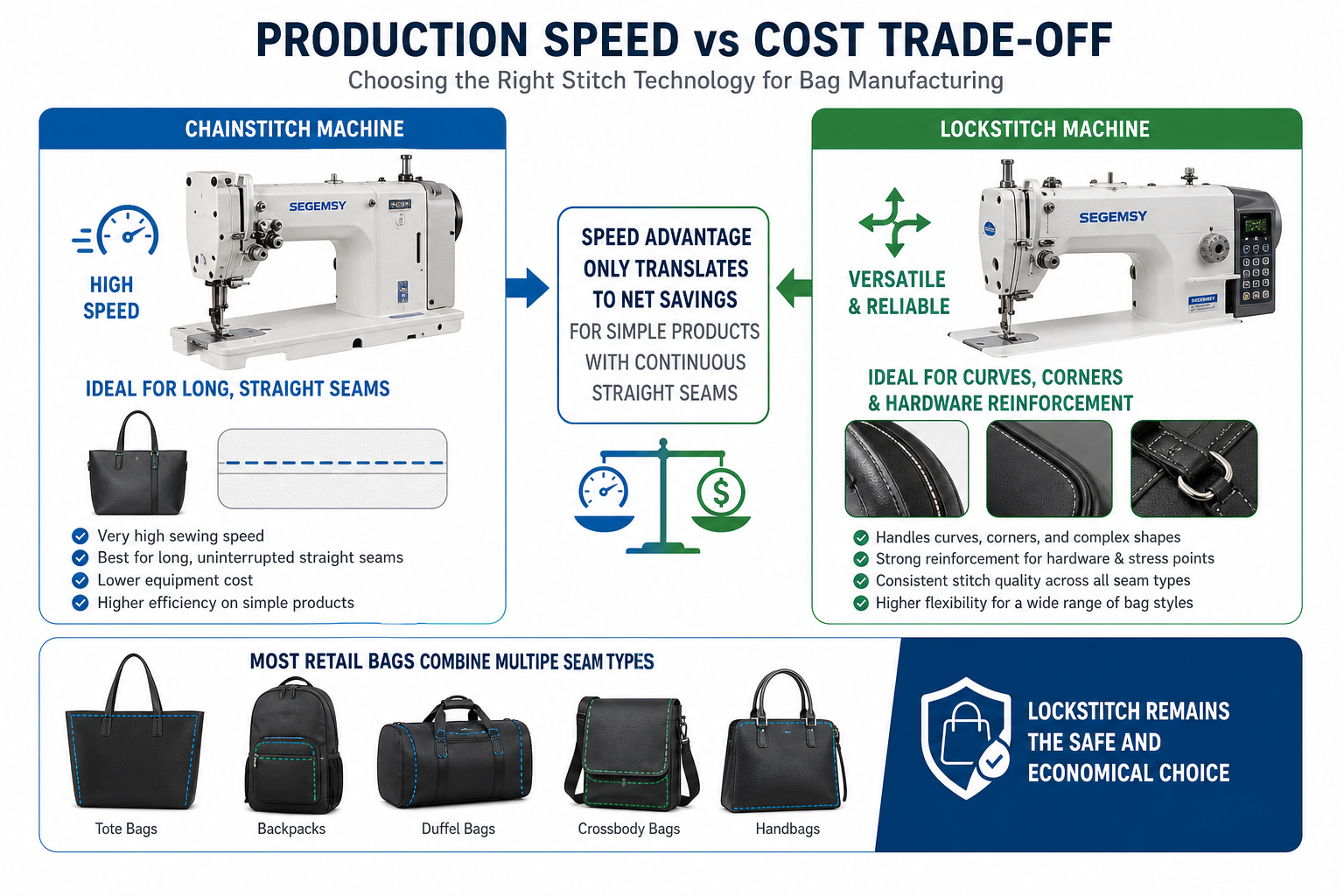
Chainstitch sewing machines operate at higher maximum speeds than lockstitch machines. This reduces the theoretical cycle time for long straight seams. However, this speed advantage does not automatically translate to a lower FOB price for your finished bags.
Several factors limit the real-world benefit of higher chainstitch speed:
* Chainstitch needs much higher thread feed rates, increasing thread consumption and material cost.
* Chainstitch quality requires tighter inspection, because a single broken stitch creates a defective seam.
* Chainstitch is unsuitable for curved seams, tight corners, hardware attachment points, handle bartacks, and box-X reinforcements.
* Most bags combine many different seam types. Even if long straight seams use chainstitch, handles, straps and hardware mounts still need lockstitch reinforcement.
For these reasons, chainstitch’s speed advantage only delivers net savings for simple products with continuous straight seams. For most retail bags sold on US independent websites, lockstitch remains the safer, more economical overall selection.
Mixing Specifications Within One Bulk Order: Upgraded Seams and Thread Without Higher MOQ
A common question for US bag importers is whether partial specification upgrades are allowed inside a single bulk order. The answer is yes, in most Chinese bag factories. You can request upgraded seam construction and premium thread on selected bags within the same bulk order without raising the full order MOQ.
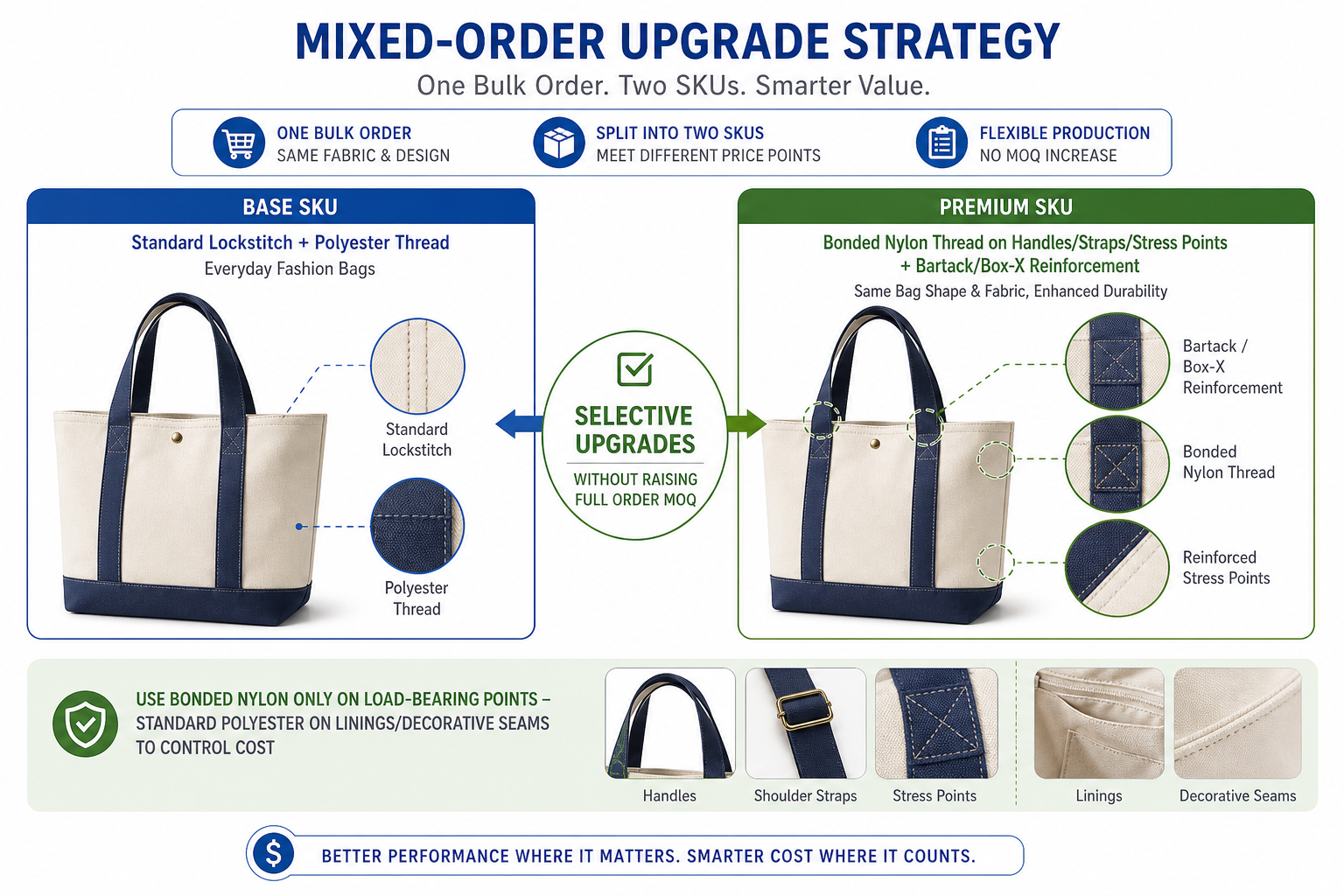
This is a powerful sourcing strategy for online bag brands. You can split one container order into two product variants:
* Base SKU: Standard lockstitch with polyester thread for everyday fashion bags
* Premium SKU: Same bag shape and fabric, with bonded nylon thread on handles, straps and stress points plus bartack or box-X reinforcement stitching
Factory support for mixed specifications depends on a few practical conditions:
* The factory must separate production batches, with clear marking to avoid mixing standard and upgraded units.
* There will usually be a small extra setup surcharge for switching thread spools and stitch settings during production.
* You must clearly define exactly which seams receive upgraded thread or reinforcement in your technical pack.
* Inspection checkpoints need separate QC standards for the two variants.
You do not need to use bonded nylon thread across every seam of the bag. Most factories can apply bonded nylon selectively only on load-bearing stress points. This method controls material cost while protecting the highest-risk areas of the product. Bonded nylon offers excellent abrasion resistance and is widely used for handbags, luggage, canvas bags, outdoor gear, and upholstery. Using standard polyester thread on non-load-bearing lining and decorative seams keeps total unit cost down.
Practical Sourcing Checklist & Quotation Template for Chinese Bag Factories
When requesting quotations from your Chinese bag manufacturer, avoid vague requests. Always ask for side-by-side quotes using identical fabric, hardware, seam length, stitch density, and reinforcement details. If specifications change quietly between quotes, price comparisons become meaningless.
Use this formal request message when contacting factories:
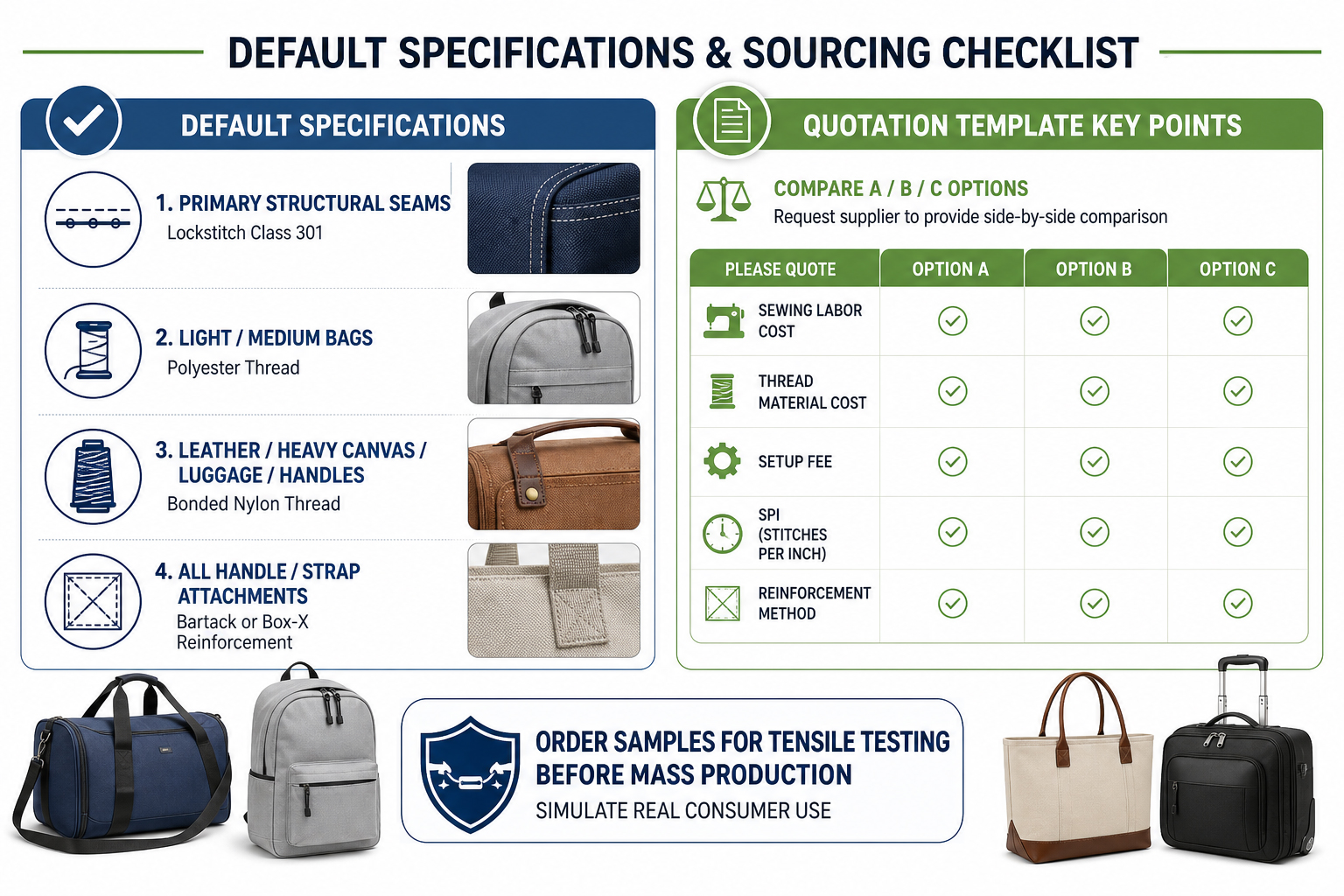
Please quote the same bag using: A. Lockstitch 301 with standard polyester thread; B. Lockstitch 301 with bonded nylon thread; C. Chainstitch 401 with your recommended thread. Please show the sewing labor cost, thread/material cost, machine or setup surcharge, estimated sewing minutes per bag, stitch density/SPI, and whether handles and stress points include bartack or box-X reinforcement. Please also confirm whether the price is FOB and whether the quotation includes sampling, inspection, packaging, and any MOQ surcharge.
For most fashion and utility bags sold on US independent websites, use this default specification:
* Primary structural seams: Lockstitch Class 301
* Light and medium-duty bags: Polyester thread
* Leather, heavy canvas, luggage, straps and handles: Bonded nylon thread
* All handle and strap attachment points: Bartack or box-X reinforcement stitching
Before approving mass production, order samples for tensile strength testing. Compare samples physically, test seam pull strength, and simulate repeated stress to mimic real consumer use. This step catches construction weaknesses before large-batch production begins.
Conclusion
For US bag sellers sourcing from China, stitch and thread selection balances upfront FOB cost, seam tensile strength, defect risk, and long-term retail returns. Chainstitch machines run faster, but higher thread consumption and unraveling risk usually negate labor savings for retail bags. Lockstitch Class 301 is the reliable baseline for most bag construction. Bonded nylon thread adds a modest material premium but drastically improves durability on handles and straps.
You can selectively upgrade seams and thread for part of your bulk order without increasing the overall MOQ. By separating load-bearing stress points from decorative and lining seams, you control production cost while maintaining product quality that satisfies US online customers. Always request fully broken-down factory quotes that separate labor, thread, setup, and reinforcement charges, and compare samples under identical testing conditions. The extra work in specification management reduces customer complaints, protects your brand reputation on your bag website, and delivers better total cost of ownership for your imported bag inventory.
Post time: Sep-21-2026