
Bag Customization Guide for US Brand Owners: Compare Silk Screen, Heat Transfer, Sublimation, Embroidery, Debossing & Metal Nameplates
Published for US bag e-commerce brands sourcing directly from Chinese bag manufacturers
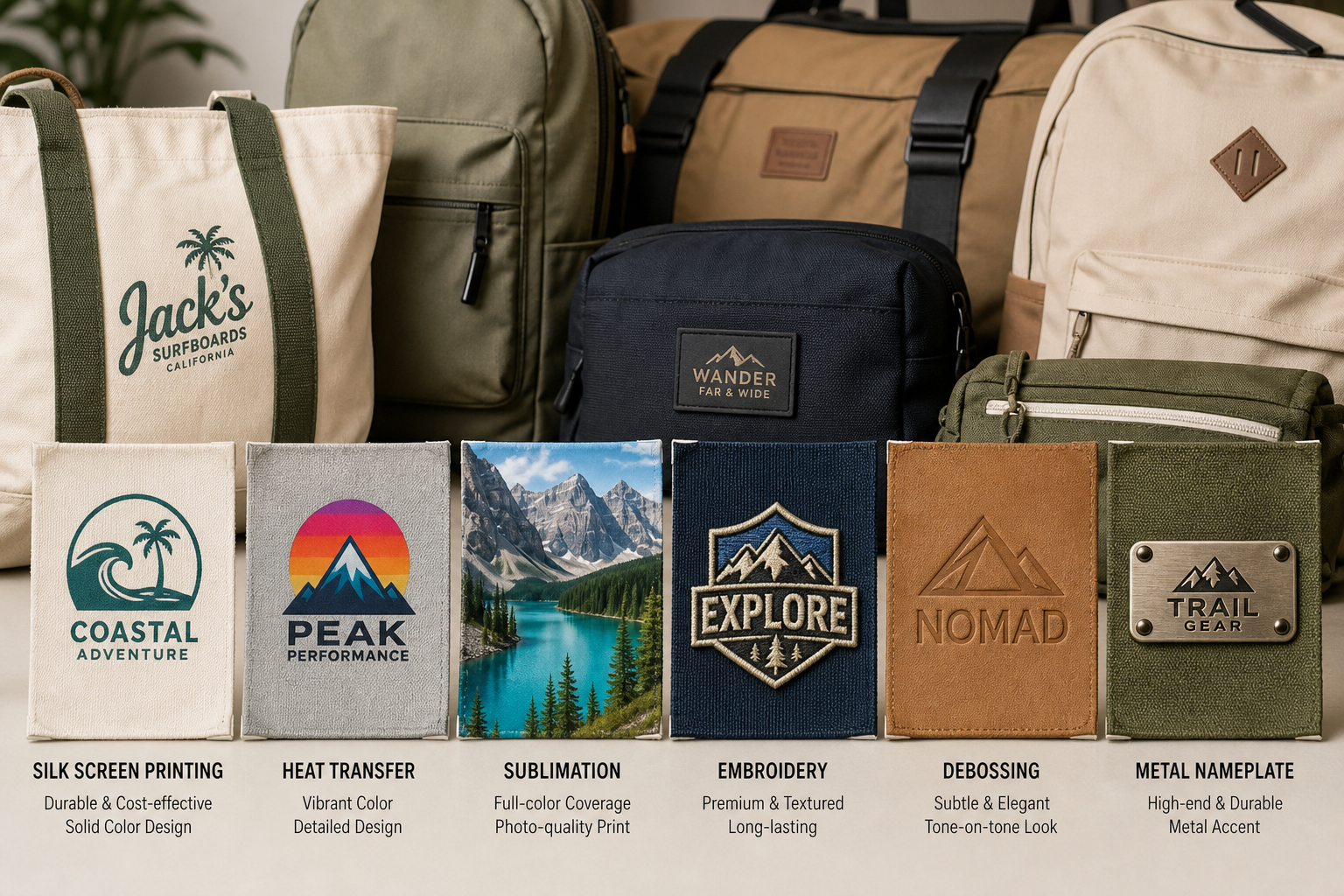
If you run an American bag brand and sell bags on your independent website, sourcing custom bags directly from Chinese factories is one of the most effective ways to control product cost, expand your product lineup, and build unique brand identity. When negotiating with Chinese bag suppliers, logo customization is always one of the core topics you need to clarify. Different decoration methods bring completely different textures, durability, unit costs, minimum order quantities, upfront setup charges, and scalability for your order sizes.
Many US bag buyers get confused when comparing quotes from multiple Chinese manufacturers. Factories may bundle plate-making fees, mold charges, digitizing fees or sample costs into the unit price, or list them separately. Without clear benchmark knowledge about each logo technique, it is easy to underestimate your total landed cost, select a decoration method unsuitable for your bag material, or lock in high upfront costs for small trial orders.
This guide breaks down six mainstream bag customization options widely used by Chinese bag factories: silk screen printing, heat transfer, sublimation, embroidery, debossing, and metal nameplates. We will compare per-unit decoration cost, typical MOQ, one-time setup and tooling fees, price fluctuation across different order volumes, and how logo size, color count and design complexity affect your final cost. You can use this article as a reference when communicating with suppliers, calculating your product budget, and selecting branding solutions for different bag lines.
Overview of Cost Structure for Bag Logo Customization
Before diving into each customization method, it is critical to understand one core principle: decoration cost has two components: recurring per-unit cost and one-time fixed setup fees. Many new importers only focus on the quoted per-bag decoration price and ignore one-time artwork, screen, mold or digitizing charges. This mistake leads to inaccurate budget estimates, especially for small and trial orders.
The formula to calculate your effective decoration cost for each bag is:
Effective cost per bag = Decoration unit price + (Total one-time setup & tooling fees ÷ Total order quantity)
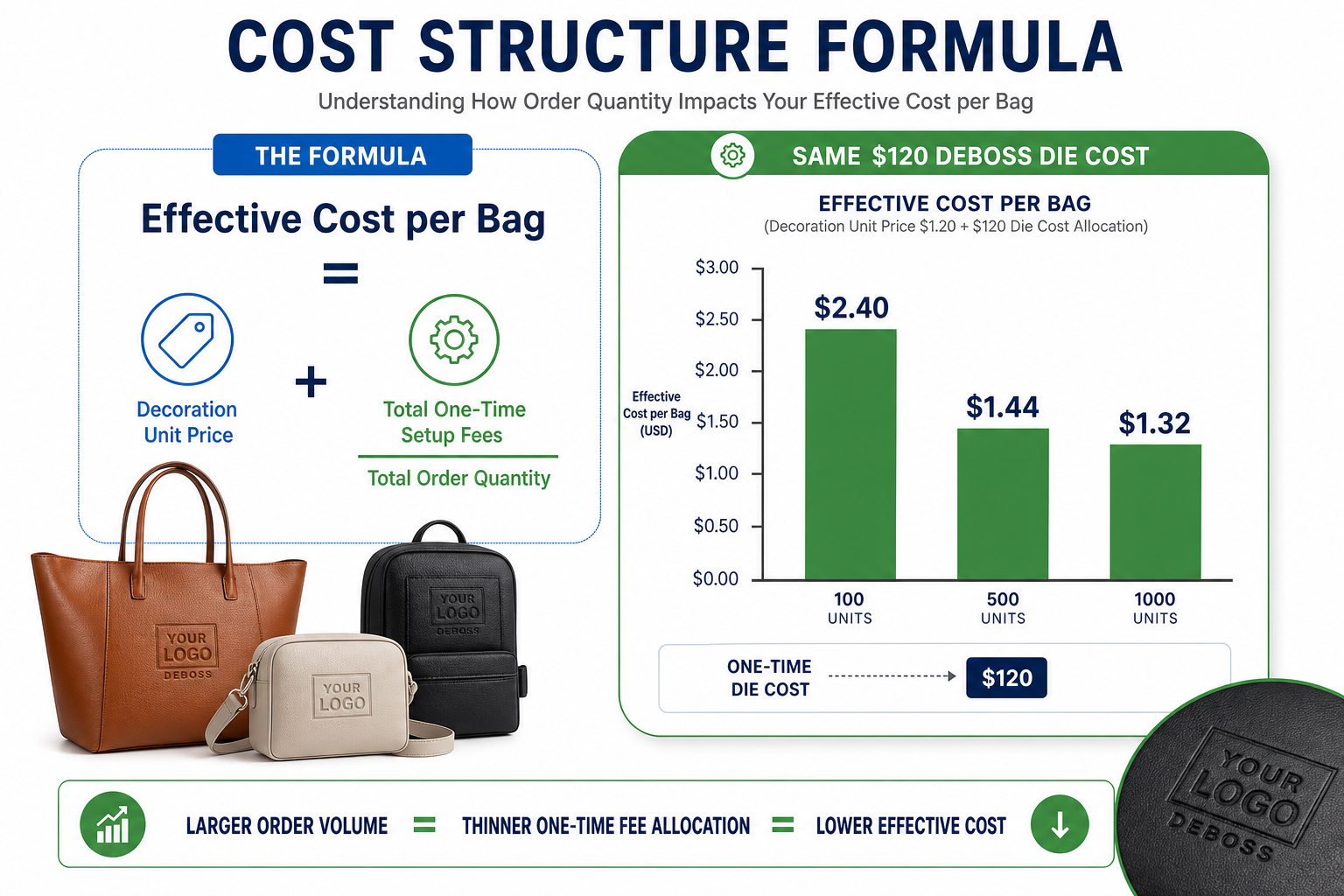
One-time fixed costs are spread across all units you order. As your order volume increases, the one-time charge allocated to each bag drops sharply. This explains why debossing and metal nameplates look very expensive for small orders but become much more competitive when you reach 500 to 1,000 units. When you request quotes from Chinese manufacturers, always ask suppliers to separate per-unit decoration price and one-time setup fees instead of accepting a combined lump price.
Another key point: all decoration costs listed in this guide are decoration premium only, not the full finished bag price. Base bag cost depends on material, construction, hardware and bag size. Logo customization is an added expense on top of the blank bag cost. Actual final quotes will vary based on factory location, bag material, logo placement, logo dimensions, artwork complexity, and quality standards for US market.
Cost, MOQ and Application Breakdown for Each Customization Method
1. Silk Screen Printing
Silk screen printing is the most widely used and budget-friendly decoration method for large production runs on canvas, cotton, jute and polypropylene bags. For US brands selling canvas totes, cotton shopping bags and simple promotional bags, silk screen is often the first choice for simple logos with 1 to 3 solid colors.
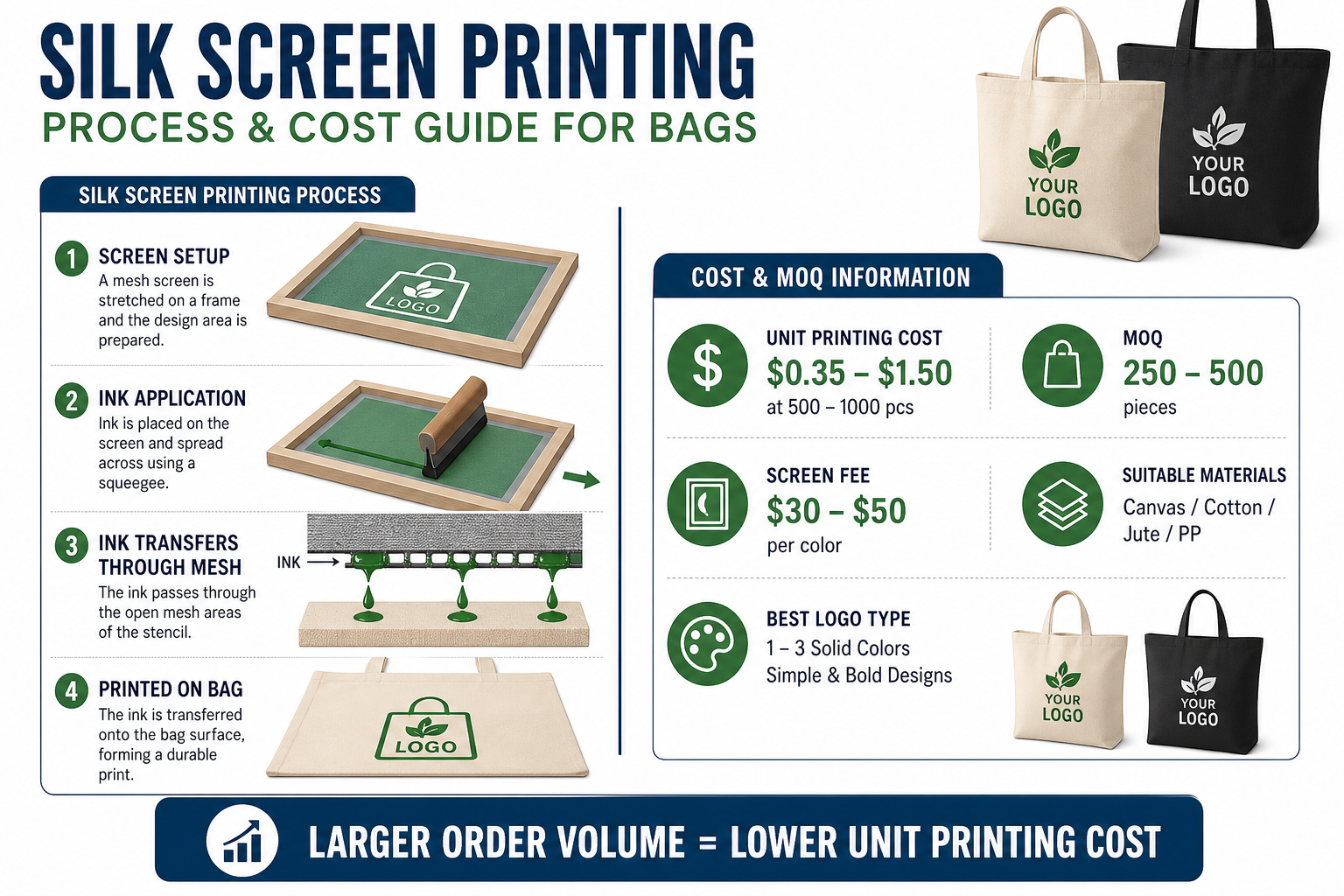
Typical per-unit decoration cost (USD): $0.35–$1.50 at 500–1,000 units. For orders of 500 pieces, simple one-color silk screen can drop to $0.35–$0.70 per bag.
MOQ from Chinese bag factories: Most factories set standard MOQ at 250–500 pieces for silk screen printing. Some flexible manufacturers accept small trial orders of 100–200 units, but the per-unit printing cost and screen setup amortized cost will rise significantly. Fabric type also impacts MOQ; woven fabric bags usually follow the 500-piece MOQ rule, while genuine leather bags may have MOQ as low as 150 pieces.
Setup & plate-making charges: Silk screen requires screen making for every color in your logo. Standard screen setup cost ranges from $30–$50 per color or per screen. If your logo has two colors, you need two screens and corresponding screen fees. Most suppliers charge screen fees as one-time artwork costs. Some factories will waive screen fees once your order quantity hits a certain threshold, so you need to confirm this clause during quotation.
Price change with order volume: The unit decoration cost of silk screen falls steadily as quantity rises. The one-time screen cost is spread over more units. Silk screen reaches its best cost efficiency starting from 200–500 units. For orders of 5,000 and 10,000 pieces, the per-unit printing cost will drop to the lower end of the price range, making it the most economical option for mass production.
Logo factor impact: Logo size, color count and registration requirement strongly affect the final price. More colors mean more screens and higher setup fees. Larger logo size consumes more ink and increases unit cost. Complex alignment and multi-color registration also raise production difficulty and pricing. Silk screen performs best for simple solid-color logos; it cannot produce smooth gradients or photo-realistic patterns.
Best fit: Simple 1–3 color logos on canvas, cotton, jute or polypropylene bags for promotional products and everyday tote bags.
2. Heat Transfer
Heat transfer (including DTF heat transfer) is a flexible logo decoration solution ideal for small-to-medium batch orders. It works well on nylon, polyester, canvas and finished bags, which means you can add heat transfer logos after bag production is completed. This advantage gives you greater flexibility for product iteration.
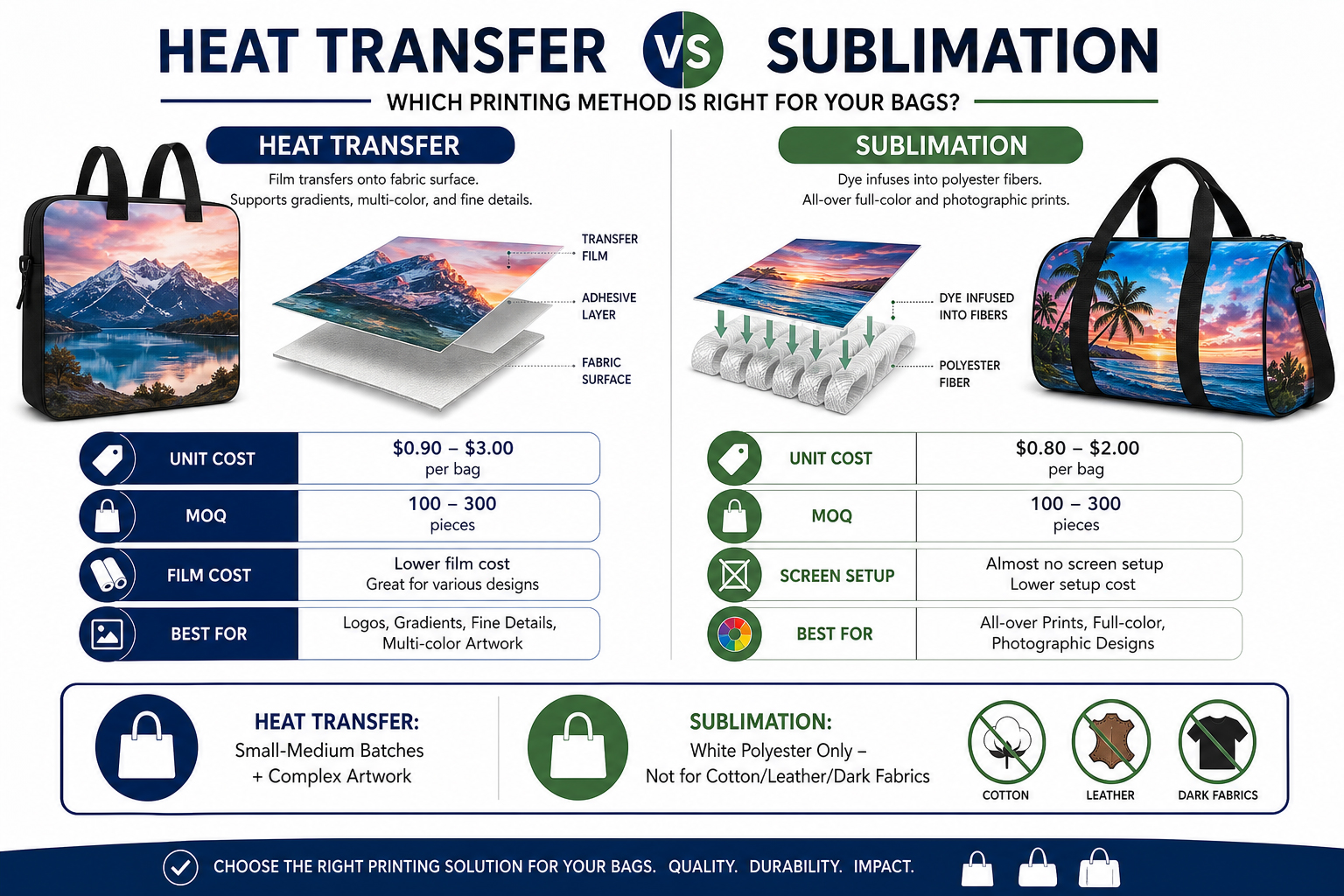
Typical per-unit decoration cost (USD): $0.90–$3.00 at 500–1,000 units. For standard DTF heat transfer, common pricing falls between $0.90–$1.80 per bag.
MOQ from Chinese bag factories: Heat transfer has lower MOQ barriers compared with silk screen. Many suppliers accept orders starting at 100–300 units. The MOQ of blank bags still follows fabric rules: most fabric bags have standard MOQ at 500 pieces, leather series can start at 150 pieces.
Setup & plate-making charges: Heat transfer usually charges film and artwork preparation fees. The one-time film cost is generally lower than silk screen screen fees for small orders. No physical screen mold is required for multi-color gradient patterns.
Price change with order volume: Heat transfer is competitive for small and medium orders. However, its cost advantage weakens for high-volume production. When your order reaches 5,000 or 10,000 units, silk screen printing will usually become cheaper per unit than heat transfer.
Logo factor impact: Logo size, pattern detail and printing positions directly affect pricing. Larger logos need bigger heat transfer film. Multiple printing positions on one single bag will add extra pressing labor and film cost. Heat transfer supports gradients, tiny details and multi-color artwork that silk screen cannot achieve.
Best fit: Low-to-medium quantity runs, logos with gradients, fine details and multi-color artwork, nylon and polyester backpacks.
3. Sublimation
Sublimation printing infuses dye into polyester fabric, creating permanent, full-color patterns that will not peel or crack. It is the preferred technique for all-over printed bags and photo-style artwork. The biggest limitation of sublimation is fabric compatibility: it only works on polyester material, preferably white polyester base fabric. It cannot work on cotton, leather or dark natural fiber bags.
Typical per-unit decoration cost (USD): $0.80–$2.00 at 500–1,000 units. Many standard orders fall within $0.80–$1.60 per bag.
MOQ from Chinese bag factories: Sublimation has flexible MOQ. Since there is almost no heavy setup cost for artwork, many factories accept small trial orders of 100–300 units for sublimation decoration. Blank polyester bags still commonly require MOQ of 500 pieces.
Setup & plate-making charges: Sublimation has almost no screen or mold setup fees. The main cost driver comes from fabric material, print coverage area and cutting & sewing complexity for full-print bags.
Price change with order volume: Sublimation has relatively stable unit cost curve. The lack of large one-time setup fees makes it the most economical choice for low-MOQ sample runs and trial orders. When scaling up to 5,000 or 10,000 units, unit cost can decrease moderately, but the drop is not as dramatic as silk screen printing.
Logo factor impact: Print coverage and full-color complexity are the major cost drivers. Full all-over sublimation across the whole bag costs much more than a small logo on one corner. Photo-rich, high-detail artwork also increases production time and cost.
Best fit: Full-color graphics, photographic prints, all-over printing designs on white polyester bags. Not suitable for cotton, leather and dark natural fiber bags.
4. Embroidery
Embroidery creates raised, textured premium logos by stitching threads onto bag surfaces. It delivers excellent durability and luxury tactile feeling, widely used on high-end backpacks, fashion canvas bags and caps. Embroidery usually has 3 to 5 times higher unit cost compared with silk screen printing.
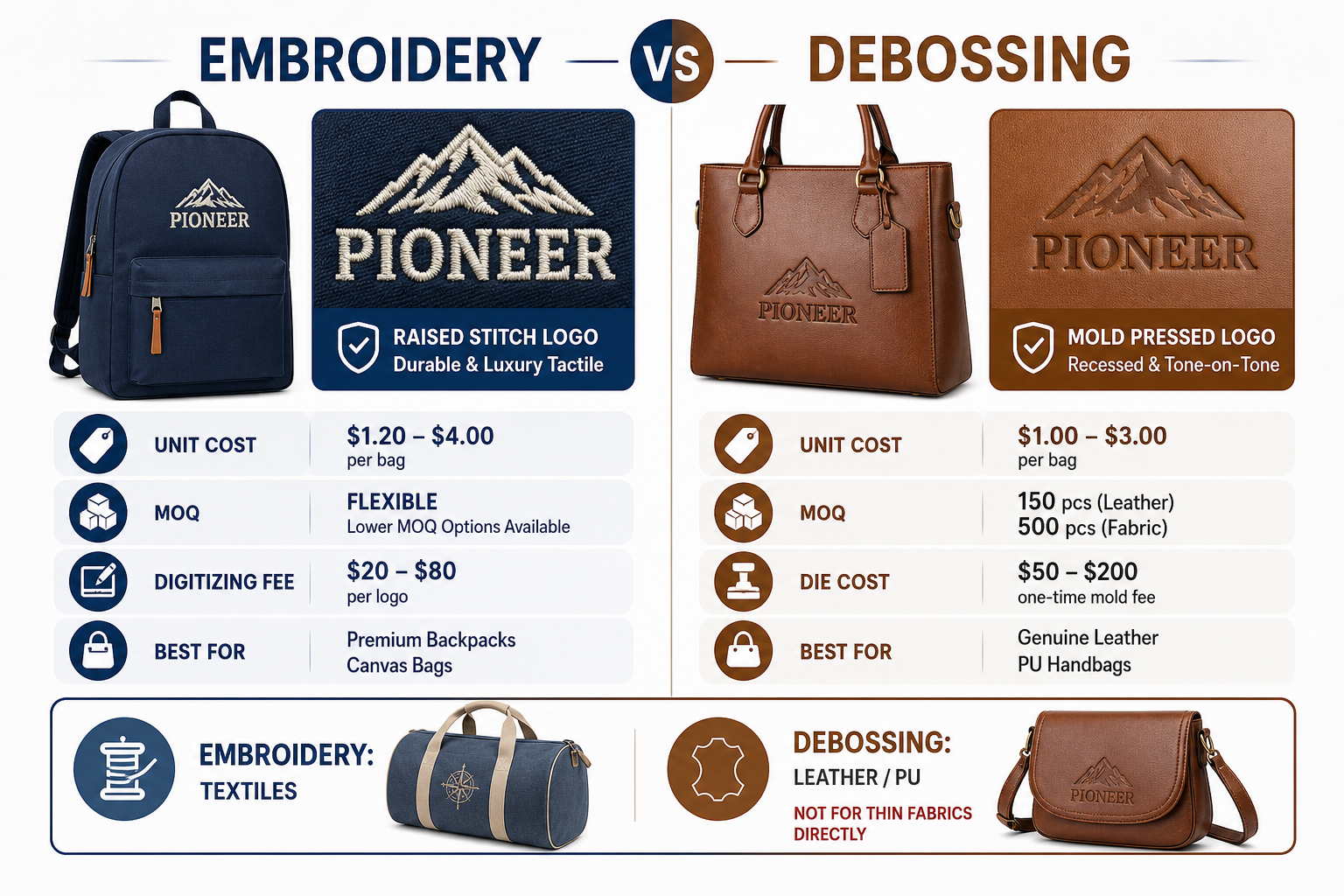
Typical per-unit decoration cost (USD): $1.20–$4.00 at 500–1,000 units. Common market range is $1.20–$2.80 per bag.
MOQ from Chinese bag factories: Embroidery decoration MOQ is flexible. Factories can process small embroidery batches, but blank bag MOQ still follows material rules: most fabric bags at 500 pieces, genuine leather bags can start from 150 units.
Setup & plate-making charges: The main one-time charge for embroidery is logo digitizing fee. Factories convert your vector artwork into stitch machine files. Digitizing cost normally ranges from $20–$80 per logo. This is a one-time upfront cost, which significantly raises your total cost for small orders. Once digitized, you can reuse the stitch file for future repeat orders without paying digitizing again.
Price change with order volume: Unit embroidery cost drops moderately with larger order sizes. The digitizing fee gets amortized over more units. For 5,000 or 10,000 unit orders, embroidery remains more expensive than printing methods, but the gap in total effective cost narrows.
Logo factor impact: Stitch count, logo size, thread color quantity and backing material are the core pricing factors. Larger, dense logos with high stitch count push up cost sharply. Heavy dense embroidery may also make thin fabric pucker, which is a quality risk you need to check with pre-production samples.
Best fit: Premium tactile branding for backpacks, fashion canvas bags and caps, where durability and luxury texture are prioritized.
5.Debossing
Debossing presses a mold into leather or PU material to create recessed, tone-on-tone logos without ink. It delivers quiet luxury branding effect for premium handbags. Debossing works best on leather, PU and faux leather patches. It is not recommended for thin fabric unless you apply debossing onto a separate leather or PU patch fixed on the bag.
Typical per-unit decoration cost (USD): $1.00–$3.00 at 500–1,000 units. Regular orders often fall between $1.00–$2.20 per bag.
MOQ from Chinese bag factories: Debossing decoration can support small runs, but blank leather/PU bags usually have MOQ starting at 150 pieces, while fabric bags maintain standard MOQ of 500 pieces.
Setup & plate-making charges: Debossing requires custom metal dies, made from brass, copper, magnesium or steel. Simple logo die cost ranges from $50–$200. Complex or oversized dies cost more. This one-time die charge is the main barrier for small trial orders.
Price change with order volume: Debossing’s effective per-unit cost falls rapidly when volume grows, because the fixed die cost is spread over more goods. For example, if your deboss die costs $120 and unit decoration price is $1.20:
* 100 bags: effective cost = $2.40 each
* 500 bags: effective cost = $1.44 each
* 1,000 bags: effective cost = $1.32 each
Debossing looks costly for orders under 200 units, but becomes much more competitive when you reach 500–1,000 units.
Logo factor impact: Mold size, logo complexity and material thickness affect pricing. Larger logo needs bigger die and higher tooling cost. Thin PU may require adjusted pressure setup, which may add production cost.
Best fit: Tone-on-tone luxury branding on leather, PU and faux leather patches for high-end handbags.
6.Metal Nameplate
Metal nameplate is a rigid hardware branding solution for premium handbags and luggage. The metal plate is manufactured separately and then attached onto bags by riveting, screwing or gluing. It brings strong brand recognition and premium appearance, yet it also adds material cost, manual assembly labor and potential quality risks including scratches, plating wear and corrosion.
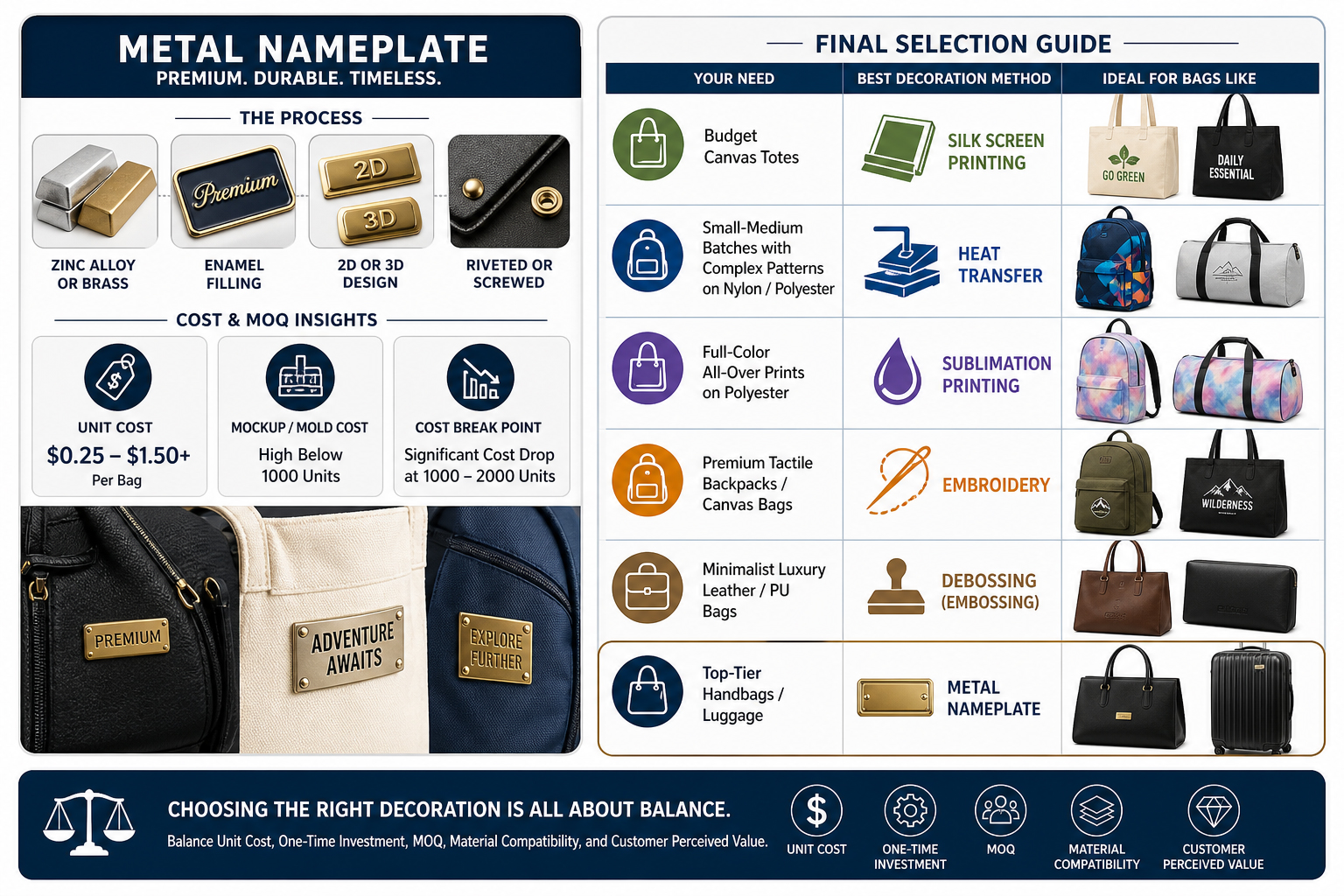
Typical per-unit decoration cost (USD): $0.25–$1.50+ at 500–1,000 units. Pricing varies extremely widely. Simple zinc alloy plates can be as low as $0.30 for 100–1,999 pieces, and drop to $0.13 each for orders above 2,000 pieces. Basic metal logo components can range from $0.08–$0.95 each. Brass, plated, enamel-filled, 3D shaped nameplates will cost significantly more.
MOQ from Chinese bag factories: Metal plate production itself has separate MOQ rules. Below 1,000 units, mold cost will push up effective unit cost heavily. Blank bag MOQ still follows material standard: fabric bags MOQ 500, leather bags MOQ 150.
Setup & plate-making charges: Metal nameplates need custom injection or stamping molds, sample charges, plating and enamel setup fees. You must confirm whether the quoted price includes manual attachment labor on the bag. Many suppliers quote metal plate price alone and charge extra for mounting work.
Price change with order volume: Metal nameplate has the biggest cost drop when order quantity crosses 1,000 to 2,000 units. Below 1,000 units, mold cost makes this option expensive. For bulk orders over 2,000 units, simple metal tags can become surprisingly affordable.
Logo factor impact: Metal material selection (zinc alloy, brass), plating color, enamel filling, 2D or 3D design, thickness and attachment method all change the price. Complex 3D enamel logos will raise mold and unit cost greatly.
Best fit: Luxury handbags, luggage and high-end fashion bags requiring solid hardware brand identity.
How to Request Standardized Quotes from Chinese Bag Manufacturers
When you send RFQ to multiple Chinese bag factories, consistency of your specification is the key to compare quotes fairly. Different suppliers will quote based on different assumptions, so you need to send identical requirements to every factory.
Use this standardized request template in your inquiry email:
Please quote FOB China and EXW prices for 100, 300, 500, and 1,000 pieces. The bag is [material], size [dimensions], color [color], with one logo measuring [dimensions] in [position]. Please quote separately for silk screen, heat transfer, sublimation, embroidery, debossing, and metal nameplate. Include artwork/setup fee, mold or plate fee, sample fee, MOQ, production time, packaging, and whether the logo cost is included in the bag price.
Besides the quotation, you need to ask suppliers for the following supporting information:
* Physical pre-production sample or logo swatch sample
* Close-up photos of finished logo samples for each decoration method
* Exact stitch count if you select embroidery
* Number of color screens for silk screen printing
* Metal material, plating finish, thickness and attachment solution for metal nameplates
* Policy about refund or waiver of setup fees after reaching target order volume
Incoterm confirmation: FOB, EXW or DDP. Remember ocean freight, US customs duty and import charges are not included in decoration pricing.
Do not make your final sourcing decision based only on the lowest unit decoration price. Print adhesion, embroidery density, deboss depth, plating durability and color consistency matter more than a small price difference of a few cents. Always order pre-production samples before mass production to verify quality and texture.
Final Selection Guidance for US Independent Site Bag Sellers
For US bag brands selling on independent websites, your decoration selection should match your product positioning, target customer and order volume plan.
* For budget canvas tote bags with simple solid logos and order volume above 250–500 units: silk screen printing is your first pick for best cost efficiency.
* For small or medium batch orders with gradient and multi-color detailed logos on nylon or polyester bags: heat transfer delivers good flexibility.
* For polyester bags with full-color photographic patterns or all-over prints: sublimation is the only suitable option, and it works well for low-volume trial launches.
* For fashion bags and backpacks targeting premium consumers who value tactile texture: embroidery adds high-end brand feeling.
* For PU and leather handbags with minimalist luxury positioning: debossing creates subtle tone-on-tone branding.
* For top-tier handbags and luggage lines: metal nameplates strengthen premium brand identity, but you need to budget for mold and hardware quality control.
As a US bag brand owner sourcing directly from China, you need to balance unit decoration cost, one-time setup investment, MOQ restriction, material compatibility and customer perceived value. A decoration technique that looks cheap on paper may bring adhesion failure or inconsistent quality after shipping to US customers. Compare quotes carefully, verify samples, and calculate your total effective cost including all one-time charges before confirming your custom logo solution.
Post time: Sep-14-2026