
Published for independent e‑commerce bag retailers | B2B sourcing playbook for direct‑from‑China custom bag orders
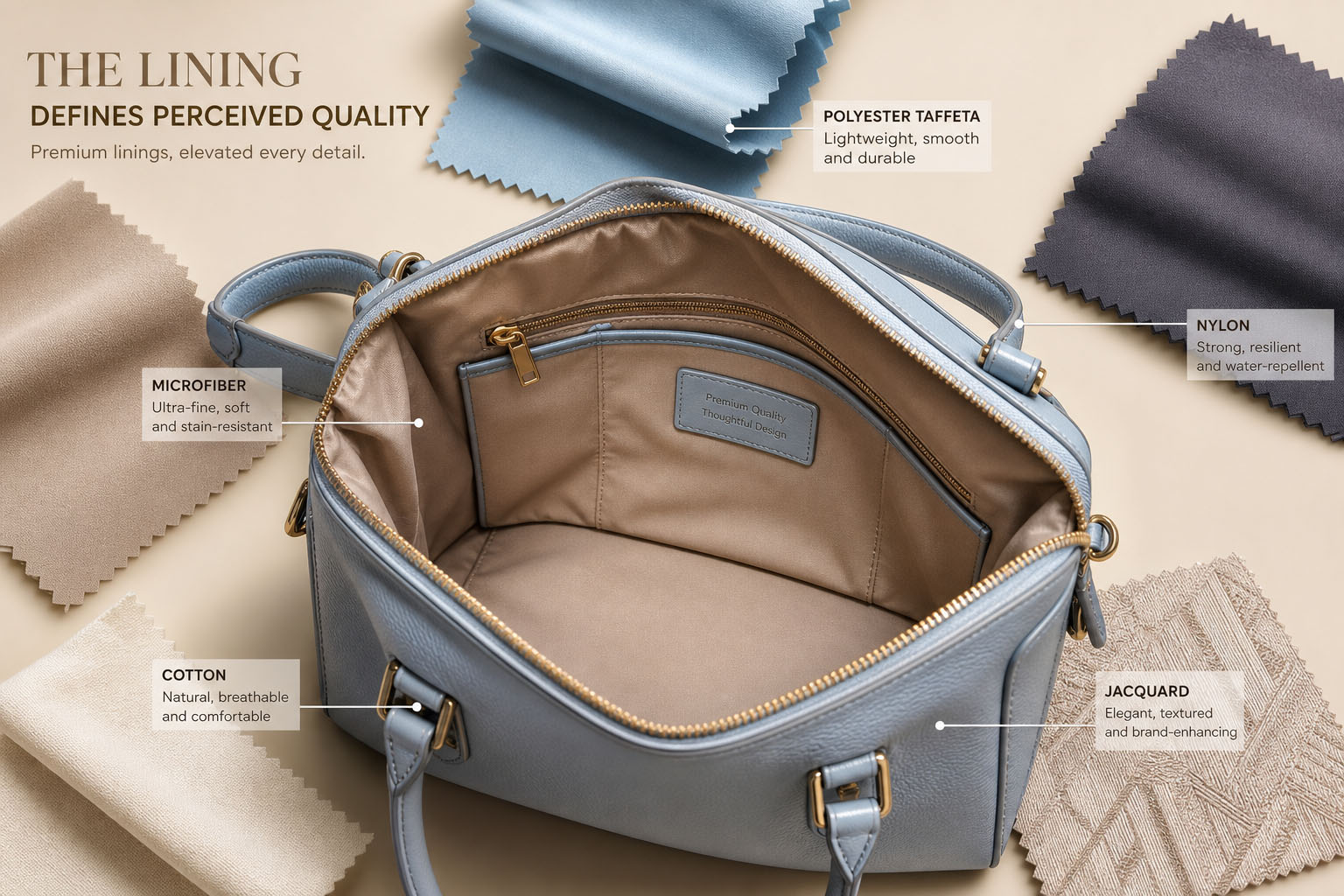
If you run an online bag store selling handbags, backpacks, travel totes, laptop cases, or outdoor gear, you likely focus most of your product development energy on exterior fabrics, hardware, silhouette, and branding. Yet one under‑rated component heavily shapes customer satisfaction, perceived value, and long‑term product performance: **bag lining**. Many US importers treat lining as an afterthought, simply accepting whatever default material the Chinese OEM factory provides. In reality, lining directly influences hand feel, interior durability, stain resistance, and your product’s premium positioning in a crowded online marketplace.
When you work with Chinese bag manufacturers for OEM or ODM production, suppliers routinely ask detailed questions about lining requirements. Factories want clarity because lining choices cascade across material cost, unit FOB pricing, minimum order quantities (MOQ), production timelines, and end‑user experience. Too many Western buyers give vague answers and receive inconsistent quality as a result. This article breaks down lining fabric types, denier and GSM specifications, custom lining capabilities, premium and recycled lining trade‑offs, common production pitfalls, and actionable email templates you can copy‑paste when communicating with your Chinese manufacturing partners. Whether you source budget‑friendly everyday bags or build a mid‑to‑premium direct‑to‑consumer brand, these sourcing insights will help you write precise specifications, avoid costly production errors, and elevate your finished goods.
Why Lining Matters: Hand Feel, Interior Durability, and Brand Positioning
Your bag’s interior lining serves three core business purposes: tactile hand feel, functional durability, and brand positioning. Even a beautifully constructed bag with high‑grade outer material can appear cheap if fitted with thin, scratchy, easily‑teared lining. Conversely, thoughtfully‑specified lining upgrades perceived quality without dramatic increases in landed cost.
**Hand feel** describes how fabric feels to consumers when they reach inside the bag. It can be crisp, silky‑smooth, soft, plush, or stiff. This tactile moment creates an immediate subconscious impression for shoppers opening your product for the first time. Customers will associate a smooth, substantial interior with higher‑quality merchandise. Thin, crinkly, noisy lining signals low‑cost mass‑market goods.
**Interior durability** covers tear resistance, abrasion performance, stain resistance, pilling, and color fastness. Linings take constant abuse: keys, pens, laptop corners, and sharp‑edged personal items rub against pocket seams and zipper openings thousands of times over a bag’s lifespan. Cheap thin lining frays, rips along pocket corners, or develops unattractive pilling, generating product returns and negative customer reviews. Dark‑dyed low‑quality lining may bleed color and stain wallets, clothing, or electronics stored inside the bag — a serious quality failure for which your brand receives blame, not your overseas factory partner.
**Premium positioning** is where lining becomes a quiet branding tool. Luxury and mid‑tier brands leverage custom‑colored, logo‑printed, or jacquard‑woven linings to differentiate their product lines. Customers see branded interior details as exclusive and deliberate, justifying higher retail price points. Budget‑level mass‑produced bags almost always use generic unbranded standard lining. When you negotiate OEM‑ODM orders, you have full authority to decide which tier fits your brand identity.
Chinese factories will push you to define these priorities early in sampling. Suppliers frequently ask: *“Do you have specific lining material requirements?”* This question is not procedural box‑checking. Factories need your requirements to select correct raw materials, calculate unit pricing, prepare accurate samples, and avoid post‑production disputes over quality.
When responding, always communicate your bag category, intended‑use case, target quality tier, desired hand‑feel profile, and performance requirements, rather than replying “whatever you normally use.”
Common Lining Fabric Types Offered by Chinese OEM Bag Manufacturers
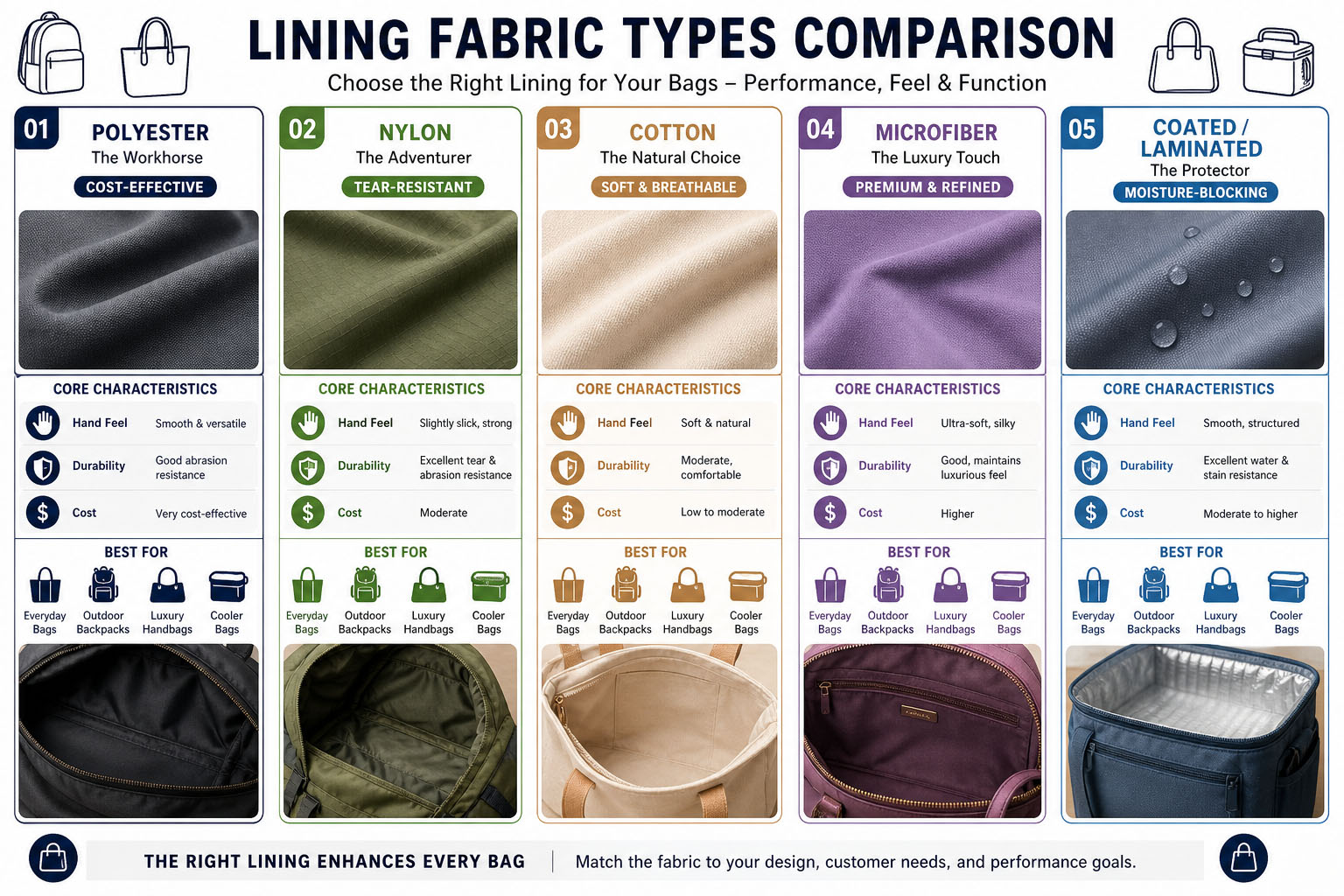
Chinese bag OEM and ODM factories maintain large material libraries, with lining options tailored for handbags, travel luggage, school backpacks, outdoor tactical gear, cooler bags, camera cases, and laptop sleeves. The most mainstream materials are polyester, nylon, cotton, microfiber, plus coated and laminated specialty textiles. Each fabric family delivers distinct performance, hand‑feel, and cost characteristics.
Polyester
Polyester is the workhorse lining for mass‑market and mid‑range bag production. It is widely accessible, cost‑effective, wrinkle‑resistant, easy to clean, and available across many densities and finishes. **210D and 230D polyester linings represent the most widely‑used standard specifications for everyday handbags, tote bags, and travel bags** from Chinese factories. Polyester taffeta and polyester twill are the two most common weave styles for bag interiors. Taffeta has a light sheen and crisp hand feel, while twill delivers a softer, more substantial touch. Recycled rPET polyester, made from post‑consumer plastic bottles, belongs within the polyester family and has grown massively popular for sustainable‑focused Western brands.
Nylon
Nylon linings (210D, 420D are typical OEM specifications) excel in tear strength and abrasion resistance. For this reason, Chinese manufacturers prefer nylon lining for outdoor backpacks, tactical bags, heavy‑duty travel gear, and equipment carriers. Nylon is lighter weight than equal‑denier polyester and delivers good water repellency. It costs moderately more than standard polyester lining. Nylon’s smooth surface prevents sharp contents from snagging interior fabric. Recycled nylon options exist, though MOQs are generally higher than recycled polyester.
Cotton
Cotton lining offers a soft, natural hand feel favored for select fashion handbags. Pure cotton is breathable, but it lacks synthetic fabric’s stain and moisture resistance. Cotton wrinkles easily and can degrade with repeated exposure to damp conditions. It appears less frequently in mass‑produced utility bags, and more often in boutique‑level fashion accessories. Factories may blend cotton with polyester to balance natural texture and durability.
Microfiber
Microfiber and microfiber suede‑style linings are the premium interior choice. Chinese OEM factories deploy these materials heavily inside laptop bags, high‑end handbags, and camera bags. Microfiber delivers a luxuriously soft, velvet‑like hand feel while providing padding that protects delicate surfaces such as laptop casings, eyeglasses, and camera bodies. Silk‑touch microfiber is an upgraded variant that elevates luxury perception significantly. Microfiber carries a higher per‑unit cost than polyester or nylon.
Coated and laminated fabrics (PVC‑coated, PEVA‑coated)
PVC‑coated or PEVA‑coated lining materials prioritize moisture‑blocking performance. Chinese manufacturers assign these specialized linings to cooler bags, insulated lunch totes, and fully waterproof gear. The coating creates a barrier against water and condensation, yet these coated textiles are rarely used for general‑purpose handbag interiors due to stiffer hand‑feel.
Jacquard woven lining
Jacquard is a production technique rather than raw fiber type. Factories weave brand logos, monograms, or repeating patterns directly into the fabric itself, rather than printing on top. Jacquard lining creates a high‑end luxury aesthetic, but it demands substantially higher fabric MOQ compared to screen‑printing or digital print options.
How Lining Weight, GSM and Denier (190T vs. 210T Polyester) Impact Durability and Hand‑Feel
Once you select a fiber type, the next critical specification is fabric thickness, measured either in denier (D), threads‑per‑inch T‑rating (Taffeta, e.g.190T,210T), or GSM (grams per square meter). Many US buyers are unfamiliar with these textile metrics and rely exclusively on subjective descriptions such as “soft” or “thick.” Misunderstanding these numbers leads to sample‑rework cycles and unsatisfactory final production quality.
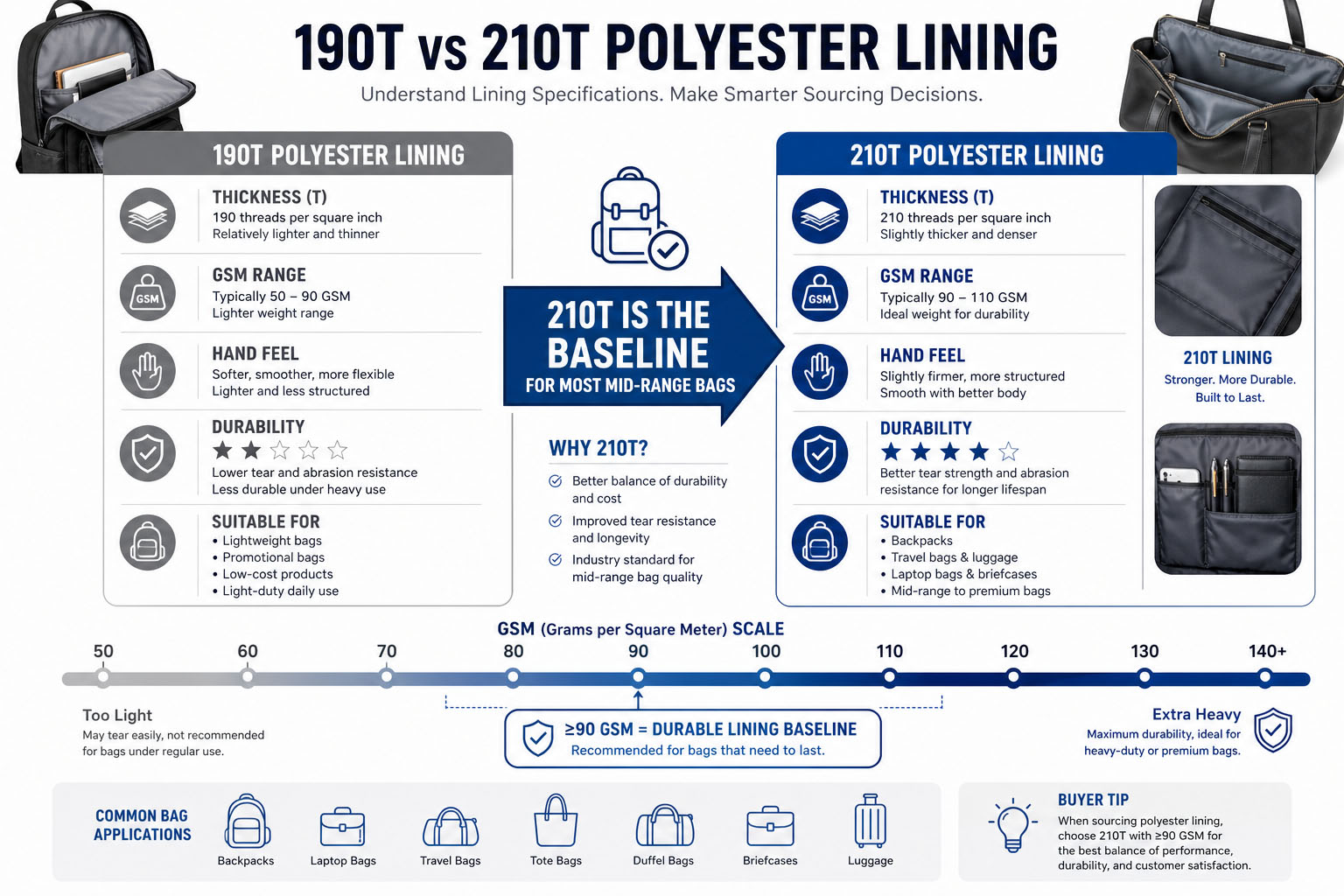
Denier measures yarn thickness: higher denier means coarser yarn, stronger fabric, greater durability, but also more fabric weight. T‑ratings (190T, 210T) describe thread density for taffeta‑style woven fabrics. GSM measures fabric weight per square meter and works reliably for all lining fabric categories.
**Lining GSM directly impacts hand‑feel and interior durability. A GSM value ≥90 generally signals thicker, more durable lining construction.** Thin linings at 50‑70 GSM feel lightweight but tear easily around pockets and zipper stress‑points. Thick lining above 120‑140 GSM feels robust and structured, yet adds overall bag weight and raises material costs.
Take polyester taffeta as a real‑world example:
**190T Polyester**: Low‑to‑mid GSM, lightweight, thin, cost‑efficient. It creases easily, can tear under heavy friction. It suits promotional bags or low‑cost accessories, but it is risky for premium‑positioned products where interior longevity matters.
**210T Polyester**: Higher thread density than 190T. Smoother hand‑feel, improved tear and abrasion performance. This is the most common baseline specification for mid‑market OEM bag orders.
A very common mistake is prioritizing softness alone. Ultra‑soft lining can be extremely thin. Soft‑feeling lightweight fabric may tear along pocket openings and seams under regular usage. Conversely, overly‑heavy lining boosts durability but adds bulk inside the bag, increases finished‑product weight, and pushes your FOB unit price upward. The target for most mid‑range everyday bags is balanced performance: substantial enough for abrasion resistance, without unnecessary extra weight.
For QC purposes, always ask your Chinese supplier to document GSM, denier, weave style, and fabric weight on every sample spec sheet, rather than verbal descriptions.
Custom OEM‑ODM Lining: Branded Prints, Patterns, and Signature Colors
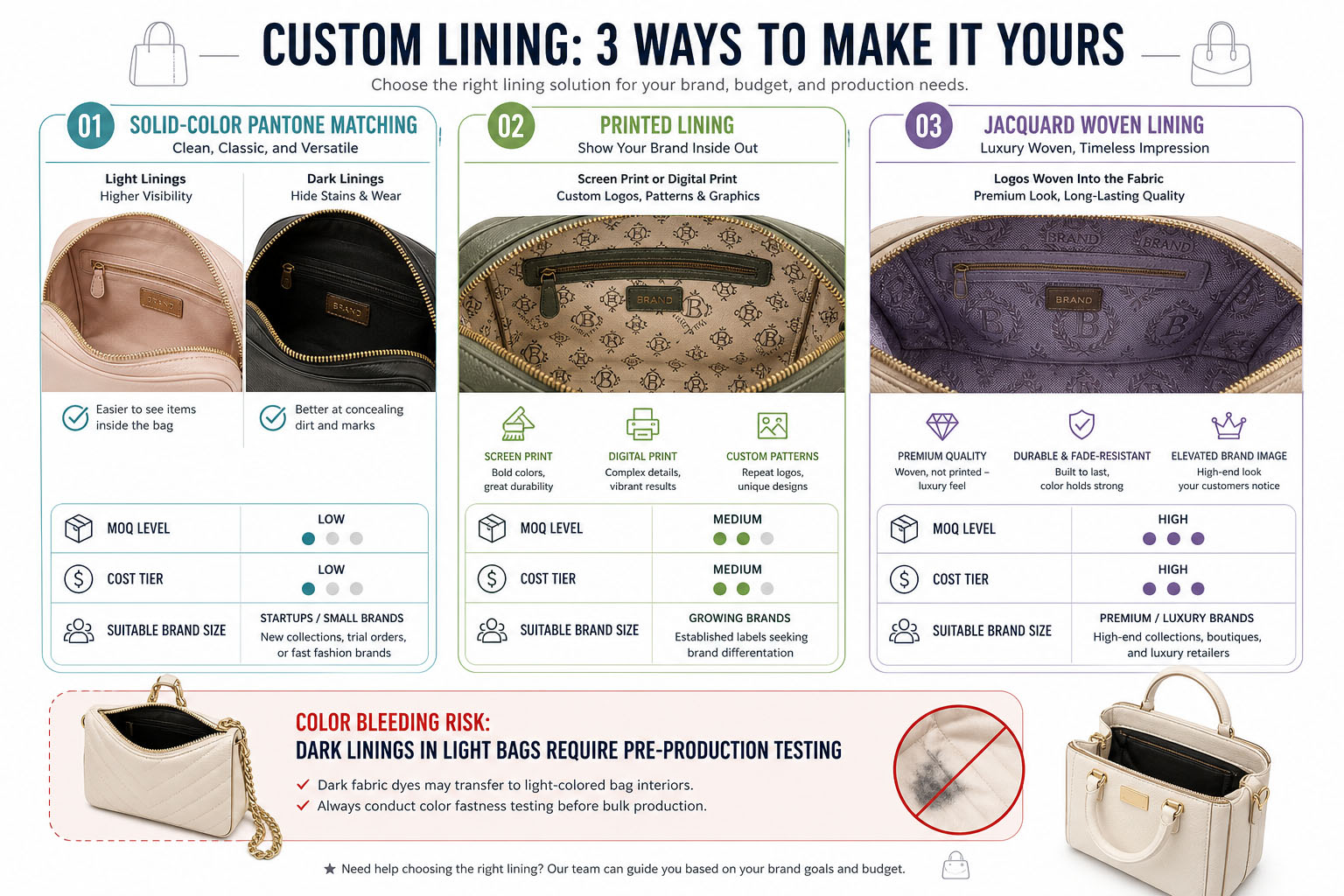
**Yes, buyers can customize lining with branded prints, patterns, or signature colors through OEM and ODM services from Chinese bag factories.** Customized lining has become a popular, comparatively low‑cost differentiation tactic for brands chasing premium positioning. Three primary customization pathways exist: Pantone signature solid‑color matching, screen printing or digital printing of logos and repeating patterns, and jacquard woven lining with embedded logos or motifs.
Signature solid‑color lining lets you align interior tones with your brand identity. Luxury handbag brands frequently select light‑toned linings (off‑white, beige, light gray). Light‑colored interiors improve visibility inside the bag; end‑users can locate small items more quickly. School backpacks, travel gear, and tactical bags typically use dark‑colored linings (black, charcoal navy). Dark linings hide dust, scuffs, and everyday stains.
An important quality risk when custom‑ordering dark‑hued lining for light‑colored exterior bags is **color bleeding (dye transfer)**. Poor color fastness causes dark‑lining dye to rub off and stain contents. Reputable Chinese factories will perform color‑fastness testing, but importers should explicitly request pre‑production testing for dark linings, especially when paired with light‑toned bag shells.
Printed lining uses screen‑print or digital print technology to apply logos, repeating brand patterns, or artwork onto base lining fabric. Printing has lower fabric minimums than jacquard weaving, making it accessible for smaller‑volume brand launches. Digital printing supports complex multicolor artwork, while screen printing works best for limited‑color designs.
Jacquard woven lining embosses your logo or pattern into the weave itself, rather than applying ink on top. It delivers a classic high‑luxury look, yet jacquard development requires fabric mill setup costs and significantly higher MOQ thresholds.
Premium Chinese bag factories routinely offer all these custom lining options as part of ODM‑OEM workflows to reinforce brand identity and communicate higher perceived value to end consumers. When requesting custom lining, always ask factories to supply physical pre‑production sample swatches before mass manufacturing commences.
Premium and Recycled Lining Upgrades: rPET Polyester and Silk‑Touch Microfiber — MOQ and FOB Cost Impact
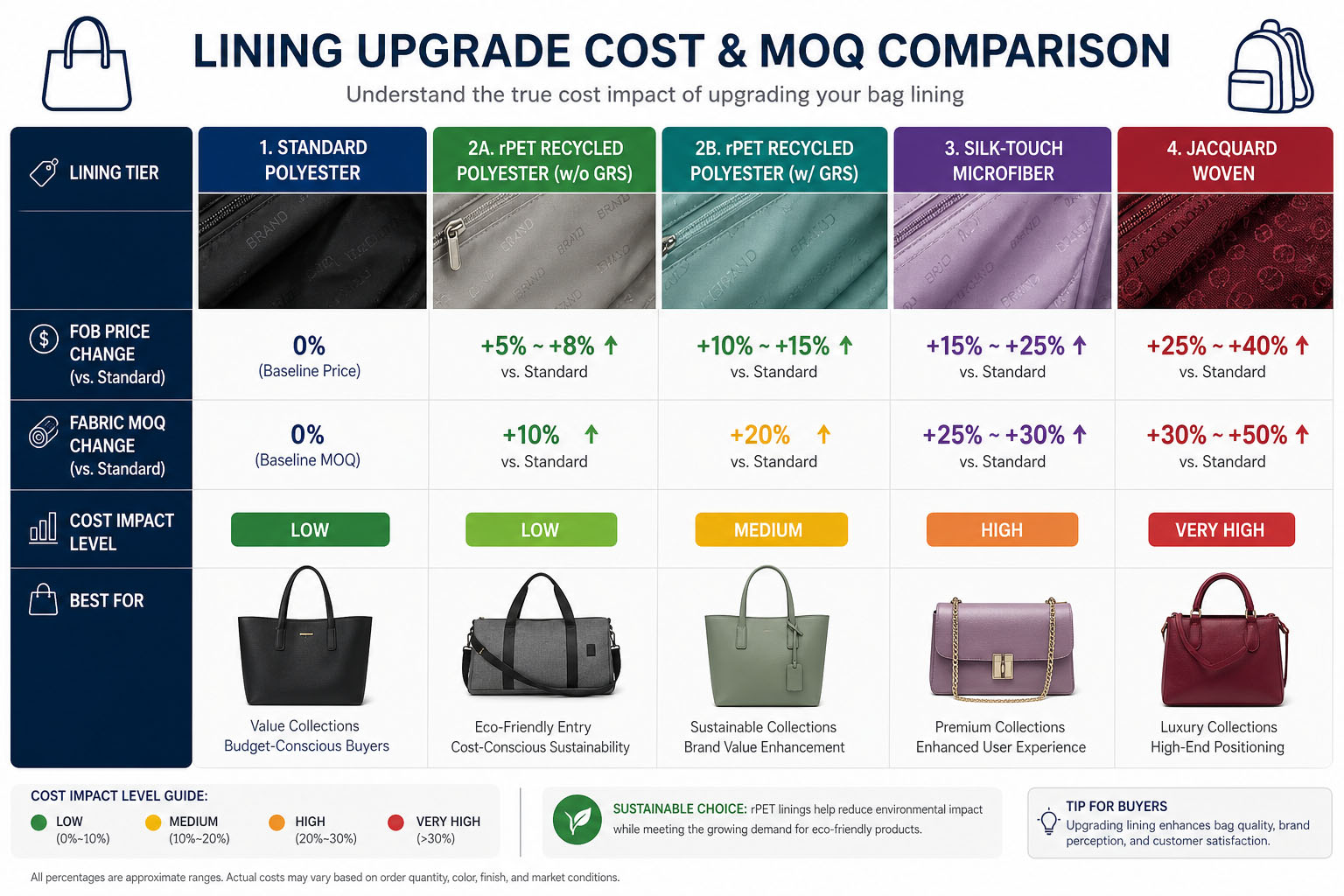
Upgrading to premium‑grade or recycled lining materials such as GRS‑certified rPET polyester or silk‑touch microfiber **will generally raise either unit FOB cost, fabric‑level MOQ, or both**, though the scale of increase varies widely depending on material grade, certification requirements, and your total order volume.
For rPET recycled polyester lining:
- Base rPET fabric without certification has minimal MOQ uplift, with a small per‑meter premium over standard virgin polyester.
- If you require formal GRS certification (needed for valid sustainability marketing claims for US customers), fabric mill MOQs rise, and per‑unit FOB cost increases more noticeably. Factories must provide traceability documentation. If your total bag order volume is small, you may hit minimum fabric‑roll limits even if your bag‑piece MOQ stays unchanged.
For silk‑touch microfiber and suede‑style premium lining:
- Material cost per unit is markedly higher than standard polyester or nylon lining. There is often no dramatic increase in piece‑count MOQ for the finished bags, but raw‑material purchase minimums apply for fabric rolls. Small‑batch orders may force factories to source from limited stock lots.
Notably, upgrading lining material does not always require you to increase your finished‑bag piece‑count MOQ. In many scenarios, you keep your existing bag‑order MOQ, but you pay a higher FOB unit price, or you accept a higher minimum for fabric roll purchase. Every factory operates differently, so you must explicitly ask two questions during quotation:
1. What is the difference in per‑unit FOB price for this upgraded lining?
2. Are there higher fabric‑roll minimums that apply beyond the finished‑bag MOQ?
Many US independent sellers incorrectly assume switching to recycled or premium lining automatically forces them to double their order quantity. That is not always true. But price premiums and fabric‑roll minimums must be budgeted for during quoting.
Critical Sourcing Workflow: What to Communicate to Your Chinese Supplier
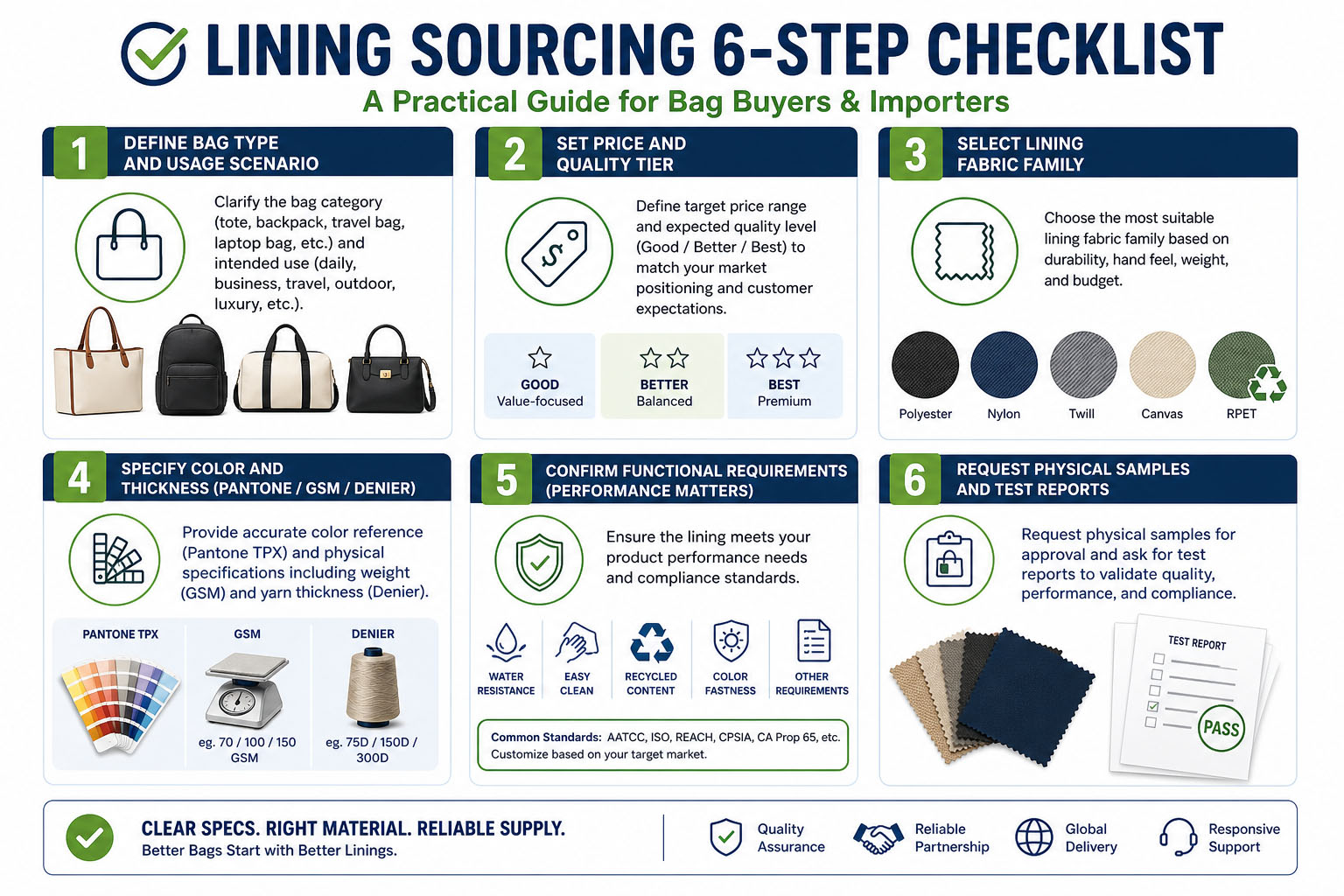
Chinese factories cannot guess your market requirements. To avoid sampling misalignment and costly production errors, you need to convey six sets of information clearly during your OEM‑ODM discussions:
1. **Bag type and real‑world intended‑use**: Is this a fashion handbag, daily backpack, travel luggage, laptop sleeve, cooler bag, outdoor tactical pack? What stress will the lining endure?
2. **Your target price and quality tier**: Budget entry‑level, mid‑range everyday use, premium direct‑to‑consumer, luxury fashion.
3. **Preferred lining fabric family**: Polyester, nylon, microfiber, cotton, rPET recycled polyester etc. If you are unsure, ask factories to provide comparative swatches for multiple material options.
4. **Required color, plus thickness specifications**: Specify Pantone color codes, GSM or denier requirements. Clarify whether you want light‑colored high‑visibility interior or stain‑hiding dark interior.
5. **Functional requirements**: Water‑resistance, easy‑wiping clean‑ability, recycled content with or without GRS certification, color‑fastness standards, tear‑strength requirements.
6. **Sample requirements**: Request physical fabric swatches and pre‑production PP samples before mass‑production begins. Specify whether you need independent lab test reports for color fastness or abrasion resistance.
Also specify reinforcement requirements: high‑stress zones including zipper openings, pocket corners, and handle attachment points frequently fail first. Request lining reinforcement in these areas.
Template Email for General‑Purpose Premium Everyday Bags
> Yes, lining material is very important for our brand. We prioritize comfortable hand‑feel, solid interior durability, and premium visual presentation for our end‑customers. Please recommend suitable lining options for this bag style and send physical swatch samples showing material composition, thickness, GSM or denier weight, color, and surface finish.
> Our preference is soft, smooth, durable lining with good abrasion resistance and easy‑to‑clean properties. Please quote the unit‑price difference for polyester, nylon, and microfiber lining alternatives. Also confirm each lining’s fabric composition, GSM/denier rating, color fastness grade, tear‑strength performance, and whether custom‑logo printing or custom Pantone‑color matching can be completed for OEM production.
For balanced everyday premium bags, this practical written specification works well for sending to manufacturers:
> Preferred lining: high‑quality polyester twill or nylon twill, approximately 180‑250 GSM. Fabric should feel soft yet substantial (not flimsy), smooth enough to protect personal belongings, stain‑resistant, easily wipe‑cleanable, and meet high‑color‑fastness standards. Please reinforce lining material around zippers, pocket openings, and other high‑stress seam locations.
For luxury‑style handbags:
> Please provide quotations for microfiber suede lining and premium polyester‑cotton twill lining options. The lining should feel soft and substantial, have a neat clean appearance, resist pilling and staining, and be securely sewn with no loose threads or interior wrinkling.
Common Pitfalls US Buyers Must Watch
1. **Specifying softness without thickness requirements**: Soft fabric can be thin and fragile. Always add GSM or denier requirements alongside hand‑feel descriptions.
2. **Ignoring color‑fastness risk with dark linings inside light‑colored bags**: Dye‑bleed incidents generate high return rates. Mandate pre‑production testing.
3. **Skipping physical swatch samples**: Digital photos misrepresent fabric thickness, texture, and true color. Always request physical swatches.
4. **Confusing finished‑bag MOQ with fabric‑roll MOQ**: Recycled or jacquard lining may impose fabric‑roll minimums even if finished‑bag quantities stay unchanged. Clarify this point during quotation.
5. **Overlooking stress‑point reinforcement**: Even good‑quality lining will fail quickly if pocket and zipper seams lack reinforcement stitching.
Final Thoughts
Lining remains one of the most underutilized levers for US independent bag sellers sourcing from Chinese OEM‑ODM manufacturers. Many brands compete on exterior appearance and hardware while neglecting interior material. Thoughtful lining specification enables you to boost perceived quality, reduce return rates from torn or stained interiors, and use custom‑printed or signature‑color lining as quiet branding without massive cost increases.
When you communicate with your manufacturing partners, move past vague requests such as “good quality lining.” Give concrete requirements for fabric type, GSM or denier weight, color fastness, custom branding, stress‑point reinforcement, and sample validation. Understand the trade‑offs of polyester, nylon, cotton, microfiber, and recycled rPET options, and anticipate how premium upgrades affect your FOB pricing and fabric minimums. By mastering lining specifications, you create better‑performing finished goods and give your independent‑site store a competitive edge in a crowded online marketplace.
Post time: Aug-28-2026