
Blog Post for US‑based bag e‑commerce store | Word count: ~2700 | Target audience: Independent website bag buyers, importers, e‑commerce brand owners sourcing bags from Chinese manufacturers
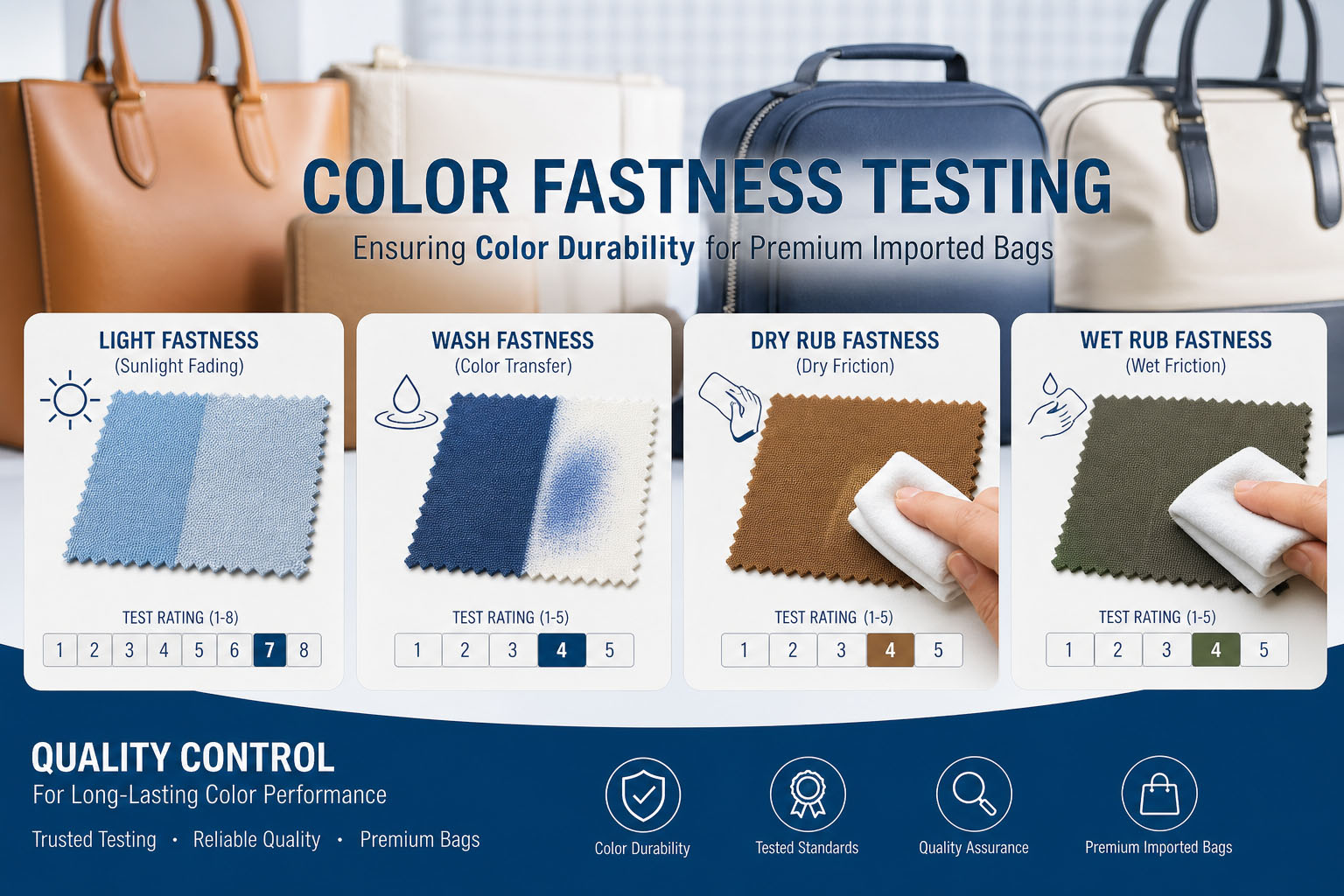
When you sell bags on your US‑based independent website, product quality directly determines customer satisfaction, return rates, and long‑term brand reputation. Fading fabric, color transfer onto clothing after rubbing, or discoloration after sunlight exposure are among the most common consumer complaints for imported bags. Many US bag importers overlook one critical QC indicator during sourcing: **color fastness**.
If color fastness performance fails to meet market requirements, your finished bags may fade under daily UV exposure, bleed dye during cleaning, or leave color stains on users’ clothes. High return rates, negative product reviews, and even product liability risks will follow. For US importers purchasing bags directly from Chinese factories, it is essential to understand how Chinese bag suppliers handle color fastness in standard quality control, which test standards they adopt, typical passing grades, third‑party testing rules, and performance gaps among mainstream bag fabrics including nylon, polyester, and coated canvas. This article breaks down all these practical sourcing questions to help you build clear, enforceable quality requirements before placing bulk orders with Chinese bag manufacturers.
Are Light, Washing and Rubbing Color Fastness Treated as Baseline QC Requirements by Chinese Bag Factories?
For reputable Chinese bag and fabric manufacturers serving export clients, color fastness to light, washing, and rubbing are regarded as fundamental quality‑control checkpoints for fabric‑based bag products. This practice stems from three core drivers: domestic national textile standards, export‑market expectations from US and EU buyers, and standardized pre‑shipment third‑party inspection workflows.
China has published systematic national textile testing specifications. Representative standards include GB/T 3920 for color fastness to rubbing, GB/T 5713 for color fastness to water, GB/T 3922 for color fastness to perspiration, and the updated GB/T 21295‑2024 standard covering physical and chemical performance requirements for textile products. These national standards set clear baseline color‑fastness indexes. Factories focused on overseas export will align their internal fabric QC workflows with these domestic standards as a starting point.
Beyond domestic regulation, North‑American and European buyers consistently list wash fastness, crocking (rubbing fastness), and light fastness as mandatory test items within tech packs and purchase orders. Experienced Chinese export‑oriented bag factories fully understand these market requirements, so they integrate color‑fastness verification into routine fabric incoming inspection and finished‑product QC processes. Pre‑shipment third‑party inspections widely adopted in China also include on‑site crocking and washing fastness spot checks. When outdoor‑oriented bags are involved, inspectors will request formal lab reports for light fastness verification.
Not every factory treats color fastness as a non‑negotiable baseline. Some low‑cost factories focusing purely on ultra‑low‑price promotional goods may skip formal lab testing to cut production costs. This is a clear red flag for US importers. When you encounter such suppliers, ask them to specify which standards they follow, whether ISO, AATCC, or Chinese GB/T standards, and request their internal quality specification sheets. You can also enforce pre‑production third‑party lab testing as a non‑negotiable condition, or shift cooperation to manufacturers with mature experience serving United States bag buyers.
Color Fastness Test Standards Adopted Within Chinese Bag Factory QC
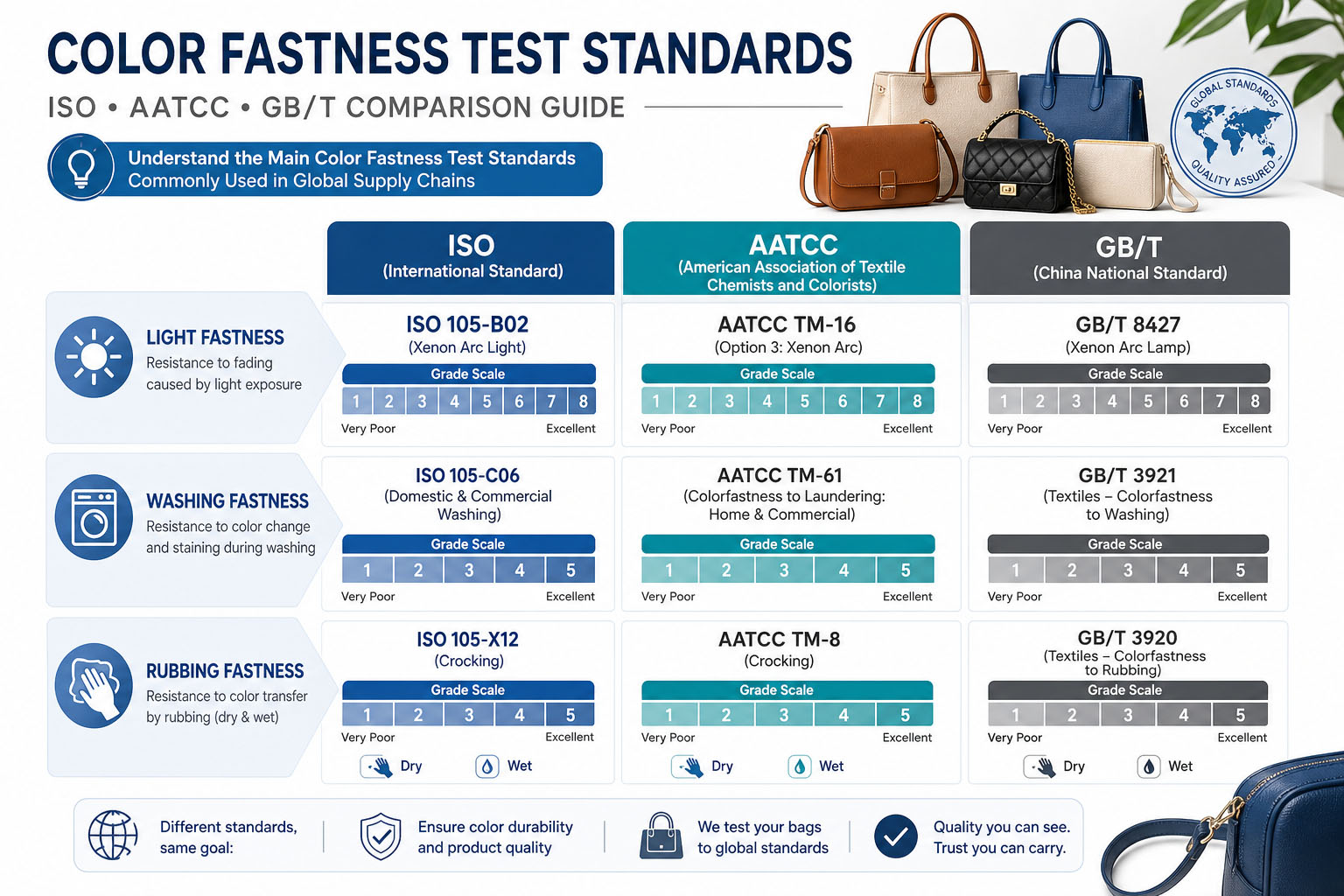
Chinese export‑focused bag factories frequently apply two major testing‑system frameworks in their QC workflows: ISO international standards widely used across global textile trade, and AATCC standards that are mainstream for the North‑American market.
For **color fastness to light**, the most‑common reference is ISO 105‑B02, using xenon‑arc lamp exposure simulation, with evaluation grades ranging from 1 to 8; a higher grade represents better anti‑fading performance. For US‑market‑oriented orders, many factories will also accept AATCC TM‑16 test requirements specified by buyers.
For **color fastness to washing**, factories commonly use ISO 105‑C06. This test assesses two key dimensions: color change of the sample fabric itself and dye staining onto adjacent multi‑fiber fabric. Evaluation grades run 1‑5, grade 5 equals zero discoloration or staining. When US customers place orders, suppliers will also execute AATCC TM‑61 washing fastness testing per buyer specifications.
For **color fastness to rubbing, also known as crocking fastness**, the primary ISO method is ISO 105‑X12. Tests are separated into dry rubbing and wet rubbing conditions, and two independent rating results need to be recorded. Corresponding to United States market practice, AATCC TM‑8 is also widely adopted for crocking testing by export‑qualified Chinese bag manufacturers.
It is worth emphasizing: factories may follow Chinese GB/T standards for internal self‑inspection. However, as a US independent‑site seller, you should explicitly write ISO or AATCC standard numbers into your tech pack and purchase order. Do not rely only on the factory’s internal domestic standard results, because evaluation conditions and test parameters between different standard systems are not completely equivalent. Clear written requirements eliminate quality disputes after mass‑production.
Typical Minimum Color Fastness Acceptance Grades from Chinese Bag Manufacturers
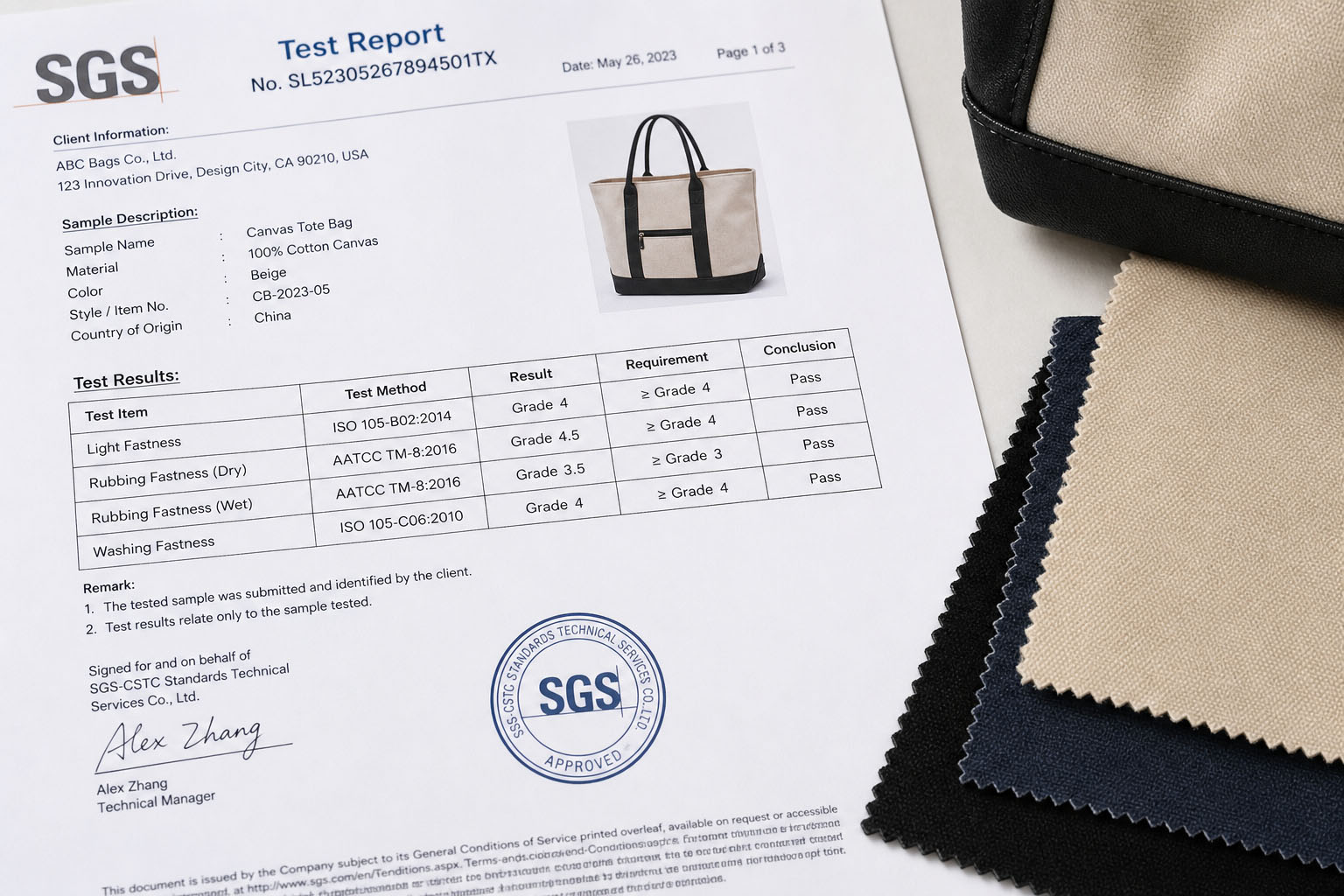
Grading rules differ across test categories. Washing and rubbing fastness adopt a 1‑5 scale (grade 5 = no color shift or staining). Light fastness uses a 1‑8 scale (grade 8 = excellent resistance to UV fading). The minimum acceptable grades will shift based on bag application scenarios, fabric types, and color depth. Dark‑toned dyes such as black, navy blue, and deep red usually deliver weaker rubbing fastness, especially under wet‑rub test conditions, which is a common textile industry limitation.
For general‑purpose handbags, tote bags, and daily backpacks for US customers, the widely‑accepted baseline thresholds from Chinese export factories are shown below:
1. **Color fastness to washing**: Color change grade ≥ 4.0; staining grade ≥ 3‑4. Dark‑colored fabrics may hit the lower end of this range without dedicated high‑grade dye formulation.
2. **Color fastness to rubbing (crocking)**: Dry rubbing ≥ 4.0; wet rubbing ≥ 3.0. Wet crocking is far harder to achieve. Many quality complaints originate when wet‑rub performance falls below grade 3.
3. **Color fastness to light**: General daily‑use bags require light fastness ≥ 4‑5. For outdoor‑use bags frequently exposed to sunlight, such as beach totes, hiking backpacks, promotional outdoor bags, the target should rise to ≥ 6.0 or higher.
Special‑use bags need upgraded specifications. For school backpacks carried by children or heavy‑duty outdoor bags, you should demand higher rub‑fastness indexes in your order documents. Always note these elevated requirements in your tech pack and purchase contract.
Beyond color‑fastness grades, chemical compliance has grown into a basic requirement for Chinese export‑oriented bag factories. Azo‑free dyes and REACH‑compliant colorants are increasingly standard configurations for goods shipped to strict‑regulation markets in North America and Europe. When you negotiate orders, you can also confirm dye‑related chemical compliance together with color‑fastness indicators.
Third‑Party Lab Reports: Can Chinese Suppliers Provide SGS, Intertek, Bureau Veritas Reports Before Bulk Shipment?
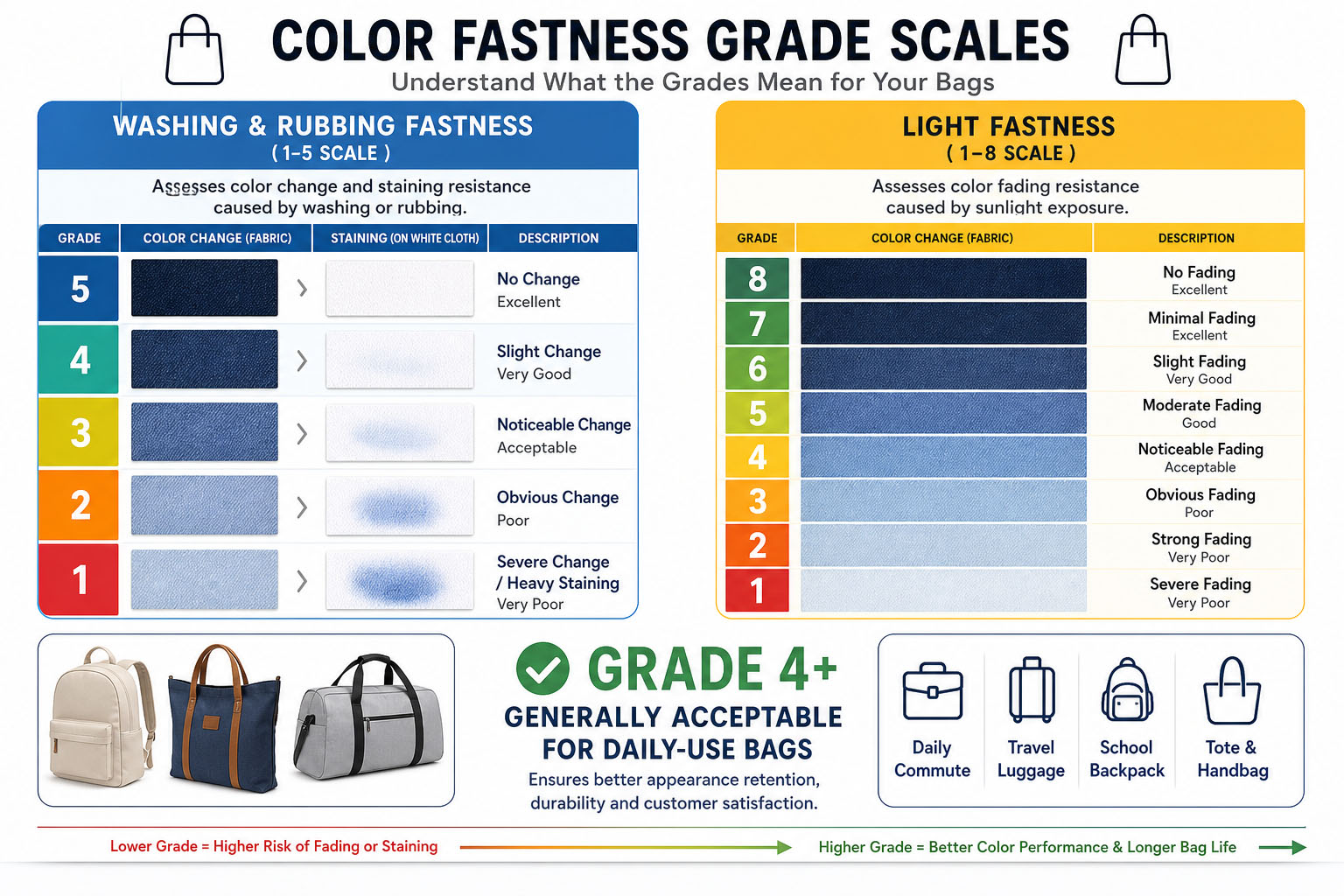
As a US importer running your own independent website, third‑party accredited lab reports are your critical evidence to verify fabric color‑fastness performance before bulk goods leave China.
Most qualified Chinese bag suppliers for overseas markets are capable of issuing third‑party lab test reports from globally‑recognized organizations including SGS, Bureau Veritas (BV), and Intertek to confirm color‑fastness test outcomes before bulk shipment, but this capability does not mean reports will be provided automatically. Many factories only complete internal self‑checking without sending samples to independent labs unless buyers explicitly require third‑party certification.
You need to clarify three key points in your RFQ and purchase documents:
1. Require accredited third‑party lab reports for the initial bulk production run.
2. Mandate new testing and new lab reports whenever fabric lots, dye batches, or dye suppliers change during production. Without this rule, fabric quality can drift between different production batches.
3. Specify which bag components need testing. For finished bags, testing scope must at minimum cover outer shell fabric, dyed lining fabric, printed or decorated surface areas, and contrast‑color trims that may cause dye staining.
Also add contractual constraint terms: any production batch failing to reach agreed color‑fastness grades will be treated as non‑conforming goods, giving you rights of rejection or requiring the supplier to perform rework. If suppliers are unwilling to support pre‑shipment third‑party testing, this serves as an important warning signal for your sourcing decision.
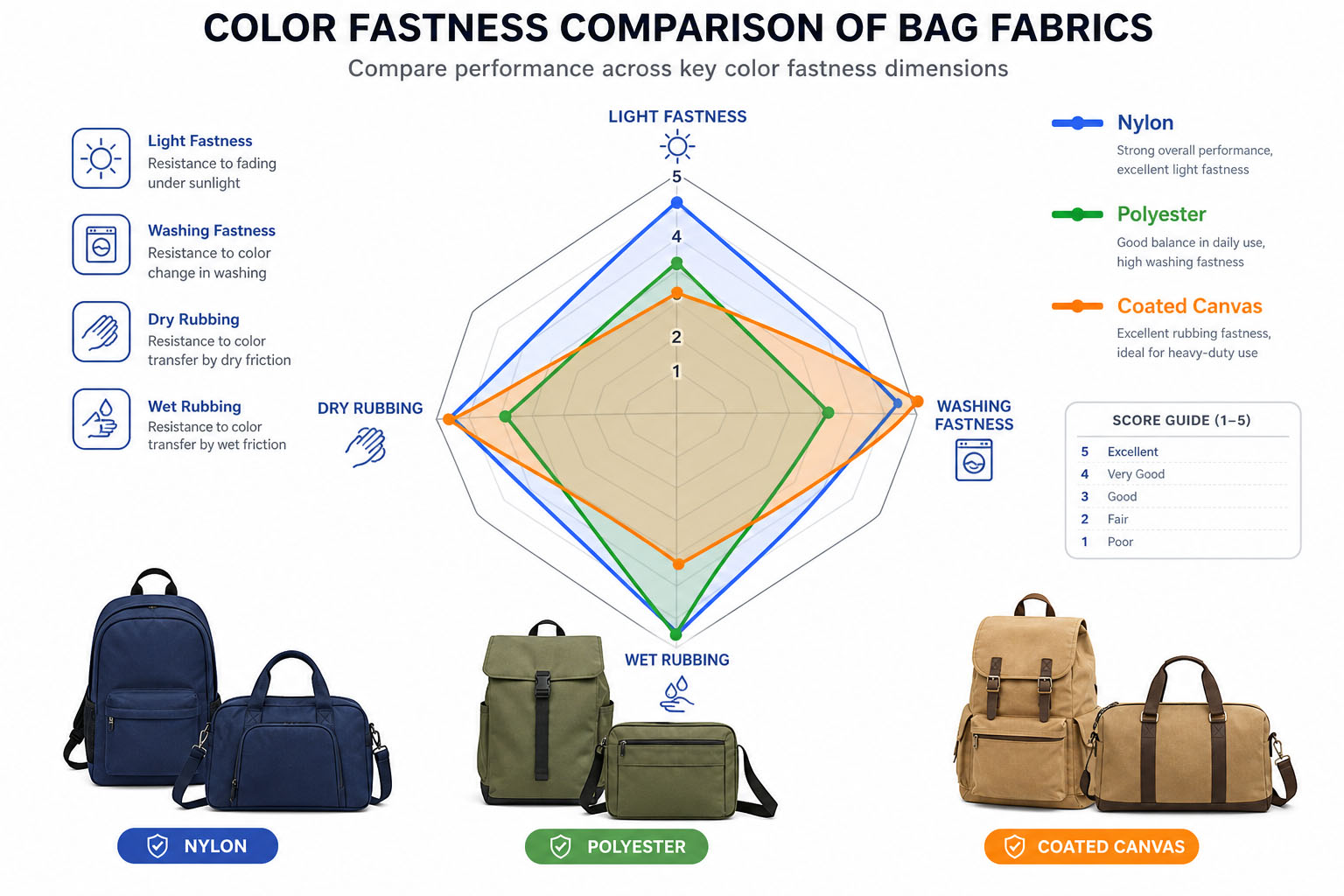
Color Fastness Differences: Nylon, Polyester and Coated‑Canvas Under Long‑Term UV Exposure and Repeated Washing
Even when fabrics pass lab color‑fastness testing, real‑world service performance varies significantly among nylon, polyester, and coated canvas under long‑time ultraviolet radiation and repeated cleaning cycles. The difference originates from fiber chemical structures and dye‑absorption characteristics.
**Polyester fabric** is synthetic fiber with compact molecular structure. Its light fastness performance stands out among the three materials. After long‑term UV irradiation, polyester shows relatively slow fading speed. Its washing fastness is also stable. However, polyester has limitations for deep‑color dyeing. If the dyeing process is not well controlled, loose surface dye may lead to sub‑standard rubbing fastness. Polyester is a reliable choice for bags that will stay outdoors for extended periods.
**Nylon fabric**, widely applied in lightweight backpacks and travel bags, absorbs dye in a different way from polyester. Nylon demonstrates good washing‑fastness potential, yet its anti‑UV capability is weaker. Under continuous sunlight exposure, nylon fabrics are prone to photodegradation, which causes both color fading and partial decline of fabric physical strength. For nylon bags used outdoors, you need to raise the light‑fastness grade requirement in advance, and confirm whether UV‑stabilized dye formulas are adopted. Wet rubbing fastness of dark‑color nylon also deserves close attention.
**Coated‑canvas fabric** is built on canvas base cloth with surface coating treatment. Its color‑fastness status is jointly decided by base‑fabric dye quality and coating formula. UV radiation may trigger coating aging, yellowing, or peeling. Repeated washing may damage the coating layer, further accelerating color change. Coated canvas bags are not suitable for frequent washing. When you select coated‑canvas material, communicate clearly with suppliers about expected usage scenarios. Suppliers can recommend optimized coating and dye solutions matching your product positioning.
No single fabric is perfect for all scenarios. Experienced Chinese bag factories will give targeted material recommendations based on your end‑use requirements. If your product is mainly for outdoor scenarios, polyester is more advantageous in UV resistance. If you select nylon for lightweight advantages, you must tighten light‑fastness testing indexes. For coated‑canvas fashion bags, you need to remind consumers on your independent‑site product page to avoid repeated washing and long‑term direct sunlight.
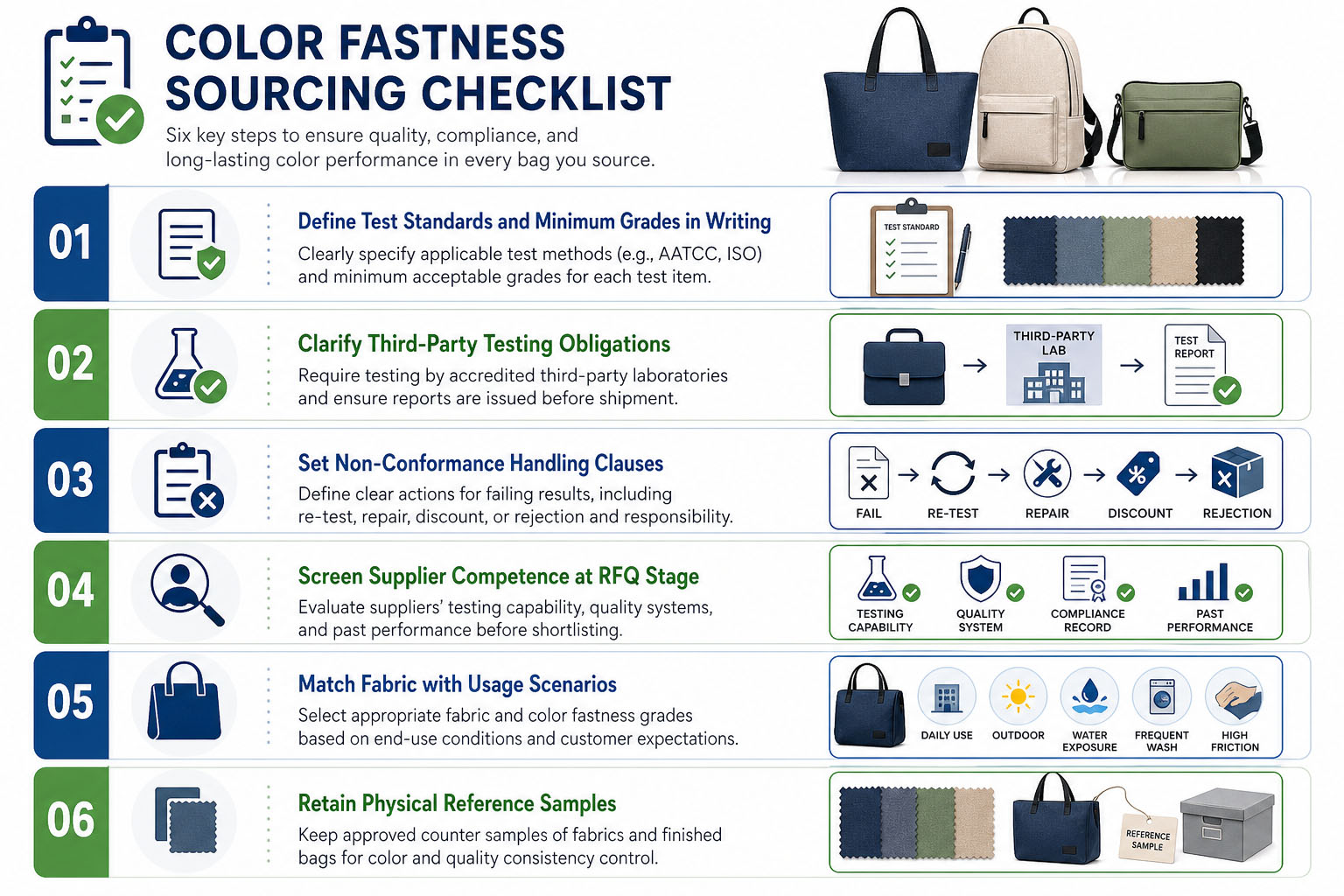
Practical Sourcing Checklist: Lock Color‑Fastness Quality in Your China‑Sourced Bag Orders
Many quality disputes happen because buyers only make oral agreements instead of writing precise specifications into formal documents. Below is actionable guidance you can directly copy into your tech packs, RFQs and purchase orders when sourcing bags from China.
1. Define explicit test standards and minimum grades in written documents
Sample specification text you can reuse:
> “Colorfastness to washing: ISO 105‑C06 or AATCC 61. Minimum grade ≥ 4.0 for color change; ≥ 3.5 for staining.
> Colorfastness to rubbing (crocking): ISO 105‑X12 or AATCC 8. Dry rub ≥ 4.0; wet rub ≥ 3.0.
> Colorfastness to light: ISO 105‑B02 or AATCC 16. Minimum grade ≥ 4.0 for general‑use bags; ≥ 6.0 for outdoor‑exposed fabric.”
2. Clarify third‑party testing obligations
Require accredited lab reports from SGS, Intertek or BV for initial bulk goods. New test reports are mandatory for any change in fabric batch, dye lot, or dye supplier before shipment. Specify test coverage: outer shell, dyed lining, print areas, contrast trims.
3. Set clear non‑conformance handling clauses
State that batches failing agreed color‑fastness specifications count as non‑conforming. You hold rights to reject shipment or demand supplier‑paid rework.
4. Screen supplier competence at RFQ stage
Ask potential Chinese suppliers to provide their existing internal quality‑spec sheets covering color fastness. Confirm whether they are familiar with ISO or AATCC standards for United States market. If suppliers claim color fastness is not a basic QC requirement for export‑grade bags, evaluate carefully before cooperating.
5. Match fabric selection with application scenarios
Communicate your selling scenarios to suppliers: whether bags are for daily indoor use, outdoor frequent sunlight exposure, or may go through repeated cleaning. Let suppliers propose appropriate fabric options among nylon, polyester, coated canvas and others, together with corresponding target test grades.
Final Thoughts
For US independent‑site sellers importing bags directly from China, color fastness is not an obscure technical indicator, but a core link controlling product return rate, review quality, and brand credibility. You cannot fully rely on suppliers’ self‑reported quality. You need to master applicable ISO and AATCC test standards, define clear minimum acceptable grades, make use of third‑party lab verification, and combine material characteristics of nylon, polyester and coated canvas to set reasonable quality goals according to actual usage scenarios of your bags.
Many sourcing failures come from vague oral agreements. Putting all color‑fastness requirements into your tech pack and purchase order will greatly lower the risk of defective bulk shipments. If you provide further details of your product portfolio, such as main bag styles (canvas totes, nylon backpacks, fashion PU bags), target price range and MOQ, you can obtain more customized test‑spec suggestions and supplier‑screening checklists for your RFQ documents.
Post time: Aug-24-2026