Custom Bag Logo MOQ Guide for US Independent Store Sellers: Sourcing from Chinese Manufacturers
Word count: ~2750 | Target audience: US e-commerce bag brand owners, independent website sellers, small importers sourcing custom bags from China
If you run an independent website selling bags in the United States, custom branding is one of your most powerful tools to stand out from mass-market retailers and Amazon generic listings. Your logo is not just a graphic mark printed or stitched onto fabric; it is the core identity your customers see in product photos, unboxing videos, and customer reviews. But every US bag importer will quickly run into the same critical question when contacting Chinese bag factories: What MOQ (Minimum Order Quantity) should I expect for different logo customization techniques?
Many first-time overseas buyers misunderstand MOQ as a single fixed number set arbitrarily by factories. In reality, MOQ for custom bag logos is determined mainly by bag style, raw material, logo tooling, number of colors, and whether the logo component is manufactured separately. This sourcing guide breaks down typical MOQ ranges for every common logo method, explains mixed-order rules, negotiation strategies, MOQ counting standards, and how MOQ shapes lead time, production scheduling and consolidated shipping for US-based independent sellers. It also includes practical sourcing checklists and recommended logo options for small-batch product testing for your online store.
What Is MOQ in Chinese Bag Manufacturing, and Why Does It Vary?
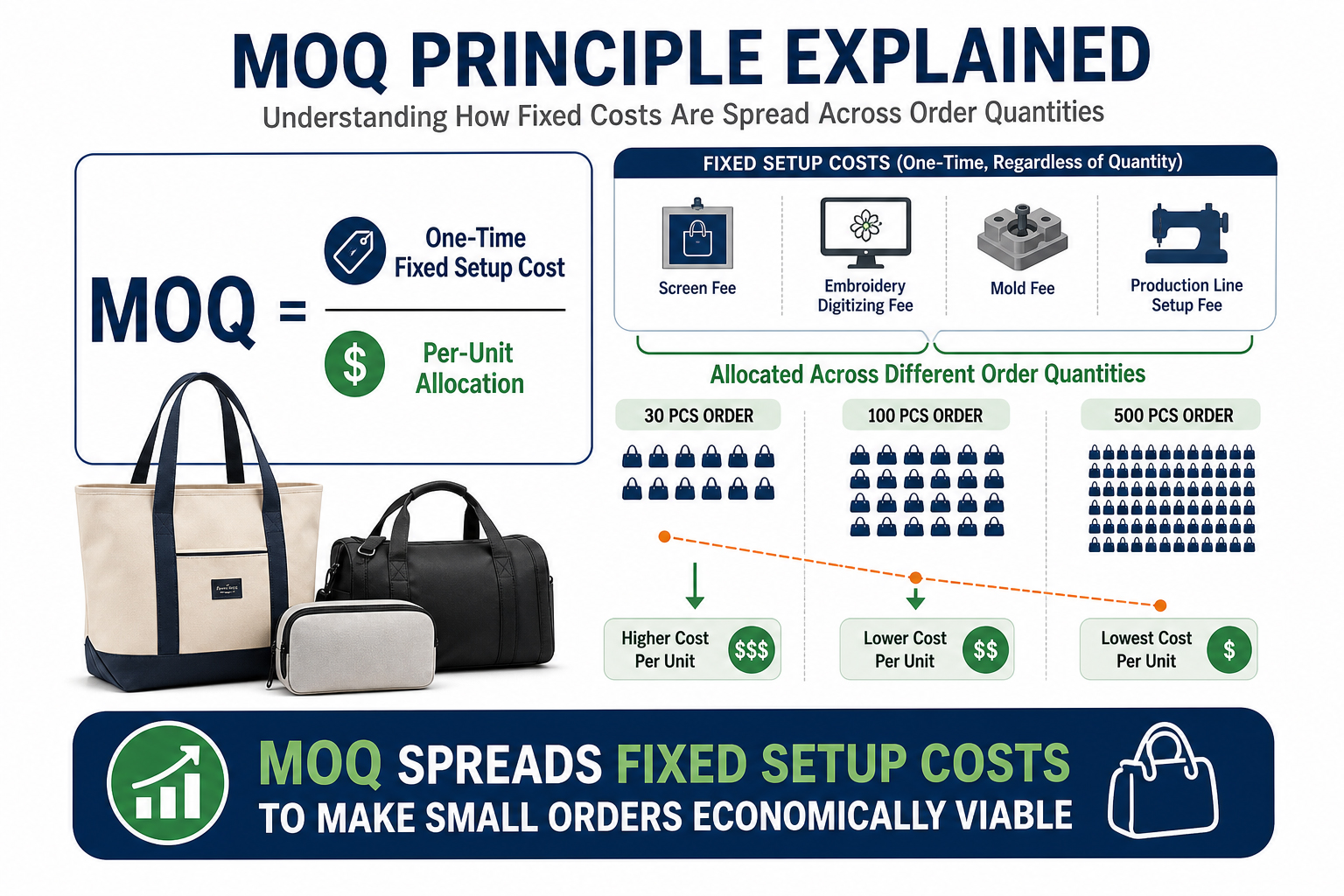
MOQ, Minimum Order Quantity, is the minimum number of finished units a factory is willing to produce for one customized order. Factories set MOQs to cover fixed setup costs: screen making for printing, embroidery digitizing, metal die carving, mold creation for PVC patches, fabric preparation, production line setup and quality inspection. These setup fees are mostly fixed, regardless of whether you order 30 bags or 500 bags. Factories use MOQ to spread these one-time fixed expenses across enough finished units to make the project economically viable.
For US independent website sellers, MOQ is especially important. Most small online brands start with product validation before committing to large inventory. Over-ordering ties up your capital, creates warehousing pressure and inventory risk. Ordering below MOQ without proper negotiation may result in rejected quotes, poor quality control or unexpected surcharges. It is therefore essential to learn how each logo technique impacts MOQ before sending your first inquiry to Chinese bag suppliers.
Typical MOQ for Each Logo Customization Method
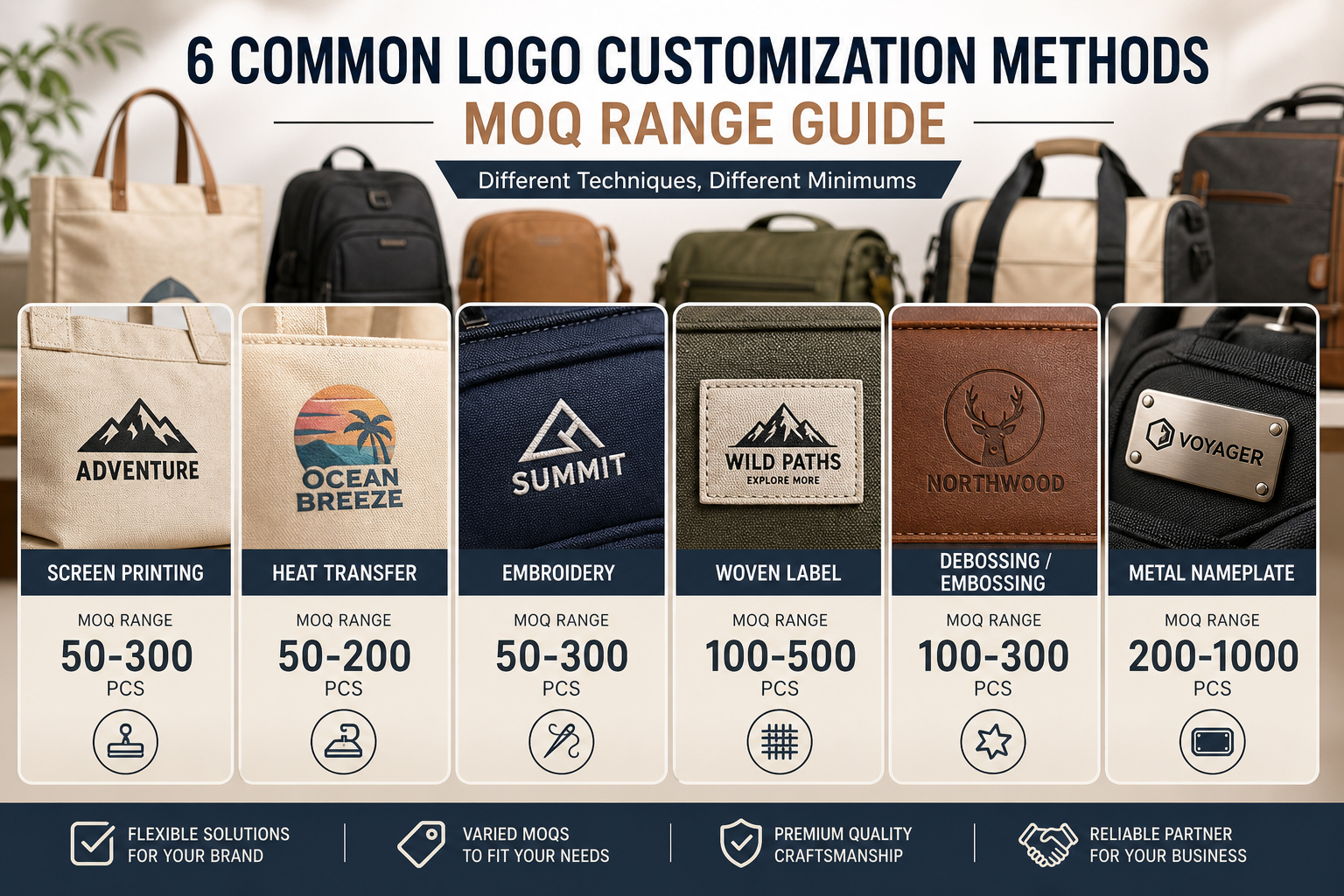
Below is a detailed breakdown of common logo decoration techniques used by Chinese bag factories, including typical MOQ per design and practical notes for US buyers.
Screen Printing / Silk Screen Printing
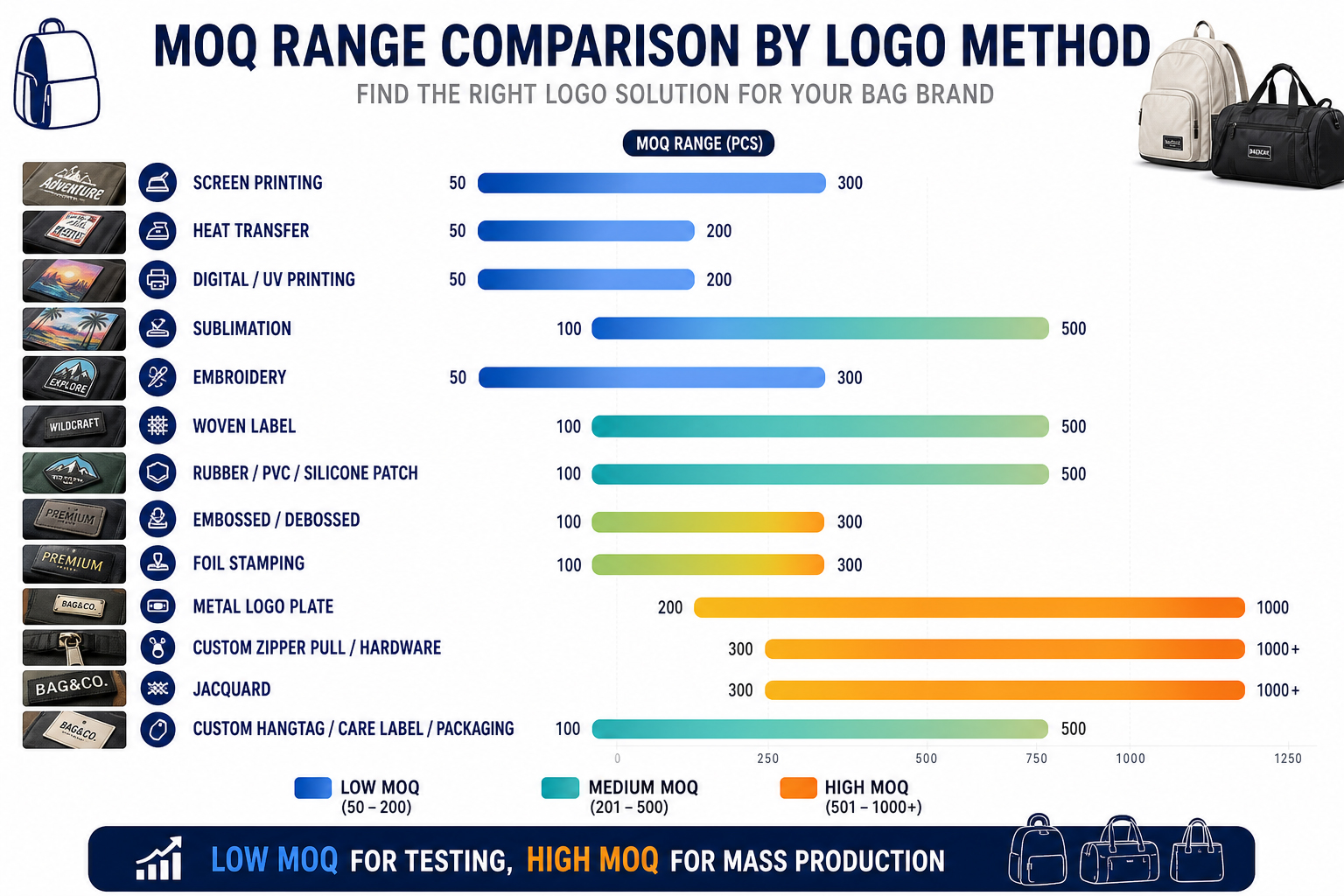
Typical MOQ: 50–300 pieces per design and color Silk screen printing is the most widely adopted and cost-effective logo technique for canvas, cotton and polyester promotional bags. The process pushes ink through mesh screens onto fabric. Each separate logo color requires one dedicated screen, which creates setup labor and material cost. One-color or two-color logos are the easiest and lowest-cost option for screen printing. Simple screen print projects can sometimes accept 50 units, while most standard bulk orders require 100 to 300 bags. Silk screen works best for solid, simple logos, and is less suitable for photographic gradients or ultra-fine details.
Heat Transfer Printing
Typical MOQ: 50–200 pieces per design Heat transfer prints your logo onto special transfer film first, then bonds the graphic to bag fabric with heat and pressure. It excels for detailed, multi-color and gradient logos. This method is very friendly to small-batch testing. Some flexible Chinese factories accept orders starting at 50 pieces, though 100 units is the more common baseline requirement. Heat transfer is widely used for nylon backpacks, sport bags and fashion bags, ideal for US sellers who want rich, complex artwork without high screen setup fees.
Digital / UV Printing
Typical MOQ: 50–200 pieces per design Digital and UV printing directly print graphics onto bag surfaces without screen production. It supports photographic images, gradients and full-color artwork. MOQ requirements are relatively low, but the per-unit price is generally higher than screen printing. This technique is perfect for limited-edition bag collections sold on independent websites, where you prioritize visual effect over bulk unit cost.
Sublimation Printing
Typical MOQ:100–500 pieces per design Sublimation infuses dye directly into polyester fabric, creating long-lasting all-over patterns or full-surface logos. It is commonly used for polyester drawstring bags, backpacks and tote bags. If you require custom dyed or custom-woven fabric for sublimation bags, the MOQ will increase significantly. It is critical to note: silk screen, heat transfer and sublimation printing usually calculate MOQ and charges by color. More colors mean extra setup work and higher costs, which can also raise the practical minimum quantity.
Embroidery
Typical MOQ: 50–300 pieces per design Embroidery uses computerized machines to stitch thread directly onto bag material. It delivers a premium, tactile, highly durable finish, making it a favorite for backpacks and high-end fabric bags. The factory needs to digitize your logo into stitch files before production, which creates a fixed setup cost. Simple embroidery can start at 50 units. However, complex patterns, oversized logos, many thread colors or 3D puff embroidery will push the MOQ upward to 100–200 bags. Stock blank bags with embroidery customization often allow lower MOQs than fully custom OEM bag designs.
Woven Label / Sewn Label
Typical MOQ:100–500 pieces Woven labels are separate branded tags sewn onto bags. The label supplier has its own independent MOQ, commonly 100 pieces for the labels themselves. The bag factory will normally set MOQ for finished bags between 100 and 300 units. One batch of woven labels can sometimes be applied across multiple bag styles, which gives sellers flexibility for multi-SKU small-batch testing. Woven labels are a popular private-label solution for US independent stores to create professional brand presentation without extremely high MOQ.
Rubber, PVC or Silicone Patch
Typical MOQ:100–500 pieces Custom rubber and silicone patches need new molds for each unique design. Simple flat patches can start at 100 pieces, while 3D or multi-color silicone patches usually require 300–500 units. The patch is produced separately and then sewn or riveted to the bag. Outdoor and casual bag brands often select rubber patches for a rugged, branded look.
Embossed / Debossed Logo
Typical MOQ:100–300 pieces.Embossing creates raised logos, while debossing presses the logo inward into the material. This technique works best on leather, PU and some synthetic materials, delivering a quiet luxury aesthetic without printed ink. Some leather bag manufacturers accept orders starting from 100 pieces if no complicated separate metal plate is required. For premium leather handbags, debossing often requires 200 to 500 bags to offset die tooling costs.
Foil Stamping / Hot Stamping
Typical MOQ:100–300 pieces Hot stamping applies metallic gold, silver or colored foil onto leather or PU bags under heat and pressure. A custom stamping die is required, so factories either set a higher MOQ or charge a one-time die setup fee for small runs. It is widely used for premium fashion bags and leather accessories.
Custom Metal Logo Plate
Typical MOQ:200–1,000 pieces Custom metal nameplates are among the highest-MOQ logo options. Each unique design requires a new metal mold. For a standard bag product line, a realistic expectation is 200–500 finished bags. Many metal tag suppliers set MOQ at 500 or even 1,000 units. Metal plates are riveted or stitched onto structured handbags and high-end backpacks, bringing strong premium branding, but they are not recommended for first-time product testing due to high tooling and quantity requirements.
Custom Zipper Pull or Custom Metal Hardware Logo
Typical MOQ:300–1,000+ pieces Custom zipper pulls and branded metal hardware are manufactured separately from the bag body. Factories usually quote MOQ based on the hardware design itself instead of finished bags. This category has one of the steepest minimum quantity thresholds among all branding choices.
Jacquard (Logo Woven Into Fabric)
Typical MOQ:300–1,000+ pieces Jacquard weaves your logo directly into fabric or webbing during textile production. It creates integrated, high-end branding but demands custom fabric weaving. The MOQ and overall cost are much higher than printing a logo onto existing stock fabric.
Custom Hangtag, Care Label or Packaging
Typical MOQ:100–500 pieces Custom hangtags, care labels and retail packaging can be produced separately. These items carry their own independent MOQ, even if your finished bag MOQ is lower. Many US sellers overlook packaging MOQ, which can delay shipments if not confirmed in advance.
MOQ Differences By Bag Category
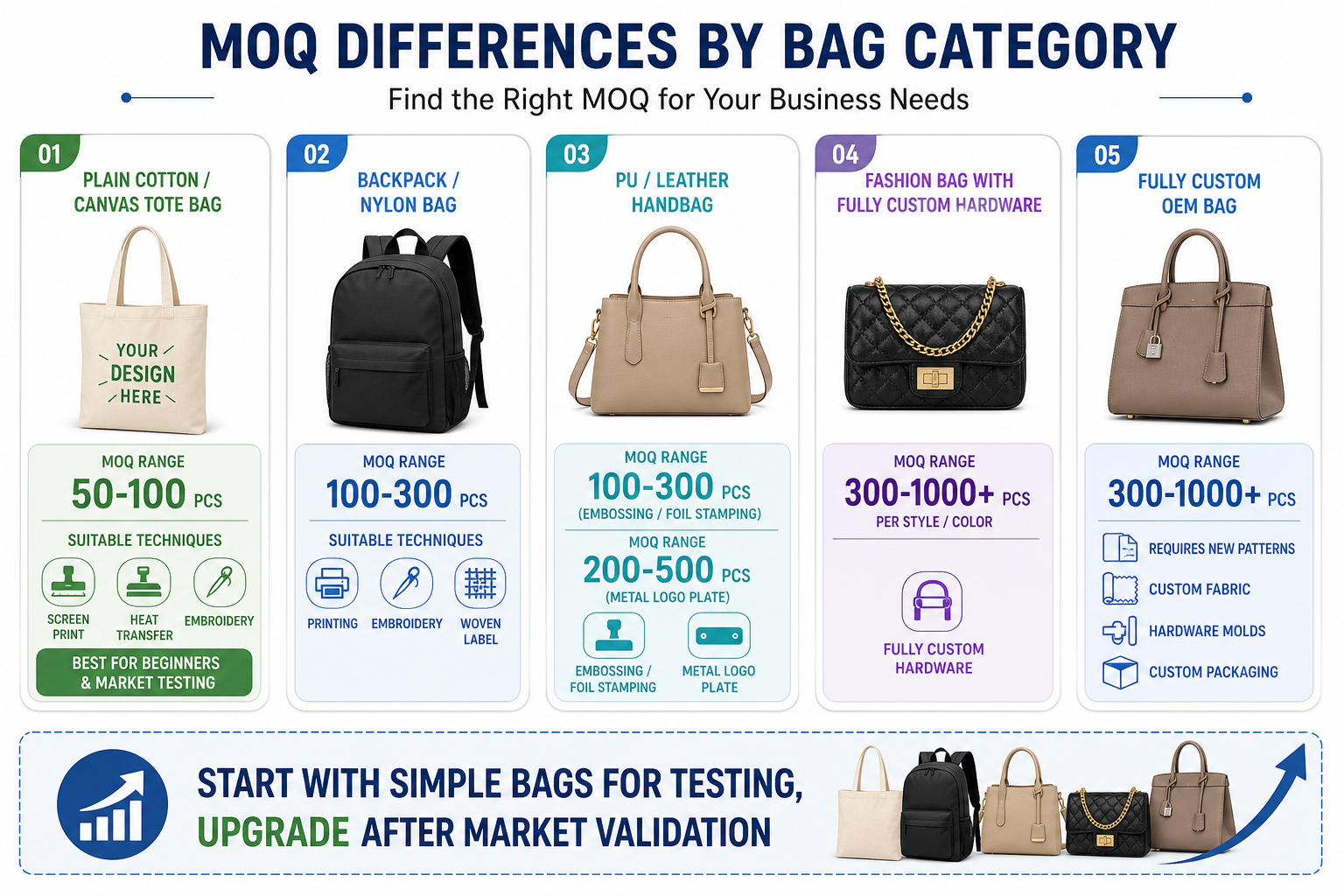
Beyond logo techniques, the base bag style heavily affects the minimum quantity you will be quoted:
* Plain cotton or canvas tote bags: 50–100 pieces for screen printing, heat transfer or embroidery when working with flexible factories. These are the most beginner-friendly bags for US independent store product tests.
* Backpack or nylon bags: 100–300 pieces for printing, embroidery or sewn woven labels.
* PU or leather handbags: 100–300 pieces for embossing or foil stamping; 200–500 pieces for custom metal logo plates.
* Fashion bags with fully custom hardware: 300–1,000+ pieces per style and color.
* Fully custom OEM bags: Usually 300–1,000+ pieces. The MOQ rises when the factory must create new patterns, source custom fabric, build molds for hardware, and produce custom packaging from scratch.
Key Sourcing Questions from US Buyers
Does the MOQ differ when placing a mixed-order combining multiple logo methods on the same bag style?
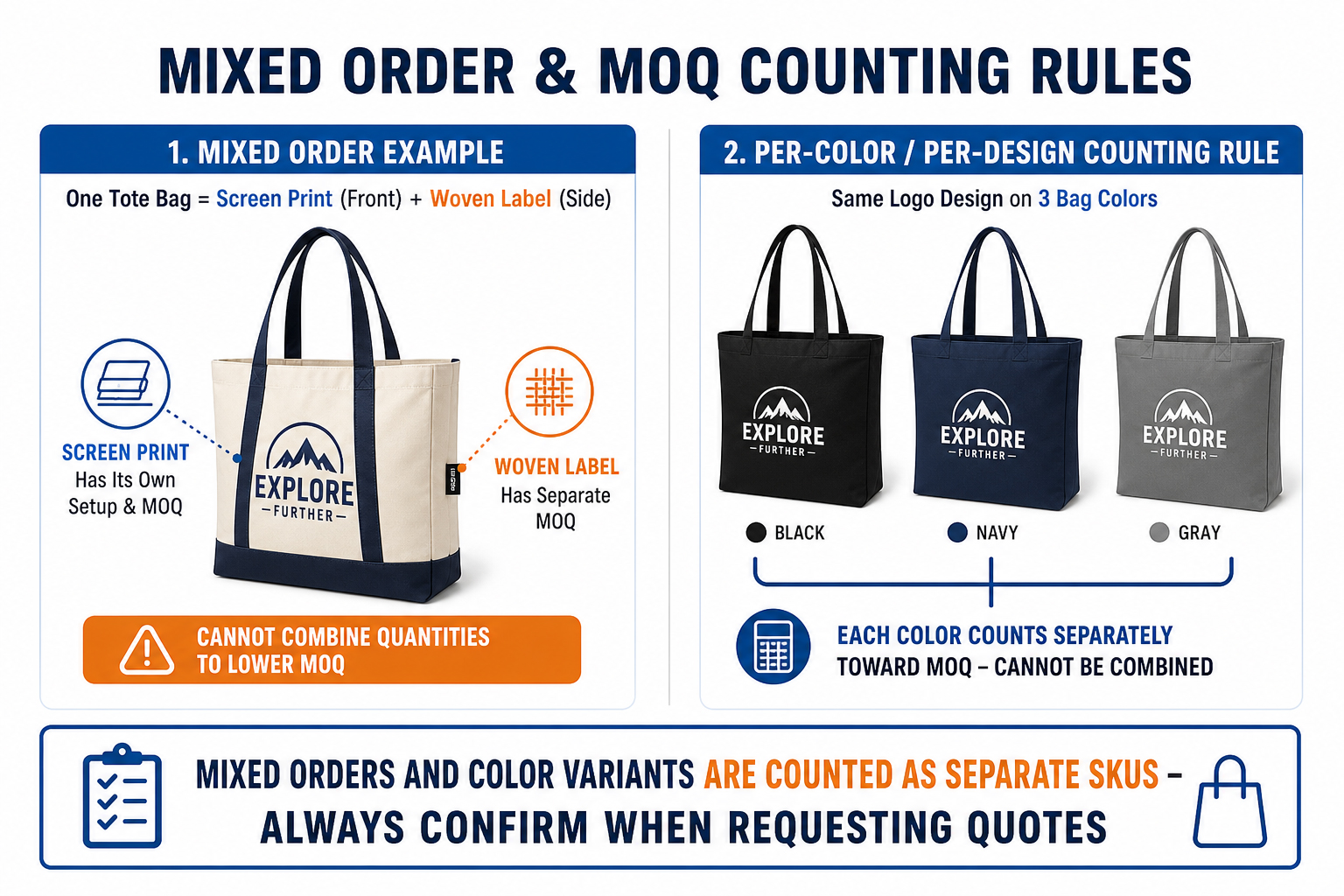
Yes. When you combine multiple logo techniques on the same bag style, factories usually treat each branding component as separate SKUs, each subject to its own MOQ threshold. For example: if one tote bag uses screen printing on the front plus a woven label sewn to the side, the screen print has its own setup and MOQ, and the woven label order has its own separate minimum. Mixed logo processes increase setup work, tooling and inspection time. Therefore, mixed logo orders rarely allow you to combine quantities to meet a single lower MOQ.
Can MOQ requirements be negotiated lower if the buyer agrees to pay a higher per-unit price upfront?
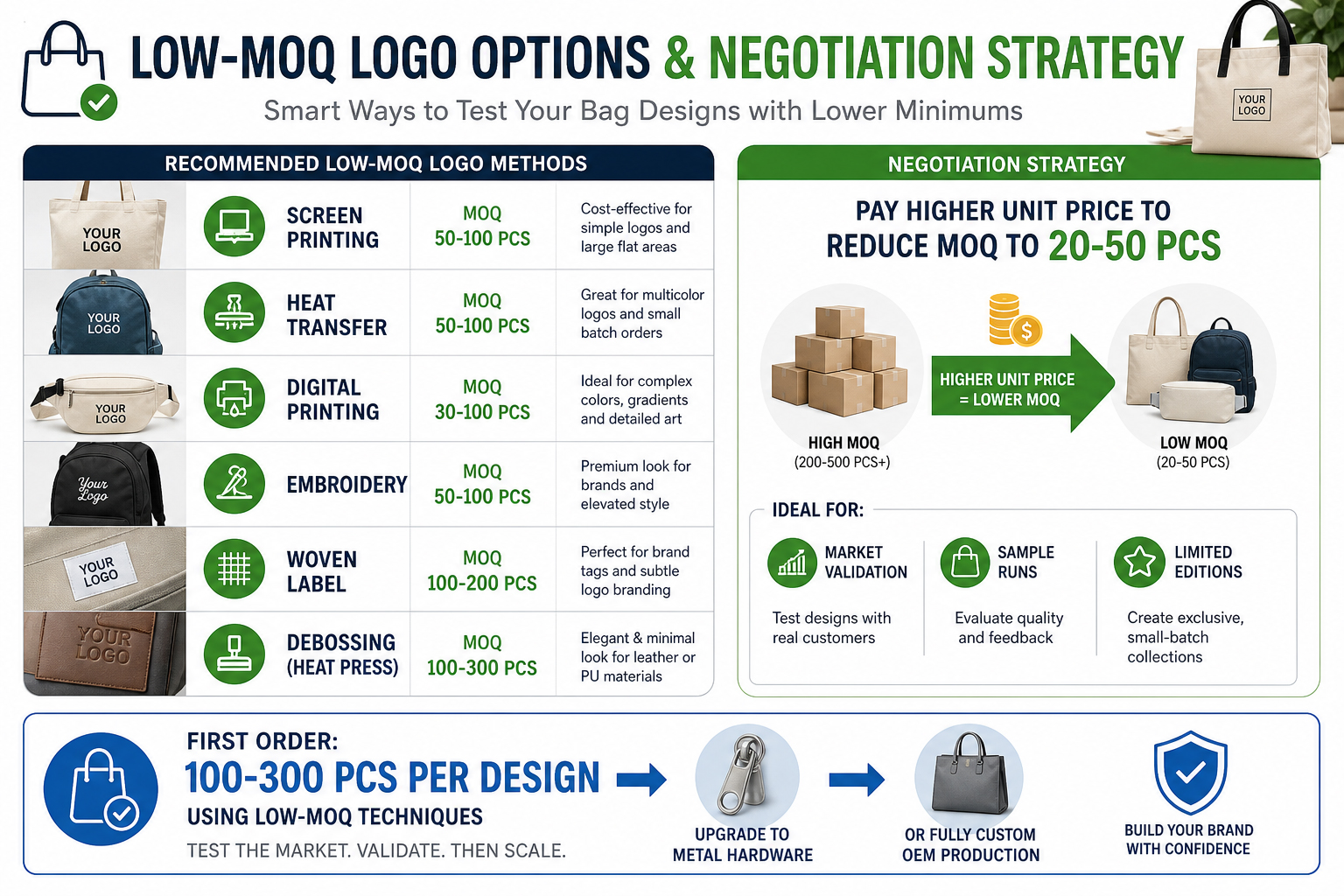
Absolutely. This is one of the most common negotiation tactics for US small independent website sellers. When your quantity cannot meet the factory’s standard MOQ, many Chinese bag manufacturers accept small batch orders with a surcharge. You pay a higher unit price, and the extra premium compensates the factory for the fixed setup costs spread over fewer finished bags. This tradeoff is perfect for market validation, sample runs, limited-edition collections and low-risk testing before scaling up bulk production. Trade-show or sample-run orders can often be negotiated down to 20–50 units across most logo methods with a price premium.
Is the MOQ applied per design or per color when using silk screen, heat transfer, or sublimation printing?
This is a frequent source of miscommunication between US buyers and Chinese factories. For silk screen, heat transfer and sublimation printing, MOQ and pricing are normally calculated per color. Factories usually define MOQ per design, per color, per bag style. If you order one logo design in three different bag colors, each color variant may count separately toward MOQ, not combined. Always clarify this point before confirming quotations.
How does the MOQ impact lead time, production scheduling, and shipping consolidation options for overseas buyers?
MOQ directly shapes your entire production and shipping timeline. Small MOQ orders generally get shorter production lead times. Factories can slot small batches into gaps between larger mass-production runs. However, small orders often have lower priority on the production line; if the factory receives large rush orders, your small batch may be rescheduled. Large MOQ orders get dedicated production line scheduling and more stable lead times. Factories allocate full cutting, sewing and branding capacity for big orders, with fewer delays.
For shipping consolidation: small MOQ orders are less economical for sea freight. Many US sellers combine multiple small SKUs into one consolidated shipment to reduce per-unit international freight cost. However, consolidation requires coordinating production completion dates across multiple styles, colors or logo versions. Large MOQ bulk shipments enjoy better per-unit sea freight rates, but they increase inventory holding cost and capital risk for your US warehouse.
A low-MOQ order may be ready quickly but have expensive per-unit air or sea shipping. A high-MOQ bulk order has cheaper unit product and shipping cost, but longer lead time, higher upfront investment and greater inventory risk for your independent website store. This balance is the core of sourcing strategy for US e-commerce bag brands.
Essential Questions to Ask Your Chinese Bag Factory
When you reach out to suppliers, do not simply ask “What is your logo MOQ?” Use this complete list of targeted questions to avoid misunderstandings and hidden fees:
* Is the MOQ per logo, per bag style, per color, or per size?
* Can I mix colors or styles to reach the required MOQ?
* Is the logo setup fee included in the quoted price?
* Is the mold or embroidery digitizing fee refundable after I place my next bulk reorder?
* Does this MOQ apply to finished bags, or only for separate labels, patches, and metal hardware parts?
* Can you produce pre-production samples before bulk manufacturing?
* Can the same logo mold, label, or patch artwork be reused for future repeat orders?
* What MOQ applies for repeat orders after my first bulk run?
* Please provide formal quotations for 50, 100, 300, and 500 pieces for comparison.
* Is your quoted price FOB, CIF, or DDP to the United States?
Recommended Logo Options for Small US Independent Website Retailers
If you are testing bag products on your independent website and want to minimize risk and upfront investment, select branding techniques with lower MOQ first:
* Screen printing: Best low-cost option for canvas and promotional tote bags with simple logos.
* Heat transfer or digital printing: Best choice for complex, multi-color, gradient logos on small test batches.
* Embroidery: Premium tactile finish for backpacks and high-quality fabric bags.
* Woven labels: Clean private-label branding to make your bags look professional without expensive metal molds.
* Embossing / debossing: Elegant luxury appearance for PU and leather bags, without the high MOQ required by custom metal hardware.
We strongly recommend avoiding custom metal hardware and fully custom OEM bag construction in your first order. Those options require high MOQ, expensive tooling and large upfront capital investment. Reserve those upgrades until your independent website sales data proves the product sells steadily.
Sample Inquiry Template You Can Send Directly to Chinese Bag Factories
Copy this inquiry to send to suppliers when collecting quotes:
Please quote your MOQ and unit price for 50, 100, 300, and 500 pieces per style and per color. Please compare screen printing, heat transfer, embroidery, woven label, rubber patch, embossing, and metal logo plate options. Include sample fee, logo setup or mold fee, production lead time, packaging specifications, and total shipping cost to the USA.
For your first bulk order, target roughly 100–300 finished bags per design. Use printing, embroidery, woven labels or embossing to launch your product line. This quantity balances inventory risk, unit cost and branding quality perfectly for most US independent bag websites.
Final Thoughts
Understanding logo MOQ is the foundation of successful bag sourcing from China for US independent store sellers. MOQ is not a rigid rule written in stone. It changes based on logo method, bag material, color count, tooling cost and negotiation. Low-MOQ branding techniques such as heat transfer and screen printing are ideal for testing new designs, while embroidery, debossing and woven labels deliver premium branding at moderate minimum quantities. Custom metal plates, jacquard fabric and custom hardware create the most luxurious look, but they come with high MOQ and large upfront investment.
When negotiating with factories, always confirm whether MOQ counts by design, color or SKU, clarify mixed-logo order rules, and ask about small-batch surcharges. Align your MOQ selection with your sales forecast on your independent website. Start small, validate demand with low-risk test orders, then scale up to larger MOQs once your products gain traction with US customers. This sourcing strategy protects your cash flow, reduces inventory waste, and builds a stable long-term partnership with reliable Chinese bag manufacturers.
Post time: Sep-15-2026