
Word count: 2742 | American English | Blog post for US‑based bag e‑commerce website
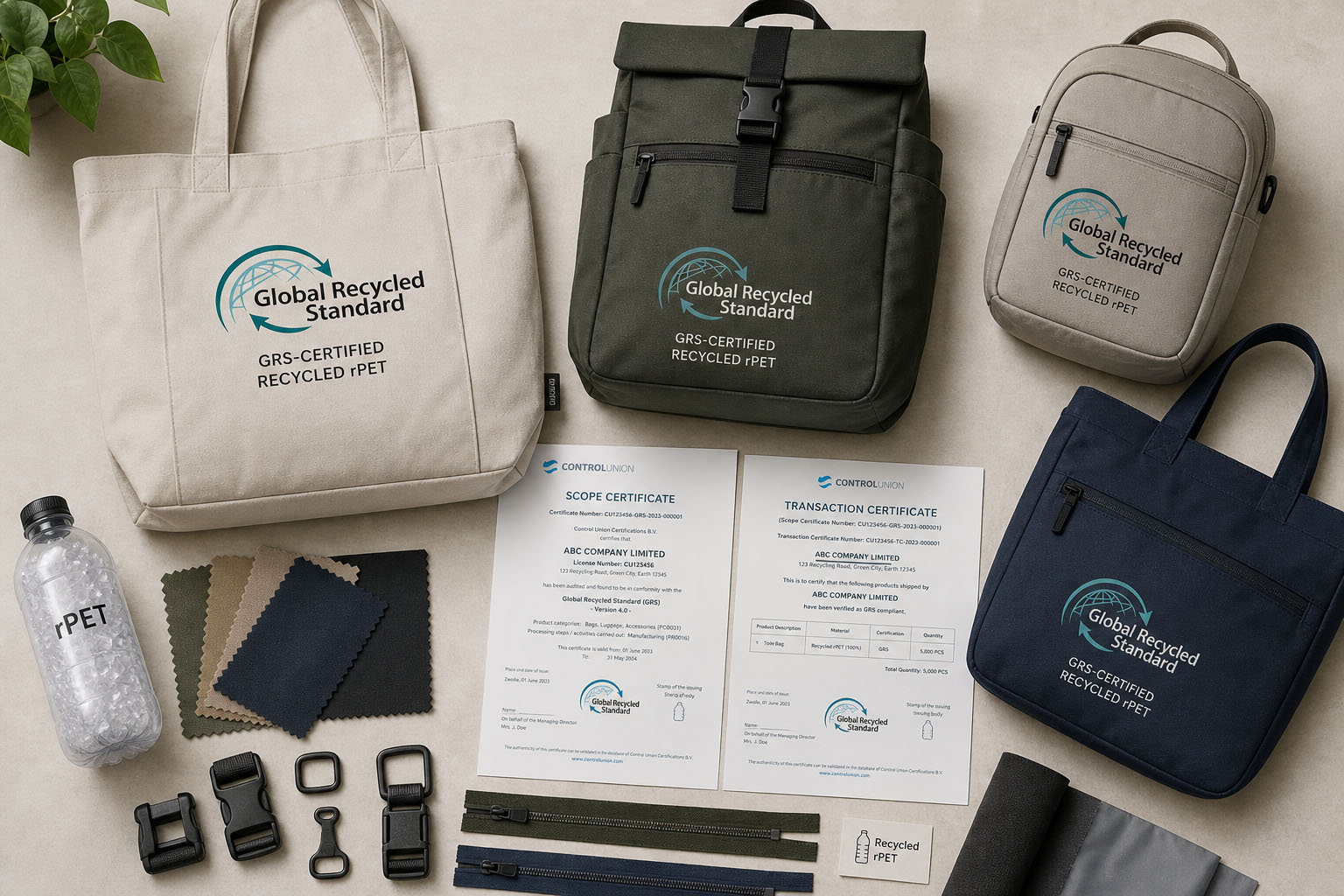
Sustainable consumer demand continues to surge across the United States. Modern online shoppers no longer accept vague marketing phrases such as “eco‑friendly” or “made from recycled plastic”. Customers want verifiable proof that the bags they purchase genuinely contain recycled raw materials, without greenwashing. For US‑based bag sellers sourcing inventory directly from Chinese manufacturers, the Global Recycled Standard (GRS) has become the gold‑third‑party certification to validate recycled‑material product claims for brand marketing. If you operate a bag e‑commerce website and plan to source tote bags, backpacks, cooler bags and other bag categories from China, fully understanding GRS rules, factory capabilities, cost impacts, certificate scope and compliance risks directly shapes your product development, marketing copy and supplier selection. This practical guide breaks down every critical question US importers face when sourcing GRS‑certified bags from Chinese factories, including content thresholds, certificate coverage, MOQ and price changes, audit cycles, and step‑by‑step supplier verification workflows.
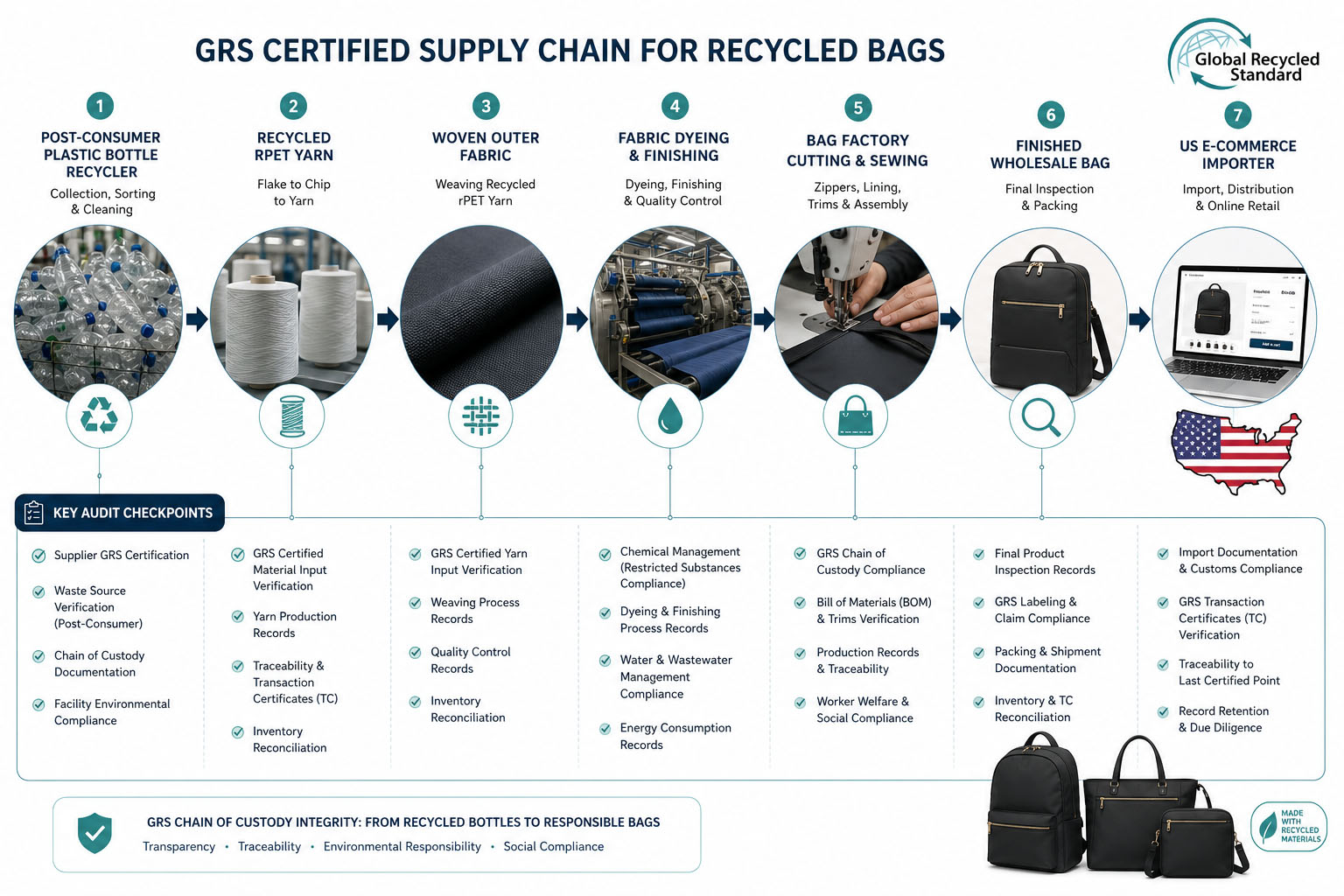
GRS (Global Recycled Standard) certification is increasingly adopted by Chinese bag manufacturers to validate recycled material claims for export markets targeting North America and the European Union. Unlike generic self‑declarations from factories, GRS covers the entire supply chain, tracing recycled content from raw material origin all the way through to the final finished bag product. To hold valid GRS certification, certified factories must satisfy three core categories of requirements: recycled material content thresholds, formal environmental management protocols inside production facilities, and mandatory social responsibility standards covering factory worker conditions. A large number of Chinese bag suppliers already maintain active GRS certificates, with high concentrations of qualified manufacturers located in major bag‑producing regions including Guangdong, Zhejiang, and Fujian. Most GRS‑certified bag goods produced in these regions rely heavily on rPET (recycled polyester), which is manufactured from post‑consumer waste plastic bottles, the most widely accessible recycled feedstock for soft‑goods bag production today.
Many new US independent‑site sellers misunderstand what GRS actually delivers. GRS is an international, voluntary industry standard. It does not only calculate what percentage of recycled fibre sits inside your finished bag. It enforces verified recycled content claims, strict chain‑of‑custody tracking, plus binding social compliance rules, environmental controls, and restricted chemical substance lists, all validated through independent third‑party certification audits. Authorized global audit bodies issuing GRS credentials include well‑known names such as SGS, Intertek, Bureau Veritas (BV), SCS Global Services and GCL‑International. For US e‑commerce merchants, this multi‑layer verification is extremely valuable. When you advertise “recycled bags” on your website, social media and product packaging, GRS documentation defends you against greenwashing accusations, reduces consumer complaints, and satisfies growing sustainability requirements from retail partners and online marketplace policies.
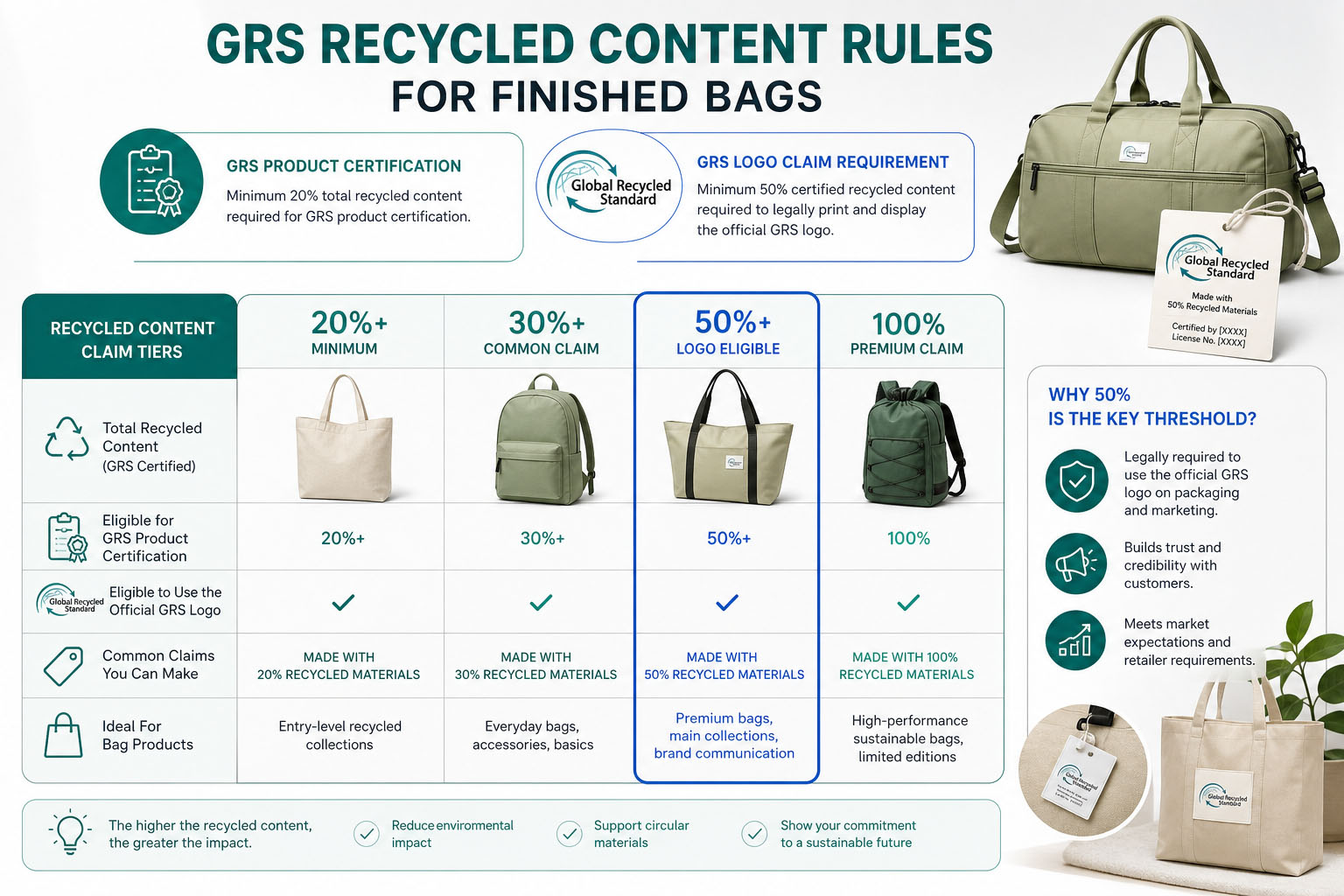
Core GRS Rules: Recycled Content Thresholds for Bags and Bag Components
One of the most frequent questions from US bag buyers is: what minimum recycled content percentage is required for GRS certification on bags and bag components?
Per official GRS protocol, a finished product qualifies to receive GRS certification with a **minimum of 20% recycled material** by product weight. This 20% baseline applies to the complete finished bag unit, not merely the main outer fabric. You are fully permitted to market and label higher recycled‑content values on your store product pages, with common selling tiers at 30%, 50%, or 100% certified recycled material.
There is a critical distinction between holding GRS‑certified product status and the right to use the official GRS logo in your brand marketing. Even if your finished bag meets the 20% minimum for GRS product certification, you **cannot legally print the GRS logo on your product tags, packaging or website marketing visuals unless your final finished bag contains ≥50% total certified recycled content**, and every individual recycled input material within that item also meets at least the 20% recycled threshold. This rule creates common pitfalls for US independent‑site sellers. Many importers receive GRS‑qualified bags hitting 25‑40% recycled content, then incorrectly add the GRS logo to product photos and landing pages. This mistake creates compliance risk, trademark violations and potential green‑washing claims. You can still write descriptive text stating “This product is GRS‑certified with X% recycled content” for items between 20‑49% recycled material, but visual use of the GRS mark is restricted for products below the 50% threshold.
It is also important to separate GRS from RCS, the Recycled Claim Standard. RCS only verifies recycled material percentages, without GRS’s social compliance, chemical restriction and environmental factory requirements. RCS can act as a practical fallback option when GRS lead‑times or costs become prohibitive, but it carries far less weight for US brand‑level marketing and major retailer vendor requirements.
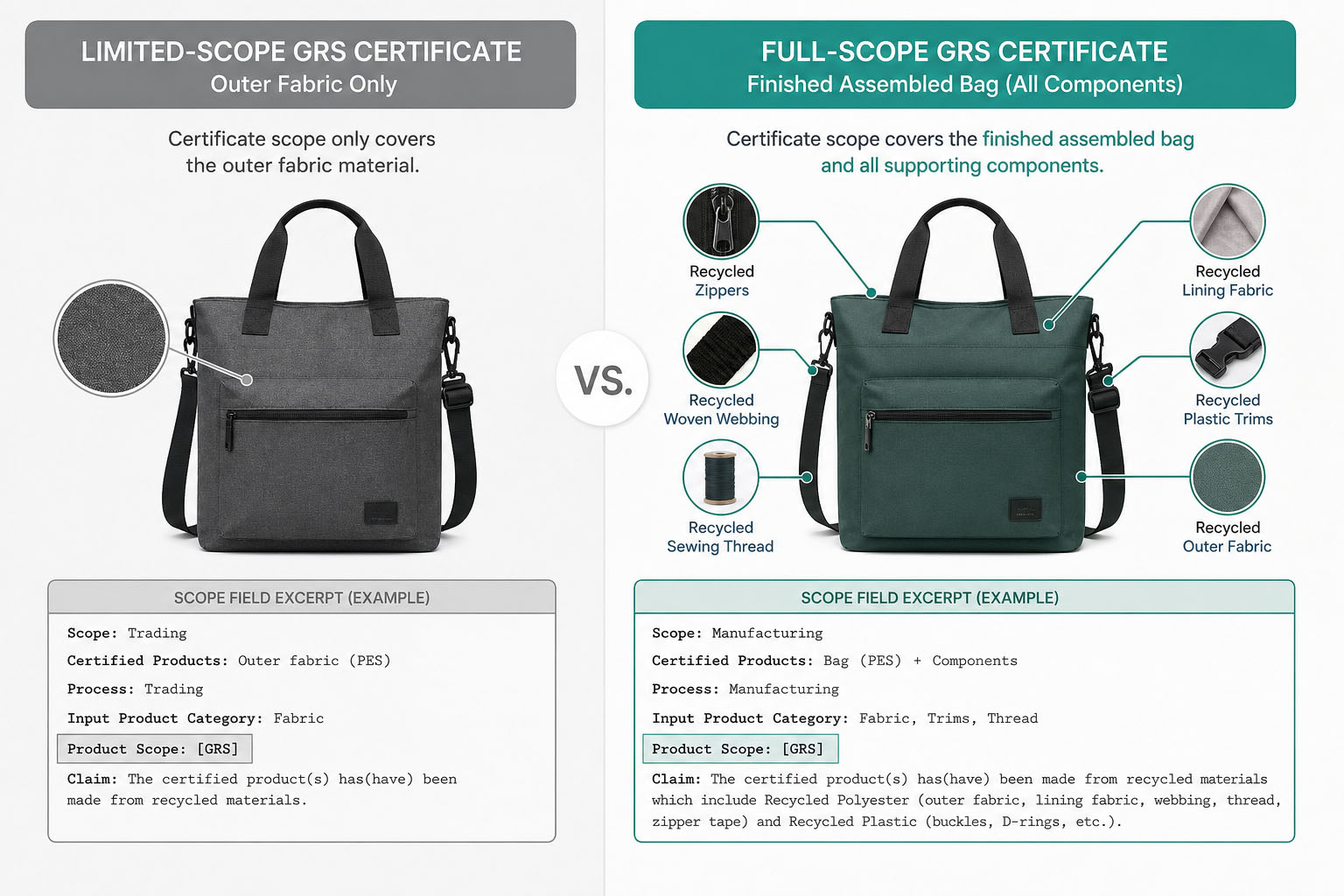
GRS Certificate Scope: Do Chinese Factory Certificates Cover Full Finished Bags or Only Outer Fabric?
This represents one of the highest‑risk points for cross‑border bag buyers sourcing from China. Many US merchants receive a GRS certificate from a Chinese bag factory and immediately assume the whole finished bag including hardware and inner components falls under certification coverage. This is not automatically true.
You must carefully read the scope section printed on the supplier’s GRS Scope Certificate. Some Chinese factories only hold GRS certification for cutting and sewing operations using pre‑certified GRS outer fabric. Their certificate scope explicitly excludes auxiliary bag components: zippers, lining fabrics, woven webbing, sewing thread, plastic buckles and decorative trims. In this scenario, only the main outer fabric carries GRS traceability. The rest of your bag parts come from non‑GRS‑qualified supply sources. While the finished bag can still hit the overall 20% minimum recycled content requirement calculated by weight, you cannot make full‑product GRS marketing claims for the complete assembled bag.
Premium compliant GRS bag suppliers maintain full‑chain traceability. Every upstream link in their supply chain — recycler, yarn spinner, fabric mill, dyeing house, component supplier for zippers and lining, and final bag assembly factory — must be covered under GRS chain‑of‑custody rules. Each tier needs valid certification documentation. For US e‑commerce sellers, you must explicitly ask your Chinese manufacturer whether their GRS scope certificate includes finished assembled bags together with all secondary components, or only base outer fabric material. If zippers, lining and trims sit outside the certified scope, your transaction certificate will reflect this limitation, and your marketing copy must accurately reflect which parts of the bag contain certified recycled content.
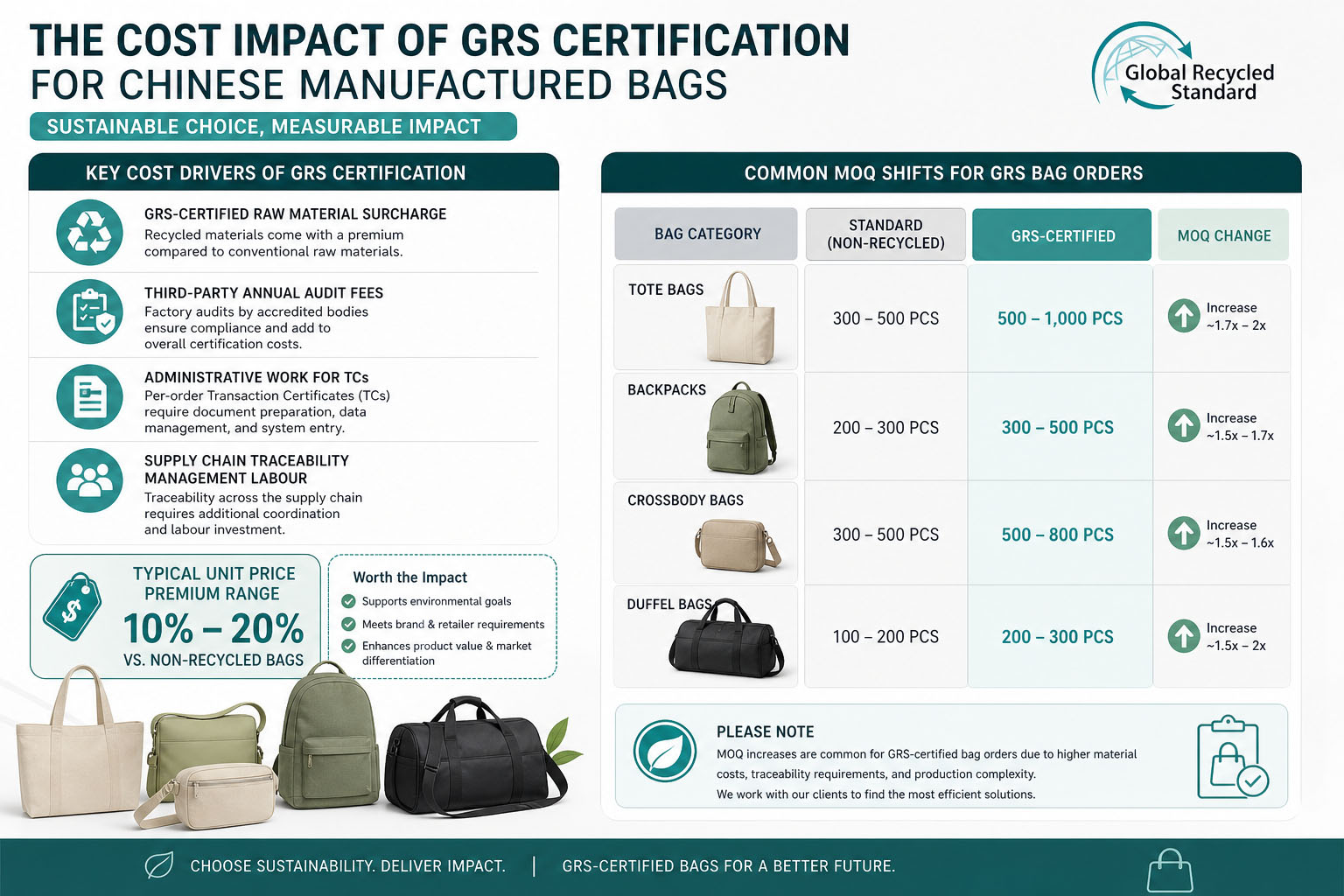
Price Premium and MOQ Changes When Sourcing GRS‑Certified Bags From Chinese Bag Manufacturers
Sustainable certification comes with tangible production‑cost consequences that every US independent‑site seller must budget for. GRS‑certified bags typically carry higher unit price points, because certified recycled raw materials, factory audit expenses, traceability administration and TC document processing collectively lift overall production costs by **10‑20% versus equivalent non‑GRS conventional bags**. This percentage range is the industry‑wide typical price premium US buyers encounter working with Chinese GRS bag factories.
Beyond per‑unit price increases, you will often see adjustments to minimum order quantities (MOQ). There are two primary reasons for higher MOQ expectations. First, GRS‑certified recycled fabrics and certified hardware components are produced in dedicated production runs. Factories cannot freely mix GRS‑certified and non‑certified materials on the same production line without strict line‑cleaning protocols to avoid cross‑contamination. Small batch orders become operationally complex for manufacturers. Second, factories absorb fixed annual third‑party audit overhead regardless of order volume. Many suppliers apply higher MOQ thresholds for GRS projects to offset these fixed compliance costs.
It is worth noting that MOQ increases vary widely across different Chinese regions and factory sizes. Larger established GRS‑certified bag factories in Zhejiang and Guangdong maintain bigger stock pools of GRS‑qualified rPET fabric, and can sometimes accept relatively lower MOQ for stock‑style tote bags and simple backpack designs. Smaller sewing workshops with GRS credentials usually enforce significantly higher minimum order sizes. As a US buyer, you should separate two questions during RFQ: what is the unit‑price premium for GRS‑certified finished bags versus standard identical‑spec non‑GRS goods, and what is the exact MOQ for GRS production for your specific bag style. Do not accept vague replies. Secure written pricing and MOQ terms within your formal quotation document.
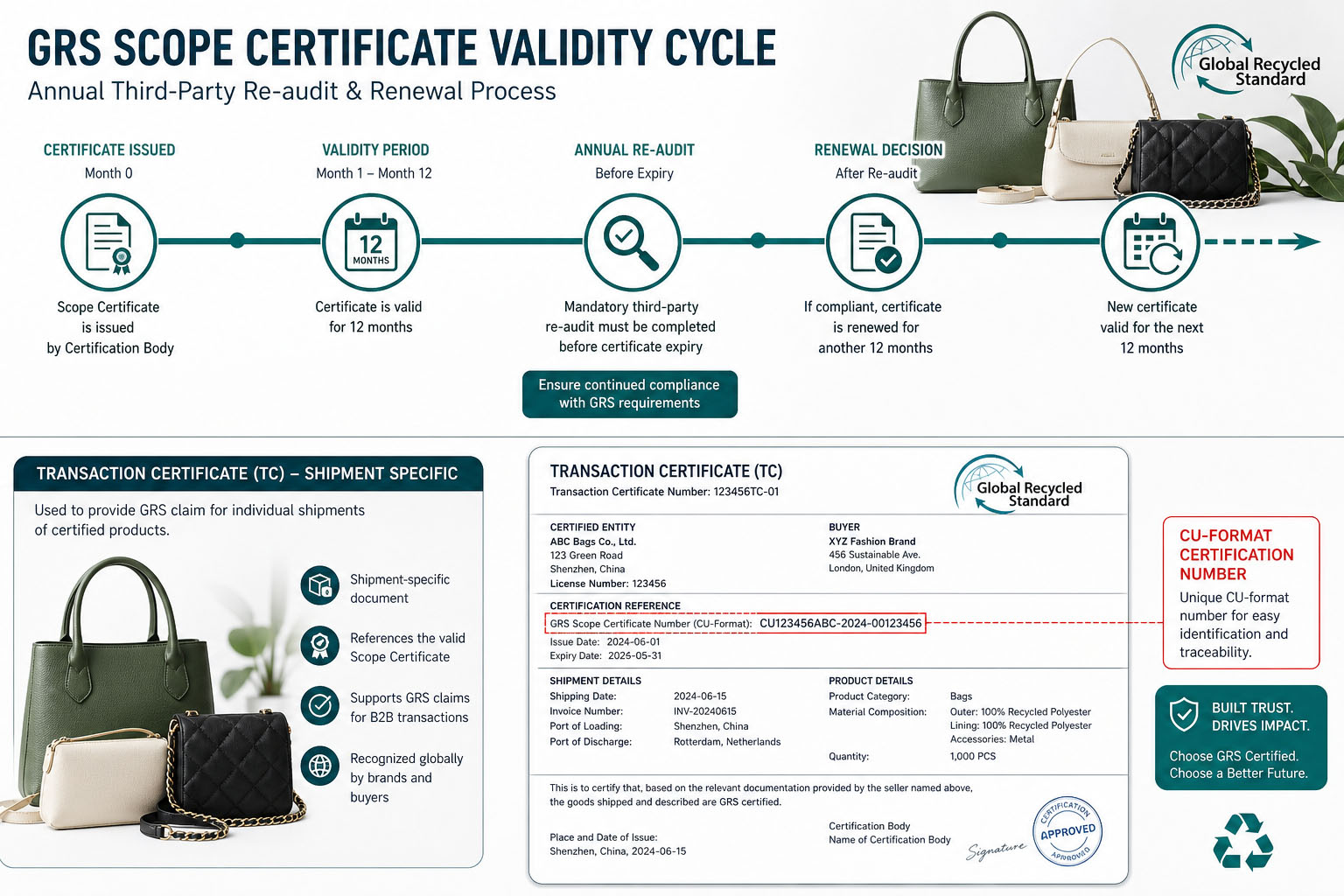
GRS Certificate Validity, Annual Audits and Transaction Certificate (TC) Critical Details
Many importers mistakenly believe one‑time GRS certification lasts indefinitely. All official GRS scope certificates have a fixed validity period of **12 months**. Factories are required to complete mandatory annual third‑party re‑auditing to achieve certificate renewal. If a supplier fails their yearly audit, their GRS credentials will suspend or expire, and they can no longer produce GRS‑traceable goods. When you receive a supplier’s scope certificate file, always double‑check the issue date and expiration date printed clearly on the document. Out‑of‑date certificates hold zero commercial value for your US‑market sales.
A second non‑negotiable document for US bag sellers is the Transaction Certificate, universally shortened to TC. The scope certificate only proves the factory itself holds GRS qualification. A TC is generated per individual production order and shipment. It formally traces the exact quantity of GRS‑certified finished bags moving from the certified Chinese factory to your US import entity. Without valid shipment‑specific TC documentation, you do not hold legal grounds to make GRS‑linked recycled‑content marketing claims on your US website, product listings or advertisements. Even if the factory holds a current active scope certificate, you must request corresponding TC paperwork for every GRS‑certified container you import.
You can independently validate supplier credentials through Textile Exchange’s public “Find Certified Company” online database. Input the supplier’s unique CU‑prefixed certification number to cross‑check certificate status, expiry date and official certification scope. This is your most powerful defence against fake or altered GRS certificates circulating among Chinese trading companies. Some trading firms forward third‑party factory certificates while their own company remains uncertified. Always confirm whether your direct business partner is listed under the certified entity record.
Major United States and European brand buyers already embed GRS compliance clauses inside formal supplier agreements. For Chinese bag factories, maintaining valid GRS certification represents a major competitive advantage to win export business. For you as an independent‑site US bag merchant, GRS documentation mitigates reputational risk, satisfies sustainability‑focused consumer expectations, and opens potential wholesale partnership opportunities with offline retail channels.
Practical Step‑by‑Step Workflow: How US Buyers Verify Chinese Supplier GRS Claims
Working with GRS‑certified Chinese bag suppliers requires structured due diligence before you place large‑volume orders. Follow this checklist for every potential vendor:
1. Request their official GRS Scope Certificate issued by an accredited certification body such as SCS Global Services, Bureau Veritas, Intertek or GCL International. Inspect the certificate expiry date and the defined product scope. Confirm finished assembled bags and your required bag components fall within that scope.
2. Explicitly require sample or historical shipment Transaction Certificates (TC), to review document format before your production run. Confirm they will issue a full TC for your exact order quantity upon completion of manufacturing.
3. Record the supplier’s official CU‑series certification number, and manually verify status inside Textile Exchange public certified‑company database.
4. Confirm upstream supply‑chain status: ask whether fabric, webbing, sewing thread, zippers and lining material suppliers also hold matching GRS chain‑of‑custody certification.
5. If a factory cannot produce valid GRS scope and TC documents but continues to advertise “recycled material” bags, you have two reasonable alternatives. You can move to RCS (Recycled Claim Standard) as a lower‑bar alternative certification, or require independent lab test reports to verify recycled‑fibre content without full GRS compliance. Remember RCS does not cover social responsibility or chemical restrictions.
Below is a set of practical direct questions you can copy‑paste into your RFQ messages when communicating with prospective Chinese bag manufacturers:
- “Are your production facilities GRS‑certified? Please share your full current Scope Certificate plus examples of recent Transaction Certificates.”
- “For our target bag model, what are the minimum and typical recycled‑content percentages we can achieve in finished production?”
- “If our finished bag reaches ≥50% certified recycled content, can we legally apply the official GRS logo on our US‑market packaging and website product pages?”
- “Which accredited certification body issued your GRS credentials? Please provide your certification number so we can complete independent verification.”
- “Do all key upstream suppliers within your supply chain (fabric, webbing, thread, lining and hardware components) also maintain valid GRS chain‑of‑custody certification?”
Final Takeaways for US Bag E‑commerce Sellers Sourcing GRS Bags From China
Consumer demand for authentic sustainable bag products will keep expanding across the United States. GRS certification delivers standardized, third‑party‑backed proof of recycled‑material content, social factory standards and chemical compliance for bags imported from China. Successful sourcing depends on more than simply finding a factory that says “we have GRS”. You must audit certificate expiry, carefully review certification scope to confirm coverage of zippers, lining and trims, plan for 10‑20% expected unit‑cost increases, understand MOQ adjustments, collect shipment‑level TC documents, and remember the 20% product certification threshold versus the 50% threshold required for GRS‑logo usage.
Many US independent‑site sellers make expensive early‑stage mistakes: trusting self‑declared recycled claims without documentation, misusing the GRS logo on products below 50% recycled content, accepting expired certificates, or confusing fabric‑only certification scope with full finished‑bag certification. By applying the verification steps laid out in this guide, you can source genuine GRS‑certified bags, build trustworthy sustainable product listings for your website, avoid greenwashing‑related risks, and differentiate your bag brand in the competitive US e‑commerce marketplace.
If you share further details including your target bag styles (tote bags, backpacks, cooler bags etc.), your target recycled‑content percentage, and your target retail or landed cost range, we can assist you with building a shortlist of pre‑vetted GRS‑certified Chinese bag manufacturers, plus a ready‑to‑send RFQ template you can use for supplier outreach.
Post time: Aug-26-2026