
Introduction: Why Quality Control Is a Survival Skill for Small-Batch Bag Sellers
If you run an independent bag brand and you’ve decided to manufacture in China, you already know the tension: small order quantities mean less leverage, tighter margins, and zero room for error. Unlike a 50,000-unit buyer who can absorb a 3% defect rate, a 500-unit order with 15 defective bags can wipe out an entire season’s profit and trigger a flood of returns, negative reviews, and chargebacks.
Over the past decade, we’ve helped hundreds of small DTC bag brands navigate the exact questions you’ll face below. This guide compiles the same quality-control framework we use for our own production lines, adapted for small-batch buyers who don’t have an in-house Asia team.
Whether you’re importing your first 100 cosmetic pouches or scaling a tote-bag collection, the principles are the same: lock down the spec, approve a golden sample, inspect before you pay, and only work with factories that welcome verification.
Let’s break it down.
1. Should You Order Samples Before Placing a Bulk Order with a Chinese Bag Manufacturer?
Short answer: Yes — and you should order two kinds, not one.
Many first-time buyers think a pre-shipment sample is enough. It isn’t. When sourcing bags from China, you need at least three sampling milestones:
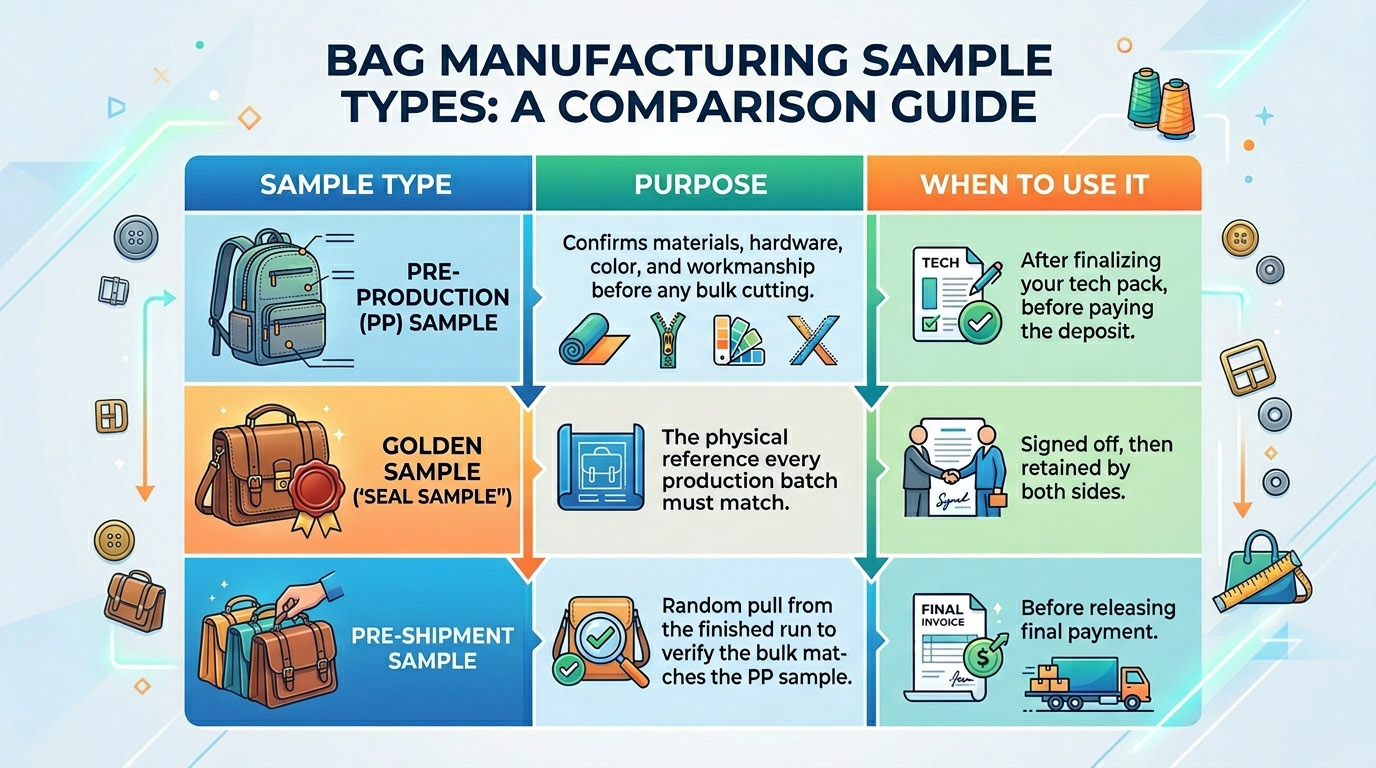
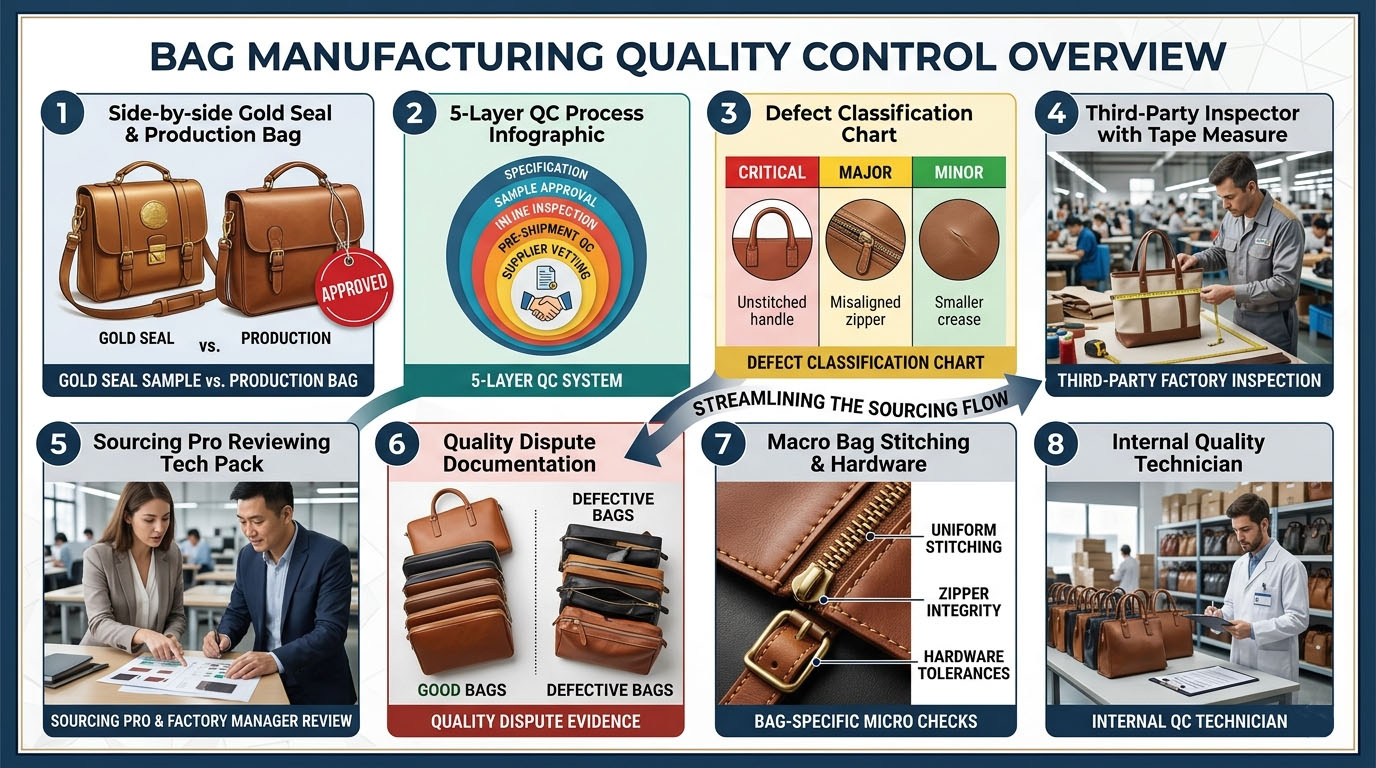
Pro Tip: Always approve a pre-production (PP) sample and retain a “gold seal” reference sample for every style. This single sample becomes the legal and visual benchmark for the lifetime of that SKU. If a future batch drifts, you hold the seal sample up to a finished unit and the variance is obvious.
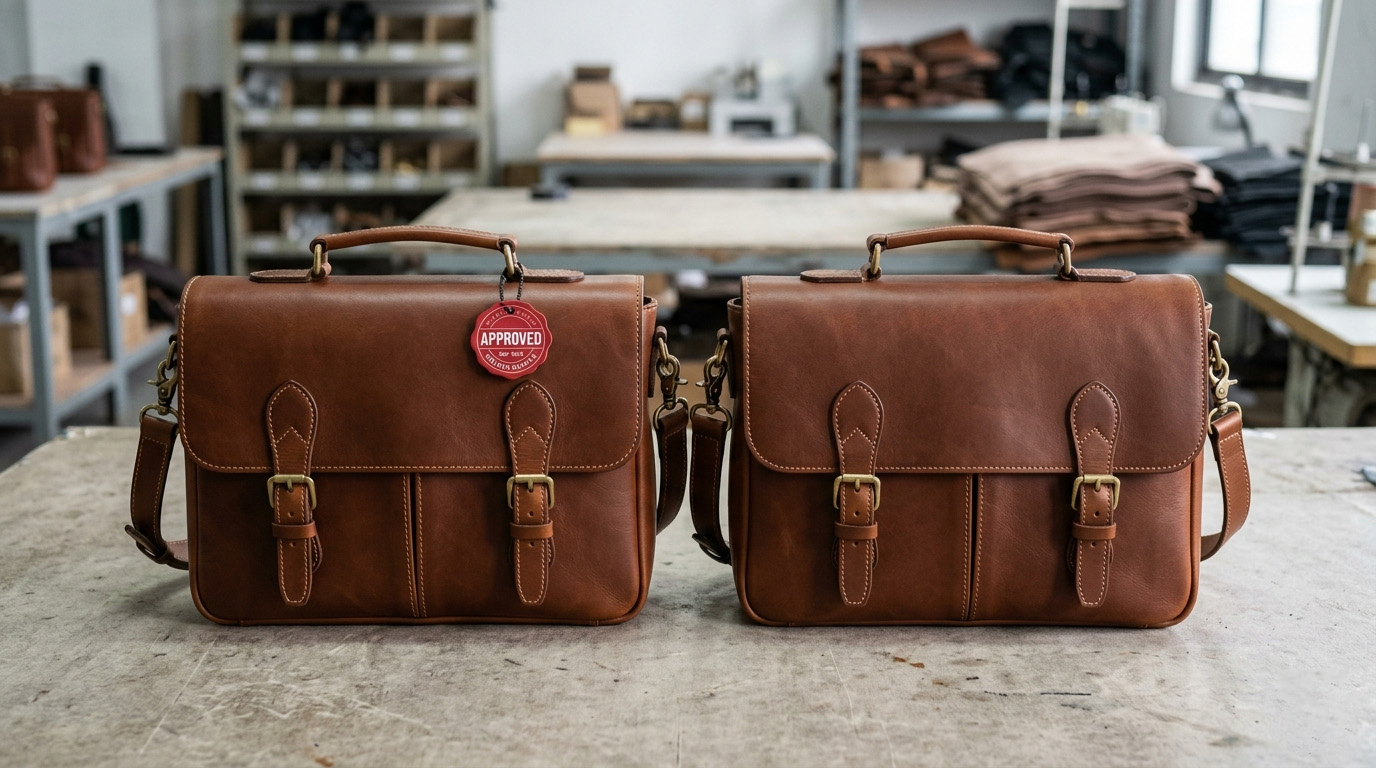
The First-Article Inspection (FAI) — Your Earliest Safety Net
Before the factory cuts fabric for the full run, ask them to produce one finished first article. The FAI catches problems when they’re still cheap to fix — wrong thread color, misaligned logo, incorrect zipper pull. A bag with a 12-stitch-per-inch spec that gets cut at 8 stitches per inch is unsalvageable after 500 units are sewn.
Pro Tip: Request a first article inspection before full production begins to catch issues at the earliest stage. The cost is usually zero or trivial; the savings can be the entire batch.
2. How Do You Ensure Product Quality and Consistency for Small Batches?
Consistency is the silent killer of small-batch bag brands. A tote that looked perfect in sample can come back in production with subtly stiffer canvas, slightly duller hardware, or off-center logo placement. Customers notice. Reviews suffer.
The fix is layered. No single tactic is enough — you need specification, sampling, in-line inspection, pre-shipment inspection, and a trusted supply partner working together.
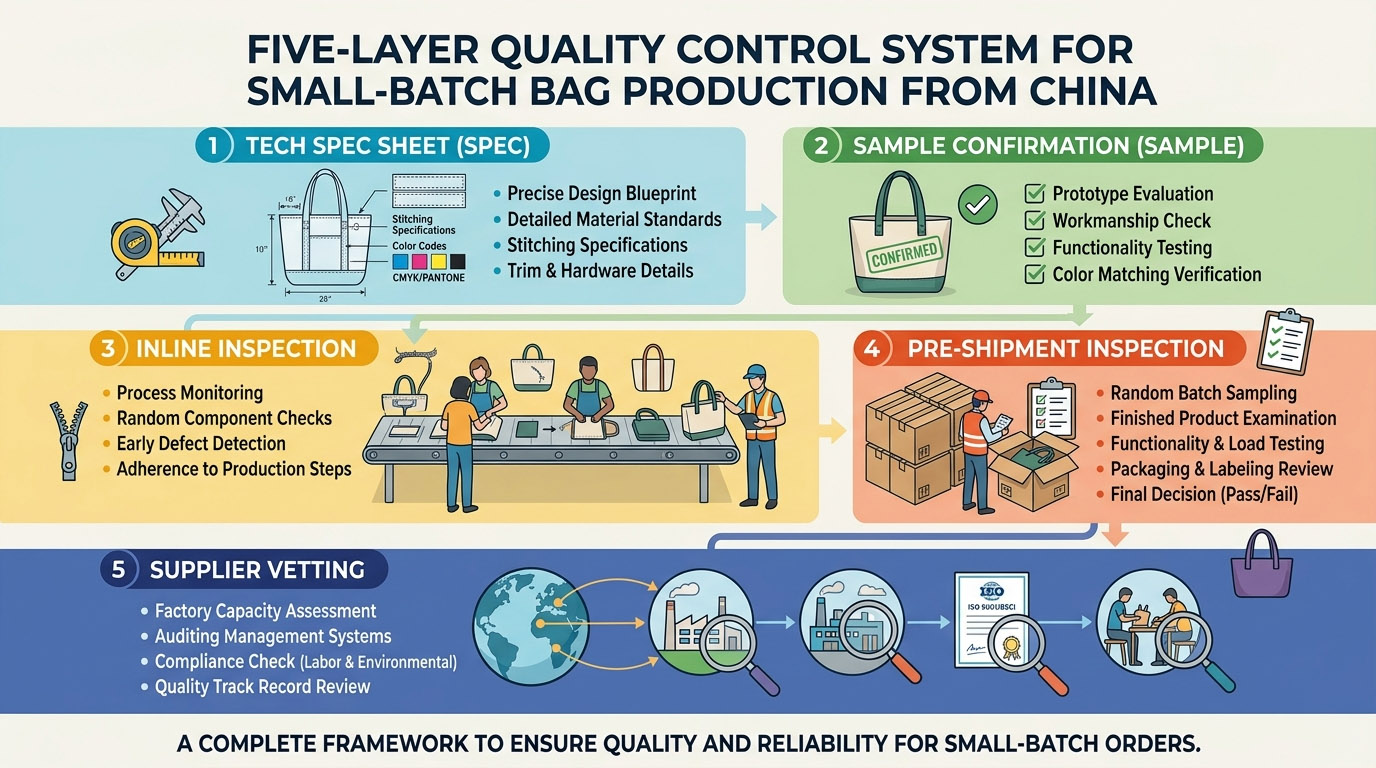
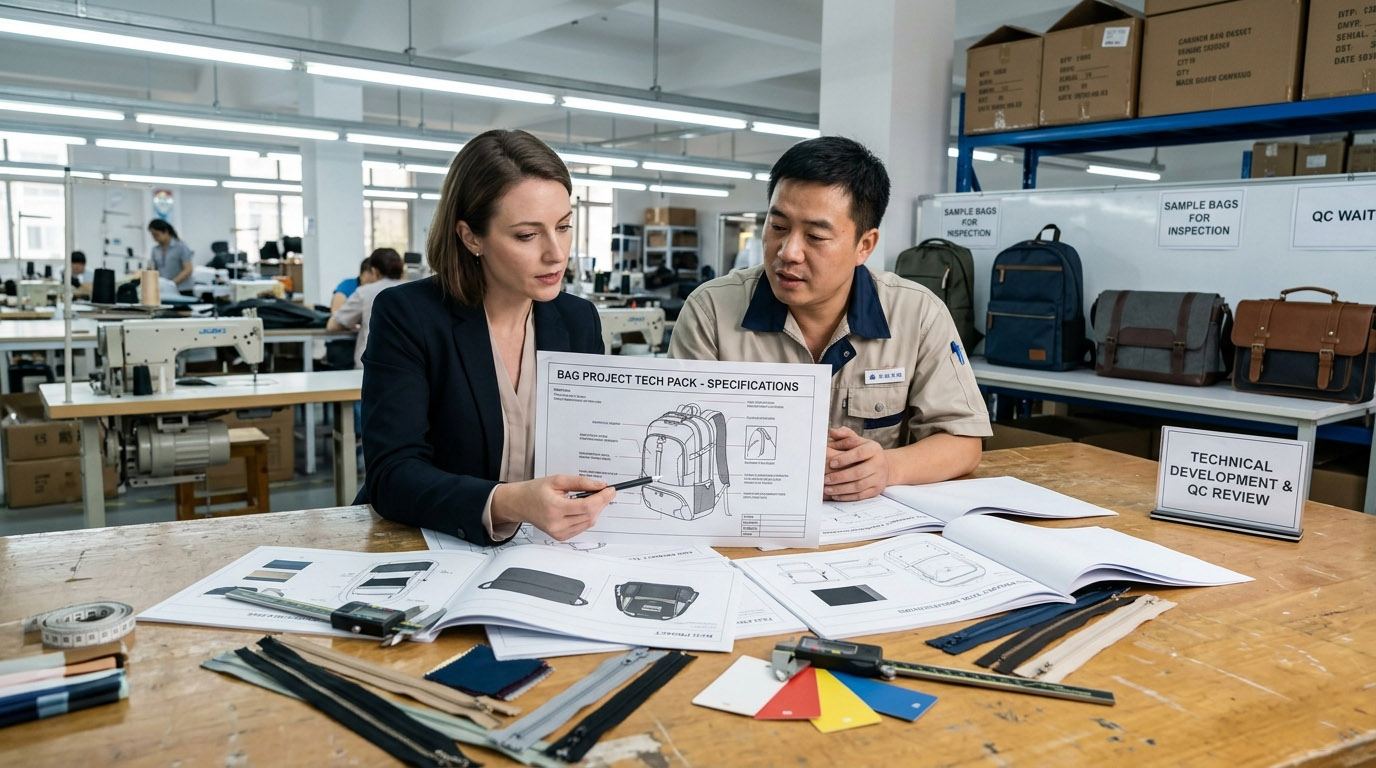
Layer 1: The Tech Pack (Your Quality Constitution)
A tech pack is not a “nice to have.” It is the single most important document in the entire relationship. Without it, you’re hoping the factory guesses correctly.
Pro Tip: Provide suppliers with detailed tech packs including material specs, Pantone codes, hardware details, and stitching standards. Every detail that matters to your customer should be written down with a number attached.
A complete bag tech pack should include:
Materials: fabric weight (oz/gsm), composition, leather grade, lining type
Color references: Pantone TPX/TPG or PMS codes, not “beige” or “off-white”
Hardware: brand, model, finish (antique brass, matte black, polished nickel), supplier if proprietary
Stitching: SPI (stitches per inch), thread type, thread color, seam allowance
Dimensions: L × W × H in cm or inches, with ± tolerance (e.g., ± 0.5 cm)
Logo placement: size, position from reference point, application method (embroidery, deboss, screen print, metal plate)
Packaging: poly bag spec, hangtag, sticker, master carton dimensions
Defect classification: what counts as critical, major, minor (more on this below)
Layer 2: In-Line Inspections During Production
This is where most small buyers cut corners — and where most defects slip through. Pre-shipment inspection alone is too late; you’ve already paid for the labor.
Pro Tip: Schedule in-line inspections during production (typically at 10–20% and 50–70% completion) to identify defects before final runs. Two short inspections dramatically reduce the defect rate of the finished goods.
A 10–20% check verifies the factory is using the correct materials. A 50–70% check catches workmanship drift midway, when corrections are still easy.
Layer 3: The Defect Classification Sheet
Vague language like “good quality” is unenforceable. You need numbers.
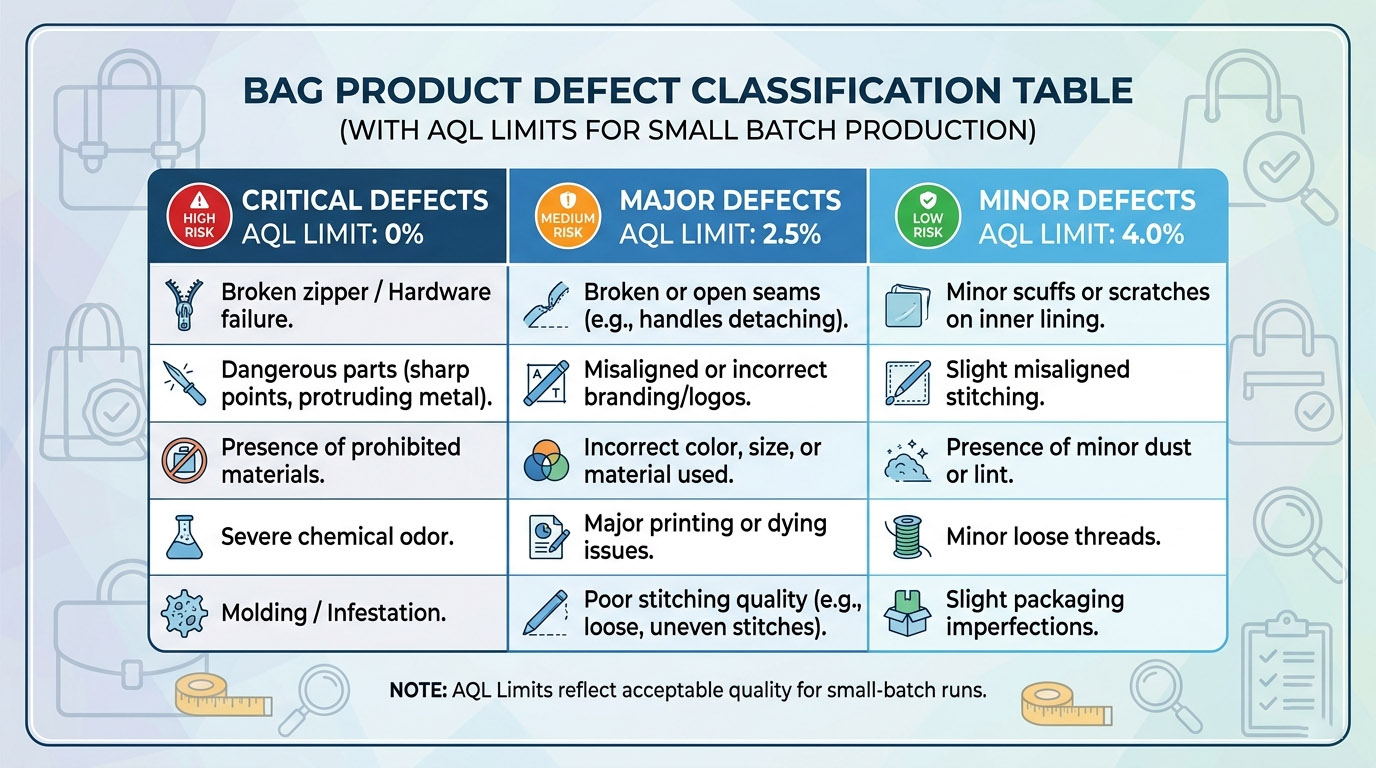
Pro Tip: Define a clear defect classification sheet (critical, major, minor) and include acceptable quality limits in the purchase contract. Standard AQL (Acceptable Quality Limit) for consumer bags is typically:
Critical defects: 0 allowed (AQL 0)
Major defects: 1.0 (e.g., 4% of 80 units sampled can have a major defect)
Minor defects: 2.5 (e.g., 10% of 80 units sampled can have a minor defect)
Critical defects include: broken zipper, sharp edge, missing strap, structural failure, incorrect logo.
Major defects include: loose thread, misaligned seam, color variance visible at arm’s length, hardware tarnishing.
Minor defects include: minor scuff on lining, slightly off-center stitch on a non-visible panel.
Write this down. Sign it. Attach it to every purchase order.
3. What Quality Inspection Methods Are Most Cost-Effective for Small Bag Orders?
For small orders, the goal isn’t more inspections — it’s the right inspections at the right time. Three methods give you the most coverage per dollar.
Method 1: Third-Party Pre-Shipment Inspections
The single most cost-effective QC investment for a small buyer.
Pro Tip: Hire independent third-party inspection services (e.g., QIMA, SGS, V-Trust) to conduct AQL-based pre-shipment inspections. These firms send a trained inspector to the factory (usually within 24–48 hours of your booking) who randomly samples units, tests functionality, and produces a pass/fail report with photos.
Cost reality check: A standard pre-shipment inspection in China typically costs $150–$300 per man-day depending on the city and inspector. For a small order, that’s often less than the cost of one returned bag multiplied by ten.
Method 2: Remote Video and Photo Audits
When a third-party visit is overkill, real-time verification still matters.
Pro Tip: Request production photos or short videos at key manufacturing stages — material arrival, cutting, stitching, hardware assembly, finished goods. A 30-second factory walkthrough video is more revealing than 50 emails.
Ask for:
A photo of the bulk fabric/leather next to a Pantone chip
A short video of the zipper being opened/closed 10 times
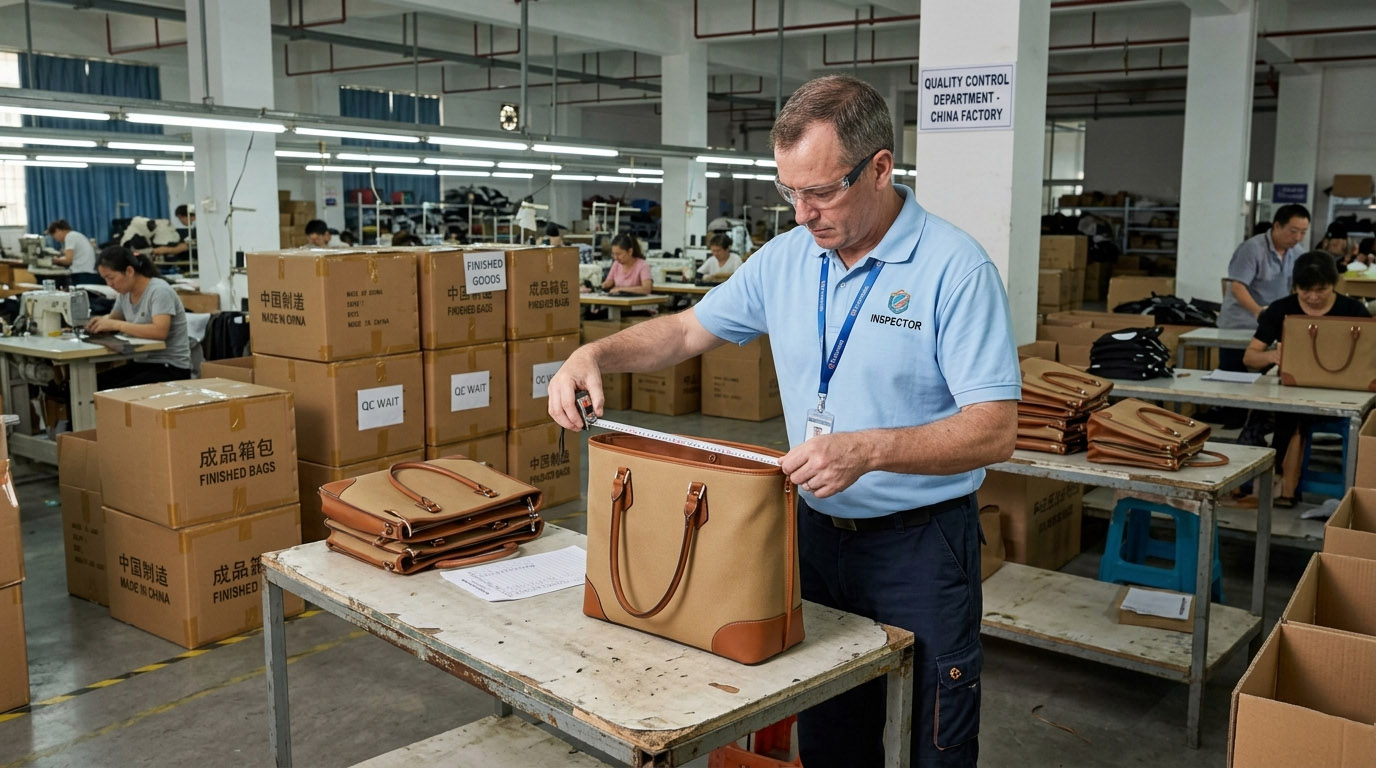
A photo of the finished batch laid out on a table with a tape measure visible
Method 3: The Pilot Run Pattern
A pilot run is your cheapest insurance policy. Before committing to your full small batch, order 10–20% of the planned quantity, inspect it thoroughly, and only release the rest after it matches spec.
Pro Tip: Partner with factories that specialize in low-MOQ or flexible small-batch production to reduce minimum order pressure. A 100-unit pilot run with a 400-unit follow-up is dramatically lower risk than a single 500-unit order.
4. How Do You Communicate Specific Quality Standards to Chinese Bag Suppliers?
Miscommunication is the #1 root cause of small-batch QC failures. Translation gaps, cultural shorthand, and assumption mismatches compound over email threads. Here’s how to eliminate them.
The 5 Communication Rules for Bag Buyers
1. Repeat specs in every PO. Even if it’s in the contract, restate the key tolerances in the email that triggers production. Fatigue causes drift.
2. Use the same language every time. Pick “navy blue, Pantone 19-3939 TPX” and use it verbatim, in English, every order.
3. Reference the seal sample by photo in every conversation. Attach the same approved image each time. Visual anchors survive translation.
4. Confirm in writing before changes. If a factory proposes a substitution (“we can use YKK zipper instead of SBS”), reply in writing with the new spec and a re-signed sample.
5. Avoid “same as last time” without a fresh reference. Even trusted factories forget. Always re-attach the gold sample photo.
Pro Tip: Build long-term relationships with a small group of vetted factories rather than switching suppliers frequently. A factory that knows your brand’s standards intimately will catch a problem before you do — because they know what “your” version of good looks like.
When to Consider an On-Site Factory Audit
If your annual volume justifies the cost, an annual on-site audit (by you, a sourcing agent, or a third party) is invaluable. A full audit covers production capacity, quality systems, worker conditions, and financial stability.
For most small DTC brands, one annual visit plus periodic remote audits is sufficient. The key is consistency — irregular visits don’t change factory behavior.
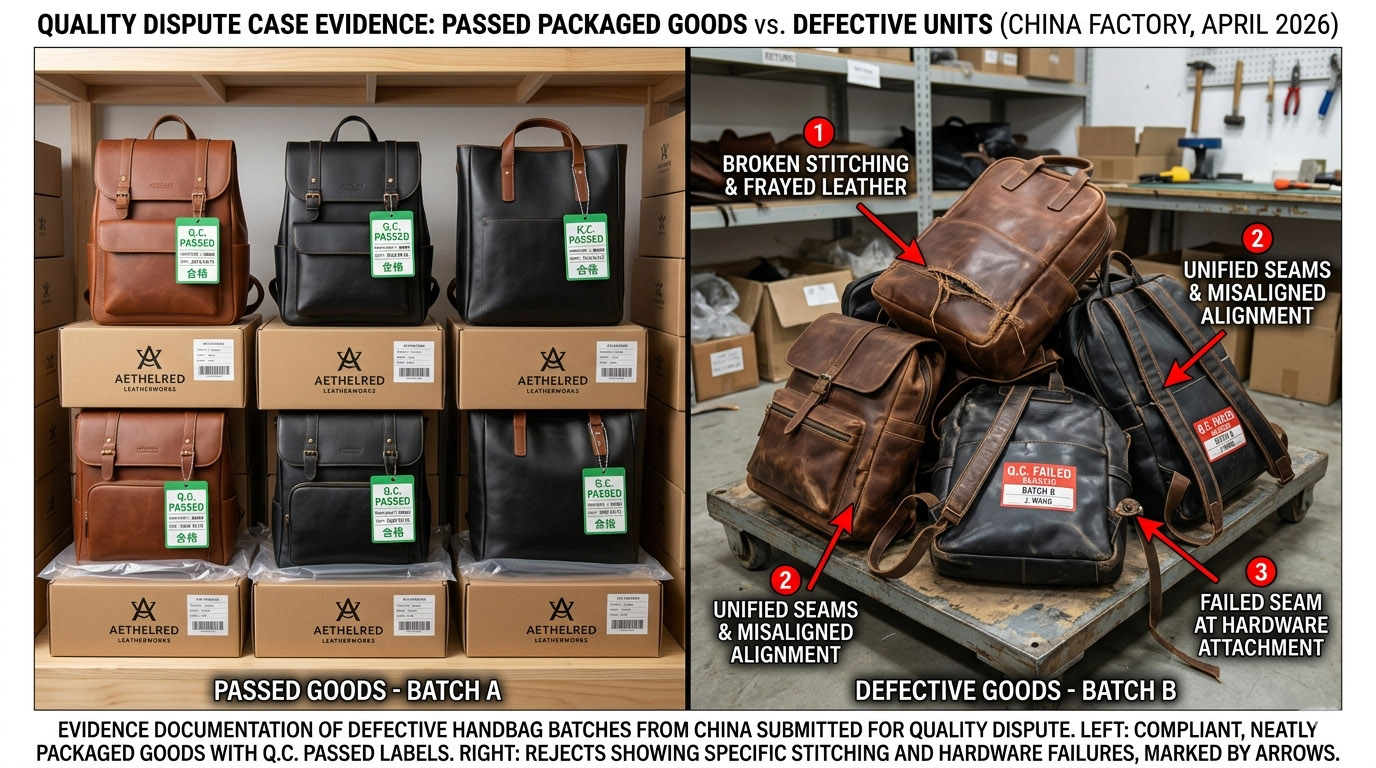
5. How Should You Handle Quality Disputes or Defective Goods from a Small Batch Shipment?
Even with perfect systems, disputes happen. The difference between a brand that survives and one that doesn’t is how the dispute is resolved.
Step 1: Document Everything Immediately
Before raising the issue with the supplier:
Photograph every defective unit on a clean, well-lit surface
Record the defect count vs. total received
Note carton numbers, batch codes, and shipping documents
Save the inspection report from your third-party inspector (if you used one)
Step 2: Invoke the Pre-Agreed AQL and Defect Sheet
This is why the contract work matters. Refer to the signed defect classification and AQL, not emotion.
Pro Tip: Use secure payment methods like escrow or Trade Assurance to protect against quality disputes and defects. If you’re paying via T/T (bank wire), the protection disappears after the funds clear. Platforms like Alibaba Trade Assurance, PayPal for samples, and LC (Letter of Credit) for larger orders give you leverage.
Step 3: Negotiate Resolution Tiers
A good supplier will usually offer one or more of these:
Replacement of defective units on the next order
Partial refund matching the defect rate
Credit note toward future production
Re-work of borderline units at the factory’s cost
Step 4: Decide If the Relationship Continues
One QC miss is forgivable. Two in a row is a pattern. If a factory repeatedly fails to meet agreed AQL, even after in-line inspections, it’s time to move on — gracefully, with the door open for the future. Bag manufacturing capacity in China is deep; never feel locked in.
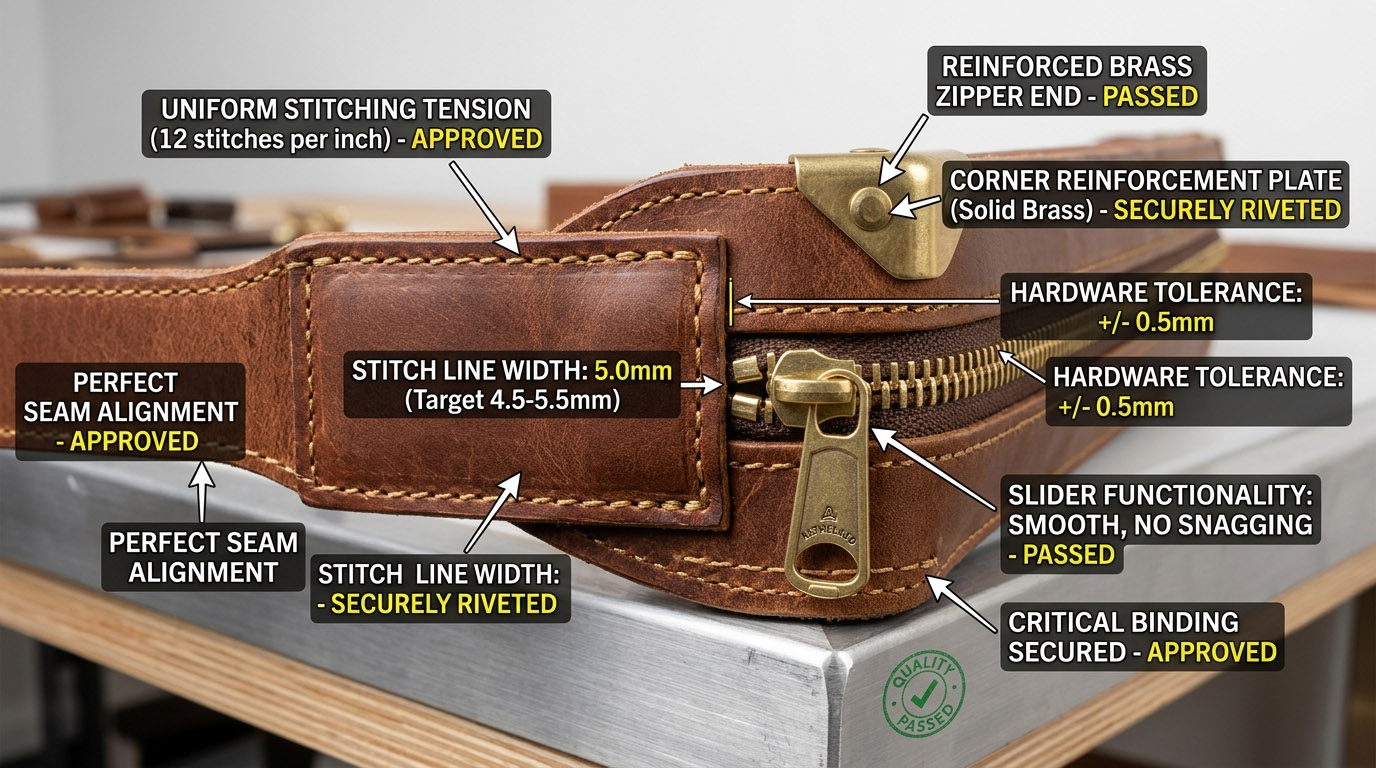
Bag-Specific Quality Checks Most Buyers Miss
Bags are tactile, wearable products. Customers interact with them every day, which means tiny flaws become big frustrations. Here are the bag-specific quality points that small brands most often overlook:
Stitching straightness: Hold the bag up to a straight edge. Lines should be ruler-straight, with no wandering.
Zipper smoothness: Open and close 10 times. No catching, no grinding, no exposed teeth.
Hardware finish: Look for color uniformity across all metal parts. Mixed finishes (e.g., one gold, one antique brass) are a major defect.
Lining seams: Open the bag. Inside quality signals the brand’s true standard.
Print/logo alignment: Measure from a fixed reference point (top of bag, left edge of pocket). The variance should be under 2 mm.
Color matching across variants: If you sell 5 colors, all 5 should match the approved Pantone within ΔE 2.0 or better.
Strap attachment: Pull-test every strap. A bag that fails at the strap attachment is a return waiting to happen.
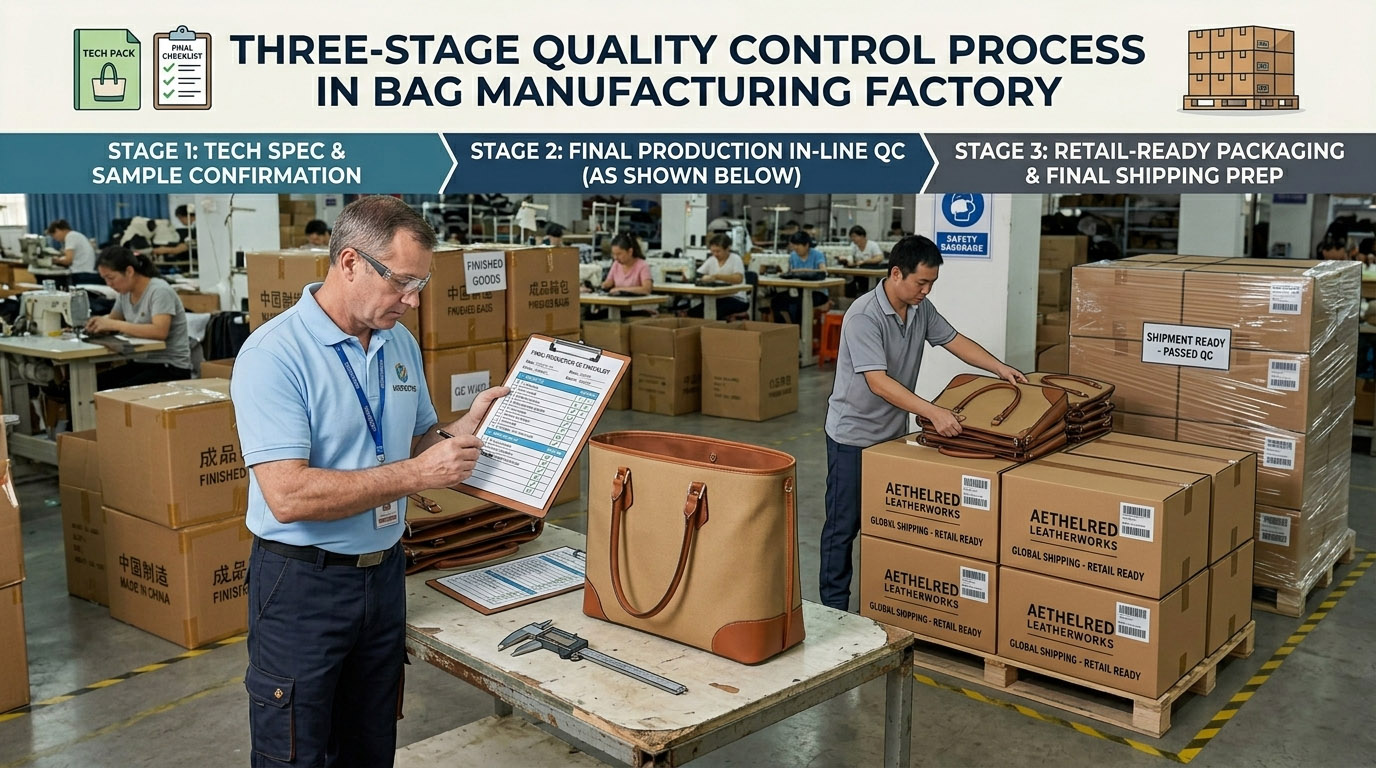
Our Internal Quality Control Process (3 Layers of Verification)
We don’t just recommend these systems — we run them on our own production floor. Every bag that leaves our facility passes through three distinct QC stages:
Stage 1: In-Process Quality Checks (Minimum 3 Inspection Points)
Throughout production, our QC team conducts at least three dedicated inspection moments — typically at material receiving, mid-production, and pre-assembly. Issues are logged, photographed, and corrected on the line before they cascade.
Stage 2: Final Product Inspection (100% Review of Finished Goods)
Once production is complete, we conduct a complete inspection of every finished unit. This is a full audit, not a sampling — every bag is opened, zipped, lifted, and visually examined. Defective units are pulled, tagged, and either reworked or rejected.
Stage 3: Post-Branding Final Check (For Custom Logo Orders)
For ready-made goods that receive your custom logo or branding, we run one additional quality check after the branding is applied. This catches any logo-related issues — misaligned embroidery, peeling heat transfer, uneven debossing — before the product is packed.
This three-stage process is what allows us to ship small batches with the same consistency that large brands expect from their 10,000-unit runs.
Quick-Reference Checklist for Small-Batch Bag Buyers
Before you place your next order, run through this list:
1. ☐ Tech pack finalized with Pantone codes, dimensions, and tolerances
2. ☐ PP sample approved and signed off in writing
3. ☐ “Golden seal” sample stored by both buyer and factory
4. ☐ First article inspected before full production cut
5. ☐ Defect classification sheet (critical/major/minor) attached to PO
6. ☐ AQL limits (0 / 1.0 / 2.5) written into the contract
7. ☐ In-line inspection scheduled at 10–20% and 50–70%
8. ☐ Pre-shipment third-party inspection booked
9. ☐ Photos/videos of materials and finished goods received
10. ☐ Secure payment method (escrow / Trade Assurance / LC) in place
11. ☐ Factory relationship documented with audit history
12. ☐ Dispute resolution process agreed before production starts
Final Thoughts: Quality Is a System, Not a Sample
The most common mistake small bag brands make is treating quality control as a single event — usually the sample approval. In reality, QC is a system of overlapping safeguards that begins with the tech pack and ends with the customer’s unboxing.
The brands that scale successfully into six- and seven-figure revenue almost always share one trait: they treat quality as a workflow, not a checklist. They inspect at multiple stages, they document everything, they partner with factories that welcome verification, and they keep their golden samples for the lifetime of the product.
You don’t need a huge team in Asia to do this. You need the right documents, the right inspection partners, and the right factory partner who treats your 200-unit order with the same care as a 20,000-unit run.
That’s the standard we hold ourselves to — and it’s the standard we’ll help you build into your brand.
About the Author / Company
[Insert a 2–3 sentence bio about your bag brand or sourcing company, your years of experience, and what types of bags you specialize in. Reinforce authority.]
Related Articles You Might Like:
How to Find a Reliable Bag Manufacturer in China: The 7-Point Vetting Checklist
A Complete Guide to Private Label Bags: MOQ, Costs, and Timelines
Top 10 Bag Materials Compared: Cost, Durability, and Sustainability
Image Asset List (For Your Designer)
Below is a summary of every image referenced in the article, with descriptive prompts to source or commission them:
Want to see our factory’s QC process in action? [Request a virtual walkthrough →] or [Book a sample order →] to experience the system firsthand.
Post time: Jun-02-2026