
Meta Description: Learn which ASTM and ISO standards apply to bag seam slippage and tensile testing, what minimum values to require, and how to verify quality across multiple production runs when sourcing from China.
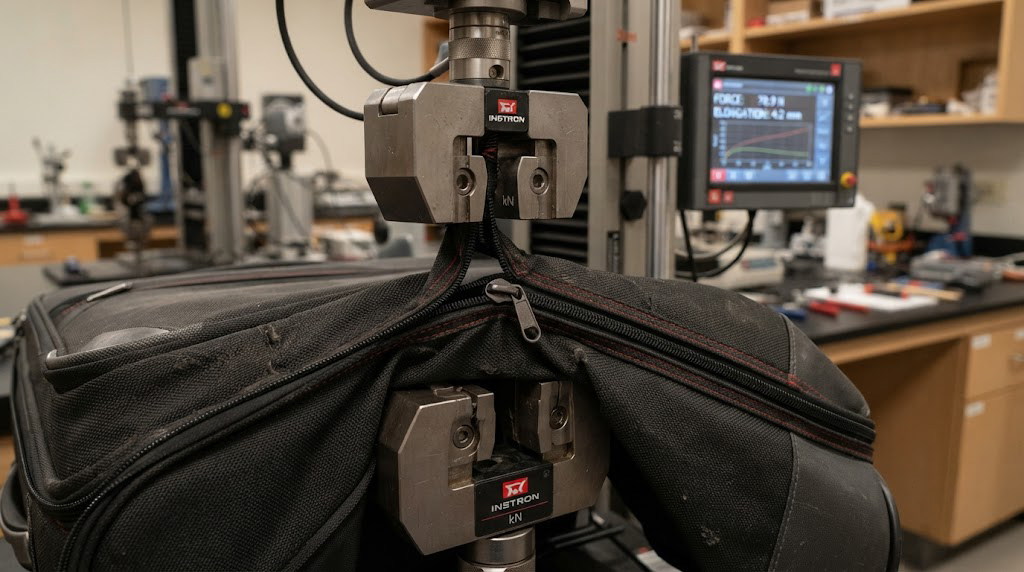
If you are a bag buyer sourcing wholesale inventory from Chinese factories, you already know that a beautiful product photo rarely tells the full story. The real question is: Will the strap hold after 5,000 cycles? Will the side seam split open when a customer overpacks the tote? Will the handle anchor point survive being yanked off a crowded commuter train?
These are not hypothetical concerns — they are the most common warranty claims we see from U.S. and European retailers every season. And in almost every case, the root cause traces back to two under-discussed physical tests:
1. Seam slippage resistance
2. Tensile / seam strength
Together, these two tests are the gold-standard way to verify whether the fabric and the stitched seam stay intact under stress. This guide will walk you through which standards to ask for, what numbers are “acceptable,” how to find a reliable third-party lab in China, and how to lock in consistent quality across multiple production runs.
1. What Do These Two Tests Actually Tell You?
Before talking standards, let’s clarify the engineering behind the tests — because the language your supplier uses can be confusing.
1.1 Seam Slippage Testing
Seam slippage testing (most commonly ASTM D1683 or ISO 13936) measures the resistance of yarn displacement at a sewn seam under a perpendicular load. In plain English: when you pull the fabric perpendicular to the seam, do the yarns in the woven fabric start sliding apart before the thread or seam itself actually fails?
This test is especially important for woven fabrics — canvas, nylon oxford, polyester twill, jacquard — which is what most mid- to high-end bags are made of. Knit and non-woven materials behave differently and usually require different standards.
Why this matters for bags: Bag seams are constantly under multi-directional stress — a tote is pulled sideways when carried, a backpack is pulled downward when loaded, a duffel is yanked at angles when overstuffed. If the yarns slip, the seam “opens up” long before the thread actually breaks, and the bag looks like it is falling apart even though no stitch has failed.
1.2 Tensile and Seam Strength Testing
Tensile testing determines the breaking force and elongation of a fabric or a sewn seam using either the grab method (ASTM D5034 / ISO 13934-1) or the strip method (ASTM D5035 / ISO 13934-2). It tells you the maximum force the material — or the sewn assembly — can withstand before rupture.
When applied to a finished seam, it is often called seam strength or seam tensile testing, and the result is reported in Newtons (N) or pounds-force (lbf).
Why this matters for bags: A backpack strap that pulls out at 80 N is useless. A tote handle that breaks at 150 N will fail within a week of real-world use. Knowing the breaking force lets you spec the right construction for the intended load.
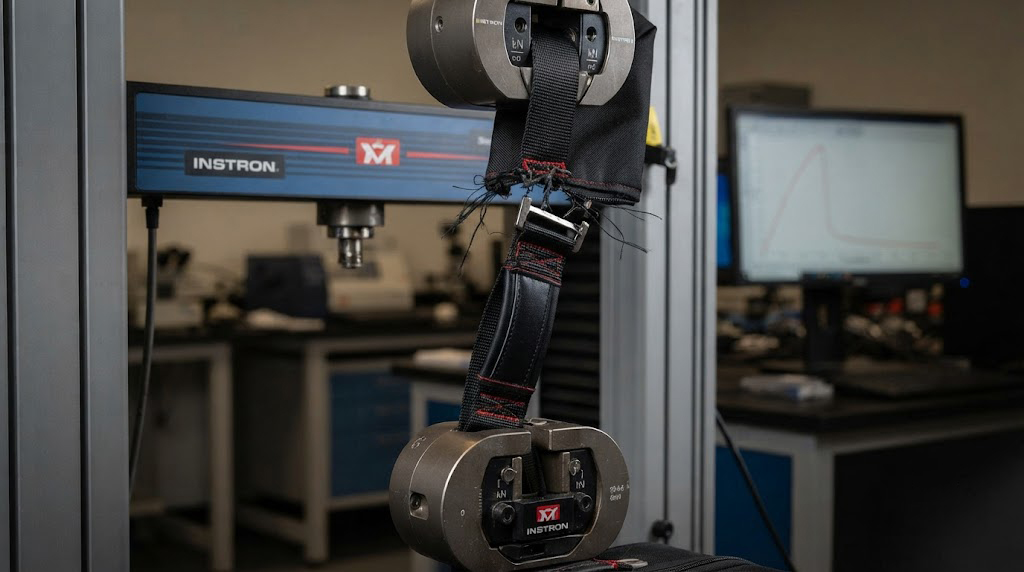
2. Which ASTM or ISO Standards Are Commonly Used?
Most reputable Chinese bag factories — and any third-party lab you’ll work with — will be familiar with the following standards:
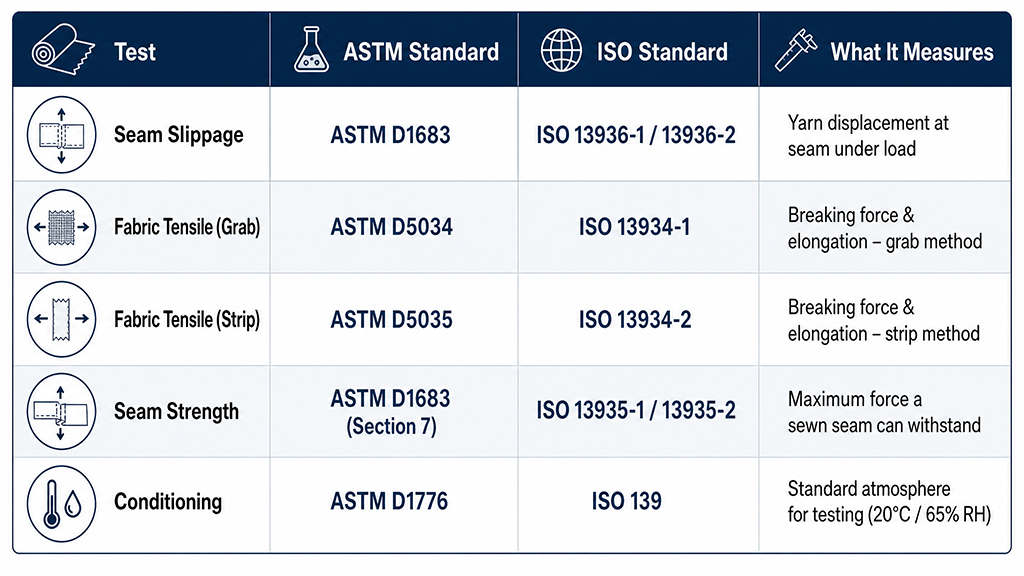
Pro tip for buyers: If a supplier’s lab report doesn’t state the standard used, the load rate, the specimen size, and the failure mode, the report is essentially useless. Always ask for the full report with method reference.
3. What Minimum Tensile and Seam Slippage Values Should You Require?
There is no single universal “pass/fail” number that applies to every bag. The right value depends on material, construction, and intended use. That said, here are the industry-accepted baselines we recommend for different bag categories:
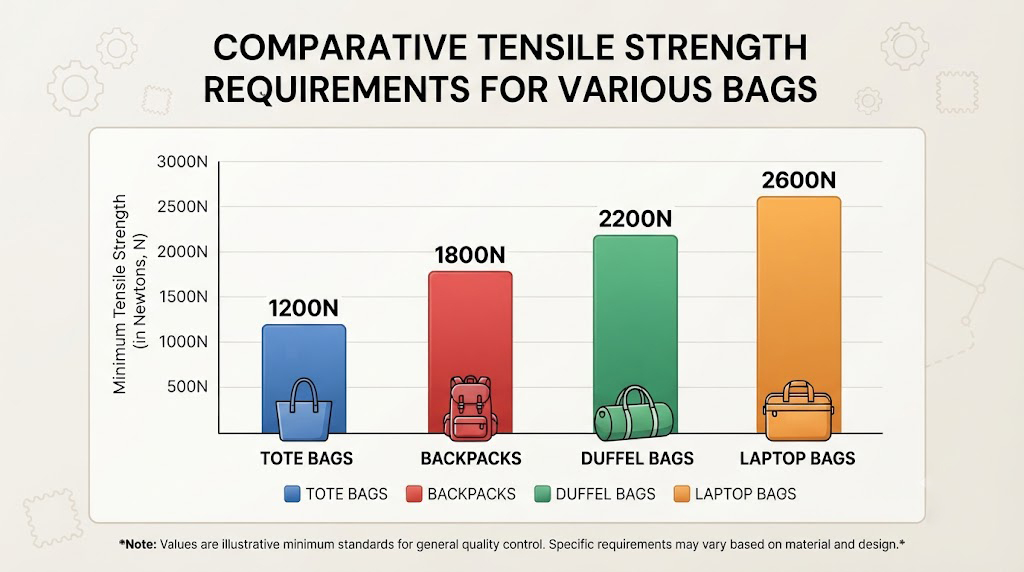
3.1 General Minimum Recommendations
Seam slippage: Typically ≤ 6 mm at a defined load (often 40 N or 5 kg depending on the fabric weight). Anything above 6 mm is generally considered a failure for woven bag fabrics.
Seam strength: A minimum of 20 N per stitch row is the floor, but most quality bags target 80 N–200 N depending on application.
Fabric tensile (woven):
Lightweight nylon/PU (cosmetic bags, pouches): ≥ 200 N warp and weft
Mid-weight canvas/oxford (totes, backpacks): ≥ 400 N warp and weft
Heavy-duty canvas/ballistic (duffels, travel bags): ≥ 600 N warp and weft
3.2 Material-Specific Guidance
Coated canvas – lower elongation, higher stiffness; can mask slippage, so test both directions.
Genuine leather – typically tested under ISO 3376 or ASTM D2208, not fabric standards.
PU / PVC coated fabric – the coating can hide weak yarns; insist on testing the base fabric separately.
Nylon (210D–1680D) – excellent tensile, moderate slippage; choose ripstop for load-bearing panels.
Recycled PET (rPET) – tensile is usually comparable to virgin polyester, but slippage can be higher due to shorter fiber length. Add a 10–15% safety margin to your spec.
⚠️ Critical insight: Material composition dramatically affects test outcomes. Coated canvas, genuine leather, PU, and nylon each exhibit different break-elongation profiles and require material-specific acceptance criteria. Never apply a polyester spec to a PU-coated bag, or vice versa.
4. SPI, Thread, and Stitch Density — The Hidden Variables
Test results are only meaningful when the construction itself is correct. Two factors make or break seam performance:
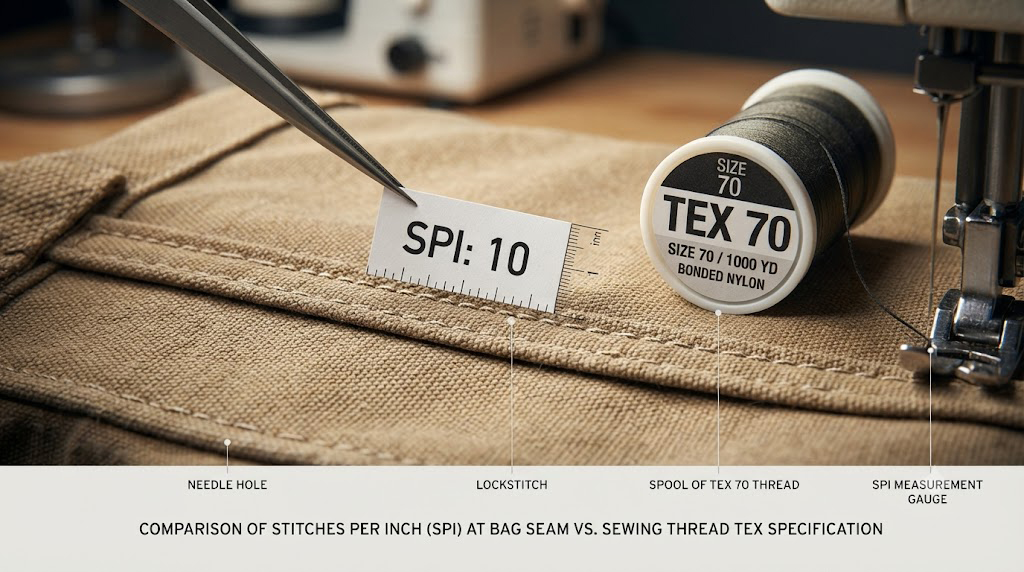
4.1 Stitches Per Inch (SPI)
Stitch density directly correlates with seam strength.
6 to 8 SPI is standard for handbags, totes, and fashion bags.
8 to 10 SPI is required for heavy-duty or load-bearing areas — backpack straps, duffel handles, base reinforcements.
Below 5 SPI is a red flag; the seam will almost certainly fail in tensile testing.
4.2 Thread Tensile Strength
The thread must always be stronger than the fabric. This is a basic rule that gets broken surprisingly often. Industry-standard threads for bags:
Bonded nylon (Tex 70–Tex 210) – the workhorse for backpacks, duffels, and tactical bags.
Bonded polyester (Tex 75–Tex 180) – preferred for UV-exposed bags and outdoor gear.
Core-spun polyester/cotton – used in fashion handbags where appearance matters.
If your supplier is using Tex 40 or Tex 50 thread on a heavy-duty duffel, walk away. The thread will break before the fabric does, and the seam tensile test will fail — no matter how good the fabric is.
5. High-Risk Failure Zones — Where to Focus Your Testing
You don’t need to test every seam. Strategic testing on high-risk zones is faster, cheaper, and more informative than blanket testing.
The four failure zones we prioritize for every client QC protocol:
1. Handle-to-body stitching — the #1 cause of bag returns. Test at multiple anchor points.
2. Base corners — stress concentration zone; frequently the first to split.
3. Strap anchor points (D-rings, O-rings, ladder locks) — must withstand both static load and dynamic shock.
4. Zipper terminations and bottom stops — often overlooked, but a major warranty issue for travel bags and backpacks.
For each of these zones, request a seam strength test (ASTM D1683) and a pull-out test on hardware (ASTM D4833 or equivalent).
6. How to Locate a Reliable Third-Party Testing Lab in China
This is where most overseas buyers lose leverage. You have three credible options:
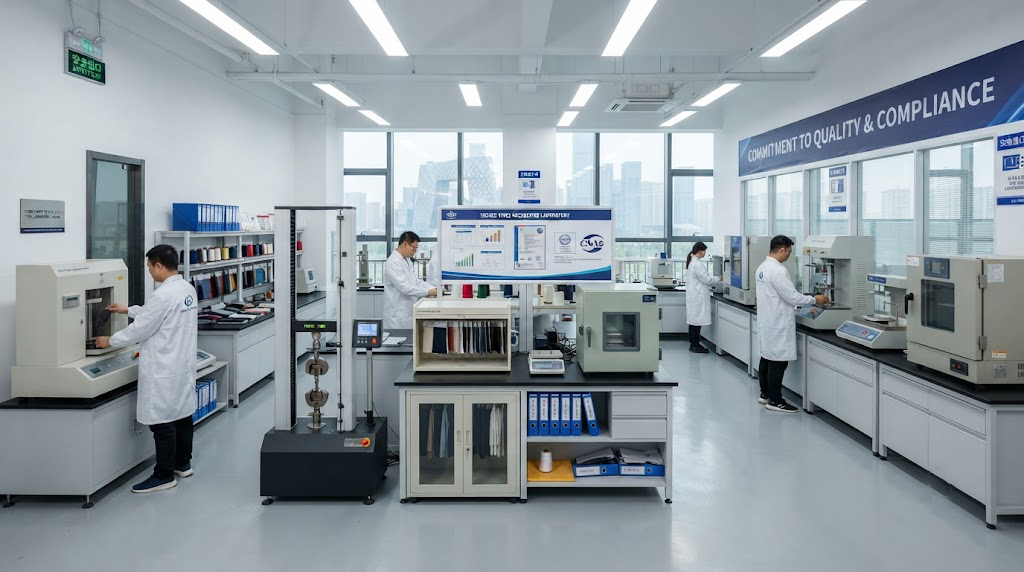
6.1 Global Third-Party Labs with China Presence
SGS – the most recognized globally; offices in Shenzhen, Shanghai, Guangzhou, and dozens of other Chinese cities.
Intertek – strong consumer goods testing infrastructure in China.
Bureau Veritas – another top-tier option with full textile labs.
TÜV Rheinland / TÜV SÜD – excellent for European compliance, but also handle ASTM testing.
These labs are expensive (typically $300–$800 per test method per sample set), but their reports are accepted by U.S. retailers and customs with no questions asked.
6.2 Independent Chinese Labs
There are many reputable local labs — CTTC (China Textile Testing Center), NTC (National Textile Quality Supervision Testing Center), and various provincial fiber inspection bureaus. They are usually 30–50% cheaper and can issue bilingual CN/EN reports. Always ask for CNAS accreditation (China National Accreditation Service for Conformity Assessment) to ensure international recognition.
6.3 Factory In-House Labs
Many large factories have their own QA labs. Use them for in-line and pre-shipment inspections, but never rely solely on factory lab reports for first-article qualification. A factory’s incentive to fail its own product is, understandably, low.
Best practice for U.S. buyers: Use the factory’s in-house lab for routine production runs, but commission a third-party pre-shipment inspection (PSI) from SGS, Intertek, or Bureau Veritas for every bulk order. This gives you unbiased verification before goods leave the port.
7. Ensuring Consistent Quality Across Multiple Production Runs
This is the hardest part of sourcing from China, and the part most blogs skip. A great first order is meaningless if the second order is full of defects.
7.1 Lock Down Your Specification
Before the first PO, you need a written technical specification that includes:
Material composition (with weight in g/m² or oz/yd²)
Acceptable tensile and seam slippage values per material and per seam type
SPI requirements per seam
Thread specification (fiber, Tex, bonded vs. non-bonded)
Test method (ASTM or ISO) and conditioning standard (ASTM D1776: 20°C, 65% RH)
AQL level (most U.S. bag buyers use AQL 2.5 for major defects, 4.0 for minor)
Attach this spec to every Purchase Order. No spec, no order.
7.2 Sample Conditioning Is Non-Negotiable
One of the most common sources of inconsistent test results is improper sample conditioning. Per ASTM D1776 (or ISO 139), all textile samples must be conditioned for at least 24 hours at 20°C and 65% relative humidity before testing. A lab that skips this step will give you numbers that don’t match the next run.
7.3 Statistical Sampling
Test a representative sample of 3 to 5 units per production lot, drawn from different cartons and different production days. This gives you statistical reliability while keeping QC costs proportionate to order value.
For large orders (10,000+ units), use MIL-STD-1916 or ANSI/ASQ Z1.4 sampling tables to set your inspection size based on lot size and AQL.
7.4 Keep a Reference Sample
Always retain gold-seal samples from the first approved production run. Compare every subsequent batch against this reference — both visually and through spot-check testing. If the numbers drift by more than 10–15% from the original, investigate before shipping.
7.5 Pre-Production + During Production + Pre-Shipment
Don’t rely on a single inspection. The standard three-stage QC protocol is:
1. DUPRO (During Production Inspection) – at 20–30% completion
2. Final Random Inspection (FRI) – at 80–100% completion, before packing
3. PSI (Pre-Shipment Inspection) – on packed cartons, ready to load
8. How to Talk to Your Chinese Supplier
Language and cultural gaps cause more failed QC outcomes than bad factories. Here is professional, ready-to-send wording in both English and Chinese:
English:
“Before I place the bulk order, I need seam slippage and seam tensile test reports for the bag fabric and stitched seams. Please share the test standard used (ASTM or ISO), specimen size, load rate, conditioning protocol, and pass/fail results. Reports must come from a CNAS-accredited third-party lab.”
Most reputable factories will respond professionally. If they push back or offer only an in-house report for a first order, treat it as a warning sign.
9. Bonus: Load and Tensile Strength Testing for Handles & Straps
Beyond the fabric and seam tests, you should also specify load-bearing tests for handles, shoulder straps, and backpack straps. These are governed by standards like:
ASTM F2055 – Standard Test Method for Size and Strength of Purses and Handbags (load testing)
ISO 11243 – Backpack strap strength and attachment
The typical buyer requirement:
Handbag handles: Withstand 20–50 lb (90–225 N) static load for 1 minute without seam slippage > 6 mm or visible deformation.
Backpack straps: Withstand 75–150 lb (335–670 N) static load, plus a cycle test (5,000+ repetitions at 50% of breaking load).
Tote straps: Withstand 30–50 lb (135–225 N) depending on intended use (grocery tote vs. laptop tote).
Specifying these upfront in your tech pack prevents the most common field failures — and saves you a fortune in returns.
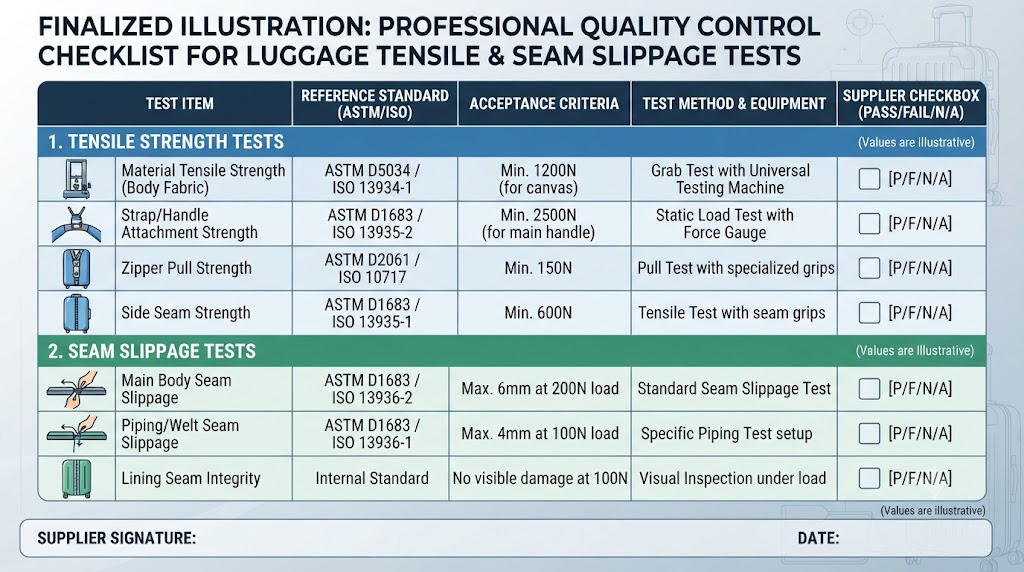
10. Your One-Page Supplier Checklist
Use this checklist with every Chinese supplier, on every order, for every bag type:
Material spec (composition, weight, finish) confirmed and signed off
Fabric tensile test report (ASTM D5034 / D5035 or ISO 13934) — passed
Seam slippage test report (ASTM D1683 or ISO 13936) — slippage ≤ 6 mm at spec’d load
Seam strength test report (ASTM D1683 §7 or ISO 13935) — meets minimum N value
SPI confirmed and measured on pre-production sample
Thread spec confirmed (fiber + Tex)
Handle/strap load test (ASTM F2055 or equivalent) — passed
Conditioning protocol ASTM D1776 followed
Report from CNAS-accredited or SGS/Intertek/BV lab
DUPRO inspection scheduled at 20–30%
FRI + PSI scheduled before shipping
Gold-seal samples retained for future comparison
Closing Thoughts
Seam slippage and tensile strength testing aren’t just “nice to have” for the engineering-obsessed. They are the most cost-effective insurance policy a bag buyer can buy. A $400 lab report can prevent a $40,000 warranty recall. A 30-minute supplier conversation about ASTM D1683 can save you a season of customer complaints.
At Trust-U bag, every bag we ship to our U.S. and European wholesale customers has passed seam slippage, seam strength, and load testing — either at the factory’s CNAS-accredited lab or through an independent SGS / Intertek audit. We document everything, condition everything to ASTM D1776, and retain reference samples for every production run. That’s the baseline — and we believe it should be the baseline for the entire industry.
If you are evaluating a new Chinese supplier, run the checklist above. If they can’t — or won’t — provide ASTM D1683 and D5034 reports from a recognized lab, keep looking. The right factory is out there, and the right lab is a short email away.
Post time: Jul-27-2026