
The Complete Buyer’s Guide to Load and Pull-Strength Testing for Bag Handles and Straps
How to verify supplier quality, avoid costly returns, and protect your brand reputation before shipping from China
Why This Guide Matters for Your Bag Business
If you’re sourcing handbags, backpacks, duffels, or luggage from Chinese manufacturers, you’ve probably already learned the hard truth: a beautiful product photo means nothing if the handle snaps on a customer’s first trip to the grocery store.
Handle and strap failures are among the top three reasons for negative reviews, returns, and Amazon complaints in the bag category. Yet most first-time importers never ask their supplier a single question about load and pull-strength testing—until they receive a 500-bag shipment where 40 units fail after two weeks of use.
This guide consolidates the testing standards, weight thresholds, documentation requirements, and supplier communication scripts you need to source bags confidently. Whether you’re buying 200 units or 20,000, the principles below will save you money, time, and brand equity.
Part 1: Understanding Load and Pull-Strength Testing
What These Tests Actually Measure
Load testing evaluates how much static weight a handle or strap can bear before structural failure. Pull-strength testing goes further by measuring tensile force applied in specific directions—usually downward, lateral, and at the stitching anchor point.
A complete test program should assess:
Static load capacity — the maximum weight the handle supports without permanent deformation
Ultimate breaking strength — the point at which the handle, stitching, or hardware fails
Dynamic cycle performance — how the bag performs under repeated loading and unloading
Hardware integrity — whether D-rings, buckles, rivets, and anchor plates hold their rated load
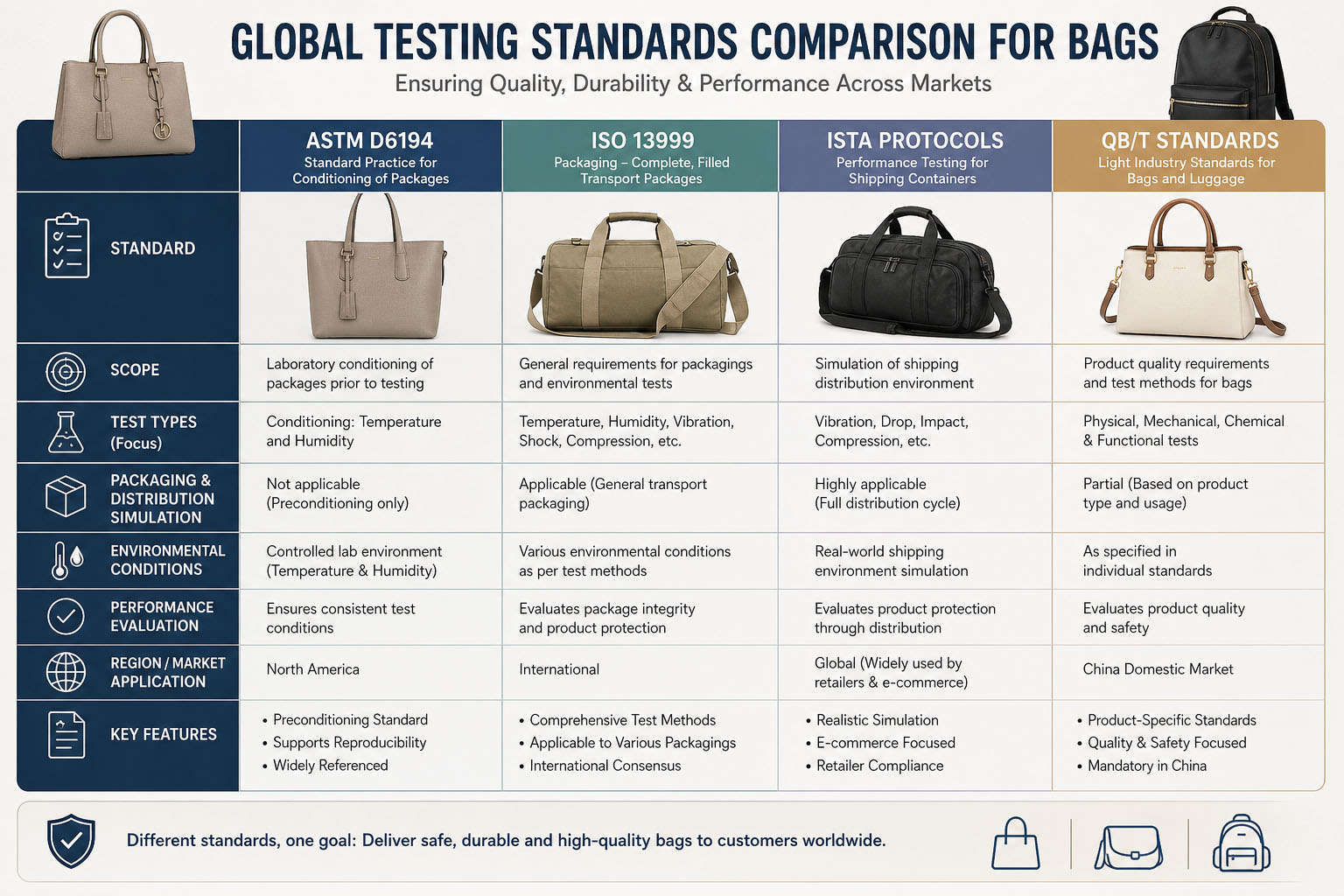
Industry testing labs such as SATRA in the UK, SGS, and CTC Groupe all publish standardized methods specifically for luggage and bag components, including handle and strap strength under loaded conditions with both static and dynamic stress.
Part 2: The International Standards You Should Reference
ASTM Standards
ASTM D6194 is the most commonly cited standard for strap tensile testing in the U.S. market. It defines the procedures for measuring the breaking strength and elongation of webbing, narrow fabrics, and strapping materials—directly applicable to bag shoulder straps and handles.
ISO Standards
ISO 13999 and related ISO 13934 / 13935 standards cover tensile properties of fabrics and seams, which are highly relevant to stitched strap assemblies. ISO also publishes bag-specific durability standards used in European retail compliance.
ISTA Standards
ISTA 1A, 2A, and 3A are transit simulation protocols, not strap-specific tests. However, they are critical for luggage and travel bags because they simulate the vibration, drop, and compression stresses a bag endures during shipping. Many U.S. retailers and Amazon sellers require ISTA-certified packaging performance.
Chinese QB/T Industry Standards
Most Chinese factories default to QB/T 1333 (handbags and knapsacks) or QB/T 2155 (luggage). These are legitimate standards, but they are not identical to ASTM or ISO. Always confirm which standard the factory is testing to and whether it meets your target market’s requirements.
Pro tip from our sourcing team: When we audit factories in Guangzhou and Yiwu, we ask for the exact standard number printed on the test report. If the supplier says “we follow our own internal standard,” that is a red flag—we move on.
Part 3: Typical Weight Capacity Requirements by Bag Type
Weight thresholds vary dramatically by product category. Below are the minimums we recommend for our private-label clients selling into the U.S. market:
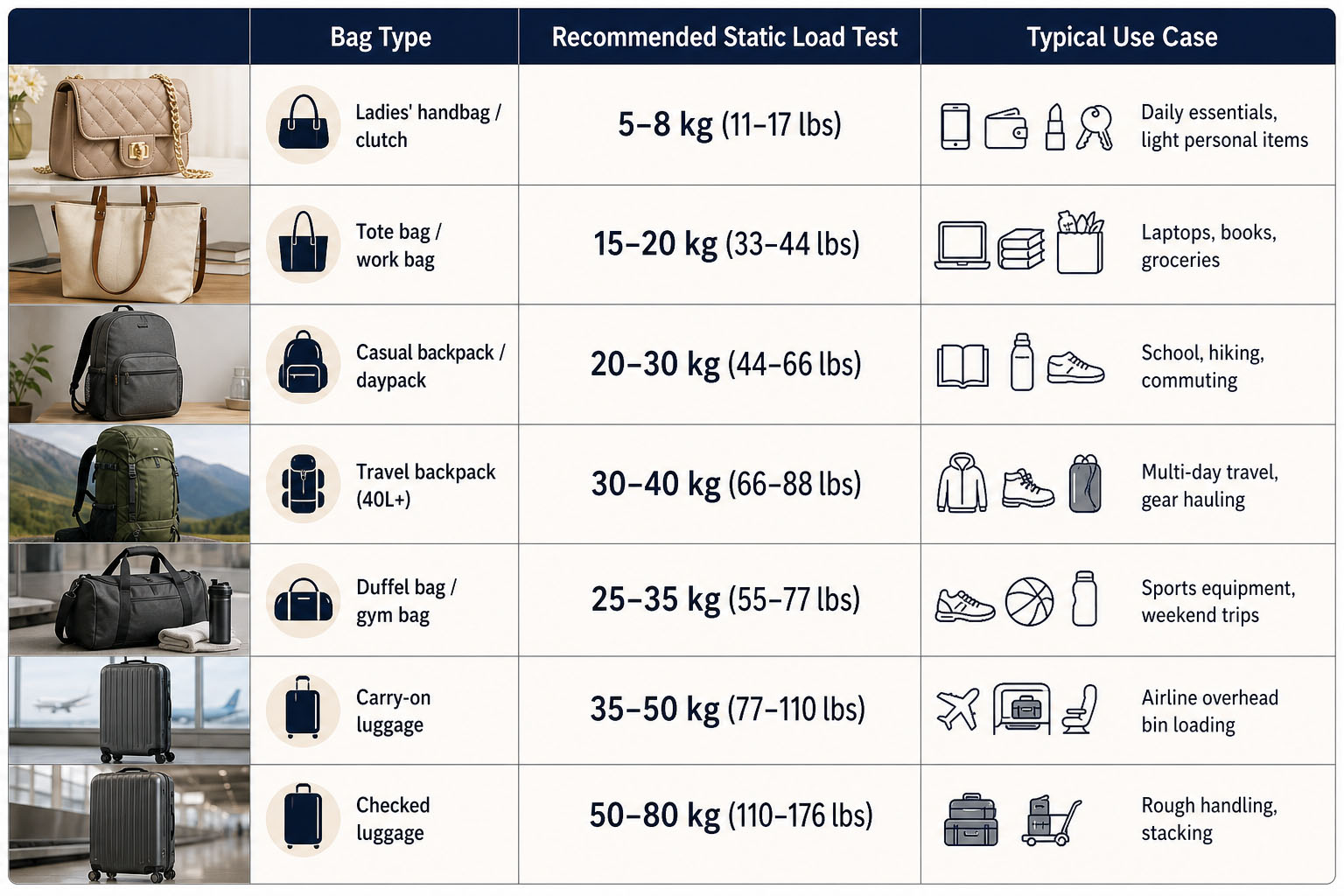
These numbers represent minimum safe design loads. We always specify that handles and straps must withstand 3 to 5 times the rated load capacity to ensure an adequate safety margin.
Part 4: Test Reports and Certifications to Request
Before placing a production order, your supplier should provide the following documentation:
1. Material test report — for the webbing, leather, or PU strap material
2. Handle/strap tensile test report — showing static load and breaking strength
3. Stitching/seam strength report — critical because seams typically fail before the strap material
4. Hardware test report — D-rings, buckles, magnetic snaps, zippers
5. Cycle/durability report — for products with moving parts (backpack suspension, trolley handles)
6. ISTA transit test report — for luggage, travel bags, and any product shipped by air/sea
7. Batch-numbered pre-shipment test certificate — links the report to your specific production lot
Ask whether the report comes from the factory’s in-house lab or an independent third-party lab such as SGS, Bureau Veritas, Intertek, or CTI. Third-party reports carry significantly more credibility and are often required by U.S. retailers and Amazon Brand Registry.
Part 5: How Frequently Should the Factory Test?
There is no universal answer, but here is the framework we use with our partner factories:
First article (pre-production sample): Full battery of tests on the gold sample
Every production run: Spot-check testing on the first 5–10 units off the line
Per shipment: Batch-numbered pull-strength test on a minimum of 3 units from the finished goods
Annually or per material change: Re-test when the factory changes fabric supplier, hardware supplier, or stitching thread
For large orders above 5,000 units, we strongly recommend commissioning an independent pre-shipment inspection that includes a witnessed pull-strength test. This typically costs $200–$400 and has saved our clients from receiving defective shipments worth tens of thousands of dollars.
Part 6: 10 Expert Insights from Our Quality Team
These are the lessons we’ve learned from inspecting hundreds of bag factories across Guangdong, Zhejiang, and Fujian.
Insight #1: Test handles and straps to at least 3–5 times the rated load capacity.
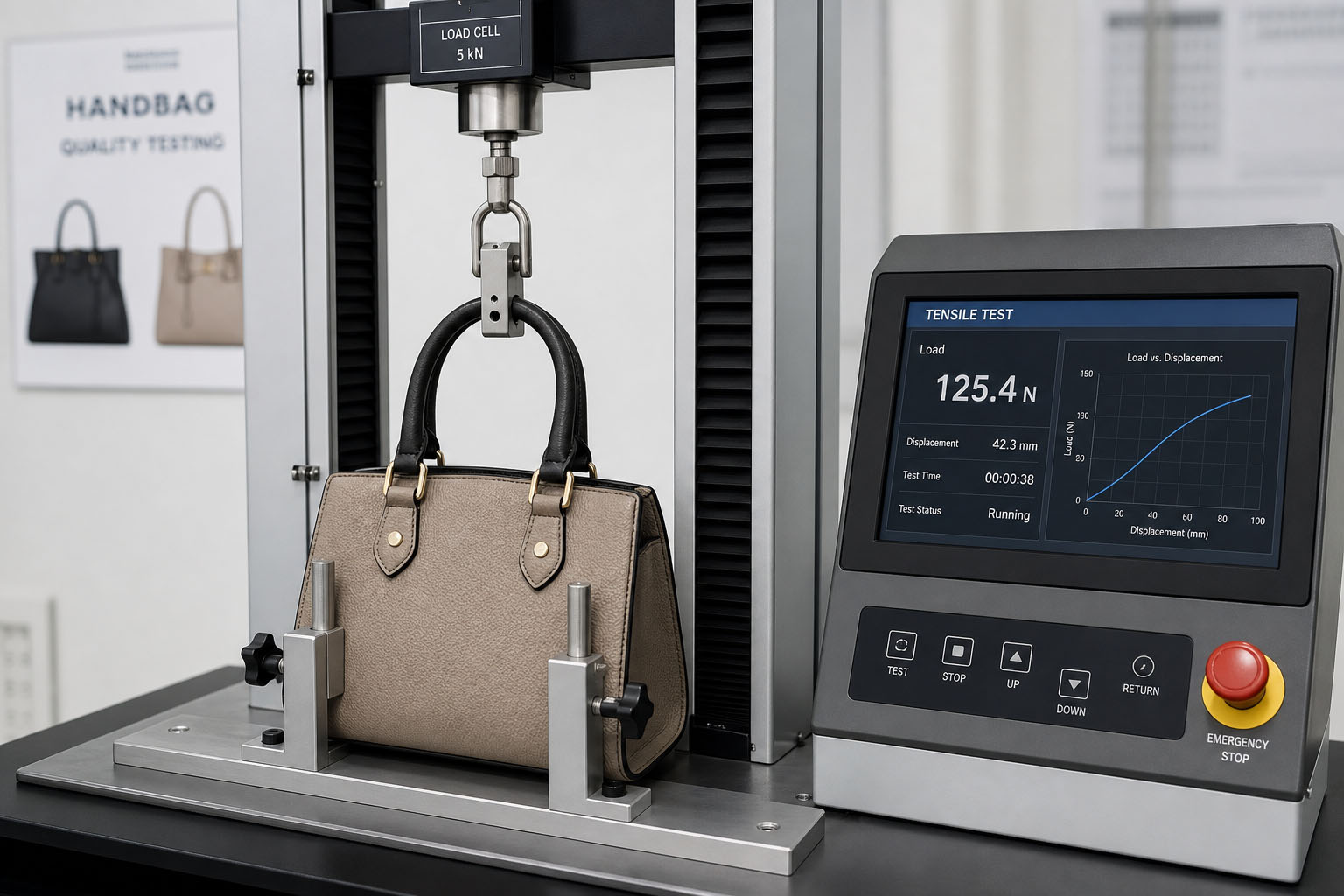
A bag rated for 10 kg should never be tested to only 10 kg. The 3–5x safety factor accounts for shock loading (a customer dropping the bag, a child pulling on the strap) and material fatigue over time. Most reputable brands set their safety factor at 4x.
Insight #2: Reference ASTM D6194 or ISO 13999 in your purchase order.
Don’t assume the factory knows which standard you mean. Write it explicitly into your spec sheet:
“Handle and strap tensile strength shall be tested per ASTM D6194 with a minimum breaking strength of [X] lbf and elongation at break not exceeding [Y]%.”
This eliminates ambiguity and gives your QC team a benchmark to verify.
Insight #3: Stitching and seam integrity usually fail before the strap material itself.
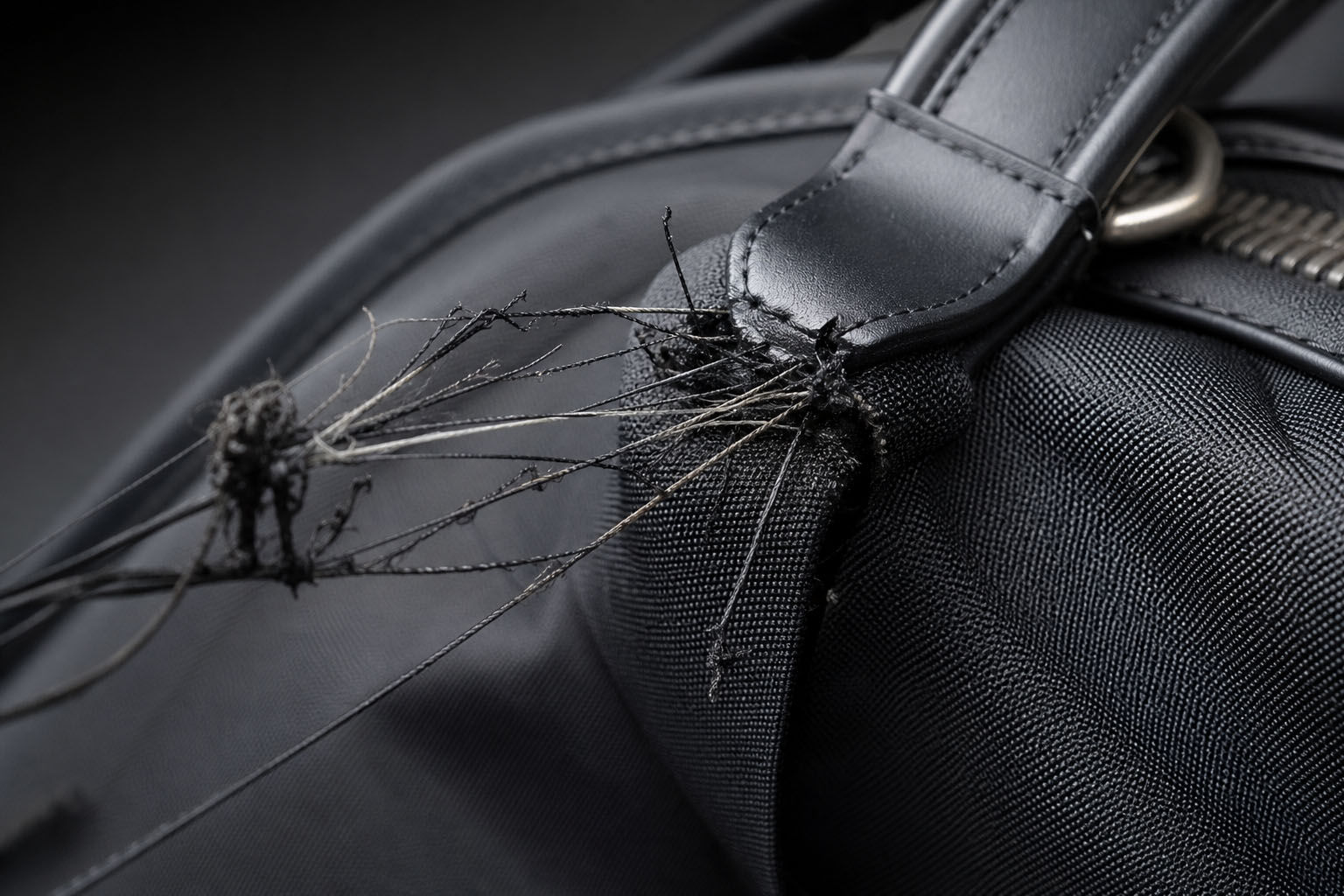
In over 70% of our failure analyses, the webbing or leather strap is still intact—the stitching has simply unraveled. This is why every serious test program must include seam slippage resistance and stitch thread tensile strength testing, not just the strap material alone.
Insight #4: Apply both static load tests and dynamic cycle tests.
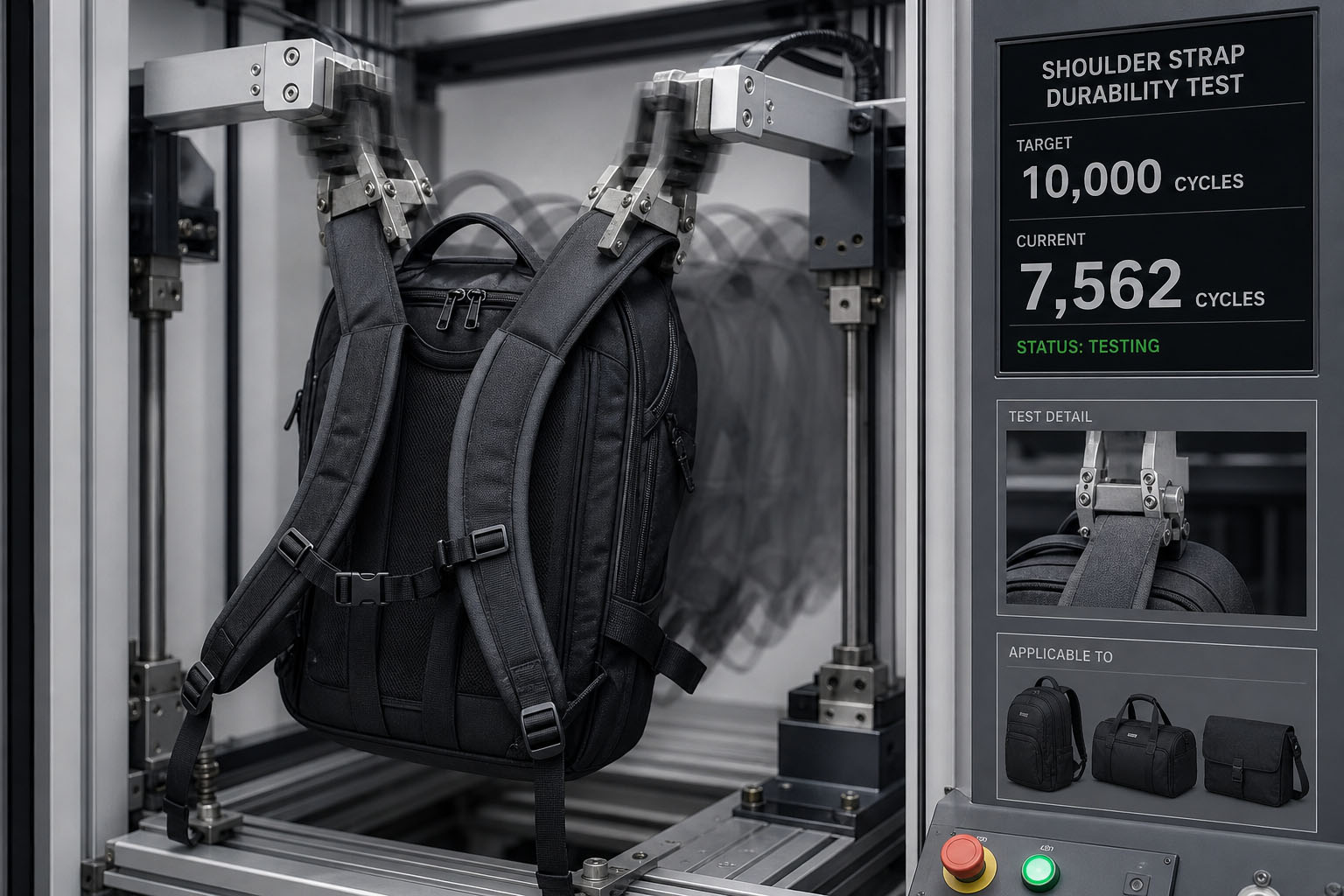
A static load test tells you only that the handle can hold a weight once. Real customers load and unload their bags hundreds of times per year. A dynamic cycle test (typically 5,000 to 50,000 cycles) reveals fatigue failures, loose stitching, and hardware loosening that static tests miss entirely.
Insight #5: Specify pull speed, angle, and attachment point in your test method.
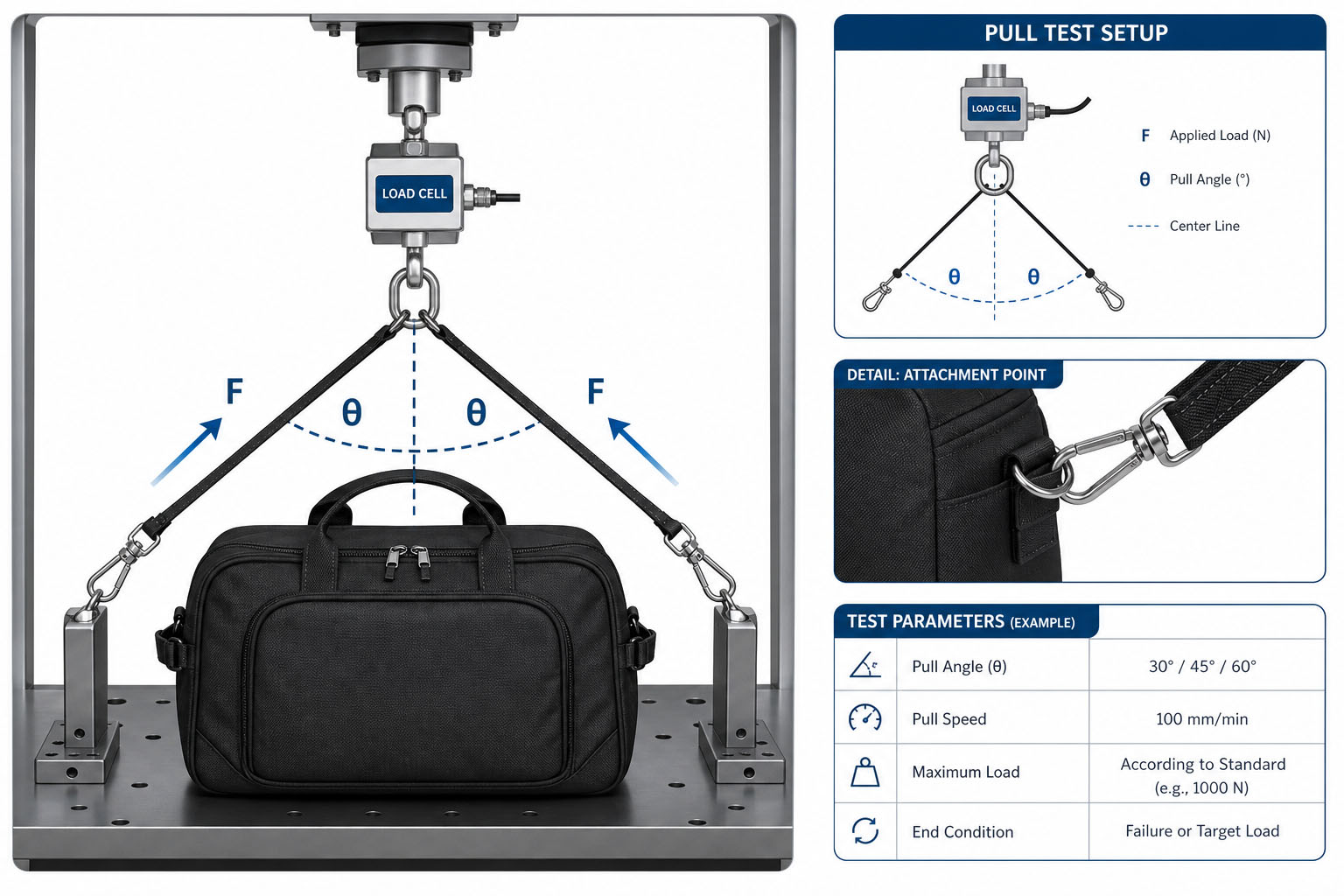
A pull test at 100 mm/minute yields different results than one at 500 mm/minute. A strap pulled straight down behaves differently than one pulled at a 45° angle (mimicking a shoulder carry). Lock down all three variables—speed, angle, and anchor location—to ensure comparable, repeatable results between factories and between production runs.
Insight #6: Request batch-numbered pre-shipment test reports.
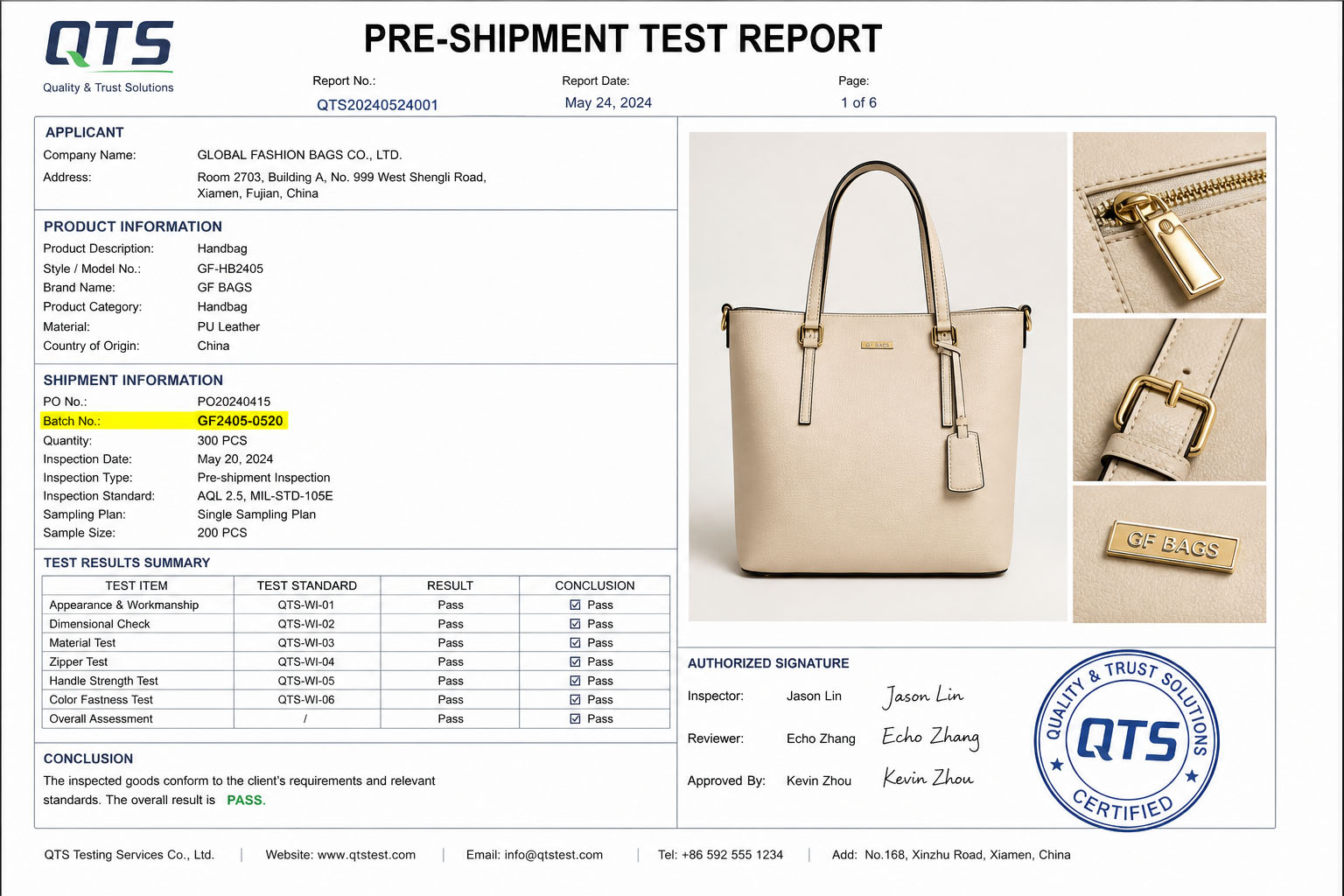
A test report from January is meaningless for a shipment leaving in November. Always require a report dated within 30 days of shipment, with a batch number that matches the carton labels. This is your traceability anchor if a defect surfaces in the field.
Insight #7: Confirm whether the factory tests to Chinese QB/T or to your specified U.S./international standards.
Many factories default to QB/T because that’s what their lab is set up for. QB/T 1333 and QB/T 2155 are valid standards, but their test methods and pass/fail thresholds differ from ASTM and ISO. Don’t let the factory substitute one for the other without your written approval.
Insight #8: Test metal hardware independently—D-rings, buckles, and rivets often have lower failure thresholds than straps.
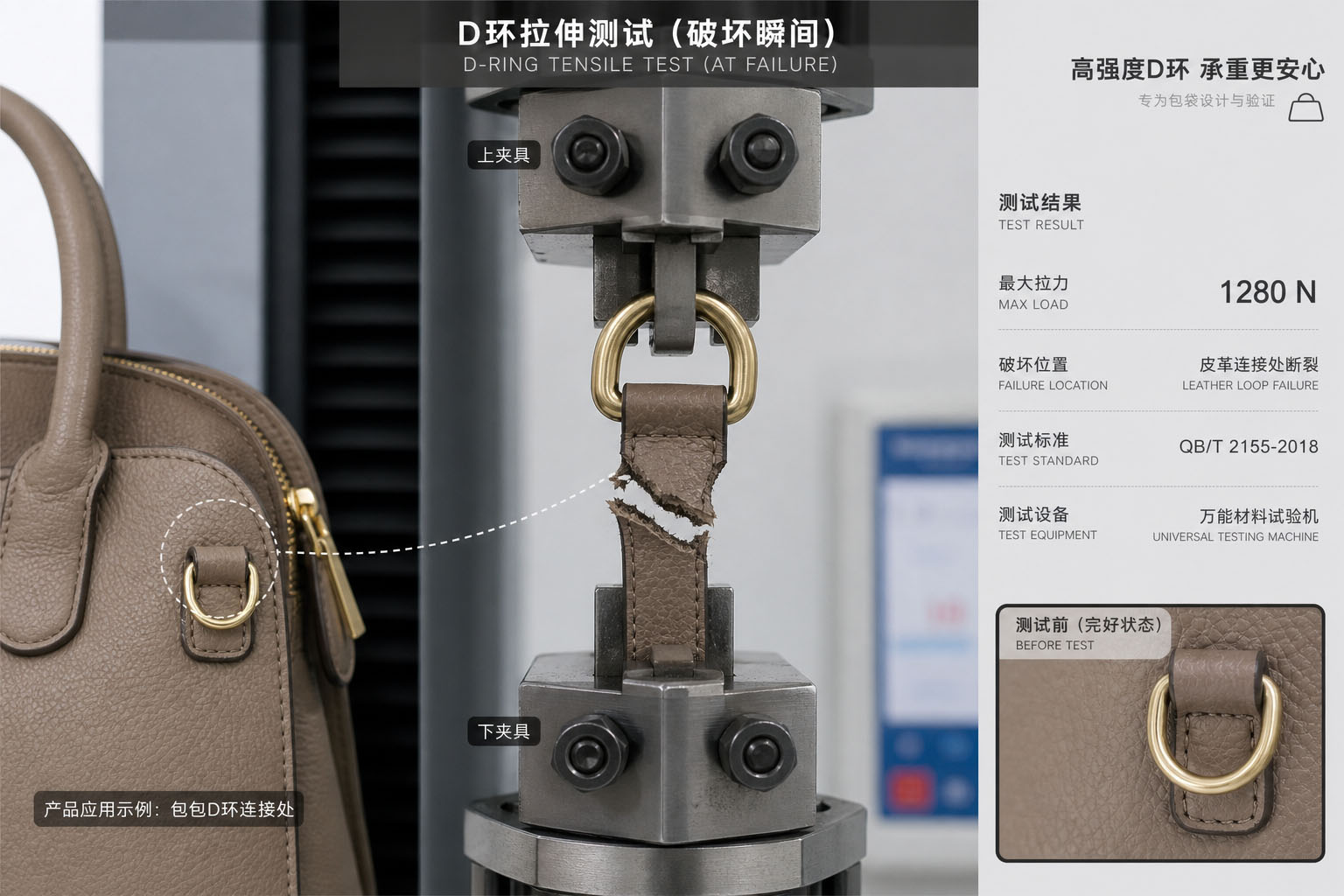
A heavy-duty nylon strap rated for 200 kg is worthless if it’s anchored to a zinc D-ring that fails at 60 kg. Insist on separate test reports for every metal component. We’ve seen beautiful bags recalled because the buckle supplier quietly downgraded to a cheaper alloy.
Insight #9: Include climate conditioning in your pre-test protocols.
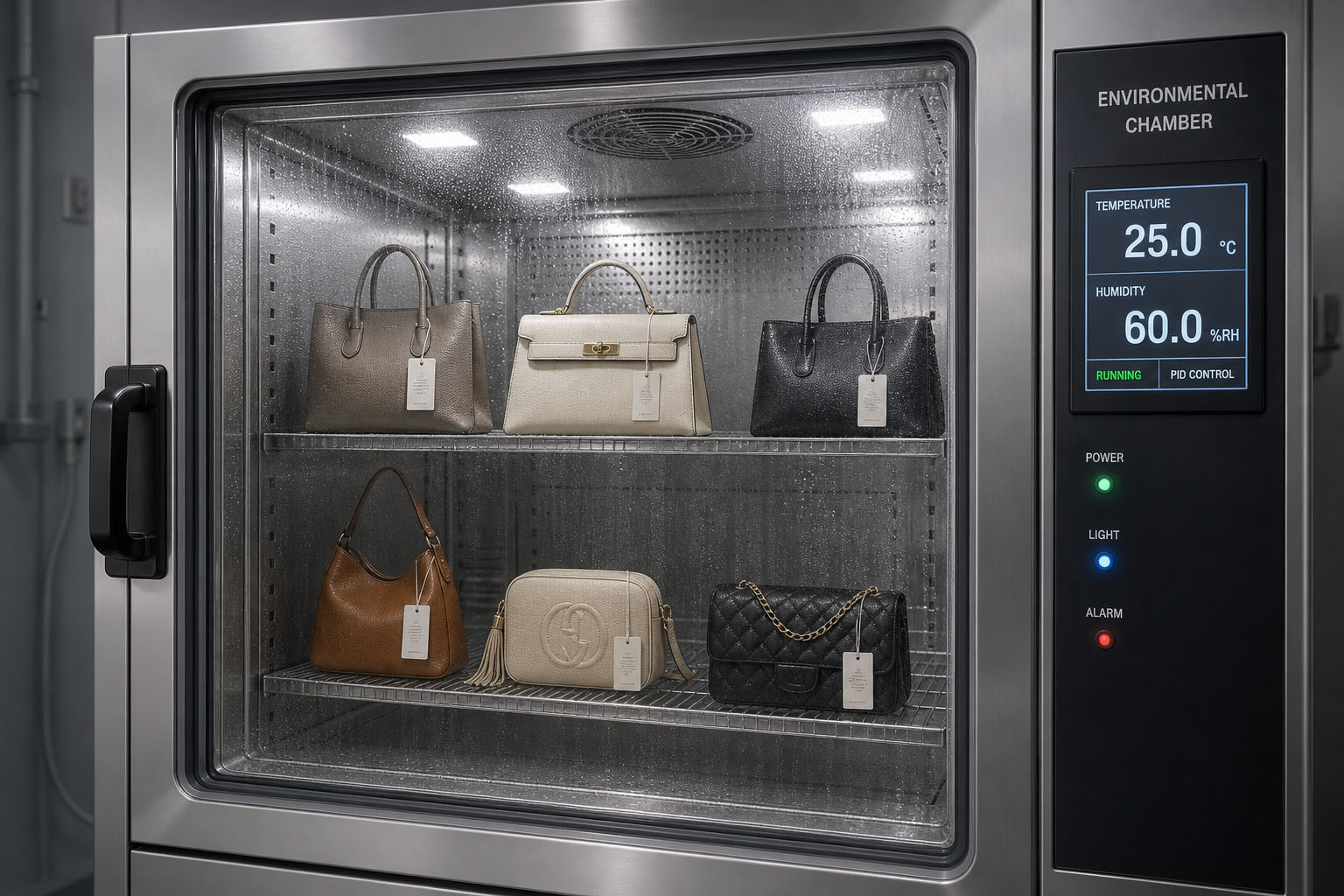
Bags shipped to humid Florida, dry Arizona, and cold Minnesota experience very different stress profiles. Specifying 24–48 hours of pre-conditioning at 20°C/65% RH (or your target climate) ensures test results reflect real-world performance, not lab-only conditions.
Insight #10: Commission an independent third-party pre-shipment inspection.
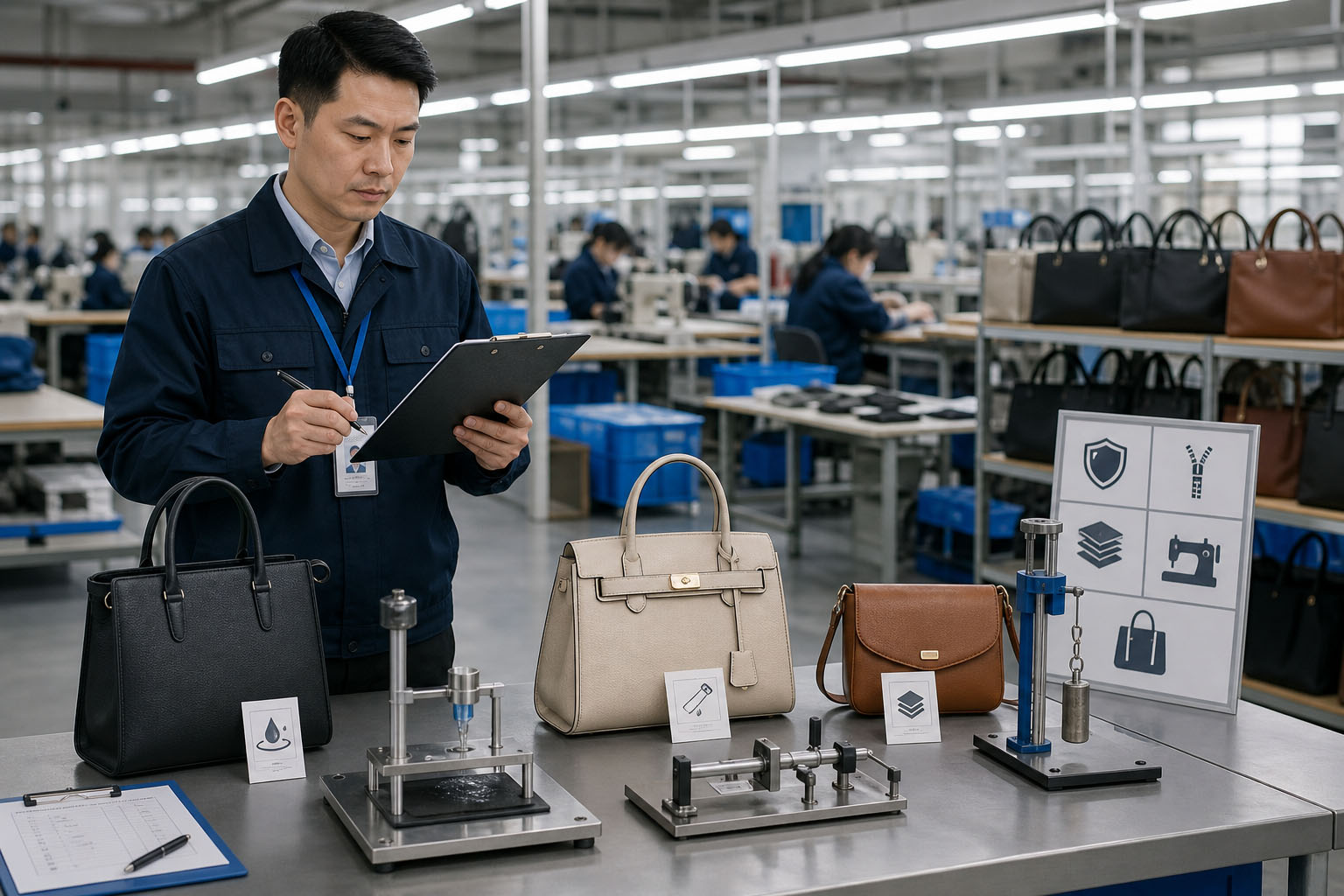
Even trustworthy factories make mistakes. A third-party inspector—companies like QIMA, AsiaInspection, V-Trust, or Bureau Veritas—will witness a live pull-strength test on units pulled from your finished goods, photograph the results, and issue a pass/fail report you can rely on. This is the single highest-ROI step in any bag import operation.
Part 7: How to Ask Your Chinese Supplier (Word-for-Word Scripts)
We’ve tested these messages with hundreds of factories. They work.
Initial Inquiry
“Before placing an order, please confirm whether the handles and straps have passed load and pull-strength tests. Kindly share the test standard, the test report, and the maximum weight the product can withstand.”
Follow-Up Questions
1. “Do you have test reports for handle and strap load-bearing strength?”
2. “What is the maximum tested weight for the handles and straps?”
3. “Which test standard do you follow—ASTM, ISO, ISTA, or Chinese QB/T?”
4. “Can you share photos, videos, or lab reports of the testing?”
5. “Is the report from an independent third-party lab or in-house only?”
6. “What is the batch number on the test report, and does it match the production lot?”
7. “Has the product passed with no breakage, loose stitching, or attachment failure?”
Formal Purchase Order Clause
Add this language directly to your PO:
“Supplier shall provide, prior to shipment, a third-party pull-strength test report certifying that all handles and straps withstand a minimum static load of [X] kg and survive [Y] dynamic cycles without failure. Testing shall conform to ASTM D6194 or ISO 13999. Test report must reference the production batch number and be dated within 30 days of the ship date.”
Part 8: What to Do When the Supplier Says “We Test In-House”
You’ll hear this constantly. It’s not necessarily a deal-breaker, but it requires follow-up:
Ask to see the lab. Most reputable factories have a small tensile testing machine on-site. If they won’t show it to you, that’s a concern.
Request a video of a live test. Any factory with a real quality program can record a 60-second video of a pull test on your actual sample.
Cross-check with a third party. Even if the factory’s report is solid, commission your own independent test on a pre-production sample before mass production.
Conclusion: Build Your Sourcing Process on Data, Not Trust
The bag industry has a low barrier to entry, which means there are excellent factories and terrible factories operating in the same city. The difference between them is almost always their quality testing discipline.
By embedding load and pull-strength testing into your sourcing workflow—specifying standards in your PO, requiring batch-numbered reports, and commissioning third-party inspections when order values justify it—you’ll:
Reduce return rates by 60–80%
Eliminate the worst-performing 10–15% of factories from your supplier pool
Build a brand reputation that justifies premium pricing
Sleep better at night
Want us to review a supplier’s test report before you place an order? Send it to our sourcing team and we’ll give you a free 24-hour assessment.
Post time: Jul-25-2026