
Low‑MOQ Material Sourcing from Chinese Bag Factories: A Complete Guide for US B2B Online Bag Sellers
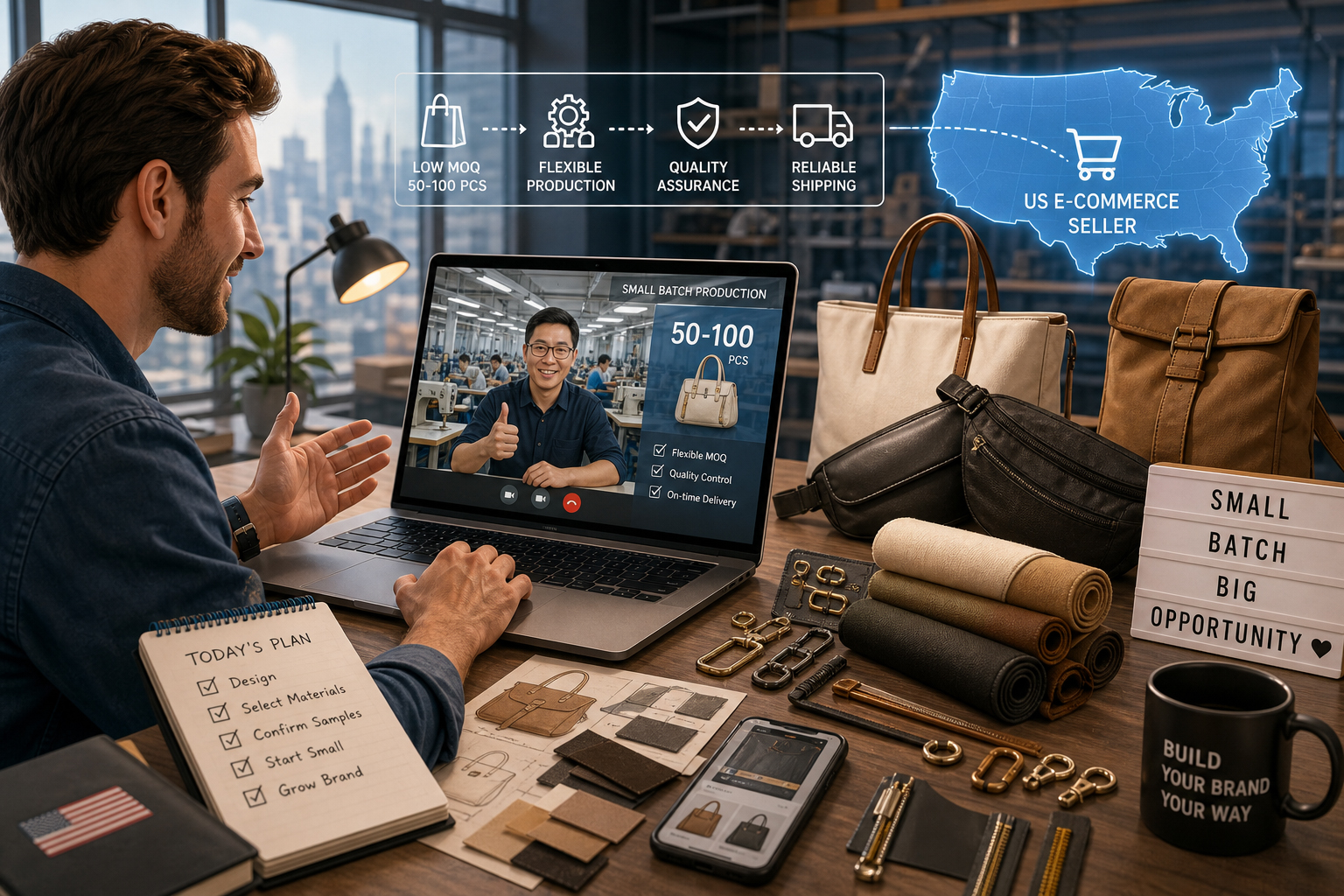
If you run an American online bag store or a small‑scale B2B wholesale bag business, you know one pain point better than anyone else. You want to launch new styles, test market demand and develop samples without committing to thousands of finished bags or huge rolls of fabric. Low‑MOQ material sourcing capability has become a make‑or‑break factor for small‑batch orders and new sample development. Many US buyers send the same core questions to Chinese bag manufacturers: Can factories really support flexible small‑volume material procurement? What is the normal material MOQ in China’s bag industry? Are customization services available for low‑MOQ B2B projects? How long will small‑batch production take? And most critically, how do suppliers maintain stable quality and identical material performance across tiny trial runs?
A large number of overseas buyers fall into a common trap. They simply ask factories “can you offer low MOQ?” and accept vague, one‑sentence promises without digging into real details. “Low MOQ” is a broad marketing phrase. It may only apply to fabrics and hardware that the factory already keeps in stock. Custom colors, specialty textiles, genuine leather, custom‑molded zippers and brand‑exclusive buckles often still carry high minimum purchase thresholds. As a professional US‑based bag merchant, you need a structured, data‑backed understanding of China’s bag‑making supply chain before negotiating your next trial order.
1. Low‑MOQ Material Sourcing: What Real Factory Strength Looks Like
Not every Chinese bag factory has reliable low‑volume material sourcing systems. A supplier that genuinely supports small B2B buyers builds its flexibility through multiple practical mechanisms.
First, reputable manufacturers maintain in‑house material inventories for sample development and small orders. Instead of purchasing raw fabric only after buyers confirm bulk production, they keep popular nylon, polyester, canvas, PU leather, lining, webbing, standard zippers and common buckles stocked on‑site. When you only need dozens of finished bags for market testing, the factory can draw existing stock rather than placing a new large‑scale order with textile mills. This eliminates the rigid material minimums that usually block small projects.
Second, experienced factories maintain dedicated internal sourcing teams. When your ideal fabric is out of stock, these teams can source suitable alternative materials quickly without forcing you to meet high mill MOQs. Many factories also adopt hybrid sourcing models, combining locally produced Chinese textiles and imported premium raw materials to fit small‑batch requirements.
Third, long‑established bag makers form stable partnerships with local fabric and hardware wholesalers. These alliances allow them to split bulk textile rolls and flexible purchase smaller quantities of lining, webbing and metal fittings, something most individual overseas buyers cannot achieve on their own. Some larger factories also absorb leftover surplus inventory from their high‑volume mass‑production lines. Those residual fabric rolls become the primary material pool for small B2B trial orders.
A very practical service professional suppliers provide is material substitution consultation. If your selected exclusive fabric requires a 1,000‑meter minimum purchase that exceeds your budget and order scale, they will propose comparable alternative fabrics with lower stock MOQs while preserving the texture, weight and waterproof performance your design demands.
Advanced factories also use digital sourcing platforms linked to their internal warehouse systems. Buyers can confirm real‑time fabric availability, color options and stock quantity before starting sampling. A few suppliers operate bonded warehouse solutions, allowing US merchants to access materials without massive upfront capital commitments. For brands planning multiple bag lines, consolidated material sourcing is another valuable option. Factories combine your different styles and color variants to reach the minimum purchase requirement of textile suppliers, which greatly reduces the financial pressure of separate small orders.
It is vital to separate marketing claims from verifiable strength. A trustworthy factory will not just claim “we support low MOQ”. It can answer concrete questions: the lowest usable quantity for each in‑stock material, extra surcharges for small‑meterage picking, available swatch kits, material composition reports, GSM and thickness data, and the feasibility of mixing multiple colors or styles to meet mill minimums.
2. What Is the Typical MOQ for Materials at Chinese Bag Factories?
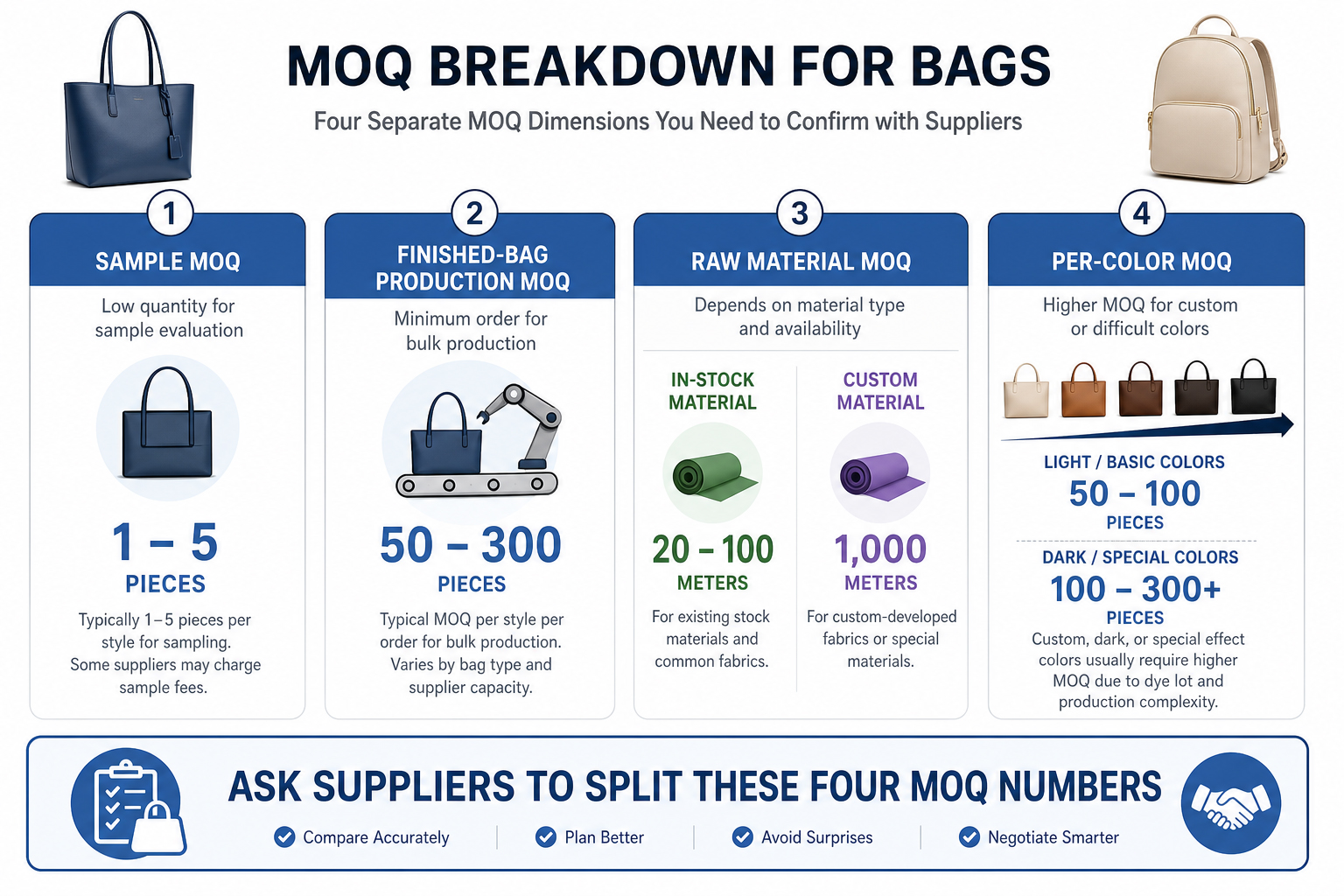
This is the most frequently asked question from US B2B bag buyers, and the answer must distinguish finished‑bag production MOQ and raw‑material MOQ, two concepts that many suppliers intentionally mix together.
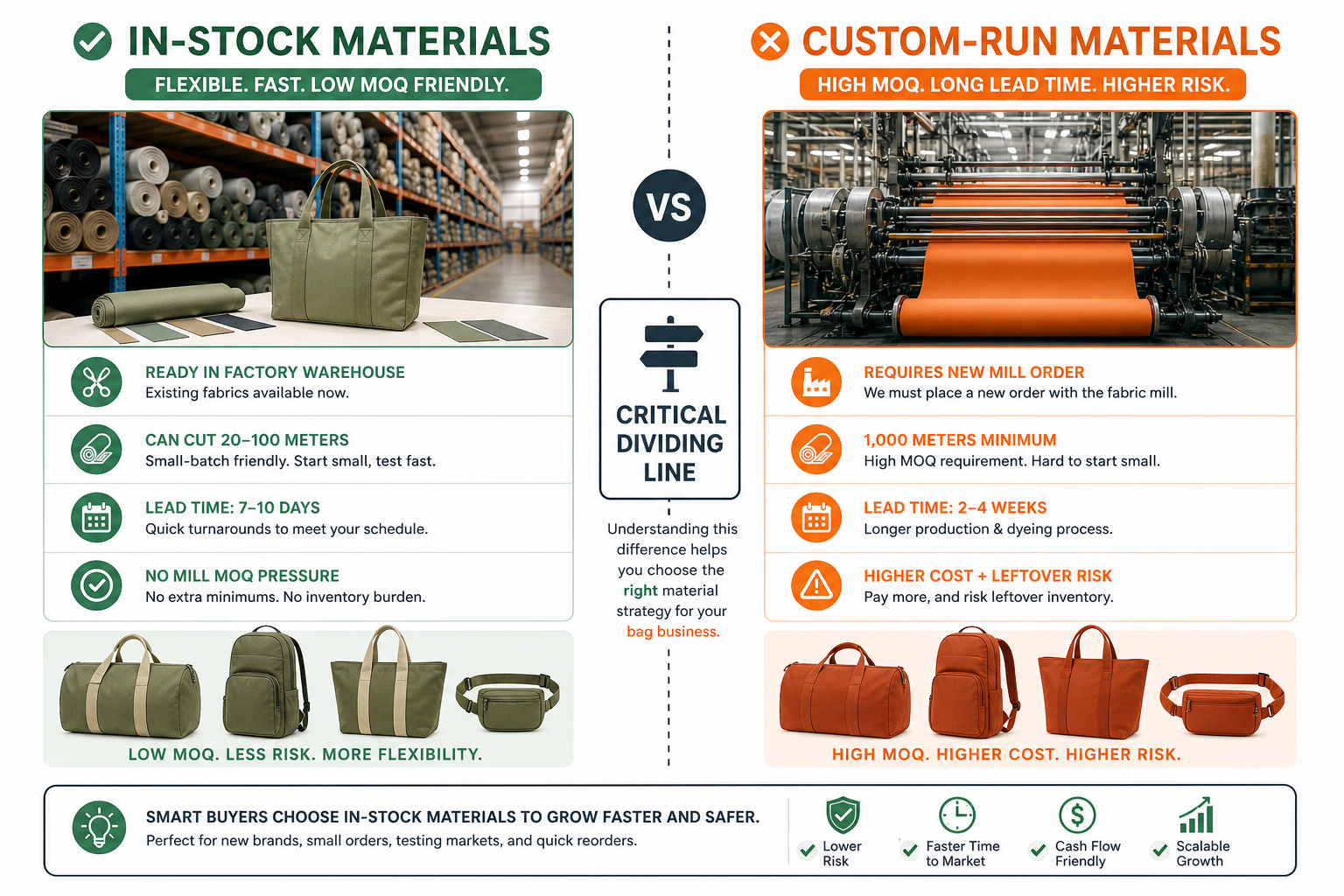
In China’s mainstream bag supply chain, the standard raw‑fabric MOQ set by textile mills is usually 1,000 meters. However, this 1,000‑meter rule applies mainly to newly dyed, custom‑colored or specially finished fabrics ordered directly from textile manufacturers. The exact number of finished bags that 1,000 meters of fabric can produce changes drastically depending on bag style, bag size, cutting waste, lining usage and accessory consumption. A slim crossbody pouch consumes far less fabric than a large travel backpack, so you cannot judge a factory’s low‑MOQ capability only by the 1,000‑meter mill threshold.
Here is the key dividing line:
In‑stock materials: The factory already owns fabric rolls. There is no new mill order, so the material MOQ can drop sharply. Factories can cut 20–100 meters or even smaller amounts for samples and tiny trial runs, though small picking often brings an additional material surcharge.
Custom‑run materials (new dyeing, custom texture, exclusive finish): The factory has to place a fresh order with fabric mills. The mill’s 1,000‑meter MOQ still applies, even if you only want 100 finished bags. In this case, the factory accepts a low finished‑bag MOQ, but it does not have true low‑MOQ custom‑material sourcing capability.
Hardware MOQ: Standard zippers, snaps and buckles in common sizes and finishes usually exist in stock. Custom metal hardware with engraved logos or new molds has high minimum quantities and extra mold fees.
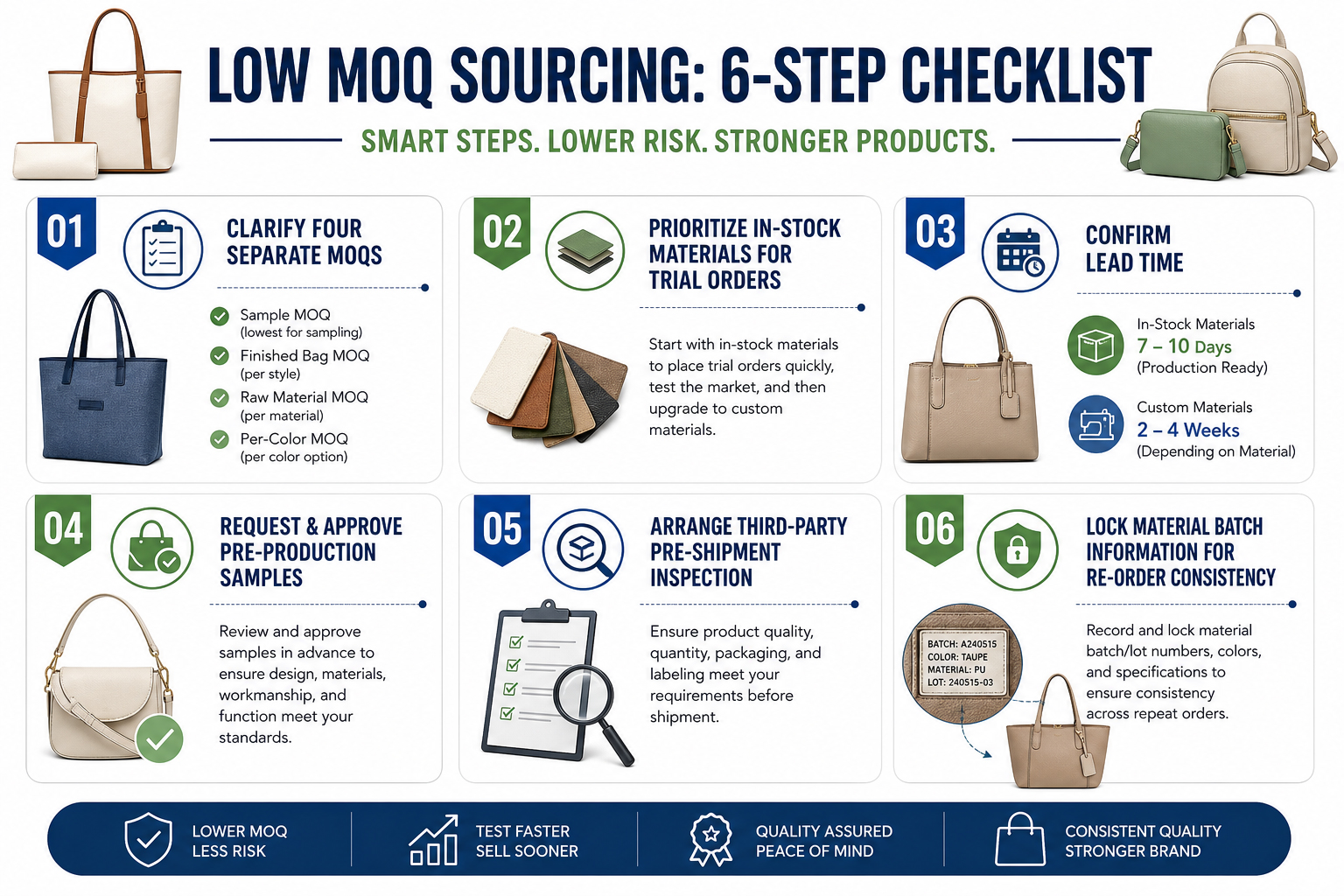
Many online suppliers advertise production starting at 30 or 50 finished bags, while most handbag factories set trial‑order thresholds around 50–300 pieces. These figures only represent finished‑goods MOQ. You must ask suppliers to split four separate MOQ numbers in every quotation: sample MOQ, finished‑bag production MOQ, raw‑fabric MOQ and per‑color MOQ. This detailed breakdown reveals whether their low‑MOQ offer is genuine or a sales gimmick.
For US independent website sellers, the most cost‑effective strategy is clear. At the sample and initial trial‑order stage, prioritize the factory’s existing stock fabrics, standard colors and regular hardware. Avoid custom molds and exclusive dyeing in your first cooperation. Once your product proves market popularity and you plan larger repeat orders, you can switch to custom fabrics and branded metal accessories. This approach balances low investment risk and product uniqueness.
3. Do Chinese Factories Offer Customization Options for Low‑MOQ B2B Bag Orders?
The short answer is yes. Qualified Chinese bag factories can deliver customization services even for small‑volume B2B orders, but the range of customizable items has obvious limits tied to stock status.
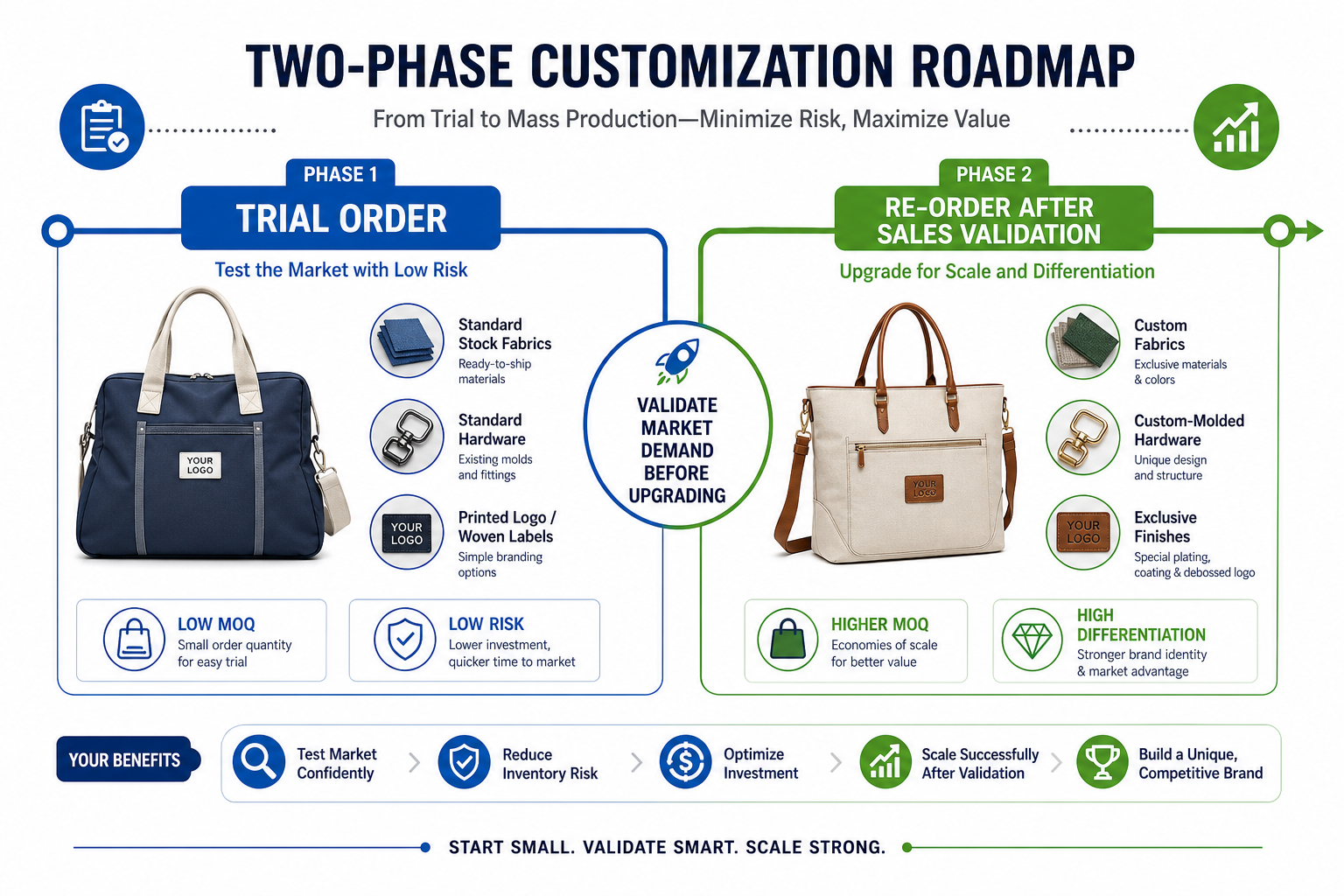
Available low‑risk customization for small orders includes printed logos, woven fabric labels, removable hang tags, customized packaging bags and minor size adjustments based on existing bag patterns. The factory uses in‑stock fabrics and standard hardware, so no new material minimums are triggered. These modifications help you build branded merchandise without huge upfront spending.
Customization that requires new raw‑material batches has stricter restrictions. If you require a unique Pantone fabric color, special waterproof coating, custom embossed texture, bespoke lining fabric or brand‑exclusive metal buckles, the textile or hardware factory will enforce high MOQs. The bag manufacturer may still accept your small finished‑bag order, yet the extra material cost, surcharges and leftover fabric waste will push up your unit price significantly.
Professional factories provide a flexible two‑phase customization roadmap for overseas B2B buyers. Phase one uses standard stock materials for prototypes and trial batches. After you verify sales performance and confirm re‑order demand, phase two introduces custom fabrics, custom‑molded hardware and exclusive surface treatments for mass production. This staged plan perfectly matches the operating rhythm of US online bag brands that rely on continuous product iteration and market testing.
When negotiating customization, send the factory a precise checklist. Clarify logo printing technique, label size, packing requirements, color tolerance, test report demands and whether leftover stock fabric can be reserved for future repeat orders. Many buyers experience inconsistent quality on re‑orders because they fail to lock in customization specifications and material lot information in the first small batch.
4. What Are the Lead Times and Production Schedules for Low‑MOQ Bag Orders from China?
Lead time is another critical concern for US independent merchants. Your online store has seasonal promotion cycles, and delayed shipments can ruin holiday sales plans. Production schedules for low‑MOQ bag orders fall into two distinct scenarios: in‑stock material packing and full new production.
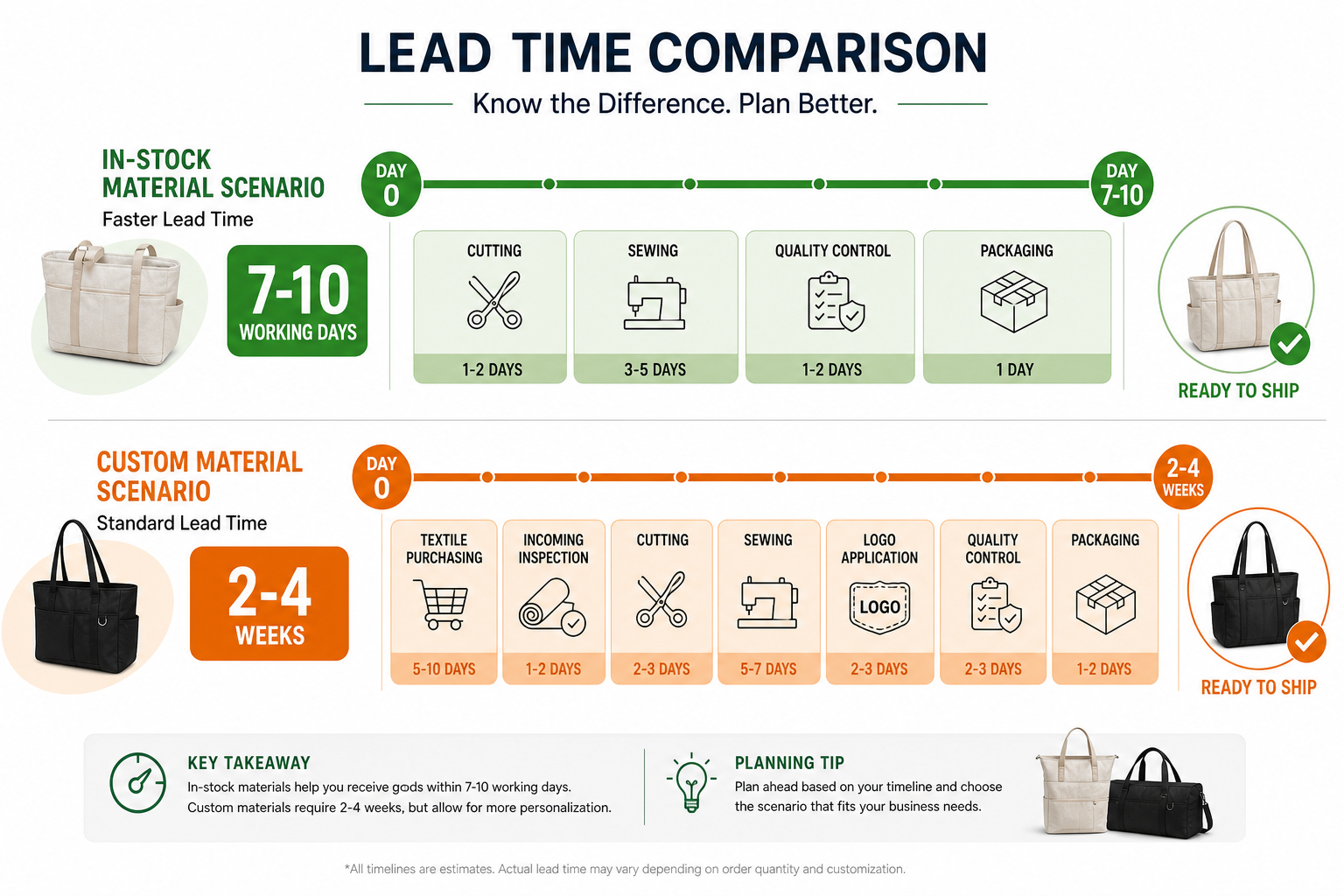
If the factory already holds all required fabrics and accessories in its warehouse, they only need cutting, sewing, quality inspection and customized packaging. The typical turnaround is 7–10 working days after sample confirmation. This ultra‑fast schedule is ideal for urgent small replenishment, limited‑edition collections and seasonal trial launches.
When no suitable stock exists and the factory has to source materials and arrange a complete new production run, the lead time extends to 2–4 weeks. This longer cycle covers textile purchasing, incoming material inspection, pattern cutting, stitching, logo application, final QC and export packing. You must reserve enough buffer time for international ocean or air freight after factory production finishes.
A common mistake made by US buyers is assuming low‑MOQ always equals fast delivery. If your small order involves custom‑dyed fabric or new hardware molds, textile mill lead time and mold opening time will add extra weeks to the whole schedule, even if you only buy 100 bags.
Reliable factories provide a transparent step‑by‑step production timetable for every small‑batch order. They share progress photos or short video updates at key milestones: material arrival, cutting completion, semi‑finished assembly and pre‑shipment inspection. Clear scheduling helps you synchronize inventory planning, website listing updates and US warehouse receiving arrangements.
5. How Do Chinese Factories Ensure Quality Control and Material Consistency for Low‑MOQ Orders?
Many overseas buyers hold a biased assumption: factories lower their QC standards for tiny trial orders. In reality, reputable bag manufacturers follow identical quality specifications for small‑batch and large‑volume production runs. Their core QC logic is simple: all bulk production strictly follows the pre‑approved sealed sample, regardless of order size.
The complete low‑MOQ quality assurance workflow has three stages. First, incoming raw‑material inspection. Every fabric roll, zipper and metal fitting is checked against the swatch sample for color shade, thickness, hand feel, surface defects and coating performance before cutting starts. Any non‑conforming materials get rejected immediately. Second, inline workshop inspection during sewing. Workers and QC staff monitor seam strength, stitching density, zipper smoothness and logo positioning continuously. Third, finished‑goods final inspection before shipment. Each bag undergoes a full visual and functional test.
Material consistency across repeat small orders is harder to maintain than one‑off production. Stock fabric batches change periodically, and discontinued stock is a major hidden risk. Excellent suppliers record fabric batch numbers, hardware part codes and color lot information for every buyer’s order. They will reserve partial stock rolls for returning customers when possible. If a material is out of production, they notify you in advance and offer equivalent replacement swatches for confirmation instead of secretly switching materials without permission.
For US B2B sellers, the safest practice is to request a pre‑production sample for final written approval, and arrange third‑party professional inspection before balance payment and shipment. Do not rely only on factory self‑inspection reports. Independent inspection effectively avoids color deviation, fabric substitution and workmanship defects that often appear in low‑volume runs.
6. Practical Sourcing Checklist for US B2B Bag Buyers
After understanding the core mechanics of low‑MOQ material sourcing, you need actionable inquiry templates and verification steps to screen qualified factories. Avoid vague messages. Send suppliers targeted, detailed questions instead of a simple “can you do low MOQ”.
We recommend this professional inquiry script for your factory outreach:
Hello, we are a US‑based online bag retailer seeking a long‑term Chinese manufacturing partner. Low‑MOQ material sourcing is extremely important for our small B2B orders and sample development. Please answer the following points clearly:
What is your lowest MOQ for custom bag designs using your existing stock materials?
What separate MOQ applies per style, color and raw material?
Can you source small quantities of nylon, polyester, canvas, PU leather, recycled fabric, lining, webbing, padding, zippers and buckles?
Which materials are in stock, and which items require a new mill production run?
Can you source fabric in 20–100‑meter small lots? Please provide real examples.
Are mixed colors or mixed styles allowed to meet textile suppliers’ minimum purchase quantities?
Can we start sampling and trial orders with standard stock materials and switch to custom materials for later bulk re‑orders?
What extra surcharge applies to small‑quantity material picking?
Can you supply material cards, swatches, composition data, GSM, thickness, color options and test certificates?
Can you keep the identical material and color available for future repeat orders?
State sample MOQ, sample cost and sample lead time separately.
Quote production MOQ and lead time for trial orders of 50,100,300 and 500 pieces respectively.
Share photos or short videos of your material warehouse and production workshop.
Confirm whether your company is a direct manufacturer or a trading intermediary.
Provide your complete low‑MOQ material sourcing solution and formal quotation based on our attached design drawing.
Before placing bulk payment, complete these verification checks: obtain the factory’s full business registration name and address, ask for a live virtual factory tour, receive physical courier‑delivered swatch samples, review itemized quotations listing sampling, material, mold, printing and packing fees, approve pre‑production samples, and schedule third‑party pre‑shipment inspection.
For your first cooperation, adopt a conservative launch plan. Select one or two mature designs, prepare 2–3 material options for each style, place a 50–100‑piece trial order using standard stock materials, apply affordable printed or woven‑label branding, and arrange independent quality checks before shipment. This method limits financial risk, tests factory reliability and collects real sales feedback from your US website customers.
Final Conclusion
Low‑MOQ material sourcing is not just a buzzword for small‑batch bag manufacturing. It is a comprehensive supply‑chain capability built on warehouse stock, stable wholesaler partnerships, professional sourcing teams, clear QC protocols and flexible production scheduling.
Chinese bag factories can support small B2B customization, but the feasibility depends heavily on whether you choose stocked or custom‑run materials. Remember the industry benchmark: custom fabric usually carries a 1,000‑meter mill MOQ, while in‑stock raw materials unlock small‑meter picking and fast 7–10‑day lead times. Trustworthy suppliers apply identical quality standards to tiny trial orders and mass production, and they preserve material records to maintain consistency on repeat purchases.
As an American independent‑site bag merchant, your biggest advantage is agility. Do not chase unlimited customization at the initial stage. Use stock‑material low‑MOQ trials to validate market demand, build stable factory partnerships step by step, and gradually upgrade to exclusive custom materials when your sales data proves the product line profitable. By asking precise questions, verifying factory claims with tangible evidence and following a staged sourcing strategy, you will turn low‑MOQ manufacturing from a risky challenge into your core competitive edge in the US bag wholesale and D2C market.
Post time: Sep-02-2026