
Mastering Lockstitch Seam Specifications for Bag OEM Purchasing: SPI, Seam Allowance & QC Standards for US Bag Brands
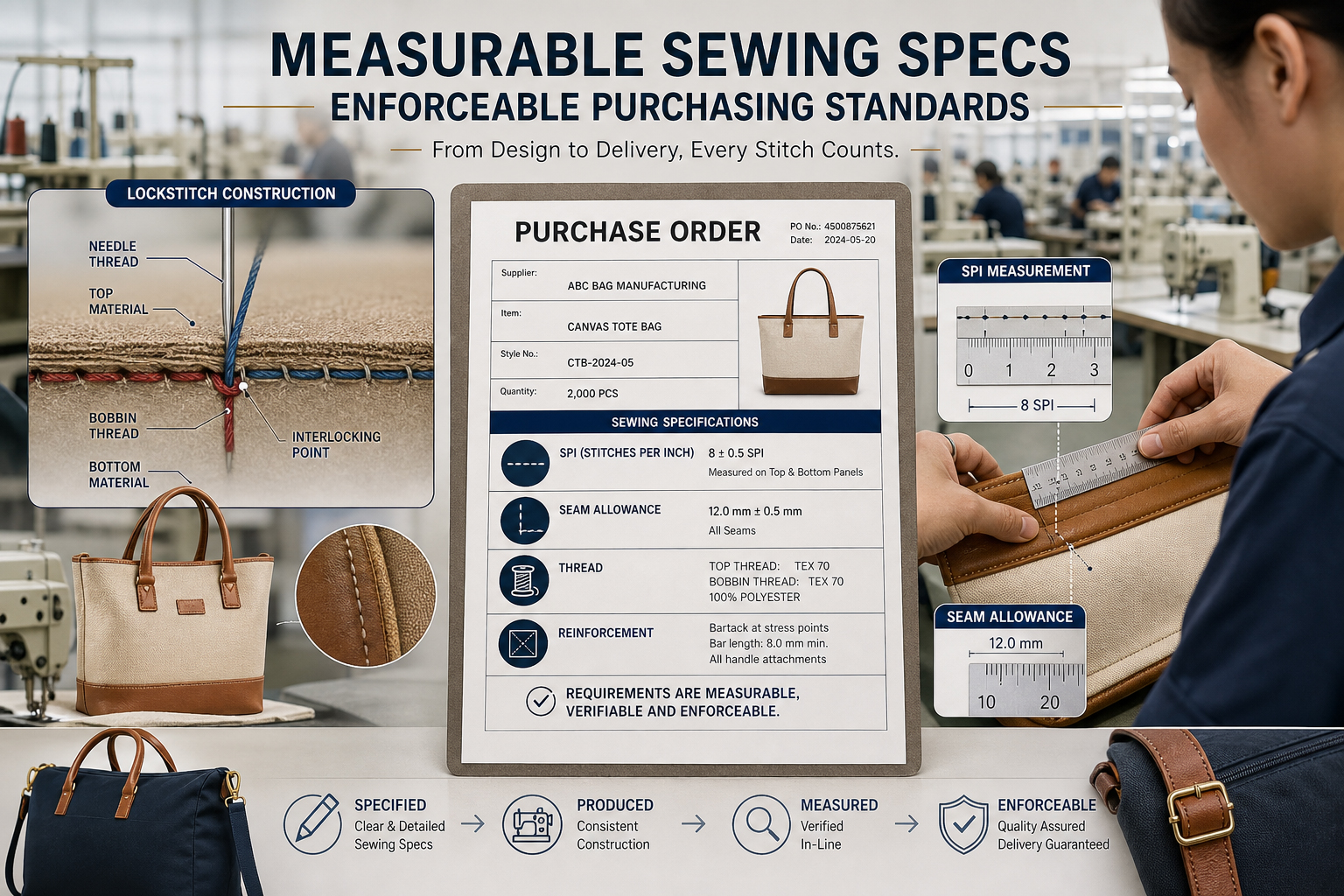
For US-based bag brands sourcing directly from Chinese OEM factories, stitching quality is one of the most common sources of disappointment, returns, and customer complaints. Many buyers write purchase orders with vague language such as “good stitching” or “neat workmanship.” This approach leaves interpretation entirely to the factory sewing team. When production batches vary, seams tear, stitches skip, or reinforcement points fail, there is no enforceable standard to hold the manufacturer accountable.
Consistent bag durability starts with measurable, clearly defined lockstitch seam specifications written directly into your purchase order (PO). These specifications cover stitch type, stitches per inch (SPI), seam allowance, thread specifications, reinforcement details, seam strength testing rules, and formal quality control sampling protocols. When paired with approved technical drawings and golden reference samples, these standards align your Chinese OEM’s production setup with your product expectations across every production run.
This guide breaks down lockstitch seam inspection rules, typical SPI ranges for different bag materials, seam allowance variations across bag panels, the direct relationship between stitching parameters and bag service life, and factory inspection methods used in Chinese bag OEM facilities. It also provides ready-to-use purchase order clauses you can copy and customize for your next bag order.
How to Specify and Inspect Lockstitch Seam Quality in Your Purchase Order
Lockstitch, most commonly stitch type 301 two-thread lockstitch, is the primary seam construction used for most consumer bags because it delivers stable strength and resistance to unraveling compared to chain stitches. However, lockstitch quality cannot be guaranteed by verbal agreement or reference to photos alone. All requirements must be quantified in your PO, supported by a marked technical drawing and an approved golden sample.
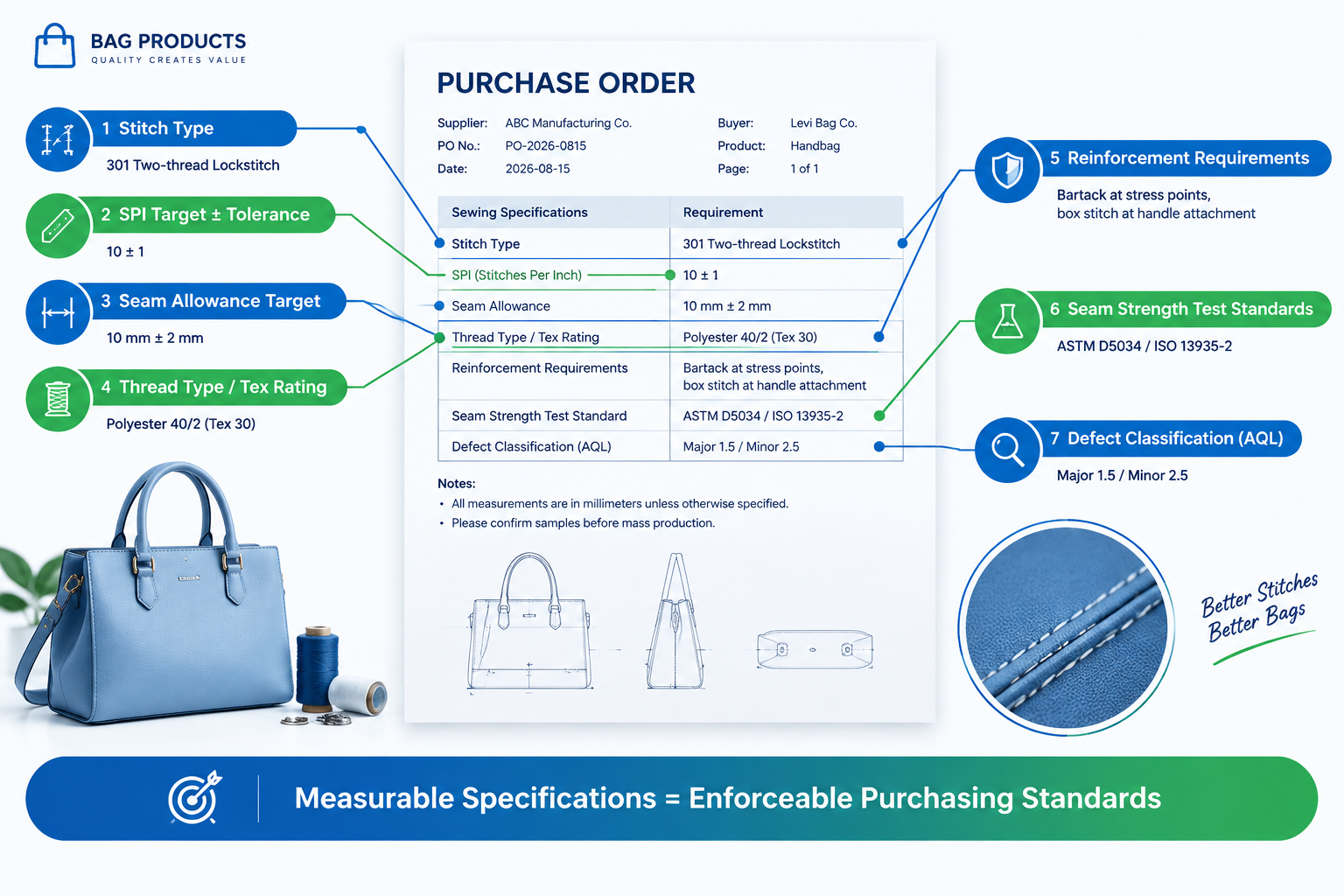
A robust PO lockstitch specification package includes stitch construction rules, SPI target and tolerance, seam allowance with dimensional tolerance, thread type and Tex rating, visual workmanship rules, reinforcement requirements for stress points, seam performance test standards, and defined defect sampling rules.
Seam allowance tolerance is a critical and frequently overlooked detail. In Chinese bag OEM production, the standard acceptable tolerance for seam allowance is commonly ±2 mm. Without this tolerance written explicitly into the PO, factories may trim seam edges inconsistently, which weakens seams or creates uneven exterior finishing.
Inline quality control must happen at fixed intervals during production. QC staff check for stitch skipping, broken thread, and uneven thread tension as sewers run production. Final inspection requires inspectors to measure stitch density using a stitch counter over a defined measured length to verify SPI compliance against your PO limits.
All high-stress points on bags — handles, shoulder straps, gussets, D-ring anchors, and buckle attachment areas — must include bar tack or box stitch reinforcement with a defined stitch count. These reinforced zones bear the majority of load when customers carry the bag, so visual inspection alone is not enough. You must define reinforcement construction in your PO.
Material performance testing is also required. The PO should mandate colorfastness testing and seam strength testing using established AATCC or ASTM test methods. For woven and synthetic outer panels, specify seam slippage resistance testing to prevent seams from separating under normal daily load.
Sampling rules for inspection should use random AQL sampling defined in the PO. A widely adopted setup for bag orders uses AQL 2.5 for general stitching defects and AQL 1.0 for critical seam defects. Critical defects must carry zero acceptance, regardless of sampling results.
Your PO should also require pre-shipment photo documentation of seam cross-sections for every production batch. The factory must provide self-inspection reports signed by both the factory QA representative and your buying team before shipment release.
Core principle: Never rely on subjective descriptions. Every bag PO must include measurable stitching requirements: stitch type, stitch density, seam allowance, thread specifications, dimensional tolerances, critical seam strength thresholds, defect classification limits, and approved inspection methods. ASTM D6193 defines stitch and seam classification rules for sewn goods, while ISO 2859-1 establishes the AQL acceptance sampling system for batch inspection.
Detailed Stitch Construction Specifications to Add to Your PO
For every seam category on your bag, define exact construction requirements and attach a dimensioned technical drawing. Drawings are far less ambiguous than reference photos for factory cutters and sewers.
Standard stitch construction parameters to define:
* Stitch type: For example, 301 two-thread lockstitch or the exact machine stitch designation.
* Seam type: Plain seam, turned seam, edge stitch, binding seam, or decorative topstitch.
* Number of parallel stitch rows: Single row or double row topstitching.
* Seam allowance target and tolerance: Example: 10 mm ±2 mm.
* Topstitch offset: Example: topstitch placed 3 mm ±1 mm from fabric edge.
* Required fabric layers: Confirm all outer fabric, lining, reinforcement webbing, foam, and leather layers are captured by the needle.
* Backtack requirement: 3–4 locking stitches at the start and end of every seam unless replaced by bar tack reinforcement.
* Exterior thread tail limit: Trim all loose thread tails to maximum 3 mm on visible exterior surfaces.
Lockstitch visual quality rules must also be written clearly. Approved lockstitch seams must run straight and parallel to fabric edges. Needle thread and bobbin thread must interlock inside the material stack, with no loose loops visible on either side of the seam.
Rejectable defects include skipped stitches, broken stitches, loose stitching, bird-nesting, thread knots, puckering, seam grinning, fabric damage, and needle cuts. Seams must not unravel under light manual pulling. Thread color and thread thickness must match the approved golden sample. Thread tension must be balanced; excess tension gathers fabric, creates tunneling, distorts panels, or leaves permanent needle holes. Seams must align cleanly at corners, curved sections, handle attachments, pocket openings, zippers, and symmetrical bag panels.
ASTM D6193 emphasizes that stitch and seam specifications are construction requirements, not only cosmetic appearance rules. Even a seam that looks neat may fail under load if stitch construction, SPI, or seam allowance falls outside your defined tolerances.
Typical SPI Ranges in Chinese OEM Factories: Lightweight Polyester Bags vs Heavy Canvas & Leather Bags
Stitches per inch (SPI) describes stitch density, counting how many individual stitches fit within one linear inch of seam. Chinese bag OEM factories adjust SPI targets based on material thickness, fabric strength, layer count, and end-use load. Higher SPI means more stitches per inch, but excessive stitch count creates too many needle holes, perforating coated fabrics and leather and weakening the material itself. Too low SPI reduces seam security and tear resistance.
Below is a practical baseline SPI framework widely used in Chinese bag OEM production, separated by seam location and material type:
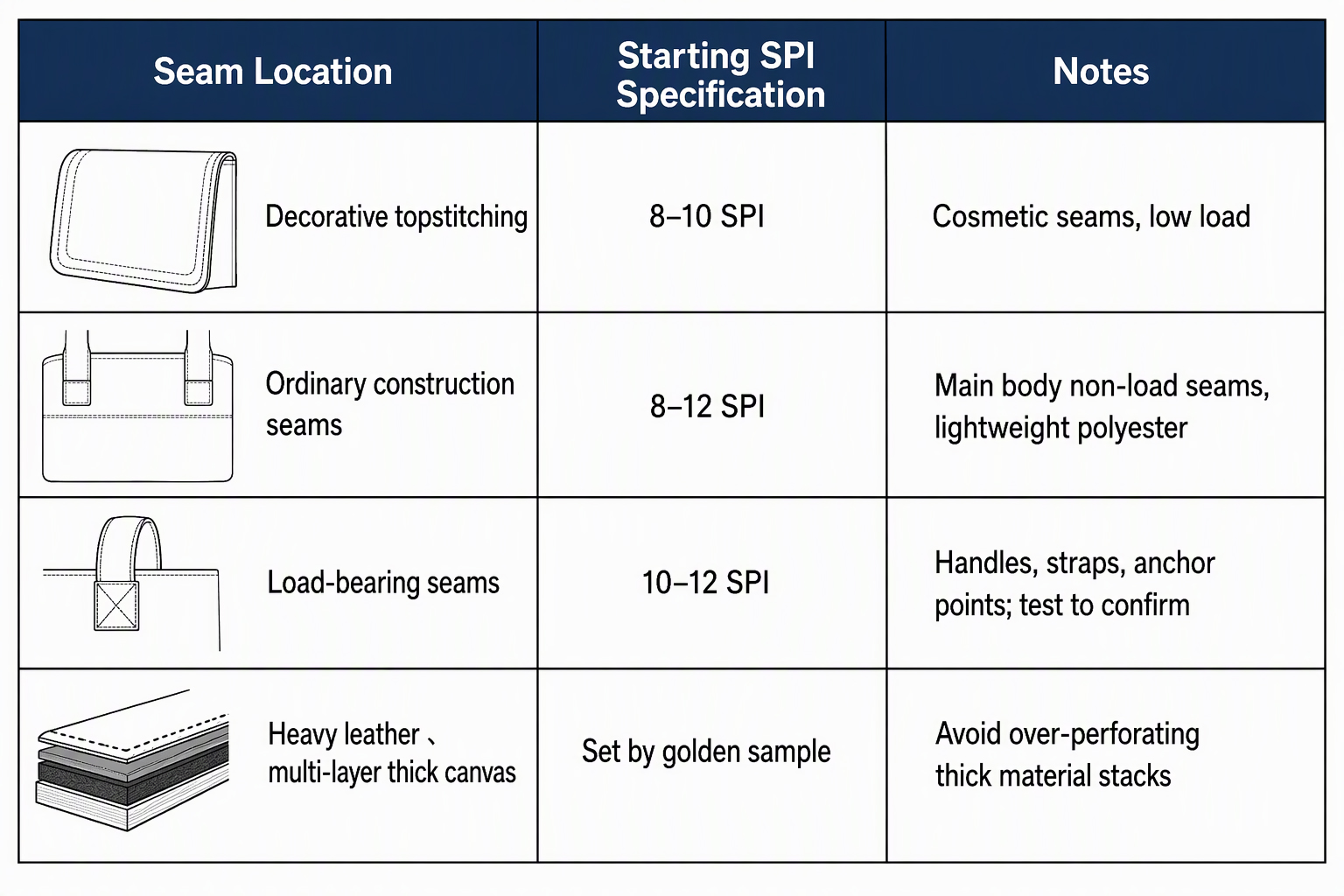
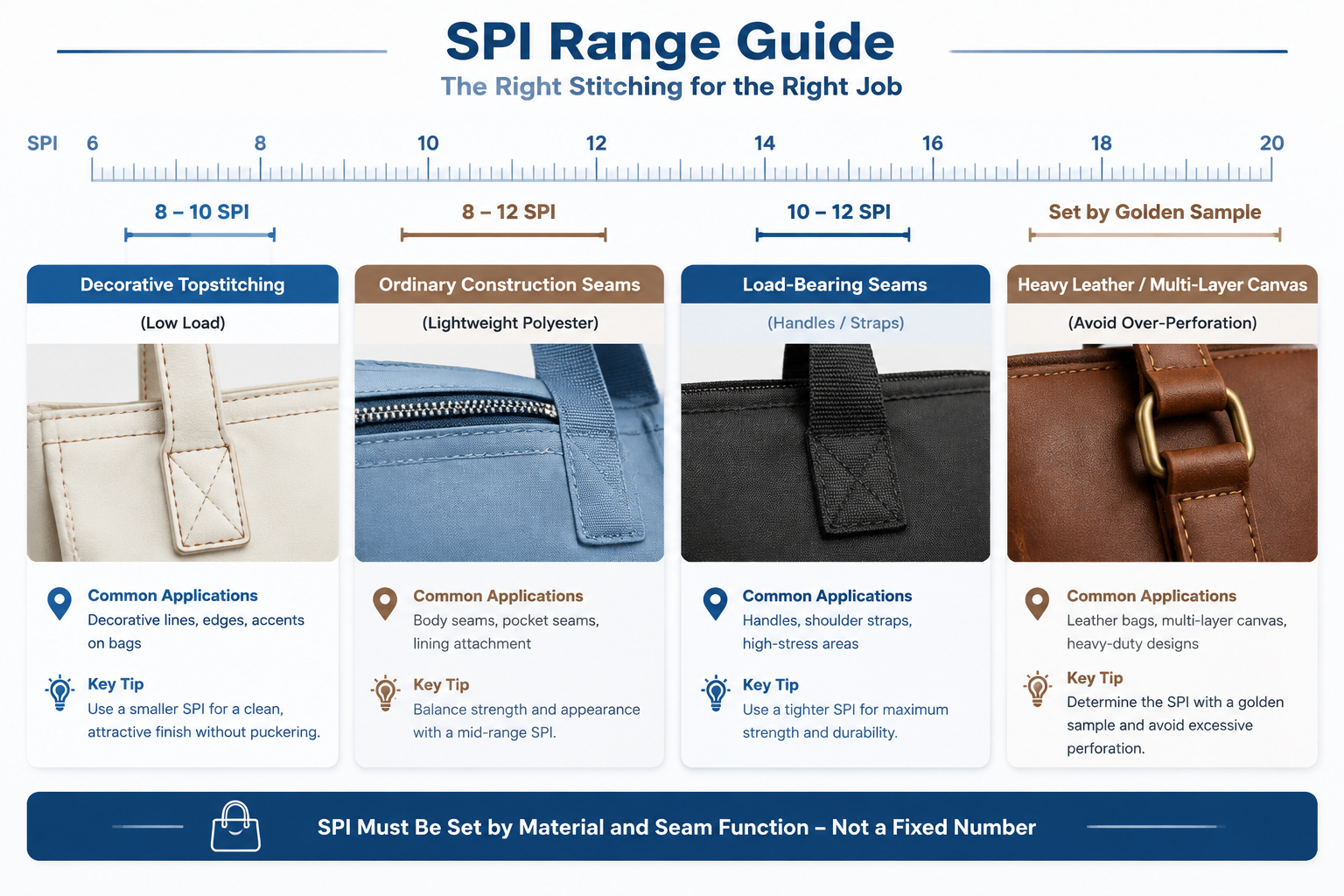
Lightweight polyester bags use thinner fabric and fewer stacked layers. For standard polyester bag construction seams, factories commonly run between 8–12 SPI. Decorative topstitching on polyester is often set at 8–10 SPI for a clean visual finish. Load-bearing seams on lightweight polyester bags still move up to 10–12 SPI to maintain strength, even though the base fabric is thin.
Heavy-duty canvas bags and leather bags require careful SPI adjustment. Thick canvas and leather create dense material stacks. Factories cannot run very high SPI because repeated needle penetration cuts into leather fibers or creates a line of perforation holes along canvas seams, which become tear initiation points. For leather and thick multi-layer canvas, the final SPI must be locked in with your approved golden sample rather than a fixed number.
Always specify a target SPI plus acceptable tolerance in your PO. Example wording: “Stitch density: 10 SPI target, acceptable range 9–11 SPI, measured over any continuous 1-inch section excluding reinforced backtack zones.”
Some Chinese factories work in metric units, counting stitches per centimeter. You may add a secondary metric reference such as approximately 4 stitches/cm, but keep SPI as your primary unit in the PO to avoid conversion disputes.
Seam Allowance Differences: Main Panel Seams, Pocket Seams, and Lining Seams
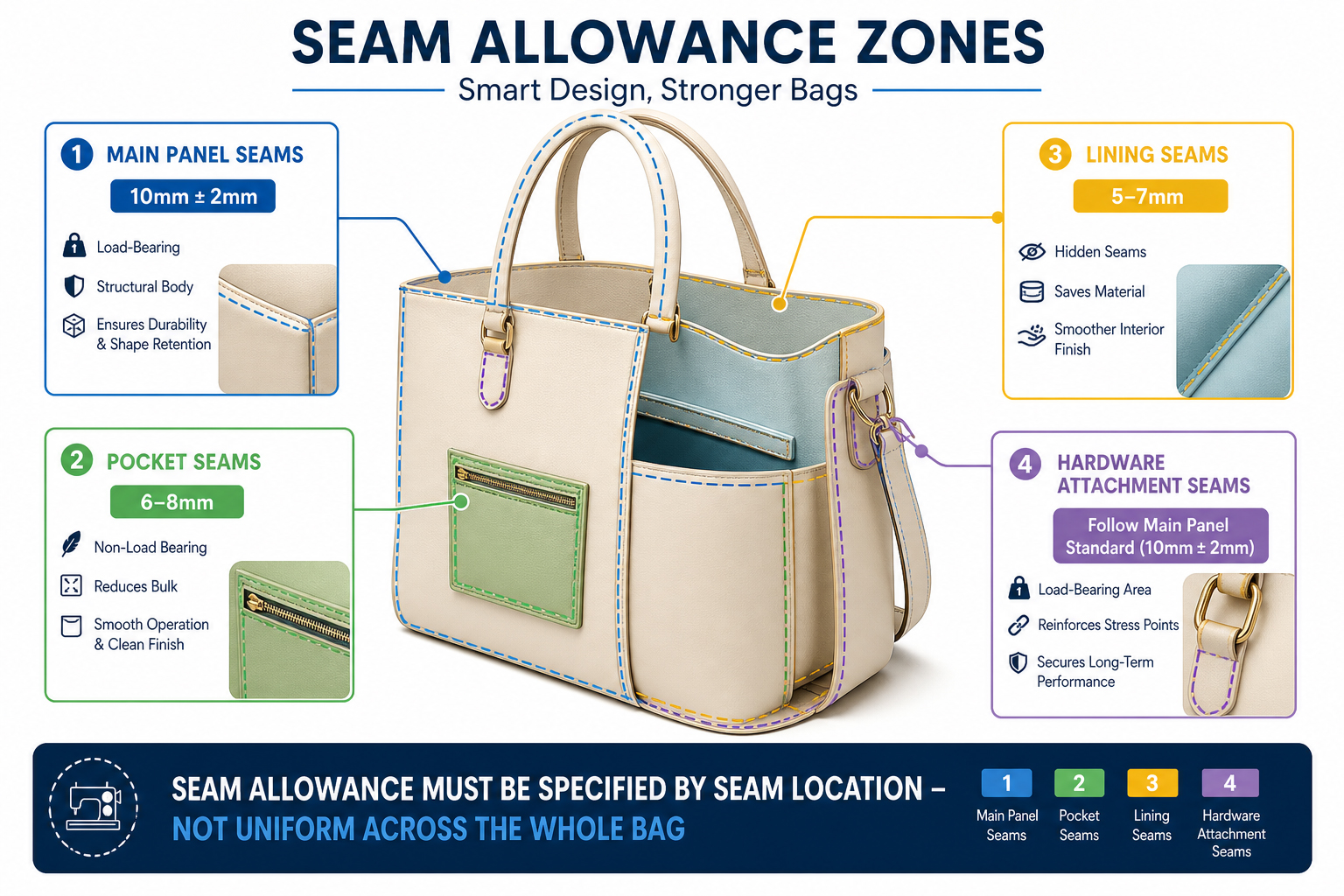
Seam allowance is the fabric margin between the stitch line and the raw cut edge of the fabric. Industry standard seam allowance values are not identical across all seams in OEM bag manufacturing. Different seam locations carry different loads and different finishing requirements, so factories tailor seam allowance width accordingly.
Main panel seams form the structural body of the bag, including side panels, gussets, bottom panels, and back panels. These seams hold the bag shape and transfer load across the whole product. Main panel seams use the widest seam allowance, often 10 mm ±2 mm. The extra fabric margin provides safety if stitching drifts slightly, adds tear resistance, and prevents seam failure when the bag is filled and carried.
Pocket seams, especially exterior patch pockets and zippered pocket openings, use a narrower seam allowance than main panels. Pocket seams are not primary load-bearing structures. Factories commonly use 6–8 mm seam allowance for pocket construction. If pockets are large or heavy-duty tool pockets, you can increase the pocket seam allowance closer to main panel standards. Interior slip pockets may use even smaller allowance.
Lining seams sit hidden inside the bag. Lining fabric is lighter and does not support product weight. Lining seams typically use the narrowest seam allowance, often 5–7 mm. Narrow lining allowance saves material cost and reduces bulk inside the bag cavity. However, if lining attaches to load-bearing hardware points, the lining attachment seam must follow main panel seam allowance rules.
Your PO must define seam allowance separately for each seam category. Do not apply one single seam allowance number across all seams of the bag. Clearly label main panel seams, pocket seams, lining seams, and hardware attachment seams on your technical drawing with individual target dimensions and ±2 mm tolerance.
How SPI and Seam Allowance Directly Impact Seam Strength, Tear Resistance and Bag Lifespan
SPI and seam allowance are not just cosmetic sewing parameters. These two variables directly determine seam tensile strength, tear propagation resistance, and how long the bag survives daily consumer use.
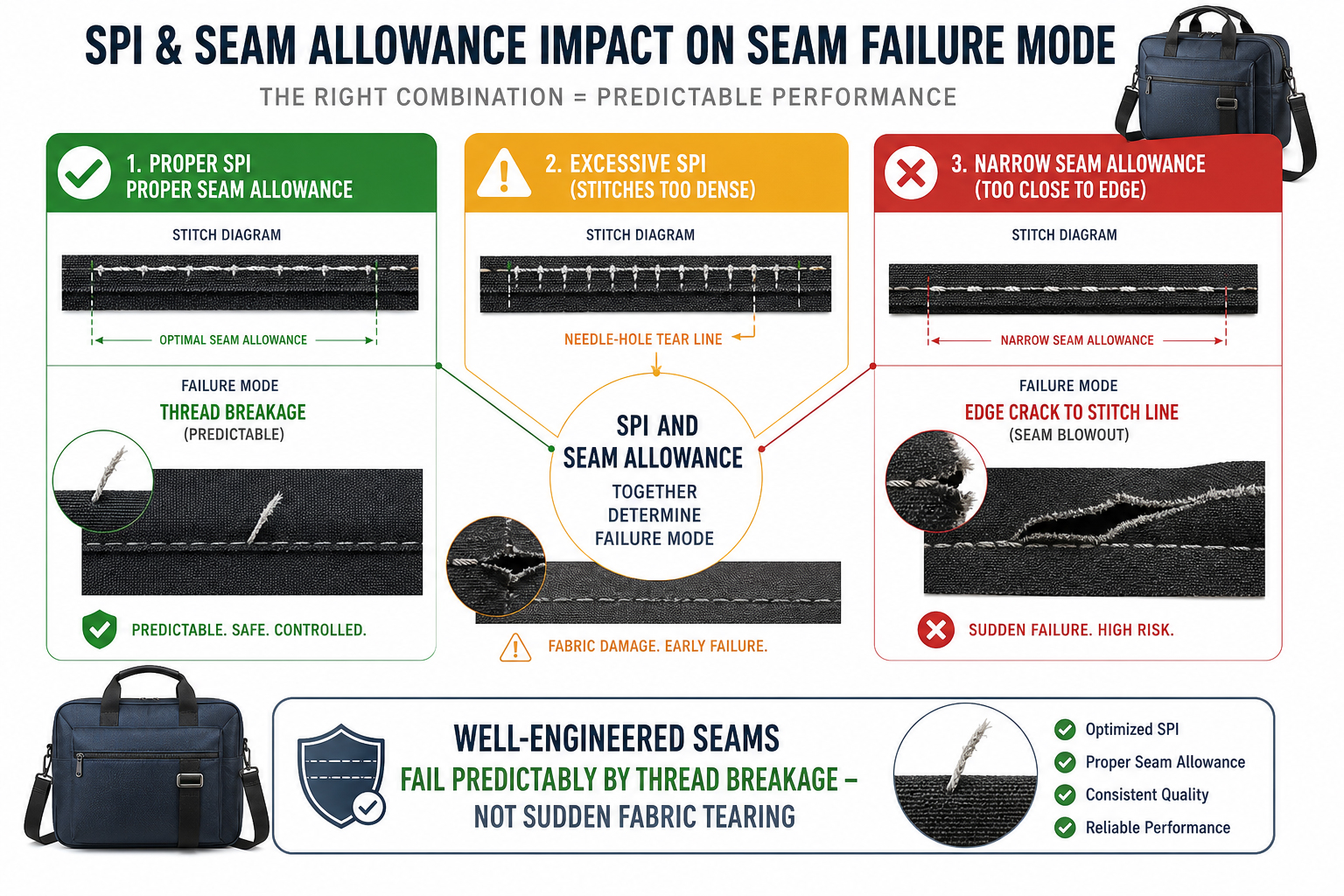
SPI controls seam strength in two opposing ways. Increasing SPI adds more stitch points to distribute load along the seam. Up to a material-specific limit, more stitches per inch improve seam holding power and reduce the chance of seam opening under stress. This is why load-bearing handle and strap seams use higher SPI targets.
Once SPI exceeds the safe threshold for your material, the large number of needle holes creates a line of weakness. Leather, coated polyester, and heavy canvas are all damaged by excessive needle perforation. The fabric will tear along the line of stitch holes before the thread breaks. In this scenario, higher SPI actually reduces bag lifespan. That is why leather and thick multi-layer canvas seams must be validated by physical sample testing.
Seam allowance acts as a safety buffer for tear resistance. Wider seam allowance means more fabric remains between the stitch line and the raw edge. If a cut or stress crack starts at the fabric edge, extra seam margin slows tear propagation toward the stitch line. When seam allowance is too narrow, a small nick at the fabric edge can quickly run straight to the stitches, splitting the seam open during use.
When seam allowance is inconsistent, some sections of the same seam will have wide margin and other sections very narrow margin. The narrow segments become failure hotspots. This is why enforcing ±2 mm seam allowance tolerance is essential for batch consistency.
The combined effect of SPI and seam allowance determines failure mode. A well-engineered seam will fail by thread breakage under overload. This failure is predictable. A poorly specified seam will fail by fabric tearing along needle holes or edge cracks, which causes sudden, unexpected bag failure for end customers.
For critical load-bearing seams, you must define minimum seam strength requirements in your PO. For woven fabrics, ISO 13935-1 measures seam rupture force when pulling perpendicular to the seam. ASTM D1683 / D1683M is another widely referenced standard for woven fabric seam strength testing.
Sample PO clause for critical seam strength:
Critical handle seams shall withstand a minimum load of ___ N for ___ seconds without thread breakage, seam opening greater than ___ mm, fabric tearing, or permanent separation. Test finished bags using actual production materials, thread, stitch density, reinforcement, and seam construction. If fabric tears before thread breaks, record the failure location and submit a separate deviation report.
Do not copy load force values from unrelated bag products. Validate seam strength by testing your prototype, defining your target product working load, and adding a safety factor appropriate for your brand.
Factory Inspection Methods Used in Chinese OEM Bag Production for SPI and Seam Allowance
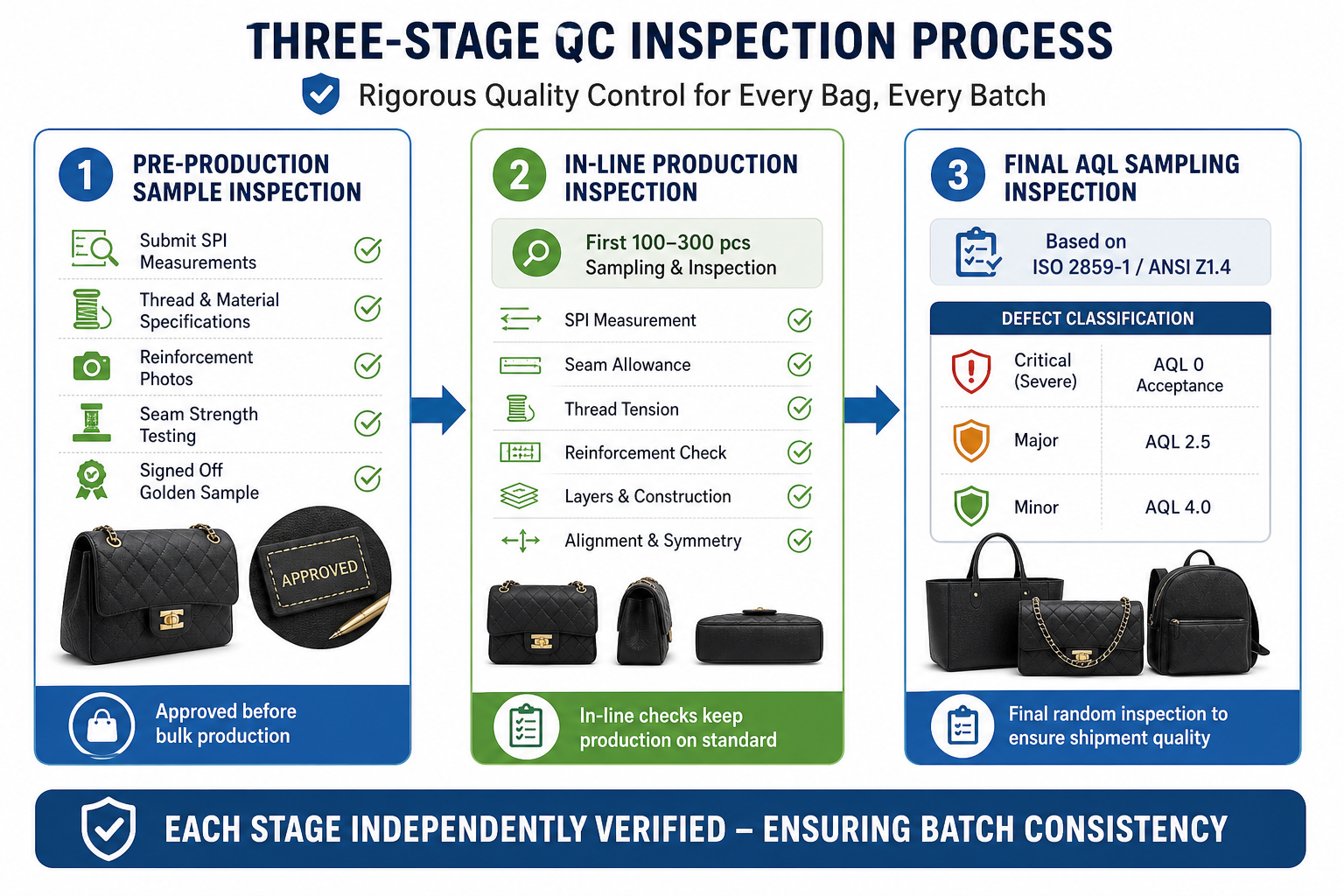
Chinese bag OEM factories use three staged inspection workflows: pre-production sample approval, inline during-production inspection, and final pre-shipment inspection. Each stage verifies SPI accuracy and seam allowance consistency.
Pre-production inspection happens before bulk sewing starts. The factory must submit pre-production seam samples made with mass-production materials. The sample package includes SPI measurements, thread brand and size, close-up photos of normal seams and critical reinforcement seams, seam strength test results, and a signed golden sample. Bulk production cannot start until your team approves this sample in writing. Pre-production checks catch wrong thread selection, incorrect machine setup, or unsuitable SPI before hundreds or thousands of bags are cut and sewn.
During-production inline QC inspects early production output, typically the first 100 to 300 finished bags off the sewing line. QC staff measure SPI at multiple seam locations, verify seam allowance and topstitch position, check thread tension and stitch balance, confirm secure seam start and end locking, inspect bar tack and box stitch reinforcement, verify all required fabric layers are captured by the needle, and check handle and strap alignment. Inline inspection catches operator error or sewing machine drift early, before the full production lot is completed. Sewing machine timing can shift during long production runs, so inline spot checks must continue through the full bulk run.
Final pre-shipment inspection uses formal AQL sampling following ISO 2859-1 or ANSI/ASQ Z1.4. Most consumer bag orders use General Inspection Level II. Sample size scales according to total lot quantity.
You must define defect categories inside your PO:
* Critical defects: Zero acceptance. Examples include completely unsewn handle attachments, seams that fail functional load testing, missing reinforcement on load-bearing seams, or sharp hazardous defects. Any critical defect found in the sample rejects the whole lot.
* Major defects: AQL 2.5. Skipped stitches on load-bearing seams, broken unsecured seams, seam allowance below minimum limit, SPI outside tolerance on critical seams, severe puckering or seam misalignment affecting function.
* Minor defects: AQL 4.0. Small leftover thread tails, slightly uneven stitch spacing on non-critical interior lining seams, cosmetic variation that does not impact seam strength or bag function.
Factory QC teams measure SPI with a dedicated stitch counter gauge on a continuous one-inch seam length, excluding backtack reinforcement. Seam allowance is measured with a precision ruler across multiple points on each inspected seam. Inspectors document all defects with photos and label the exact panel or seam location on the bag.
Final Key Control Points for US Bag Buyers Sourcing from Chinese OEMs
* Keep two signed golden samples: one held at the factory and one retained by your third-party inspector or buying team.
* Require formal factory notification before any changes to thread, needle type, sewing machine, fabric material, reinforcement pattern, or SPI. Any construction change requires a new sample approval before continuing production.
* Request lot-specific inspection records, not only a generic factory certificate of compliance.
* Instruct inspectors to measure hidden interior seam allowance and not only visible exterior stitching.
* Perform seam strength tests on finished assembled bags, not loose fabric swatches, for handle and strap seams.
* Photograph every defect and tag it by bag panel and seam number for traceability.
The core idea is simple: define how the seam is built, how much dimensional variation is acceptable, how seam strength will be tested, and how many defects trigger lot rejection. Transforming vague requests for “good stitching” into measurable, enforceable purchase order standards eliminates batch inconsistency, reduces product returns, protects your brand reputation, and builds a more reliable long-term partnership with your Chinese bag OEM factory.
Post time: Sep-24-2026