
How a single-fiber approach is reshaping the bag industry — and what US buyers need to know before placing their next order.
Why Mono-Material Construction Is No Longer Optional
If you’re sourcing bags from China for the US market in 2025 and beyond, you’ve likely encountered a question that wasn’t even on the table five years ago: Can your factory build a bag from a single fiber family? This isn’t a fringe sustainability request from a niche brand anymore. It’s becoming a baseline expectation from major retailers, sustainability-focused consumers, and increasingly, from legislators working on extended producer responsibility (EPR) frameworks across the United States.
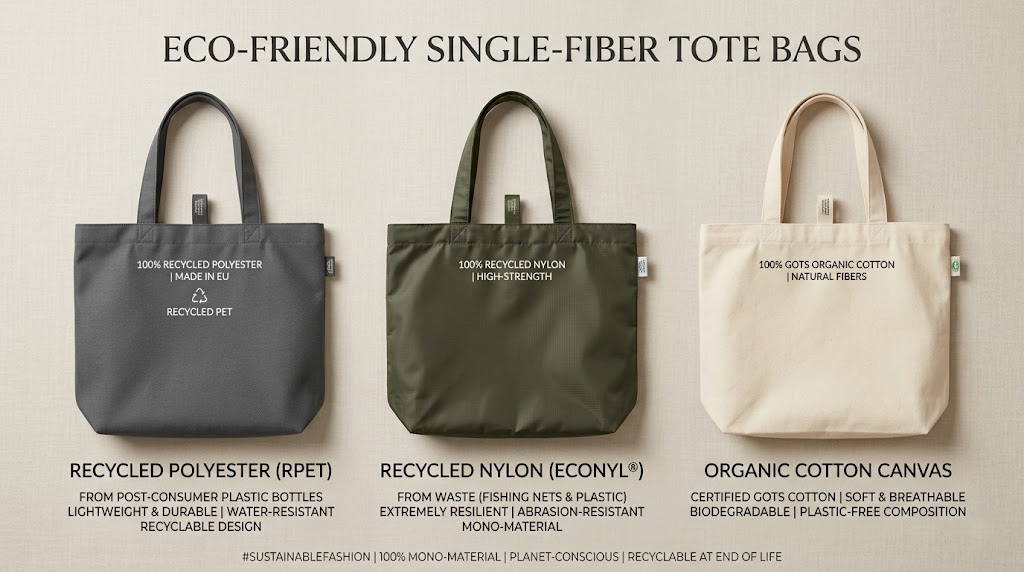
The logic is simple but powerful. When a bag is built from a single fiber family — polyester throughout, or nylon throughout, or cotton throughout — its end-of-life recyclability improves dramatically. Mixed-material bags, the industry standard for decades, are notoriously difficult to recycle because separating polyester from nylon from cotton from metal hardware requires costly, energy-intensive processes that most municipal recycling facilities simply don’t perform.
Insight 1: Mono-material bag construction — using a single fiber family throughout the body, lining, trims, and webbing — dramatically improves end-of-life recyclability.
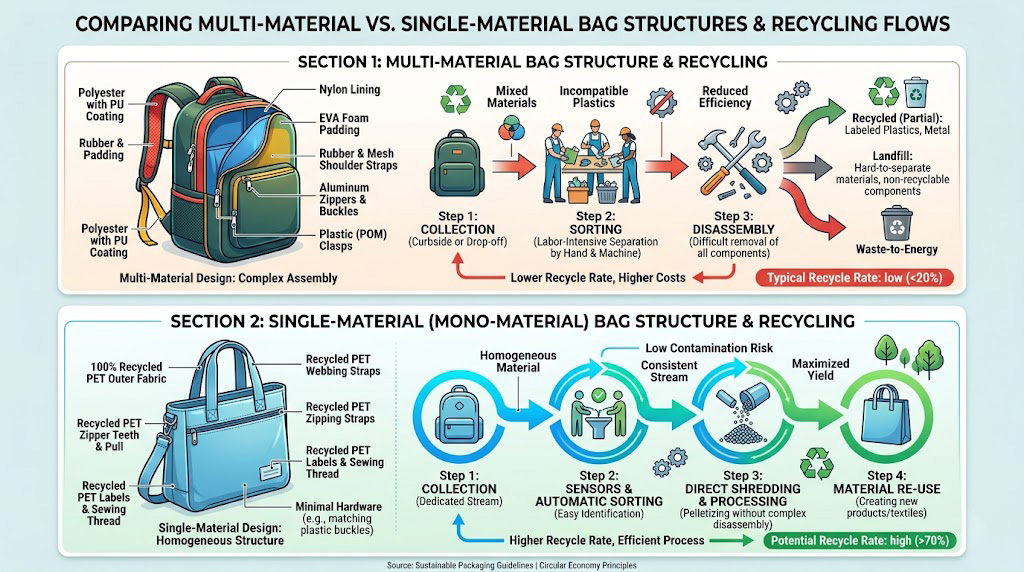
For US bag buyers sourcing from Chinese manufacturers, the question is no longer whether mono-material is desirable. It’s whether their supplier can actually deliver it — and what trade-offs come with the switch.
Question 1: Can Chinese Factories Produce Fully Mono-Material Bags?
The short answer is yes — but with important qualifications that depend on which fiber family you choose.
Polyester Mono-Material Bags
Insight 2: Polyester mono-material bags are the most common option offered by Chinese factories, as polyester components (fabric, lining, thread, webbing, zippers) are widely available.
This is where the Chinese supply chain shines. Polyester — particularly rPET (recycled polyester) and conventional PET-based fabrics — has the most mature ecosystem of matching components. Chinese manufacturers can source polyester fabric for the body, polyester lining, polyester thread, polyester webbing for handles and straps, and even polyester-tape zippers with compatible teeth. For a US buyer, this is typically the easiest entry point into mono-material construction.
Nylon Mono-Material Bags
Insight 3: Nylon mono-material bags are technically possible but harder to source, since zippers, buckles, and elastic trims in matching nylon 6 or nylon 6,6 are less common.
If your brand aesthetic demands the specific hand-feel and durability of nylon — common in outdoor, tactical, and premium athletic bags — be prepared for a more complex sourcing process. Nylon 6 and nylon 6,6 are the two main variants, and they technically should not be mixed for true mono-material recycling. Finding zippers, buckles, and elastic trims that match a specific nylon grade requires deeper supplier relationships and longer lead times.
Cotton Mono-Material Bags
Insight 4: Cotton mono-material bags — using cotton canvas, cotton webbing, and cotton thread — are popular in the US market for eco-friendly totes, backpacks, and grocery bags.
For brands targeting the natural, organic, or “farm-to-fashion” aesthetic, cotton mono-material construction is a strong choice. Chinese factories in regions like Shandong and Hebei have deep expertise in cotton canvas production, and matching cotton webbing and thread are readily available. Just confirm whether your supplier offers organic cotton (GOTS-certified) or BCI (Better Cotton Initiative) cotton if sustainability claims are part of your marketing.
The Hidden Complexity: It’s Not Just the Body Fabric
Here’s where many US buyers get tripped up. A factory might offer a polyester body and call it a “polyester bag,” but true mono-material construction goes much deeper.
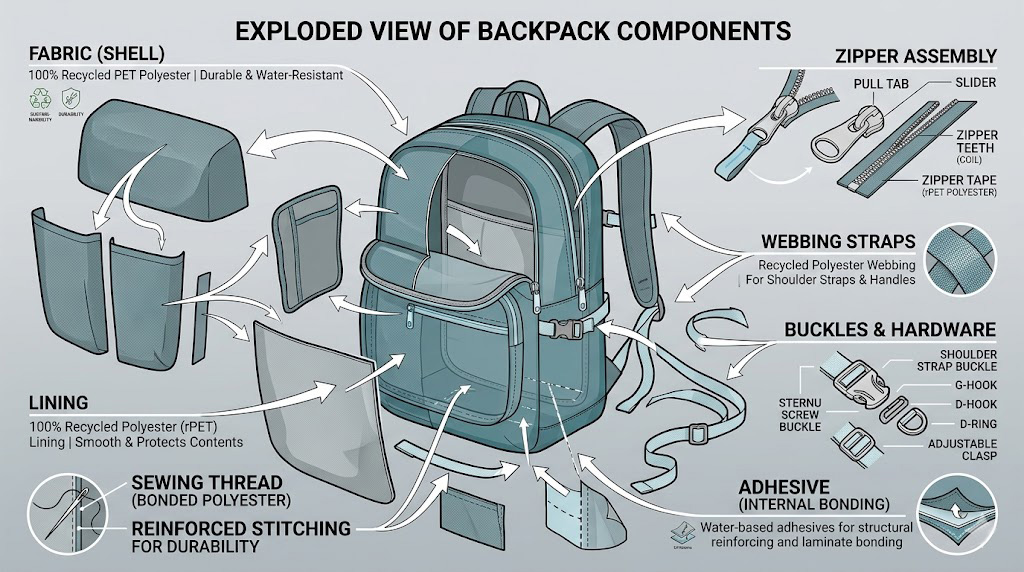
Insight 5: True mono-material construction requires all components — fabric, lining, thread, zippers, buckles, webbing, labels, and even adhesives — to come from the same fiber family.
Think about what’s actually inside a typical bag:
Outer shell fabric
Inner lining
Stitching thread
Zipper tape and teeth
Webbing for handles and shoulder straps
Buckles and adjusters
Reinforcement patches
Care labels and brand labels
Adhesives used in lamination or bonding
Edge paint or binding coatings
For a true mono-material bag, every single one of these components needs to be engineered from the same fiber family. This is where Chinese factories with mature supply chains excel — and where less experienced ones fall short.
Detailed exploded view diagram of a bag showing all components: outer fabric, lining, thread, zipper, webbing, buckles, labels, and adhesives
Question 2: How Does Switching to Mono-Material Affect Design, Color, Performance, and Cost?
This is the question every buyer should ask — and the answer isn’t always comfortable.
Design Constraints
Mono-material construction imposes real design constraints. If you want a black nylon body with a contrasting gray polyester lining, that’s no longer a mono-material bag. The design vocabulary shrinks. Colors, textures, and component sourcing must align around a single fiber family’s available variants.
Color Options
In polyester mono-material bags, color options remain relatively broad. In nylon, the palette is somewhat narrower, and matching dyed components (especially for zippers and webbing) requires careful coordination. Cotton offers the most natural color story but limited vibrant or technical colorways.
Functional Performance
Some performance features take a hit. Heavy-duty waterproofing often relies on multi-layer laminations (PU, TPU, PVC coatings on a base fabric) that compromise mono-material integrity. Factories can offer water-resistant treatments that maintain mono-material status, but true submersible waterproofing is harder to achieve in a single-fiber system.
Insight 7: Coatings, laminations, and waterproof membranes (PU, TPU, PVC) often compromise mono-material recyclability, so factories offer uncoated or single-polymer-coated options for true circularity.
Production Cost
Insight 9: Mono-material bags are typically priced 5%–15% higher than standard multi-material bags because compatible components are more expensive and less readily available.
This is a meaningful margin impact for any US e-commerce brand operating on tight unit economics. The premium comes from smaller batch runs of matching components, more complex supplier coordination, and in some cases, custom-developed accessories. Some buyers absorb this cost as part of their sustainability positioning; others struggle to justify it to price-sensitive customers.
Question 3: Are Coatings, Zippers, and Laminations Recyclable Within the Same Stream?
This is the question that separates marketing claims from genuine recyclability.
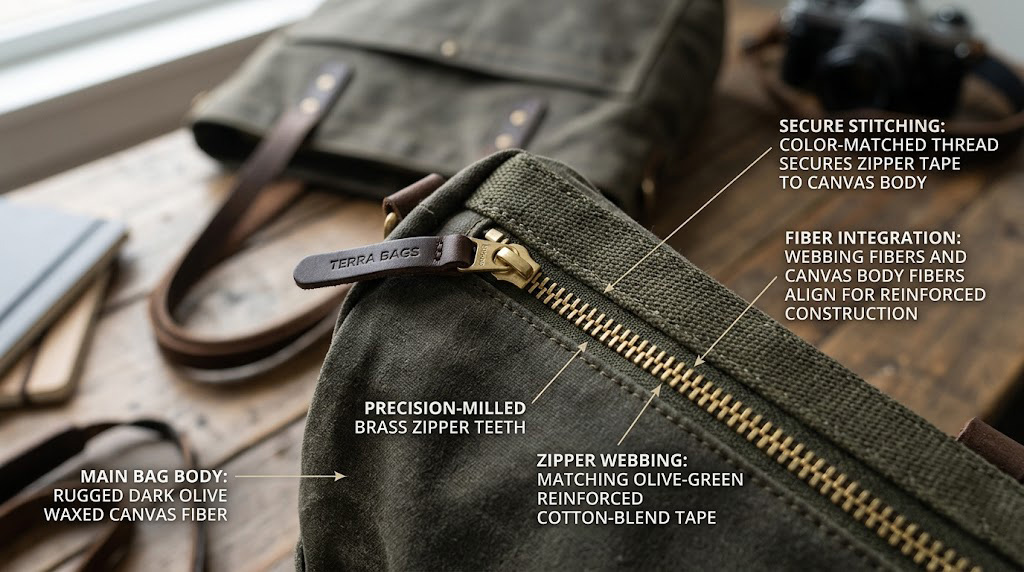
Insight 6: Zippers are the biggest construction challenge, since most zippers use polyester tape and metal or plastic teeth, requiring careful material matching to maintain mono-fiber integrity.
For polyester mono-material bags, polyester-tape zippers with plastic (POM or similar) teeth are widely available and can be designed to recycle within the polyester stream. For nylon bags, matching nylon zippers exist but require more diligent sourcing. Metal zippers — even on a polyester bag — typically need to be removed before recycling, so the bag’s design should make this easy.
Insight 7 (expanded): Coatings are the silent recyclability killer. A polyester bag with a heavy PU coating might be marketed as “recyclable polyester,” but in practice, most recycling facilities cannot process coated textiles.
The most responsible Chinese factories now offer:
Uncoated mono-material options (limited water resistance)
Single-polymer coatings compatible with the base fiber
Bio-based or water-based DWR (durable water repellent) treatments that don’t compromise recyclability
Insight 8: Hardware — including metal buckles, magnetic snaps, and D-rings — is typically removed during recycling, and the factory can design bags with easily detachable hardware to preserve mono-material purity.
The best mono-material bag designs incorporate hardware that consumers or recycling facilities can easily remove — snap-off buckles, detachable straps, magnetic closures. This is a design feature worth specifying upfront with your factory.
Question 4: Do Factories Partner with Certified Recycling Programs?
This is where the supply chain gets honest. Most Chinese bag factories don’t directly operate recycling programs — and they don’t need to. Their role is to design and manufacture bags that are recyclable in principle within established fiber streams.
Insight 10: Mono-material bags can be paired with GRS, OEKO-TEX, or BCI certifications on the same fiber family, allowing US buyers to combine recyclability with verified material-safety claims.
What this means in practice:
GRS (Global Recycled Standard): Verifies recycled content and chain of custody. Can apply to rPET-based mono-material bags.
OEKO-TEX Standard 100: Verifies the bag is free from harmful substances. Compatible with mono-material construction.
BCI (Better Cotton Initiative): For cotton mono-material bags, verifies more sustainable cotton farming.
Insight 3 (additional context): Extending product lifespan is widely recognized as the most effective way to reduce a bag’s environmental impact.
This is a critical point. A bag that lasts 10 years, even if it’s eventually hard to recycle, has a smaller lifetime environmental footprint than a “recyclable” bag that’s discarded after two years. The most credible US brands are now messaging both: our bags are built to last, AND they’re designed to be recyclable when their useful life ends.
How to Verify Supplier Claims: A Buyer’s Checklist
The bag industry is unfortunately full of “recyclable” claims that don’t survive scrutiny. Before placing a bulk order with a Chinese factory on mono-material construction, request the following:
1. Full Bill of Materials (BOM): Every component, with fiber content percentages. If a factory can’t provide this, walk away.
2. Material Safety Data Sheets (MSDS): For any coatings, adhesives, or treatments used.
3. Third-Party Test Reports: From labs like SGS, Intertek, or Bureau Veritas, confirming fiber content and absence of harmful substances.
4. Recyclability Statements: Some factories have invested in testing their bags with organizations like the Textile Exchange or specific recycling facilities.
5. Certifications: Request copies of GRS, OEKO-TEX, GOTS, or BCI certificates — and verify the certification number on the issuing body’s website.
The Supplier Message That Works
Here’s a message you can send directly to Chinese factories to test their mono-material capabilities:
“We are a US-based bag brand looking to develop a [polyester/nylon/cotton] mono-material collection. Can you confirm whether you can supply a bag where all components — outer fabric, lining, thread, webbing, zipper tape, zipper teeth, and any coatings — are made from the same fiber family? Please share the full BOM, any relevant certifications (GRS, OEKO-TEX, BCI), and a recyclability statement. We are also interested in sample swatches of your matching component options.”
A factory that takes this seriously will respond with detailed documentation. A factory that responds vaguely with “yes, we can do eco-friendly bags” is telling you everything you need to know.
Photo of a designer reviewing material samples and fabric swatches at a bag factory, with components organized by fiber type
The Realistic Takeaway for US Buyers
Mono-material bag construction is not a marketing gimmick. It’s a genuine engineering and sourcing shift that delivers real end-of-life recyclability benefits. But it’s also not a checkbox you can tick with a single email to your factory.
The most successful US brands sourcing mono-material bags from China approach it as a long-term product development investment:
They start with a smaller collection (often a single SKU) to learn the supply chain.
They partner with factories that have proven mono-material experience, not general bag manufacturers.
They pay the 5%–15% premium as part of their sustainability positioning and pass it through to consumers with transparent storytelling.
They invest in third-party certifications that verify their claims.
They design for durability, recognizing that a long-lasting bag is the most sustainable bag of all.
Post time: Jun-16-2026