
The Ultimate Buyer’s Guide to Quality Control When Sourcing Bags from China: 5 Critical Inspection Standards Every Importer Must Understand
How professional QC protocols protect your brand, your customers, and your bottom line
Meta description: Discover the 5 essential quality control checkpoints every bag buyer must understand when sourcing from China — from measurement verification to AQL sampling and corrective action protocols.
Introduction: Why Quality Control Is the Backbone of Your Bag Business
If you’re running a bag brand and sourcing products directly from Chinese manufacturers, you already know that the lowest factory quote rarely translates into the lowest landed cost. The truth is far more nuanced: the difference between a profitable, reputation-building product line and a returns nightmare almost always comes down to quality control.
Over the past decade, I’ve helped hundreds of U.S.-based bag importers navigate the complexities of working with Chinese factories. The single most common pain point I hear? “I received a shipment that looked nothing like the sample I approved.” In 9 out of 10 cases, that problem was preventable — not by choosing a different factory, but by enforcing a clear, documented quality control protocol at every stage of production.
In this comprehensive guide, I’m breaking down the five inspection standards that separate amateur importers from professional buyers. Whether you’re a first-time entrepreneur launching your handbag line or an established brand expanding your product range, these protocols are non-negotiable.
Let’s dive in.
1. Measurement Verification: The Foundation of Every Quality Program
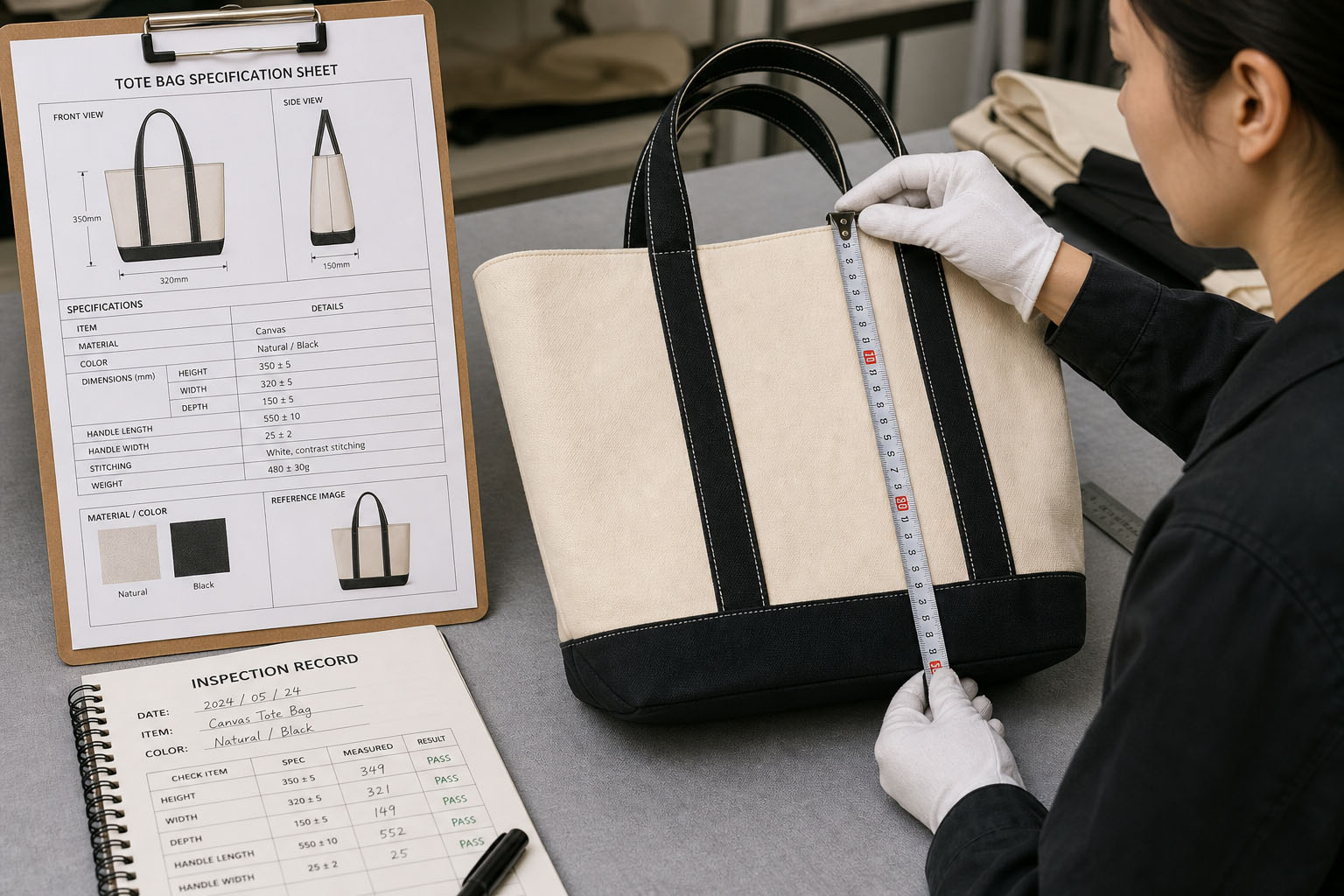
“Measurement checks verify each piece conforms to the approved specification sheet.”
— The single most important sentence in your purchase order
Why Measurements Matter More Than You Think
A handbag that is 2cm shorter or 3cm narrower than the approved sample doesn’t just look “off” to your customer — it changes how it carries, how it fits a laptop, and how it hangs on the shoulder. For fashion bags, dimensional accuracy is the silent foundation of perceived value.
The Professional Approach to Measurement Inspection
A factory’s commitment to measurement verification should never be vague. When you ask a Chinese supplier “do you check measurements?” the answer will almost always be “yes.” The real question is how — and that’s where the differences between professional and amateur operations become obvious.
Here’s what a proper measurement protocol looks like:
Stage 1: Inline Checks During Production
Measurement should be performed continuously, not just at the end. By the time a finished bag reaches final inspection, dimensional errors have already been baked into hundreds of units. Inline verification catches deviations while they’re still correctable.
Stage 2: Final Random Inspection
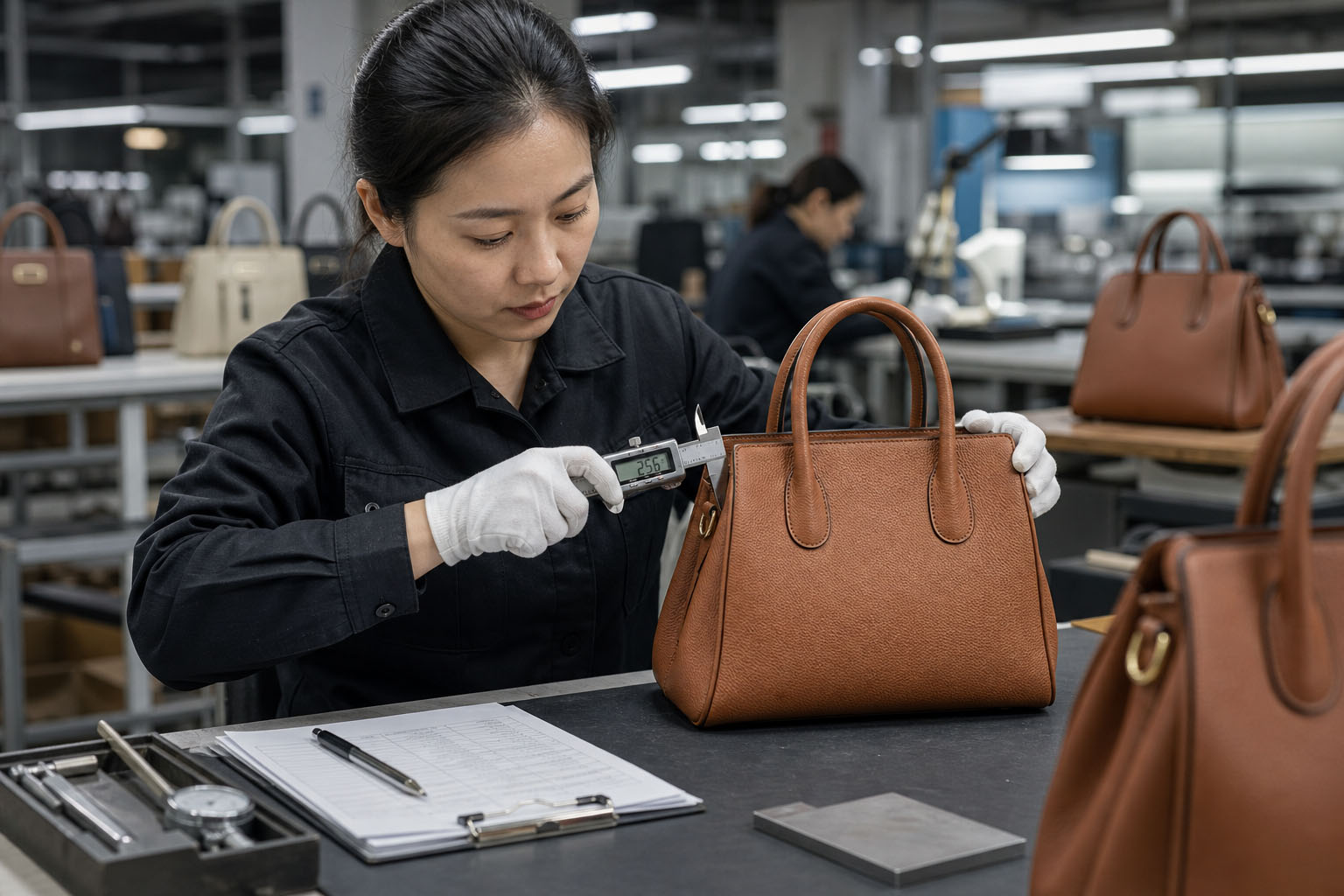
Before any bag is packed, a final measurement sweep is performed against the approved specification sheet within clearly defined tolerance ranges. Critical dimensions — the ones that affect function or fit — should be held to zero tolerance or ±2mm, while decorative measurements may allow ±5mm.
Stage 3: Instrument Calibration
Every tape measure, caliper, and ruler used must be regularly calibrated to recognized standards. A factory that can’t show you calibration certificates is one that measures with whatever they happen to find in the workshop drawer.
Stage 4: Documentation & Traceability
Every measurement check should be documented with photos, written records, and inspector signatures. This creates a paper trail you can review before authorizing shipment and use as evidence if disputes arise later.
Stage 5: The Golden Sample Reference
A sealed golden sample — the absolute reference unit approved at the start of production — must remain on the production floor throughout the run. Inspectors should physically compare units against this golden sample, not rely on memory or interpretation.
Critical Dimensions for Bags
For handbags, totes, backpacks, and shoulder bags, the standard measurement points include:
Overall length, width, and height
Handle drop length (the distance from the top of the bag to the top of the handle)
Strap length and width
Pocket dimensions and placement
Zipper length and opening size
Logo position and size
Base dimensions and corner radius
Weight (where specified)
Pro Tip: Eliminate Interpretation Differences
The #1 cause of measurement disputes between buyers and Chinese factories is ambiguous tech packs. Always include measurement diagrams with exact reference points on your specification sheet. Instead of writing “width: 30cm,” draw an arrow on a technical sketch showing exactly where the measurement begins and ends. This eliminates interpretation differences between your team and the factory floor.
2. AQL Sampling Standards: The Science of Acceptable Quality
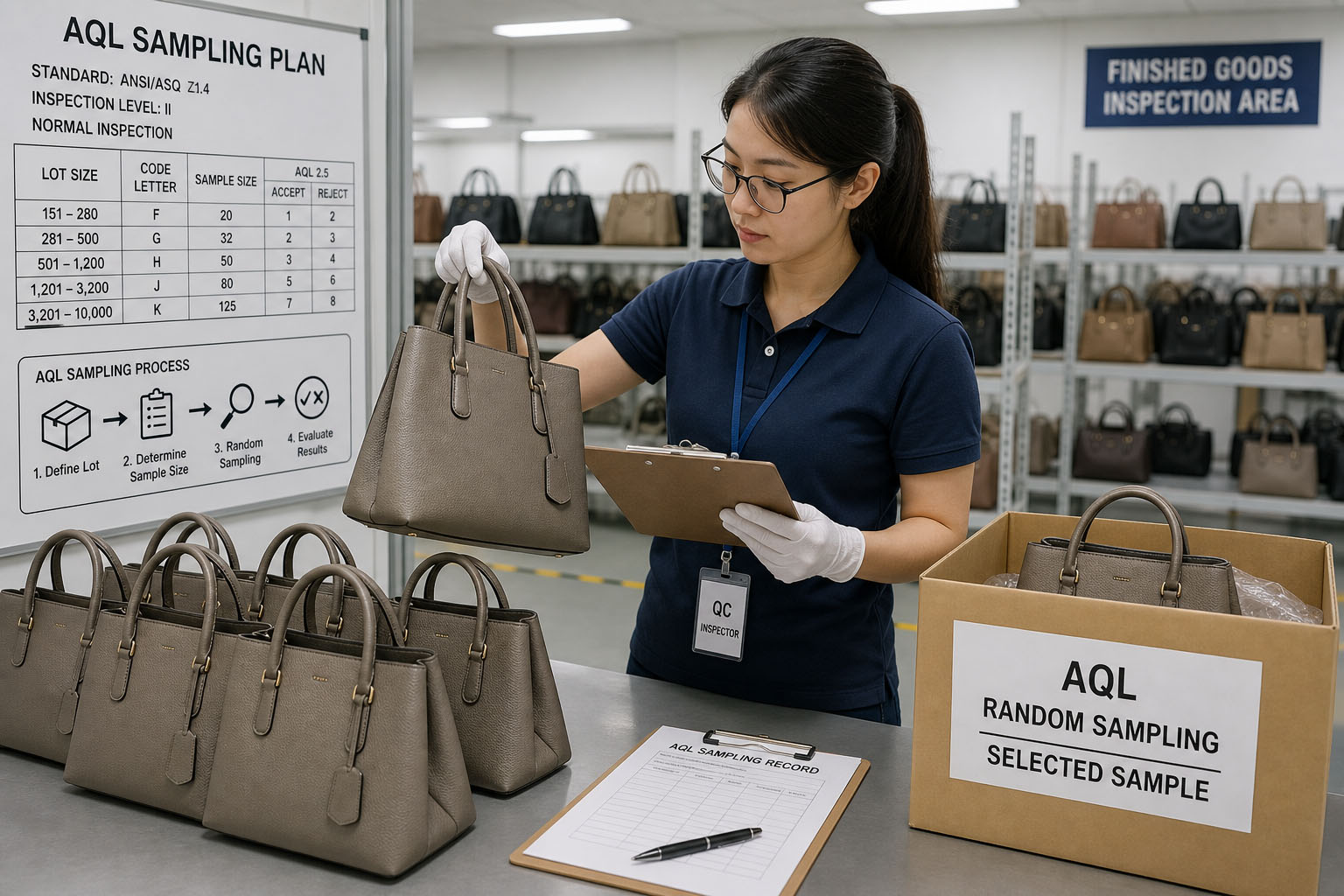
“How are AQL sampling standards applied during the final random inspection of finished bags?”
If you’ve spent any time in international sourcing, you’ve heard the term AQL — but you’d be surprised how many buyers don’t fully understand what it means or how to use it to their advantage.
What Is AQL?
AQL stands for Acceptable Quality Level — a statistical sampling system defined by ISO 2859-1 that tells you the maximum number of defective items considered acceptable in a random sample. It’s the global standard for final random inspection, and any reputable Chinese factory will already be familiar with it.
The most commonly used AQL levels for consumer goods are:
AQL 1.0 — Very strict (luxury goods, electronics)
AQL 2.5 — Standard for most consumer products (recommended for bags)
AQL 4.0 — More lenient (lower-cost items)
For U.S. bag brands, AQL 2.5 is the industry sweet spot. It balances acceptable defect rates with realistic manufacturing tolerances.
How AQL Sampling Works in Practice
Let’s say you’re producing 2,000 handbags. Using AQL 2.5 general inspection Level II:
1. The inspector randomly selects a sample size of 125 bags from the lot
2. Each bag is examined for defects across multiple categories (critical, major, minor)
3. The lot is accepted if defects fall below the AQL threshold
For example:
Critical defects (safety issues, functional failure): Accept = 0
Major defects (visible flaws, dimensional non-conformance): Accept = 5, Reject = 6
Minor defects (cosmetic imperfections): Accept = 10, Reject = 11
If the lot exceeds any of these numbers, the entire shipment is rejected — and the factory is responsible for 100% sorting, rework, or replacement.
Why You Need to Specify AQL in Your Purchase Order
Never assume the factory will apply AQL by default. Always state it explicitly in your purchase order:
“Final random inspection will be conducted according to AQL 2.5, General Inspection Level II, with 0 acceptance for critical defects.”
This single sentence can save you thousands of dollars in defective products and is the standard reference used by professional third-party inspection agencies.
The Third-Party Inspection Advantage
While many factories have internal QC teams, hiring an independent third-party inspection company is one of the smartest investments an importer can make. Services like Asia Inspection, QIMA, or V-Trust provide unbiased verification that’s not influenced by the factory’s production schedule or sales pressure. The typical cost of $200–$350 per inspection is a fraction of what a defective shipment would cost in returns, refunds, and brand damage.
3. Pre-Production Sample Approval: Your Insurance Policy
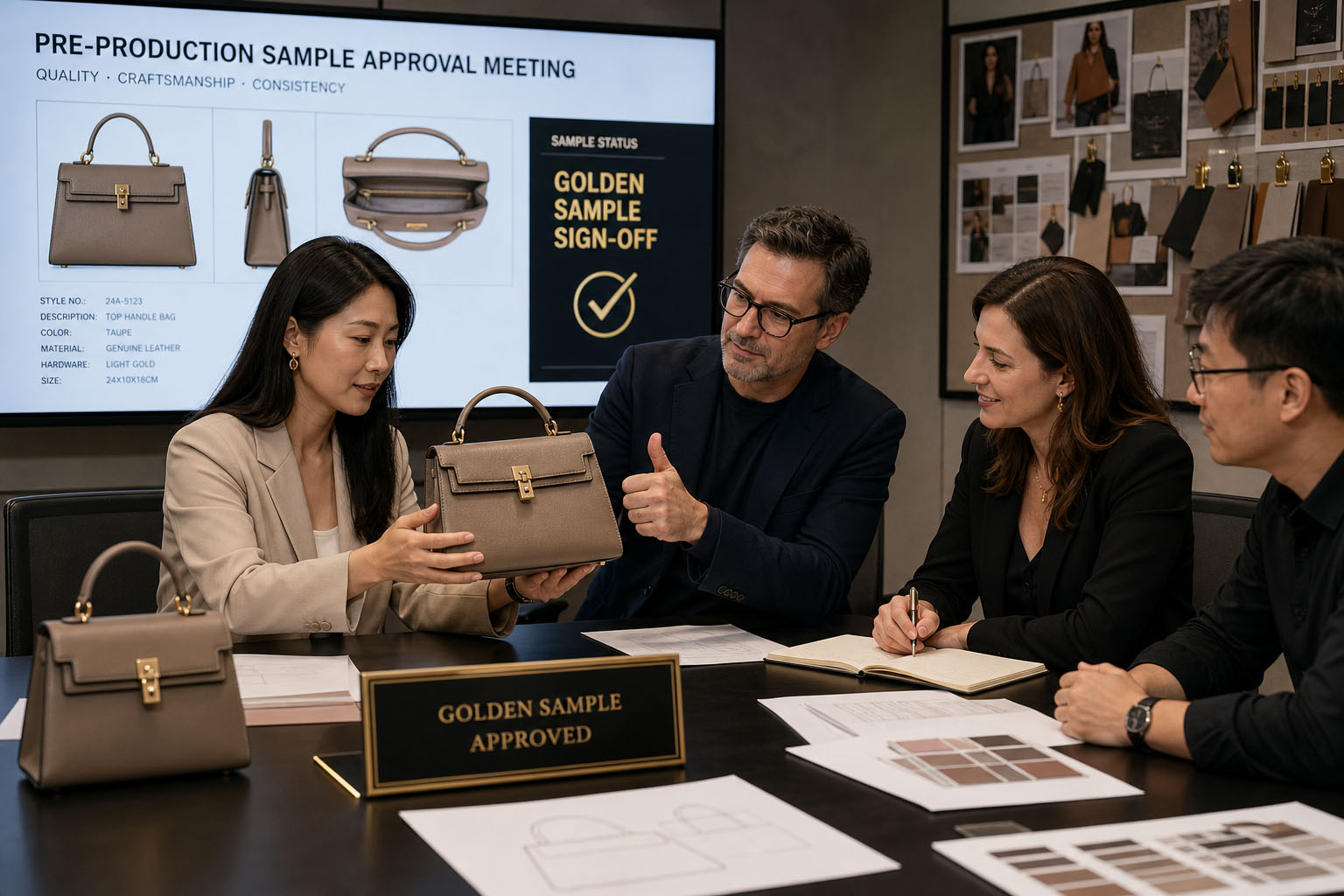
“What is the procedure for pre-production sample approval and golden sample sign-off before mass production begins?”
This is the moment that determines everything. Rush this step, and you’ll be chasing problems for the next 90 days. Get it right, and production becomes almost effortless.
The Three-Stage Sample Process
Stage 1: Pre-Production Sample (PPS)
The factory produces a sample using the exact materials, processes, and workmanship intended for mass production. This is NOT a prototype or marketing sample — it should be made in the actual production line by the actual production team.
Once you receive the PPS:
Inspect it against your tech pack line by line
Test it functionally (zip it, fill it, carry it, lift it)
Compare it to your original reference sample if you have one
Approve in writing, or list every change required
Stage 2: Counter Sample / Revised Sample
If changes are requested, the factory submits a counter sample incorporating your feedback. This continues iteratively until the sample meets your standards.
Stage 3: Golden Sample Sign-Off
Once you’re 100% satisfied, you sign off on the golden sample — the master reference. This sample is:
Sealed with a signature stamp or QC sticker
Stored at the production line for continuous reference
Sent to you as the physical reference standard
Used as the comparison benchmark throughout the entire production run
Why the Golden Sample Is Sacred
The golden sample isn’t a formality — it’s the legal and practical reference for every quality decision that follows. If a dispute arises about color, finish, or dimension, the golden sample wins. Period.
A professional factory will:
Sign and date the golden sample
Photograph it from multiple angles
File it in a controlled-access cabinet
Pull it for comparison during every inspection
If a factory can’t produce a sealed golden sample when you ask, that’s a red flag about their quality discipline.
The Cost of Skipping Sample Approval
I cannot stress this enough: never approve mass production based on photos, descriptions, or a marketing sample. Every season, I hear from buyers who skipped this step to “save time” and ended up with 5,000 unsellable bags. A 2-week delay for proper sample approval is a small price to pay compared to a 5,000-unit loss.
4. Color Shade & Material Consistency: The Hidden Challenge
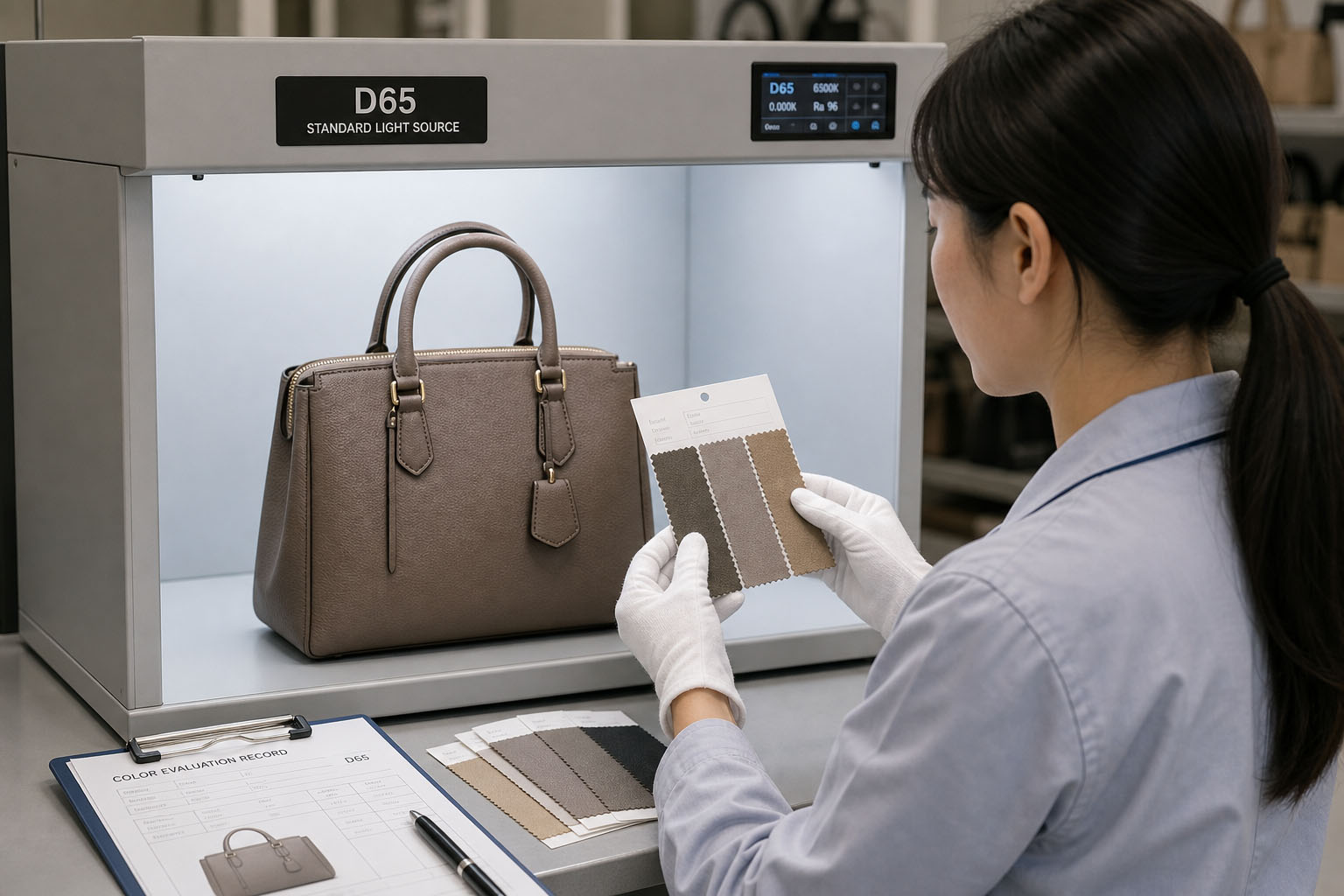
“How is color shade and material consistency verified against the approved sample throughout the production run?”
This is where even experienced importers underestimate the complexity. Color matching across a production run of thousands of bags is one of the most challenging aspects of bag manufacturing — and one of the most common sources of customer complaints.
Why Color Consistency Is So Difficult
Several factors create color variation in bag production:
Material batch differences (leather, PU, fabric, nylon all vary between dye lots)
Environmental conditions (temperature, humidity affect dye uptake)
Production timeline gaps (the same factory may produce your order over several weeks)
Lighting conditions during inspection (a bag can look different under factory fluorescent lights vs. natural daylight)
The Professional Color Control Protocol
Step 1: Lock the Material
Before production starts, require the factory to procure and reserve all material required for the full order quantity in a single batch. Splitting material across multiple lots is the #1 cause of color shift mid-production.
Step 2: Standardized Lighting Inspection
All color comparisons must be performed in a D65 standard light box — a controlled lighting environment that simulates daylight. Never accept a factory’s claim of “color is fine” based on visual inspection under random factory lighting.
Step 3: Inline Material Verification
Inspectors should pull material samples at the start, middle, and end of production and compare them side-by-side with the golden sample under D65 lighting. Any visible shift should trigger an immediate hold.
Step 4: Functional Testing
For materials like PU, nylon, or coated canvas, run standardized tests:
Rub fastness (will color transfer with friction?)
Light fastness (will it fade in sunlight?)
Water resistance (does it meet spec?)
Peel strength (for laminated materials)
Step 5: Documented Shade Bands
For some materials (especially leather), expect natural variation. Define an acceptable shade band in your specification sheet — for example, “Color variation within Pantone range X to Y is acceptable; beyond this range is a defect.”
The Material Consistency Reality
Beyond color, material consistency covers:
Grain pattern uniformity (especially for leather and PU)
Thickness (measure with a caliper across the material)
Hand feel (softness, drape, stiffness)
Surface finish (matte vs. gloss levels)
A factory’s willingness to perform these checks — and their ability to show you the results — is one of the strongest indicators of overall quality maturity.
5. Corrective Action & Rework Protocol: When Things Go Wrong
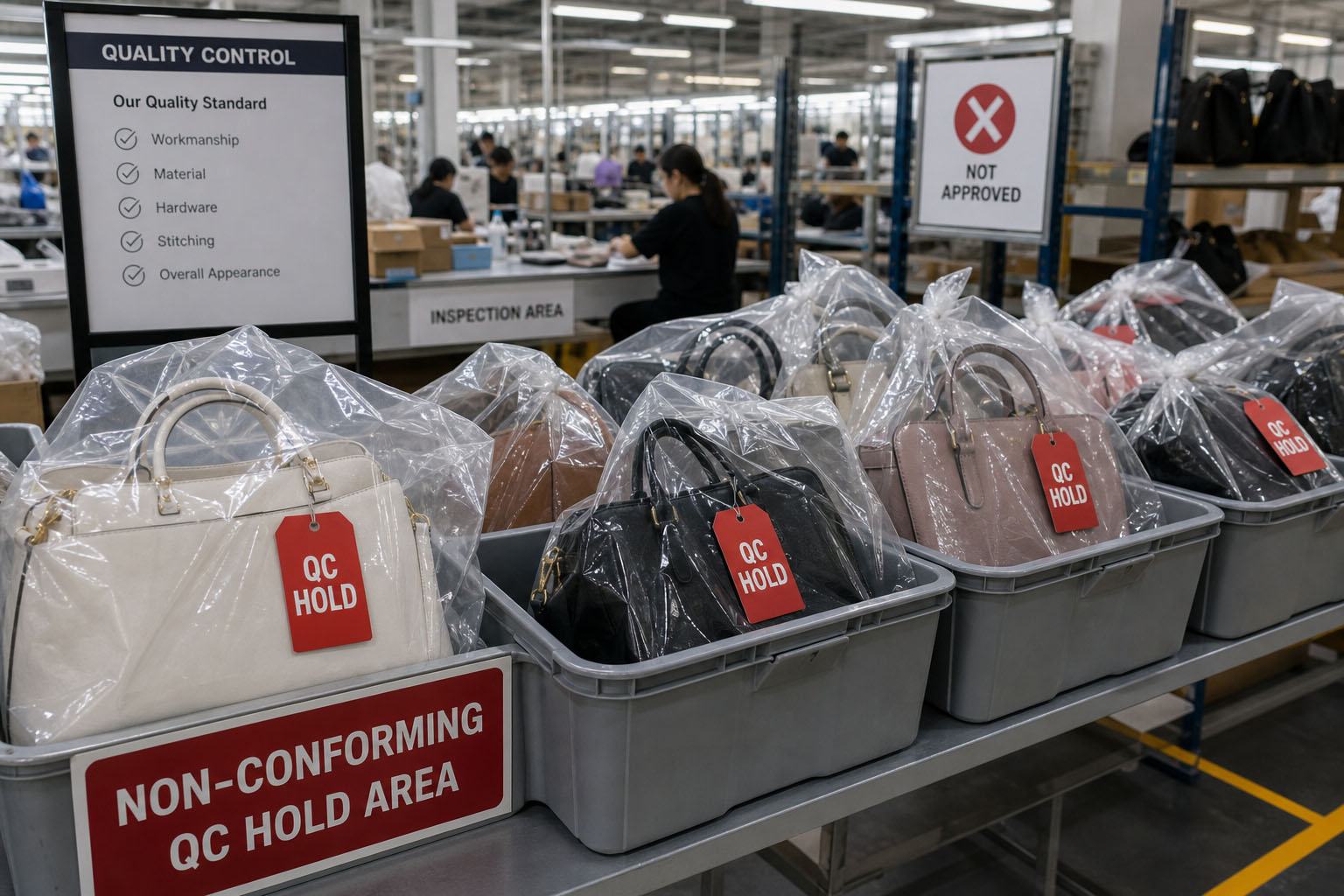
“What corrective action and rework protocol is followed when inspection identifies non-conforming units?”
Defects will happen. The difference between a professional factory and an amateur one isn’t the absence of problems — it’s how they respond to them.
The Standard 4-Step Corrective Action Process
Step 1: Physical Segregation
Non-conforming units must be physically separated from the main production lot and clearly marked with red QC hold tags. A defect that ends up in a finished shipment because it “got mixed back in” is a quality system failure.
Step 2: Disposition Decision
Each defective unit receives a documented disposition:
Rework — can it be repaired to meet spec? (most common)
Re-grade — can it be sold as a B-grade at a discount?
Reject/Scrap — must be destroyed or returned
Step 3: Root Cause Analysis
The factory should perform a root cause analysis to identify why the defect occurred. Common causes include:
Material defect
Machine malfunction
Operator error
Process parameter drift
Tooling wear
The corrective action should address the root cause, not just the symptom. If a sewing defect appears in 50 bags because a needle was dull, replacing the 50 bags without changing the needle means another 50 will fail tomorrow.
Step 4: Corrective Action Implementation & Verification
The factory implements the corrective action, and the inspection team verifies that the issue has been resolved before production resumes. This is typically documented in a Corrective Action Report (CAR) that you, the buyer, should receive and approve.
What You Should Require in Writing
Add this language to your purchase order:
“All non-conforming units identified during inspection must be physically segregated, clearly marked, and reported to the buyer within 24 hours, with a written corrective action plan submitted before any rework begins. Root cause analysis is required for any defect category affecting more than 2% of the inspected sample.”
The Refused Shipment Protocol
If a final inspection fails and the lot is rejected, the protocol should include:
100% sorting of the entire lot (not just the sample)
Rework or destruction of all defective units with documented evidence
Re-inspection by the same third-party agency before re-presenting the lot
Cost responsibility clearly assigned — typically the factory for quality issues, the buyer for spec changes made after golden sample approval
Why Documentation Is Your Best Protection
Every rework, every correction, every disposition should be photographed and documented. If a dispute ever escalates — whether with the factory, your customer, or a regulatory body — this documentation is your proof that you maintained professional quality standards.
Conclusion: Quality Control Is a System, Not a Conversation
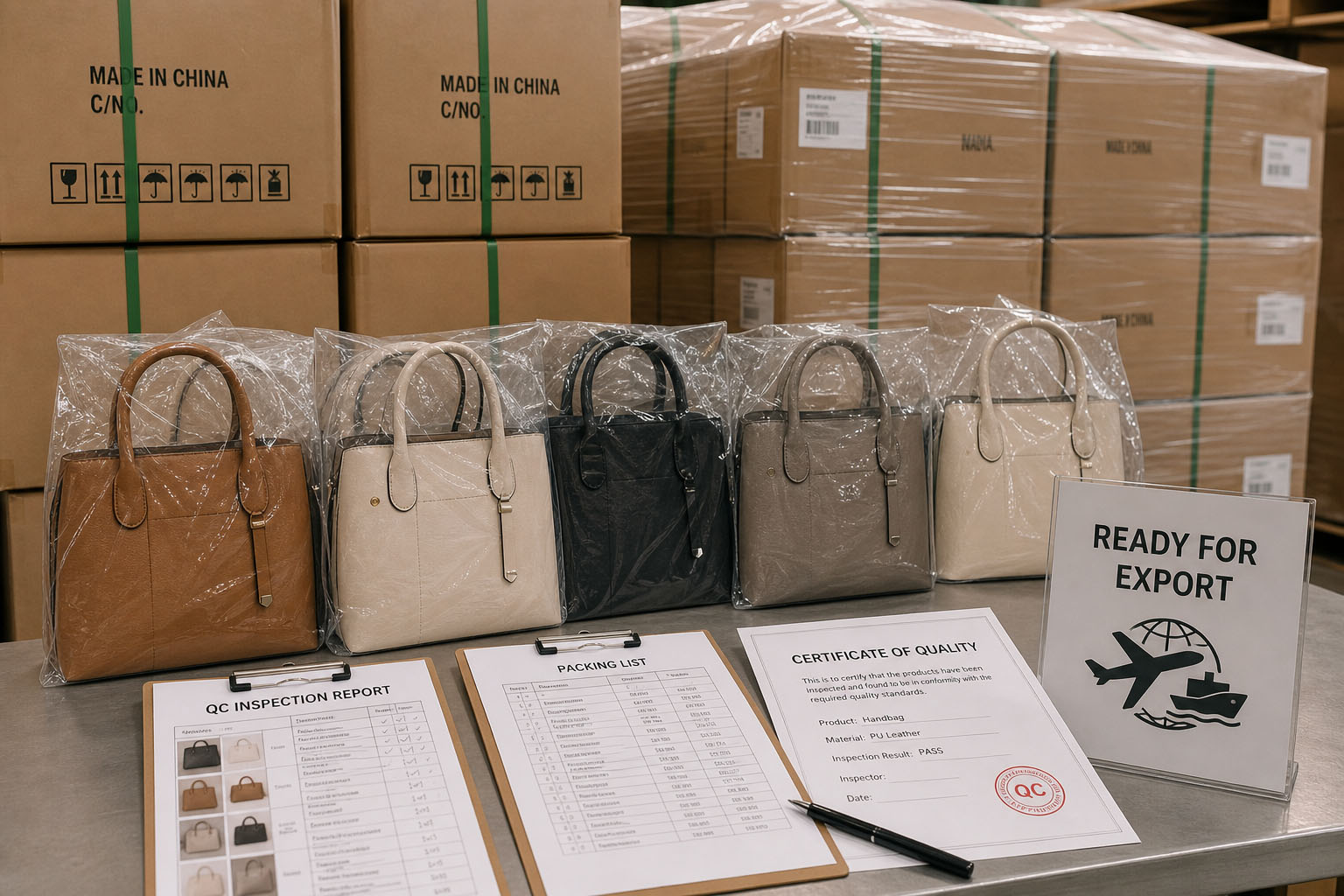
Sourcing bags from China can be extraordinarily profitable — but only when it’s done with the same discipline that any world-class brand would apply to domestic manufacturing. The five quality control standards covered in this guide are not optional luxuries; they are the operational foundation that determines whether your business grows or drowns in returns.
Let me leave you with the single most important principle: quality control is a system, not a conversation. You cannot inspect quality into a product after it’s been produced. You must design it into the process from the very first sample to the final shipment.
The buyers who succeed in this industry are the ones who:
Document every specification in writing
Approve golden samples meticulously
Specify AQL standards explicitly
Hire third-party inspectors for unbiased verification
Demand corrective action reports, not just promises
Partner with factories who share their commitment to quality
Your customers don’t see the inspection reports, the calibration certificates, or the golden samples. What they see is a bag that looks the way it did in your product photos, performs the way they expected, and lasts as long as they hoped. That experience is built long before the bag ships — it’s built in the quality systems you implement today.
Post time: Jul-30-2026