
Published for US‑based bag e‑commerce operators | B2B Sourcing Guide for Imported Handbags, Luggage, and Fashion Bags
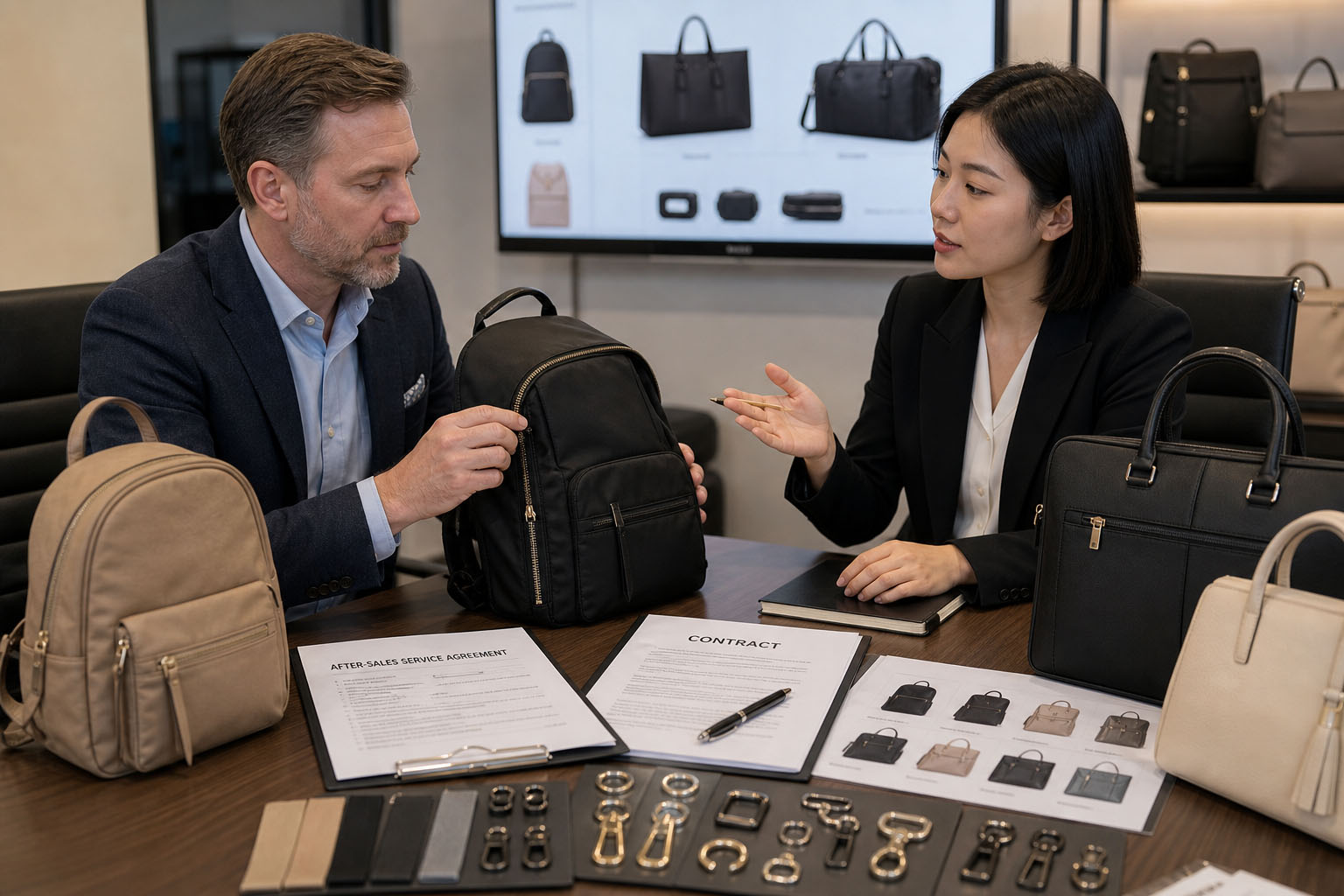
For US‑based bag sellers running independent e‑commerce websites, sourcing quality bags directly from Chinese OEM and ODM factories creates huge profit potential. However, many cross‑border importers focus heavily on unit price, minimum order quantities, lead times, and custom private‑label requirements, while overlooking one high‑risk business segment: factory‑provided after‑sales support.
When defective merchandise reaches your US warehouse, you cannot quickly visit overseas production facilities to resolve quality failures. Repair guidance, spare‑part availability, warranty coverage, defective‑item resolution, and formal contractual guarantees will directly shape your customer return rates, brand reputation, and bottom‑line profitability. Many American merchants discover too late that Chinese bag factories operate under after‑sales frameworks significantly different from domestic US suppliers. Accepting vague verbal promises during negotiations will leave you with limited recourse once shipments land on US soil.
This guide breaks down core after‑sales questions every US independent‑site bag seller must resolve before confirming bulk orders. It covers real‑world industry norms, key warranty inquiries, spare‑part logistics, defective‑goods handling, contractual safeguards, and actionable negotiation scripts for communicating with Chinese bag manufacturers.
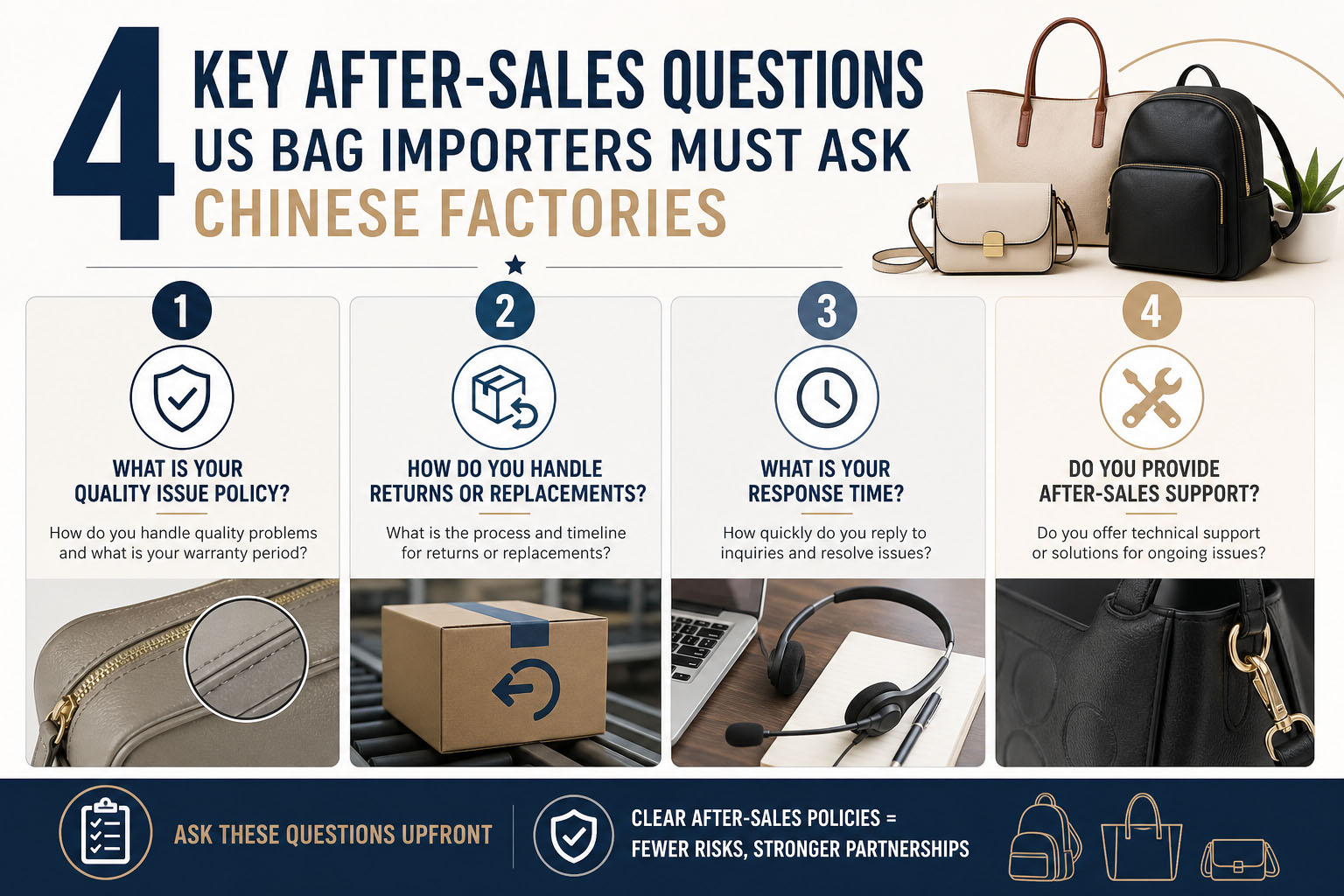
The four foundational questions you must put forward to every prospective Chinese bag supplier are as follows:
1. What is the warranty period, and does it cover manufacturing defects, hardware failure, and stitching issues?
2. How do you handle return shipping costs and logistics for defective or low‑quality items?
3. Can you provide a formal written after‑sales service agreement or guarantee included in the contract?
4. Are replacement units shipped in the next available batch or held in ready stock for urgent fulfillment?
These four points form the baseline of your after‑sales risk management. Verbal assurances over instant‑messaging apps hold almost no practical weight during cross‑border disputes. Every agreed‑upon term needs formal documentation before deposit payment.
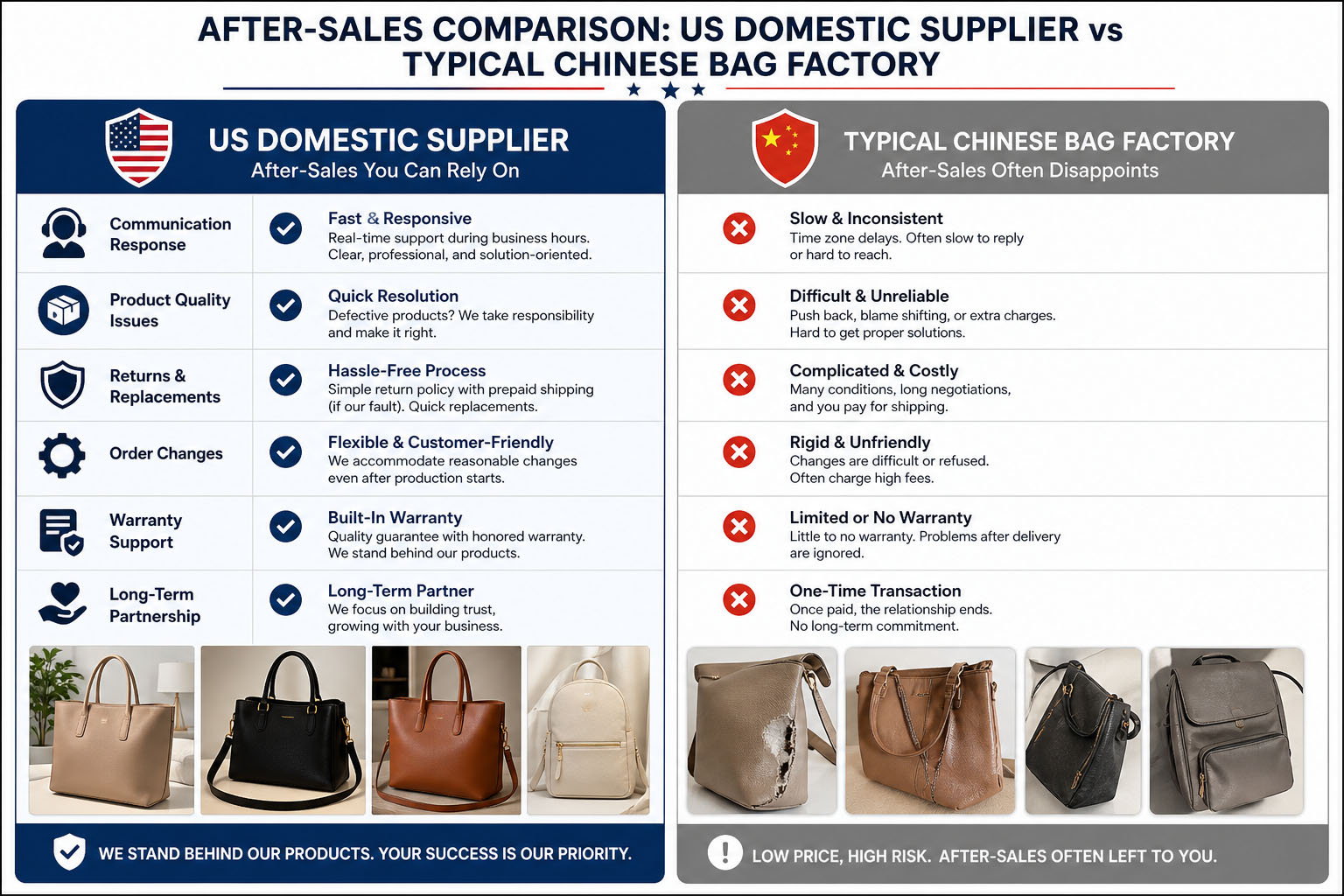
Common Industry Realities of After‑Sales Service From Chinese Bag Manufacturers
Before starting supplier negotiations, US sellers need realistic expectations. Most Chinese bag factories deliver certain levels of after‑sales support, yet these services carry inherent limitations, and business rules differ substantially from United States commercial standards. All favorable after‑sales terms must be actively negotiated and embedded within purchasing contracts.
Below are ten widely‑observed industry insights based on real B2B import operations:
1. Most Chinese bag manufacturers offer a standard warranty of 6–12 months covering manufacturing defects.
2. Replacement commitments for defective units are typically honored within the warranty window and require buyer‑provided photo or video evidence.
3. Repair guidance is commonly delivered through PDF manuals, instructional videos, or real‑time messaging on WeChat or WhatsApp.
4. Spare‑part supply (zippers, buckles, straps, wheels) is generally available but often subject to minimum order quantities.
5. Many B2B suppliers participate in Trade Assurance programs, providing escrow‑based refund or replacement guarantees for qualifying defects.
6. After‑sales communication is primarily handled via messaging apps rather than formal ticketing or CRM systems.
7. Suppliers typically distinguish between “production defects” and “buyer‑caused damage,” with replacement applying only to verified manufacturing issues.
8. OEM/private‑label buyers usually do not receive pre‑stocked spare‑part inventory unless explicitly contracted.
9. Repair instructions are more readily available for mechanical products (e.g., luggage with wheels) than for simple fabric bags.
10. Third‑party pre‑shipment inspections (e.g., SGS, QIMA) are widely accepted by Chinese factories as evidence when filing replacement claims.
Repair Guidance: Remote Support Instead of On‑Site Technicians
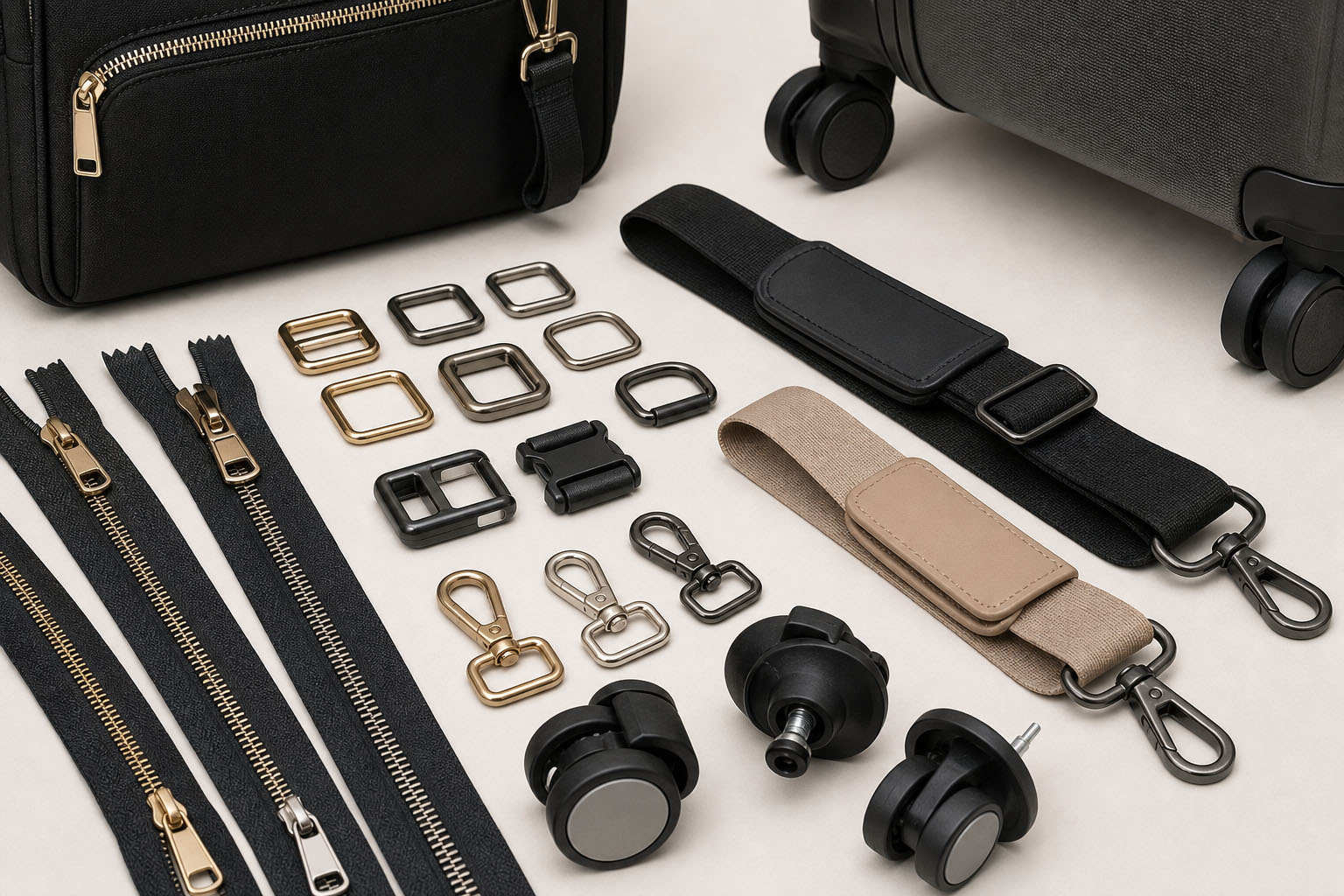
Repair guidance is one segment where established Chinese bag suppliers can deliver practical resources for US independent‑site sellers. Reputable factories will share repair and maintenance guidance upon explicit buyer request. These resources cover practical scenarios: fixing loose stitching, swapping out defective zippers, and cleaning instructions for genuine leather, synthetic leather, and woven fabric materials.
All guidance is transmitted digitally: annotated photos, short demonstration video clips, or downloadable PDF documents. Factories will not dispatch field technicians to the United States for finished fashion‑bag after‑sales cases. In rare large‑volume long‑term cooperation scenarios, some factories will arrange technician remote troubleshooting. On‑site overseas technician visits remain extremely uncommon for finished bag orders; such support is standard for industrial machinery instead of consumer fashion merchandise.
For your independent‑store business, this means your US‑based customer‑service team becomes the end‑point for repair guidance. You will repurpose factory‑provided instructional content to support your American retail shoppers. Luggage and rolling bags with wheel assemblies tend to receive far more detailed repair documentation than basic fabric tote bags or simple cosmetic pouches.
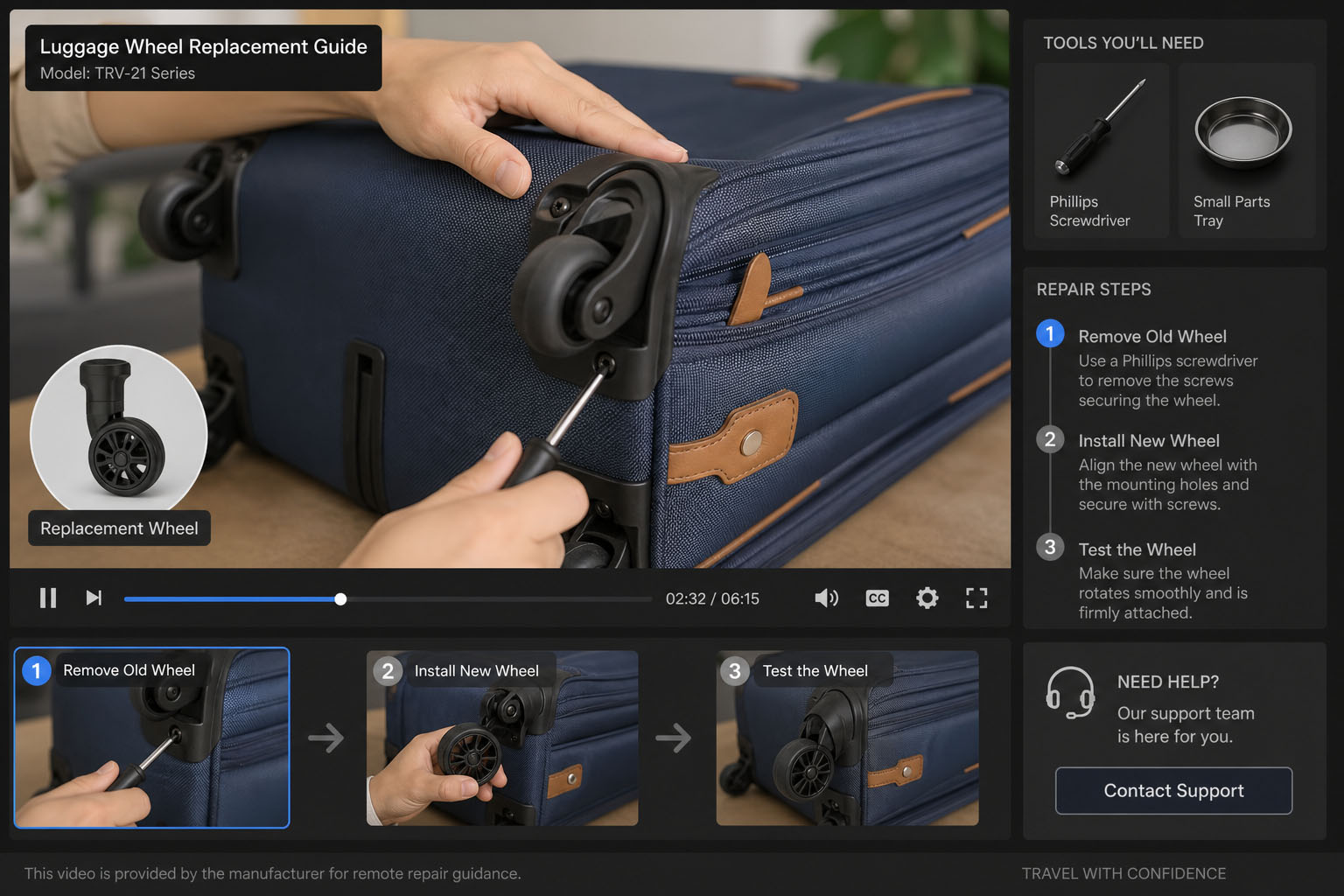
Spare‑Part Supply: Available, But Rarely Free and Often MOQ‑Bound
Spare parts for bag products include zippers, metal buckles, adjustable shoulder straps, lining sections, custom‑branded hardware, and luggage spinner wheels. Most Chinese OEM and ODM bag factories can manufacture matching spare components, especially when you ordered custom‑molded hardware or specified brand‑name zipper systems for your private‑label collection.
Importers must understand three standard supplier limitations for spare‑part orders:
1. Spare components count as separate paid orders. Factories do not automatically throw in free spare parts alongside your bulk bag shipment.
2. Minimum‑order quantity rules or minimum‑charge thresholds almost always apply. You cannot order one single replacement buckle in most circumstances without pre‑negotiated contract clauses.
3. Shipping fees for spare‑part consignments default to the buyer’s expense unless you have negotiated supplier‑covered freight within your purchase contract.
When you evaluate potential manufacturers, submit these pointed questions in writing:
- “Can you supply matching spare parts (zippers, buckles, straps) for our custom bag models? Please share applicable MOQs, unit pricing, and production lead‑times.”
- “Will you permanently archive our material specifications and custom‑hardware tooling records so you can reproduce matching spare parts for future orders?”
Without documented commitments, once your production run closes, the factory may discard custom molds and material references, making matching replacement hardware impossible to source later. Private‑label buyers should note that factories will not maintain pre‑stocked spare‑part inventory for your SKUs unless you write that obligation into formal agreements.
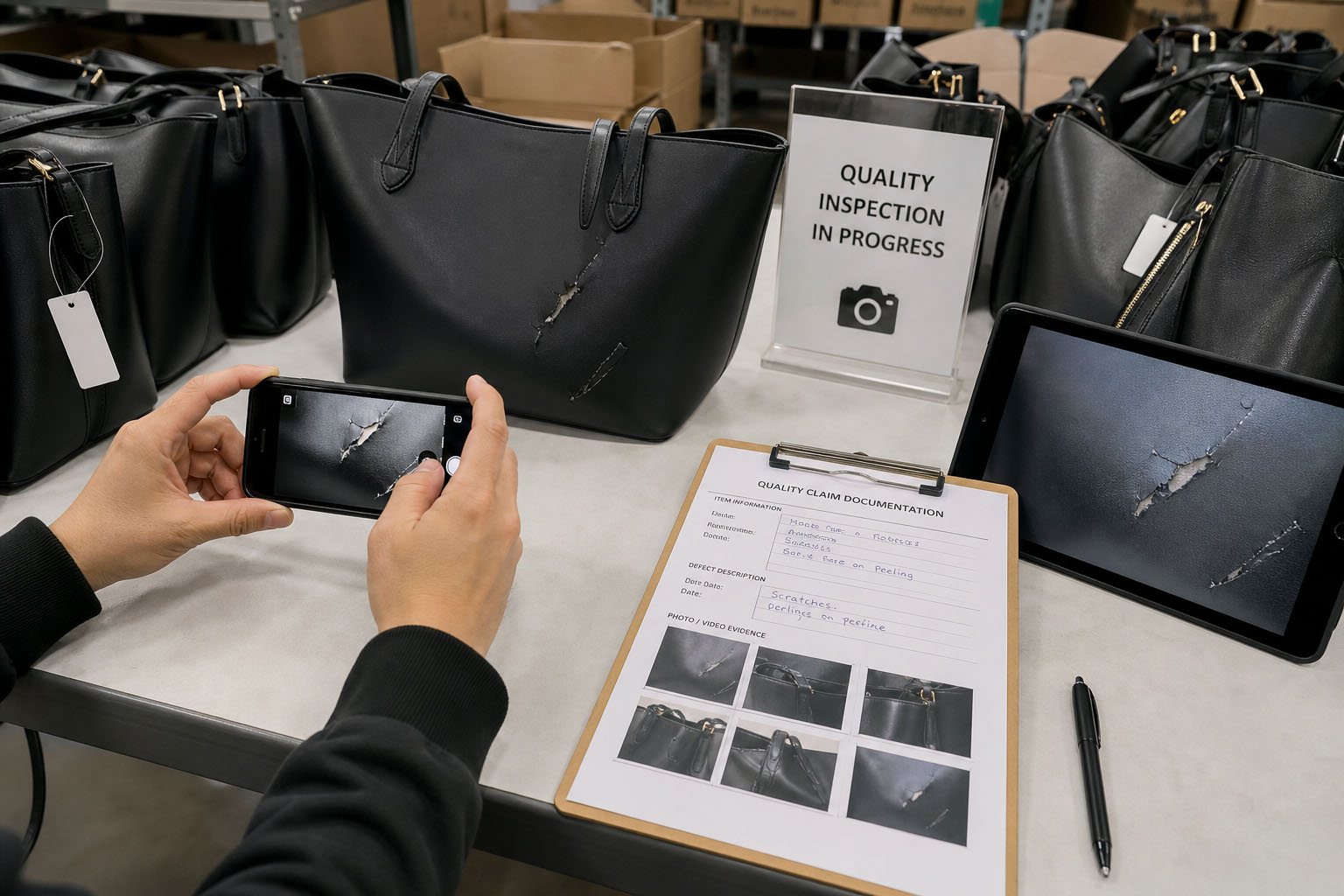
Replacement Commitments for Defective Units: Pre‑Shipment vs Post‑Arrival in USA
Replacement policies represent the highest‑stakes after‑sales topic for US independent‑site merchants. Practices differ significantly between defects caught before shipment leaves China versus quality problems discovered after goods clear US customs and arrive at your domestic warehouse.
Pre‑shipment third‑party inspection is best practice for serious bag importers. Service providers such as SGS and QIMA conduct on‑site factory audits before containers load for ocean freight. When inspectors identify manufacturing defects at the factory location, suppliers typically offer three resolutions: rework defective items within the factory, fully replace flawed units prior to shipment, or apply an invoice credit to offset the value of non‑conforming goods.
The real challenge emerges after your shipment lands in the United States. Due to high international ocean‑freight costs, customs clearance fees, and return‑handling complexity, most Chinese bag factories will not accept physical return of finished bags back to China. Sending defective inventory backwards across the Pacific is commercially impractical for most consumer‑bag orders.
Instead, industry‑standard remedies fall into three categories:
1. Include replacement units within your next incoming production batch, the most widespread solution across the industry.
2. Issue account credit to apply toward your future factory orders, equal to the wholesale value of confirmed defective merchandise.
3. Grant partial refunds or percentage‑based discounts applied to current or upcoming purchase orders.
Under narrow conditions, responsible factories will agree to ocean‑shipping replacements at their own cost. This outcome requires clear proof that defects stem entirely from manufacturing error, and you must file formal claims within an agreed time window, commonly 30 days after buyer receives cargo. Direct cash refunds remain uncommon; account credit and batch‑included replacements are the default industry norm.
Standard warranty wording you will encounter from many Chinese factories reads: “For defects in material or workmanship under normal use, the factory will repair or replace at its option.”
Two critical fine‑print points deserve your full attention. First, suppliers strictly separate manufacturing defects versus buyer‑caused damage. Replacements and credits apply exclusively to verified production flaws. Wear‑and‑tear, consumer misuse, improper storage, or damage incurred during US domestic transit will not trigger factory liability. Second, every quality claim requires supporting evidence: high‑resolution photos, short video clips of defects, and original production batch numbers. Claims also carry firm submission deadlines, usually between 30 to 60 calendar days after you receive goods.
Advanced negotiation targets include defect‑rate threshold clauses. If the defective percentage within one shipment passes an agreed benchmark (for example 3 percent), you can negotiate expanded factory liability covering related rework, replacement, and logistics expenses. This protection will never apply automatically; you must codify it inside your formal contract.
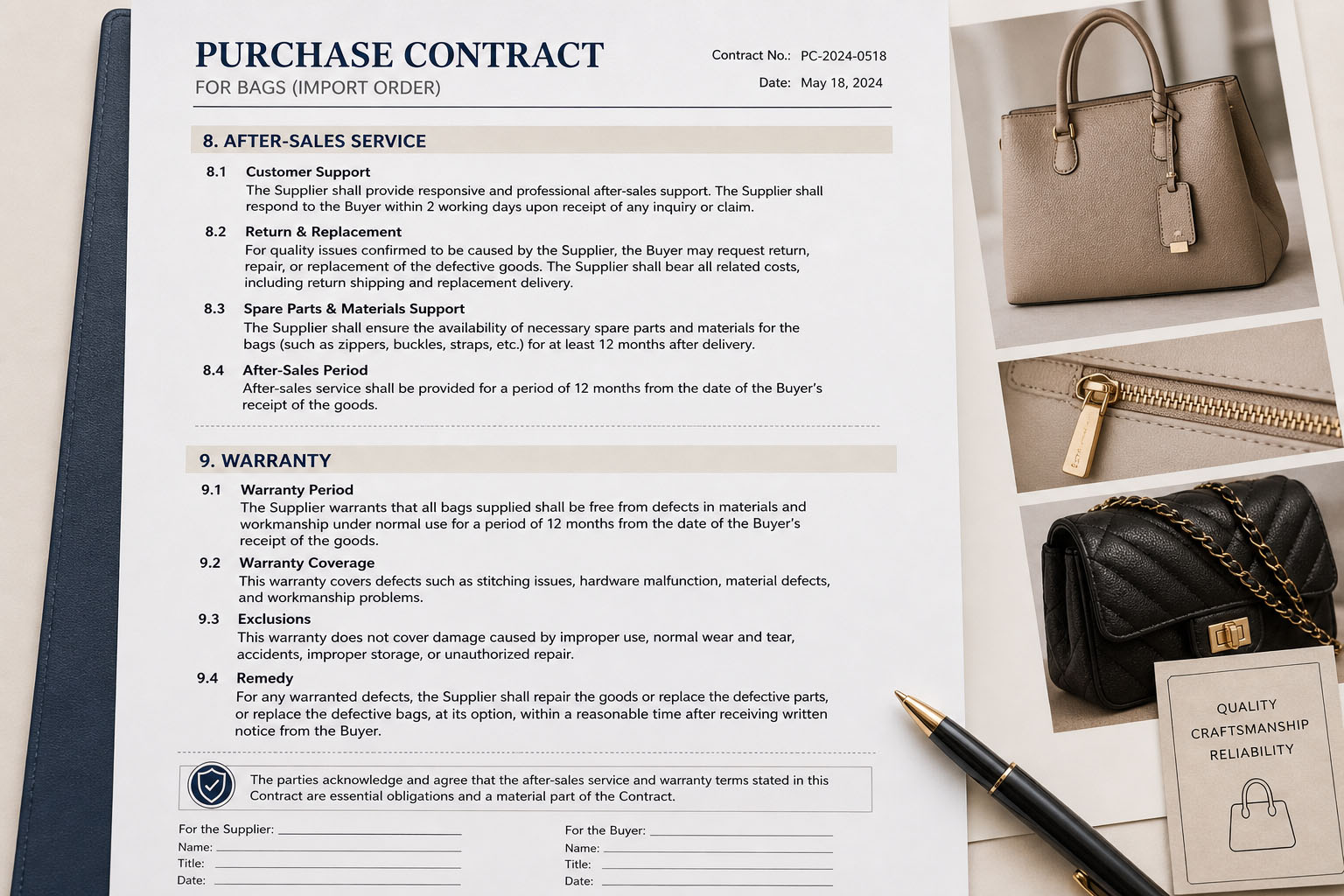
Formal Written After‑Sales Agreements and Warranty Terms
Verified reliable Chinese bag suppliers are fully capable of incorporating formal written after‑sales service agreements and warranty clauses within official purchasing contracts or proforma invoices. Do not accept commitments delivered only via chat messages.
Your written documentation needs to answer all four core sourcing questions. Reputable factories can formalize warranty scope, spare‑part obligations, defective‑goods remedies, claim‑submission procedures, and time limits.
A small number of suppliers join Alibaba Trade Assurance programs. This escrow service creates a baseline safety net for eligible quality disputes, supporting refunds or replacement arrangements for validated manufacturing defects. Even with Trade Assurance active, you still need independent contract wording for long‑term private‑label projects.
One key point to clarify early: replacement‑unit fulfillment modes. Qualified factories support dual options: replacement goods can ship together with your next available production batch, and they can also maintain limited ready‑stock inventory to satisfy urgent replacement requests when your business faces pressing US‑customer needs. Confirm both capabilities and define under which scenarios each fulfillment method activates.
Note that most Chinese‑factory after‑sales workflows run through instant‑messaging platforms including WhatsApp and WeChat. Sophisticated ticket‑tracking CRM systems for handling after‑sales cases are rare. You will manage quality‑claim communications through direct chat conversations, so always save full message histories, attachments, photos, and video evidence for every dispute.
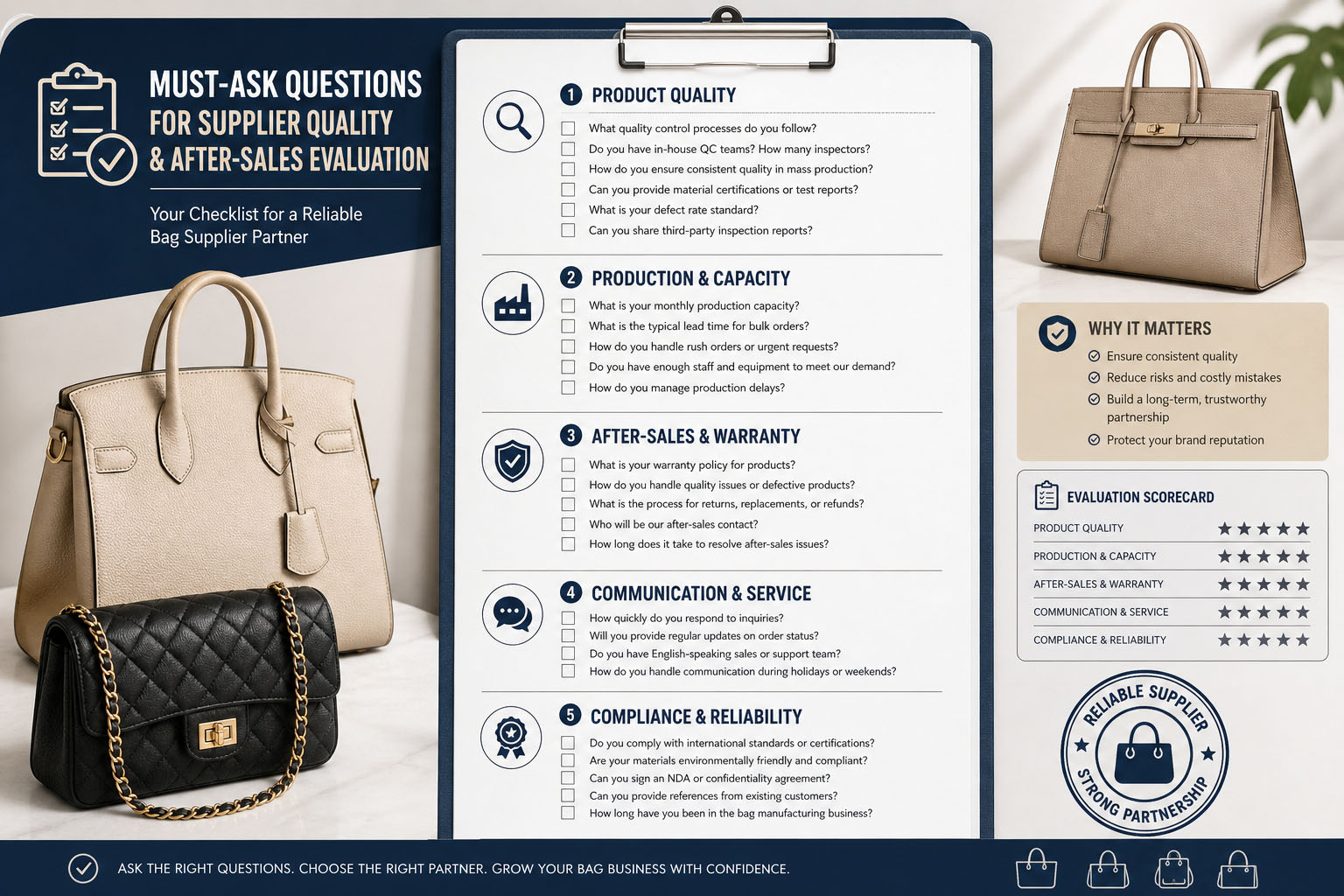
Actionable Questions to Ask Every Potential Chinese Bag Supplier
As a professional independent‑site bag seller, you must raise these questions explicitly during supplier vetting. Insist on written replies rather than casual verbal conversations.
Defect Policy
- “What is your complete resolution policy when we discover defective bags after merchandise arrives at our United States warehouse?”
- “Will you offer unit replacements, future‑order credit, or direct cash refunds? How many calendar days do we have to submit claims after receiving shipment?”
- “Which party pays ocean or air freight costs for sending replacement units to our US address?”
Warranty Period Scope
- “Do you provide a formal warranty period covering manufacturing defects? How many months long is this warranty?”
- “Please itemize exactly what failure modes qualify for warranty protection: stitching failure, hardware breakage, raw‑material flaws, color deviation, dimensional non‑conformity.”
Spare‑Part Program
- “Can you produce matching spare parts for our custom bag SKUs? Please share unit pricing and minimum‑order requirements.”
- “For how many years will you retain our custom hardware tooling and material records so matching spare components can be reproduced?”
Repair‑Support Resources
- “Can you create dedicated written repair and maintenance guidance files for our unique product SKUs?”
- “If recurring quality problems emerge, can you deliver remote technical troubleshooting support upon our request?”
Inspection and Claim‑Filing Process
- “Do you accept third‑party pre‑shipment inspection reports from SGS, QIMA, or other independent testing organizations as formal claim evidence?”
- “What exact documentation must we submit for a manufacturing‑defect claim: photos, video footage, batch codes, inspection reports?”
- “What hard deadline applies for submitting quality claims after cargo delivery to our US location?”
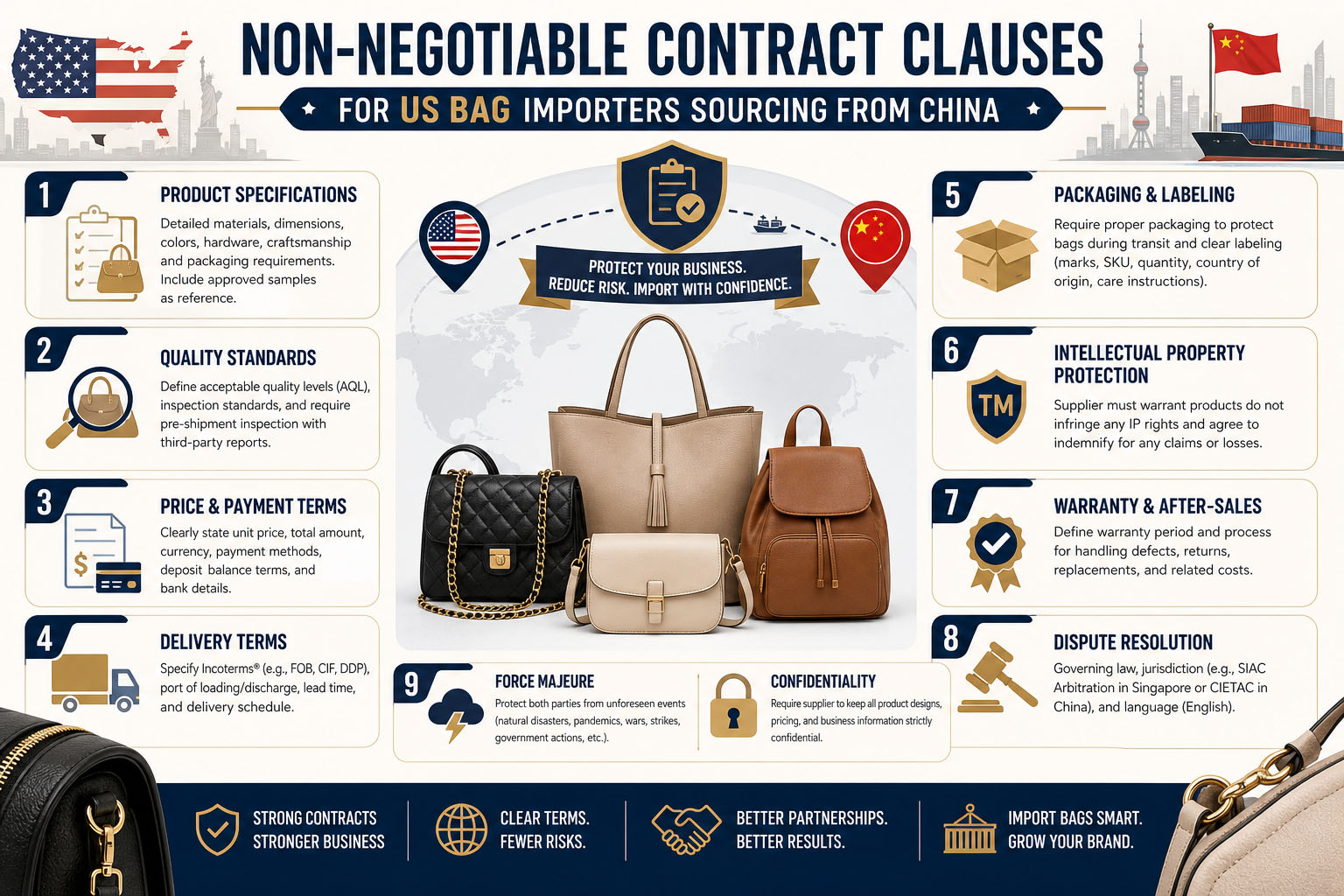
Non‑Negotiable Clauses to Insert Into Your Purchase Agreement or Proforma Invoice
Your purchase contract is your most powerful risk‑mitigation tool when importing bags from China. Below are essential clauses every US independent‑site seller should push to include within formal paperwork.
1. Clear defect definition
Precisely list which issues constitute manufacturing defects: broken stitching, hardware failure, material flaws, incorrect color matching, and out‑of‑spec dimensions. Explicitly exclude damage from end‑user misuse, improper storage, or US domestic shipping transit harm.
2. Formal claim‑notification window
Example wording: “Buyer shall notify Seller of manufacturing defects within 30 calendar days after receipt of goods, accompanied by photo, video, and batch‑number supporting evidence.”
3. Dual remedy options controlled by the buyer
Secure your right to select your preferred resolution path. Sample clause: “Seller shall grant Buyer the option of either (a) shipping replacement units by sea freight at Seller’s expense or (b) issuing future‑order credit equivalent to the wholesale value of verified defective merchandise.”
Also clarify fulfillment rules for replacements: replacements can be consolidated into the next production batch; for urgent business scenarios, seller shall maintain limited ready‑stock replacement inventory for expedited dispatch.
4. Binding spare‑part commitment
Example contract text: “Seller agrees to supply matching spare parts corresponding to Buyer’s bag models for a minimum of X years, following an agreed‑upon price list. Minimum order quantity for spare‑part orders shall not exceed Y pieces for each individual SKU.”
5. Repair‑support obligation
“Upon Buyer’s reasonable request, Seller shall provide written repair and maintenance guidance documents plus remote messaging‑based technical support for confirmed manufacturing‑quality issues.”
6. High‑defect‑rate liability trigger clause
This clause protects you when one shipment contains an unusually large share of flawed goods. Sample: “If the verified manufacturing‑defect rate within any single shipment exceeds 3 percent, Seller shall bear all reasonable buyer costs linked to product rework, unit replacement, and associated international logistics fees.”
Real‑World Practical Reality for US Independent‑Site Bag Sellers
Physical product returns shipping all the way back to Chinese factories is almost never commercially feasible for finished fashion bags. Structure your whole after‑sales workflow around receiving batch‑added replacements or future‑order credit rather than expecting product returns.
After‑sales support is available from Chinese bag manufacturers, yet it is never automatic. Service quality fluctuates dramatically based upon two major factors. First is factory scale and operational professionalism. Larger established OEM factories with stable overseas‑customer bases maintain far clearer, more consistent after‑sales frameworks than small workshops. Second, and equally important: every favorable term must be negotiated and written down before you send deposit payments.
Many new US independent‑store bag sellers make the mistake of locking in unit pricing and custom‑label artwork while overlooking after‑sales rules. When defective inventory lands in your US warehouse, renegotiating favorable terms after production finishes becomes extremely difficult.
Proactive risk reduction should combine multiple layers: detailed supplier due diligence, explicit written after‑sales contractual commitments, third‑party pre‑shipment quality inspections, and systematic photo‑video evidence preservation for every shipment you receive. By fully understanding how Chinese‑factory after‑sales systems function and embedding protections into your purchasing documents, you will reduce costly cross‑border quality disputes, stabilize your inventory quality, protect your independent‑site brand reputation, and build sustainable long‑term sourcing partnerships with reliable Chinese bag manufacturers.
Post time: Aug-13-2026