
Published for US‑based independent website bag importers | Sourcing Insights for Backpacks, Totes, and Travel Bags
> **Disclaimer**: This blog serves as practical sourcing reference only, not legal compliance advice. Always cross‑verify certification scope, local regulatory requirements, and supplier documents before placing bulk orders.
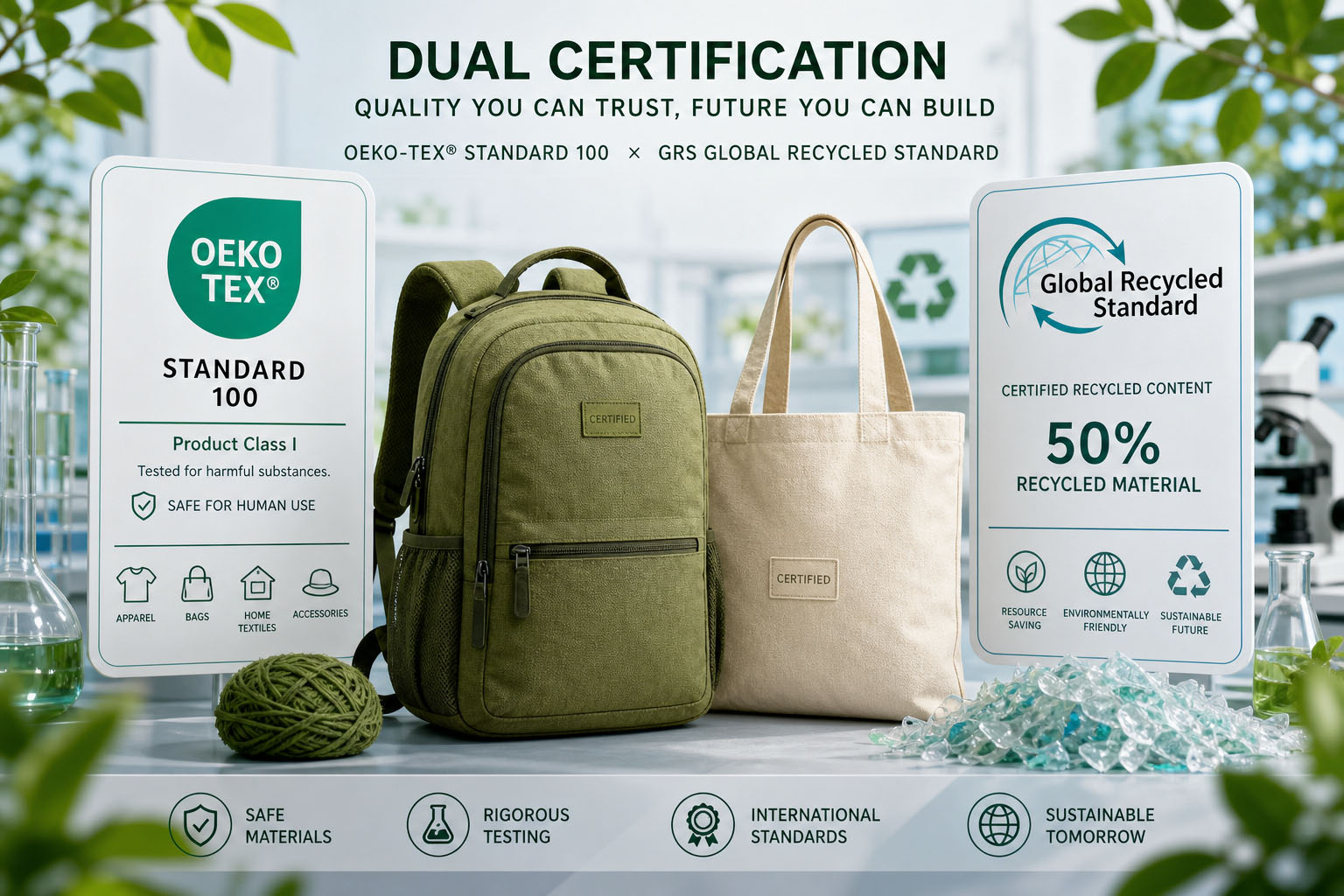
As a US‑based bag importer running your own e‑commerce website, sourcing backpacks, tote bags, travel bags and other soft‑goods luggage directly from Chinese factories brings huge profit potential. However, chemical safety and recycled‑material certifications are among the most confusing topics during supplier communication. Many new independent‑site sellers get stuck on critical questions: How frequently do EU and US importers need OEKO‑TEX Standard 100? Which product class fits my bag lineup? Does certification cover zippers, linings and trims or only outer fabric? What price premium and MOQ adjustments should I expect? How does GRS certification work for finished bags?
This blog breaks down OEKO‑TEX Standard 100 and GRS real‑world practices among Chinese bag manufacturers, helping you make data‑driven sourcing decisions, avoid supplier pitfalls, and build trust with your US online shoppers.
Is OEKO‑TEX Standard 100 a Mandatory Import Document for EU and US Bag Shipments?
A widespread misconception among new cross‑border sellers is that OEKO‑TEX Standard 100 is a customs‑required legal document for importing bags into the United States or European Union. **In fact, OEKO‑TEX Standard 100 is a fully voluntary third‑party textile certification, not a legal import mandate.** No US federal law or EU customs rule forces bag shipments to hold a valid OEKO‑TEX certificate to clear border inspections.
Even so, this does not mean chemical safety standards can be ignored. Both markets enforce strict hazardous‑substance regulations that importers must satisfy.
For the European Union, REACH regulation restricts harmful substances including azo dyes, formaldehyde, heavy metals, nickel release from metal hardware, and specific phthalates. While REACH does not mention OEKO‑TEX by name, many European brands and retailers treat OEKO‑TEX Standard 100 as practical proof of REACH‑aligned chemical safety. It simplifies vendor qualification workflows instead of running separate lab tests for every component.
For United States importers, core legal compliance comes from domestic product‑safety rules. CPSIA governs children‑oriented bags with strict heavy‑metal limits. California Proposition 65 enforces warning obligations for goods containing listed toxic chemicals. US customs will not reject cargo purely for missing OEKO‑TEX paperwork. Nevertheless, major retail partners often write OEKO‑TEX requirements directly into vendor handbooks.
When Chinese bag factories mention “we require OEKO‑TEX”, it rarely refers to legal import rules. More accurately, it reflects existing demand from their long‑term Western brand clients. Factories serving EU and US markets build production workflows around OEKO‑TEX expectations, so they pass those conditions onto new overseas buyers. If you source non‑certified goods, you still bear full importer liability to meet CPSIA, Prop 65 and REACH chemical limits for your end‑market customers.
How Common Is OEKO‑TEX Standard 100 Demand Among Chinese Bag Factories?
How frequently Chinese bag suppliers encounter OEKO‑TEX requests heavily depends on their core customer base and product portfolio.
Factories oriented toward EU‑US brand clients, department‑store retailers, textile‑heavy bags (fabric totes, cosmetic pouches, everyday backpacks), kid‑focused bags, or merchandise marketed as safe and eco‑friendly will deal with OEKO‑TEX on a routine basis. A large share of mid‑to‑high‑level export‑focused Chinese bag manufacturers already maintain valid OEKO‑TEX Standard 100 certificates, or have established processes to certify new product lines. For these facilities, OEKO‑TEX compliance becomes a baseline pre‑condition for working with Western buyers.
On the opposite side, price‑oriented factories targeting low‑margin generic markets or producing goods dominated by non‑textile materials (pure leather bags, heavy PVC bags with minimal textile components) treat OEKO‑TEX as an optional upgrade service. If you do not explicitly ask for certification, they will produce non‑certified merchandise at lower unit cost. They can launch certification projects upon buyer request, yet this adds lead‑time and extra expenses.
For US independent‑site sellers, you face two commercial realities. Legally you can import bags without OEKO‑TEX certificates, provided you satisfy all US product‑safety statutes. Commercially, your target audience decides its value proposition. When you sell to safety‑conscious consumers or plan future wholesale cooperation with offline retailers, OEKO‑TEX acts as persuasive marketing proof on your product pages. If your direct‑to‑consumer website serves price‑focused shoppers with no explicit safety‑related customer inquiries, mandatory certification may not be urgent. Even so, be prepared: many export‑specialized Chinese manufacturers will still push OEKO‑TEX requirements inherited from their existing overseas client base.
OEKO‑TEX Standard 100 Product Classes for Backpacks, Totes and Travel Bags
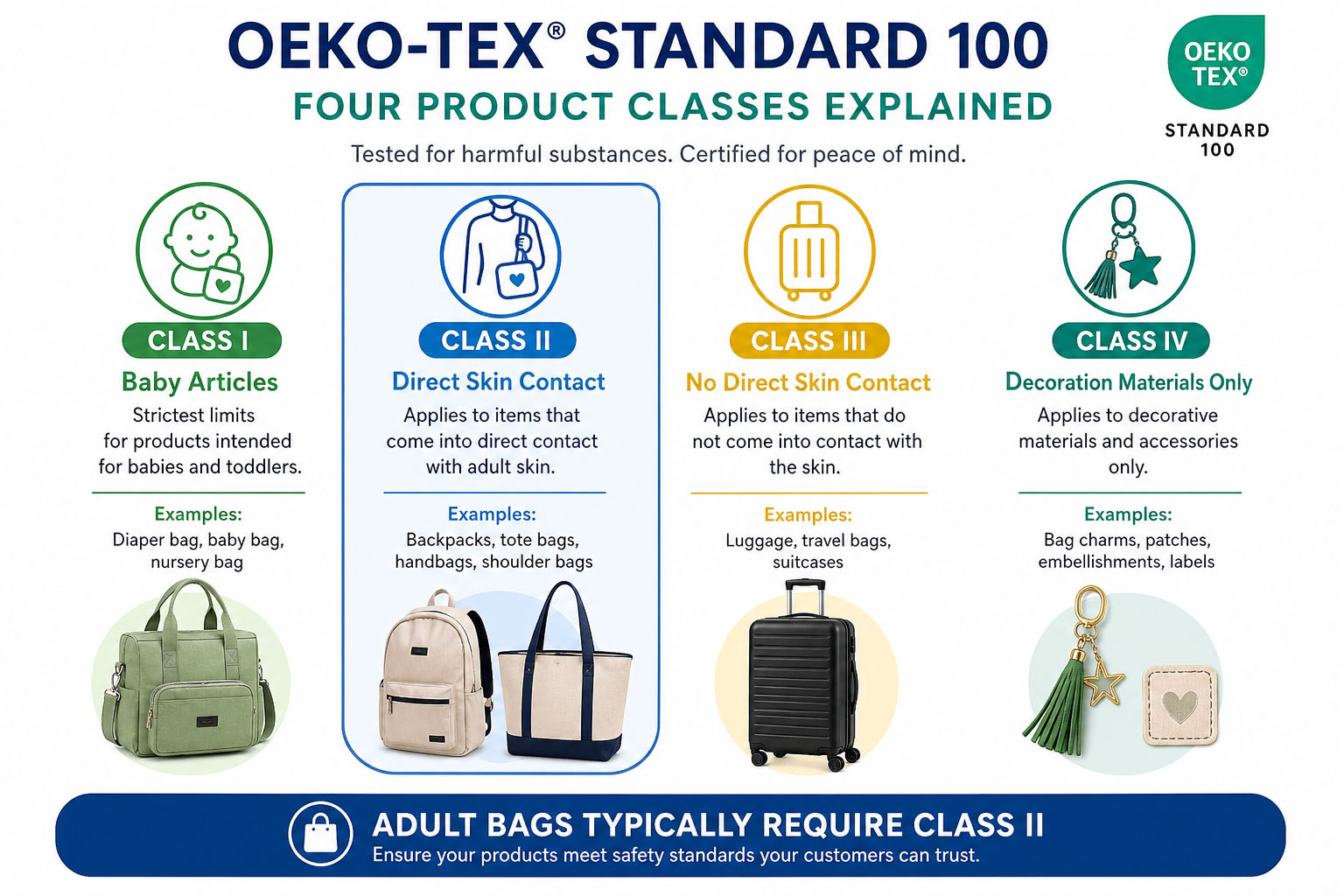
OEKO‑TEX Standard 100 divides goods into four distinct product classes based on end‑use exposure to human skin, and each certificate is tied to one specific class.
**Class I**: Baby articles, for items intended for infants under 36 months old. This holds the strictest hazardous‑substance thresholds.
**Class II**: Products with direct skin contact. Most adult‑use textile bags fall into this classification: daily backpacks, canvas tote bags, casual travel bags where fabric touches user skin during regular use.
**Class III**: Products without direct skin contact. Used for items where textile layers rarely touch human skin in normal operation.
**Class IV**: Decoration materials only, for ornamental components not designed for regular user contact.
Most adult‑oriented backpacks, totes and travel bags sourced for US independent websites require **Class II compliance**. Reserve Class I exclusively for bags truly designed for babies and toddlers, since Class I testing carries higher lab costs. Mis‑selecting product classes creates certification waste; asking for Class I for ordinary adult bags will unnecessarily raise your sourcing budget without real‑world market benefit.
Critical Scope Question: Does OEKO‑TEX Standard 100 Cover Full Finished Bags?
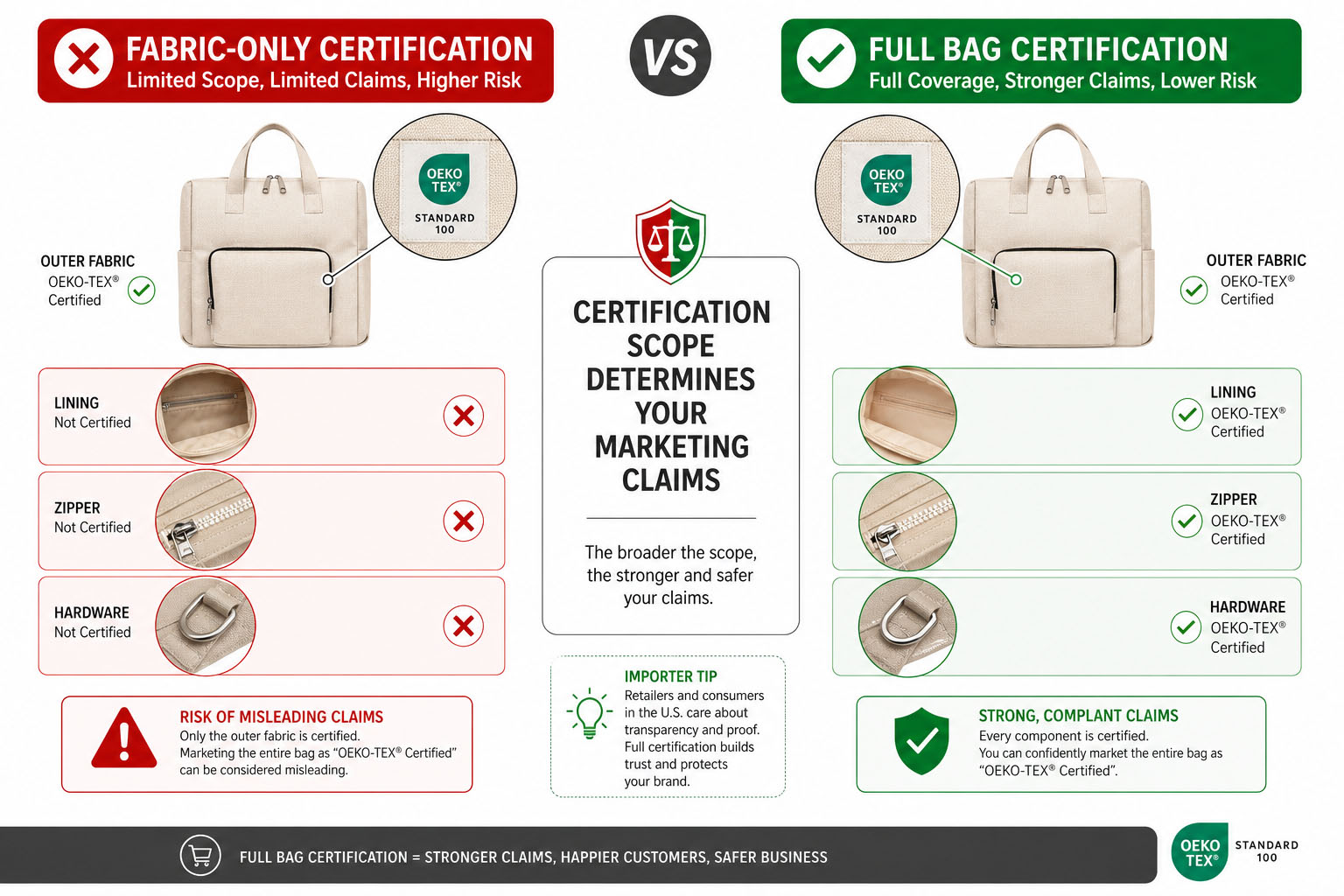
This is one of the most frequent hidden pitfalls for first‑time US bag importers. Many Chinese factories hold OEKO‑TEX certificates for main outer fabric only. Some suppliers provide partial certification: only the primary exterior textile passes OEKO‑TEX testing, while linings, padding, printed artwork, plastic hardware, and metal zippers sit outside the certification scope.
A certificate marked for main fabric does **not automatically validate the complete finished bag**. If you rely solely on fabric‑only certification, non‑certified trims and linings may contain restricted chemicals. When you market your website products as “OEKO‑TEX certified”, you must confirm the certification covers the whole finished unit, including all auxiliary components.
During supplier negotiation, explicitly ask to review the full certificate scope document. Confirm whether linings, interlining, zippers, plastic buckles, drawcords, labels and decorative trims are included. Many experienced buyers leverage existing pre‑certified component materials from the factory’s material library. Reusing already‑qualified fabrics and accessories reduces additional lab‑testing charges compared with certifying every new component from scratch.
Price Premium, MOQ Changes and Cost Allocation for OEKO‑TEX Orders
Demanding OEKO‑TEX Standard 100 certification will bring measurable impacts on unit price and minimum order quantities, though ranges shift from factory to factory.
First, certification‑related expenses include initial sample lab testing and annual renewal fees. Cost ownership is negotiable. Some manufacturers absorb certification costs as a long‑term investment for their export business. In many other scenarios, testing charges fall on the buyer, or costs get split between both parties. If the factory already owns valid certificates for your chosen material, you avoid large‑scale new‑certification expenses. If you need to launch brand‑new certification for custom materials, you will bear higher out‑of‑pocket costs.
Unit‑price premium stems from multiple factors: certified raw‑material surcharges, traceability management work, extra quality‑control steps to keep production aligned with certified material batches. Factories must strictly separate certified‑material inventory from ordinary non‑certified stock to prevent cross‑contamination during manufacturing. These operational overheads translate to higher per‑bag costs.
MOQ adjustments also occur. Certified textiles often carry higher material minimum order quantities. If you select custom‑dyed certified fabrics, fabric mill MOQs will constrain your total bag order volume. Small‑batch independent‑site sellers should clarify material MOQs upfront, rather than only checking finished‑bag MOQ on quotation sheets.
OEKO‑TEX Certificate Validity Period and Renewal Rules
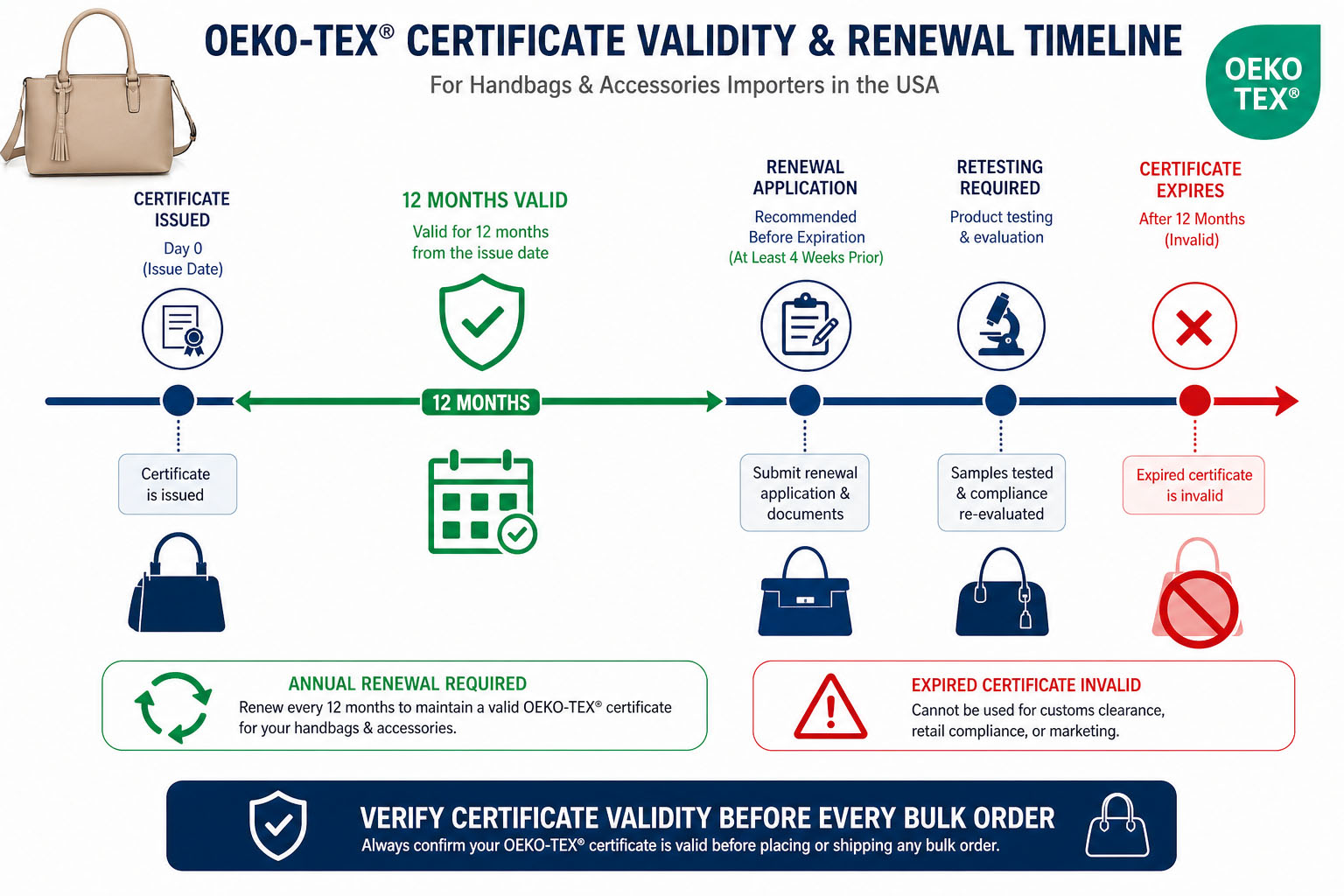
Every OEKO‑TEX Standard 100 certificate stays valid for **12 calendar months**. It is not a permanent one‑time certification. Suppliers must complete renewal procedures every single year to keep documentation active. Annual renewal includes re‑testing procedures. Without timely renewal, the certificate expires and cannot be used for product marketing or vendor qualification.
As a US buyer, you should build certificate‑validation steps into your sourcing workflow. Before placing each large‑batch order, request the latest valid certificate copy and double‑check its expiration date. Accepting expired OEKO‑TEX documents creates risk: you cannot legally reference expired certification on your independent‑site product descriptions, and you lose third‑party proof of chemical safety for customer disputes.
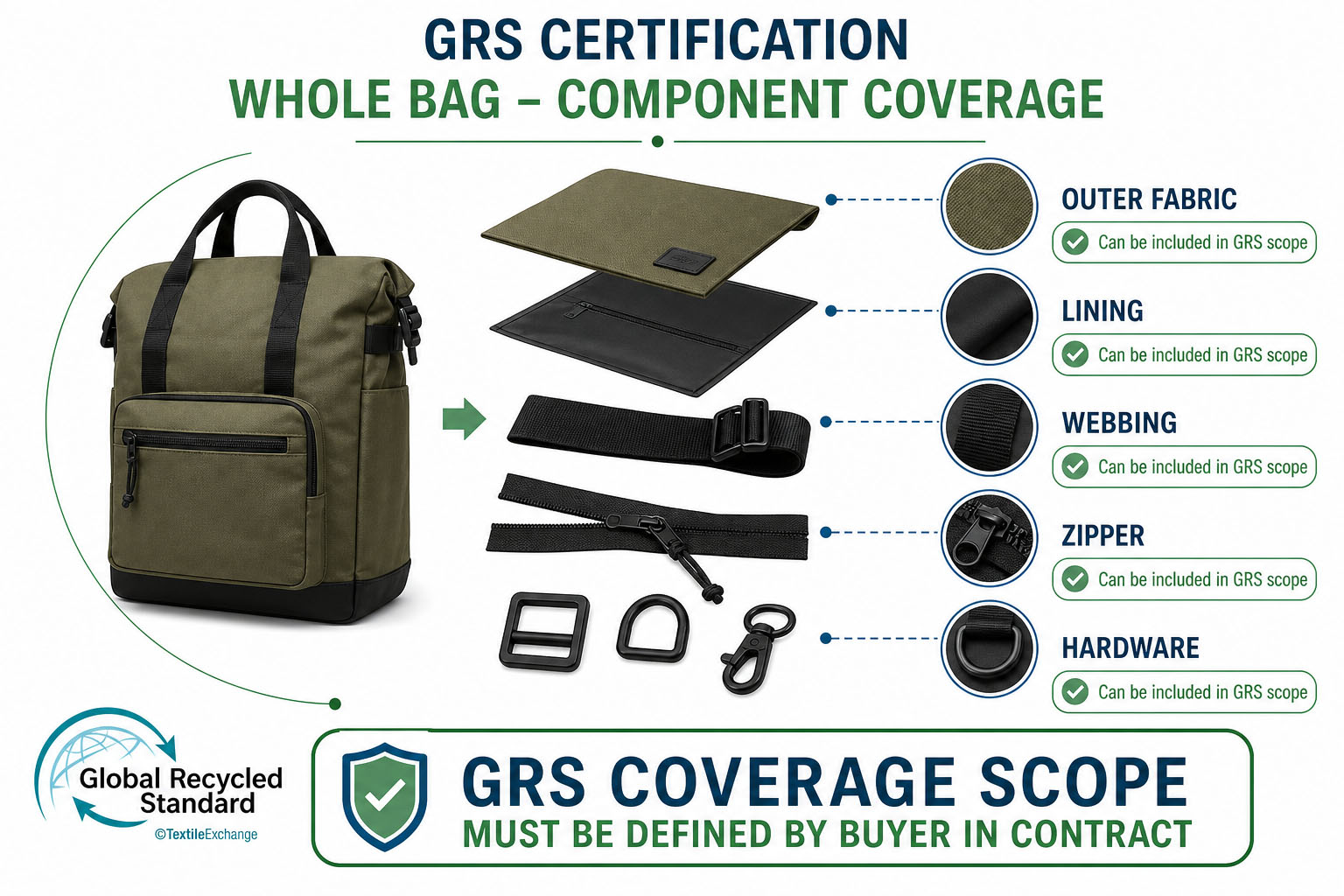
GRS Certification for Finished Bags: Component Coverage & Sourcing Realities
Besides OEKO‑TEX Standard 100, GRS (Global Recycled Standard) is another high‑demand certification for US e‑commerce bag sellers, especially for sustainable‑themed product lines. GRS verifies recycled‑content percentages, social production conditions, chemical restrictions and traceability through the whole supply chain.
One frequently asked question: **Does GRS certification cover complete finished bags including zippers, linings and decorative trims, or only main outer fabric?**
There is no universal yes‑or‑no answer. GRS coverage scope depends entirely on your specific bag style and formal requirements set by you, the buyer. You can push suppliers to certify the full finished bag covering outer fabric, inner lining, webbing trims, and recycled‑content hardware. Alternatively, some projects certify only the main outer textile layer. You must define component scope clearly at quotation stage. If you only require main‑fabric GRS qualification, linings and hardware can remain non‑GRS materials. If you plan to advertise “100% GRS finished bag” on your independent‑site storefront, all relevant recycled‑components must fall within audit scope.
When US buyers request GRS certification, what price premium and MOQ increases should you anticipate? The primary constraint comes from minimum‑order requirements of GRS‑qualified raw materials. Custom‑colored GRS textiles commonly carry material MOQs around 100 yards per single color. This fabric‑level MOQ will determine your final finished‑bag MOQ. If your design uses multiple custom‑dyed GRS fabrics, total material volume requirements will rise accordingly.
GRS also adds extra costs: third‑party audit fees, supply‑chain traceability administration, premium pricing for GRS recycled raw materials. Similar to OEKO‑TEX, audit‑related costs can be factory‑borne, buyer‑borne, or shared through business negotiation. Small‑batch sellers need to balance marketing value of GRS labels against extra sourcing expenditure.
Practical Negotiation Checklist for US Independent‑Site Bag Importers
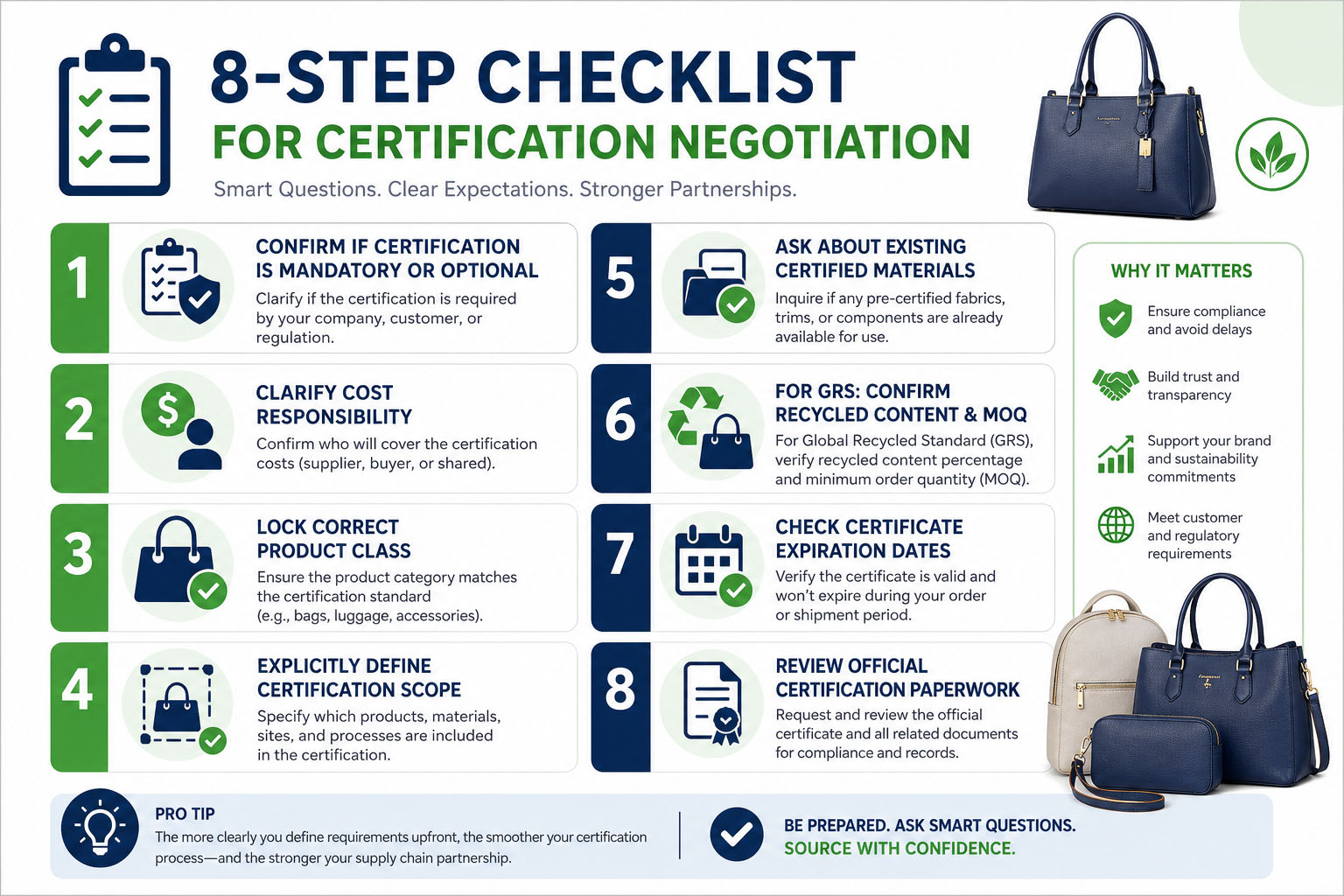
When you communicate with Chinese bag manufacturers about OEKO‑TEX Standard 100 and GRS certifications, use this structured checklist to avoid ambiguous verbal agreements:
1. Confirm whether OEKO‑TEX / GRS is a mandatory factory requirement or an optional add‑on service for your project.
2. Clarify financial responsibility: Who pays for initial lab testing, sample fees, and annual certificate renewal?
3. Lock in correct product class for OEKO‑TEX: Class II for most adult bags; Class I only for infant‑targeted merchandise.
4. Explicitly define certification scope: List every component (outer fabric, lining, padding, zippers, buckles, trims, prints) to confirm which items are included in certification. Require suppliers to provide official certificate documents showing full scope.
5. Ask whether they can reuse existing certified materials from their inventory to cut your testing and MOQ pressure.
6. For GRS projects: Confirm recycled‑content percentage, material MOQ per color (typical 100 yards per color for custom GRS fabric), and whether hardware or lining falls under GRS audit.
7. Check certificate expiration dates, and confirm renewal schedules for long‑term repeat orders.
8. Reserve document‑review time before mass‑production starts. Never rely on sales‑team verbal promises; always inspect official third‑party certification paperwork.
Final Thoughts for US Website‑Based Bag Sellers
Certifications like OEKO‑TEX Standard 100 and GRS are not just boxes to tick for overseas factories. For your independent e‑commerce store, they serve dual purposes: risk mitigation for import compliance, and persuasive marketing assets to build shopper confidence.
You are not legally forced to purchase OEKO‑TEX or GRS certified bags to sell on your US website. However, partial‑scope certification is a widespread hidden risk among Chinese bag suppliers. Many factories hold fabric‑only certificates, while hardware, lining and trims sit outside testing coverage. Without careful verification, you may mistakenly market incomplete certification to your customers.
Before committing to certification upgrades, evaluate your own business situation: your target customer expectations, product positioning, acceptable unit‑cost increase, and feasible order volume. If you sell high‑quality lifestyle‑oriented backpacks, travel totes and eco‑themed bags, proper full‑scope certification delivers strong return on investment. If you run ultra‑low‑cost generic‑bag lines, weigh whether certification premiums match your profit model.
When you clearly communicate certification scope, cost allocation, and MOQ constraints up‑front with Chinese manufacturers, you will reduce post‑order disputes, avoid non‑compliance surprises, and build a more stable cross‑border bag‑sourcing supply chain for your US‑based independent website.
Post time: Aug-25-2026