
Published for independent US bag e‑commerce store operators | B2B sourcing insights for Chinese bag factory partnerships
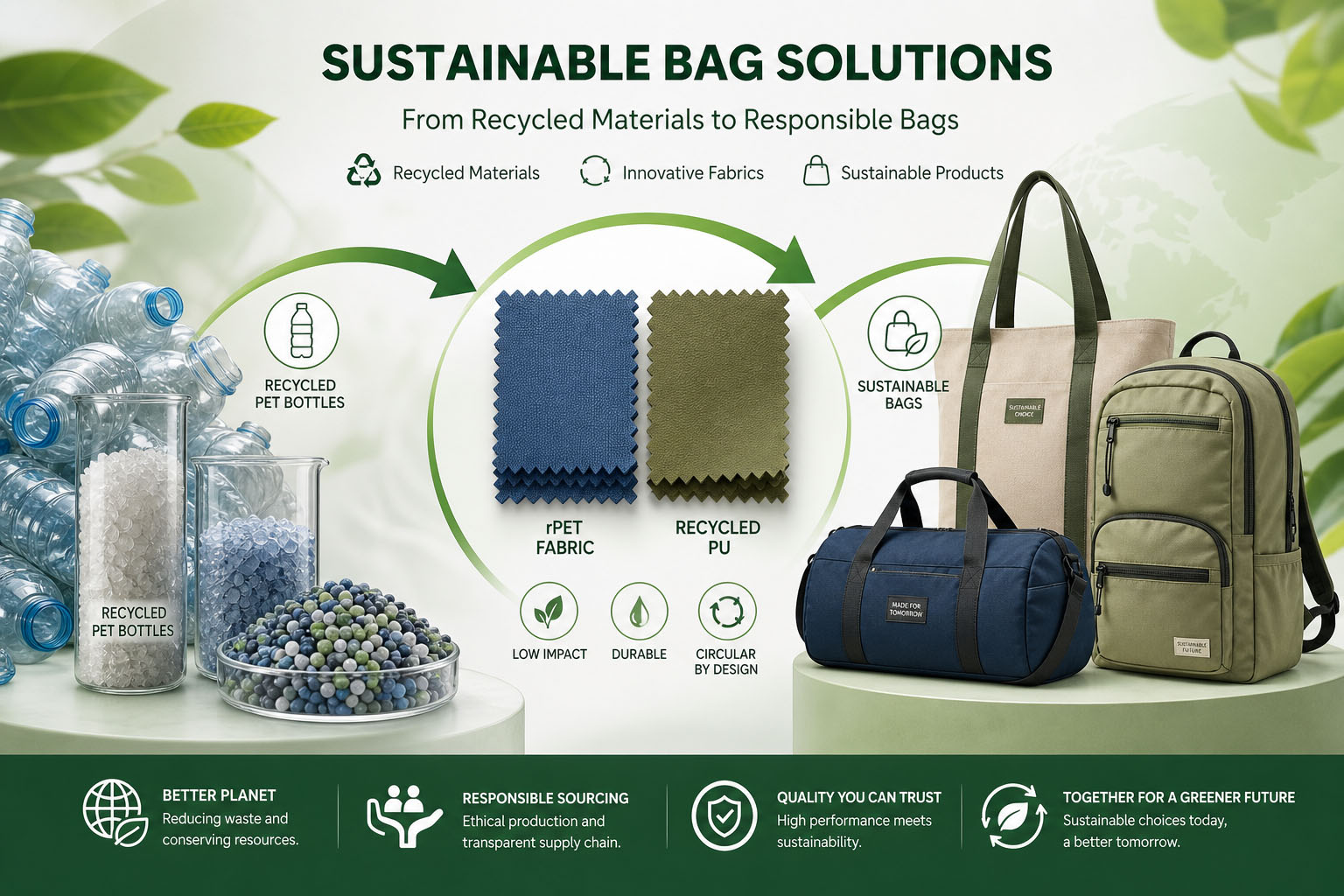
As an independent online bag retailer based in the United States, sourcing eco‑friendly bags directly from Chinese manufacturers is one of the most impactful ways to meet growing consumer and corporate sustainability demands. However, navigating recycled materials, certification standards, price gaps, material durability, and FTC‑compliant marketing language creates real challenges for cross‑border buyers. Many overseas suppliers market “eco‑friendly” bag lines, yet vague material descriptions, incomplete documentation, and inconsistent product performance can lead to costly inventory mistakes, misleading website copy, and regulatory risk. This blog breaks down practical, field‑tested sourcing knowledge for recycled PU, rPET and other recycled fabrics, helping you vet Chinese bag factories, validate sustainability claims, manage cost expectations, and build trustworthy product storytelling for your website.
Overview of Recycled Fabrics in China’s Bag Manufacturing Supply Chain
Chinese bag factories have rapidly expanded their recycled‑material product portfolios to serve international B2B buyers, with options including rPET (recycled polyester), recycled nylon, recycled cotton, recycled PU and other recycled textiles. Many suppliers showcase recycled‑material bag collections on B2B platforms such as Made‑in‑China, targeting overseas retailers, corporate custom‑order clients and e‑commerce merchants. Even with widespread marketing of eco‑friendly products, buyers cannot rely purely on supplier product‑page descriptions. Every sustainability claim needs independent verification before you place bulk orders.
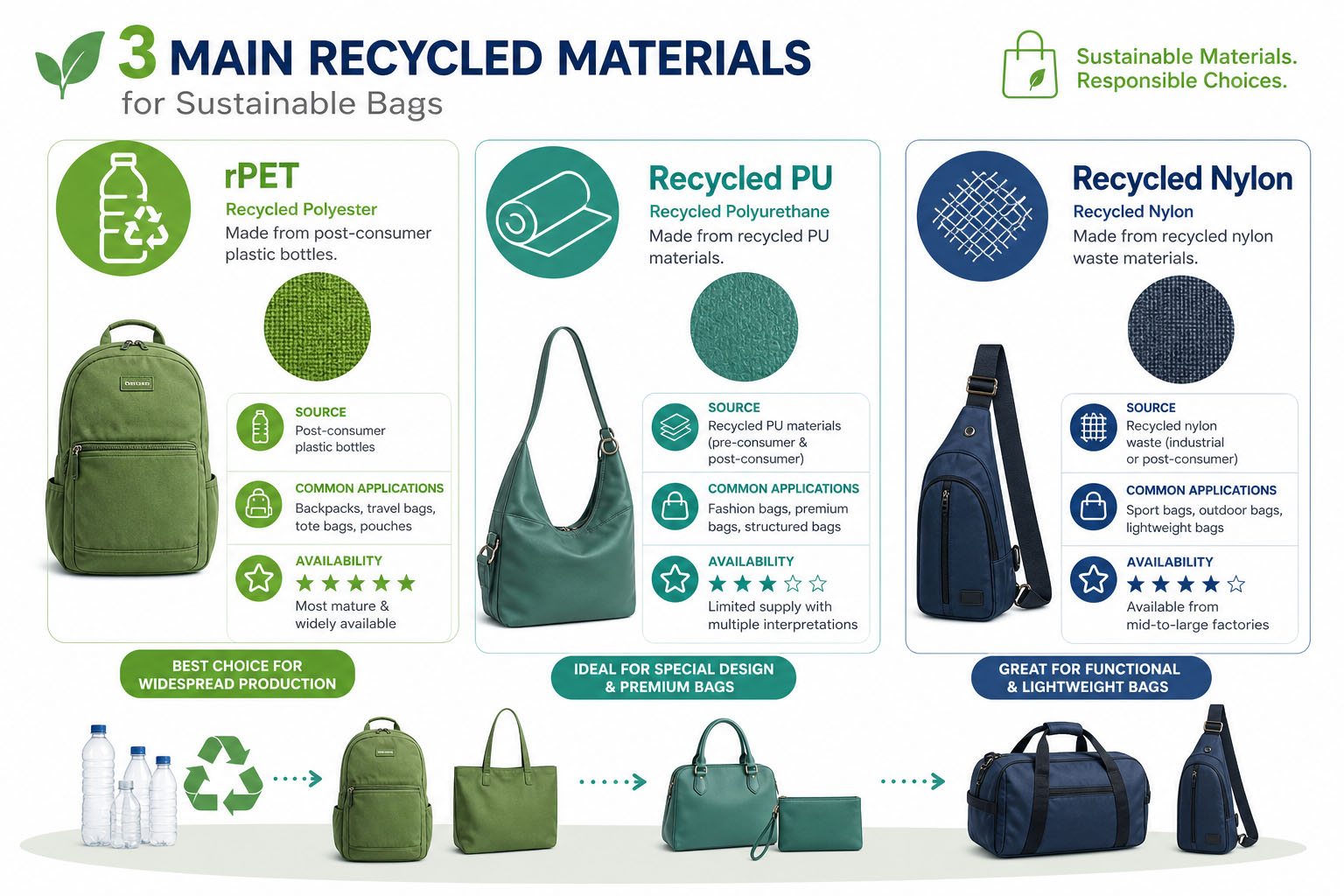
Among all recycled textiles available in China’s bag industry, **rPET (recycled polyester)** is the most mature and widely accessible option. It is produced by melting down post‑consumer PET plastic bottles and re‑processing them into polyester fiber for tote bags, backpacks, laptop sleeves, cross‑body bags and promotional‑style accessories. Recycled nylon and recycled cotton are also offered by medium‑to‑large export‑oriented factories. Recycled PU (rPU) exists within the supply chain but remains comparatively limited in real‑world production volume. Most sustainability‑driven bag production still prioritizes rPET and recycled nylon rather than recycled PU options.
Key material definition notes for buyer reference:
**rPET**: Recycled PET plastic, most frequently manufactured from post‑consumer waste plastic bottles, transformed into polyester fabric for bag bodies.
**Recycled PU**: This term carries multiple interpretations in Chinese factories. It may reference polyurethane made from recycled production scraps, a PU surface film paired with an rPET backing fabric, or partially reformulated recycled polyurethane. Do not assume “recycled PU” means 100% recycled polyurethane material.
“Eco‑friendly PU” is not equivalent to recycled‑content PU. This description may only indicate water‑based surface coatings, bio‑based additives, or an rPET backing layer without any recycled‑PU component.
Small‑scale workshops often label conventional items as eco‑friendly for marketing purposes. Mid‑sized and large export‑focused Chinese bag factories are far more likely to maintain formal material traceability systems for recycled‑material orders.
Core Sustainability Certifications for Recycled‑Material Bags: GRS, RCS, GOTS and Supplementary Standards
When you source recycled‑material bags for your US‑based website, third‑party certifications are your primary tool to validate recycled content, supply‑chain traceability, chemical safety and social compliance. Many US corporate clients require certified recycled materials to fulfill their internal ESG and corporate sustainability goals. You will frequently encounter GRS, RCS, GOTS and OEKO‑TEX in Chinese bag‑factory documentation.
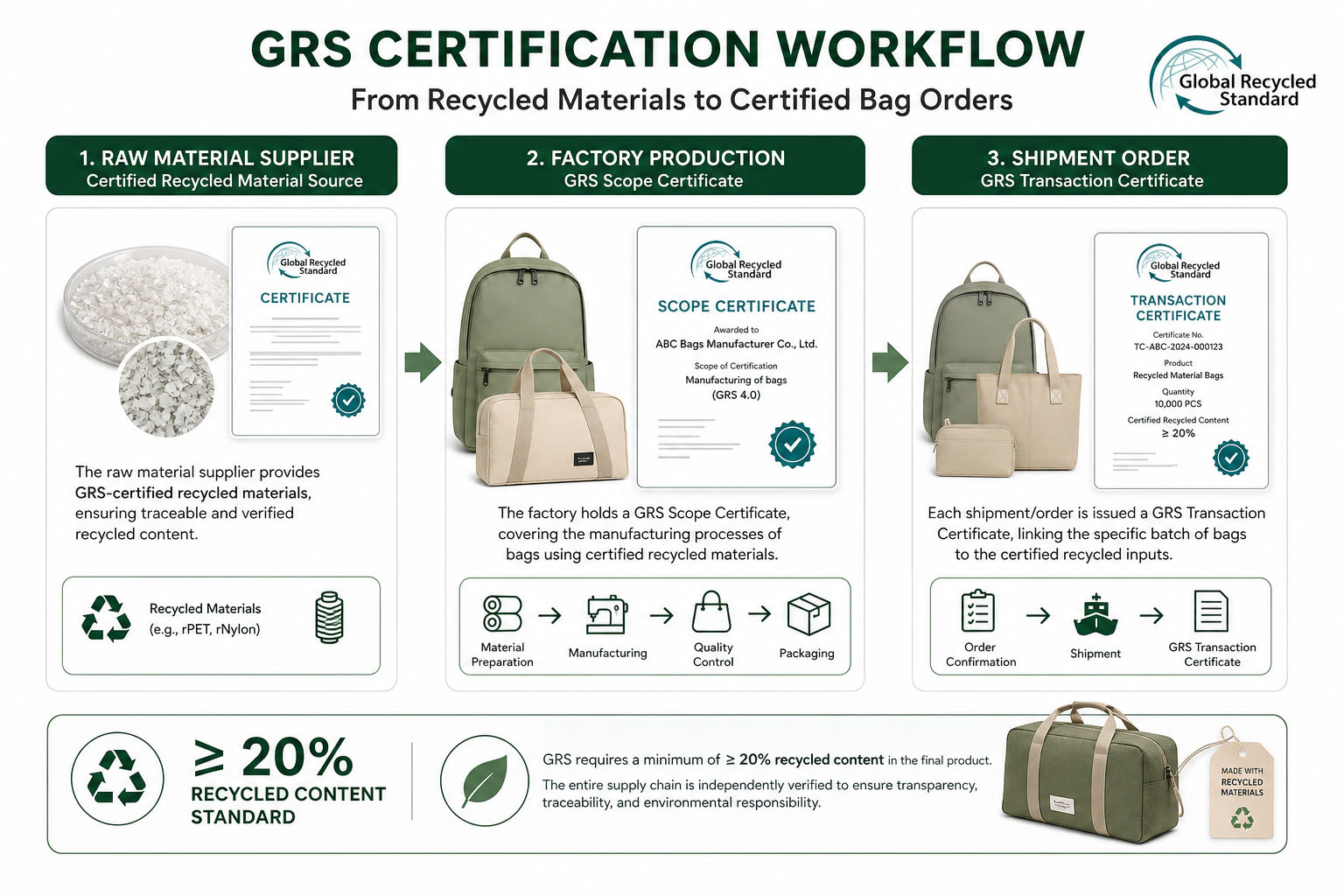
**GRS (Global Recycled Standard)** is the most widely requested certification for recycled‑material bag orders. Valid GRS certification verifies recycled‑material percentage, full supply‑chain chain‑of‑custody traceability, restricted chemical compliance, and basic social‑responsibility requirements for production facilities. The standard requires a minimum of 20% recycled content within certified products. For US‑based e‑commerce sellers, GRS documentation supports credible corporate‑customer reporting and defensible website sustainability claims.
**RCS (Recycled Claim Standard)** sets a lower threshold of minimum 5% recycled content. RCS validates recycled‑material traceability, but it has far fewer requirements for chemical restrictions and factory social‑compliance rules compared to GRS. It works for simple recycled‑content verification, yet it is less accepted for formal corporate ESG reporting.
**GOTS (Global Organic Textile Standard)** targets organic fiber inputs, mainly organic cotton. It is less common for rPET and recycled‑PU bag projects, as GOTS applies to organic raw materials rather than plastic‑based recycled textiles. Many buyers mistakenly ask for GOTS for rPET orders; this certification only applies when organic natural fibers form the core material.
Many export‑focused Chinese bag factories hold dual‑certification sets: GRS paired with OEKO‑TEX. This combination satisfies two critical buyer priorities: verified recycled content and restricted‑substance safety testing for end‑user products.
Certification documents require careful review. Two separate documents must be obtained for a compliant order:
1. **GRS Scope Certificate**: Factory‑level certification showing the factory’s approved production scope covers your target recycled material and bag product category.
2. **Transaction Certificate**: Order‑specific documentation linking your exact production batch to certified recycled raw‑material inputs.
Never accept only a generic factory‑name certificate. Confirm that documents remain within their valid term, are issued by recognized third‑party audit bodies such as Intertek, and cover the exact material used in your bags. A scope certificate alone does not confirm that your specific shipment uses certified recycled inputs. Smaller Chinese factories often cannot provide complete chain‑of‑custody paperwork for post‑consumer recycled (PCR) material content, which creates a major risk point for buyers targeting genuine post‑consumer waste‑based raw materials.
Price Premium & MOQ Realities for Recycled‑Material Bags
Cost is always a top concern for independent US e‑commerce sellers. Recycled‑material bags carry clear price premiums versus equivalent bags made from virgin polyester or virgin leather alternatives.
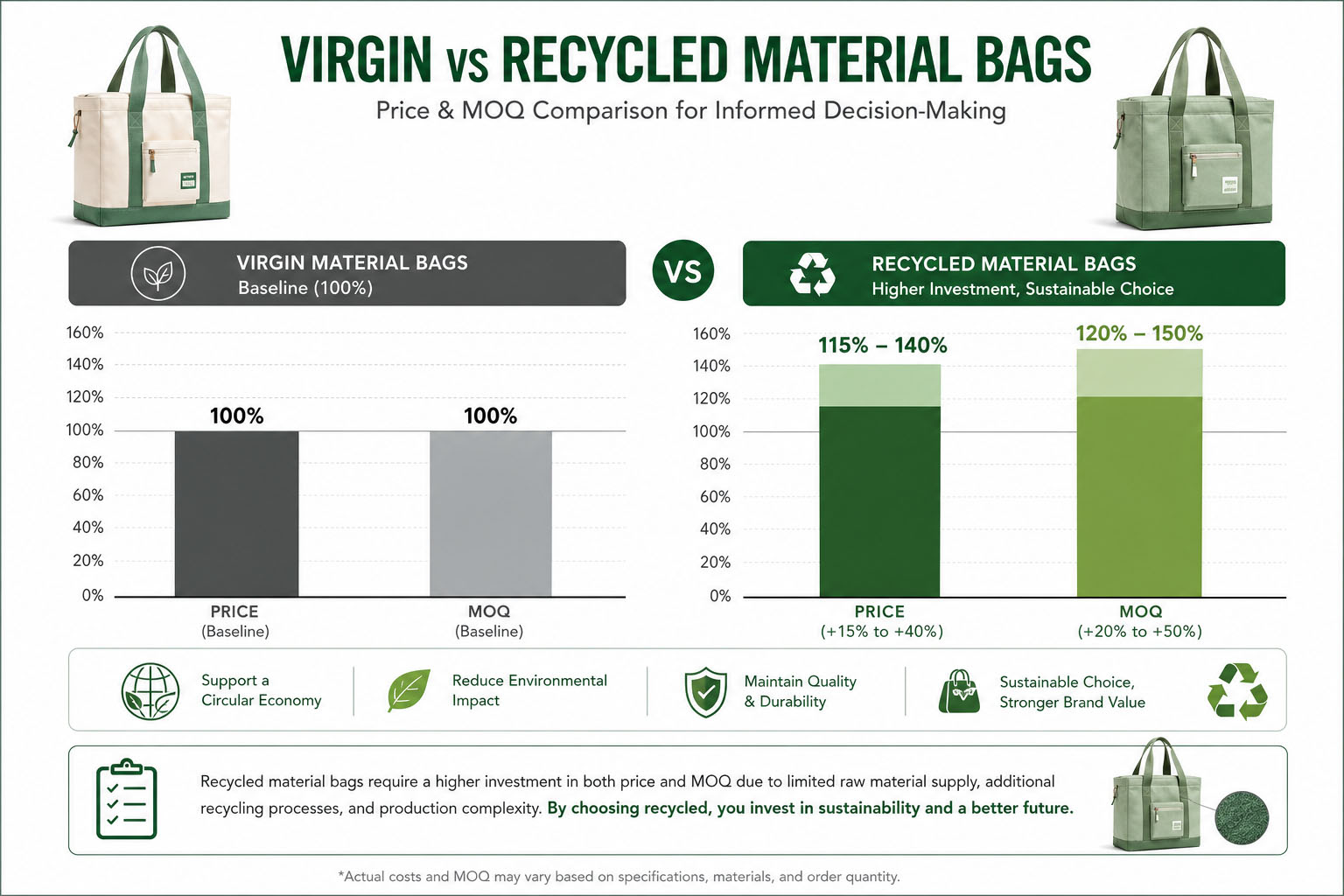
In China’s bag‑manufacturing market, recycled‑fabric goods typically add a **15 %‑40 % price premium compared to virgin‑material counterparts**. This range shifts significantly based on certification requirements, recycled‑content percentage, raw‑material source (pre‑consumer versus post‑consumer waste), and your total order volume. High‑complexity certified GRS orders with post‑consumer recycled inputs trend toward the higher end of this premium bracket. When order quantities rise, unit‑cost premiums will shrink accordingly.
Minimum order quantity (MOQ) represents another frequently overlooked cost barrier. Production lines for certified recycled fabrics usually carry MOQs **20 %‑50 % higher** than comparable virgin‑material bag styles. Factories need to run dedicated production batches for certified recycled inputs, separate from regular virgin‑material production to maintain GRS traceability rules, which drives higher minimum‑order thresholds. For small‑batch independent‑store buyers, this creates practical inventory‑planning challenges. Sample costs for recycled‑material prototypes are also generally higher than standard samples.
Many new buyers only compare outer‑fabric pricing. You must clarify whether recycled‑content requirements apply exclusively to exterior fabric, or extend to lining, webbing, padding, thread, zippers and metal hardware. Many factory offers only deliver recycled‑content for the main outer shell, with all secondary components made of virgin materials. Without clarification, you may overstate sustainability performance on your store website. Mid‑to‑large Chinese export factories are beginning to offer carbon‑footprint and Life Cycle Assessment (LCA) reports as value‑adding competitive differentiators for B2B customers, although this remains a niche offering today.
Third‑Party Lab Testing: Verifying Recycled‑Content Percentage & Physical Performance
Verified recycled‑content percentage cannot rely solely on supplier self‑declarations. As a US‑based seller subject to FTC Green Guides advertising rules, you need objective third‑party lab reports to back up every recycled‑content claim published on your website or product listings.
Reputable Chinese bag manufacturers are able to supply third‑party laboratory test reports covering recycled‑material content percentages. Still, you must specify exactly what documentation you require during supplier communication. Generic material‑safety test reports do not automatically include recycled‑content validation.
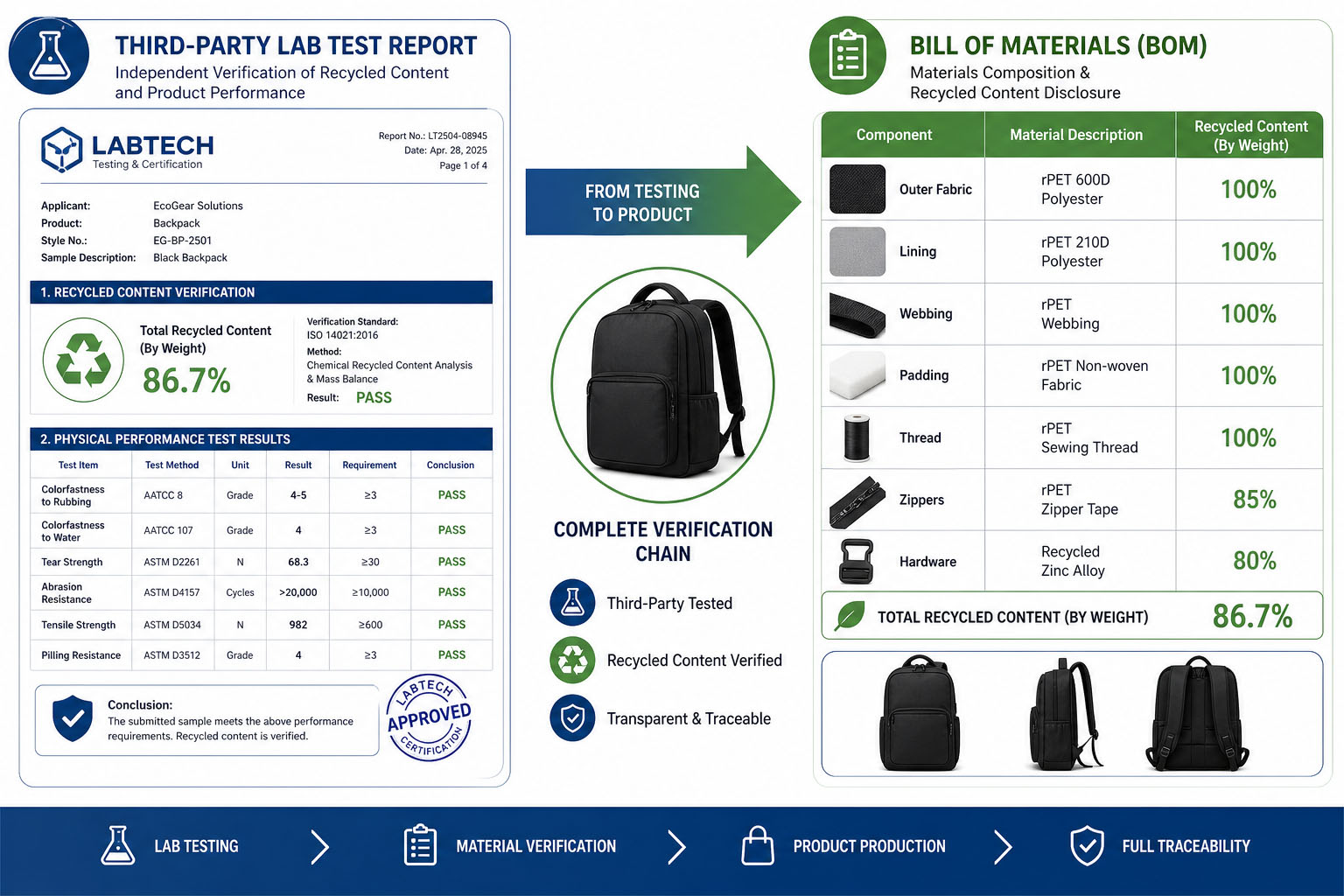
Beyond recycled‑content percentage, you should demand test data covering real‑world product performance: colorfastness, tear‑resistance, abrasion‑resistance, and restricted‑chemical testing. These lab outputs help you understand long‑term bag durability and avoid customer complaints after retail sales.
Request suppliers to deliver a full bill‑of‑materials document. This document itemizes material composition and recycled‑content percentage for every bag component: outer fabric, lining, webbing, padding, sewing thread, zippers and metal hardware. A complete bill‑of‑materials allows you to make precise, accurate sustainability statements on your e‑commerce site and perform fair side‑by‑side comparisons across multiple Chinese factories.
Sourcing checklist for lab‑report requirements:
1. Third‑party lab report confirming recycled‑content percentage of primary fabrics
2. Abrasion, tear‑strength and color‑fastness test reports
3. Restricted‑chemical test results
4. Bill‑of‑materials breaking down each component’s material and recycled‑content share
Durability Performance: Wear, Peeling, and Fading of Recycled PU and rPET Bags
A critical practical question for e‑commerce retailers: under normal consumer‑use conditions, do recycled‑PU and rPET bags develop visible wear, peeling or color‑fading faster than virgin‑material alternatives?
For rPET fabric: When produced with quality raw‑material inputs and stable dyeing processes, rPET delivers performance broadly comparable to virgin polyester. Major performance gaps usually stem from low‑grade raw‑material batches or poor factory dyeing and finishing processes rather than the recycled nature of the fiber itself.
For recycled PU (rPU): The technical performance gap is more noticeable. Recycled PU demonstrates inferior hydrolysis resistance and surface durability versus virgin PU. Recycled‑PU material is more prone to surface peeling and accelerated wear under heavy‑use scenarios. This material limitation restricts recycled‑PU’s suitability for high‑wear bag categories such as heavy‑use daily backpacks and work‑oriented utility bags. Recycled‑PU performs better for light‑use fashion‑style bags, where heavy‑abrasion stress is limited.
Before committing to large‑volume bulk orders, always order physical samples and conduct real‑world usage testing. Check surface peeling tendency, color transfer, fading after simulated wear, and seam‑abrasion performance. Do not base purchasing decisions only on supplier‑provided specification sheets.
Practical Supplier Questionnaire: Template for Your Chinese Factory Outreach
Use this standardized inquiry template when messaging potential Chinese bag manufacturers. Copy‑paste this text during initial B2B communication to gather consistent, comparable information across different suppliers.
“Do you offer bags made with recycled PU, rPET, recycled polyester, recycled nylon, or other recycled fabrics? Please provide the following information:
1. The exact material composition and recycled‑content percentage.
2. Whether the recycled material is pre‑consumer or post‑consumer.
3. The material supplier’s name and country.
4. A valid GRS or RCS certificate, if available.
5. A Transaction Certificate for the specific material or order.
6. Test reports for colorfastness, tear strength, abrasion, and restricted chemicals.
7. Whether the recycled content applies to the entire bag or only the exterior fabric.
8. The MOQ, sample cost, production time, and price difference compared with standard material.”
Standardized questions prevent incomplete replies and reduce miscommunication caused by translation gaps in cross‑border trade.
FTC‑Compliant Sustainability Marketing for Your US‑Based Website
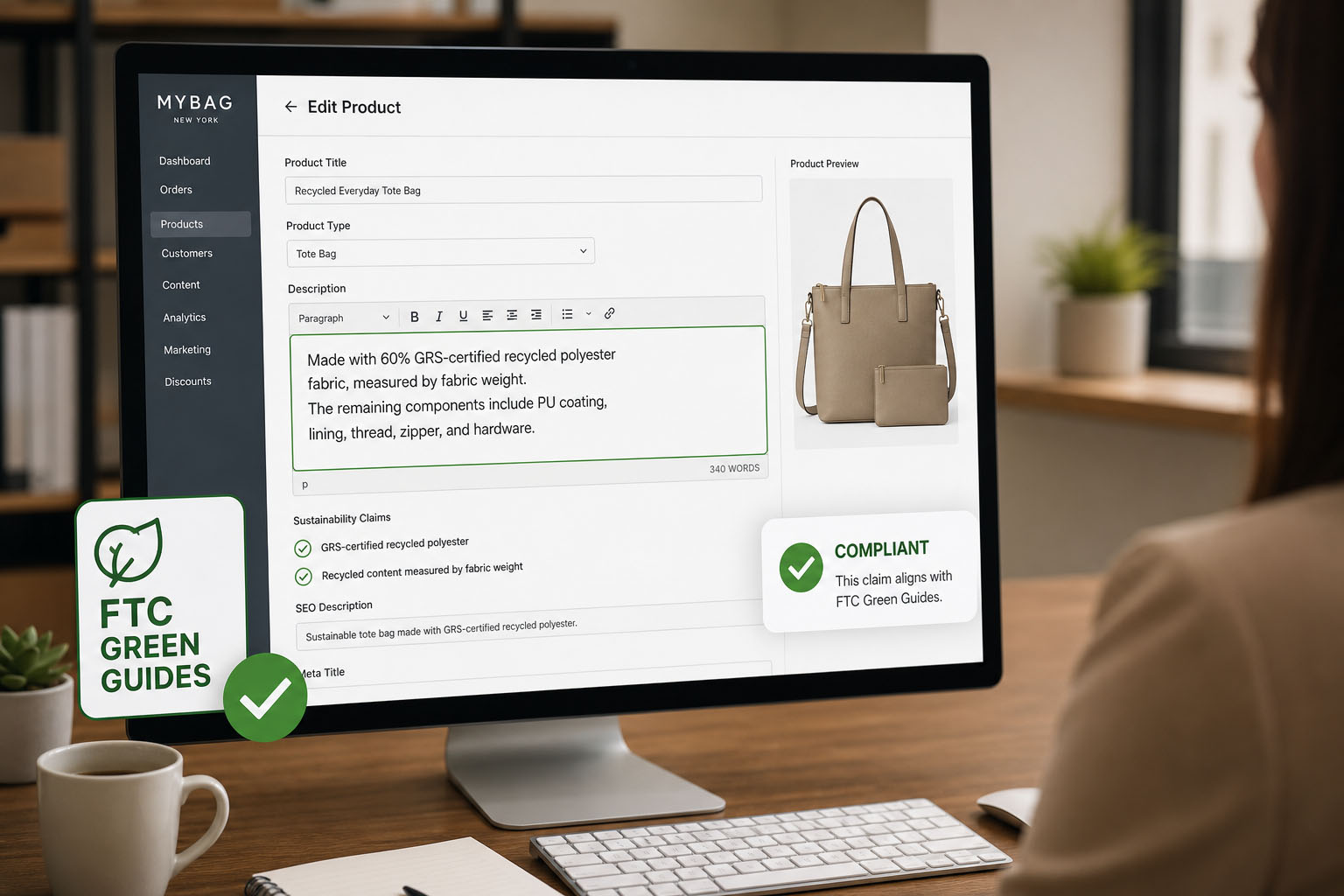
Many US independent store owners overlook regulatory risks around green‑marketing statements. The FTC Green Guides require all recycled‑content product claims to be factual and backed by verifiable supporting documentation. Broad, unsubstantiated phrases such as “100% recycled”, “fully sustainable”, or “eco‑friendly” carry significant risk if you lack complete supporting certification and lab‑report evidence. Misleading green claims may trigger regulatory scrutiny and customer‑complaint disputes.
Instead of vague marketing language, use precise, evidence‑based product descriptions.
Example of safe, compliant product copy:
“Made with 60% GRS‑certified recycled polyester fabric, measured by fabric weight. The remaining components include PU coating, lining, thread, zipper, and hardware.”
This phrasing clearly defines which parts of the bag use recycled inputs and acknowledges non‑recycled auxiliary components. Pair this description with supporting bill‑of‑materials documentation stored for your internal reference.
Final Key Takeaways for US Bag Retailers Sourcing from China
1. rPET is the most readily available recycled fabric in China’s bag industry, widely used for backpacks, tote bags and laptop sleeves. Recycled‑PU supply remains limited, with performance drawbacks for high‑wear‑use cases.
2. GRS certification is the gold standard for verified recycled‑content for corporate‑customer requirements. Always collect both scope certificates and order‑specific transaction certificates.
3. Expect 15 %‑40 % unit‑price premiums for recycled‑material bags, alongside higher MOQs of 20 %‑50 % above virgin‑material equivalents.
4. Post‑consumer recycled content requires complete chain‑of‑custody documentation, which many small Chinese factories cannot provide.
5. Request third‑party lab reports and full bill‑of‑materials to verify recycled‑content percentage and check every component of your bags, not only outer shell fabric.
6. Recycled‑PU lags behind virgin‑PU in durability and hydrolysis resistance; test samples thoroughly before bulk ordering for high‑wear‑product lines.
7. Avoid broad, unsubstantiated eco‑marketing language on your US website. Follow FTC Green Guides and write specific, documented product descriptions.
Sourcing recycled‑material bags from China offers huge market opportunities for US‑based independent bag sellers. Success depends not on chasing vague “eco‑friendly” labels, but on systematic supplier vetting, document verification, sample performance testing, and responsible, transparent product storytelling for your store visitors.
Post time: Aug-18-2026