
Sewing Construction for Custom OEM Bags: Lockstitch, SPI, Seam Allowance & Production Quality Control
Blog Post for US Bag E-commerce Site | American English | Word count: ~2750
Introduction
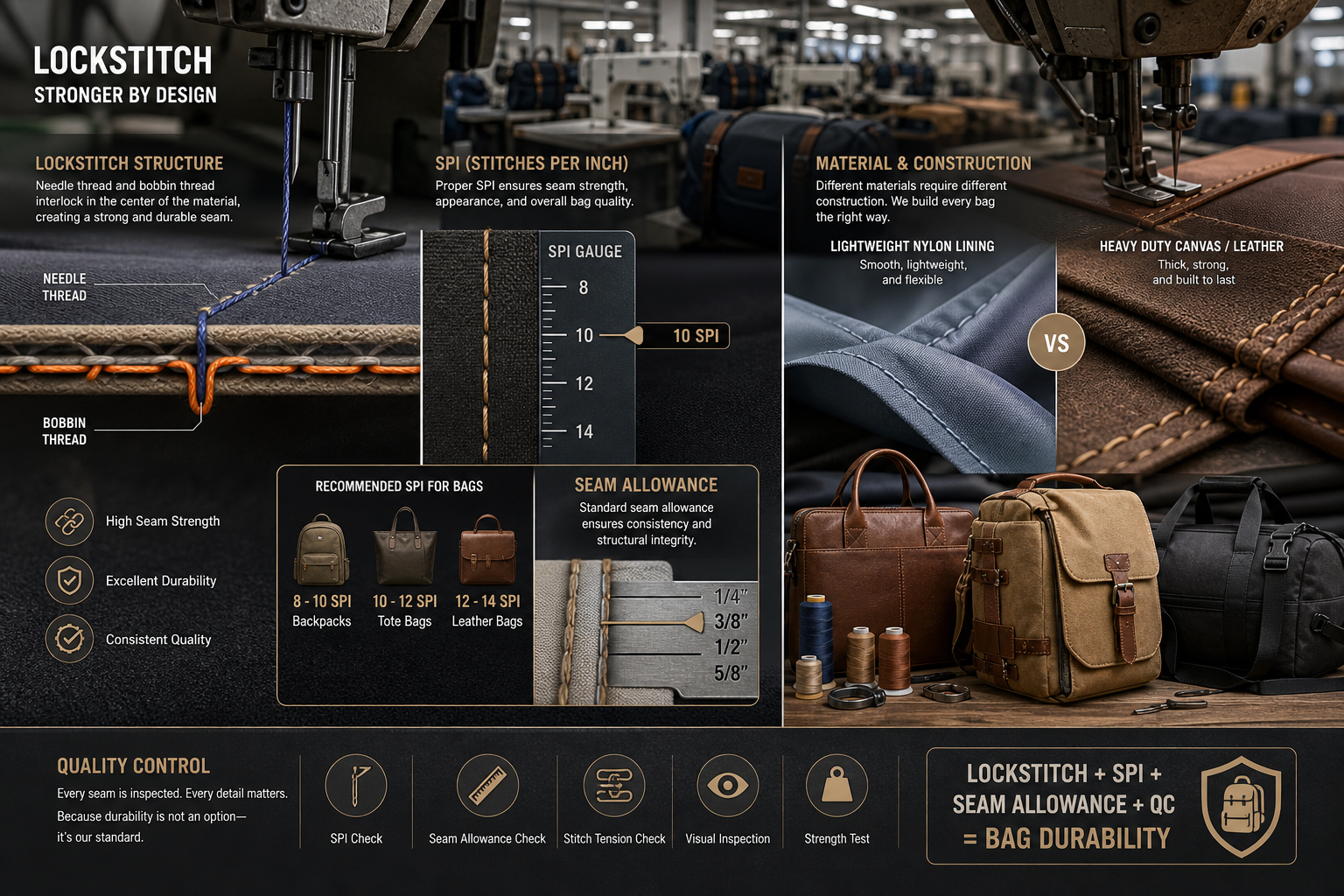
When you source custom bags from Chinese OEM factories, the sewing construction is one of the most overlooked yet critical factors that determine your product quality, durability, customer satisfaction and return rates. Many US bag importers focus only on materials, hardware and design drawings, while ignoring core sewing parameters: lockstitch machine capability, SPI (stitches per inch), seam allowance, seam strength and bulk production inspection standards. A well-designed bag can fail quickly if the factory uses improper stitch settings, mismatched sewing equipment or inconsistent seam allowance during mass production.
For mixed-material bags — designs pairing lightweight nylon lining with heavy canvas or leather outer shells — the sewing challenge becomes even greater. Thin, flexible lining fabrics behave completely differently from dense, rigid canvas and leather. The same machine setup that delivers clean, wrinkle-free stitching on nylon lining may create skipped stitches, broken needles and material tearing when sewing multi-layer leather panels.
This guide breaks down key sewing construction questions that every US bag buyer should discuss with Chinese OEM manufacturers. We will cover industrial lockstitch machine compatibility, standard SPI ranges for different bag materials, seam allowance variations across bag components, how SPI and seam geometry impact long-term bag durability, and factory inspection methods to guarantee consistent quality in bulk orders.
1.Can Industrial Lockstitch Construction Work for Both Lightweight Nylon Linings and Heavy-Duty Canvas or Leather Outer Panels?
Industrial lockstitch sewing machines are the backbone of OEM bag manufacturing, but not every lockstitch model can seamlessly handle ultra-light lining fabrics and thick leather panels within the same production run. The lockstitch structure itself is ideal for bag production: unlike chainstitch, lockstitch creates interlocked top and bottom threads that will not unravel when the seam is stressed, which is the primary reason bag factories prefer lockstitch for multi-layer load-bearing seams.
The adaptability of lockstitch equipment comes from adjustable needle systems, thread selection, presser foot pressure and feed mechanisms. With proper calibration, one lockstitch machine can be reconfigured to sew materials ranging from 1oz ripstop nylon lining up to 16oz heavy canvas. When sewing leather panels, factories must swap to leather-point needles and increase presser foot pressure compared to fabric assembly work. For thin nylon lining, manufacturers typically use finer thread ranging from Tex 40 to Tex 60. Fine thread reduces bulk on the interior and maintains a smooth, clean lining finish inside the bag.
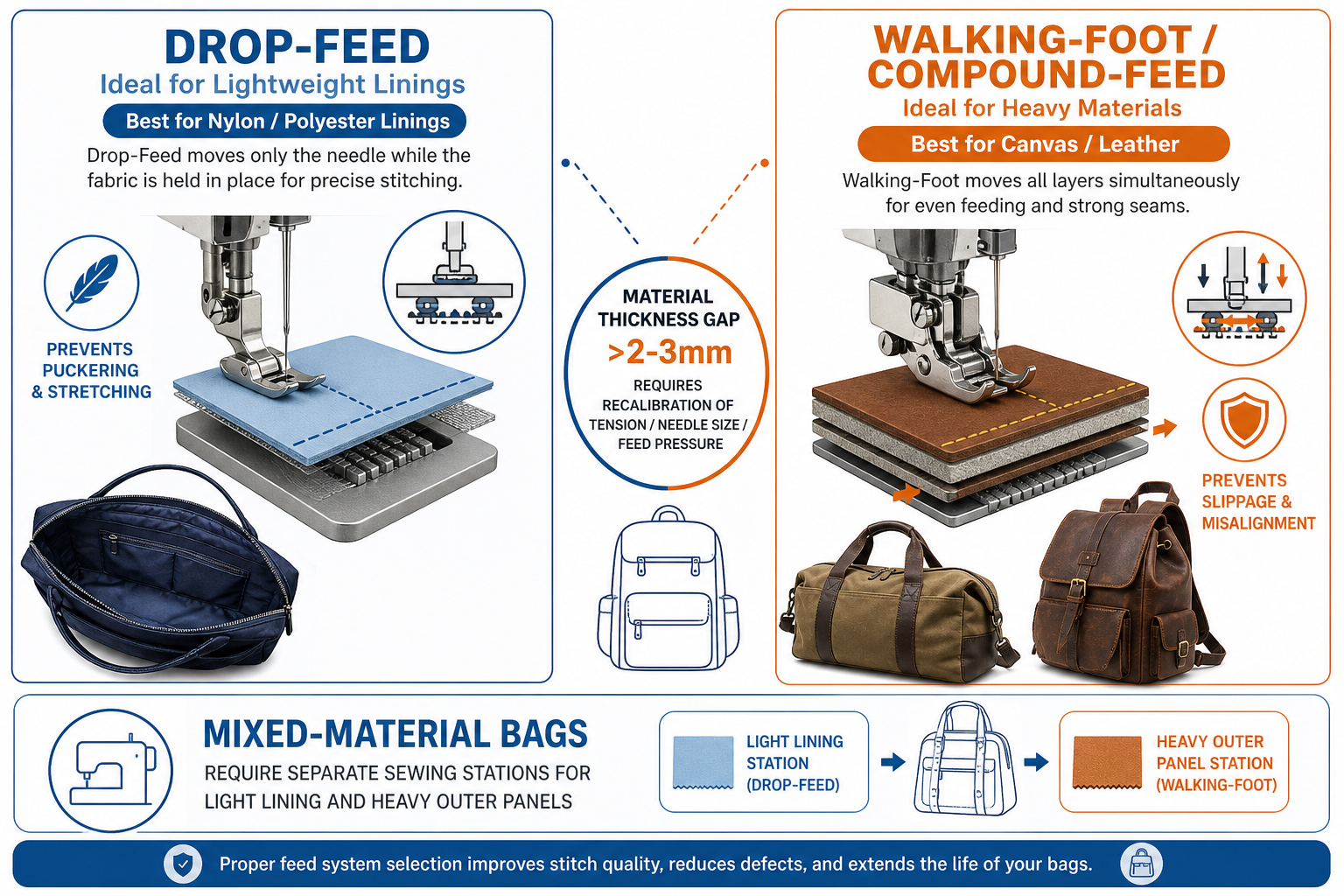
The biggest distinction lies in the machine feed system. Standard drop-feed lockstitch machines work best for lightweight nylon and polyester lining materials. Drop-feed setups apply gentle fabric feeding to prevent puckering, stretching and material distortion on thin, easily damaged linings. In contrast, heavy canvas and leather require walking-foot or compound-feed lockstitch machines. Walking-foot machines move all fabric layers together synchronously, eliminating layer slippage. Without a walking foot, stacked canvas, leather and interfacing layers will shift during sewing, resulting in uneven seams, misaligned panels and skipped stitches.
Most large-scale Chinese bag OEMs operate mixed-material production lines. Factories separate dedicated machines for light lining sewing stations and heavy outer panel sewing stations. Splitting machines increases line setup time, but it delivers far more stable stitch quality for hybrid bags with nylon lining and canvas/leather shells. Material thickness gaps between lining and outer shell create the most common production headache. When the thickness difference between lining and outer panels exceeds 2mm to 3mm, the factory must fully recalibrate machine tension, needle size and feed pressure. If recalibration is skipped, stitches will loosen or tighten unevenly at transition points between thin lining and thick outer fabric.
Important note for US bag buyers: a general-purpose lockstitch can handle light nylon and medium-weight canvas. However, if your bags include stacked leather patches, woven webbing reinforcement, zipper assemblies and multiple folded seams, you must require your supplier to use walking-foot or compound-feed lockstitch machines. Do not accept simple verbal confirmation that “this machine works for all materials.” Send physical samples of your thinnest nylon lining, thickest canvas, thickest leather, specify the number of stacked layers, and request a continuous sewing test video. The video should show top and bottom stitch formation, reverse tack stitching, corner turning, and confirm no skipped stitches or fabric damage occurs during sewing.
Key Questions to Send to Your Chinese OEM Supplier
* Can your lockstitch machine sew our lightweight nylon lining and multi-layer heavy canvas / leather outer panels?
* Please provide the recommended machine model, maximum sewing thickness rating, compatible needle sizes and thread specifications.
* Does the machine have walking foot or compound feed? What type of presser foot is included for leather work?
* Please share a sewing test video using our actual material samples, showing top and bottom stitches, corner sewing and reverse stitching.
2.Typical SPI Range Used by Chinese OEM Factories: Lightweight Polyester Bags vs Heavy-Duty Canvas & Leather Bags
SPI, or stitches per inch, is the measurement of how many individual stitches fit within one linear inch of seam. SPI directly controls stitch density, and Chinese bag manufacturers follow well-established SPI baselines segmented by bag material and end-use application.
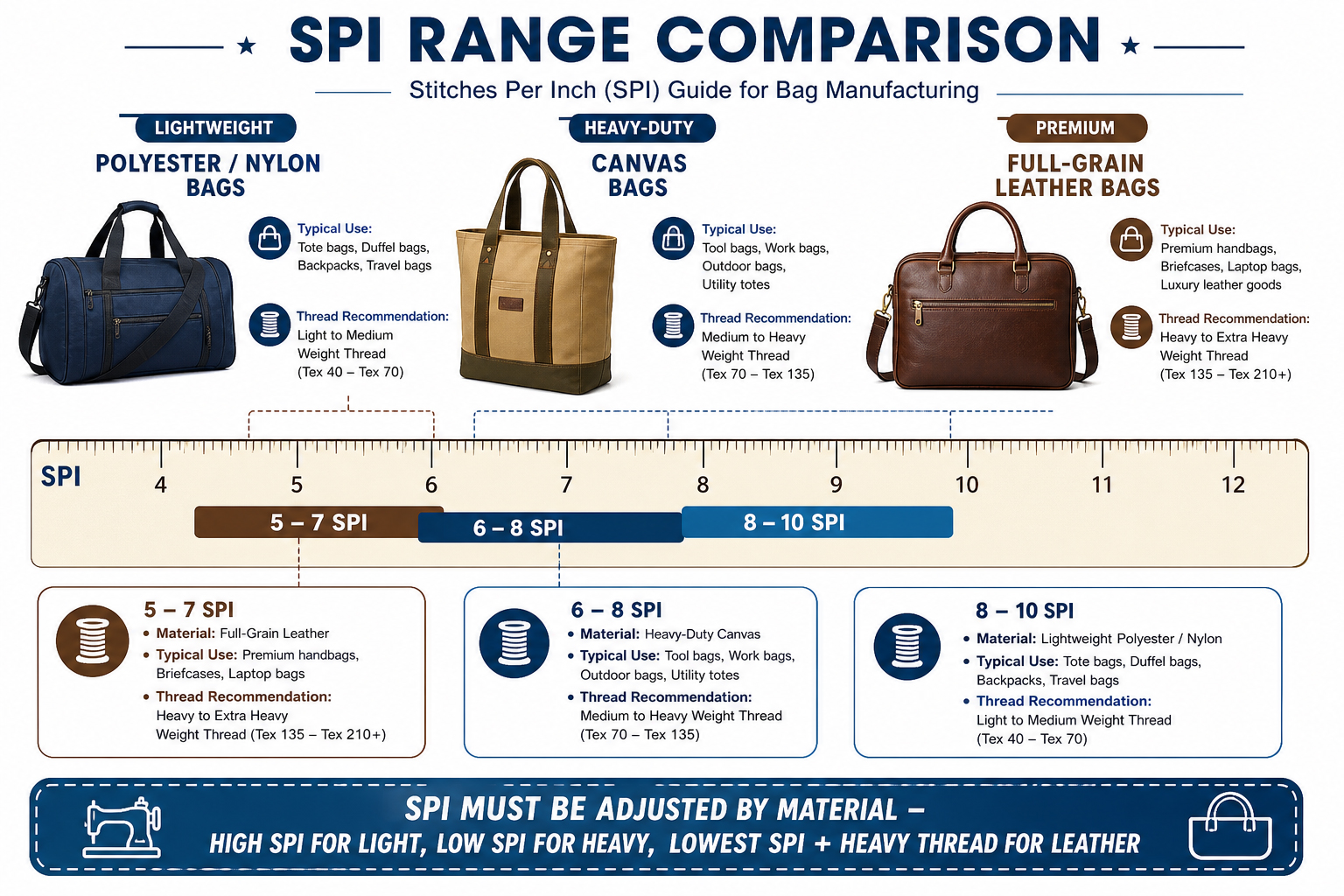
For lightweight polyester and thin nylon daypacks, cosmetic bags, small tote bags and promotional pouches, OEM factories commonly use a higher SPI setting. Higher stitch density creates neat, tight seams on thin fabric without leaving large needle holes that can tear the delicate substrate. Lightweight polyester bags usually run 8–10 SPI. At this stitch density, seams look clean, fabric distortion stays minimal, and needle penetration does not weaken thin polyester panels. If SPI drops too low on lightweight fabric, large gaps between stitches create stress concentration points, and small tears can propagate along the seam line.
For heavy-duty canvas bags, utility totes, work bags and backpacks built from 12oz to 16oz canvas, factories reduce SPI to 6–8 SPI. Thicker canvas has stronger tear resistance, so fewer stitches per inch are sufficient. Longer stitch length also avoids excessive needle perforation. Too many stitches on heavy canvas creates a dense line of needle holes, turning the seam line into a weak zone prone to tearing under heavy load.
Full-grain leather bags, leather trim panels and leather reinforced attachment points use the lowest SPI range, typically 5–7 SPI. Leather cannot recover from needle holes like woven fabric. Dense high-SPI stitching creates a perforated line along the leather seam. When the bag is loaded, stress concentrates on those tiny holes, causing leather to crack or tear along the stitch line. Longer stitch spacing preserves leather integrity. OEM factories also increase thread size for leather seams, pairing lower SPI with heavy bonded nylon or polyester thread.
It is critical to understand that SPI is not fixed for one material. Factories adjust SPI based on seam function. Non-load-bearing decorative seams can use higher SPI for visual polish. Load-bearing seams such as shoulder strap attachments, handle bases and bottom panel seams use lower SPI with heavier thread regardless of base material.
As an American bag importer, you should define SPI requirements clearly in your tech pack. Do not leave SPI as “factory standard.” Confirm that your factory understands SPI tolerances during bulk production. Minor SPI variation within ±0.5 SPI is acceptable, but wider variation creates inconsistent seam strength across finished bags.
3.Industry-Standard Seam Allowance: Differences Between Main Panel Seams, Pocket Seams, and Lining Seams in OEM Bag Production
Seam allowance refers to the fabric margin left between the stitch line and the raw cut edge of material. Many new bag buyers only focus on exterior appearance and overlook seam allowance specifications, yet seam allowance varies intentionally for main outer panels, pocket seams and lining seams in Chinese OEM bag production.
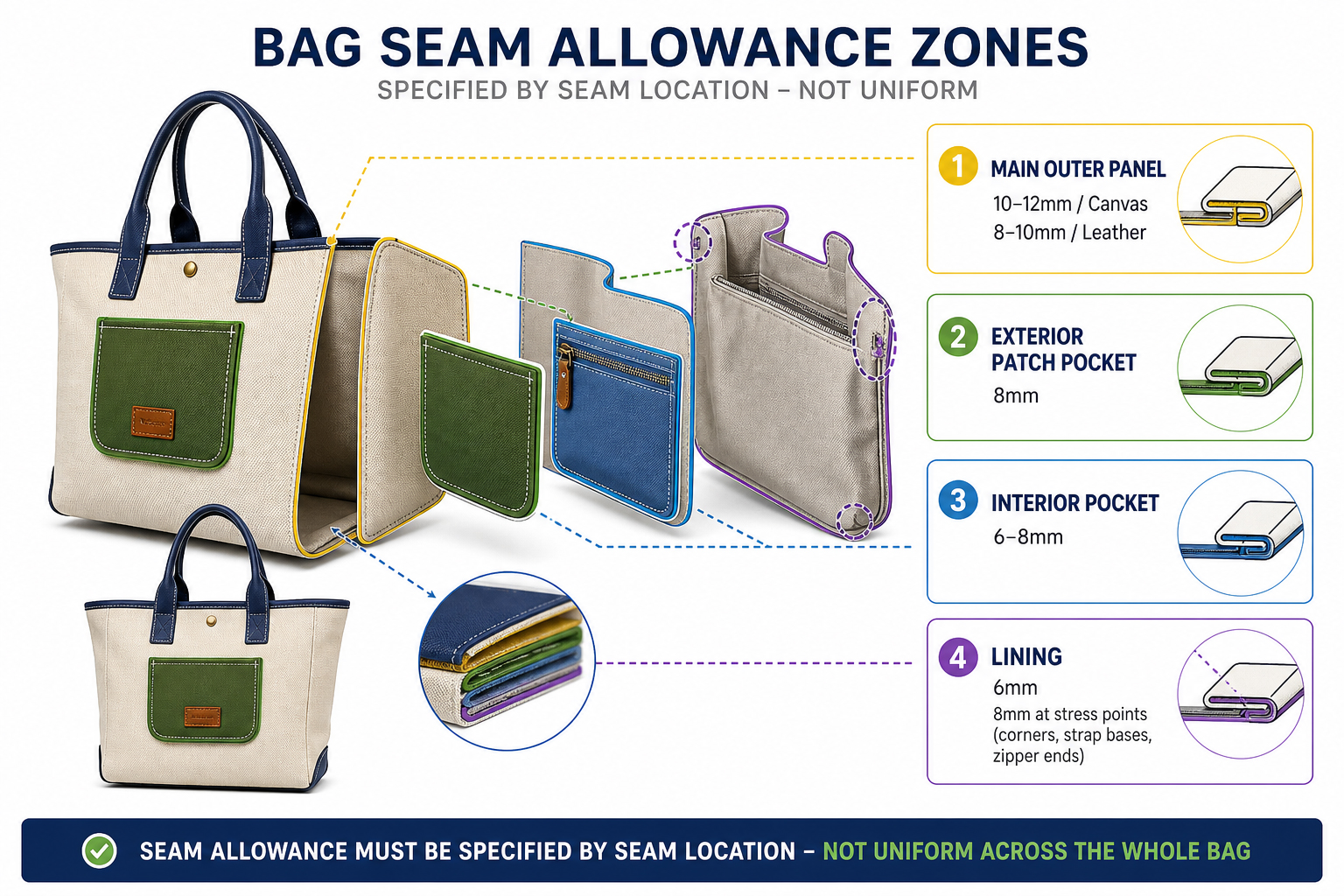
Main outer panel seams for canvas and leather bags carry the primary structural load of the bag. These seams connect front, back, side and bottom panels. Standard seam allowance for heavy outer main panels is 10mm to 12mm. The wider allowance provides extra material for seam folding, topstitching, stress distribution and minor trimming adjustments during assembly. If the bag will be lined and seams are turned inside, the extra allowance prevents seam splitting when the bag is stuffed full. For leather panels, seam allowance often stays at 8mm to 10mm, because leather edges do not fray like woven textiles, but allowance must still be sufficient to avoid tearing at stitch holes.
Pocket seams are split into exterior patch pockets and interior slip pockets. Exterior patch pockets on canvas bags usually use 8mm seam allowance. Patch pockets are attached to the main bag face; the allowance must be enough to secure the pocket perimeter, but excess bulk is undesirable. Small interior slip pockets, card pockets and document pockets inside the bag use smaller seam allowance, commonly 6mm to 8mm. Pocket seams are generally non-load-bearing, so factories reduce allowance to cut down fabric bulk and keep pocket edges flat.
Lining seams for lightweight nylon or polyester lining have the smallest standard seam allowance, normally 6mm. Lining fabric is thin, and lining seams are hidden inside the finished bag. Large seam allowance on lining adds unnecessary interior bulk, bunching and wrinkling. However, lining seam allowance must be increased to 8mm at high-stress areas such as lining openings, zipper plackets and bag mouth seams where lining attaches to the outer shell.
A common factory defect happens when the production team applies the same seam allowance across all bag components. Using wide 10mm allowance on lining creates bulky interior corners. Using narrow 6mm allowance on heavy canvas main panels creates seams that blow out when the bag is loaded. Your tech pack must separate seam allowance rules for each seam location, and your QC checklist needs to verify seam allowance at multiple positions on sample bags and bulk production inspection units.
4.How SPI and Seam Allowance Directly Impact Seam Strength, Tear Resistance, and Overall Bag Lifespan Under Daily Use
SPI and seam allowance work together to define seam performance. Changing either parameter will alter seam strength, tear resistance and long-term bag durability for your end customers.
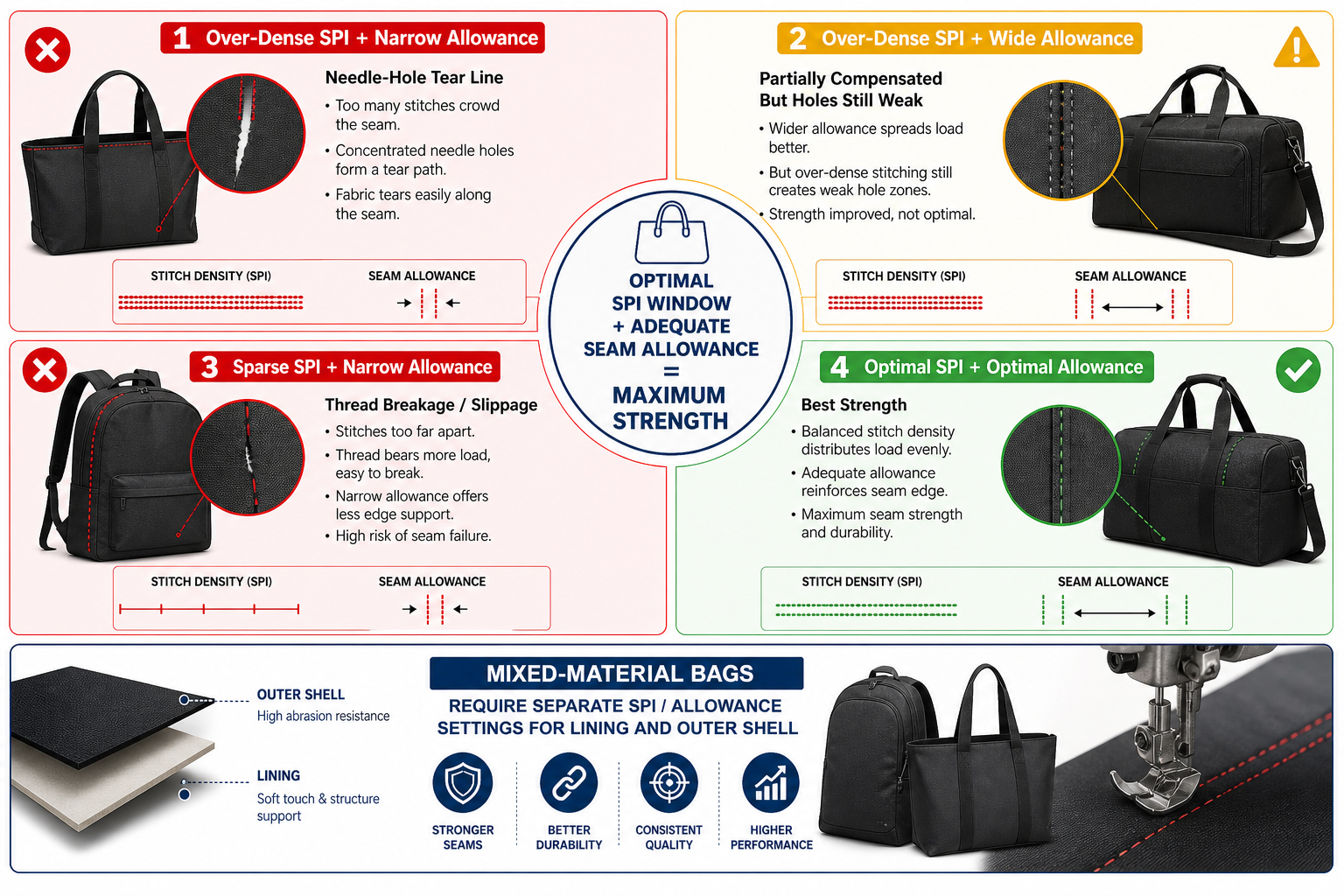
Starting with SPI: stitch density balances two competing risks. Too many stitches per inch creates a long line of needle perforations. Every needle hole is a small material defect. When stress pulls along the seam, the material tears along the row of holes. This is the main risk of over-stitching canvas and leather. Conversely, SPI set too low means only a small number of threads carry the full load of the bag. Individual stitches will pop, and the seam will split between widely spaced stitches. For every bag design, there is an optimal SPI window that maximizes strength without over-perforating the substrate.
Seam allowance controls how much material remains to absorb load after stitching. Wider seam allowance distributes pulling force away from the stitch line. When your customer overloads the bag, tension spreads across the full allowance margin instead of concentrating purely on the row of stitches. Narrow seam allowance concentrates all force directly on the stitch holes. Even with perfect SPI, a narrow seam allowance can lead to seam blowout at the bag bottom or strap mount points.
The interaction between SPI and seam allowance becomes especially important for mixed-material bags. Take a tote bag combining nylon lining and canvas outer shell: the canvas outer panel has 10mm seam allowance at 7 SPI, while the nylon lining uses 6mm allowance at 9 SPI. If the factory mistakenly uses the outer canvas settings on the thin nylon lining, the heavy needle, thick thread and low SPI will cut through the lining fabric easily. If they apply lining settings on the canvas outer panels, the high SPI creates a perforated weak line on the heavy canvas.
Daily repeated stress accelerates failure at mismatched SPI / seam allowance locations. Customers repeatedly load and unload bags, flex seams, twist handles and set bags down on hard surfaces. Over months of use, minor seam weaknesses grow into visible tears, popped stitches and split seams. Poor sewing parameters increase product returns and negative reviews for your US e-commerce store. Setting correct SPI and seam allowance is a cost-effective way to extend bag service life without upgrading to more expensive raw materials.
You should test prototype samples under load cycling to validate seam performance before mass production. Load test results confirm whether your selected SPI and seam allowance combination meets your advertised durability claims.
5.Inspection Methods Chinese OEM Factories Use to Verify SPI Accuracy and Seam Allowance Consistency Across Full Bulk Production Runs
Even with locked tech pack specifications, bulk production drift is a constant risk in OEM bag manufacturing. Sewing operators adjust machine tension over long shifts, needles wear down, fabric batch thickness varies slightly, and machine settings can drift. Reliable Chinese bag factories implement multi-stage inspection workflows to monitor SPI and seam allowance through sampling checks.
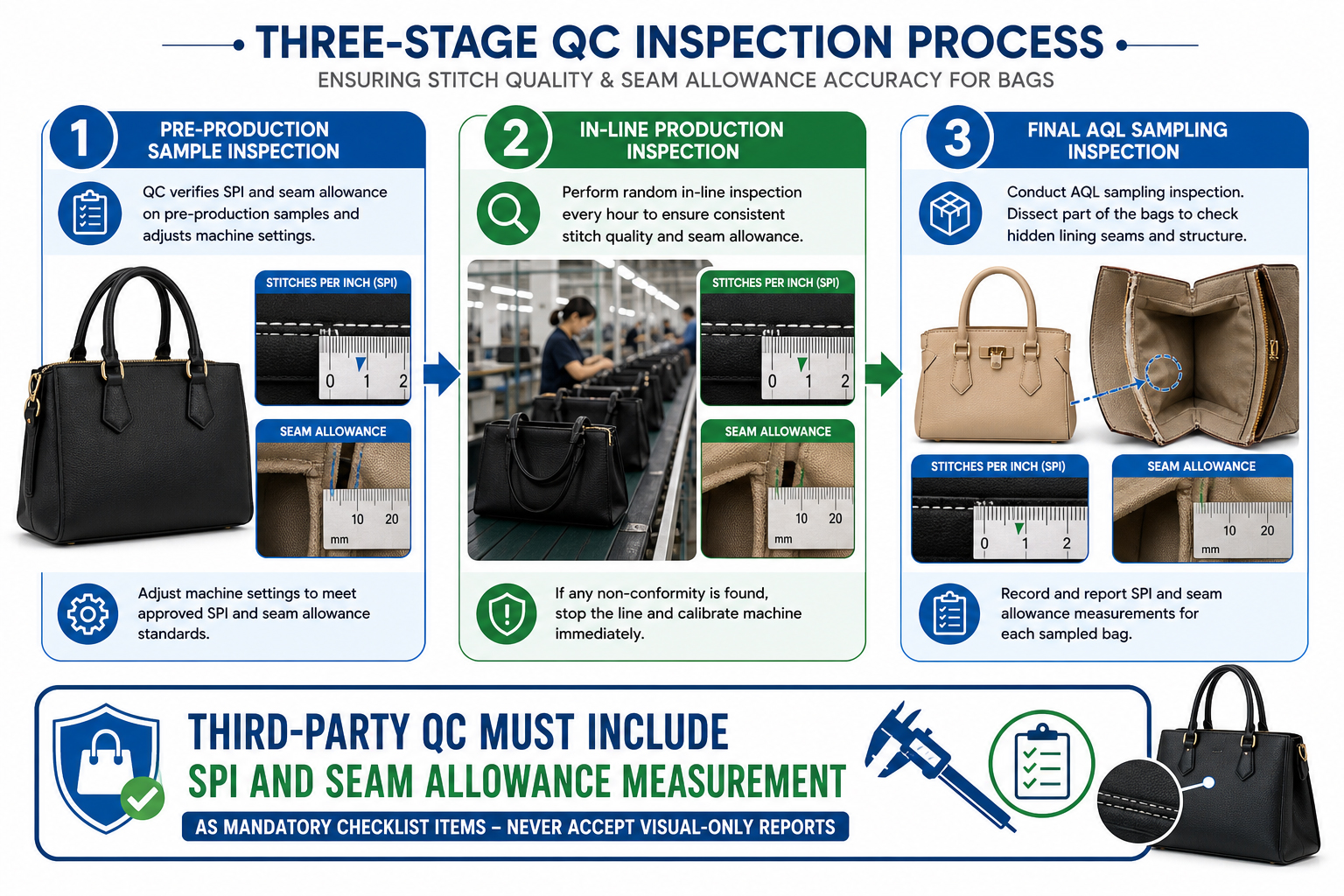
First, pre-production sample inspection. Before cutting bulk fabric and starting mass sewing, the factory QC team reviews the pre-production sample. QC verifies SPI by counting stitches over one inch of seam at multiple positions: main panels, pockets, lining, strap attachment points. Seam allowance is measured with a seam gauge ruler at intervals along every seam type. If SPI or seam allowance falls outside your specified tolerance range, the factory adjusts machine settings before bulk cutting.
Second, inline production inspection during sewing. Line QC inspectors pull random bags from the sewing station every hour. They spot-check SPI and seam allowance on the production floor. Inline inspection catches problems early, before hundreds or thousands of defective bags are fully assembled. Common inline issues include drifting SPI after needle replacement and inconsistent seam allowance caused by operators misaligning fabric against the machine guide edge. When non-conformity is found, the line stops to recalibrate machines and retrain sewing operators.
Third, final random inspection after full bag assembly. Once bags are completely sewn, lined, fitted with hardware and cleaned, QC performs AQL sampling inspection. Selected bags are dissected partially if needed to check hidden lining seams that are not visible from outside. Inspectors record SPI and seam allowance measurements for different seam types, comparing measurements against your tech pack tolerances. If the sample fails inspection, the factory must conduct 100% sorting or rework the whole batch.
Some less professional factories skip regular SPI counting and only check visual appearance. Visually neat seams can still have incorrect SPI or uneven seam allowance that fails under load. As a US buyer, you have the right to require your third-party QC inspector to include SPI and seam allowance measurement as mandatory checklist items during pre-shipment inspection. Never accept inspection reports that only comment on cosmetic appearance without stitch and seam dimension data.
Conclusion
Sewing construction fundamentals — lockstitch machine capability, SPI, seam allowance and QC verification — form the hidden foundation of durable custom OEM bags sourced from China. Many US independent website sellers win market trust by delivering high-quality bags that hold up to daily use, and reliable sewing parameters are the core of that product advantage.
When you work with Chinese OEM factories for mixed-material bags combining lightweight nylon lining and heavy canvas or leather outer shells, confirm that your supplier uses properly selected lockstitch equipment, matched feed systems and calibrated machine settings. Define clear SPI ranges for different materials, separate seam allowance requirements for main panels, pockets and lining inside your tech pack. Understand how SPI and seam allowance together affect seam strength and tear resistance. Finally, enforce factory inspection procedures to maintain consistency throughout bulk production.
Communicate all these sewing specifications clearly at the sample development stage. Require material sewing test videos and load testing for prototypes. Investing time in sewing construction details during sampling reduces defects, customer complaints and return rates for your bag brand, while building long-term stable cooperation with your Chinese OEM manufacturer.
Post time: Sep-23-2026