
When you run a bag business in the United States — whether you’re a DTC brand on Shopify, an Amazon FBA seller, or a wholesale distributor — the products you put into American consumers’ hands must clear a series of safety, chemical, and sustainability hurdles. In 2025, third-party certifications such as OEKO-TEX Standard 100, GRS (Global Recycled Standard), Bluesign, and BCI (Better Cotton Initiative) are no longer “nice to have.” They have become baseline requirements for major retailers, marketplace gating, and consumer trust.
But here’s the uncomfortable truth: not every Chinese factory holds all four certifications, and not every certificate a factory claims actually covers the bag you are ordering. This article is written for U.S. bag buyers who are evaluating Chinese suppliers and need to know, in plain English, what each certification really means, what it costs, what it covers, and where the common pitfalls lie.
By the end of this guide, you’ll be able to read a supplier’s certificate, challenge a sales rep’s claim, and structure your RFQ (Request for Quotation) so that compliance is locked in before your deposit clears — not after your container arrives in Long Beach.
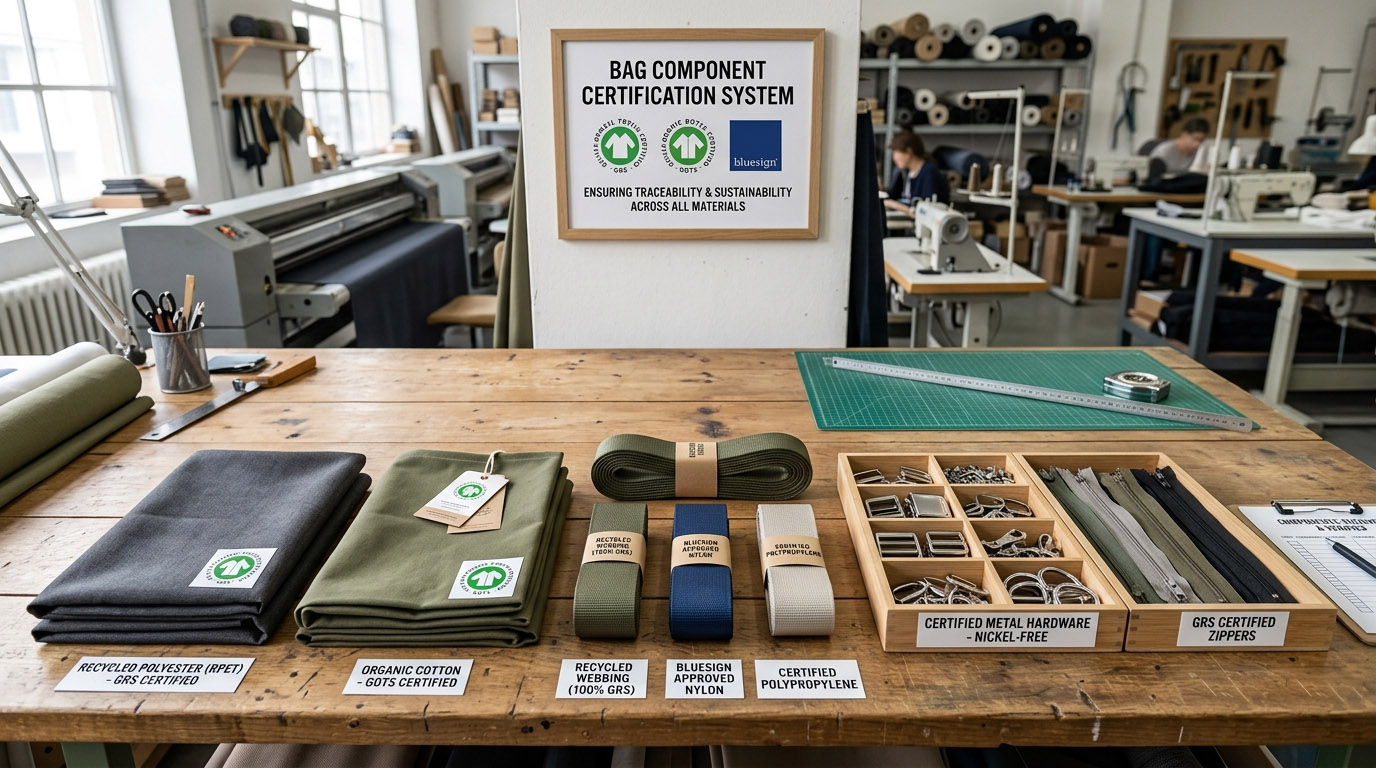
Bag certification is not a single document — it is a chain of evidence covering fabric, lining, webbing, hardware, and finishing.
1. The Four Certifications That Actually Matter for Bags
1.1 OEKO-TEX Standard 100 — The Baseline for Harmful-Substance Testing
OEKO-TEX Standard 100 is the most commonly held certification among Chinese bag factories. It is a product-safety certification that tests finished textile products for harmful substances — including heavy metals, formaldehyde, pesticides, and azo dyes. For any bag that touches skin (backpacks, totes, handbags, diaper bags, laptop sleeves), OEKO-TEX is the single most recognized proof of chemical safety globally.
For U.S. buyers, OEKO-TEX is especially valuable because it is widely accepted by major retailers and is a recognized pathway to demonstrate reduced chemical risk under California’s Proposition 65 framework. While OEKO-TEX itself is not Prop 65 compliance, the testing overlap is substantial.
What it covers: Fabric body, linings, interlinings, trims, prints, zippers (in some cases), and finished products for harmful-substance compliance.
What it does NOT cover: Recycled content, supply-chain traceability, or social/labor conditions.
1.2 GRS (Global Recycled Standard) — For Recycled Content Claims
If you sell RPET (recycled polyester) backpacks, rPET totes, or bags made with recycled nylon or recycled cotton, you need GRS. This certification verifies:
The percentage of recycled content
Chain of custody (so the recycled material isn’t mixed with virgin material at any stage)
Social criteria at processing facilities
Environmental criteria (water, energy, chemical management)
A critical point many U.S. buyers miss: GRS is a chain certification. Every supplier in the chain — the recycler, the yarn spinner, the fabric mill, the bag assembler — must hold its own valid scope certificate. If any link in the chain is uncertified, the final bag cannot carry a GRS claim.
What it covers: Recycled content verification, traceability from recycler to finished product, social/environmental criteria at each processing stage.
What it does NOT cover: Chemical safety of dyes and finishes (this is where OEKO-TEX complements GRS).
1.3 Bluesign — The Gold Standard for Chemical Management
Bluesign is held by far fewer Chinese factories because it is more rigorous and applies mainly to fabric mills rather than bag assemblers. It focuses on:
Safer chemistry at the input level
Water and energy use reduction
Eliminating harmful substances at the design stage
Resource productivity
If your bag uses fabric that has been Bluesign-certified, you are buying from a mill that has passed one of the toughest chemical-management audits in the textile industry. However, you will typically not find a Chinese bag factory that holds a Bluesign factory certificate — they source Bluesign fabric from Bluesign-certified mills.
What it covers: Chemical inputs, water/energy use, occupational safety at the mill level.
What it does NOT cover: Assembly-stage processes (cutting, sewing, packing) — which is why you pair Bluesign with OEKO-TEX or GRS.
1.4 BCI (Better Cotton Initiative) — Responsible Cotton Sourcing
BCI is relevant only for cotton-containing bags — canvas totes, cotton backpacks, denim bags, and so on. It is more common among mills than bag factories themselves. BCI is about more responsible cotton farming (reduced water, reduced pesticide use, better farmer livelihoods), not finished-product chemical safety.
What it covers: Cotton fiber sourcing from farm to mill.
What it does NOT cover: Anything after the mill — so BCI alone is not a complete bag certification. It must be combined with OEKO-TEX or GOTS (Global Organic Textile Standard) for the finished product.
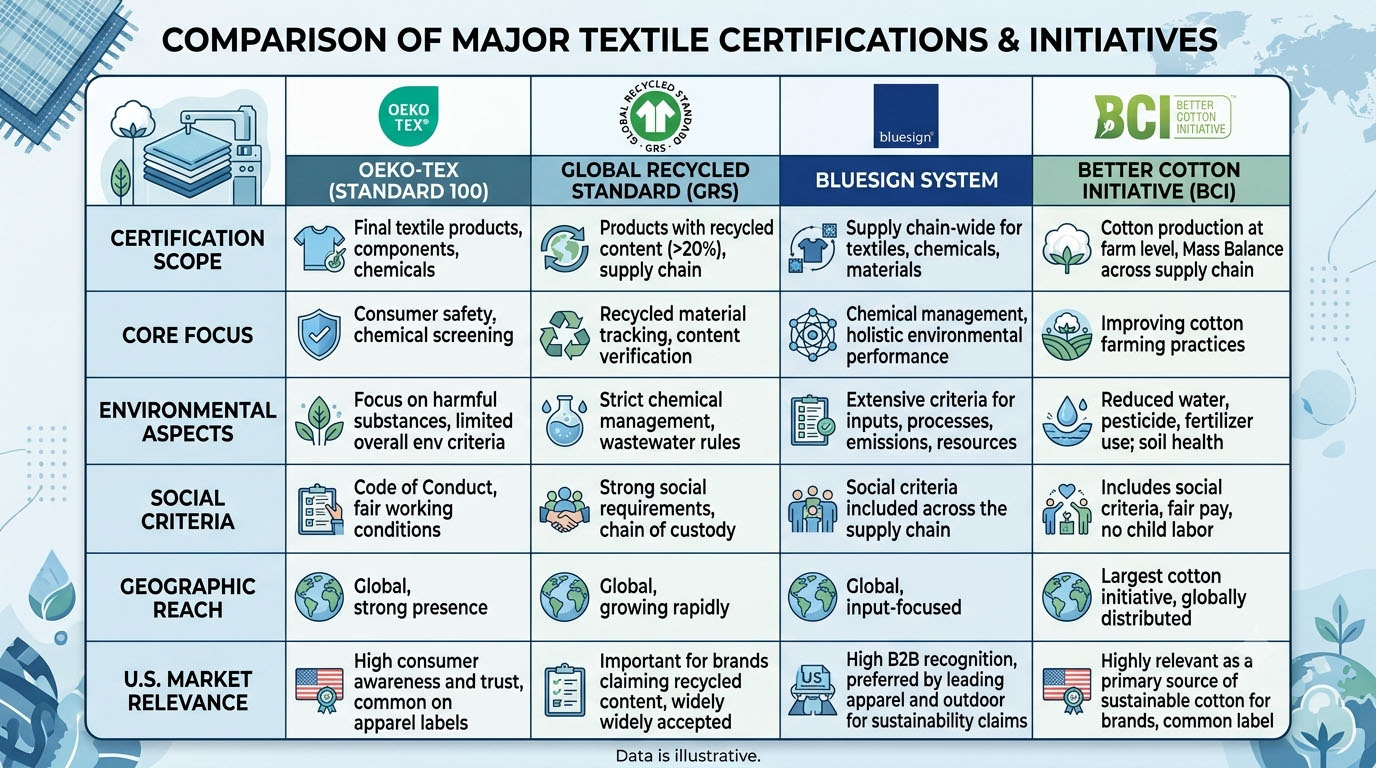
The four certifications are complementary — not interchangeable. Most reputable U.S. bag brands stack two or more on a single product.
2. Does the Chinese Factory Actually Hold These Certifications? (And How to Verify)
Yes — many Chinese bag factories can supply third-party certifications, but you should treat them as something to verify case by case, not assume by default. In practice, OEKO-TEX, GRS, Bluesign, and BCI each cover different parts of the supply chain, and a supplier may have some but not all of them.
Here’s the most common scenario we see in 2025:
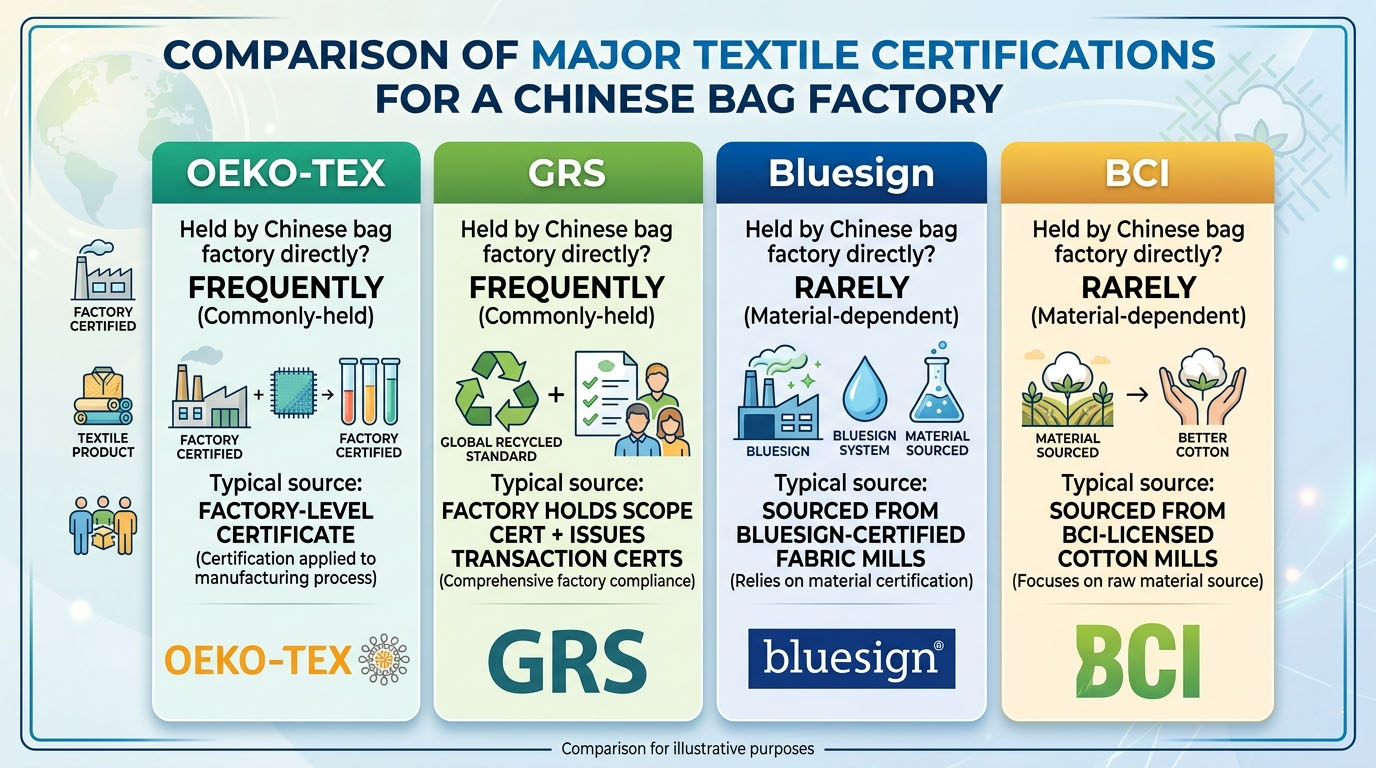
The factory’s job is to coordinate the chain — but you, the buyer, must verify the chain.
What to ask for (and what to check)
Ask the supplier to provide:
The actual certificate PDF, not just a logo on a product page
The certificate number, issuer, and expiry date
The scope of certification, confirming it covers your specific bag material and product type
Proof that the exact factory and the exact material used in your order are covered
For OEKO-TEX, the official label check lets you verify validity by QR code or certificate number. For GRS, the Textile Exchange database allows buyers to cross-check certificate numbers and scope against the public registry. Never rely on a sales rep’s verbal claim.
A practical buyer standard
A good supplier answer would sound like this:
“Yes, we can provide OEKO-TEX Standard 100 for the fabric.”
“Yes, we can provide GRS for recycled polyester bags.”
“Yes, we can provide Bluesign-related material/process documentation if the mill is covered.”
“Yes, we can provide BCI cotton sourcing documentation if the cotton is BCI sourced.”
If a factory only says “we support eco-friendly production” but cannot provide the certificate and scope, treat that as a red flag.
3. The Money Question: Price Premiums and MOQ Increases
This is the question every buyer wants answered directly. What is the price premium and MOQ increase when sourcing OEKO-TEX, GRS, Bluesign, or BCI certified materials compared to standard options?
Here’s the realistic breakdown based on current Chinese factory pricing (2024–2025):
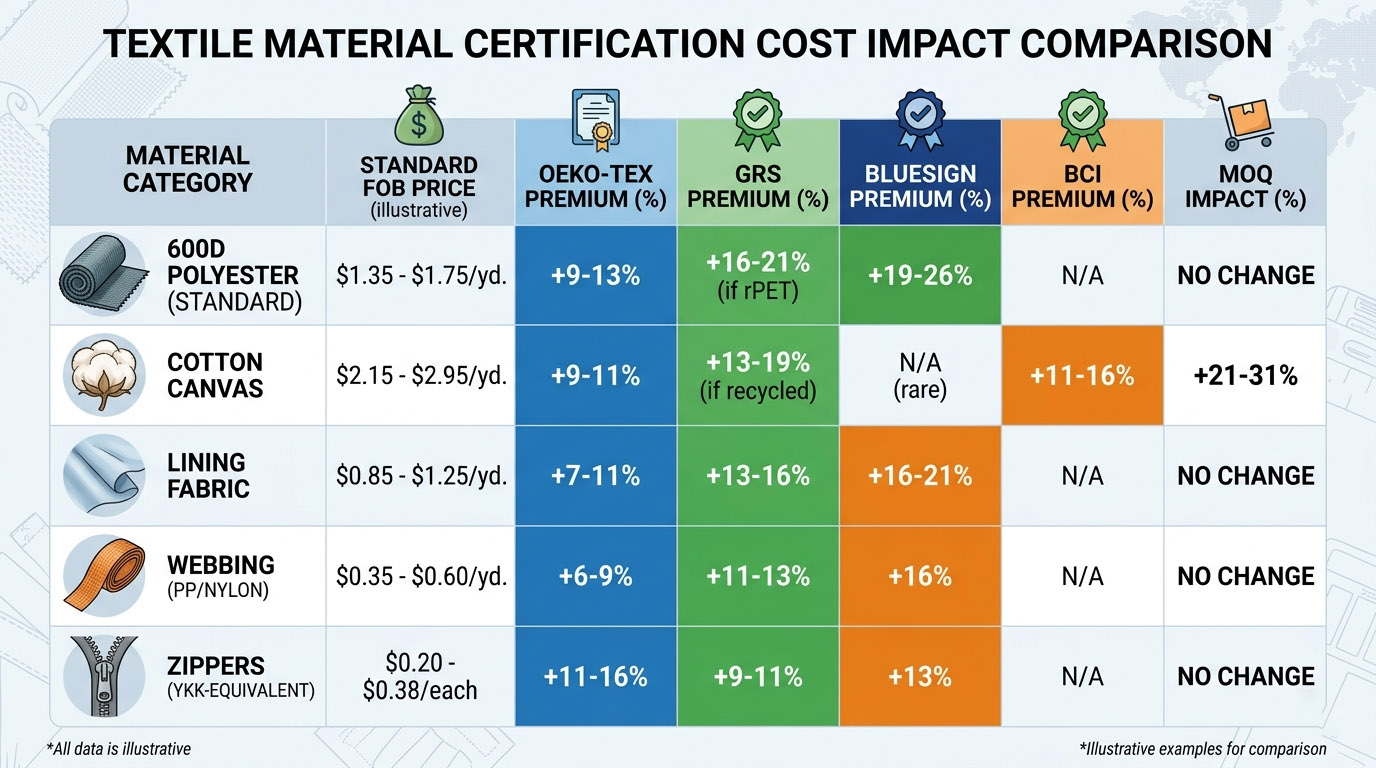
Key insights on cost:
1. OEKO-TEX is the cheapest premium because it is the most widely held certification and Chinese mills have integrated it into standard production lines.
2. GRS carries a higher premium because recycled feedstock (rPET chips, recycled cotton) costs more than virgin material, and the chain-of-custody audit burden is real.
3. Bluesign commands the highest premium because few Chinese mills hold it — supply is constrained.
4. MOQ rarely changes for OEKO-TEX or Bluesign (since the material is already certified at the mill), but GRS often requires a slightly higher MOQ (typically +20–30%) because the factory must run a separate production batch and issue transaction certificates.
Procurement tip: If you are ordering <1,000 units, ask the factory to use OEKO-TEX-certified stock fabric (no extra cost in many cases). Reserve GRS for orders of 2,000+ units where the cost premium is amortized.
4. Documentation: Scope Certificates, Transaction Certificates, and Traceability
Can the factory provide valid scope certificates, transaction certificates, and full traceability documentation for every certified shipment?
The answer depends on the certification type:
OEKO-TEX: The factory holds a single scope certificate covering all certified products. Per-shipment documentation is usually a copy of the certificate + test report. No transaction certificate is issued.
GRS: The factory MUST issue a Transaction Certificate (TC) for every shipment of GRS-certified product. The TC is generated through the Textile Exchange platform and ties the specific shipment (quantity, lot, date) to the factory’s scope certificate. Without a TC, your import cannot be claimed as GRS in the U.S.
Bluesign: Documentation is mill-level. You receive a mill certificate and a Bluesign-issued “Bluefinder” reference.
BCI: Documentation is the mill’s BCI license number and a Chain of Custody declaration.
Always request these four documents before deposit:
1. Certificate holder’s name (must match the factory legal entity)
2. Certificate number
3. Expiry date
4. Product scope (must include your specific bag model or material)
Expired or mismatched certificates are a common compliance failure point — and they are not always intentional. We have seen factories renew their GRS scope late, then ship under the old number. By the time the goods arrive in the U.S., the certificate has lapsed. Check the expiry date every order.
Process diagram: A flowchart showing the documentation chain — mill certificate → factory scope cert → GRS transaction cert → import documentation
Caption: The GRS documentation chain is the most rigorous. Missing any link invalidates the recycled-content claim for U.S. customs and FTC Green Guides compliance.
5. Component Coverage: What’s Actually Certified Inside Your Bag
Which specific components — main fabric, lining, webbing, prints, zippers, and hardware coatings — are covered under each certification scope?
This is where U.S. buyers frequently get burned. A factory may say “our bags are OEKO-TEX certified,” but the certification may only cover the main body fabric, not the lining, webbing, or zipper tape.
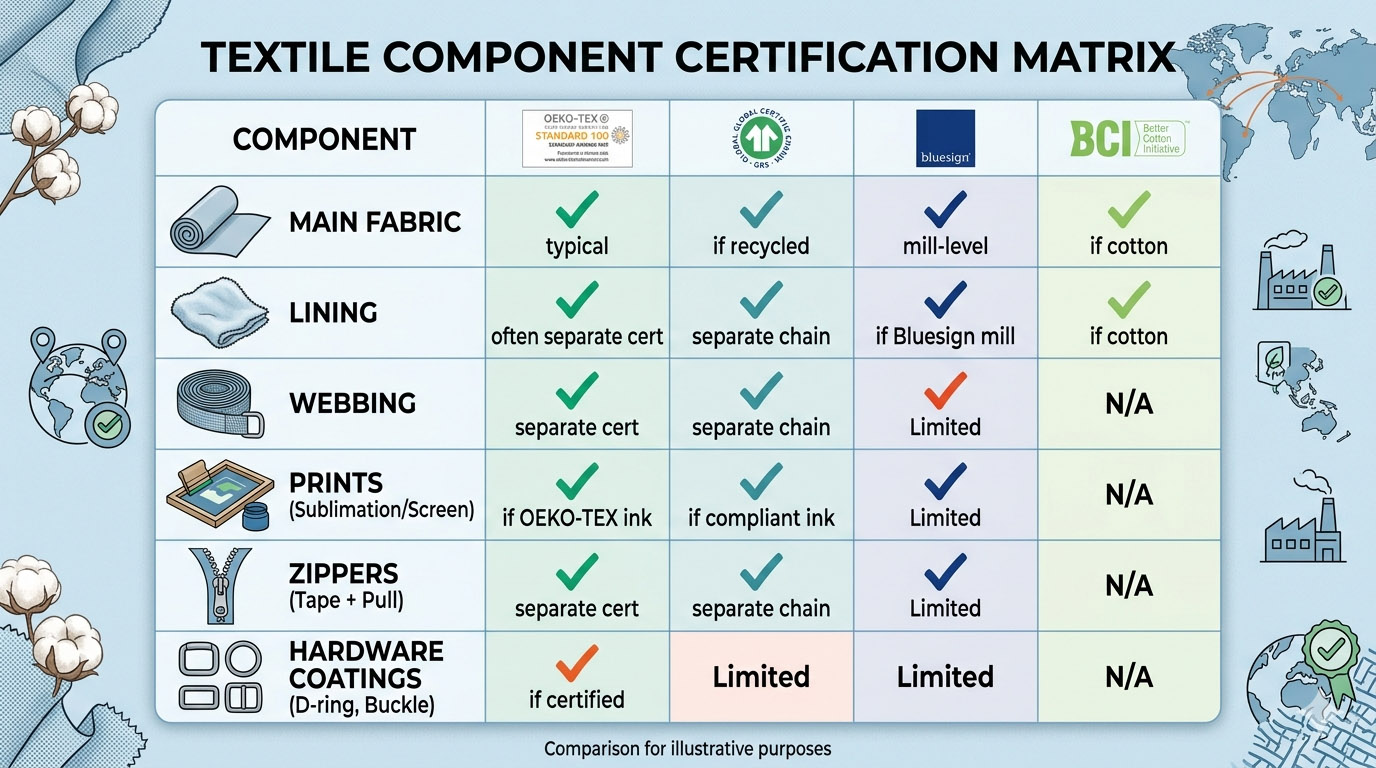
The critical rule: Certified components — zippers, buckles, webbing, and print inks — must be sourced from certified sub-suppliers. Otherwise, the final bag cannot carry the certification mark, even if the main fabric is fully certified.
Ask the factory specifically: “Is the zipper tape OEKO-TEX certified? Is the buckle plating lead-free and tested? Is the print ink OEKO-TEX compliant?” If they cannot answer component by component, the certification is incomplete.
Component diagram: A cross-section illustration of a backpack showing main fabric, lining, webbing, zipper, and hardware — with certification labels mapped to each
Caption: Every component must be covered under the certification scope. A “fully certified bag” means every layer, stitch, and metal piece is documented.
6. U.S. Compliance: CPSIA, Prop 65, and Amazon’s Restricted Substance List
Are the finished bags also compliant with US-specific safety standards such as CPSIA, Prop 65, and Amazon’s restricted-substance list?
This is a separate question from third-party certifications — and it is just as important.
6.1 CPSIA (Consumer Product Safety Improvement Act)
CPSIA applies to all consumer products used by children under 12. If you sell kids’ backpacks, diaper bags, or school bags, CPSIA requires:
Lead content < 100 ppm in accessible substrates
Phthalate content < 0.1% in accessible plastics
Tracking label on the product and packaging
Third-party testing by a CPSC-accepted lab (e.g., SGS, Intertek, Bureau Veritas)
Most Chinese factories with OEKO-TEX certification can also provide CPSIA test reports, but CPSIA testing is order-specific and must be done on the finished product, not the raw fabric. Budget $300–$800 per style for CPSIA testing.
6.2 California Proposition 65
Prop 65 is California’s “right-to-know” law requiring warnings for products containing chemicals known to cause cancer or reproductive harm. For bags, the most common Prop 65 risks are:
Lead and cadmium in metal hardware (D-rings, buckles, zippers)
DEHP and other phthalates in PVC-coated prints
Formaldehyde in some fabric finishes
OEKO-TEX testing overlaps significantly with Prop 65, but it is not a substitute. For full Prop 65 compliance, request a Prop 65-specific test report (often called a “Prop 65 screening” or “California Proposition 65 test”) from a U.S.-accredited lab.
6.3 Amazon’s Restricted Substance List (RSL)
Amazon’s RSL has become increasingly strict since 2022. For bags, Amazon requires:
No PFAS (“forever chemicals”) in water-repellent coatings
Restricted heavy metals in all components
Lead and phthalate limits in children’s products
Compliance documentation available upon request
Important: Amazon can and does remove listings that lack RSL documentation. We have seen DTC brands lose $50,000+ in inventory after a single RSL audit failure. The fix is straightforward: ask the factory to provide an RSL test report from SGS, Intertek, or Bureau Veritas before shipment.
Recommended approach: Engage a third-party inspection company (SGS, Intertek, or Bureau Veritas) to verify that the materials shipped match the certificates on file before the goods leave the Chinese port. This pre-shipment inspection costs $200–$400 and has saved our buyers from six-figure compliance failures.
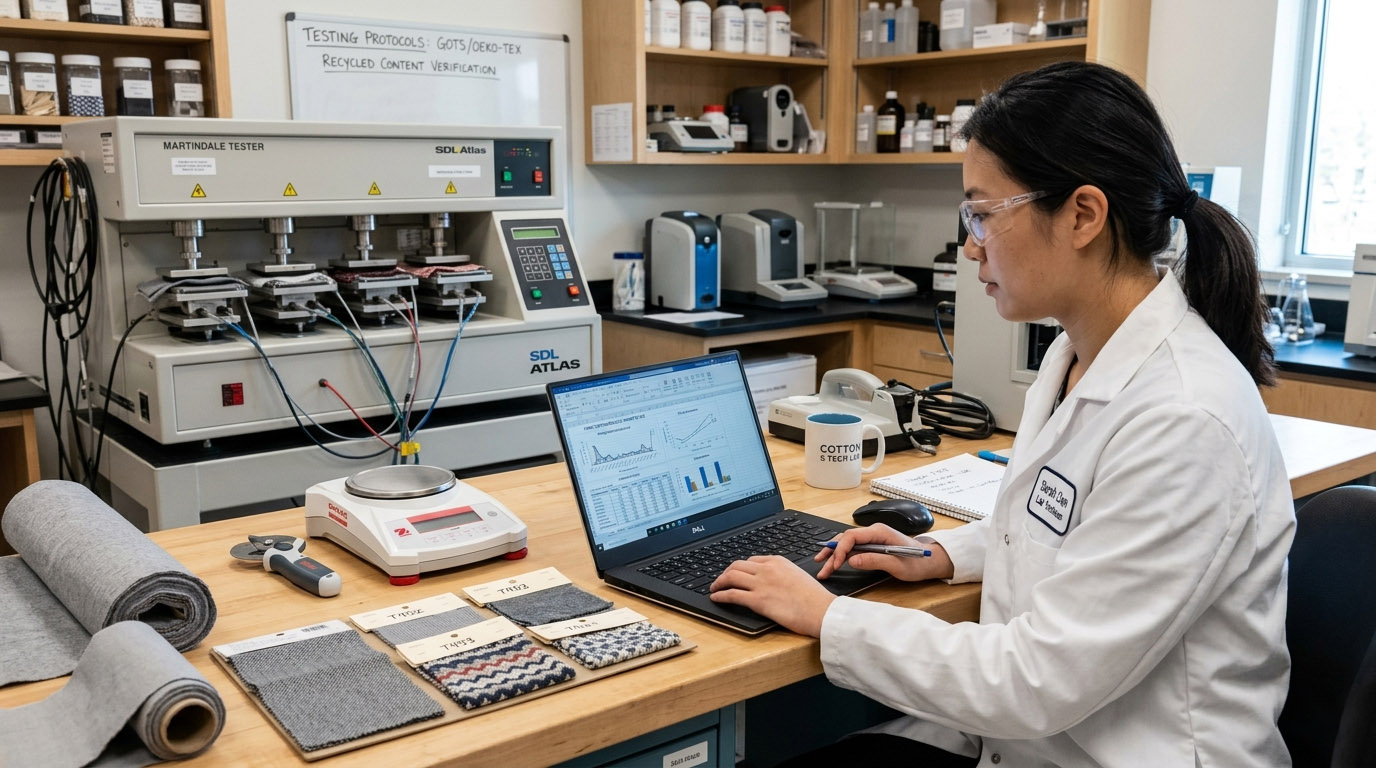
Pre-shipment inspection by SGS, Intertek, or Bureau Veritas is the final compliance checkpoint before goods leave the Chinese port.
7. Timeline Realities: Why You Must Lock Certifications Early
Lab testing under OEKO-TEX or GRS typically takes 4–6 weeks for fabric samples, so certification should be confirmed before the bulk-production timeline is locked.
A typical realistic timeline for a certified bag order:
1. Week 1–2: Factory sources certified fabric samples, sends swatches to buyer
2. Week 3–4: Buyer approves fabric, places deposit
3. Week 5–8: Factory produces pre-production sample, runs lab tests if needed
4. Week 9–14: Bulk production (6 weeks for a typical 2,000-unit order)
5. Week 15: Pre-shipment inspection + final documentation package
6. Week 16–18: Ocean transit to U.S. port
If you wait until week 9 to ask “is this fabric OEKO-TEX certified?”, you have lost a full production cycle. Lock the certification status into your PO (Purchase Order) as a contractual requirement — not a verbal promise.
8. The Supplier’s Direct Answer: What a Reliable Chinese Factory Says
To give you a benchmark, here is how a properly equipped Chinese bag factory should respond to your certification questions:
Buyer: “Do you supply OEKO-TEX, GRS, Bluesign, and BCI certified materials?”
Reliable factory: “Yes, we can. We hold OEKO-TEX Standard 100 for our main fabric and lining, and we have GRS scope certification for recycled polyester orders. For Bluesign, we source fabric from Bluesign-certified mills like [Mill Name]. For BCI cotton, we work with [Cotton Mill] which holds a valid BCI license.
Because demand for sustainable and safe materials is increasing, we have expanded our certified material library to include more recycled and low-impact options. We can provide OEKO-TEX or equivalent test reports with every order, and we issue GRS Transaction Certificates for all recycled-content shipments.
We also support CPSIA, Prop 65, and Amazon RSL testing through SGS or Intertek as an optional add-on.”
This is the gold-standard response. If your supplier gives a vague answer like “we can do eco-friendly” or “yes we have certificates” without naming the certification body, certificate number, and scope, walk away.
Supplier communication screenshot: A clean, professional email reply from a Chinese factory showing certificate numbers, scope details, and a willingness to provide documentation
Caption: A reliable supplier’s response is specific, document-backed, and references named certification bodies — not vague “eco-friendly” claims.
9. Common Procurement Failures and How to Avoid Them
Based on hundreds of buyer cases we have supported, here are the most common certification-related failures:
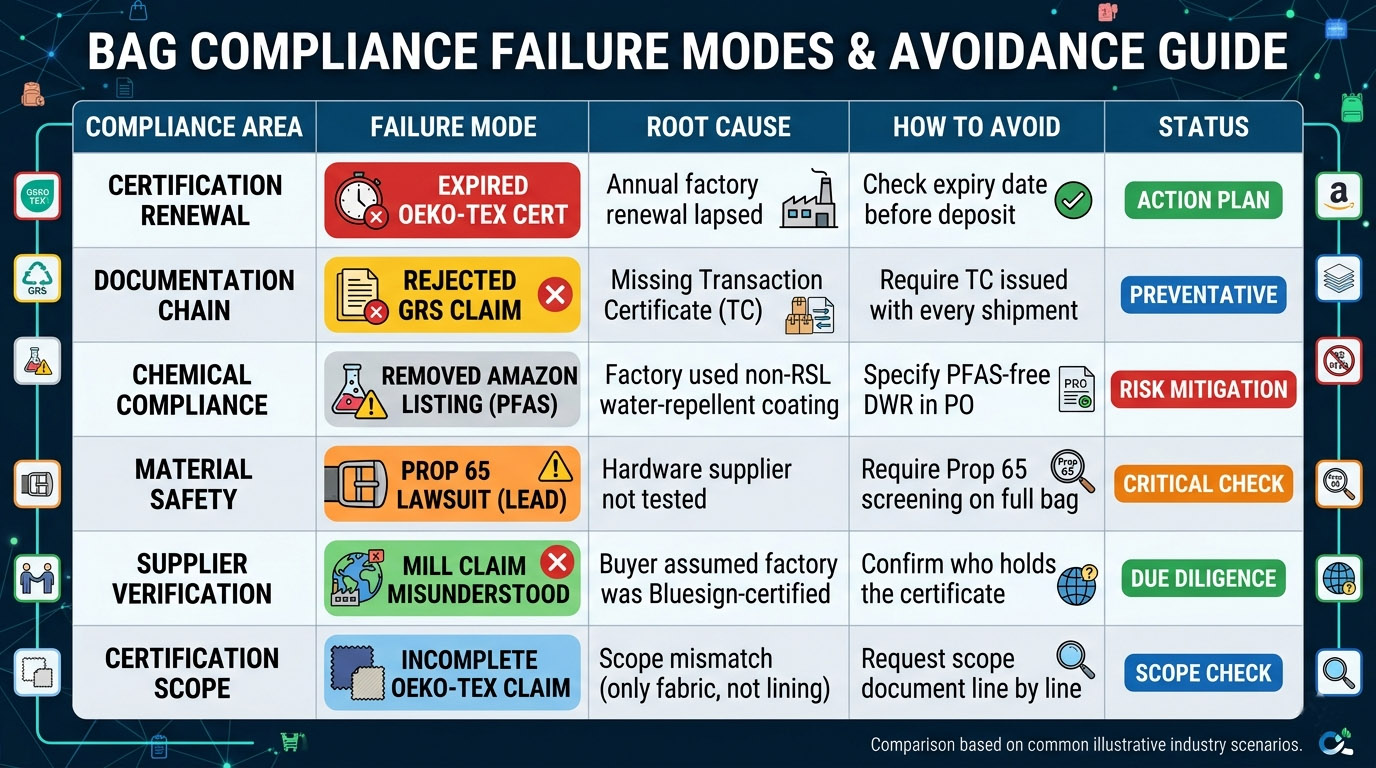
The single most important rule: treat every certificate claim as a legal document, verify it in the official database, and lock the scope into your PO.
10. Multi-Certification Capability: The New DTC Standard
Factories with multi-certification capability can offer OEKO-TEX + GRS + BCI on a single order, which is now a common procurement requirement from U.S. DTC brands. For example, a “sustainable canvas tote” might require:
OEKO-TEX Standard 100 (chemical safety)
GRS (recycled cotton content)
BCI (responsible cotton sourcing)
CPSIA compliance (if sold for children)
Amazon RSL compliance (if sold on Amazon)
This stack is complex, but it is achievable with the right factory. The key is to work with a supplier who coordinates the upstream chain (mills, trims suppliers, hardware vendors) and provides a single documentation package at shipment.
11. Your Action Checklist: 10 Steps Before Placing the Order
Use this checklist before sending your next PO to a Chinese bag factory:
1. ☐ Request the certificate PDF (not a screenshot or logo) for each certification claimed
2. ☐ Verify the certificate number on the official database (OEKO-TEX Label Check, Textile Exchange for GRS)
3. ☐ Confirm the certificate holder’s name matches the factory’s legal entity
4. ☐ Check the expiry date — refuse to ship under an expired certificate
5. ☐ Review the product scope line by line — confirm your bag model and material are covered
6. ☐ Request component-level coverage (zipper, webbing, hardware) in writing
7. ☐ Add CPSIA + Prop 65 + Amazon RSL testing to your PO as a line item
8. ☐ Require GRS Transaction Certificate issuance for every recycled-content shipment
9. ☐ Lock the certification status into the PO contractually (with breach remedy)
10. ☐ Engage SGS, Intertek, or Bureau Veritas for pre-shipment inspection
12. Final Word: Compliance Is a Margin Protector, Not a Cost Center
Some U.S. buyers still see third-party certifications as a cost burden. In our experience, the opposite is true. A $300 OEKO-TEX test report has saved our buyers from:
A $50,000 Amazon listing suspension
A Prop 65 settlement in the five-figure range
A rejected shipment at a major retailer’s compliance audit
A DTC brand reputation hit from a TikTok exposé
Compliance is a margin protector. It is the difference between a bag business that scales cleanly and one that bleeds cash on returns, fines, and listing removals.
If you are evaluating Chinese bag factories right now, use the framework in this article to qualify your suppliers. The ones who can answer every question on this list with documentation are the ones worth building a long-term partnership with.
About the Author
This guide was prepared by the [Your Brand] sourcing team, with input from certified supply-chain auditors and over a decade of bag sourcing experience across China, Vietnam, and India. We help U.S. DTC brands, Amazon sellers, and wholesale distributors source bags that meet OEKO-TEX, GRS, Bluesign, BCI, CPSIA, Prop 65, and Amazon RSL requirements — without the certification guesswork.
Need help auditing a specific factory’s certificate? Send the certificate PDF to our sourcing desk for a free scope review.
Post time: Jun-10-2026