
How thoughtful US bag buyers can build a long-lasting, lower-impact product line by working with the right Chinese manufacturing partners.
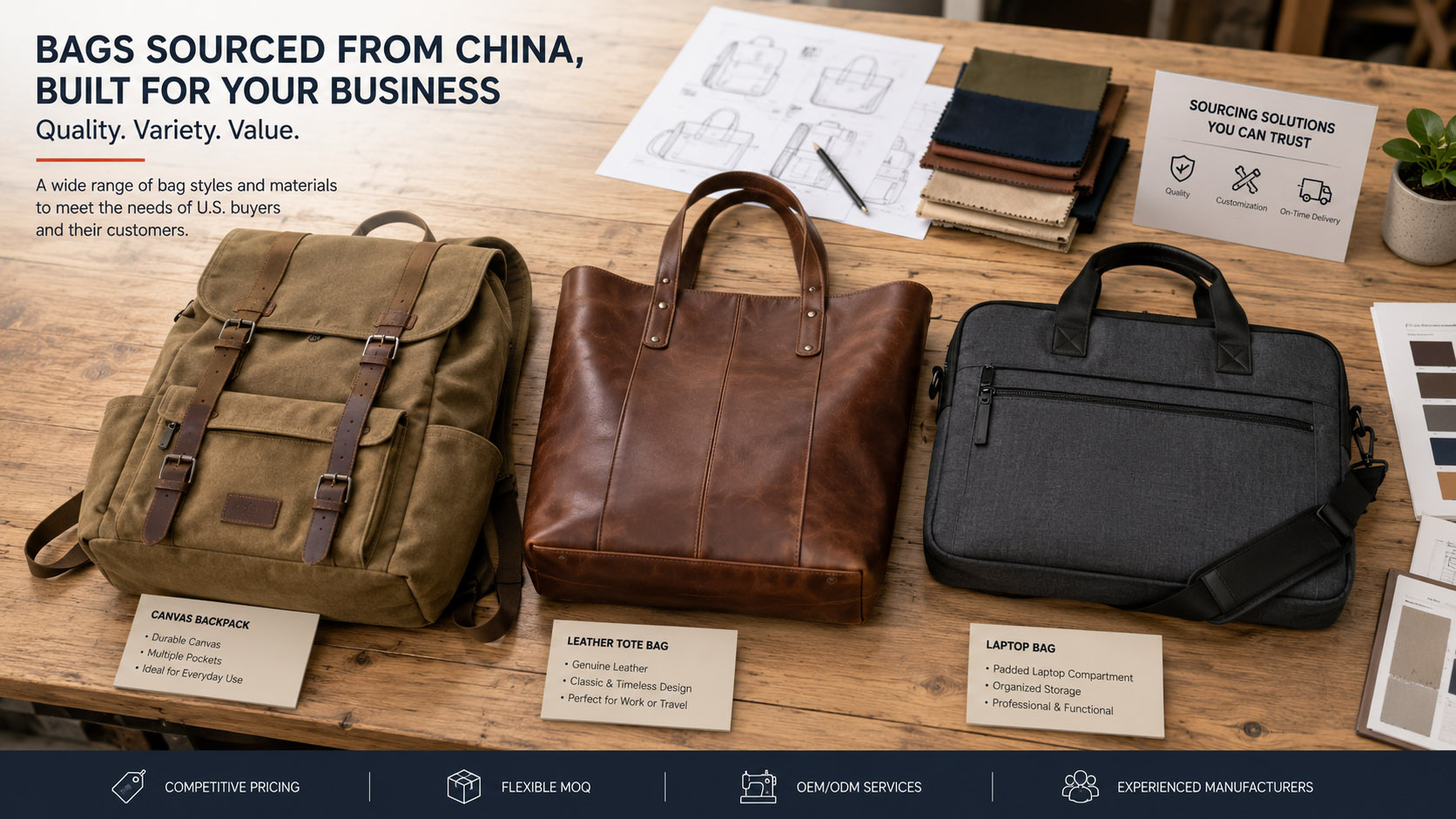
Modern Chinese factories supply a wide range of bag categories—from daily-use backpacks to premium leather totes and laptop bags—all of which can be engineered for durability and repairability when specified correctly.
Why Durability and Repairability Are the Real Sustainability Play
If you run a bag brand in the United States, you’ve probably noticed that “sustainable” is the most overused word in the industry. Every product page claims it. Every supplier slide deck promises it. But when you peel back the marketing, the metric that actually moves the needle on a bag’s environmental footprint is not recycled fabric, not organic cotton, not even recycled polyester—it’s how long the bag lasts before it gets thrown away.
The logic is straightforward. A bag that lasts ten years and is repaired twice has roughly half the lifetime carbon, water, and material footprint of two bags that each last five years and are discarded. The U.S. National Institute of Standards and Technology (NIST) has quantified this: a 50% increase in product life expectancy can cut replacement needs and related environmental impacts by approximately 33%. Repair is the single most powerful lever for extending that life expectancy, because hardware fails before fabric does in most well-made bags.
This is why, as a US buyer sourcing from Chinese factories, the most important questions you can ask are not “Is it eco-friendly?” but “How long will it last, and can it be fixed when something breaks?” The good news is that a growing number of Chinese manufacturers—particularly OEM/ODM partners in Guangdong, Zhejiang, and Fujian—already build to these standards. The challenge is that you have to ask for it explicitly, write it into your spec, and verify it in pre-production samples.
That’s what this guide is for. Below, I’ll walk you through the four follow-up questions every smart buyer should put in their first factory inquiry, the ten technical benchmarks that separate a bag built to last from a bag built to be replaced, and the buyer strategy that gets you a product line you can actually stand behind.
The Four Follow-Up Questions Every US Buyer Should Ask First
Before you get deep into Pantone colors and logo placements, get the fundamentals on the table. These four questions are the filter that separates serious manufacturers from commodity producers.
1. What specific durability tests does the factory perform — Martindale abrasion, seam strength, zipper cycle, and handle pull — and can third-party test reports be provided?
This is your single best screening question. A factory that genuinely tests for durability will list its in-house capabilities (often Martindale rub counts, tensile testers, zipper cycle machines) and will be comfortable sending you a third-party report from SGS, Intertek, Bureau Veritas, or TÜV. A factory that cannot or will not answer this question is telling you everything you need to know.
2. Are the bags designed with replaceable components such as zippers, buckles, straps, and linings so worn parts can be swapped rather than the whole bag discarded?
Repairability is a design decision, not an afterthought. If the zipper is glued in, the strap is sewn into a closed webbing loop, and the lining is bonded to the shell, the bag cannot be repaired. Ask whether zippers are sewn in (not welded), whether strap anchors are bolted or bartacked onto D-rings, and whether the lining is a separate panel that can be unpicked and re-stitched.
3. What warranty period, repair service, or repair guidance does the factory offer to support the product’s extended lifespan?
A factory that offers a 1-year, 2-year, or even lifetime-style warranty is signaling that they trust their construction. A factory that only offers “defects before shipping” is signaling that they expect the bag to fail shortly after. Even more telling: does the factory publish a care card or repair guide, and will they pre-quote spare parts (zipper sliders, buckles, webbing straps) at the time of bulk production?
4. How does prioritizing durability and repairability affect unit price, MOQ, and material selection compared to standard fast-fashion bag construction?
Be honest with your supplier about cost trade-offs. Durable construction adds roughly 10–25% to unit cost in most categories, depending on material choices and reinforcement level. MOQ is usually similar (300–500 units is the typical entry point for custom OEM bags from China), but the materials slate is where the conversation matters most: 600D vs 1680D ballistic nylon, YKK vs no-name zippers, real leather vs PU, and so on. The right factory will walk you through the cost-per-use math, not just the unit price.
Send all four questions in your first inquiry. The response you get is itself a powerful qualification signal.
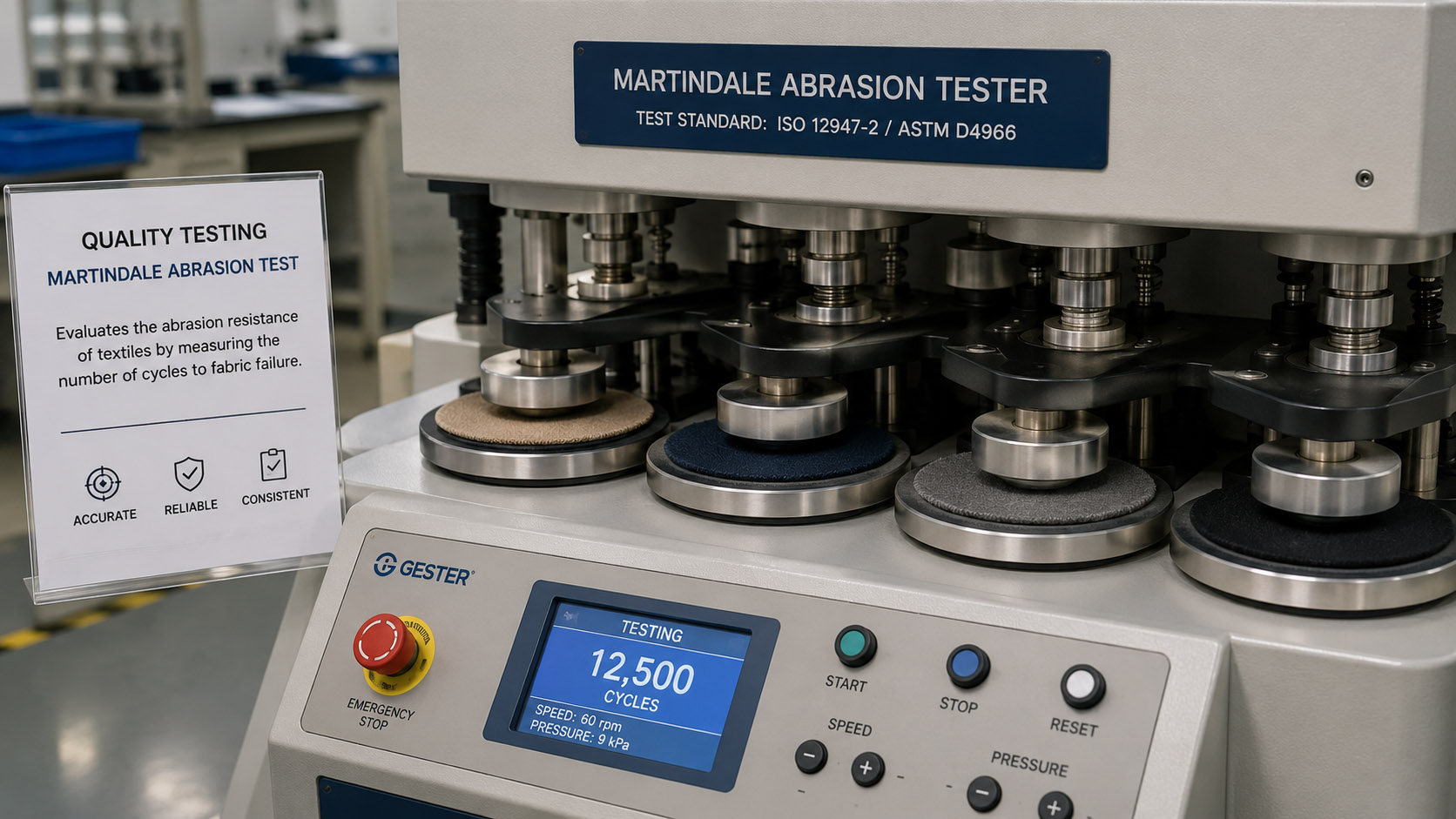
In-house labs at quality-focused Chinese factories run Martindale abrasion, seam-strength, zipper-cycle, and handle-pull tests before shipment—ask for the reports.
Ten Technical Benchmarks That Separate a Quality Bag from a Disposable One
This is the section to bookmark. These are the ten engineering specifications that consistently appear on well-built export-grade bags coming out of China, and they’re exactly what your supplier should be able to confirm on the technical pack.
1. Martindale abrasion of 20,000–50,000 cycles is a typical benchmark for daily-use backpacks, handbags, and laptop bags.
For reference: a handbag carried a few times a week typically experiences 2,000–5,000 abrasion cycles per year. A daily-use backpack or work bag sees 8,000–15,000. Specifying 20,000+ cycles is a comfortable margin; 50,000+ is “rugged” or “lifetime” territory. Anything below 10,000 cycles is fast-fashion-grade and will pill visibly within months.
2. Reinforced stitching — bar tacks, double-stitching, and box-X stitching — is applied at handle bases, strap junctions, and zipper ends.
This is where most cheap bags fail first. A standard lockstitch seam at a handle base will pull apart under 30–40 kg of static load. A proper bartack (a tight zigzag reinforcement stitch) at the same point will hold 80+ kg. Box-X stitching (an X-pattern reinforcement) is the gold standard for handle and strap anchor points. Ask your factory to call these out explicitly on the spec.
3. Replaceable components — zippers, buckles, straps, lining panels — are now standard at forward-thinking factories.
The shift here is real and recent. Five years ago, “modular bag construction” was a niche idea. Today, multiple mid-to-premium-tier Chinese factories offer it as a default, because European and US brand buyers started asking for it. A replaceable lining panel, for example, can be unpicked, swapped, and re-stitched without damaging the outer shell.
4. YKK, SBS, and SBS-quality zippers are typical for export-grade bags, with cycle-life ratings of 5,000–10,000 open/close operations.
A 5,000-cycle zipper means roughly 3.5 years of daily use before failure—acceptable. A 10,000-cycle zipper (most premium YKK ratings) is a lifetime-spec component. The slider matters as much as the tape: a YKK or SBS slider can be replaced in the field with a pair of pliers. A no-name slider usually cannot.
5. Handle pull-strength testing typically requires 25–50 kg static load, with reinforced anchors meeting 100+ kg to meet US and EU retail standards.
For handbags, totes, and laptop bags sold into the US market, 25 kg is the baseline safety threshold. For backpacks and duffels, you’re looking at 50 kg minimum, with reinforced anchor points tested to 100+ kg. These figures are not negotiable—multiple US retail compliance programs enforce them.
6. Premium factories publish care cards, repair guides, and spare-part SKUs to support brand-led repair programs.
If your factory can hand you a printed care card template and a list of spare parts with their internal SKUs, you’re working with a serious partner. This is the operational infrastructure of a repair-friendly brand, and the best Chinese suppliers now treat it as a standard deliverable.
7. YKK zippers with reverse-coil construction offer easier field replacement because the slider and tape can be swapped without unstitching the full panel.
Reverse-coil (also called “invisible” on handbags, “coil-tooth-out” on backpacks) is a small detail with a big repairability upside. The coil faces the back of the zipper tape rather than the front, which means a damaged slider can be removed, the new one threaded on, and the zipper put back in service without a sewing machine.
8. Double-layer bottoms and reinforced base panels — using 600D–1680D ballistic nylon or bonded leather — extend the lifespan of the most abrasion-prone area.
The base of a bag is the highest-wear surface: it gets dragged across floors, set down on wet pavement, and scraped against car seats. A single-layer base will fail in 1–2 years for a daily-use bag. A double-layer base with 1680D ballistic nylon or bonded leather will outlast the rest of the bag. This is one of the highest-ROI upgrades you can specify.
9. Repair-friendly construction methods — lockstitch seams and exposed interior binding — allow restitching without damaging the outer face fabric.
Chainstitch seams are faster to produce but unravel if a single thread breaks. Lockstitch (the standard 301 stitch type) is repair-stable. Exposed interior binding—where the seam allowance is finished with a separate binding tape—gives a repair technician a clean, accessible seam to unpick and re-stitch. Cheap bags hide their seams with binding that’s glued in place; quality bags expose them for serviceability.
10. Factories can pre-quote repair parts (zippers, sliders, buckles, webbing) at the time of bulk production.
This is the single most underused move in bag sourcing. When you’re placing your bulk order, ask the factory to quote a small batch of spare parts—say, 50 replacement zipper sliders, 30 buckle sets, 20 meters of matching webbing—at cost-plus pricing. These go into your warehouse, get listed as “repair parts” on your site, and let you offer a real repair service for years after the original sale.
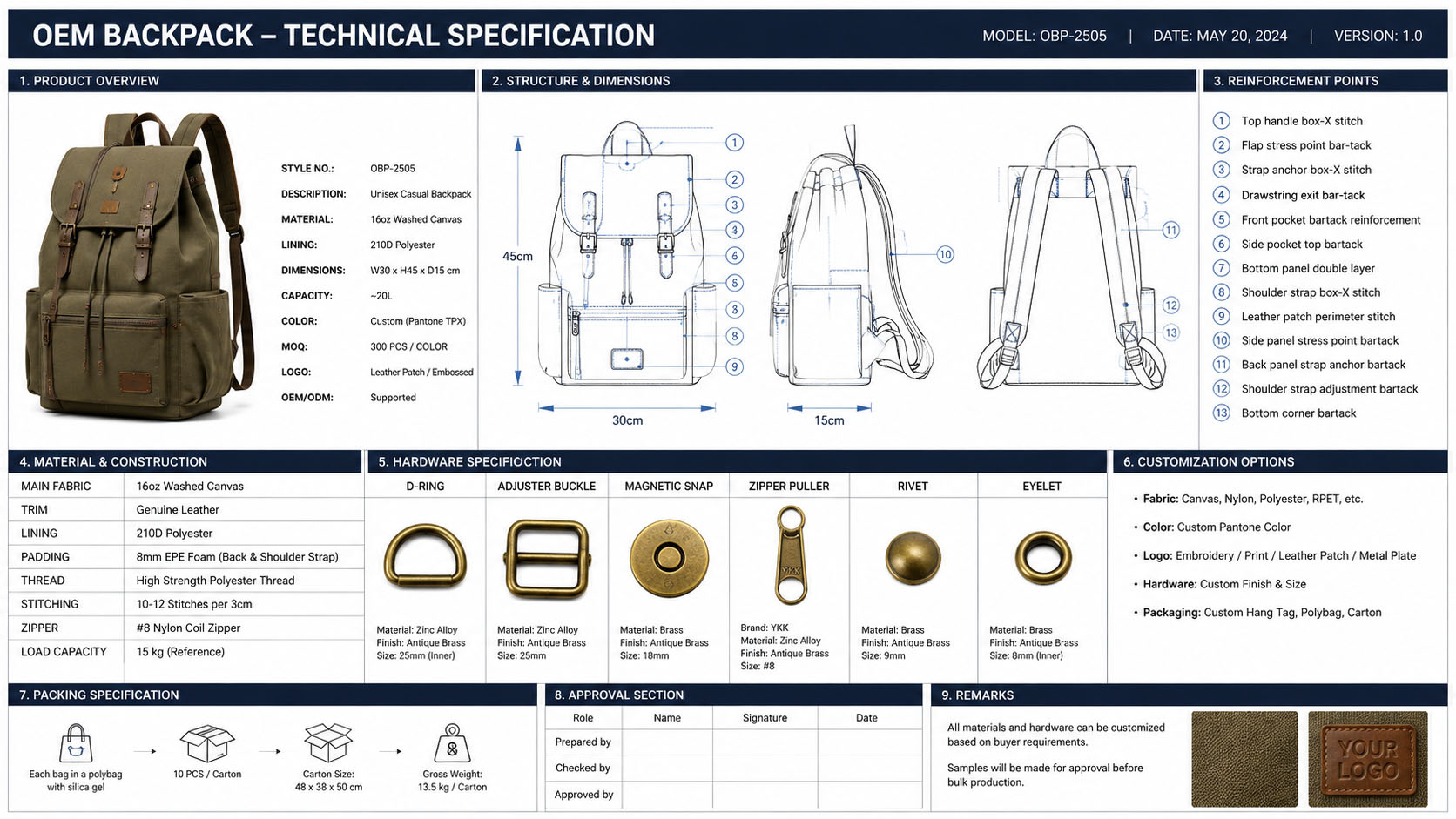
What to Require in Your Spec Sheet
The difference between a bag that lasts two years and a bag that lasts ten is almost always defined in the spec sheet. A good spec sheet is not just a list of materials—it’s a construction manual. Here’s what to include in yours:
Exact material composition and thickness. Not “600D polyester.” Specify “600D solution-dyed polyester, 0.55mm thickness, with PU back coating, supplied by [brand] or equivalent.”
Stitching density and reinforcement locations. Specify “8 stitches per inch minimum, with 2cm bartacks at all handle bases, strap junctions, and zipper ends, plus box-X reinforcement at the four bottom corners.”
Hardware standards and replaceability. “YKK #5 reverse-coil zipper on main compartment, YKK #5 coil on internal pockets, all sliders field-replaceable. D-ring strap anchors must be bolted, not sewn into closed webbing loops.”
Base construction. “Double-layer base: outer 1680D ballistic nylon, inner 600D reinforcement panel, sewn as a separate unit and topstitched to the main body.”
Lining construction. “Separate lining panel, lockstitch attached, with exposed seam binding to allow future re-stitching without disturbing the outer shell.”
Spare parts included in shipment. “50 spare main zipper sliders, 30 spare buckle sets, 20 meters of 25mm PP webbing, all packed in a labeled repair parts box inside carton 1 of the shipment.”
That last bullet is the one most buyers forget. The factories that can deliver it exist—you just have to ask.
Verifying Quality with Each Factory: A Five-Point Checklist
When you’re comparing two or three suppliers, use this simple checklist to qualify them. The right answer to all five is “yes, here’s the documentation.”
1. Can you make the bag to my durability target? (They should ask what your target is, in cycles, kg, or years.)
2. Can broken parts be repaired instead of replacing the whole bag? (They should describe replaceable components and re-stitching access.)
3. What is the expected lifespan under normal use? (They should give you a number, with a use-case assumption.)
4. What quality tests do you run before shipment? (They should list Martindale, seam strength, zipper cycle, handle pull, and drop test.)
5. Can you provide a sample built exactly like the bulk order, with full construction details? (Pre-production samples should match bulk production construction, not be a “showroom” version.)
A factory that answers all five with specifics and documentation is a partner. A factory that gives vague answers is a trading company or a low-tier assembly shop, and you’ll spend the next year managing quality issues.
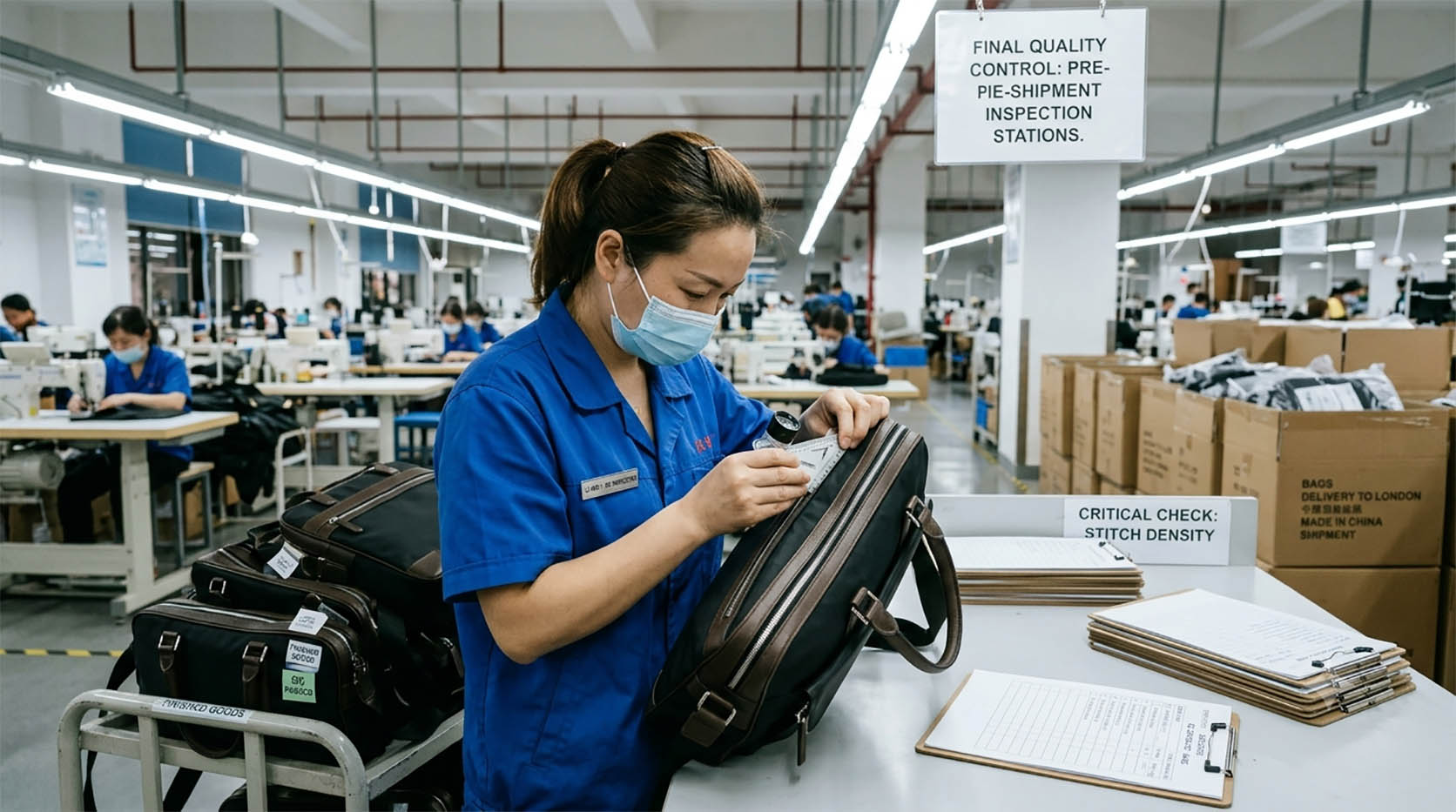
Pre-shipment inspections should verify stitching density, reinforcement placement, and hardware function—not just visual appearance.
The Buyer Strategy: How to Actually Find These Factories
Here’s the uncomfortable truth: the best Chinese bag factories are not on the first page of Alibaba search results. They are mid-sized OEM/ODM operations with 200–800 workers, in-house quality labs, and a stable client list of mid-market European and North American brands. They don’t compete on price—they compete on consistency, customization, and the ability to build to a spec.
The way you find them is by asking the right questions early, by paying for samples (never accept a “free sample” that isn’t built to your spec), and by treating the first order as a learning relationship rather than a one-off transaction.
For your website business, the safest path is to shortlist 4–6 factories, send them the same detailed inquiry (use the four follow-up questions and the ten benchmarks above), and qualify them on response quality, documentation, and sample construction. Then run a 50–100 unit pilot before committing to a full production run. The pilot is where you’ll find out whether the factory actually builds to spec, and it’s far cheaper to learn that at 100 units than at 2,000.
Final Thoughts
A bag that lasts longer and can be repaired is not a luxury anymore—it’s the baseline for any brand that wants to claim a real sustainability story. The US consumer is increasingly aware of this, and the brands that win over the next decade will be the ones that treat durability and repairability as core product features, not marketing bullet points.
Chinese factories can absolutely supply you with bags that meet these standards. The capability exists, the materials are accessible, and the engineering know-how is mature. What you need to bring to the table is the specification, the verification process, and the willingness to pay a small premium up front for a much larger return over the product’s life.
Spec it. Test it. Repair it. Stand behind it. That’s the playbook.
Post time: Jun-12-2026