
Sourcing Eco‑Friendly Bags From China: Recyclability, End‑of‑Life Guidance, MOQs and Circular Programs
What Chinese Bag Factories Can Deliver on Recyclable and Biodegradable Materials
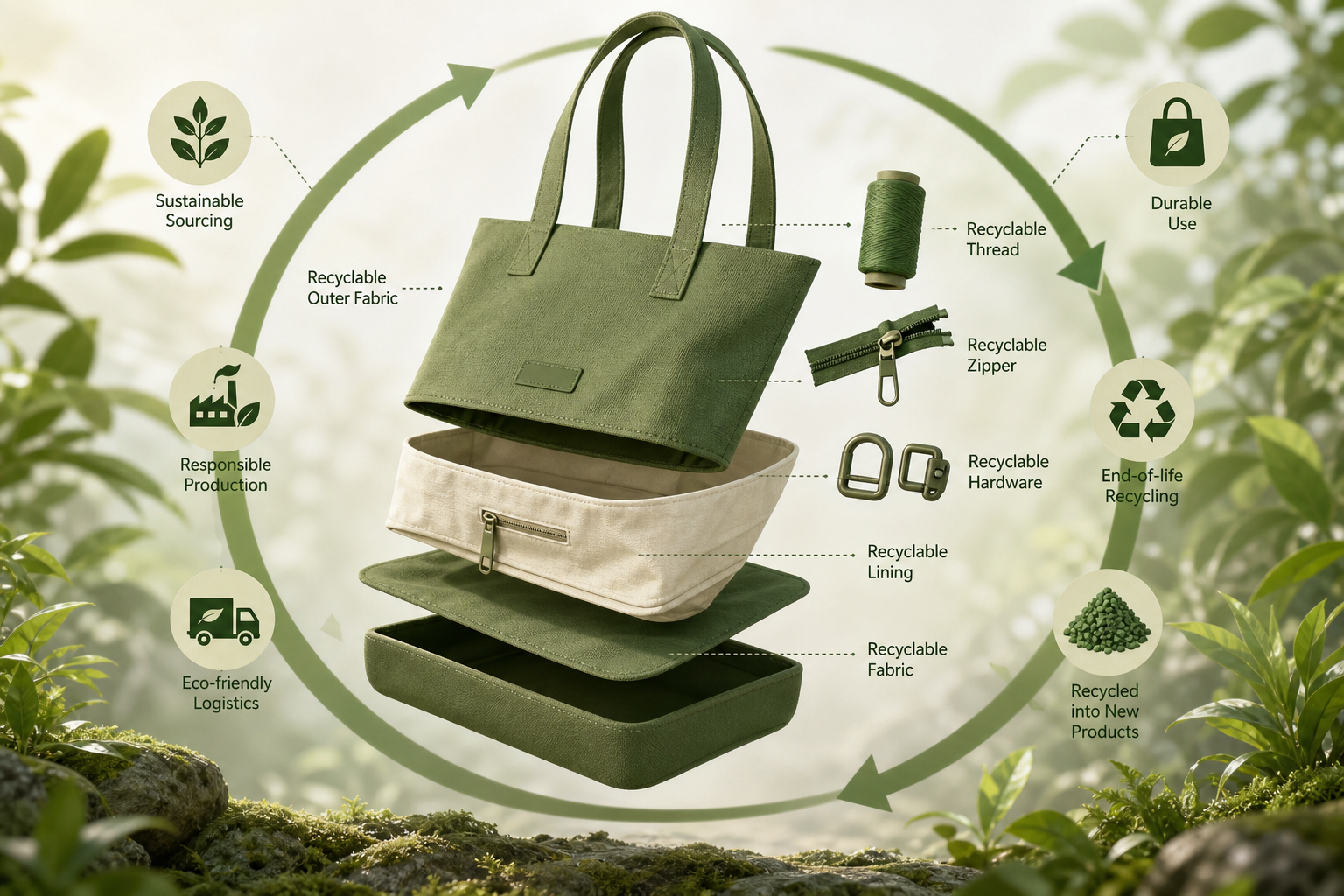
A growing number of experienced Chinese bag manufacturers have upgraded their production systems to prioritize recyclability by adopting mono‑material construction. Instead of blending dozens of different fabrics, adhesives and synthetic layers together, these factories design bags built from a single type of fiber or one consistent resin. Mono‑material design greatly simplifies sorting and processing at recycling facilities, which is the biggest bottleneck for textile recycling in North America.
Top eco‑focused factories also add transparent product documentation. They print full material composition lists on care labels or insert specification cards inside each finished bag. These documents list every component clearly, allowing American consumers and local recycling stations to separate recyclable and non‑recyclable parts correctly. Many suppliers further improve circular performance by using detachable hardware, including zippers, metal buckles, eyelets and embossed metal logos. Buyers or end users can remove these non‑textile pieces before sending the bag into recycling streams, drastically improving material recovery rates.
Certifications serve as verified proof of recycled content. Reliable Chinese suppliers hold Global Recycled Standard (GRS) or Recycled Claim Standard (RCS) certificates for bags containing post‑consumer or pre‑consumer recycled fibers. Unlike generic sales claims, GRS certification tracks recycled materials through the whole supply chain from raw fabric to finished goods. Beyond recycled fabrics, forward‑thinking factories apply bio‑based and biodegradable coatings such as PLA film and water‑based PU. These coatings reduce long‑term plastic pollution and avoid persistent synthetic chemicals that linger in landfills.
It is important to avoid over‑optimism. Factories can use sustainable materials at your request, but you must set clear requirements before production starts. Many general bag workshops own recycled fabric samples for display yet routinely switch back to mixed‑material laminates, PVC coating and composite liners for bulk orders unless buyers write eco specifications into purchase contracts. Never trust a simple “eco material” description on product listings without supporting certificates and batch‑specific test reports.
Can Chinese Suppliers Provide End‑of‑Life Disposal and Recycling Guidance for US Markets?
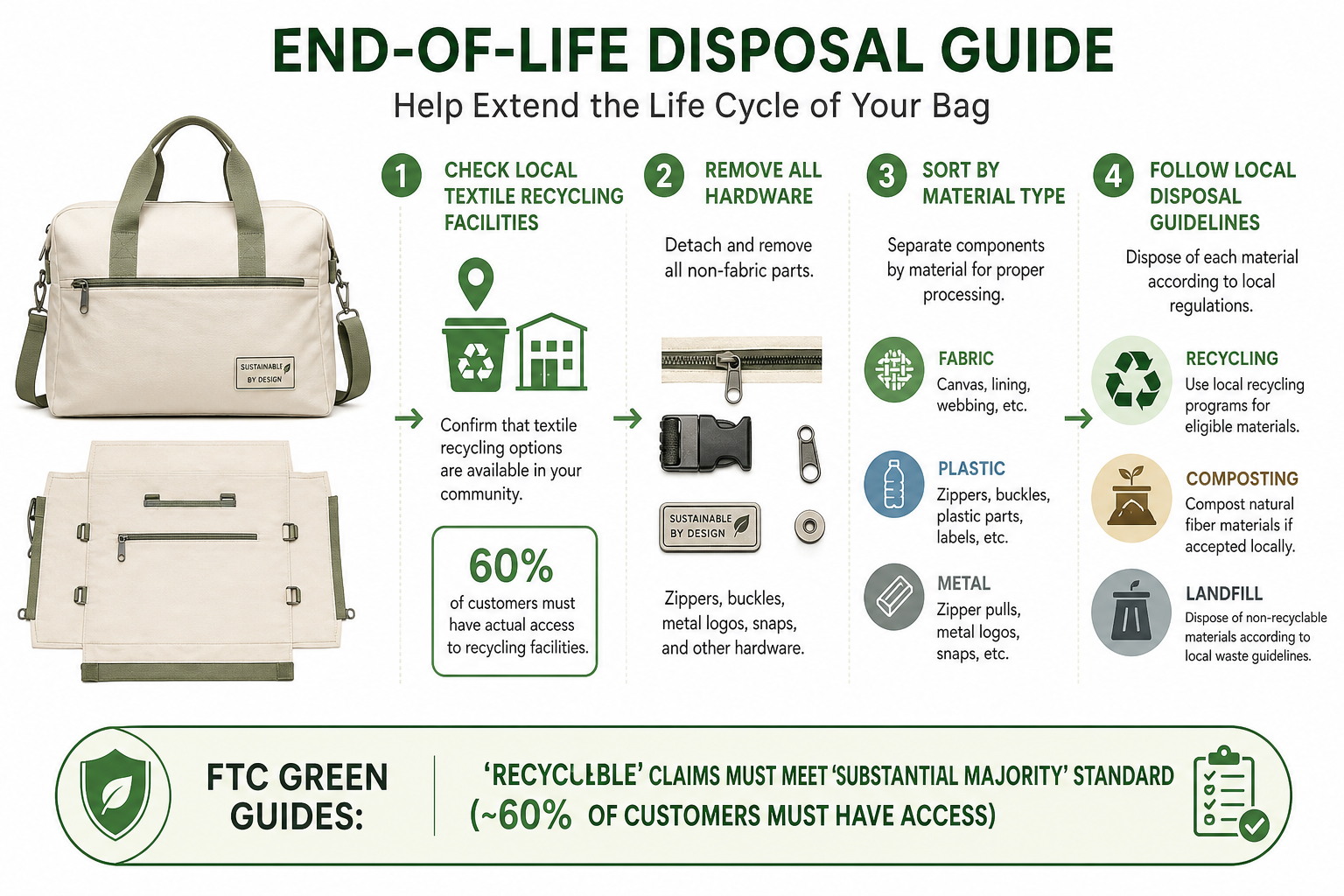
Yes, qualified Chinese bag suppliers are fully capable of creating professional end‑of‑life disposal and recycling guidance for exported products. The best manufacturers prepare official written documentation covering reuse options, textile recycling routes, plastic recycling rules, industrial composting requirements and proper landfill guidance when local recovery services are unavailable. Instructions also explain which accessories must be detached before recycling.
Several Chinese factories cooperate with third‑party recycling operators in the United States and Europe. These partnerships ensure exported bags match local recycling infrastructure rules, rather than relying on theoretical recyclability. A material may technically be recyclable in a laboratory environment, but it becomes useless for your customers if no nearby collection center accepts it. This is a major compliance risk under American advertising regulations.
Some advanced manufacturers also offer design‑for‑disassembly consulting services. Their engineering teams advise overseas buyers on stitching methods, glue selection and hardware choices to make future recycling easier. For premium eco‑brands, certain suppliers can supply condensed Life Cycle Assessment (LCA) summaries. LCA documents calculate environmental impacts across the entire product journey, from raw‑material manufacturing to final disposal, which adds huge credibility for high‑end independent store content and wholesale pitches.
One key detail US sellers must remember: your supplier’s guidance must fit American local conditions. The United States does not have uniform nationwide textile recycling infrastructure. FTC Green Guides require recyclability marketing claims to reach a “substantial majority” standard, meaning roughly 60% of your target customers must have practical access to recycling programs for that finished product. If recycling is only available through specialized drop‑off locations, broad “100% recyclable” marketing language violates US advertising rules. You need qualified, careful wording such as “Designed for textile recycling where accepted. Check local facilities. Remove metal and plastic components before disposal.”
Low‑MOQ Recyclable Bags: Small B2B Orders From Chinese Manufacturers
Recyclable bags manufactured in China are available for low‑volume B2B orders, but there is no universal fixed minimum order quantity. MOQ rules are calculated separately for each finished bag style, fabric type and certification requirement.
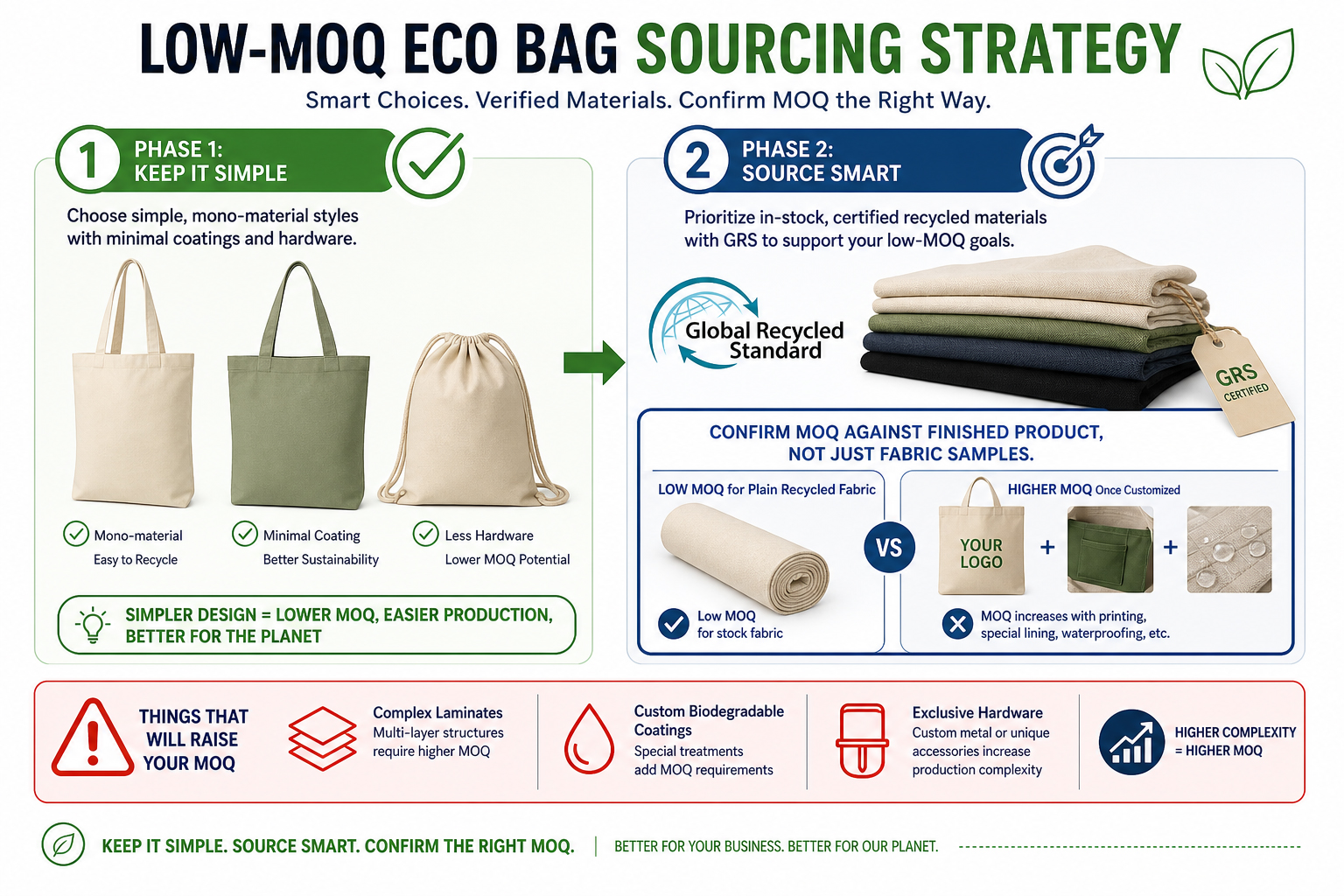
Large factories with automated mass production usually set high MOQs for GRS‑certified recycled fabric runs because certified raw materials require separate production lines and traceability records. However, many mid‑sized Chinese eco workshops accept small B2B batches for independent online merchants. The trade‑offs are predictable: smaller orders usually carry higher unit prices and longer lead times for certified fabrics.
For US independent website owners, low‑MOQ sourcing works best when you select simple mono‑material styles with minimal coatings and few decorative metal accessories. Complex laminated designs, custom biodegradable coating formulas and exclusive custom hardware will almost always raise minimum order limits. Always confirm MOQs against the final finished product, not just fabric samples. Some suppliers advertise low MOQs for plain recycled fabric yet demand large quantities once you add printed logos, special linings or waterproof layers.
Take‑Back and Circular Economy Programs From Chinese Bag Factories
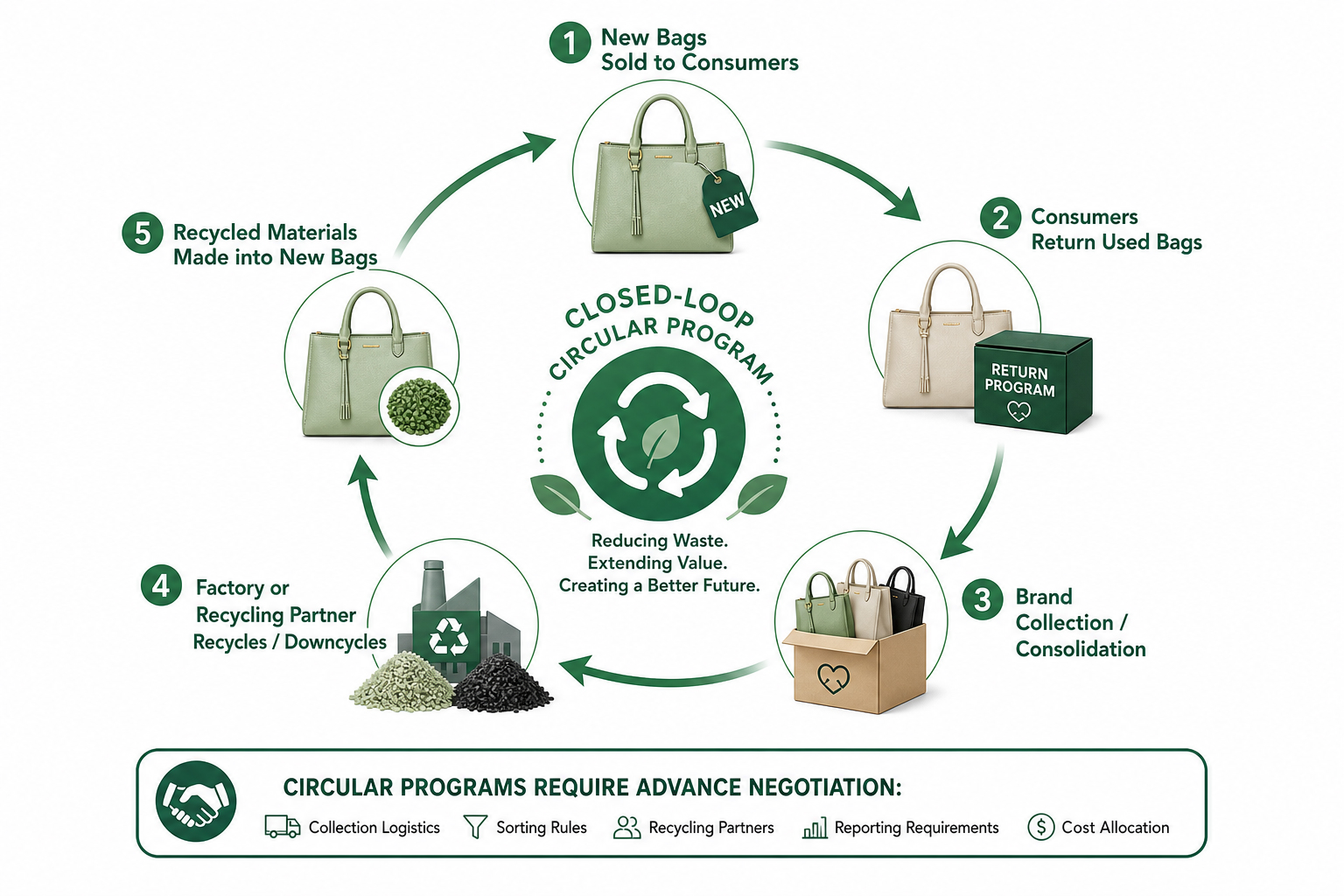
A small but growing group of Chinese bag factories provide take‑back and buy‑back circular economy programs. Under these schemes, old and worn bags are collected, consolidated and sent for material recovery or downcycling into new textile goods. Participating factories can provide official records showing collected volumes and processing results for brand storytelling on your website.
Still, you should understand the current market reality. Most Chinese factories do not run independent global take‑back systems on their own initiative. These circular programs are normally built according to the buyer’s exact standards and commercial agreements. If your brand wants to launch a consumer take‑back campaign in the US, you must negotiate terms in advance. Clarify collection logistics, sorting rules, recycling partners, reporting requirements and cost allocation before placing bulk orders.
Do not expect your supplier to automatically operate a US‑based bag recovery network. The factory’s strength lies in product design, material selection and downstream recycling cooperation. Your brand will still need to organize local American collection points or partner with domestic textile recyclers to complete the circular loop.
A Complete Supplier Verification Checklist for US B2B Buyers
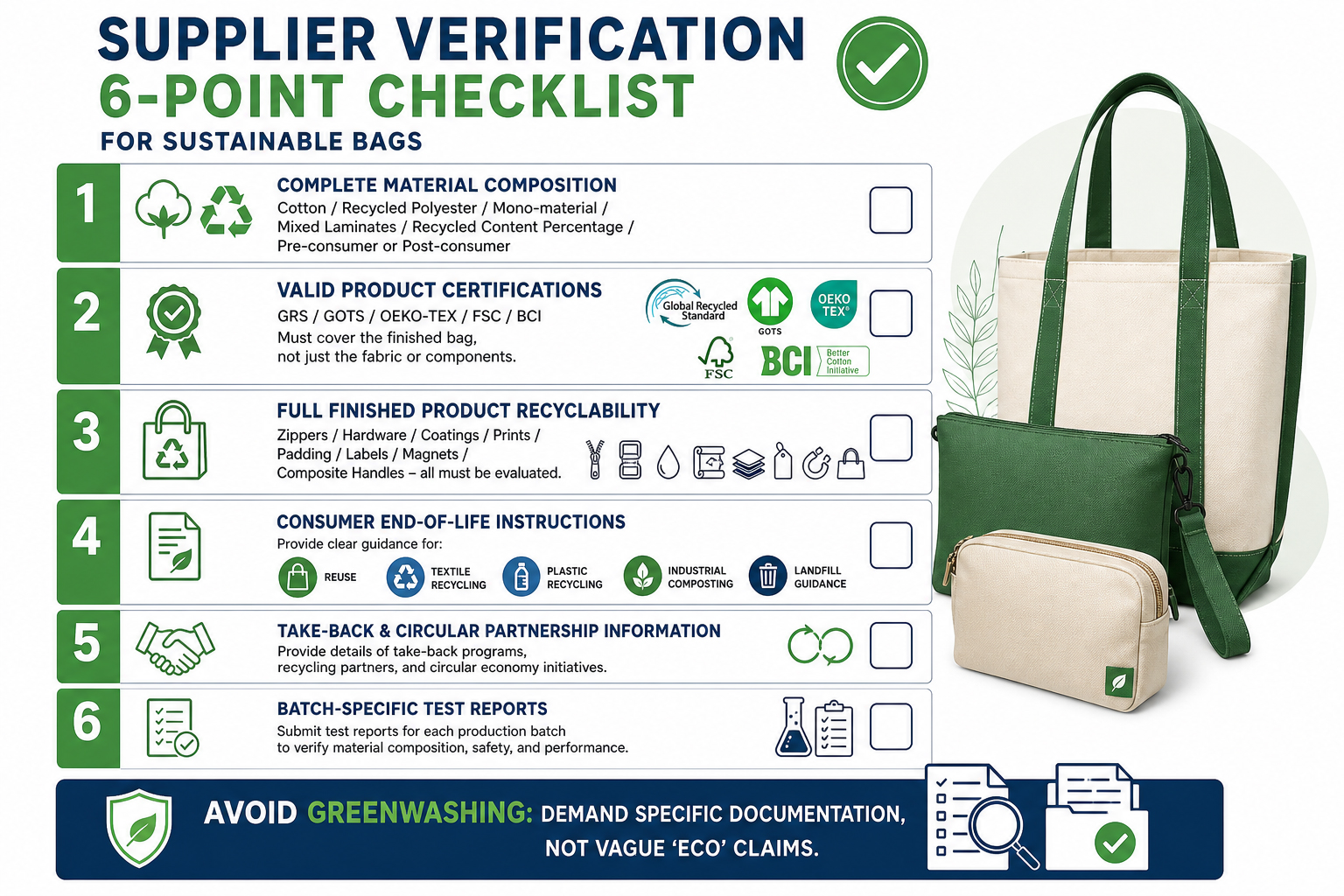
To avoid greenwashing and FTC compliance trouble, send every potential Chinese supplier this standardized questionnaire before confirming orders.
* Exact material composition Request a full breakdown: cotton, recycled cotton, polyester, rPET, nylon, PP, jute, canvas, PU or PVC. Confirm whether the bag uses a single material or mixed laminates. Ask for the percentage of recycled content and verify whether recycled material is post‑consumer or pre‑consumer waste.
* Valid product certifications Ask for GRS for recycled‑content traceability, GOTS for organic fibers, OEKO‑TEX for harmful‑substance testing, FSC for paper‑based materials and BCI documentation for sustainable cotton. Remember generic certificates for raw fabric are not enough; certifications must cover the final finished bag.
* US‑market recyclability of the complete finished product Do not only check the main fabric. Require suppliers to evaluate zippers, metal eyelets, PVC or PU coatings, screen printing, metallic foil, padding, sewn‑in labels, magnets and composite handles. Every extra mixed component reduces real‑world recyclability in American communities.
* Consumer‑friendly end‑of‑life written instructions Obtain formal documents covering reuse strategies, textile recycling, plastic recycling, industrial composting and proper disposal when recycling is unavailable. The guide must explain which non‑recyclable parts should be removed before disposal.
* Take‑back and recycling partnership information Ask whether the factory or its recycling partners can accept returned used bags, consolidate collected goods, recycle or downcycle them and provide transparent processing reports.
* Batch‑specific test reports Insist on lab documents with clear laboratory names, test dates, product references, adopted testing standards and pass‑or‑fail results. Confirm reports apply to finished bags instead of only raw fabric rolls.
Material‑by‑Material Recyclability Guide for Imported Bags
Not all sustainable fabrics perform equally at the end of product life, and recycled input materials do not guarantee recyclability after consumer use.
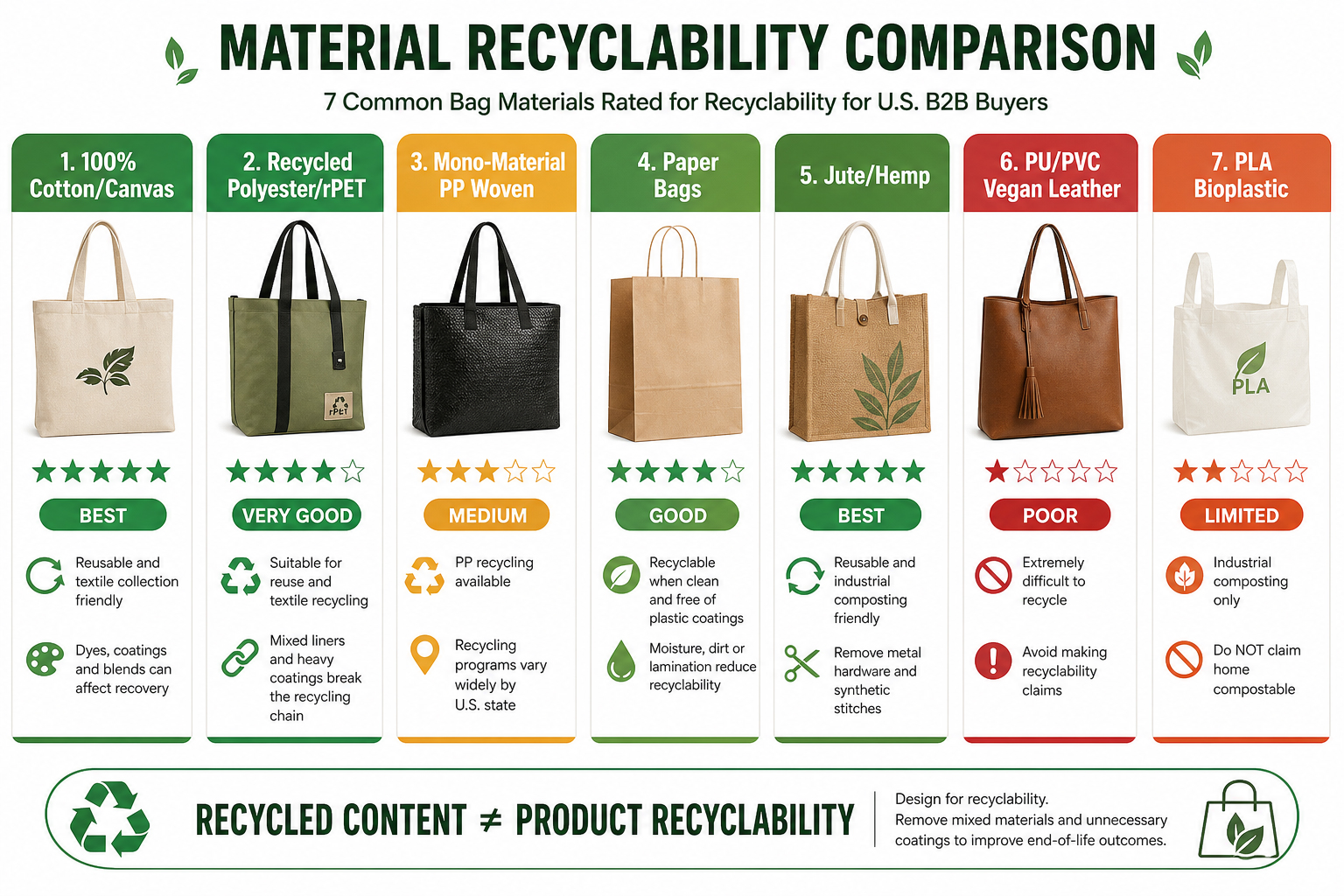
* 100% cotton or canvas: Best suited for reuse and textile collection. Dyes, waterproof coatings, printed foil and blended threads will interfere with fiber recovery.
* Recycled polyester and rPET: Great for reuse and textile recycling. The biggest myth is assuming recycled fabric automatically makes the finished bag widely recyclable in US cities. Mixed liners and heavy coatings break the recycling chain.
* Mono‑material PP woven bags: Suitable for PP recycling, but local US collection programs vary widely between states and towns.
* Paper bags: Recyclable only when clean and free of plastic lamination, foil layers and wet‑strength coatings.
* Jute and hemp: Reusable and compostable under industrial conditions. All metal hardware and synthetic stitching must be removed before composting.
* PU or PVC vegan leather: Extremely difficult to recycle. Avoid recyclability marketing unless you obtain product‑specific third‑party proof.
* PLA bioplastic: Almost only acceptable for industrial composting. Never claim home compostability without official certification.
Risky Green Marketing Claims to Avoid on Your US Independent Site
Many imported eco‑bag brands face FTC complaints because of vague, unsubstantiated wording. Steer clear of these broad phrases: “100% eco‑friendly,” “zero waste,” “biodegradable,” “compostable,” “fully recyclable,” “made from recycled materials” and “sustainable Chinese manufacturing.”
Every environmental statement needs precise supporting evidence. “Made with 60% post‑consumer recycled polyester” is credible and safe. If your product can only be recycled at specialized facilities, use qualified, responsible copy: “Designed for textile recycling where accepted. Check local facilities. Remove metal and plastic components before disposal.”
Recommended Contract Clauses for Purchase Agreements
Add this binding requirement into every purchasing contract with Chinese bag manufacturers:
Supplier shall disclose the complete material composition of the finished bag, including fabric, coatings, inks, thread, labels, closures, padding, and accessories. Supplier shall provide accurate documentation for all recycled‑content, organic, recyclable, biodegradable, and compostable claims. Supplier shall provide written end‑of‑life instructions and identify any known recycling or take‑back partner. Supplier shall not change materials, coatings, or components without the buyer’s written approval.
Always order pre‑production samples and cross‑check mass‑delivery batches against approved material specifications. A common supplier trick is using certified recycled fabric for sample bags while switching to cheaper non‑recyclable coatings and mixed liners for bulk shipments.
Final Sourcing Strategy for Your US Independent Bag Brand
The most competitive eco‑bag products for American B2B online stores share six traits: long‑wearing construction focused on repeated reuse, simple mono‑material design, fully documented recycled fiber content, minimal coating and hardware, verified laboratory test reports, customized US‑focused disposal guides, and optional take‑back textile recovery partnerships.
When you negotiate with Chinese factories, ask one direct, non‑negotiable question: “For this exact finished bag, what percentage is recyclable in the United States, which components are not recyclable, what facilities accept it, and what written evidence supports your answer?” Generic photos, vague eco slogans and fabric‑only certificates are not acceptable proof.
Sourcing sustainable bags from China is not about picking a factory that advertises “green production.” It means building strict, verifiable standards, documenting every environmental claim, and designing products with end‑of‑life disposal in mind from the very beginning. When you bring this level of professional transparency to your independent website, your brand stands out from competitors relying on empty eco‑marketing and wins trust from eco‑focused wholesale buyers and end consumers across the United States.
Post time: Sep-10-2026