
Why This Guide Exists
Three years ago, when we first started asking our Chinese manufacturing partners about recycled polyester (rPET) made from post-consumer plastic bottles, the conversation was awkward. Most factories didn’t have a clear answer. Some tried to upsell us on “eco-friendly” fabrics with no certification to back it up.
Today, the situation has completely changed. After more than a dozen supplier visits across Guangzhou, Yiwu, and Quanzhou — and after placing over 80,000 units through GRS-certified production lines — we’ve learned exactly what works, what doesn’t, and what every US-based bag brand needs to know before placing their first sustainable order.
This guide distills everything we’ve learned. Whether you’re sourcing backpacks, totes, laptop bags, or travel duffels, this is the playbook we wish someone had handed us on day one.
The Short Answer: Yes, Chinese Factories Can Supply GRS-Certified rPET Bags
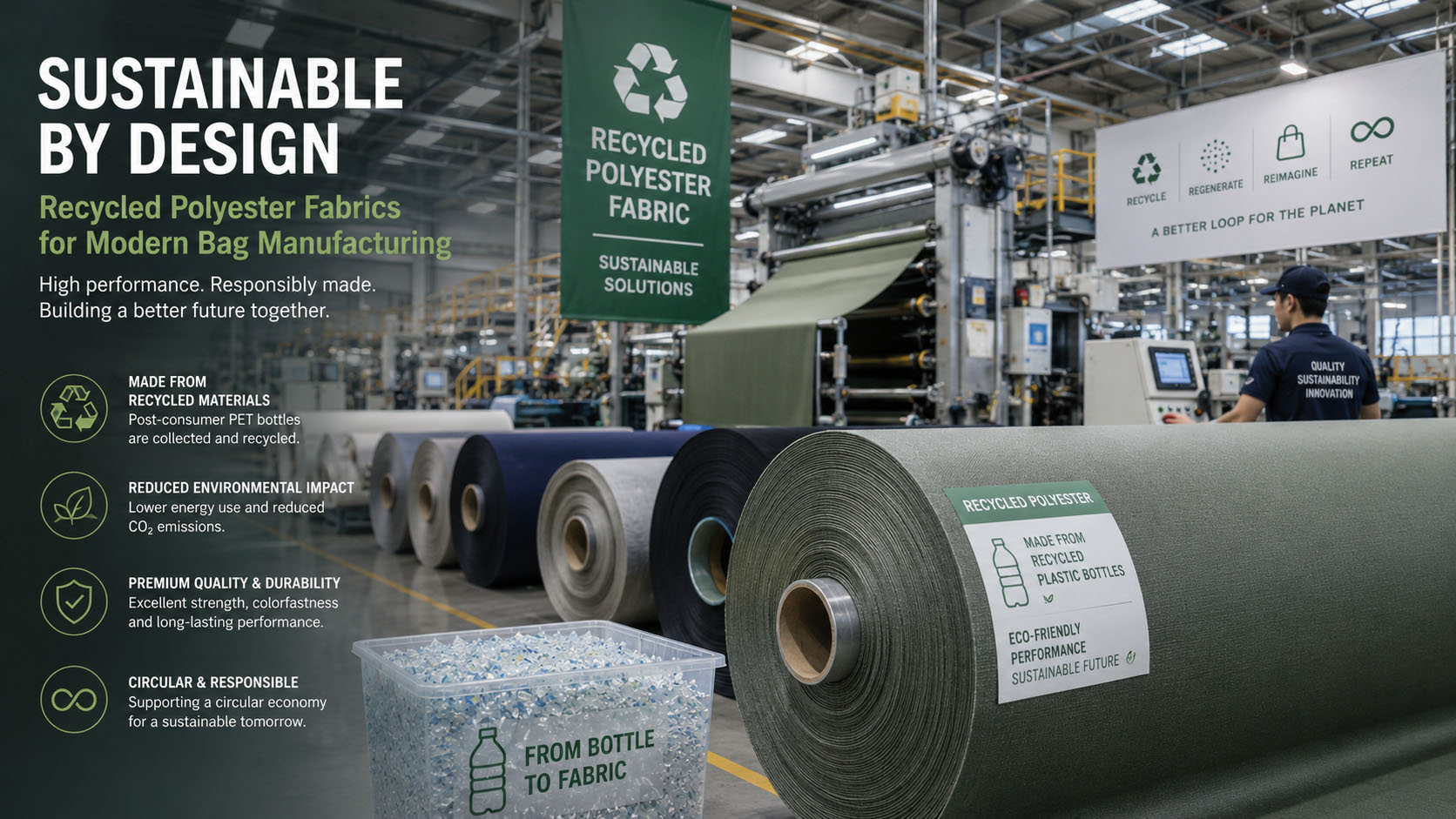
Yes — Chinese factories can supply recycled polyester made from post-consumer plastic bottles, and many also offer GRS-certified options for traceability and recycled-content claims. (Source: FYTextiles)
But “can they” and “should you” are two different questions. Let’s break down what you need to know before you wire any money.
What to Ask Your Supplier
When you first contact a factory, use these specific questions to filter the experienced manufacturers from the greenwashers:
“Do you supply recycled polyester made from post-consumer PET bottles?”
“Is the material GRS certified?”
“Can you provide a valid GRS Scope Certificate and Transaction Certificate for the fabric or bags?”
“What is the recycled content percentage, and is it from bottle-to-fiber or textile-to-textile feedstock?”
If a supplier can’t answer these within 24 hours, move on.
Why GRS Certification Actually Matters
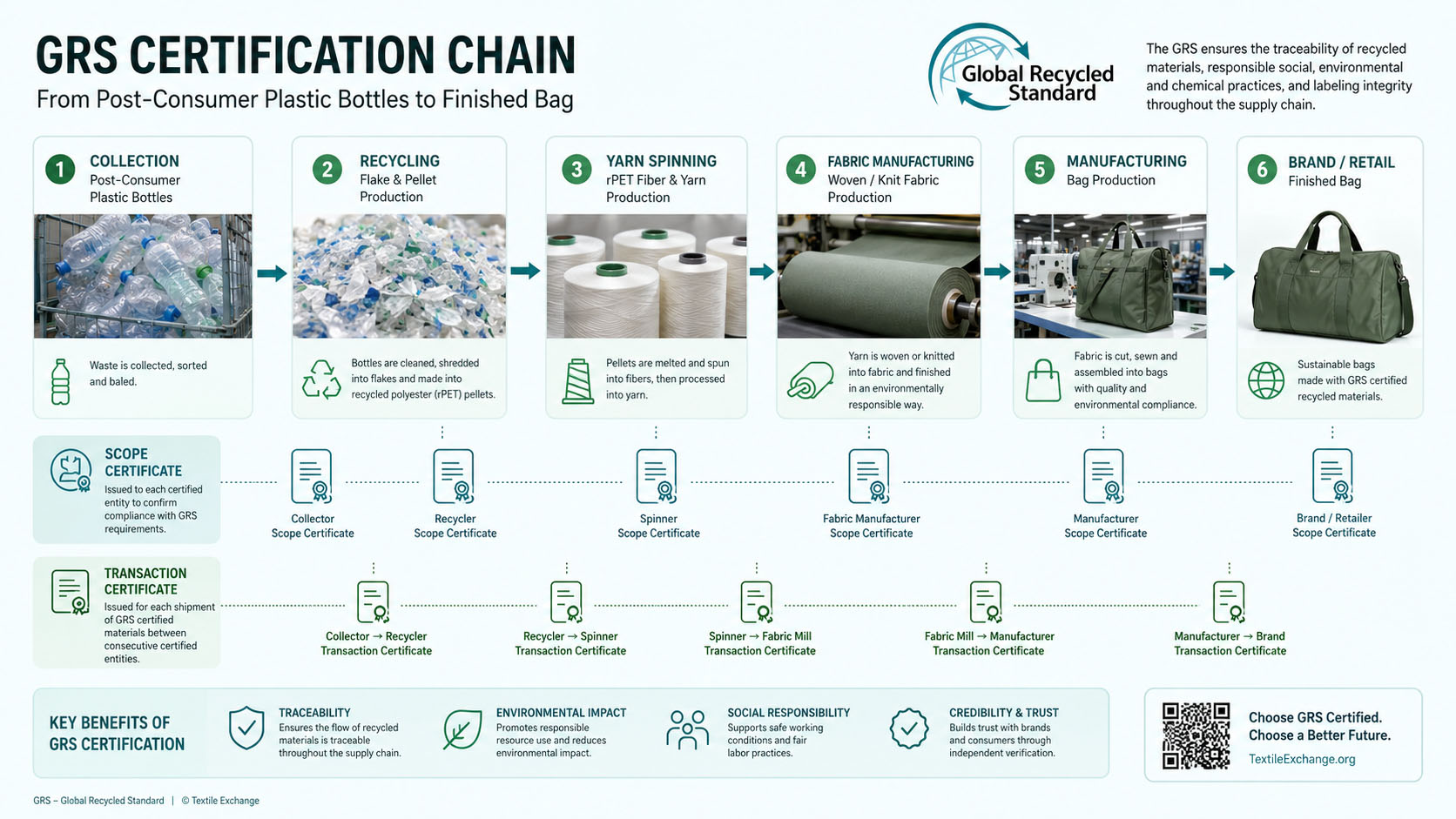
GRS is important because it verifies recycled content and supply-chain traceability, not just a marketing claim. Some suppliers in China publicly state that their recycled polyester is made from plastic bottles and that they support GRS-certified supply chains. (Source: NPC)
In plain English: a factory can claim its fabric is “recycled” without GRS. But only GRS gives you the third-party paper trail to prove it to your customers, your retail partners, and — if it ever comes up — the FTC.
What GRS-Certified rPET Actually Looks Like (The Real Specs)
Let me share what we see on actual production orders:
Recycled content: Reputable Chinese factories now offer rPET fabrics containing 50%–100% post-consumer recycled plastic bottle content, with GRS-certified options as standard.
Hand feel: At 100% rPET, modern fabrics are virtually indistinguishable from virgin polyester. The old “crunchy recycled” feel is gone.
Available deniers: 300D, 600D, 900D, 1200D, and 1680D ballistic — covering everything from lightweight packing cubes to heavy-duty duffels.
Color range: Standard black, gray, navy, and olive are always available. Custom Pantone matches typically require 200–500 kg MOQ at the mill level.
The Documentation You Must Get (Non-Negotiable)
Here’s where most first-time buyers get burned. GRS has a strict chain-of-custody model, and if any link in your supply chain lacks certification, the finished bag loses its GRS status.
What You Need in Your Hand Before Production Starts
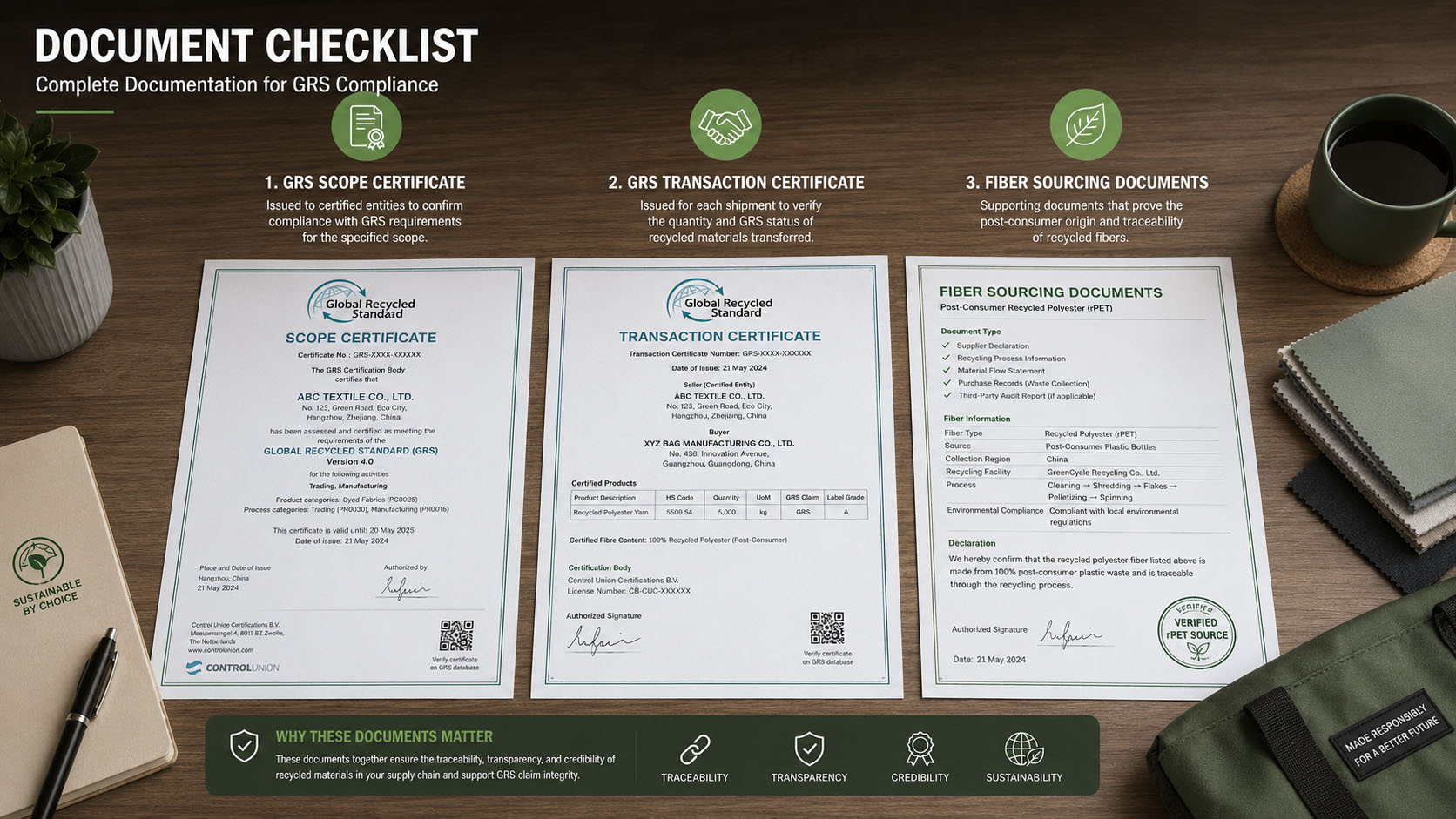
1. A valid GRS Scope Certificate held by the factory — and a separate scope certificate from the fabric mill. This is required to issue a transaction certificate for each shipment.
2. A third-party Scope Certificate for every component supplier (lining, webbing, thread, zippers) — if these aren’t GRS-certified, the finished bag cannot be.
3. A Transaction Certificate (TC) that must accompany every export shipment to allow US buyers to make verified recycled-content claims to their own customers.
Pro tip from the field:
“We once had a $40,000 order held at Long Beach port for 11 days because our zipper supplier’s GRS certificate had expired 3 weeks earlier. The factory hadn’t checked. Now we audit every sub-supplier certificate ourselves.”
MOQ, Pricing, and Lead Times: Real Numbers
Let’s talk dollars and days. These are the ranges we’ve negotiated over the past 18 months:
MOQ (Minimum Order Quantity)
Custom rPET orders (your design, your specs): Factory MOQs typically start at 300–500 pieces per style per color.
Stock designs in standard colors: Some factories offer 100–200 piece MOQs for in-stock GRS rPET styles.
Custom Pantone colors: Add 300–500 kg fabric MOQ at the mill, which usually means 1,000+ bags at the finished-goods level.
Pricing
rPET fabric prices fluctuate with crude oil and recycled-chip market conditions, so buyers should request price holds or fixed-price contracts for long-term orders.
Expect a 20%–35% premium over virgin polyester for GRS-certified rPET.
A typical 20L daypack in 600D GRS rPET runs $7.50–$11.20 FOB depending on hardware, lining, and order volume.
Always request a written price-hold of 30–60 days — recycled chip prices can swing 8–12% in a single month.
Lead Times
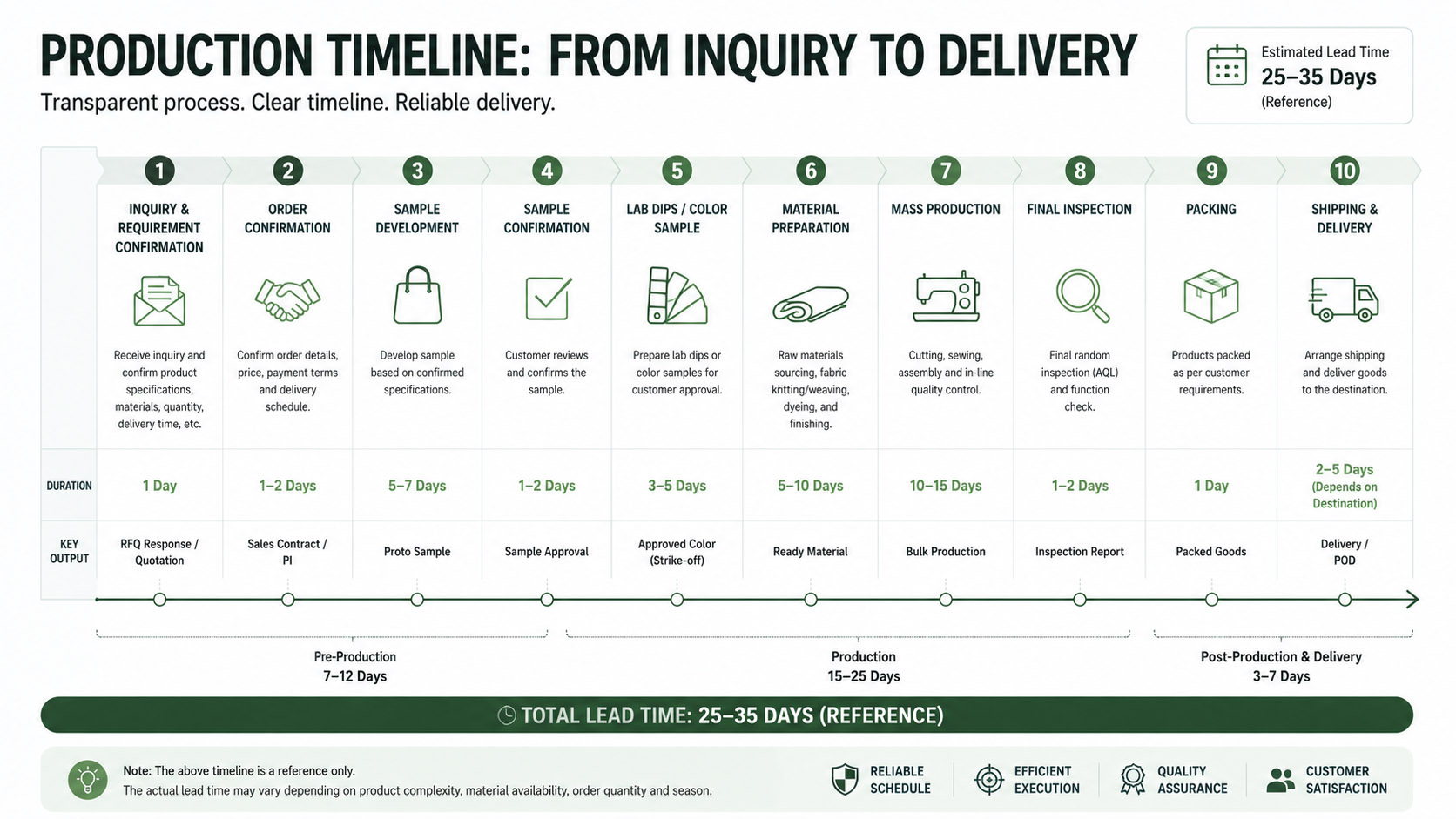
Custom GRS rPET production generally runs 30–45 days after sample approval, plus an additional 7–10 days for pre-shipment inspection and certification paperwork.
Lab-dip approval: 5–7 days. Always require a lab-dip signed-off before bulk production begins — color shifts between rPET and virgin PET are real and measurable.
Pre-shipment sample (PSS): Always, always, always request a sealed pre-shipment sample before the goods leave port.
Production Gotchas Most Buyers Never See
After hundreds of thousands of units, here are the issues that consistently catch new buyers off guard:
1. Heat-Sensitive Fibers
rPET fibers have a slightly lower melting point than virgin polyester, so heat-transfer logos and certain sublimation prints require adjusted temperature settings to avoid scorching. We learned this the hard way with a $12,000 order where 18% of the units had visible scorch marks around the logo placement.
Fix: Ask the factory to run a heat-test panel (5–10 units) before bulk production. Drop the press temperature by 10–15°C from the virgin PET setting.
2. Color Consistency
rPET absorbs dye slightly differently than virgin PET, especially in dark colors and neons. A black that looks identical to virgin PET black on a single swatch can show a greenish or brownish cast under daylight.
Fix: Request a sealed lab-dip AND a production sample (first 50 units) for color sign-off before continuing bulk.
3. Lining Compatibility
Not all linings are GRS-certified. If you use a non-GRS lining, your finished bag loses GRS status — even if the outer shell is certified. We now specify GRS-certified 210D or 420D polyester linings as standard.
Closed-Loop Manufacturing: The Real Sustainability Story
Here’s something most bag brands don’t talk about, and most buyers don’t ask about: what happens to the factory waste from your order?
Factory waste from rPET cutting and sewing can be collected and sent back to the fabric mill for re-granulation, creating a closed-loop system within the supply chain. This means the offcuts, selvage, and rejected units from your production run don’t go to landfill — they get re-pelletized and turned back into yarn.
What to ask your factory:
“Do you collect and recycle your cutting waste?”
“Can you provide a waste-diversion report for our order?”
“Is your fabric mill a closed-loop producer?”
The third question is the most important. Closed-loop production is still rare in China, but the number of mills offering it has roughly tripled in the past two years.
Sustainable manufacturing: cutting table fabric scraps being collected for recycling
US Customs & Long-Term Compliance
Here’s a piece of advice that could save you a six-figure headache:
US Customs may request GRS documentation during import clearance, so buyers should keep TC files on file for at least five years to support any future audit or claim verification. (Source: EcoLife)
We organize our GRS files by:
PO number
Supplier name
Certificate number
Shipment date
Expiration date
We also keep the original certificates (not just PDFs) for at least the first 2 years after import. If your brand ever gets acquired or goes through a sustainability audit, this documentation is gold.
Common Customs Issues We’ve Seen
Expired sub-supplier certificates (most common)
Mismatched product descriptions between the invoice and the TC
Missing fiber-source documentation for non-bottle feedstock (e.g., industrial scrap)
Incomplete chain of custody when a US-side warehouse re-labels the goods
Going Beyond rPET: Building a Fully Sustainable Line
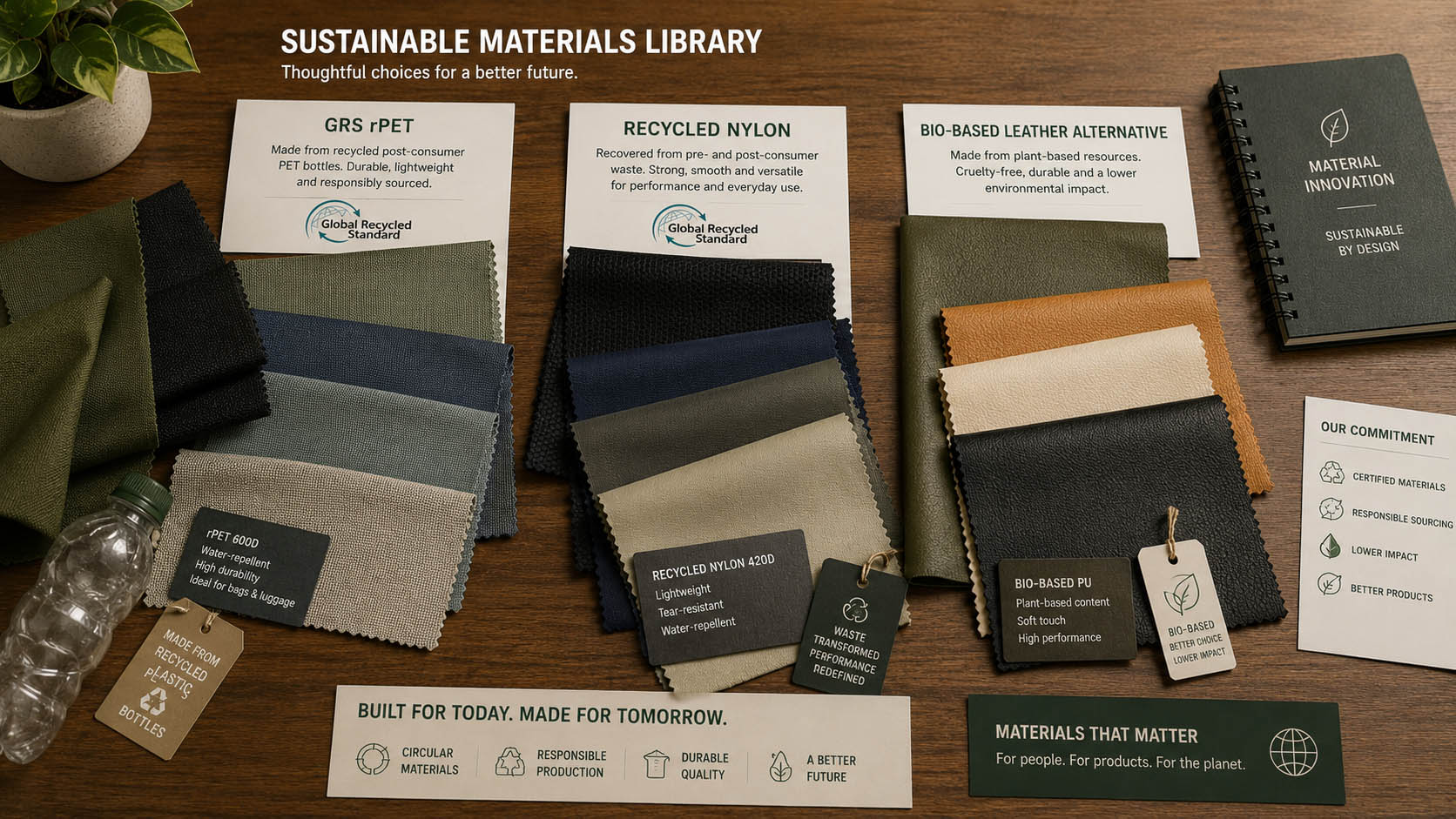
The factories we’ve built long-term relationships with don’t just stop at rPET. Factories experienced in GRS rPET production can also coordinate Bluesign, OEKO-TEX, and GOTS certifications on the same order to meet multi-standard sustainability requirements.
Here’s how we structure our sustainable collections:
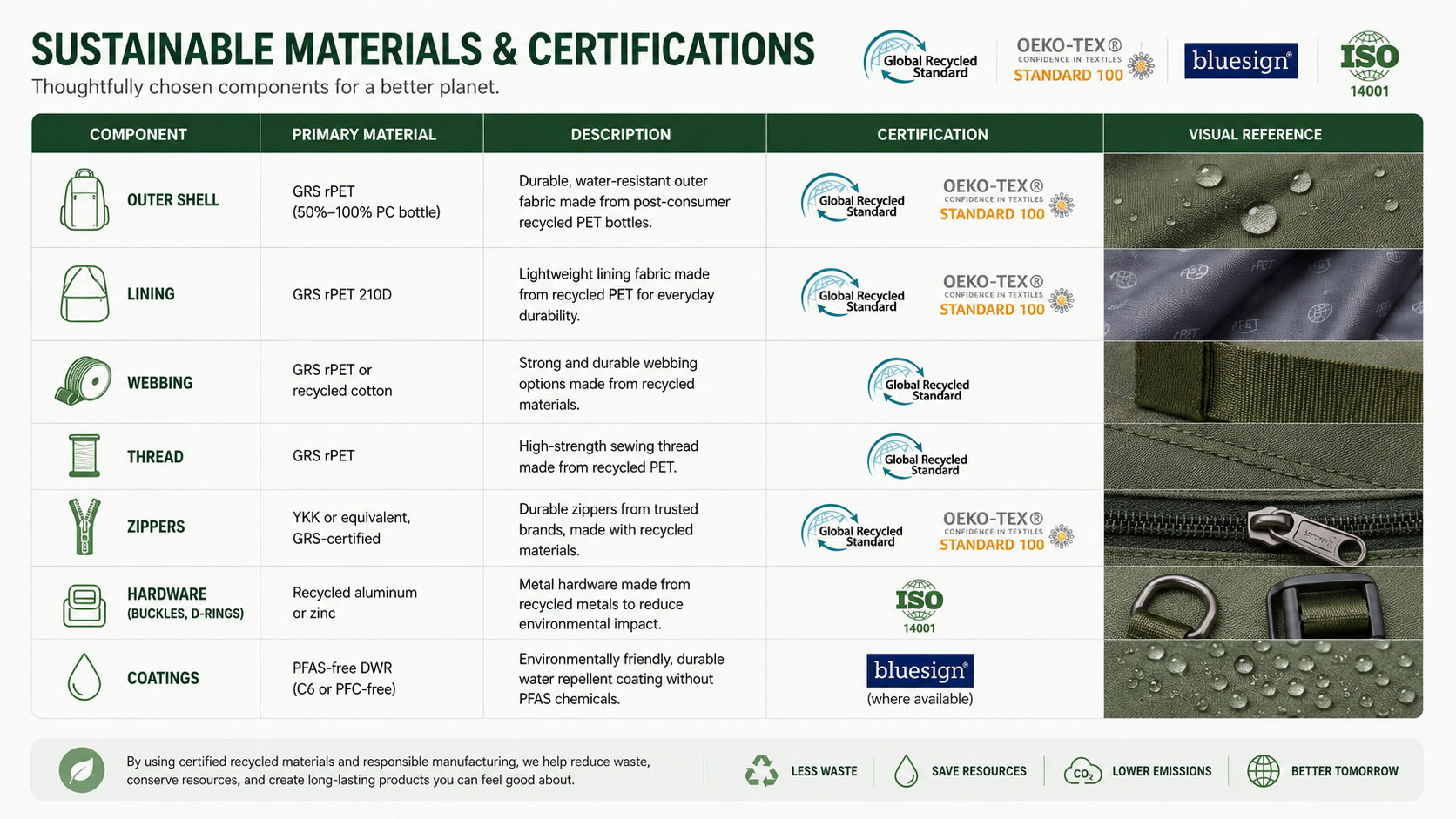
This “stack approach” lets us make multiple verified claims on a single product: “Made with 100% post-consumer recycled plastic bottles,” “OEKO-TEX certified,” “PFAS-free water repellency,” and so on.
Your Pre-Production Supplier Checklist
Before you wire a deposit, request and verify:
GRS Scope Certificate (factory)
GRS Scope Certificate (fabric mill)
GRS Scope Certificates (lining, webbing, thread, zipper suppliers)
Fiber source description (bottle-to-fiber, textile-to-textile, etc.)
Factory audit reports (GRS, ISO 14001, or BSCI)
Third-party lab test reports (OEKO-TEX, REACH, CPSIA)
Sample swatches with full material spec sheets
Lab-dip approval (signed off in writing)
Pre-shipment sample (sealed and signed off)
Written price-hold confirmation
Confirmed lead time and shipping schedule
Certificate expiration dates (all sub-suppliers, not just the factory)
Frequently Asked Questions
Q: Is the finished bag certified, or just the fabric?
A: Both can be — but only if every component in the supply chain is GRS-certified. The factory’s finished-goods scope certificate covers assembly, but each material input needs its own chain-of-custody documentation.
Q: Can I mix GRS-certified fabric with non-certified zippers?
A: Technically yes, but the finished bag cannot carry the GRS mark on the end product. Most US brands now require all major components to be GRS-certified to maintain claim integrity.
Q: How long is a GRS certificate valid?
A: Typically 12 months from issue date. Renewal audits are required annually.
Q: What’s the typical carbon savings vs. virgin PET?
A: GRS rPET made from post-consumer bottles uses roughly 50–60% less energy and generates 60% fewer CO₂ emissions than virgin PET, depending on the LCA methodology used.
The Bottom Line
Sourcing GRS-certified recycled polyester bags from China is no longer the Wild West it was five years ago. The factories exist, the documentation systems are mature, and the price premiums — while real — are predictable and manageable.
The three things that determine whether your project succeeds or fails:
1. Documentation discipline — every link in the chain, every shipment, every certificate.
2. Pre-production testing — lab-dips, heat panels, color samples, sealed pre-shipment samples.
3. Long-term supplier relationships — the factories that consistently deliver GRS-certified work are the ones who’ve invested in the audit and documentation systems. Find them, visit them, and grow with them.
We’ve built our entire bag line on these principles, and our customers can verify every sustainability claim we make — all the way back to the post-consumer plastic bottle.
Have questions about sourcing GRS-certified bags from China? Drop them in the comments below or reach out to our sourcing team directly. We share supplier lists, factory audit notes, and pricing benchmarks with verified US-based bag brands — because the more transparent this industry becomes, the better it is for everyone.
Post time: Jun-08-2026