
Sourcing Plant-Based & Bio-Based Leather Bags from China: A Complete Buyer’s Guide for U.S. Bag Sellers
How cactus, mushroom, pineapple, and apple leather are reshaping the handbag, backpack, and travel bag industry — and what every U.S. DTC brand needs to know before placing a bulk order with a Chinese factory.
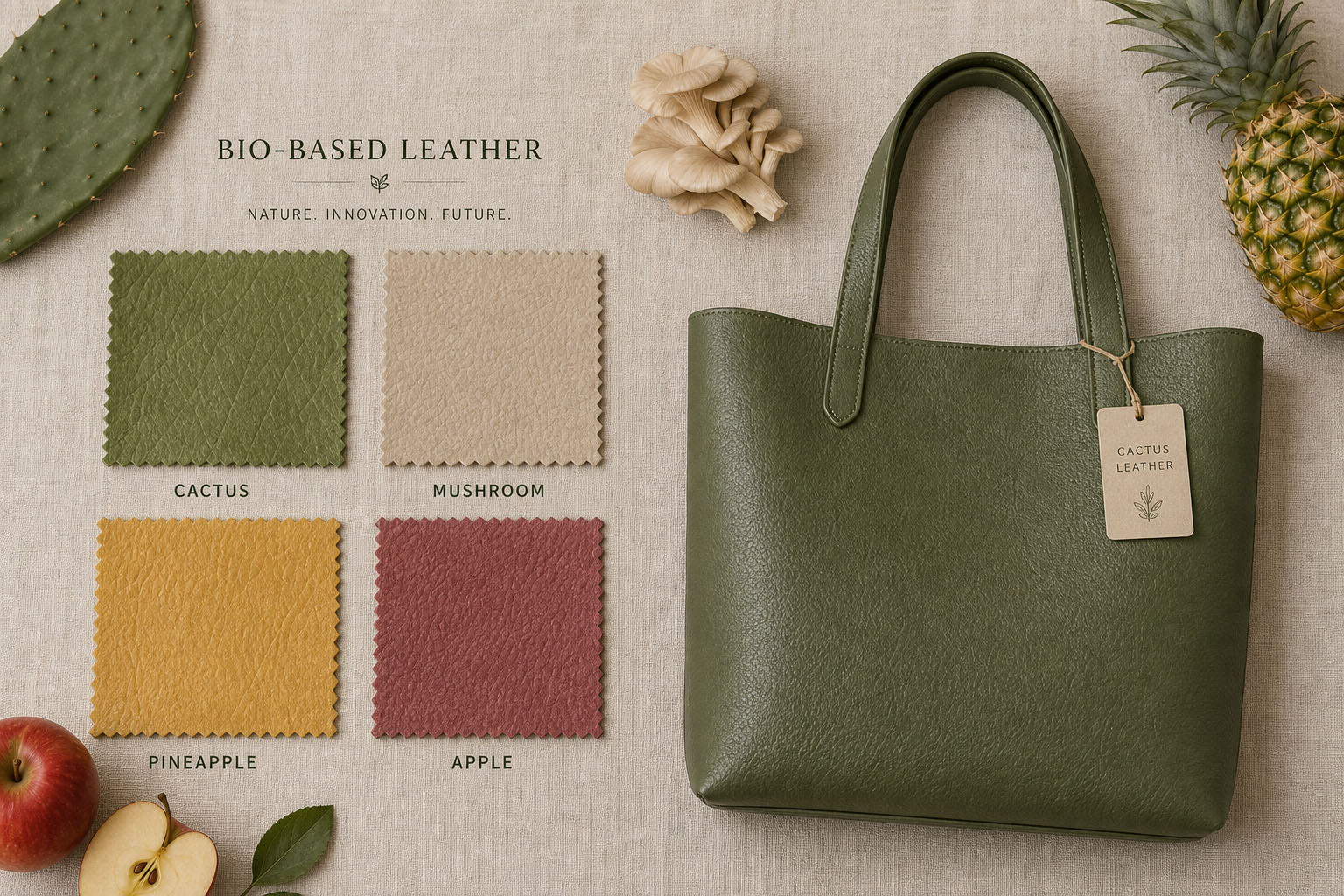
Introduction: Why Bio-Based Leather Is No Longer a Niche Trend
If you sell handbags, backpacks, or travel bags online to American consumers, you’ve already felt the shift. Search volume for “vegan leather bag” has more than doubled in the last three years on Google Trends. Millennial and Gen Z buyers are reading material labels the way they used to read nutritional facts. And in 2024, multiple U.S. department store buyers told Vogue Business that any new handbag line submitted for wholesale consideration must include at least one non-animal-hide option in the collection.
The good news for U.S. sellers sourcing from China: the supply chain has caught up. Chinese bag factories — especially those clustered in Guangzhou, Shenzhen, and Quanzhou — now routinely work with plant-based and bio-based leather alternatives, including cactus (Desserto), pineapple (Piñatex), apple (AppleSkin), and even mycelium (mushroom) leather. But “routinely” does not mean “identically.” Each material behaves differently in terms of MOQ, price, hand-feel, durability, certification, and U.S. import compliance.
This guide breaks down everything a U.S. bag buyer needs to ask a Chinese factory before committing to a bulk order, so you can build a product line that is both commercially viable and genuinely sustainable.
What “Plant-Based Leather” Actually Means (and What It Doesn’t)
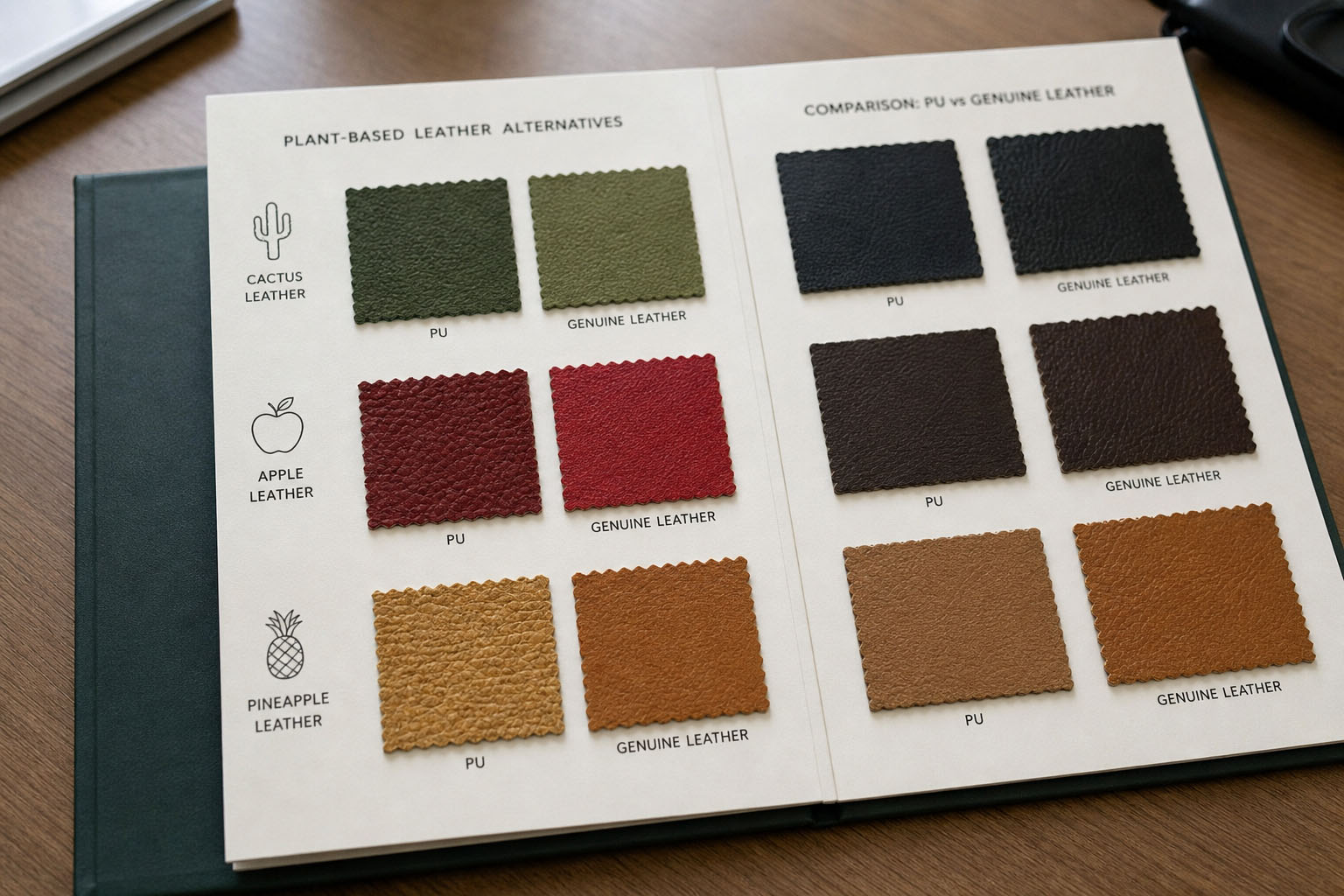
Before we get into factory questions, let’s clear up a common sourcing pitfall. In the Chinese supply market, the term “vegan leather” is used loosely. Some suppliers apply it to conventional polyurethane (PU) or PVC synthetic leather that contains no animal content but is also 100% petroleum-based. Other suppliers use it for genuinely bio-based materials made from agricultural waste.
For a U.S. seller making sustainability claims, that distinction matters — both for marketing accuracy and for compliance with the Federal Trade Commission’s Green Guides, which prohibit unqualified “eco-friendly” or “biodegradable” claims.
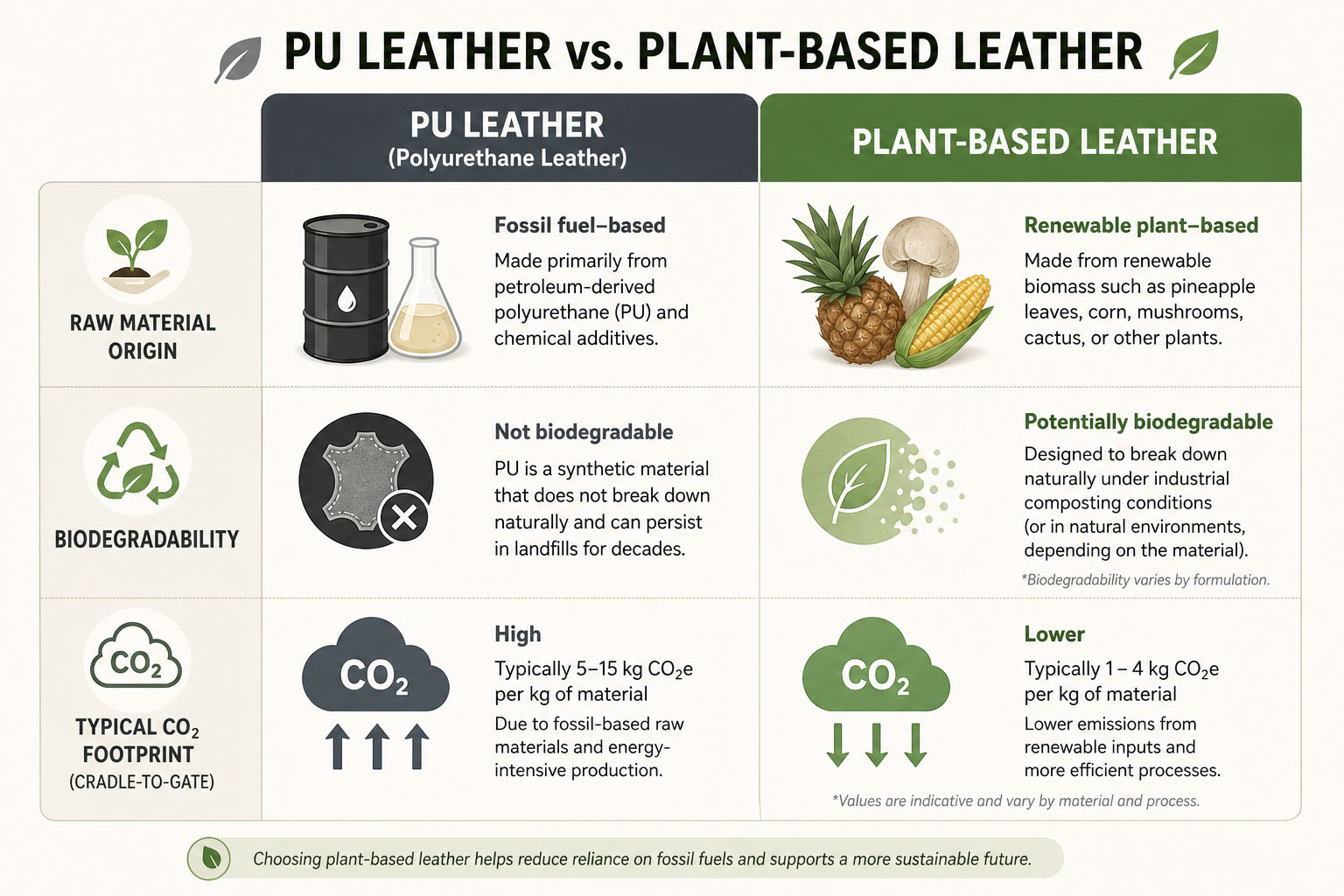
The four materials we’ll cover in this article all qualify as bio-based:
Cactus leather (Desserto) — made from mature prickly pear cactus leaves, grown organically in Mexico but processed and finished by tanneries that supply Chinese bag manufacturers.
Pineapple leather (Piñatex) — produced from pineapple leaf fiber, a byproduct of the fruit harvest in the Philippines; usually sourced as a finished non-woven substrate.
Apple leather (AppleSkin) — manufactured from apple peel and pomace waste collected from the fruit juice industry in northern Italy.
Mushroom leather (Mylo, Reishi) — grown from mycelium roots in a lab setting; still in pre-commercial or limited-commercial stages.
Question 1: What Is the MOQ, Price, and Lead Time for Each Material?
This is always the first question any serious buyer should ask, and the answer varies more by factory than by material.
MOQ (Minimum Order Quantity)
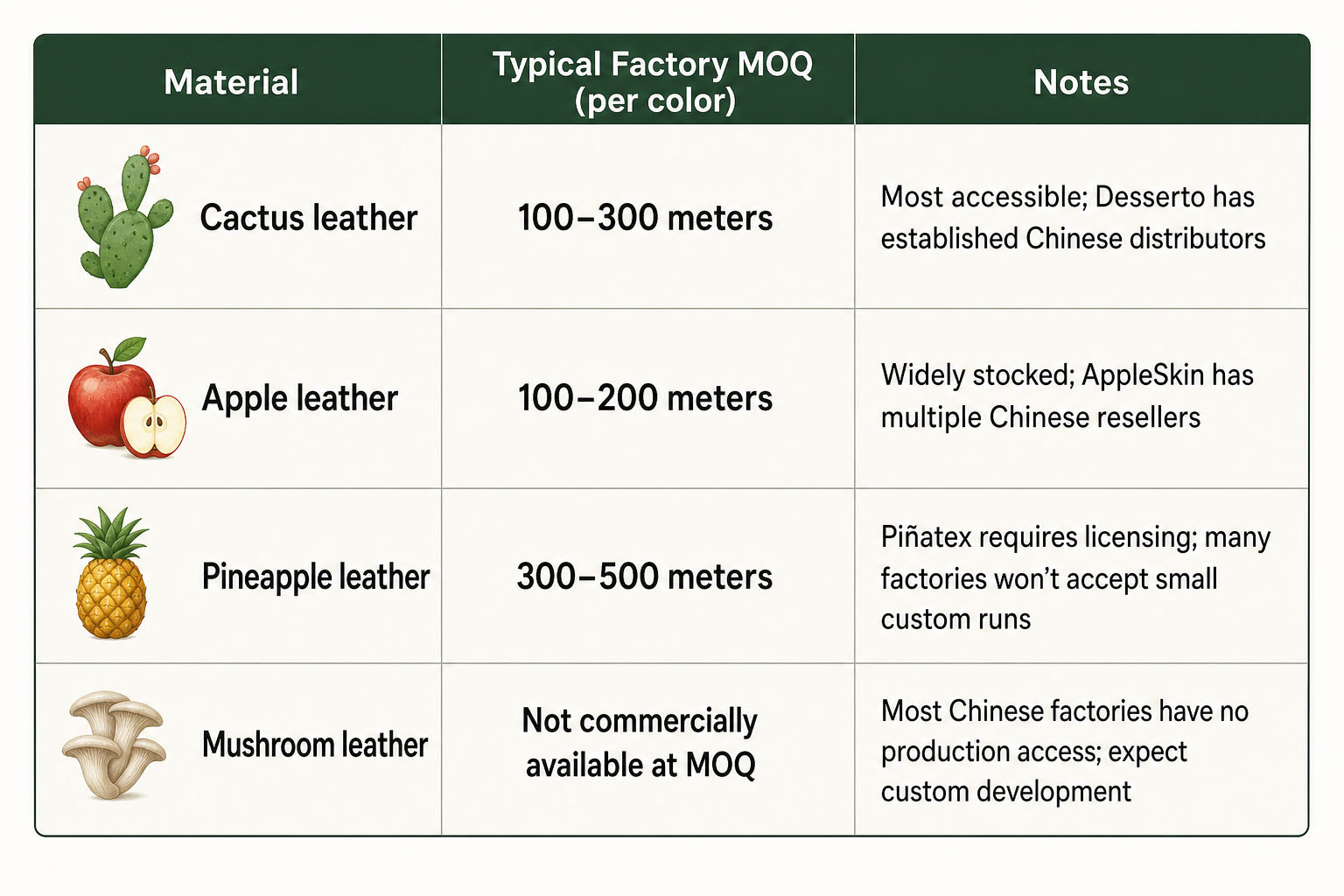
For comparison, conventional PU synthetic leather typically starts at 500–1,000 meters per color, and genuine leather is sold by hide (roughly 4–5 sqm per hide) with a much higher minimum for custom dye lots.
Pro tip from our sourcing team: Always confirm whether the factory is buying finished material from an upstream tanner or whether they have a long-term supply agreement. If they only have spot-market access to a material like Piñatex, your reorder consistency is at risk.
Price
Plant-based leathers generally carry a 30%–60% price premium over standard PU or PVC synthetic leather. As of 2025 sourcing data:
Standard PU leather: $3.50–$5.50 per meter (wholesale, 0.8–1.0mm)
Apple leather: $6.00–$9.00 per meter
Cactus leather (Desserto): $7.00–$12.00 per meter
Pineapple leather (Piñatex): $9.00–$14.00 per meter
Mushroom leather: $20.00–$40.00+ per meter (when available)
Genuine top-grain cowhide for handbags runs $8.00–$15.00 per square foot, so on a like-for-like basis, cactus and apple leather are competitive with mid-range genuine leather, especially when you factor in lower cutting waste and consistent thickness.
Lead Time
PU leather bags: 25–35 days after sample approval
Cactus, apple, pineapple leather bags: 30–45 days after sample approval
Custom-developed mushroom leather bags: 60–90+ days (if the material is even available)
The longer lead time is driven by upstream material sourcing — most Chinese bag factories don’t keep large inventories of bio-based leather, so they order against your purchase order.
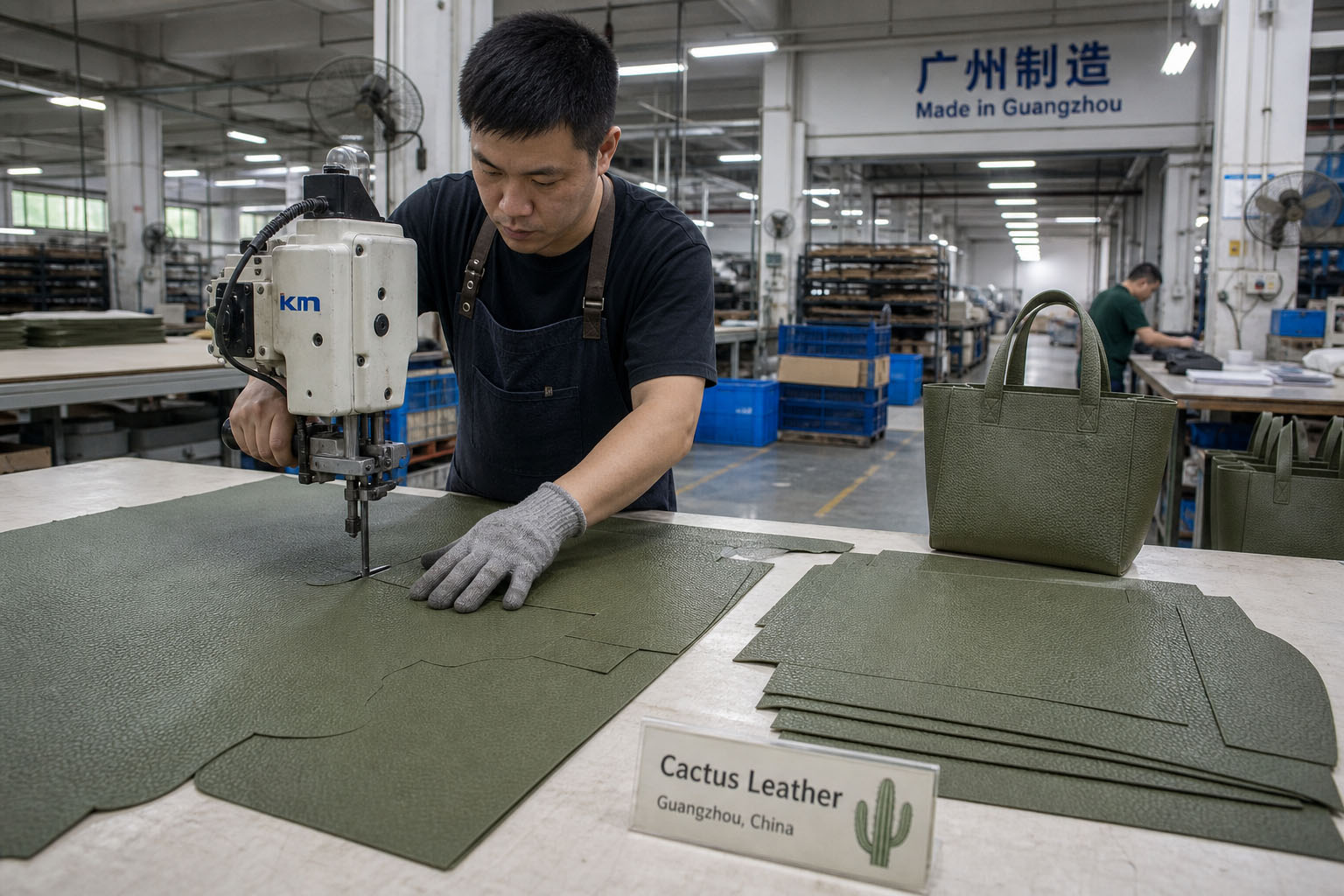
Question 2: Which Bio-Based Leather Best Matches the Look, Hand-Feel, and Durability Required for Handbags, Backpacks, and Travel Bags?
This is where handbag designers and product developers need to get specific — and where many first-time buyers get burned by ordering “vegan leather” samples that look great in a flat swatch but fail in a real bag.
A Side-by-Side Material Comparison
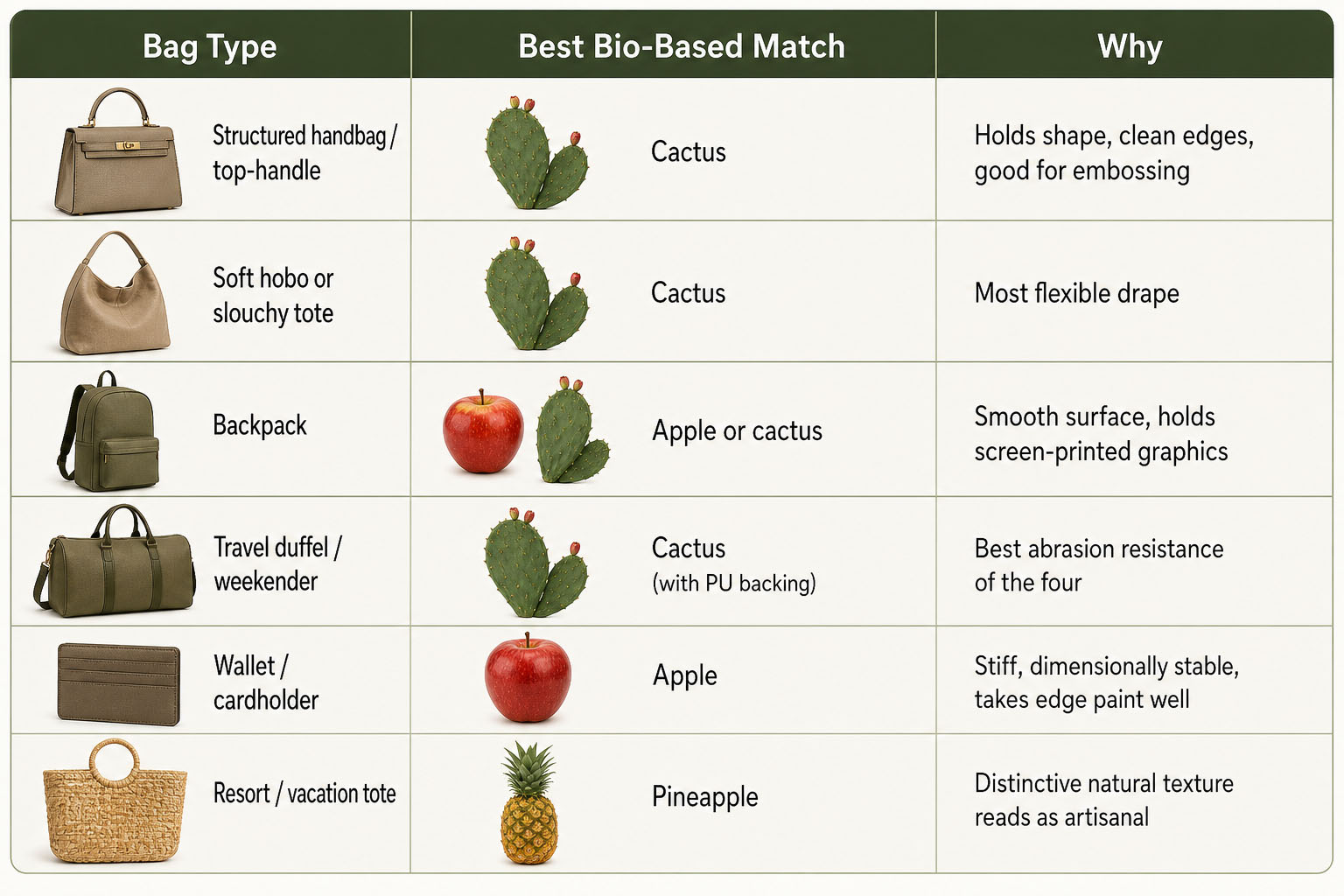
Cactus leather (Desserto) is the strongest all-rounder for U.S. bag sellers. It has a soft, slightly pebbled hand-feel, takes embossing well (snake, croc, saffiano textures all work), and the substrate is flexible enough for structured totes as well as soft hobo silhouettes. It’s the easiest bio-based material to source in China and the most forgiving in production.
Apple leather (AppleSkin) is slightly stiffer than cactus, with a more uniform grain. It works beautifully for wallets, cardholders, and small leather goods, and it’s a go-to for backpacks where you need a clean surface for screen printing or heat-transfer logos. However, it has a tendency to show creasing on sharp folds, so it’s not ideal for accordion gussets or tight pleats.
Pineapple leather (Piñatex) has a distinctive fibrous texture that reads as “natural” and “handcrafted” — perfect for the boho-premium aesthetic that dominates U.S. resort and vacation-bag categories. The trade-off is that it has a rougher hand-feel, and the visible fiber structure doesn’t lend itself to high-gloss finishes. It also requires PU backing or fabric lamination to meet the tensile strength needed for larger travel bags.
Mushroom leather (Mylo) has the most premium, almost suede-like drape, but the supply situation is fragile. Until a major Chinese distributor signs a long-term agreement with Bolt Threads or a similar mycelium producer, treat this as a “concept material” for capsule collections only.
Product Category Recommendations
Pro tip from our sourcing team: Ask the factory for a “drop test” sample. We always order 2–3 finished samples in the target material, then simulate 30 days of consumer use — stuffing with weight, exposure to sunlight, water spray, and abrasion testing on the corners and base. Cactus and apple leather consistently outperform pineapple and mushroom in this real-world test.
Question 3: Are These Materials Certified Vegan, Cruelty-Free, and Compliant with U.S. Import Regulations?
Short answer: certifications are available, but they are marketing tools, not legal ones. Compliance with U.S. import regulations is a separate (and non-negotiable) issue.
Vegan and Cruelty-Free Certifications
The three certifications most frequently requested by U.S. DTC brands are:
Vegan Society Trademark (UK-based, the original vegan cert)
PETA-Approved Vegan (U.S.-based, widely recognized on Amazon listings)
EVE VEGAN (European, growing in U.S. recognition)
None of these are required by U.S. law to sell a “vegan leather bag,” but they significantly improve conversion rates on platforms like Amazon, Etsy, and your own Shopify store. Most Chinese factories will provide the certification on a per-order basis if you request it — and most material suppliers (Desserto, AppleSkin, Piñatex) already carry the underlying certification for the raw material.
Pro tip from our sourcing team: Ask the factory for the material certificate (showing the upstream supplier’s certification), not just a generic “factory vegan letter.” U.S. customs and Amazon brand registry reviewers increasingly distinguish between verified upstream certification and self-declared compliance.
U.S. Import Compliance: Prop 65 and CPSIA
This is where U.S. bag buyers have to be most careful. Bio-based does not automatically mean safe under California Proposition 65 or the Consumer Product Safety Improvement Act (CPSIA). Both apply to the finished product, not the raw material.
California Prop 65: Tests for heavy metals (lead, cadmium), phthalates, and a long list of chemicals known to cause cancer or reproductive harm. Bio-based leathers can still contain phthalate plasticizers, and some pineapple leather finishes have failed Prop 65 testing in past years.
CPSIA: Federal law governing children’s products, but many adult bag buyers still get their products CPSIA-tested as a baseline safety benchmark. Tests cover lead content, phthalates, and flammability.
FDA and labeling: Not directly relevant to bags, but if your bag has any food-contact component (e.g., an insulated lunch compartment), that interior liner needs separate FDA food-grade testing.
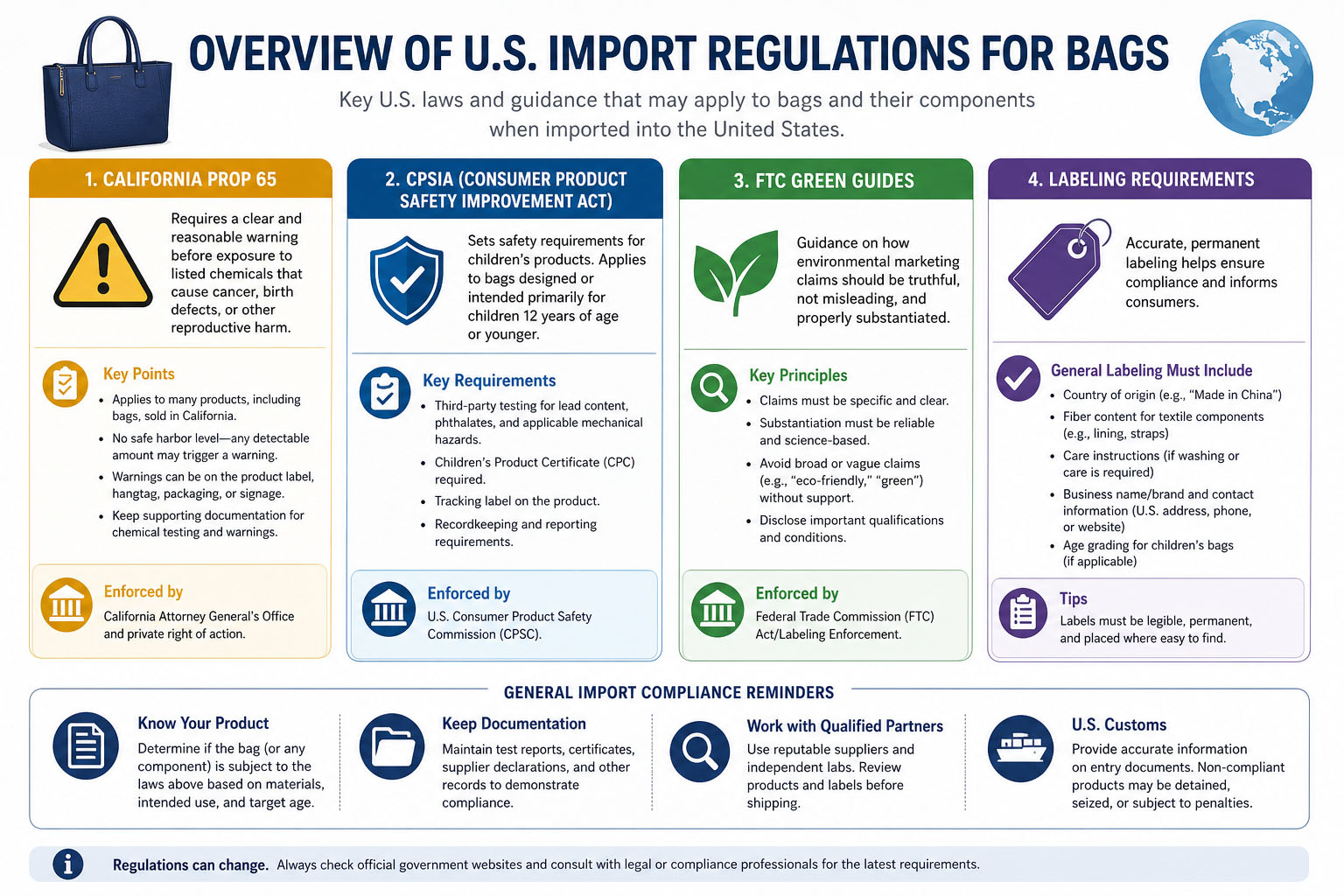
Always ask the factory for:
1. A recent Prop 65 test report on the finished bag (not the raw material).
2. CPSIA test reports if you sell any bag styles to buyers under age 12 or if you market any product as “safe for kids.”
3. A bill of materials (BOM) listing every component, including linings, threads, zippers, and hardware — because a cactus leather bag with a phthalate-loaded PU lining is still a Prop 65 risk.
Question 4: How Do Bio-Based Leathers Perform Over Time?
U.S. consumers are hard on bags. They overstuff totes, drag backpacks through airports, and leave handbags in hot cars. Any material you choose needs to survive the real world.
The Three Failure Modes to Watch
1. Peeling and delamination
The single biggest complaint with bio-based leathers is that the surface coating can separate from the plant-fiber substrate after 6–18 months of use. This is especially common with lower-grade PU-coated pineapple leather. Cactus leather (Desserto) has the strongest track record here because its bio-content is integrated throughout the substrate, not just a top coat.
2. Water resistance
Most plant-based leathers are not fully waterproof out of the box. Apple leather is the most water-resistant of the four; mushroom and pineapple are the most vulnerable. For travel bags and backpacks intended for outdoor use, specify a factory-applied water-repellent finish (typically a PFC-free DWR coating) and confirm it survives 10+ machine-wash cycles if the bag is washable.
3. Color fading under UV exposure
All bio-based leathers will fade faster than pigmented genuine leather under direct sunlight. Cactus and apple leathers typically retain color well for 12+ months of normal use; pineapple and mushroom can show visible fading within 6 months if used daily outdoors. For travel bags sold to consumers in sunbelt states (California, Arizona, Florida, Texas), we strongly recommend specifying UV-resistant top coats and including a care card in every shipment.
Abrasion Resistance (The Hard Number)
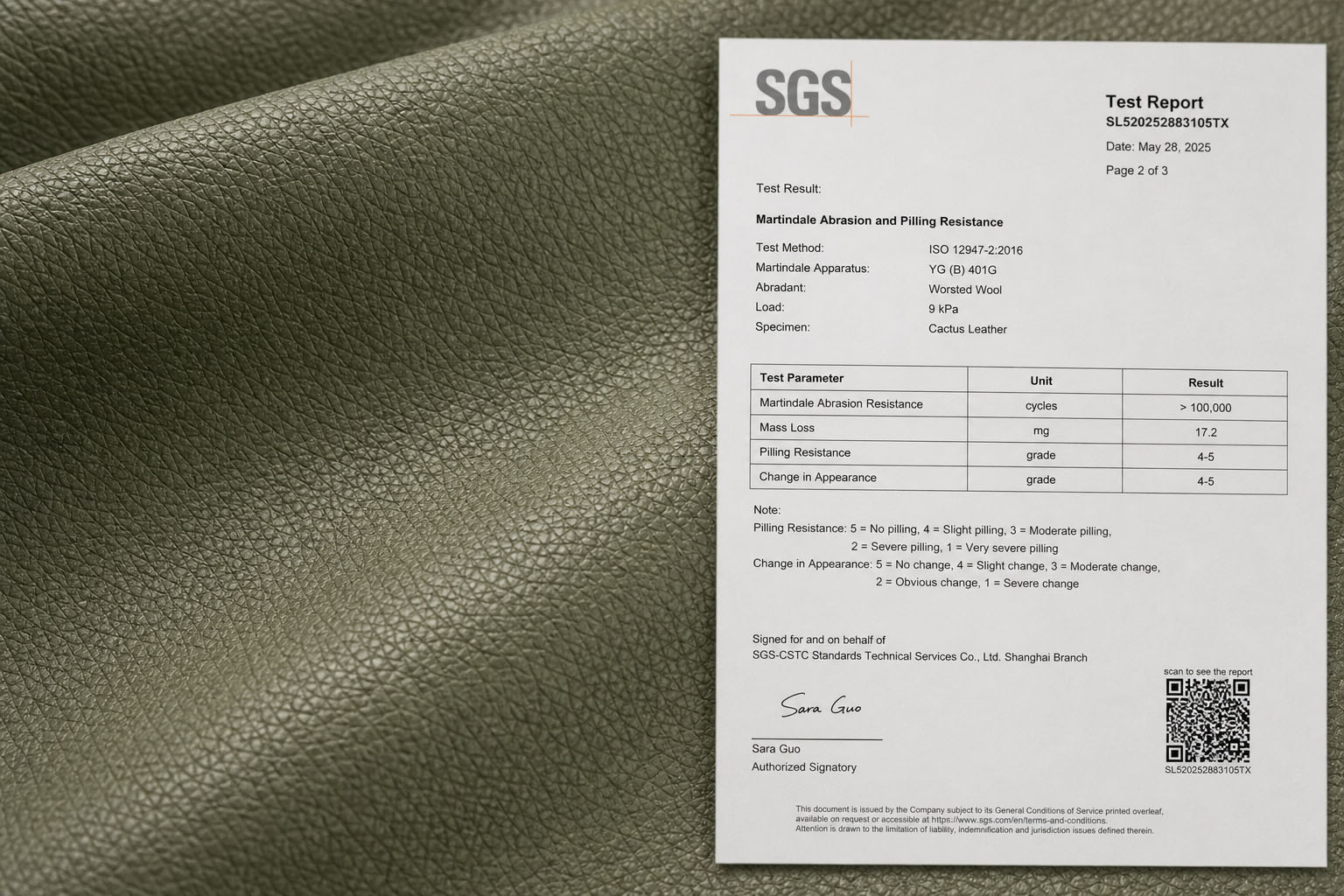
For spec-driven buyers, the standard measurement is Martindale abrasion cycles — the higher the number, the more wear the material can take before showing damage.
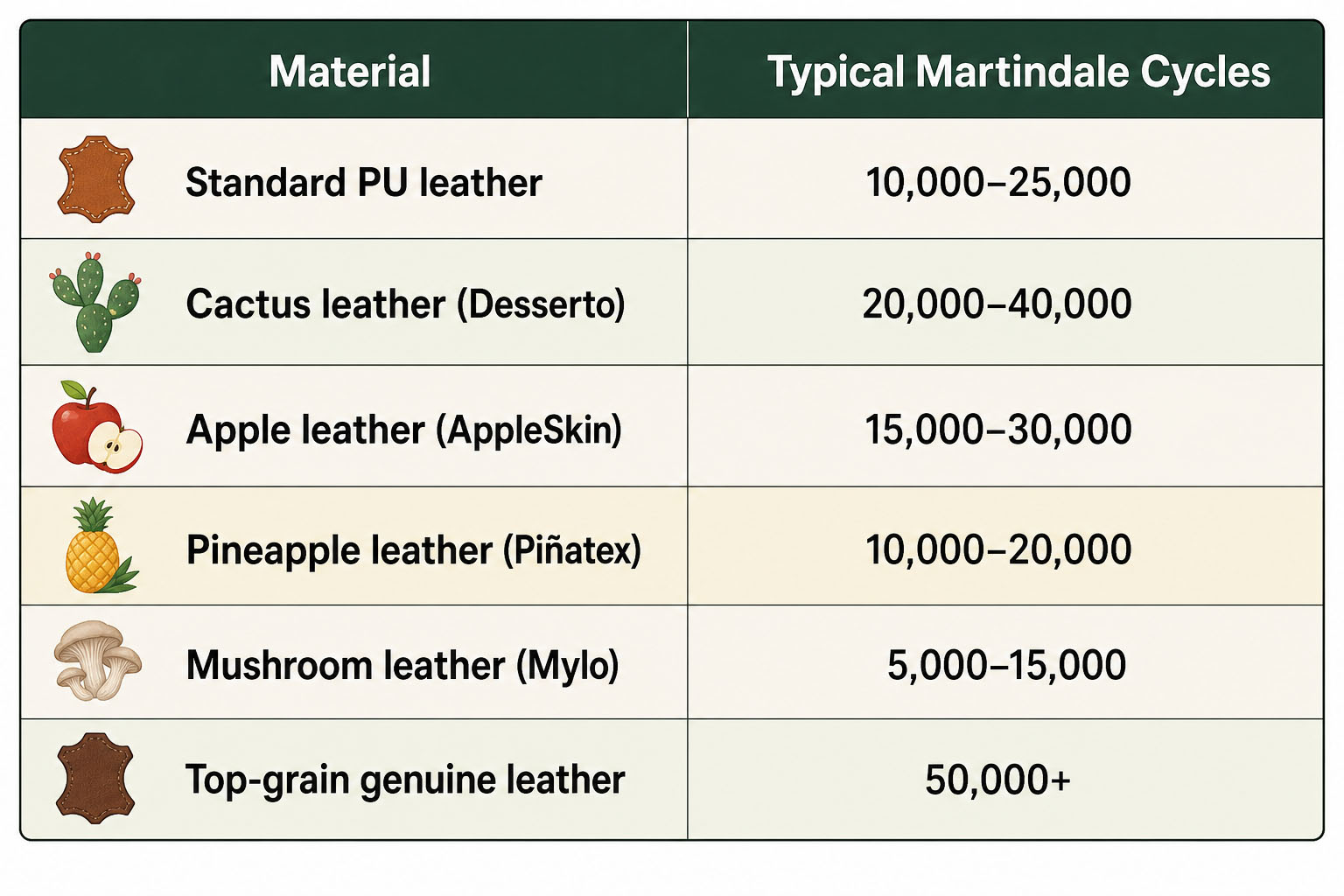
If you’re building a travel bag line, this is the spec to push the factory on. A cactus leather travel duffel with a PU backing and reinforced base corners can hit 30,000+ Martindale cycles — close to genuine leather performance.
Practical Sourcing Advice: How to Approach a Chinese Factory
After more than a decade sourcing bags from China for U.S. brands, here’s the workflow we recommend:
Step 1: Start with Material Samples, Not the Factory
Don’t contact 20 factories with the same RFQ. First, order material swatch books directly from the material suppliers — Desserto, AppleSkin, and Piñatex all sell sample packs (typically $30–$80) that you can review in your own office. This gives you a reference standard to judge the factory’s samples against.
Step 2: Run a 3-Factory Comparison
Identify 3 candidate factories — ideally one each from Guangzhou (strong for fashion handbags), Quanzhou (strong for backpacks and travel bags), and Shenzhen (strong for tech-integrated bags). Send each the same RFQ with your material choice, target MOQ, and finish specs. The factory that comes back with the most specific answers about upstream material supply is usually the most experienced.
Step 3: Order a Pre-Production Sample
Before you wire any deposit, pay for a pre-production sample (typically $80–$200 per style, plus shipping). Evaluate it for:
Material thickness and backing (most bio-based leathers are 0.8–1.2mm; thicker is better for bag construction)
Edge paint quality
Stitching consistency
Hardware function (zippers, magnetic snaps, D-rings)
Color accuracy against your approved Pantone or swatch
Step 4: Verify Certifications and Test Reports
Before bulk production, request:
The factory’s business license and export license
Material certificates from upstream suppliers
Recent Prop 65 and CPSIA test reports on a similar product
A signed proforma invoice (PI) with all specs documented
Step 5: Build a Reorder Buffer
Plant-based leather supply chains are still maturing. We recommend holding a 60–90 day safety stock of finished goods for your top-selling styles, because if your cactus leather factory runs out of stock, the lead time to replenish can be 45–60 days.
Final Thoughts: Is Bio-Based Leather Right for Your Brand?
The honest answer is: it depends on your customer.
If you’re selling premium handbags to a sustainability-conscious millennial or Gen Z buyer, a cactus or apple leather collection is no longer a “nice to have” — it’s table stakes. The price premium is real, but it’s also defensible in your marketing, and the unit margin can match genuine leather once you factor in lower waste and faster cutting.
If you’re selling price-sensitive backpacks or promotional bags, conventional PU still wins on cost, and a “vegan leather” claim based on PU may be enough for your customer.
Mushroom and pineapple leather are best treated as halo materials — perfect for limited-edition capsule drops and PR stories, but not yet reliable as the backbone of a year-round collection.
What is certain is that the bio-based leather category is moving fast. The Chinese factories that have invested in these materials are gaining real expertise, and the U.S. buyers who build relationships with them now will be the ones defining the next generation of sustainable bags.
Have a question about sourcing a specific material from China? Drop us a note in the comments or reach out via our Contact page.
Post time: Jun-09-2026