
SPI & Seam Allowance: The Complete Sourcing Guide for Lockstitched Bags from Chinese OEM Factories
Introduction
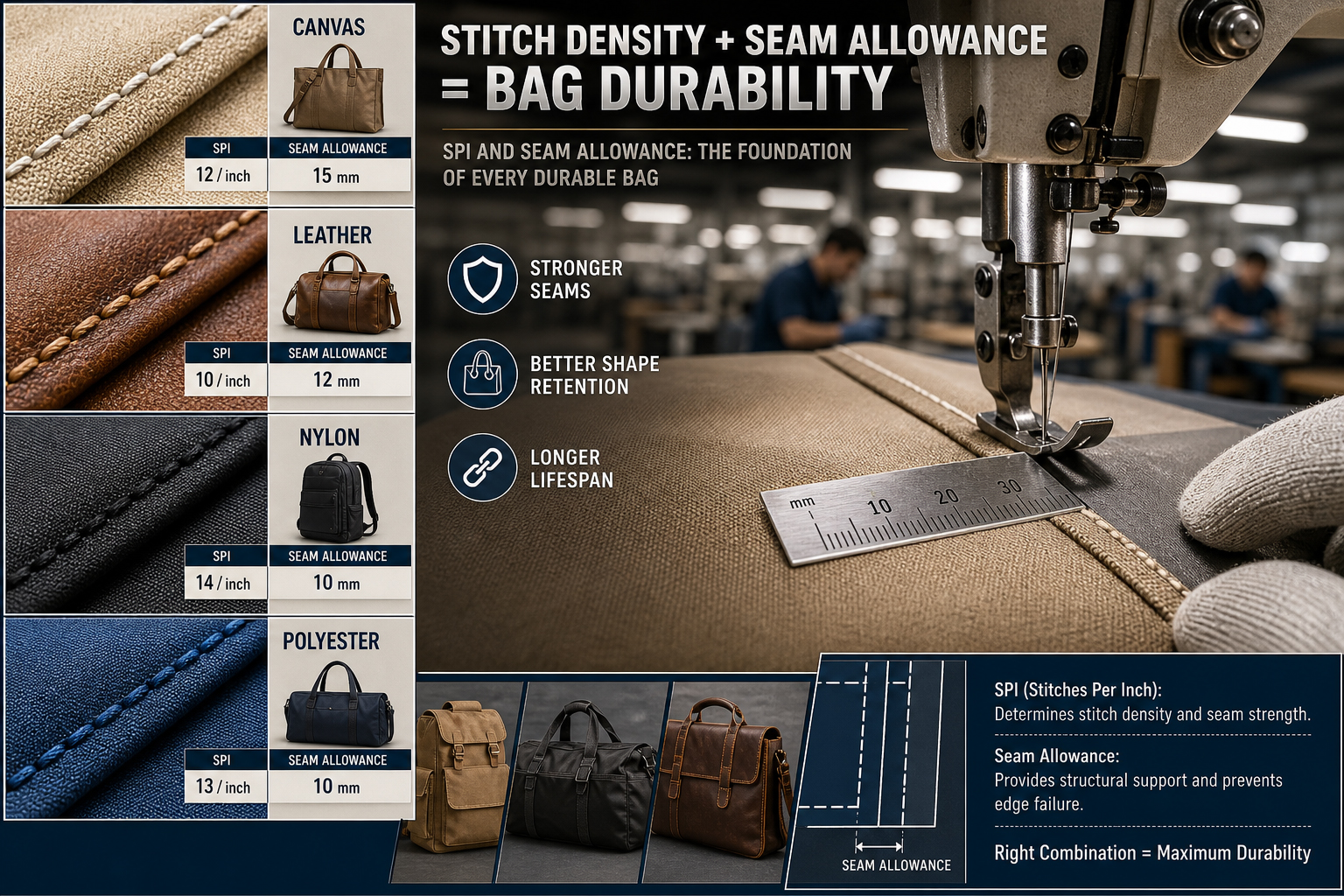
When you source custom bags directly from Chinese OEM manufacturers for your US-based bag website, most buyers focus their attention on materials, hardware, MOQ, and unit pricing. Very few independent brand owners dive deep into stitching specifications, even though stitch density and seam allowance are two of the most critical variables that define your bag’s durability, visual quality, and long-term customer satisfaction. A beautiful bag design can quickly turn into product returns and bad reviews if seams pull apart, stitches skip, or lightweight fabric tears along densely stitched lines.
This guide breaks down standard stitches per inch (SPI) and seam allowance practices for lockstitched bags from Chinese OEM factories. It covers material-specific SPI adjustments, load-bearing seam requirements, factory QC workflows, common misconceptions about stitch density, and exactly how to write these requirements into your tech pack before sampling and mass production. Whether you are sourcing canvas totes, full-grain leather handbags, nylon backpacks, or polyester travel bags, this article will help you communicate precise, measurable standards to your supplier and avoid costly misalignment between your expectation and factory default production settings.
Many US buyers assume there is one universal SPI standard for all bags. In reality, Chinese bag OEMs do not operate under a single mandatory SPI or seam allowance rule. Factories adjust stitching parameters dynamically based on material thickness, bag construction, load requirements, visual topstitching goals, and the specifications written in your tech pack. The factory’s “standard” setting is simply their default setting for low-cost mass production, which may not match the durability and finish your brand wants to sell to US consumers.
Understanding SPI and seam allowance is not just a technical detail for your production team. These details become selling points for your brand. When you can explain to your customers that your tote bags use reinforced 10 SPI stitching at handle attachment points with consistent seam allowances, you build trust and differentiate your products from low-quality imported bags that fail quickly under regular use.
What Is SPI and What Is the Typical Lockstitch SPI Range for Chinese OEM Bag Production?
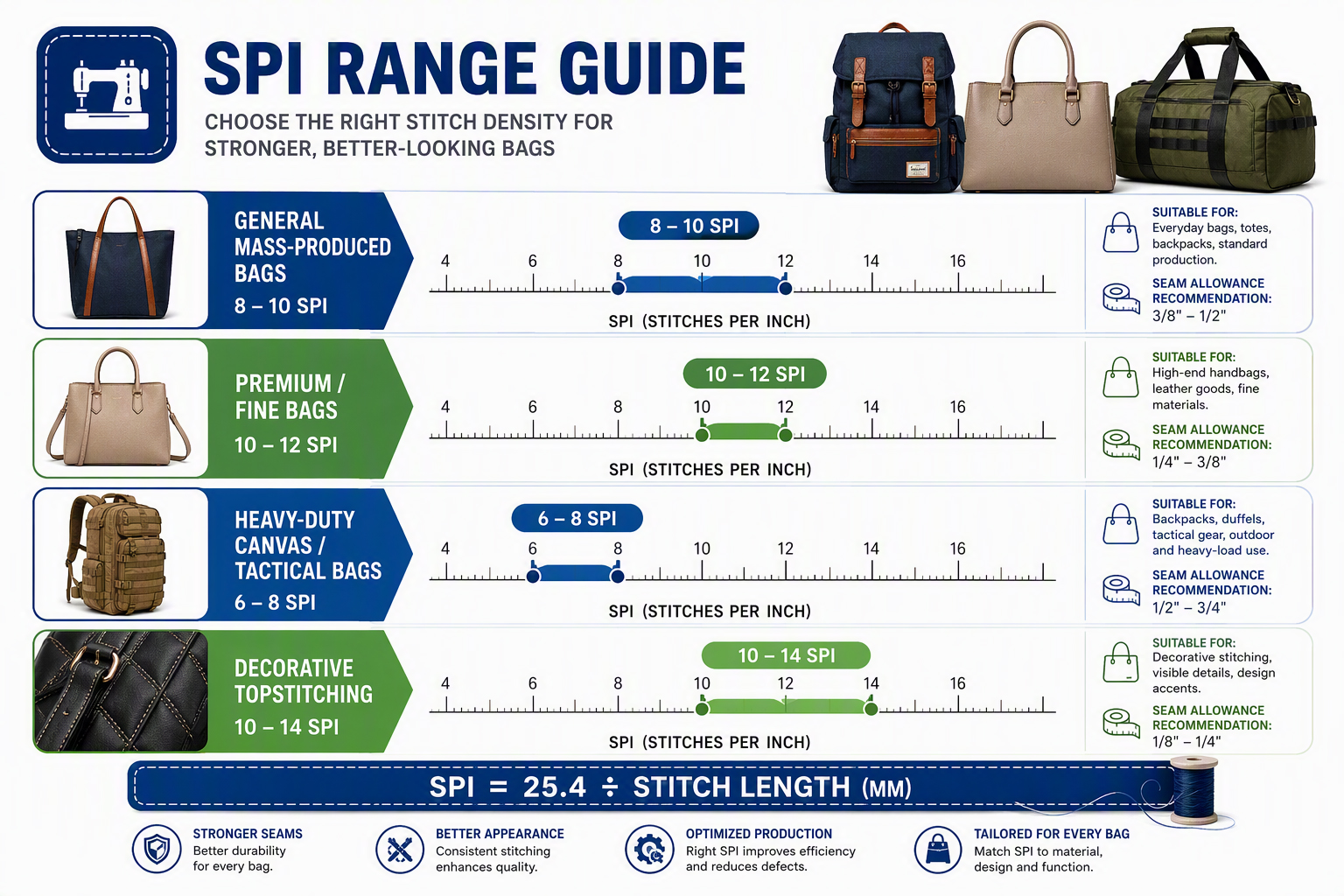
Stitches per inch, or SPI, counts how many individual lockstitches fit within one linear inch of a seam. SPI is the standard unit used by most Chinese bag factories for quoting and setting sewing machine parameters, though engineers can also convert SPI into stitch length measured in millimeters. The conversion formula is straightforward: SPI = 25.4 ÷ stitch length in mm. For example, a 3-millimeter stitch length equals approximately 8.5 SPI.
For general lockstitch construction on most mass-produced bags from Chinese OEMs, the baseline factory standard falls between 8 to 10 SPI. This range balances solid seam strength with acceptable production speed and cost efficiency for everyday tote bags, crossbody bags, and casual backpacks.
Premium and high-end bag lines that prioritize refined exterior topstitching and stronger seam density typically move to 10 to 12 SPI. The tighter stitch line creates a clean, uniform visual finish for exposed exterior seams. Heavy-duty canvas, denim, and tactical bags use a lower SPI range of 6 to 8 SPI. Thick, bulky materials need longer individual stitches; forcing a high SPI on heavy canvas can jam industrial sewing machines and distort fabric panels.
Decorative exterior topstitching is treated separately from structural construction seams. Visible topstitching is commonly set at 10 to 14 SPI. This tighter stitch line creates a neat, polished appearance on front panels and bag edges, even though decorative topstitching often does not carry heavy load stress.
Seam allowance refers to the fabric margin left between the stitched line and the raw cut edge of the material. For most standard bag production lines in China, the default seam allowance is 10 mm to 12 mm (roughly 3/8 inch to 1/2 inch). Leather bag production uses narrower seam allowances of 6 mm to 10 mm. Leather is more expensive per unit area, so factories minimize material waste, and finished leather edges can be burnished or edge-painted after sewing, removing the need for wide seam margins.
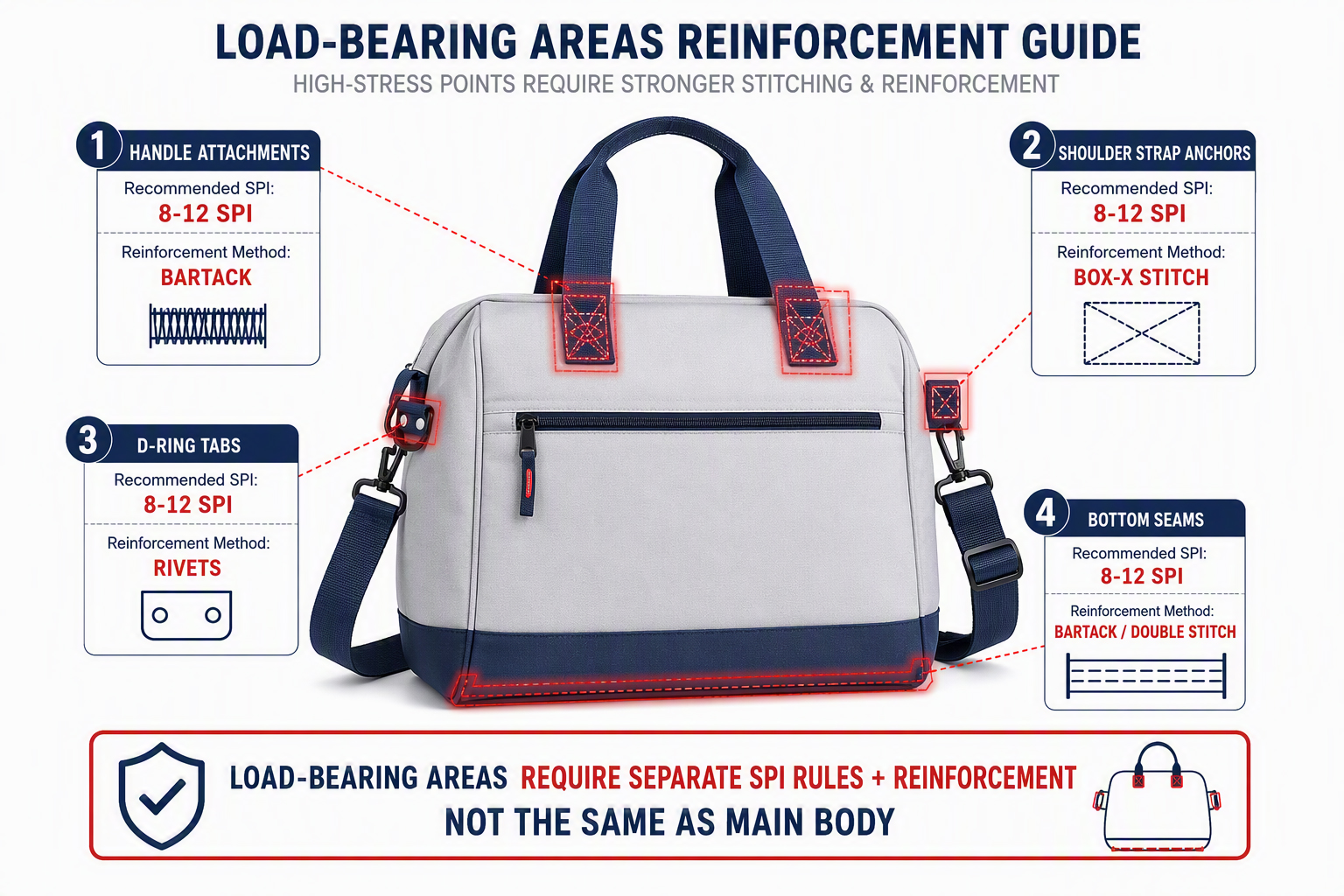
For stress-bearing seams such as handle attachments, shoulder strap mounts, and gusset joins, factories widen seam allowance to 12 mm to 16 mm, and these locations almost always get additional reinforcement using bar tacks, box-X stitching, or rivets.
It is important to note that thread selection interacts with SPI settings. Bonded nylon thread can tolerate tighter SPI settings than bonded polyester thread at the same Tex rating. When you set your SPI requirements, you must also specify thread material and thread size inside your tech pack. If you only specify SPI without defining thread, the factory may use thin thread that fails even with a high stitch count.
Does Recommended SPI Change for Canvas, Full-Grain Leather, Nylon, and Polyester?
Yes. SPI must be adjusted for each bag material. Using the same SPI setting across canvas, leather, nylon, and polyester will create uneven quality, fabric damage, or weak seams. This is one of the most frequent mistakes new US bag buyers make when sending specifications to Chinese OEMs.
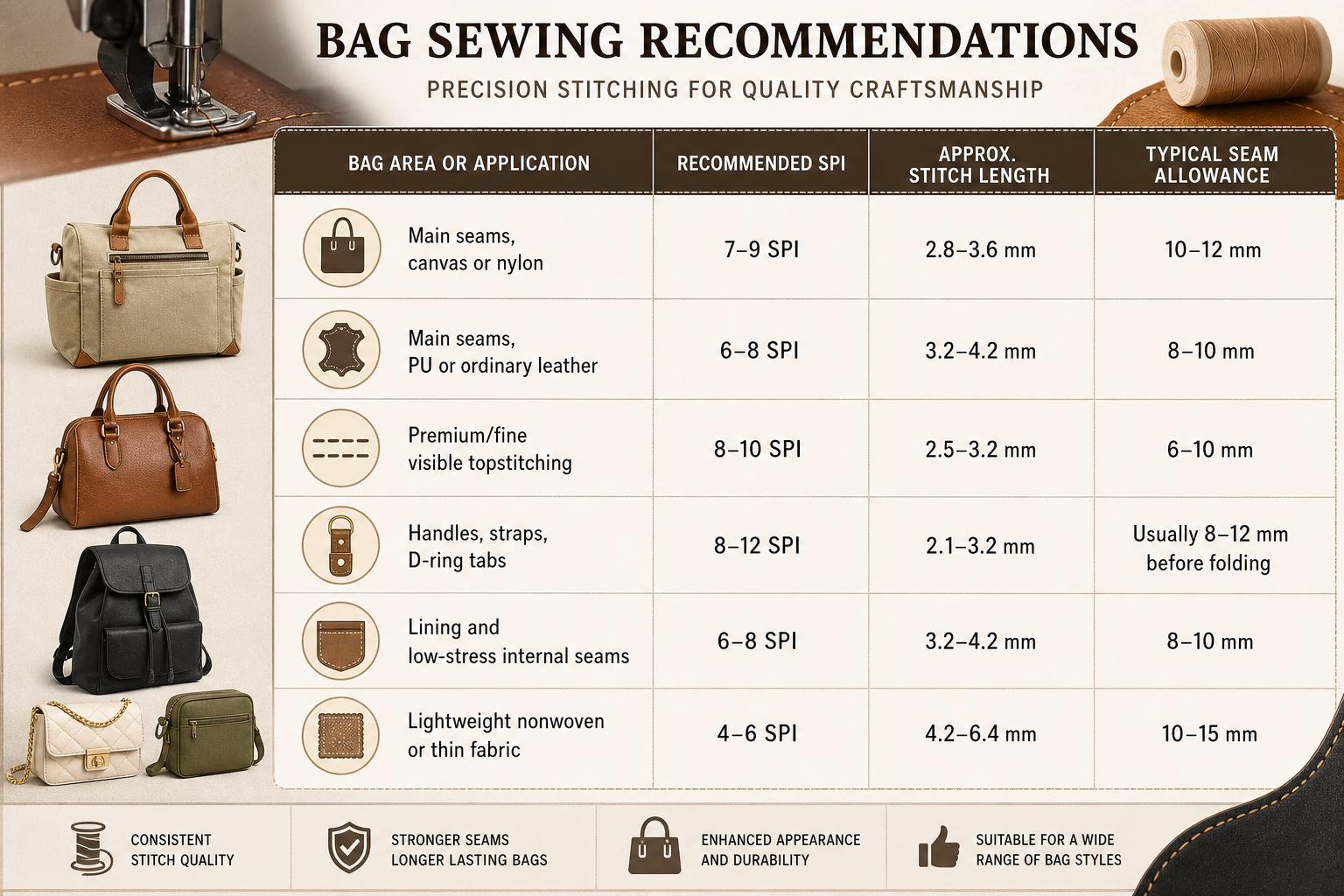
Canvas is a thick woven textile. Standard main body canvas seams run at 7–9 SPI with a 10–12 mm seam allowance. Heavy canvas and tactical canvas products drop to 6–8 SPI. Canvas can handle moderate stitch density without tearing, but overly tight stitches can still create perforation lines that become failure points over repeated pulling.
Full-grain leather is dense but vulnerable to permanent hole damage. Once a needle pierces leather, the hole does not close back up like woven fabric. For this reason, leather main body seams are usually set at 6–8 SPI with 8–10 mm seam allowance. Premium decorative leather topstitching can go to 8–10 SPI, but manufacturers avoid pushing SPI too high on leather panels. Too many needle holes in leather create a perforated tear line that can split under load.
Nylon and polyester fabrics, including lightweight pack cloth, ripstop nylon, and polyester lining, vary widely by fabric weight. Medium-weight nylon and polyester shell fabrics follow the general 7–9 SPI range for main seams. Thin lightweight polyester lining uses 6–8 SPI for low-stress interior seams. Ultra-light nonwoven fabrics drop to only 4–6 SPI. Thin synthetic fabrics tear easily when pierced repeatedly by dense stitching.
The following consolidated table summarizes recommended SPI, stitch length and seam allowance for different bag zones and materials, for use directly in your tech pack.
SPI and Seam Allowance for Load-Bearing Areas: Handles, Shoulder Straps and Bottom Seams
Load-bearing zones are the highest risk points for bag failure. Handles, shoulder strap anchor points, D-ring tabs, bottom panel seams, and gusset connections all experience repeated pulling stress every time the customer lifts, carries, or hangs the bag. These areas require separate SPI rules and reinforcement, even if the rest of the bag uses a lower stitch density.
For these high-load locations, the recommended SPI range moves to 8–12 SPI. Most standard commercial bags use 10 SPI for handle and strap attachment seams. Higher SPI creates more thread interlocks to distribute pulling force. But SPI alone is not enough. All load-bearing seams should be reinforced with bar tacks or box-X stitching at every anchor point. Some designs combine stitching reinforcement with metal rivets for heavy-use bags.
Seam allowance at these stress points is also increased. Before folding and topstitching, seam allowance for strap and handle mounts is typically 8–12 mm. When seams will be folded, turned, and double-stitched, you can specify 15 mm or wider seam allowance to ensure material layers stay secure after trimming.
A common sourcing error is to specify the same SPI for the entire bag. If you set 8 SPI for the main body but forget to upgrade handle attachment points, your bags may pass visual inspection but develop handle pull failures after short customer use. This creates warranty claims and product returns for your US store.
How Chinese OEM Factories Perform In-Line and Final QC to Verify SPI and Seam Allowance Consistency
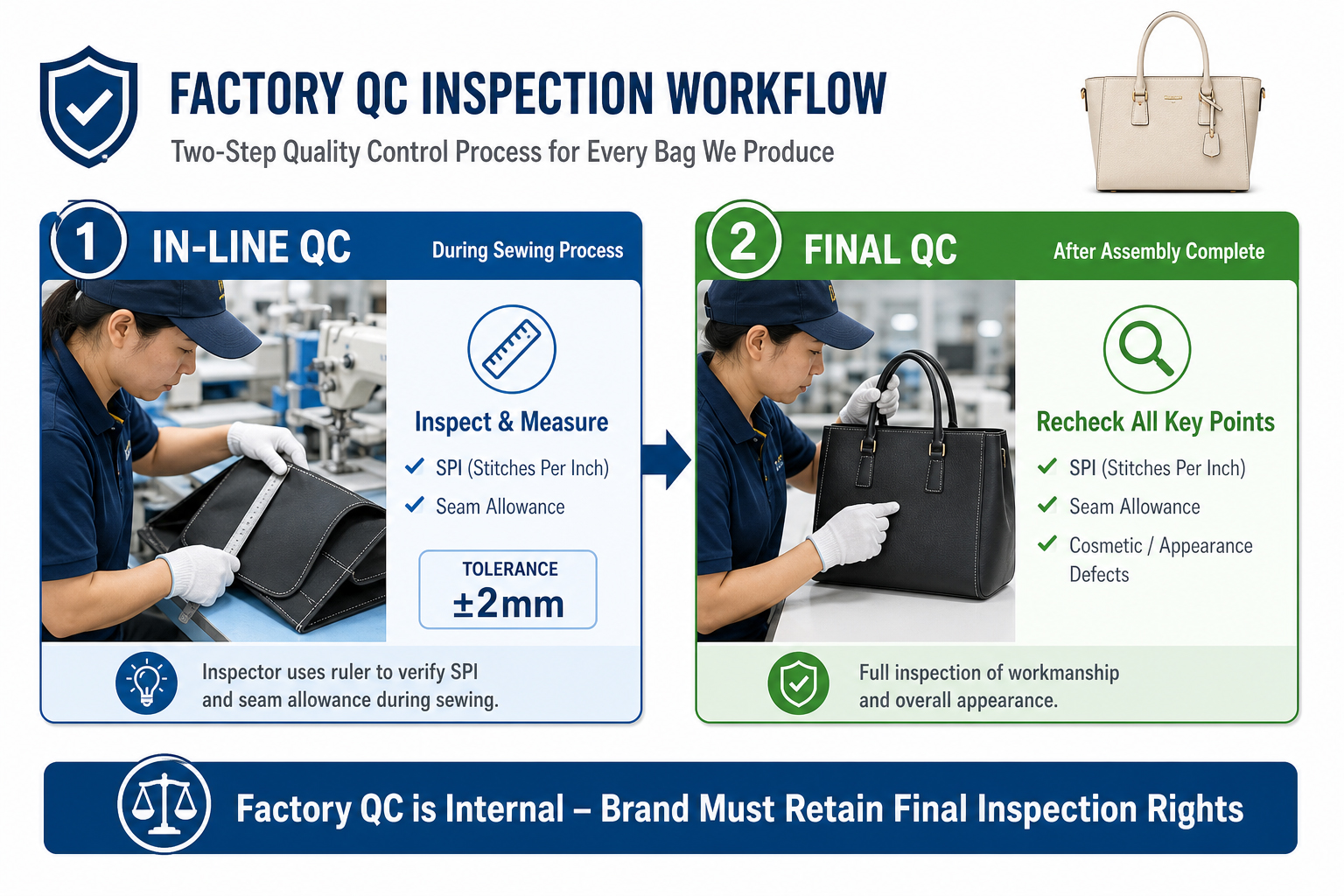
Quality control for stitching happens in two stages: in-line QC during sewing, and final finished-bag inspection before packing and shipment. Understanding this workflow helps you write clear acceptance criteria and know what to audit during factory visits or third-party inspection.
In-line QC checks occur directly on the sewing production line. Line QC inspectors randomly pull sewn panels from each sewing station while workers are assembling the bags. They measure SPI using a small ruler placed directly on the seam and count stitches over one inch. They also verify seam allowance by measuring the distance from the stitch line to the raw fabric edge. The standard acceptable tolerance for seam allowance deviation in most Chinese bag factories is ±2 mm. If the seam allowance drifts beyond this tolerance, the panel is rejected or reworked.
In-line inspection catches problems early: skipped stitches, uneven stitch tension, wandering seam lines, inconsistent SPI from one sewing operator to another, and incorrect seam allowance before the bag is fully assembled. Reworking individual panels is far cheaper than repairing finished bags.
After full assembly, final QC inspectors review the complete bag. They recheck SPI on random seams, especially load-bearing handle and strap points. They examine seam allowance on finished seams after folding and trimming. Final inspectors also check for cosmetic defects: thread nesting, loose tension, open seams, stitch run-off, and uneven topstitching alignment.
It is critical to clarify in your order contract that your team retains final quality inspection rights. Factory QC is their internal check, but your final inspection is the gate before shipment. You may use your own inspector or a third-party QC service to audit SPI and seam allowance consistency on finished goods. Define your sampling plan and acceptance threshold before mass production starts.
Critical Misconception: Higher SPI Does Not Always Equal Stronger Seams
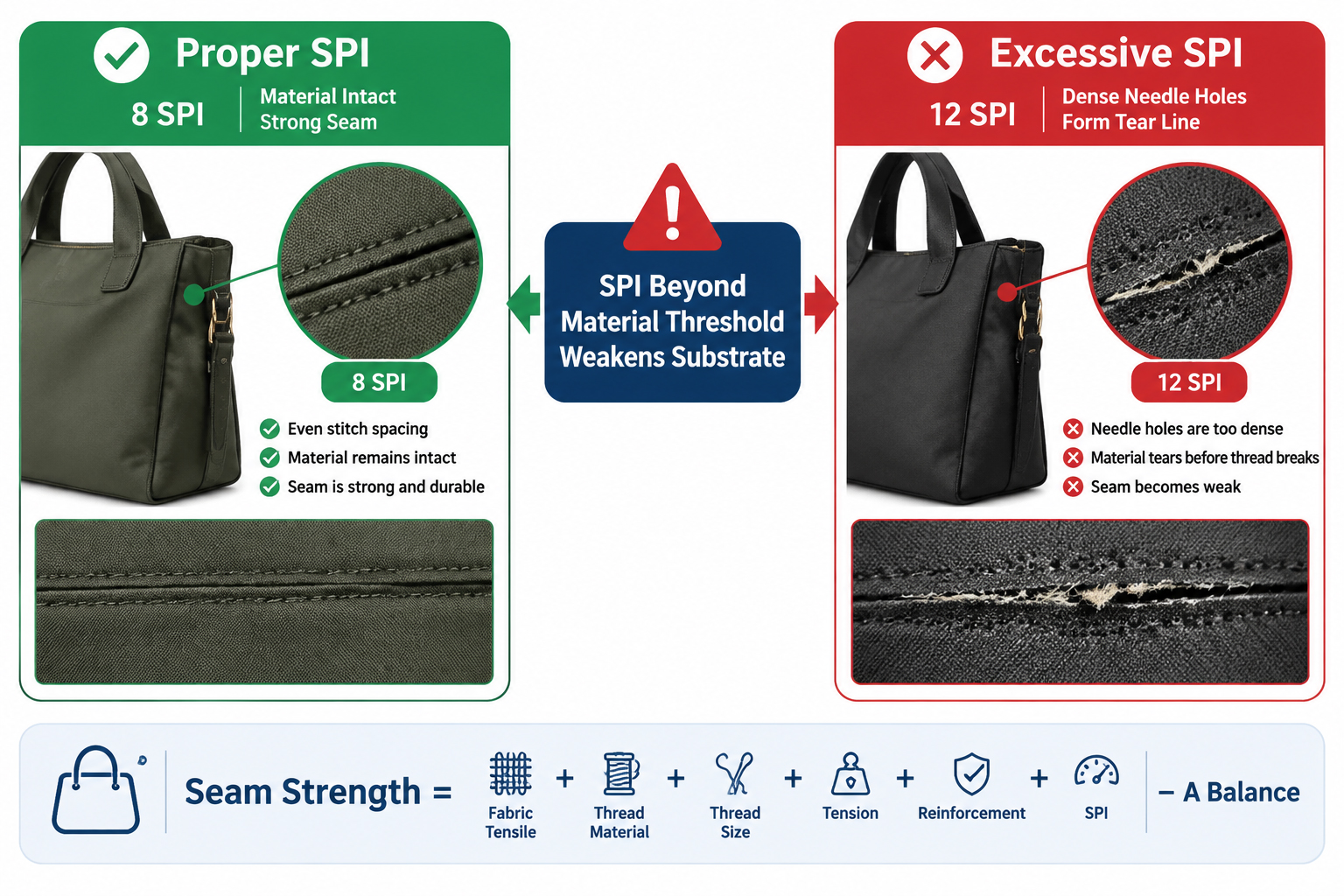
Many buyers assume that increasing SPI will automatically improve seam strength. This is only true up to a material-specific threshold. If SPI becomes too dense, the repeated needle pierces create a perforated line across fabric or leather. Instead of making the seam stronger, excessive stitching weakens the substrate material. When load is applied, the material tears along the line of needle holes before the thread itself breaks.
This risk is most pronounced on lightweight woven fabrics and full-grain leather. Leather cannot recover from needle holes. If you force 12 SPI on thin leather, the seam becomes a tear line. Lightweight polyester and thin ripstop nylon face the same perforation risk. The material fails before the stitching thread breaks.
Seam strength depends on a combination of factors: fabric tensile strength, thread material and thread size, stitch balance, seam construction, reinforcement design, and SPI. SPI is only one variable. A properly reinforced seam at 8 SPI using heavy bonded nylon thread can outperform an over-dense 12 SPI seam on thin fabric with no reinforcement.
For this reason, the factory must produce a pre-production sample using your exact final materials, lining, interlining, thread, and seam construction before bulk production begins. The sample is your reference standard, not just a theoretical SPI number. You can optionally request seam pull testing or load testing on the sample to validate seam performance before approving mass production.
How to Write SPI and Seam Allowance Specifications Inside Your Bag Tech Pack
The biggest mistake buyers make is asking the factory for their “standard SPI.” Factory default settings are designed to minimize production cost, not match your brand’s durability requirements. Instead, you need to write measurable, toleranced specifications directly into your tech pack. Use clear, quantifiable language the sewing room can execute.
Below is a ready-to-use specification block you can copy into your tech pack:
Main lockstitch seams: 8 SPI ±1 SPI, stitch length approximately 3.0–3.5 mm. Seam allowance: 10 mm ±1 mm. Handle and strap attachment: 10 SPI ±1 SPI, reinforced with box-X stitching and/or bartacks. Visible topstitching: 8–9 SPI, consistent distance from edge as shown on approved sample. No skipped stitches, loose tension, thread nesting, open seams, or stitch run-off.
For a standard commercial everyday tote or handbag, a practical starting point is:
* Main body construction seams: 8 SPI
* Handles and strap attachment points: 10 SPI with reinforcement
* General seam allowance: 10 mm for ordinary seams
* Heavy leather or thick canvas: 6–8 SPI, avoid forcing dense stitching
For heavy-duty canvas or tactical bags, lower the SPI for main panels and reserve higher SPI plus bar tacks for all stress points. For leather goods, keep SPI conservative and pay extra attention to edge finishing.
Beyond SPI and seam allowance, you should ask your Chinese OEM these seven key questions before confirming sampling:
* Is the stated SPI measured on the visible face side or measured over the full seam including underside stitches?
* Is the tolerance ±1 SPI, or will the factory commit to an exact SPI value?
* What SPI will be applied separately to body fabric, lining, handles, straps, zipper seams, and binding edges?
* What will be the finished seam allowance after trimming, turning, and topstitching?
* What thread size and thread material will be used for structural seams and decorative topstitching?
* Will handles be reinforced with bartacks, box-X stitches, rivets, or a hybrid combination?
* Can the factory produce a sewn test sample and provide seam pull or load testing results?
Your approved pre-production sample becomes the physical reference standard. The final acceptance rule is not “all seams must hit exactly 8 SPI.” The correct standard is: 8 SPI on normal seams, 10 SPI at load points, with defined 10 mm seam allowance, subject to full approval of a sample made from your final production materials.
Conclusion
SPI and seam allowance are foundational engineering details that define your bag’s durability, visual quality, and customer experience. As a US-based bag brand sourcing directly from Chinese OEM manufacturers, moving past vague requests and implementing measurable stitching specifications will reduce defects, cut down returns, and strengthen your brand reputation.
Remember three core takeaways from this guide:
* SPI must be adjusted for different materials. Canvas, full-grain leather, nylon, and polyester each require different stitch density settings to avoid perforation damage or weak seams.
* In-line and final factory QC checks SPI and seam allowance consistency, but your brand must reserve final inspection rights and define tolerance rules in your tech pack.
* Higher SPI does not always create stronger seams. Overly dense stitching can perforate lightweight fabrics and leather, creating tear-prone lines that fail under load.
When you build clear stitching specifications into your tech pack and validate through material-matched pre-production samples, you align your Chinese OEM partner to your quality standard. This level of technical detail demonstrates professionalism to your supplier, and it gives you a tangible quality story to share with your US website customers.
Post time: Sep-22-2026