
Published for US‑based independent website bag buyers sourcing directly from Chinese manufacturers
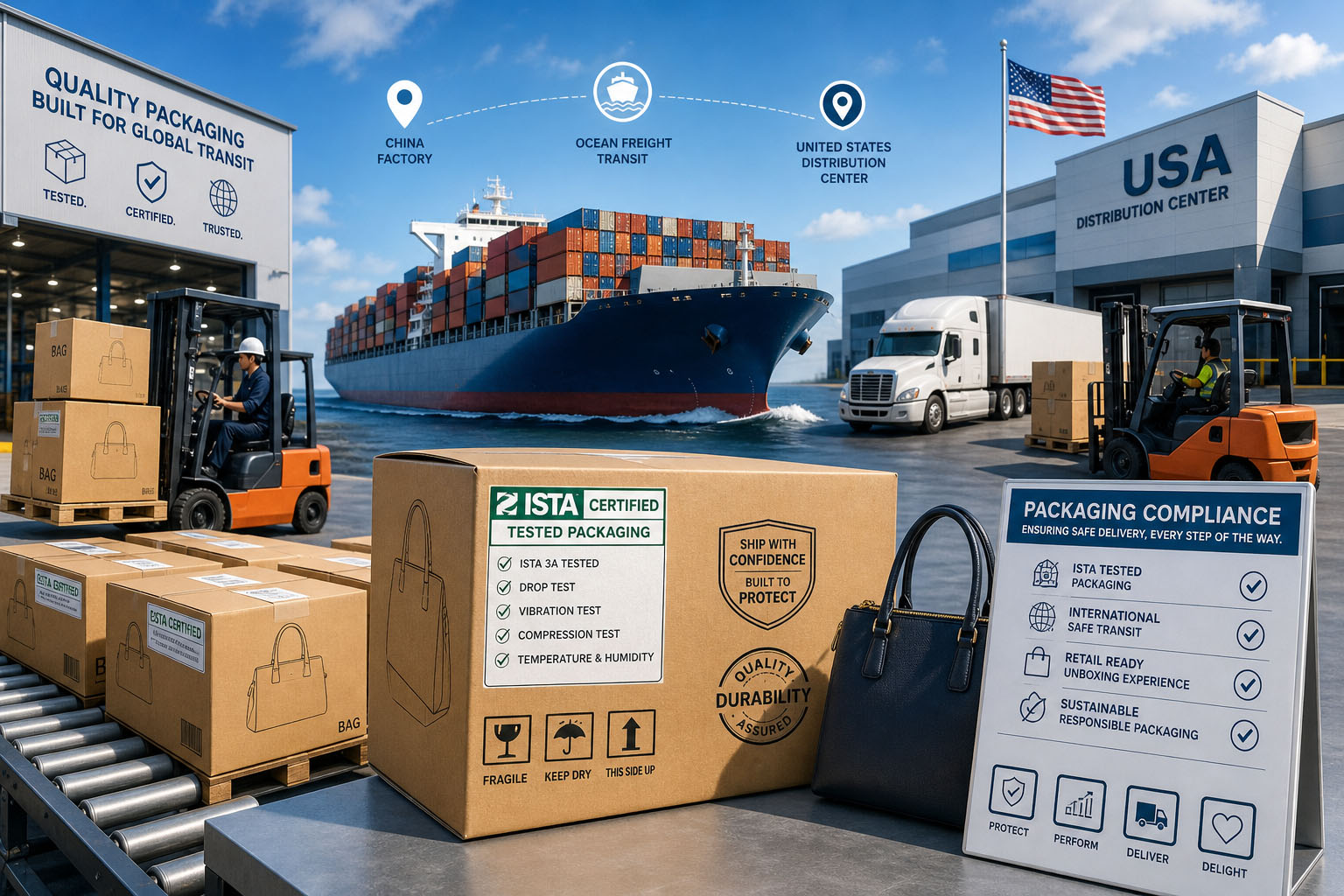
Article Summary: When importing handbags, tote bags, backpacks, and travel bags from China to sell on your independent website, US retail channels, or Amazon FBA, product quality is only half of your risk‑management work. Packaging performance, certified barcodes, compliant carton labeling, FBA label readiness, and retailer audit charge‑back penalties can create unexpected cost losses, shipment delays, and rejected cargo. Many new US bag buyers underestimate transit damage risks and vendor‑compliance requirements for US market entry. This guide breaks down critical supplier qualification questions, testing standards, mandatory documentation, red‑flag warnings, and actionable contract clauses you can copy‑paste directly into RFQs, purchase orders, and quality agreements when working with Chinese bag factories.
Do Chinese Bag Suppliers Perform Carton Drop and Vibration Transit Durability Tests?
One of the most frequently overlooked pre‑shipment checks for cross‑ocean bag shipments is distribution simulation testing on fully packed export cartons. Many US independent‑site sellers assume factories automatically validate packaging strength for long‑haul ocean transit. This is **not the default practice** across Chinese bag manufacturing facilities.
Most well‑established Chinese bag manufacturers that regularly serve North‑American markets run ISTA 1A, ISTA 2A or ISTA 3A carton drop and vibration tests on fully packed production samples before mass shipment. Testing protocols commonly reference ASTM D4169 or official ISTA industry standards. These physical tests replicate real‑world supply‑chain stress your cargo faces from inland factory handling, container loading, 25‑40‑day ocean freight crossing the Pacific, US port unloading, warehouse sorting, and last‑mile domestic distribution inside the United States.
The drop test procedure simulates rough manual handling: full export master cartons are dropped from weight‑determined heights onto rigid concrete surfaces. A standard ISTA 1A drop sequence includes 1 corner drop, 3 edge drops, and 6 face drops for a total of ten controlled impacts. For cartons under approximately 21 pounds (10 kg), the typical drop height is 30 inches (760 mm). After completing the full drop cycle, inspectors evaluate outer carton integrity, inner dunnage performance, and every packed bag for scuffs, structural deformation, zipper failure, hardware damage, or cosmetic defects on leather and fabric surfaces.
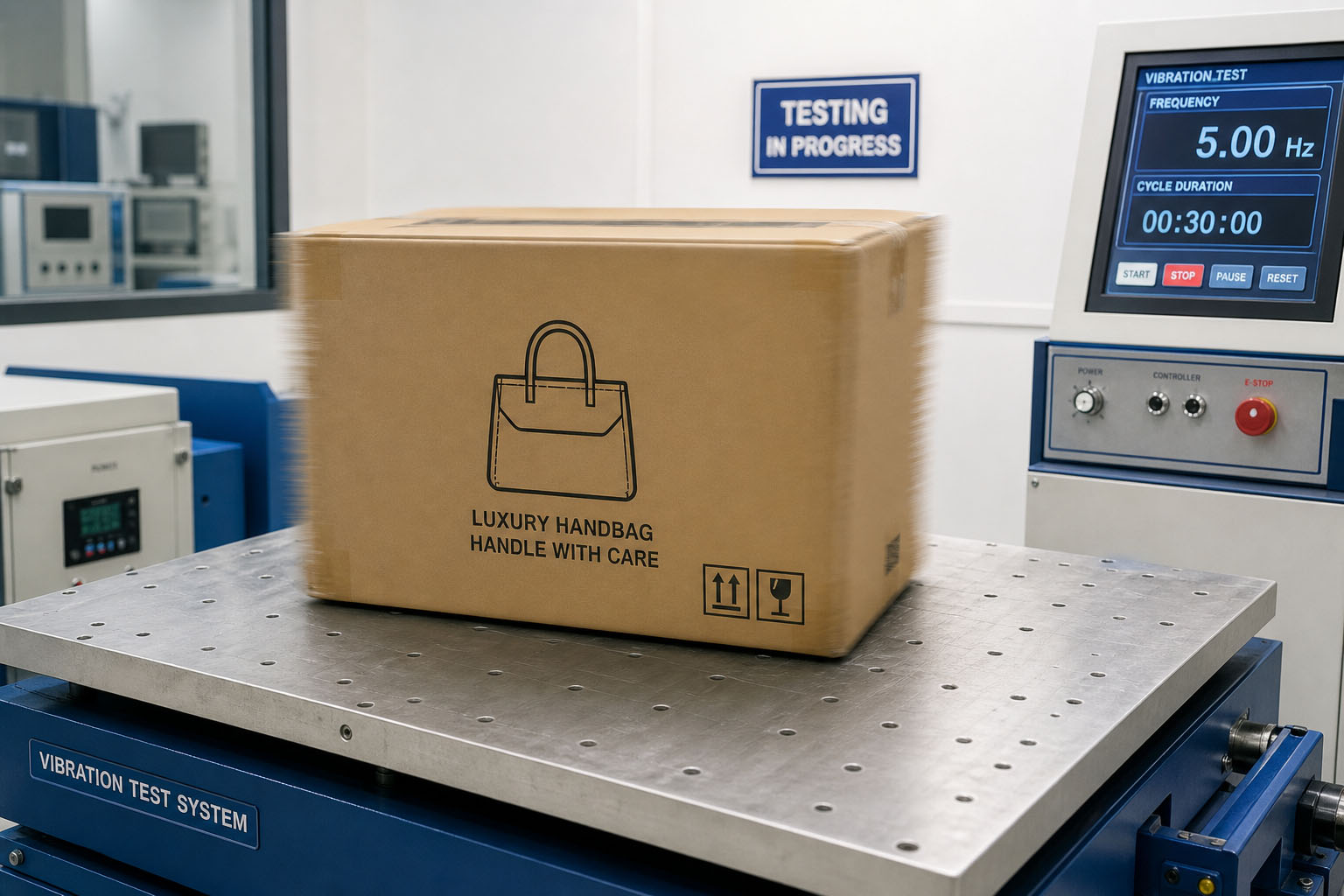
Complementing drop impact testing, vibration testing simulates continuous truck, vessel, and rail transport shaking. Factories run test cycles for 30 up to 60 minutes or longer on dedicated vibration tables, following ASTM or ISTA random‑vibration or sine‑wave profiles. This test exposes hidden risks: bag hardware abrasion against inner packaging, strap scratching, collapsed cartons, and product rubbing damage that drop testing alone will not uncover. For bag shipments, vibration damage frequently causes invisible cosmetic defects that only become visible once end‑customers open retail boxes at final destinations in the US.
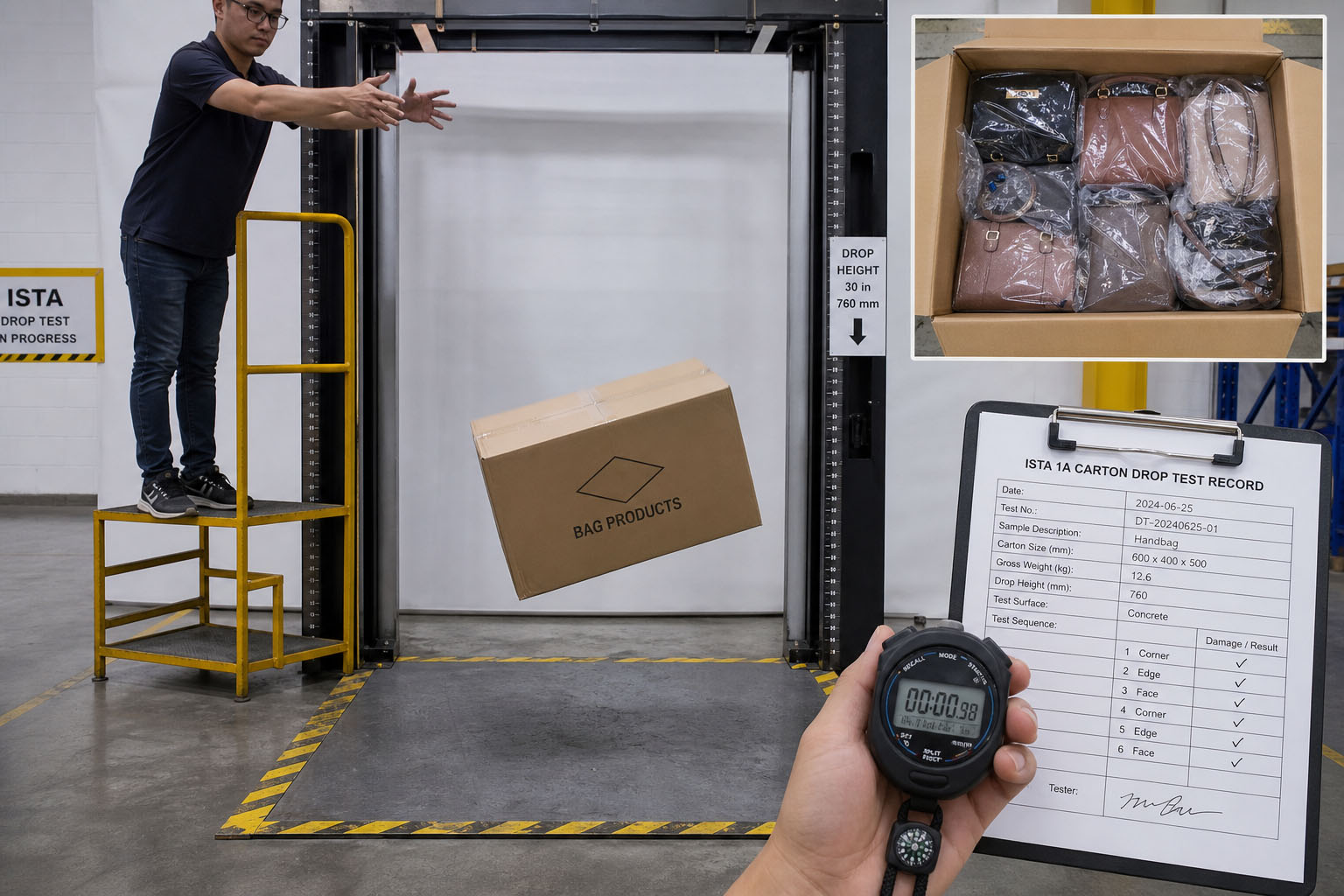
Reputable export‑focused bag factories can supply third‑party laboratory certificates issued by globally‑recognized organizations including SGS, Bureau Veritas, and Intertek alongside internal in‑house quality‑control records. However, third‑party testing does not happen automatically. Even factories with in‑house testing capacity will only execute formal drop‑and‑vibration validation when buyers explicitly write this requirement into purchase orders and quality specifications. Without written buyer instructions, routine pre‑shipment QC sampling at Chinese bag factories will skip formal transit‑durability testing entirely, relying only on visual checks of finished bags, not packed carton performance.
Critical best practice for US independent‑site bag sellers: you must define test standards (ISTA 1A / 2A /3A or ASTM D4169), exact drop‑height rules, vibration‑cycle parameters, and clear pass‑fail criteria in written documents sent to your supplier. Never depend on verbal agreements or factory assumptions about acceptable packaging performance.
Small‑scale and less‑experienced bag factories create notable risk for overseas buyers. Many of these smaller operations do not own in‑house drop‑test platforms or vibration‑table equipment and skip transit‑durability validation completely. Some mid‑tier manufacturers perform informal internal tests but will not document results or share test photos and reports unless buyers make a formal written request. Sourcing agents and trading companies rarely own physical‑testing equipment; they outsource all packaging validation work to independent specialized packaging laboratories located in major export hubs such as Shenzhen, Ningbo, and Yiwu.
Given the lengthy 25‑40‑day sea transit timeline from Chinese ports to US seaports, even packaging that passes minimum ISTA testing often benefits from extra structural reinforcement. You should evaluate adding edge protectors for master cartons, double‑wall corrugated export cartons, heavy‑duty inner dunnage materials, and secure pallet wrapping for containerized shipments. These upgrades reduce costly in‑transit bag damage claims for your independent‑site inventory, lowering your return rate and post‑arrival quality‑control workload in the USA.
Exact Wording to Copy‑Paste into Your RFQ or Supplier Email
Use this complete block when sending requests for quotation to Chinese bag manufacturers:
“Before mass production, please confirm your packaging validation process:
> – Do you perform carton drop tests and vibration tests on packed samples (full export cartons with inner boxes/dunnage exactly as will be shipped)?
> – Which standard/method do you follow (e.g., ISTA 1A/1B or equivalent)?
> – What are the drop heights and number of drops for our carton weight range?
> – What is the vibration profile/duration you use?
> – Who conducts the tests (in‑house lab or third party), and can you share test reports/photos/videos?
> – What is your pass/fail criteria (e.g., no product damage, no functional issues, acceptable carton deformation only)?
> – If we require it, can you arrange third‑party lab testing (e.g., SGS/Intertek/TÜV) and include the cost in the unit price?”
Mandatory Clauses for Your Purchase Order and Quality Agreement
Embed these terms inside every PO for bag orders manufactured in China:
1. Supplier shall perform ISTA‑based carton drop and vibration tests on first‑article packaging and whenever any packaging specification changes; supplier must deliver a complete test report including photographic evidence before shipment authorization.
2. All testing must run on production‑identical packed samples, matching final‑order carton grade, inner packing components, dunnage fill material, and exact per‑carton product quantity.
3. Official pass criteria: zero product damage, zero functional failure for zippers, buckles and hardware; only minor, non‑impacting carton deformation is acceptable.
4. If packaging test results fail pre‑shipment validation, the supplier bears all costs to redesign packaging materials and complete full retesting prior to mass packing operations.
Warning Signs of High‑Risk Suppliers
Watch for these red flags during supplier communication:
- Generalized replies such as “we test packaging” without naming concrete industry standards, defined drop heights, or offering formal written reports.
- Refusal or hesitation to provide photos and real‑time video footage of drop‑and‑vibration testing performed on your actual packed cartons.
- Pushback against allowing third‑party inspection agencies to witness or independently repeat packaging validation tests at factory premises.
If you provide your planned carton weight and dimension specifications, you can work with your supplier to lock in precise drop‑height metrics and shorten custom test clauses ready for direct PO insertion.
UPC Barcode GS1 Certification for US Retail Compliance
After solving physical packaging durability, barcode compliance represents your next major compliance checkpoint for US sales. Many China‑sourced bag shipments encounter retail audit failures because UPC barcodes are not properly GS1‑certified and registered for United States market requirements.
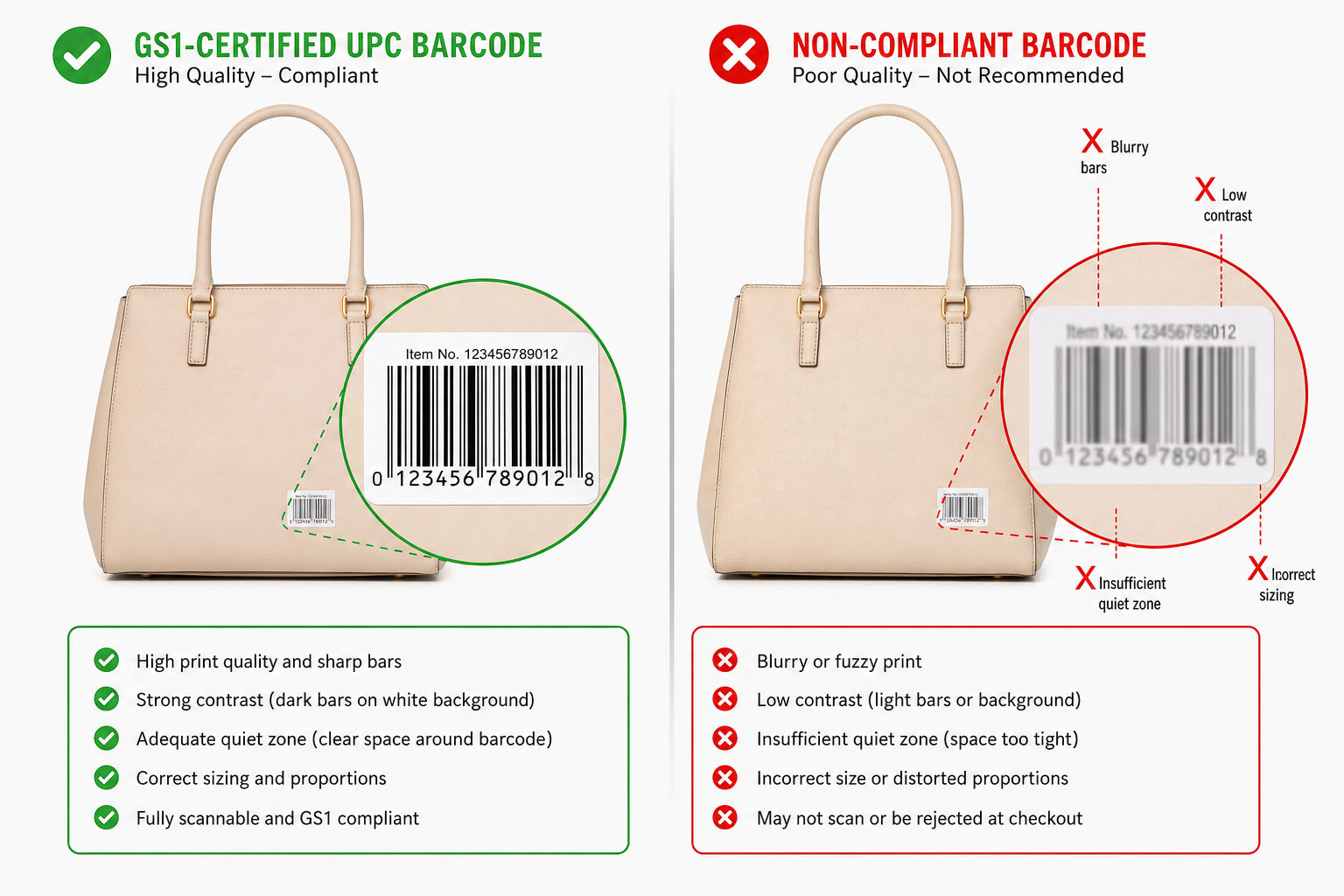
For US independent‑site sellers that also supply brick‑and‑mortar retail partners or multi‑channel marketplaces, generic unregistered barcodes will trigger audit failures, order hold, and charge‑back penalties. Reputable Chinese bag suppliers can produce UPC barcodes that meet full GS1 certification and official US retail registration standards. **Important note for importers**: the brand owner (you as the US seller) must own the GS1 company prefix. Factories cannot legally supply valid GS1‑registered UPC codes under their own Chinese company prefix for your branded bags sold inside the US market. Your supplier can print, verify, and apply your already‑registered GS1 UPC barcodes onto hang tags and packaging, but they cannot generate valid registered GS1 barcodes on your behalf.
When you evaluate vendors, explicitly ask suppliers to confirm they can scan and validate printed UPC barcodes at the factory before mass production. Poor print quality, incorrect barcode sizing, insufficient quiet‑zone white space, or wrong magnification will cause scanners at US retail warehouses to fail, even if you hold valid GS1 registration. Include barcode‑scanning verification steps in your pre‑shipment QC checklist to avoid costly post‑arrival compliance issues.
Mandatory Information for Each Export Carton Label
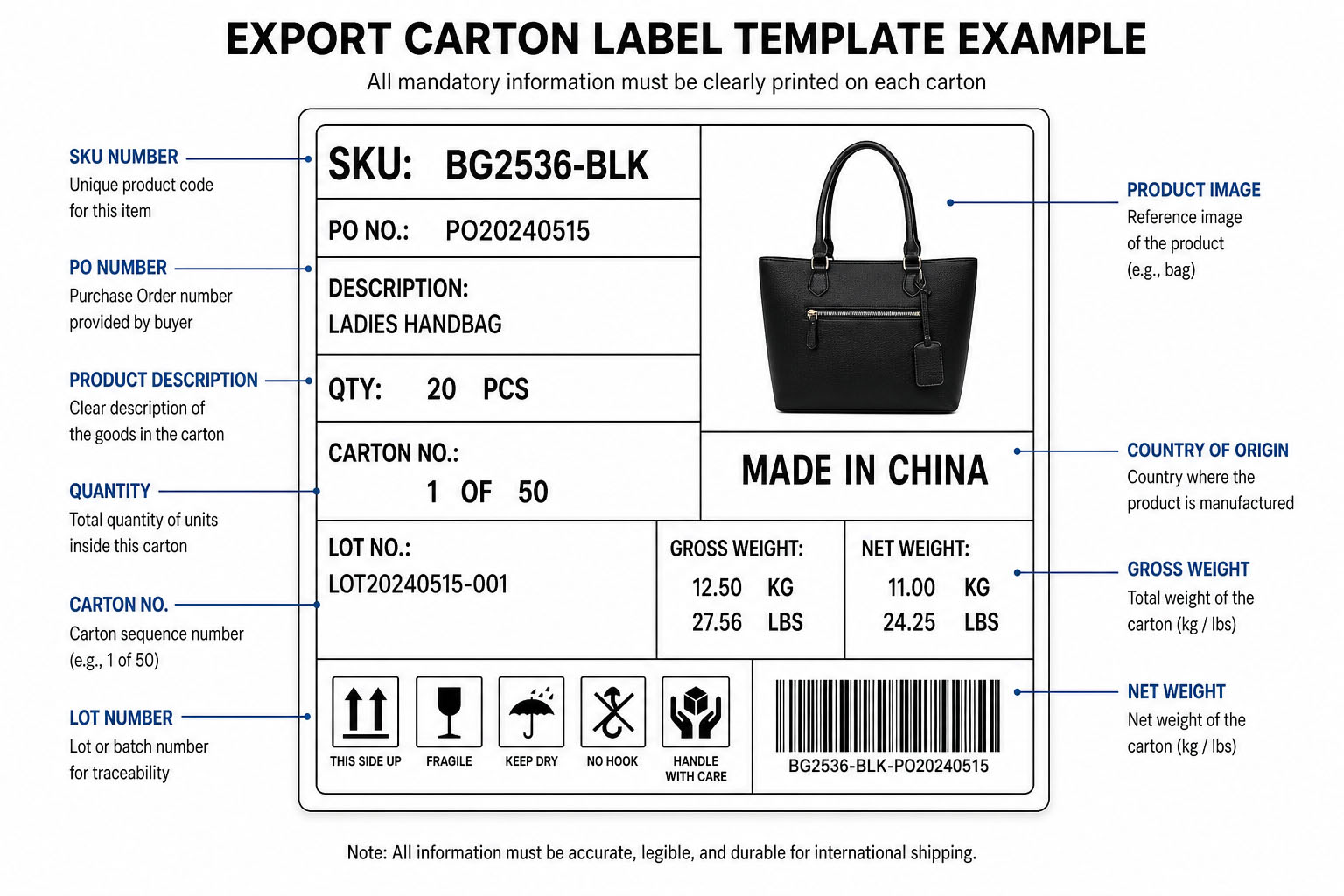
Carton label non‑compliance is one of the most common reasons for US warehouse processing delays, retail vendor‑compliance audit failures, and Amazon receiving errors. Every outer export carton shipped from China to the US must carry clearly printed label data. The core required printed elements on each carton label include SKU number, Purchase Order (PO) number, carton product quantity, and country‑of‑origin marking (“Made in China”).
Depending on your sales channel, additional fields may be mandatory: master carton gross weight, net weight, carton dimensions, case count identifiers, lot numbers, and retail‑specific vendor ID codes. Different US retail customers maintain unique label formatting rules; always request your retailer’s vendor compliance manual and pass those exact formatting specifications fully to your Chinese bag supplier. Labels must resist smudging during ocean‑freight humidity exposure; require suppliers to use waterproof thermal transfer printing instead of basic inkjet printing for carton markings.
Many new importers make the mistake of only providing SKU and PO information while skipping clear country‑of‑origin labeling. US customs and retail auditors enforce country‑of‑origin rules strictly; missing or incorrect origin markings can lead to cargo detention at US ports.
FNSKU Label Capability for Amazon FBA Shipments
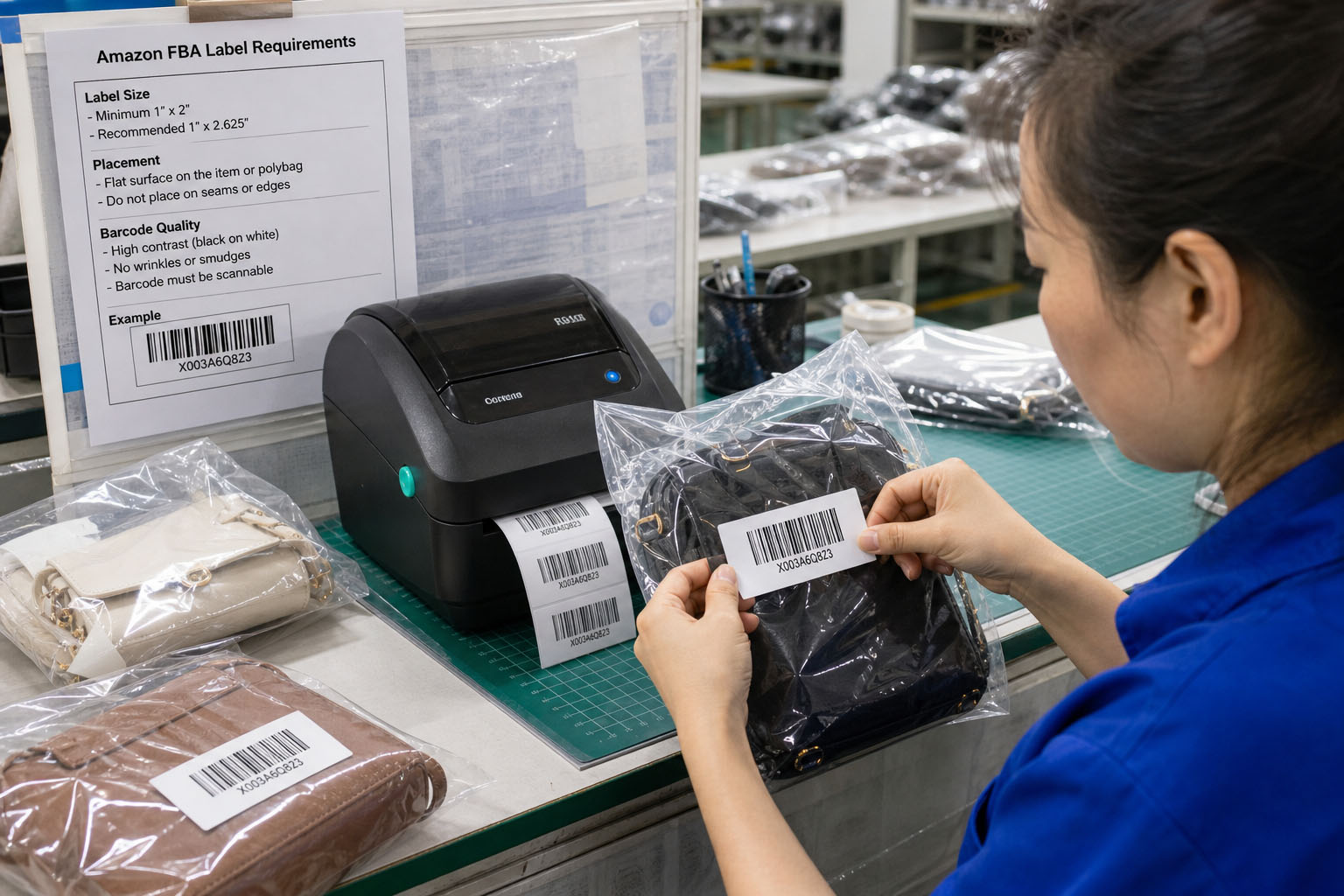
Most US bag independent‑site sellers also leverage Amazon FBA for omnichannel sales, so FNSKU label support from your overseas supplier delivers huge operational efficiency gains. Qualified Chinese bag suppliers are fully capable of generating and applying correct FNSKU labels for Amazon FBA shipments directly inside the factory before export.
This service removes your burden of receiving bulk inventory in the US, manually sticking thousands of individual unit‑level FNSKU stickers, and repackaging goods before sending them to Amazon fulfillment centers. However, clarify key points with your supplier in advance: you must provide Amazon‑generated FNSKU artwork files to your factory. Confirm label adhesive quality, size specifications, placement position on each individual bag polybag or hang tag, and anti‑smudge print quality.
Make clear contractual terms: the supplier is accountable for misprinted, misaligned, or missing FNSKU labels. If factory‑applied labels fail Amazon’s receiving scan process, the supplier should bear responsibility for correction costs, or you should build contingency cost buffers within your import budget. Many mid‑sized bag factories in Yiwu and Guangdong routinely complete FNSKU labeling for US Amazon sellers, but smaller workshops often lack experience, leading to receiving errors inside Amazon warehouses.
Charge‑Back Fees Triggered by Failed Retail Vendor‑Compliance Audits
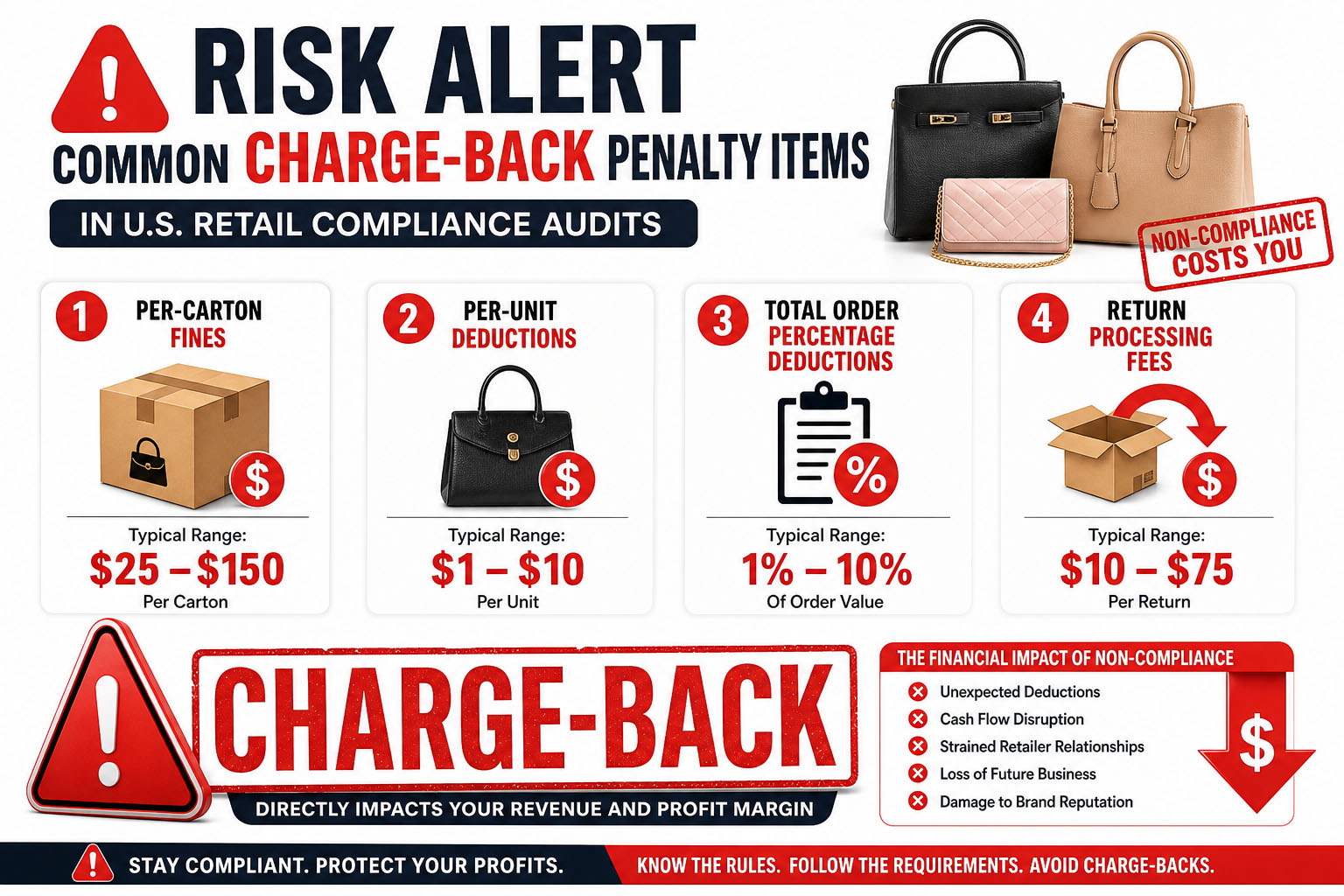
If carton labels, barcode print quality, or carton marking fail a US retail vendor‑compliance audit, you, as the importing US seller, will absorb charge‑back fees levied by your retail partners. This is a high‑financial‑risk area many China‑sourcing bag sellers overlook.
Charge‑back cost structures vary by retail chain. Penalties may include flat per‑carton fines, per‑unit deductions, total order percentage deductions, receiving‑department processing fees, or forced return of non‑compliant cargo back from US retail warehouses. In severe non‑compliance scenarios, retail buyers may place your brand on hold status and refuse future incoming shipments until compliance gaps are fully corrected.
The critical reality: US retail vendors issue charge‑backs against the US‑based brand seller (your independent‑site business), not against your overseas Chinese manufacturer. Even when non‑compliance originates from factory errors, collecting compensation back from overseas suppliers is logistically difficult and time‑consuming. For this reason, proactive pre‑shipment verification is far more effective than attempting post‑facto damage recovery.
Mitigation steps you must implement:
1. Send your full retail vendor‑compliance manual directly to your Chinese supplier and your third‑party QC inspector.
2. Add carton‑label and barcode scan checks into formal pre‑shipment inspection scope for every order.
3. Negotiate within your purchase‑order agreement: define financial liability when supplier‑caused labeling and barcode non‑compliance generates US‑side retail charge‑back fees. Document this term in writing.
4. Require suppliers to send sample printed carton labels and scanned barcode test evidence for your approval before full‑scale carton printing.
Putting Everything Together for Your Bag Import Program
For US independent‑website bag merchants sourcing directly out of China, success is not only about negotiating good unit costs for handbags and backpacks. Robust supplier qualification covers physical packaging transit validation (carton drop and vibration testing), GS1‑compliant UPC barcode workflows, standardized carton labeling, Amazon FBA FNSKU label execution, and mitigation of retail compliance charge‑back exposure.
Packaging performance and compliance work cannot be treated as an afterthought. All testing requirements, barcode rules, label formatting, and liability terms must be formalized inside RFQ documents, purchase orders, and quality‑control agreements with your Chinese bag suppliers. Do not rely on factory defaults. Many export factories only complete rigorous compliance work when buyers clearly define expectations in writing.
Ocean transit from China to the United States takes weeks. Once cargo departs Chinese ports, correcting packaging or labeling mistakes becomes extremely expensive. Investing time on front‑end supplier qualification, written specification documents, and pre‑shipment verification protects your independent‑site profit margins, prevents unexpected charge‑back losses, reduces customer returns caused by transit‑damaged bags, and supports smooth customs, retail‑warehouse, and Amazon FBA receiving operations for your bag inventory.
Post time: Aug-07-2026