
A Strategic Roadmap for Small Business Owners Importing Bags
Introduction: Why Samples Are Your Most Important Investment
When sourcing bags from China for your online business, the excitement of discovering competitive prices and diverse product catalogs can sometimes overshadow one critical step: requesting product samples before committing to a bulk order. For small business owners, this seemingly simple request can mean the difference between building a reliable product line and being stuck with thousands of dollars worth of substandard inventory that fails to meet customer expectations.
The practice of requesting samples before bulk production is not merely a formality—it is an essential due diligence process that protects your investment, validates supplier claims, and establishes the foundation for a successful long-term sourcing partnership. Chinese manufacturers understand this dynamic intimately, and most reputable suppliers view sample requests as a standard part of their business development process rather than an inconvenience.
This comprehensive guide walks you through every aspect of the sample request process, from understanding typical costs and lead times to evaluating sample quality and negotiating favorable terms. Whether you are importing tote bags, backpacks, messenger bags, or luxury handbags from Chinese factories, the principles outlined here will help you make informed decisions that safeguard your business while positioning you as a professional, knowledgeable buyer in the eyes of your suppliers.
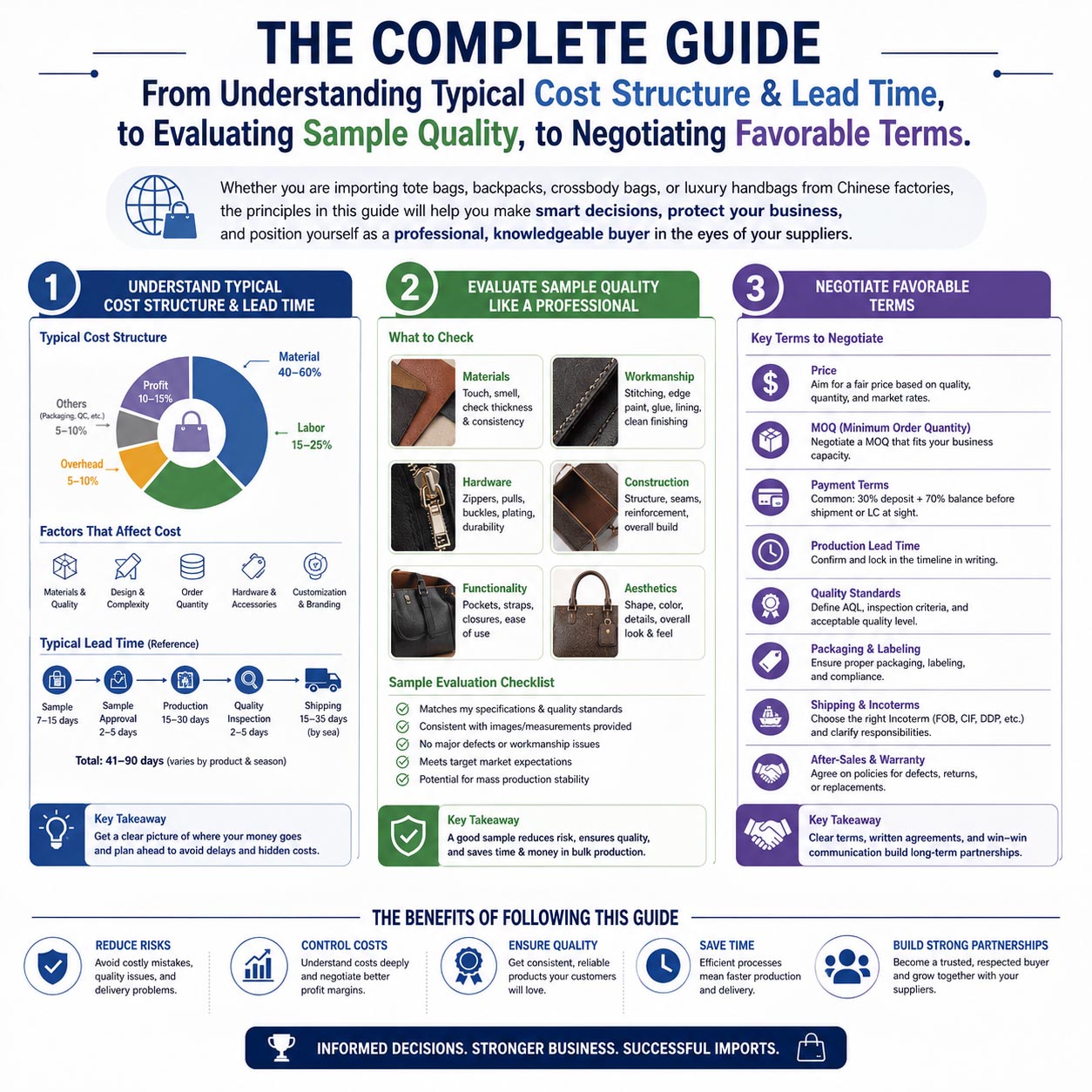
Understanding the Sample Order Process: Industry Standards and Expectations
The Cultural Context of Samples in Chinese Manufacturing
In the context of international trade with Chinese suppliers, samples serve multiple strategic purposes that extend far beyond simple product evaluation. For Chinese manufacturers, the sample phase represents the first real opportunity to demonstrate their production capabilities, attention to detail, and commitment to customer satisfaction. Most established bag suppliers in China have refined their sample processes over years of serving international buyers, recognizing that a positive sample experience often leads to substantial bulk orders and long-term business relationships.
The typical Chinese supplier approaches sample requests with one of three primary models. The first model involves sending existing inventory samples—pre-produced bags from their standard catalog that require minimal preparation time. The second model centers on producing samples specifically for the client’s design specifications, which naturally involves more time and higher costs. The third model, increasingly common among sophisticated manufacturers, offers virtual samples through detailed photography, video documentation, and specification sheets when physical shipping proves impractical or too costly.
Understanding which model a supplier employs is crucial for setting realistic expectations regarding timelines, costs, and the depth of evaluation possible before placing your bulk order. Reputable suppliers typically make their sample policy transparent from the first communication, so pay close attention to how they describe their process—this initial responsiveness often indicates their overall professionalism and customer service orientation.
Standard Sample Policies You Can Expect
Based on industry practices, most Chinese bag suppliers operate under consistent frameworks regarding sample policies. When you contact a supplier about their sample process, you can generally expect that they will require payment for sample costs upfront, with shipping fees typically borne by the buyer. The rationale behind this policy is straightforward: samples represent real production resources, including materials, labor, and quality control attention, and suppliers deserve compensation for these investments when buyers ultimately decide not to proceed.
However, the financial aspect of samples becomes considerably more favorable once a bulk order is confirmed. Many suppliers offer to reimburse sample costs—either partially or in full—against the first bulk order, effectively making samples a de facto deposit on future production. This approach aligns supplier and buyer incentives: the manufacturer demonstrates confidence in securing the bulk order, while the buyer receives tangible assurance that the supplier is invested in establishing a lasting relationship.
Some suppliers also offer a (pre-production sample) arrangement, where the buyer places a bulk order first, and the manufacturer ships a sample from the actual production run before completing the full quantity. This model minimizes the upfront sample investment for buyers while still providing quality verification before complete production commitment.
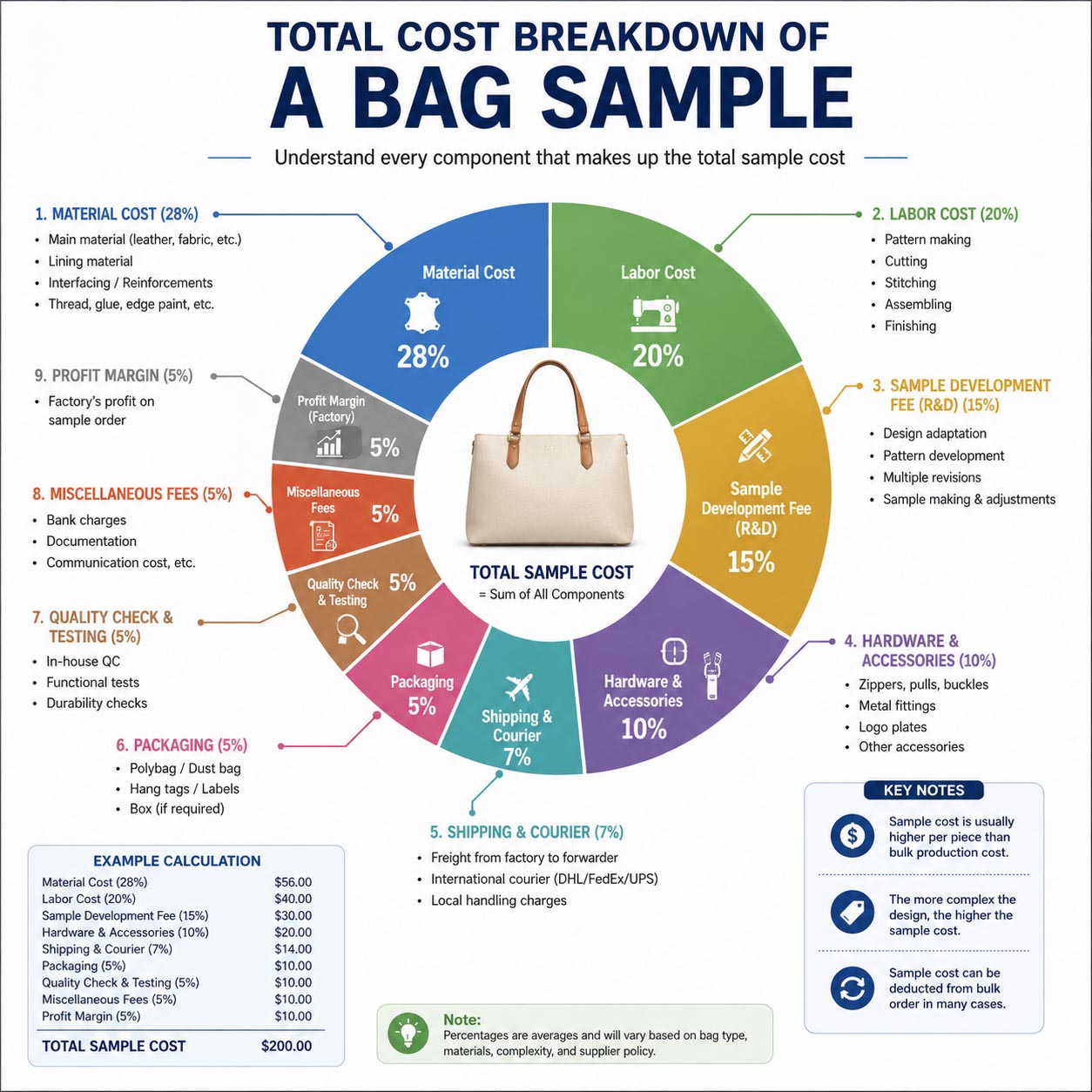
Sample Costs and Shipping: What to Budget For
Breaking Down the Financial Components
When evaluating the true cost of samples from Chinese suppliers, it is essential to distinguish between several distinct cost components that together determine your total investment. The sample product cost itself typically mirrors the per-unit bulk price or may be slightly higher to account for the lack of economies of scale inherent in small-quantity production. For a standard tote bag with a bulk unit price of $3.50, you might expect to pay $5.00 to $7.00 per sample unit, reflecting the higher per-unit cost of producing limited quantities.
Beyond the product cost, shipping fees represent a significant variable that can substantially affect the total sample investment, particularly when ordering from multiple suppliers simultaneously. Air freight represents the most common shipping method for samples due to speed, with typical costs ranging from $30 to $80 for a small package containing several bags, depending on destination, weight, and shipping speed preferences. Express courier services like DHL, FedEx, or UPS offer convenience and tracking but command premium rates that can exceed $100 for expedited delivery to North America or Europe.
Sea freight is economically impractical for samples alone but may become relevant if you consolidate samples from multiple suppliers into a single larger shipment. Some sophisticated buyers also explore consolidated shipping services that aggregate smaller packages into optimized shipments, potentially reducing per-unit shipping costs while extending delivery timelines.
Strategies for Minimizing Sample Costs
Savvy small business owners employ several strategies to manage sample costs without sacrificing the ability to evaluate multiple suppliers effectively. The first strategy involves negotiating sample reimbursement terms upfront—many suppliers are willing to reduce or waive sample fees entirely if you can demonstrate serious intent through a committed bulk order timeline. Presenting yourself as a prospective long-term partner rather than a one-time buyer often unlocks more favorable sample terms.
A second cost-management approach involves requesting samples from suppliers sequentially rather than simultaneously. By evaluating one supplier’s sample thoroughly before moving to the next, you can limit your total sample investment while maintaining thorough evaluation standards. This method also allows you to apply insights from early evaluations to refine your subsequent sample requests, ensuring each evaluation builds upon accumulated knowledge.
The third strategy involves exploring video and photo sample alternatives when physical samples prove prohibitively expensive. Many suppliers now offer comprehensive virtual sample packages that include high-resolution images from multiple angles, detailed videos of the bag in use, and specification sheets that closely approximate what you could learn from a physical sample. While not a perfect substitute for tactile evaluation, these virtual samples can help you narrow down supplier candidates before committing to physical sample orders.
Lead Times: Setting Realistic Expectations
Understanding the Variables That Affect Delivery
Sample lead times from Chinese suppliers vary considerably based on several interconnected factors, and understanding these variables helps you set realistic timelines for your sourcing schedule. For existing catalog products where suppliers maintain ready inventory or can draw from established production lines, lead times tend to be the shortest—typically ranging from 3 to 7 business days for sample preparation and handling before shipping.
Custom-designed samples introduce additional complexity that naturally extends timelines. When requesting samples that incorporate your own logo, specific color configurations, or modified design elements, suppliers must allocate production resources, potentially adjust manufacturing processes, and ensure that customization meets your exact specifications. This customization phase typically adds 5 to 10 days to the standard timeline, bringing total sample lead times to approximately 2 to 3 weeks in most cases.
Geographic factors also influence delivery speed beyond the supplier’s control. Air freight from major Chinese manufacturing hubs like Guangzhou, Yiwu, or Shanghai to North American destinations generally requires 5 to 10 business days, with express services potentially reducing this to 3 to 5 days at premium rates. European destinations typically see similar or slightly longer transit times depending on specific routing and customs clearance efficiency.
Planning Your Sourcing Timeline Accordingly
Effective project management requires incorporating realistic sample timelines into your overall product launch or inventory replenishment schedule. As a general rule, you should plan for a minimum of 4 to 6 weeks from the moment you request samples to the point where you have sufficient information to confidently place a bulk order. This buffer accounts for sample production, shipping, evaluation periods, potential revision requests, and any negotiation adjustments that may arise.
For seasonal products or time-sensitive inventory needs, these timelines become even more critical. If you need bags in stock before a major shopping event or seasonal period, begin your sample evaluation process at least 8 to 12 weeks in advance to accommodate potential delays, revisions, and the inevitable back-and-forth communication that characterizes international sourcing relationships.
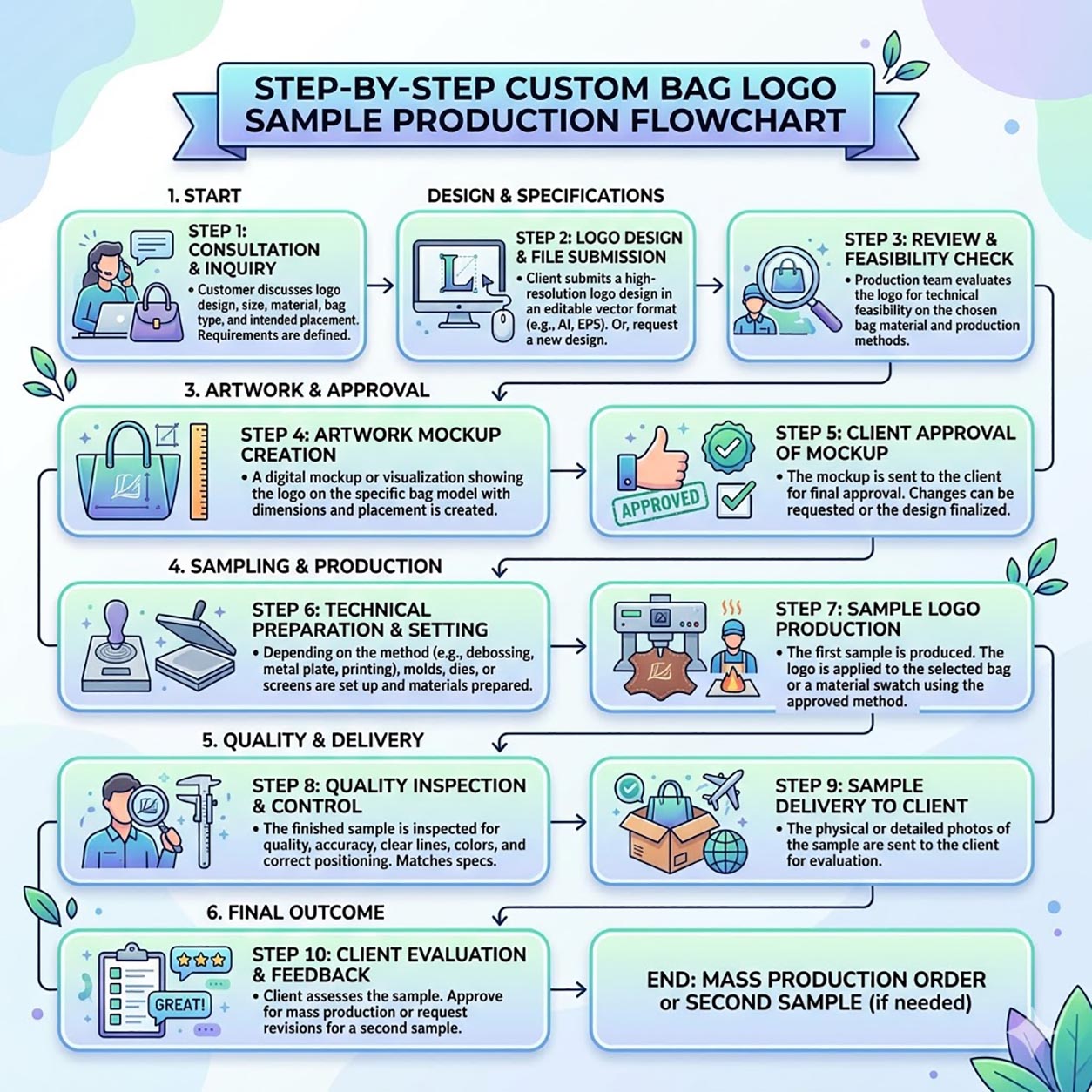
Custom Samples with Your Logo: The Branding Imperative
Why Branded Samples Matter for Business Identity
For online retailers selling bags under their own brand, the sample phase represents a crucial validation point for your product identity. A sample bearing your logo, hang tags, and packaging provides the most accurate preview of how your final product will appear to customers, allowing you to identify any discrepancies between your design vision and the manufacturer’s interpretation before committing to bulk production.
The process of requesting branded samples typically involves providing suppliers with artwork files for your logo, specifying precise placement locations, and confirming color matching requirements. Most Chinese manufacturers work with standard file formats including AI, EPS, PDF, or high-resolution PSD files, and they generally expect color specifications using Pantone Matching System (PMS) codes to ensure accuracy across different materials and printing methods.
Logo application methods vary based on bag material and desired durability. Screen printing suits canvas and fabric surfaces, offering good durability at moderate cost. Heat transfer printing provides flexibility for complex designs but may have limited wash resistance. Embossing or debossing creates premium tactile impressions particularly suited to leather and high-end synthetic materials. Laser engraving offers precision for certain synthetic materials and metal hardware. Understanding these options—and communicating your preferences clearly—ensures that your branded sample accurately represents your product vision.
Managing the Custom Sample Process
When requesting custom samples with branding elements, allocate additional time for proof approval cycles. Suppliers typically provide digital mockups or video proofs showing how your logo will appear on the bag before physical production begins. Review these proofs meticulously, checking logo proportions, color accuracy, and placement symmetry. Minor adjustments identified at this stage cost nothing; the same adjustments identified after bulk production can result in thousands of dollars of non-conforming inventory.
Pay particular attention to how your branding integrates with the bag’s overall design. A logo that looks perfect in isolation may appear visually jarring when applied to the actual product, and only physical sample evaluation reveals these integration issues. Request samples with your complete branding package—logo, hang tags, care labels, and packaging materials—to evaluate the full customer unboxing experience before committing to bulk quantities.
The Sample Approval Process: From Receipt to Bulk Commitment
Establishing Quality Checkpoints
A systematic sample evaluation process protects your business by ensuring that every aspect of the bag meets your quality standards before production scales up. Upon receiving samples, resist the temptation to immediately celebrate or condemn—instead, approach evaluation methodically, documenting findings for each checkpoint that will inform your approval decision.
The first evaluation phase focuses on material quality and authenticity. Verify that the materials match your specifications and any certification claims the supplier has made. For bags described as using organic cotton, confirm the fabric weight, weave consistency, and any accompanying certification documentation. For recycled materials, request verification of recycled content percentages and sourcing chain documentation. Material thickness, texture, and appearance should all align with your expectations based on supplier descriptions and any sample photographs or specifications previously provided.
The second evaluation phase examines construction quality, particularly stitching integrity. Examine seam straightness, stitch density (stitches per inch), and the consistency of thread tension throughout the bag. Reinforced stress points—areas like handles, strap attachments, and bottom corners—should demonstrate extra stitching layers or bar tacking that indicate thoughtful engineering. Look for loose threads, skipped stitches, or uneven seam allowances that suggest rushed or careless production.
Hardware evaluation completes the construction assessment. Test zippers for smoothness, checking for snagging, excessive resistance, or improper alignment. Evaluate buckle functionality, D-ring security, and magnetic closure strength where applicable. Metal hardware should show no signs of corrosion, plating imperfections, or weak spring tension. Plastic components should demonstrate appropriate flexibility without brittleness or deformation.
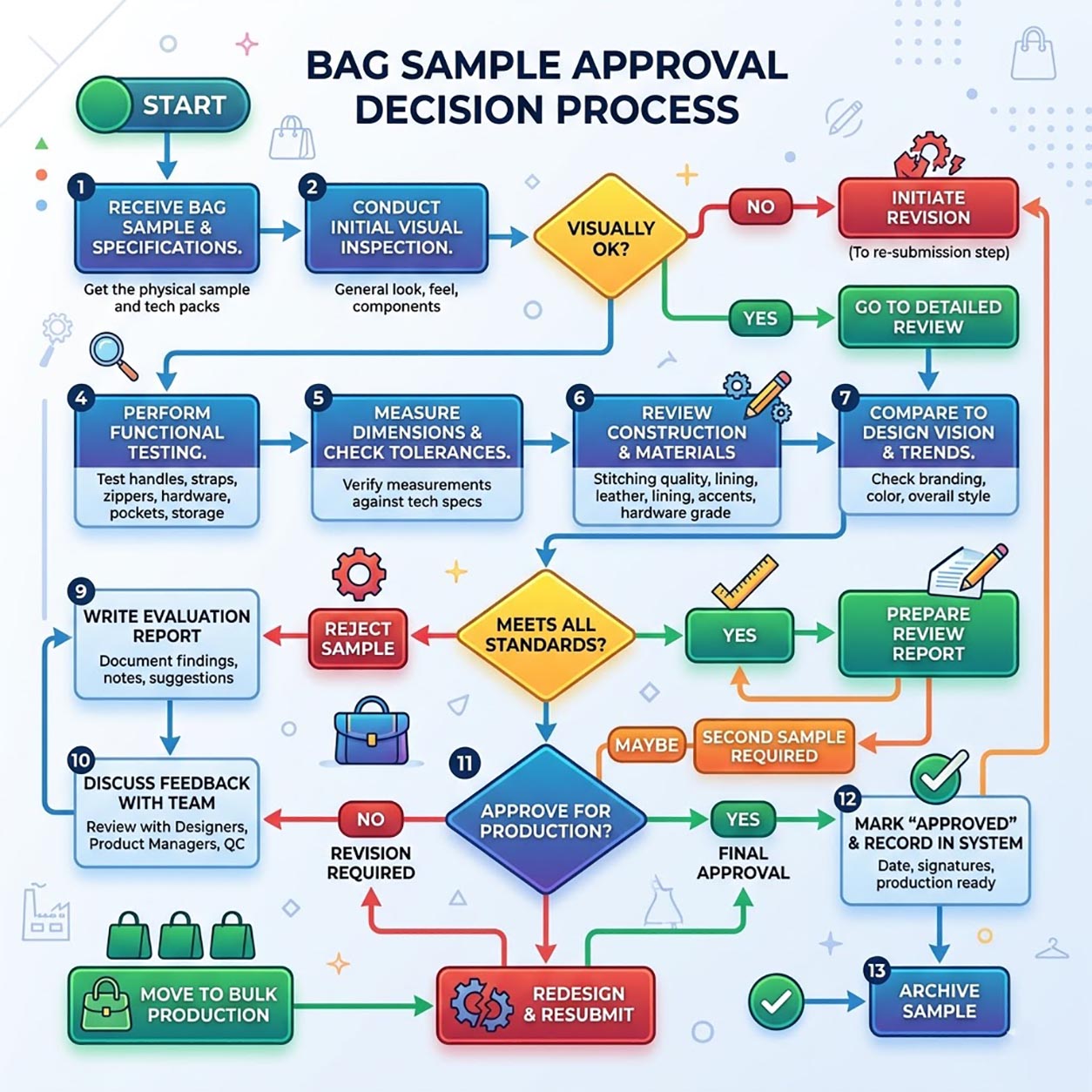
The Approval Decision Framework
After completing your quality evaluation, you face one of three approval outcomes. Full approval indicates that the sample meets all your requirements and you are ready to proceed with bulk order placement. Conditional approval means the sample demonstrates acceptable quality overall but identifies specific issues requiring correction before bulk production—these corrections might involve material adjustments, construction modifications, or specification refinements that the supplier must address in a revised sample.
Rejection occurs when the sample falls significantly short of your quality standards or diverges substantially from agreed specifications. When rejecting samples, provide detailed feedback supported by photographs and specific reference points from your original requirements. Professional suppliers appreciate clear, constructive feedback that helps them understand exactly what adjustments are needed, and many will work diligently to address legitimate concerns without requiring you to start the sample process from scratch.
Evaluating Multiple Suppliers: The Strategic Advantage
Why Comparison Matters for Small Businesses
Requesting samples from multiple suppliers simultaneously offers strategic advantages that extend beyond simple quality comparison. By evaluating three to five supplier candidates in parallel, you gain market intelligence about pricing structures, production capabilities, communication responsiveness, and overall business compatibility that inform your long-term sourcing strategy.
Quality comparison across suppliers reveals the realistic quality spectrum available at your target price point. A supplier quoting $4.00 per unit may offer noticeably different quality than one quoting $6.00, and direct sample comparison validates whether the price differential reflects genuine quality improvements or merely supplier positioning strategies. Understanding this relationship helps you make informed decisions about where to allocate your quality-versus-cost tolerance.
Craftsmanship evaluation across suppliers highlights production capability differences that may not be apparent from catalog photographs or specification sheets. One supplier may excel at canvas construction but struggle with leather goods, while another demonstrates superior hardware sourcing but inconsistent stitching quality. Identifying each supplier’s strengths enables you to match appropriate manufacturers to specific product categories within your catalog.
Creating a Comparison Framework
Develop a standardized evaluation template that allows objective comparison across suppliers. This template should include weighted categories reflecting your business priorities—perhaps material quality at 25%, construction at 30%, communication responsiveness at 15%, pricing at 20%, and lead time reliability at 10%. Scoring each supplier against these weighted categories produces a quantitative comparison that complements qualitative observations.
Document your evaluation with photographs that capture representative quality indicators from each supplier. These photographs serve multiple purposes: they provide evidence supporting your evaluation scores, they create a reference archive for future decisions, and they facilitate productive supplier conversations by enabling specific visual references rather than abstract quality descriptions.
Alternative Sample Methods: Video and Photo Samples
When Virtual Samples Make Sense
Virtual sample alternatives—detailed video documentation, high-resolution photography, and comprehensive specification sheets—have emerged as practical solutions for specific sourcing scenarios where physical samples prove impractical. These alternatives merit consideration when evaluating suppliers for low-cost promotional items where sample costs approach or exceed the value of the eventual bulk order. They also make sense when initial screening of numerous potential suppliers requires rapid evaluation without significant financial commitment.
The quality of virtual samples varies considerably across suppliers, so evaluate these alternatives critically. At minimum, request video showing the bag from multiple angles, opening and closing all compartments, and demonstrating hardware functionality. High-resolution photographs should include close-ups of stitching, material texture, and any branding elements. Specification sheets should detail exact dimensions, material compositions, and any certification documentation.
While virtual samples cannot fully replicate tactile evaluation—feeling material weight, assessing hardware quality through touch, or testing zipper smoothness—they can effectively verify that suppliers understand your requirements and can produce designs matching your specifications. Treat virtual samples as a preliminary screening step that qualifies suppliers for physical sample evaluation rather than a complete substitute.
Negotiation Strategies for Sample Costs
Leveraging Your Position Professionally
Negotiation on sample fees is not only acceptable but expected in the context of Chinese supplier relationships. Suppliers anticipate buyers will request concessions, and they build negotiating flexibility into their initial quotes. The key to successful negotiation lies in presenting yourself as a valuable long-term partner rather than a one-time buyer seeking maximum short-term concessions.
When negotiating sample terms, reference your planned bulk order volume and timeline. A supplier understands that a buyer committing to 5,000 units annually represents significantly more value than one ordering 500 units once. Quantify your business potential in concrete terms—monthly or annual order projections, multiple product categories you intend to source, and plans for expanding your product line over time.
Request sample cost reductions or waivers as part of a bundled proposal that includes your commitment to a specific bulk order timeline. Rather than asking “Can you waive the sample fee?” try proposing: “If you can reduce the sample cost by 50% and guarantee shipment within 5 days, I can confirm my bulk order of 2,000 units within two weeks of sample approval.”
Understanding Supplier Perspectives
Experienced Chinese suppliers recognize that sample costs represent minimal revenue compared to bulk orders, and they invest in sample relationships because of the potential returns from successful long-term partnerships. This understanding creates mutual benefit opportunities: you reduce upfront costs while suppliers secure preferential positioning for your bulk business.
Be respectful of supplier constraints—particularly small manufacturers who genuinely incur costs when producing samples. Avoid aggressive tactics that might damage relationship potential; instead, pursue collaborative negotiations that acknowledge supplier investments while protecting your financial interests. A supplier who feels fairly treated becomes a more reliable partner when challenges arise during bulk production.
Best Practices: A Complete Sample Request Workflow
Step-by-Step Implementation Guide
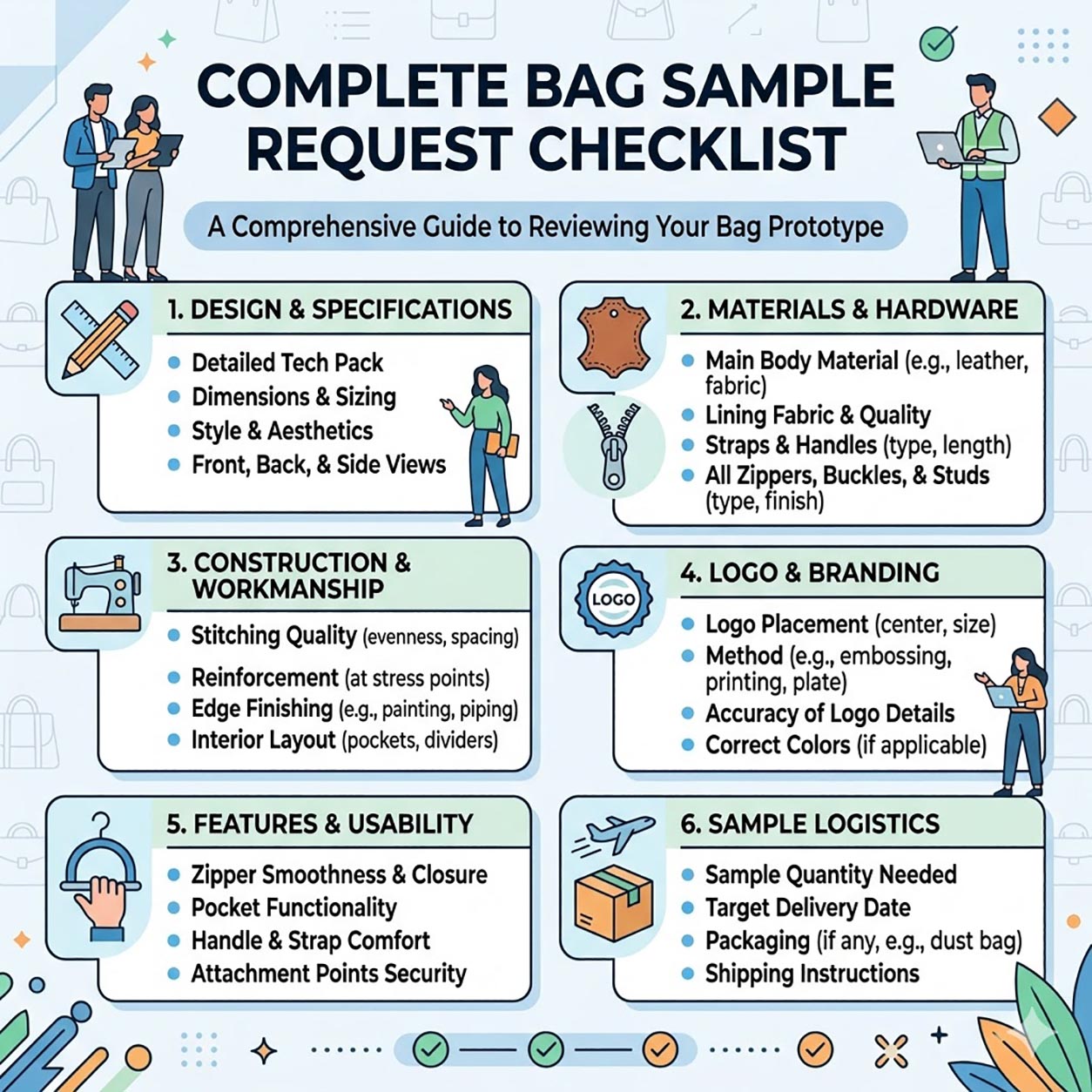
Implementing a structured sample request workflow ensures consistency and professionalism across your supplier interactions. Begin by preparing comprehensive specifications for each bag style you intend to evaluate. These specifications should include exact dimensions, material requirements, color references using standard systems like Pantone or RAL, hardware preferences, logo placement details, and any functional requirements such as water resistance or load capacity.
Draft a professional inquiry message that introduces your business, describes your product requirements, and requests specific information about sample availability, costs, and timelines. The sample inquiry message should be clear, complete, and professional—reflecting the seriousness with which you approach the sourcing relationship. Avoid sending generic messages that suggest you are broadcasting inquiries to dozens of suppliers simultaneously; instead, demonstrate that you have researched the supplier specifically and are interested in their particular capabilities.
Upon receiving supplier responses, evaluate communication quality as an indicator of future partnership reliability. Prompt, clear, and thorough responses suggest a well-organized supplier capable of managing your account effectively. Delayed, vague, or incomplete responses may indicate communication challenges that would intensify during complex bulk order management.
Documentation and Communication Standards
Maintain detailed records of all supplier communications, including email threads, specification documents, quotation summaries, and sample tracking information. These records protect you in disputes, inform future negotiations, and provide a reference archive for recurring product lines. Create a standardized tracking system that monitors sample status, expected delivery dates, evaluation outcomes, and follow-up actions.
When providing feedback to suppliers—whether positive or negative—maintain professional courtesy that preserves relationship potential. Constructive feedback delivered respectfully encourages supplier responsiveness and improvement, while harsh criticism may provoke defensiveness or relationship termination. Frame observations objectively, referencing specific evidence rather than subjective impressions.
Common Pitfalls and How to Avoid Them
Mistakes That Undermine Sourcing Success
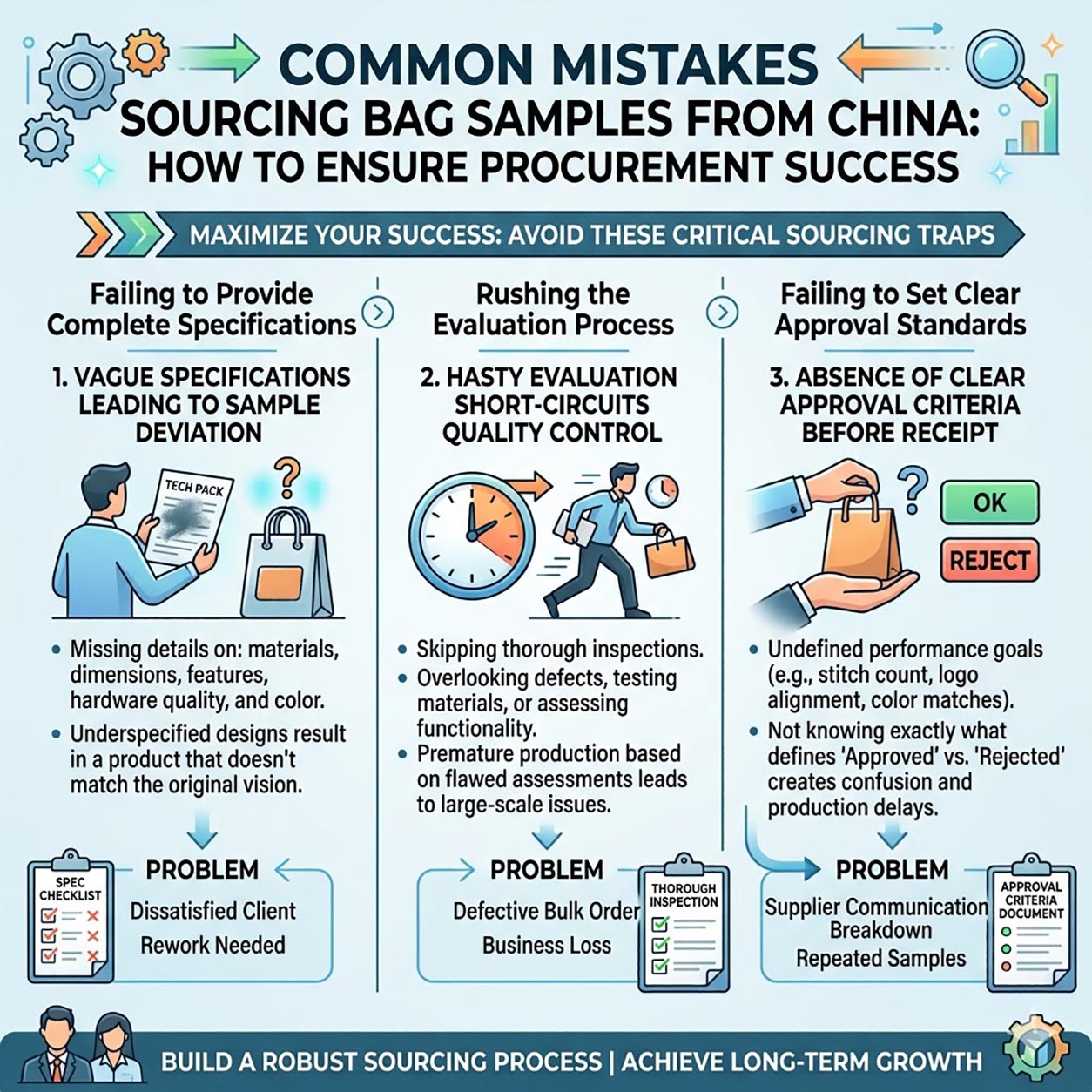
Several common mistakes undermine small business owners’ success when requesting samples from Chinese suppliers. The first involves failing to provide complete specifications, leading to samples that diverge from expectations in ways that could have been prevented with clearer communication. Every detail matters—from exact dimensions to color specifications to packaging requirements—and omitting information invites misinterpretation.
A second pitfall involves rushing the evaluation process. The pressure to move quickly from sample to bulk order can lead to superficial assessments that miss quality issues that become apparent only in extended use or after customer exposure. Allocate adequate time for thorough evaluation, including wear testing where feasible, color matching against physical reference standards, and comparison against competing supplier samples.
A third mistake involves failing to establish clear approval criteria before receiving samples. Without predefined quality standards, evaluation becomes subjective and inconsistent, potentially allowing substandard products to proceed to bulk production or unnecessarily rejecting acceptable products. Document your quality requirements in advance, reference them explicitly in supplier communications, and evaluate samples against these predetermined standards.
Protecting Yourself Legally and Financially
Before placing bulk orders following sample approval, ensure appropriate contractual protections are in place. Purchase orders should specify exact product requirements, quality standards, inspection procedures, defect tolerances, and remedies for non-conforming products. Consider requiring pre-shipment inspection by third-party quality control services, particularly for significant order values.
Payment terms should protect both parties—typically involving a deposit (30-50% of order value) with balance payment due upon shipment or upon presentation of shipping documentation. Avoid full prepayment unless you have established a trusted relationship with extensive track record. Similarly, be skeptical of suppliers who demand minimal deposits for large orders, as this may indicate desperation or fraudulent intent.
Summary: Key Takeaways for Small Business Owners
The sample request process represents one of the most critical due diligence steps in your relationship with Chinese bag suppliers. By understanding industry-standard practices, budgeting appropriately for sample costs and shipping, setting realistic lead time expectations, and implementing systematic evaluation procedures, you position yourself to make informed sourcing decisions that protect your business investment while building reliable supplier partnerships.
Remember that reputable suppliers expect and welcome professional sample requests—they recognize that serious buyers who invest time in sample evaluation are the most likely to become reliable, long-term customers. Approach each supplier interaction as the beginning of a potential partnership, and conduct yourself accordingly in communications, negotiations, and feedback provision.
Take action today by drafting your first professional sample inquiry using the frameworks outlined in this guide. Identify two or three suppliers whose catalog offerings align with your product requirements, prepare complete specifications for each bag style, and initiate contact with clear, professional inquiries. The investment you make in this sample evaluation process will pay dividends through better-quality products, stronger supplier relationships, and greater confidence in your sourcing decisions.
Quick Reference Checklist
Before sending any sample request to a Chinese supplier, confirm you have addressed these essential elements:
Complete product specifications including dimensions, materials, colors, and functional requirements
Clear branding requirements with logo artwork files and placement instructions
Certification requirements if you need materials meeting specific standards
Sample quantity needed from each supplier
Budget parameters for sample costs and shipping
Timeline requirements based on your inventory needs
Evaluation criteria against which you will assess sample quality
Approval workflow defining who makes decisions and what constitutes acceptable quality
Negotiation parameters for sample cost reductions or reimbursements
Follow-up communication plan for providing feedback and tracking supplier responsiveness
By preparing thoroughly and approaching the sample process strategically, you transform a potentially risky sourcing decision into a calculated business investment supported by tangible evidence and professional evaluation.
Post time: May-29-2026