

Premium packaging details can make or break your customer’s first impression—whether they shop in-store or unbox at home.
If you’ve been importing bags from China for any length of time, you already know the hard part isn’t finding a factory. It’s making sure the packaging and presentation match your sales channel. A handbag that looks stunning on a boutique shelf may underwhelm a customer unboxing it after a two-week transit, and a bag optimized for Amazon FBA may feel “too plain” to a retail buyer walking into a department store.
This is exactly where tissue paper, silica gel packets, and hangtags come into play. These three small elements are often the most overlooked line items in a proforma invoice, yet they carry an outsized impact on perceived value, compliance, and product protection. After years of working directly with Chinese bag manufacturers and selling through both our own website and Amazon US, we’ve learned how to navigate the retail-versus-e-commerce divide. This guide breaks down everything you need to know—and what to ask your supplier before you place the next order.
Why Packaging Details Matter More Than Most Buyers Realize
Before diving into the three specific inserts, it’s worth understanding why Chinese bag factories treat tissue, silica gel, and hangtags as separate categories from the bag itself.
In the Chinese supply chain, the “core product” usually refers to the bag only: the shell material, lining, hardware, stitching, and dimensions. Everything that goes around the bag—the wrapping, the moisture absorber, the printed card, even the zip-tie on the zipper pull—is classified as packaging, display, or compliance material. Most factories will quote these as either inclusive, optional, or separately billed line items, and that’s where the first source of confusion begins.
More importantly, retail packaging and e-commerce packaging are not the same thing. They serve different psychological and logistical functions:
Retail packaging is designed to win a customer over in 3–7 seconds of in-store browsing. It must look premium, communicate brand, and survive multi-handling on the shop floor.
E-commerce packaging is engineered to protect the product through multi-leg transit, Amazon FBA warehouses, and a “blind” unboxing experience. It prioritizes durability, weight, and platform compliance (FNSKU, suffocation warnings, etc.).
Understanding this split is the first step toward sourcing smarter.
1. Tissue Paper: The Silent Salesperson Inside the Box
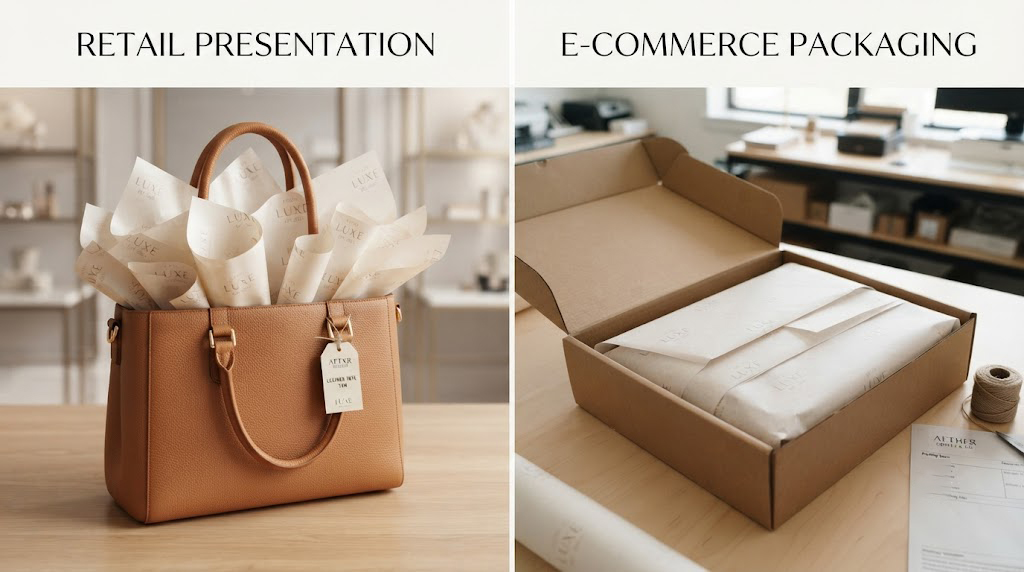
Tissue paper is one of the cheapest items in the entire supply chain, but it has a disproportionate impact on perceived value. We’ve seen customer reviews go from “nice bag” to “felt luxurious” simply by upgrading the tissue.
Retail vs. E-Commerce Tissue Paper
Retail orders typically use decorative or branded folds—often fanned inside the bag opening, with the brand logo or pattern visible at first glance. The fold is part of the visual merchandising.
E-commerce orders usually use simple flat folds—single sheets laid over the bag to prevent scratches during shipping. The visual presentation matters less because the customer rarely sees the tissue before the bag itself.
GSM and Material Quality
The GSM (grams per square meter) of tissue paper signals its purpose:
17–20 GSM tissue is the standard for e-commerce dust protection. Lightweight, low cost, and adequate for transit.
25–35 GSM tissue is more common in retail packaging. It feels thicker, holds decorative folds, and doubles as a presentation element.
Custom printed tissue with your logo is almost exclusively requested by retail buyers. The unit cost is higher (often $0.05–$0.20 per sheet), but the brand reinforcement is significant for boutique positioning.
If you sell on Shopify or run your own DTC site and want the unboxing moment to feel premium, you can absolutely request custom tissue for e-commerce too—just be aware the MOQ and cost will be higher.
What to Ask Your Supplier
“For retail orders, please use 25–30 GSM tissue with [branded/decorative] fold. For e-commerce orders, please use 17–20 GSM plain white tissue, flat-folded. Is custom logo printing available, and at what MOQ?”
2. Silica Gel Packets: The Humidity Problem No One Talks About
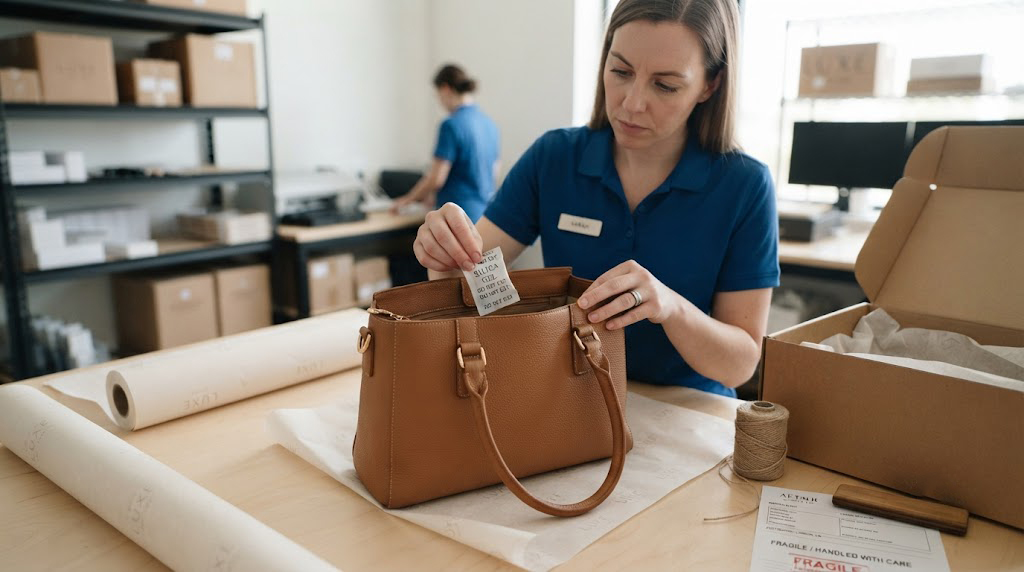
Silica gel selection depends on material type, transit time, and destination humidity—not just sales channel.
Here’s something most first-time importers get wrong: silica gel is not channel-specific. Whether the bag is heading to a retail buyer in California or to an Amazon FBA warehouse in Kentucky, moisture is moisture. The decision to add silica gel—and how much—depends on three factors:
1. The bag material (leather, coated canvas, and synthetics are most vulnerable)
2. The transit and storage duration (ocean freight + Amazon warehousing can mean 60–90 days before the customer sees the product)
3. The destination climate (humid regions like Florida, the Gulf Coast, or Southeast Asia need more aggressive moisture control)
Quantity and Sizing
Standard retail packaging typically uses 3g–5g silica gel packets, one per bag.
E-commerce shipments often use 1g–2g packets to minimize added shipping weight—but counter-intuitively, they may use more packets per carton because the outer carton sits in warehouses longer.
We’ve seen some suppliers include silica gel inside the bag (for direct customer use) and inside the outer carton (for shipping protection). Make sure you know which one you’re getting.
A Practical Note on Cost
Silica gel is rarely a major cost driver—usually $0.01–$0.05 per packet. Most Chinese factories include basic non-indicating silica gel as part of standard packaging. Indicating silica gel (the kind that changes color when saturated) costs more and is usually a special request.
What to Ask Your Supplier
“Please confirm: (1) is silica gel included by default, (2) what gram weight do you use per bag, and (3) is the silica gel placed inside the bag, inside the carton, or both? Can you upgrade to indicating silica gel if needed?”
3. Hangtags: The Most Underrated Branding Tool You Own
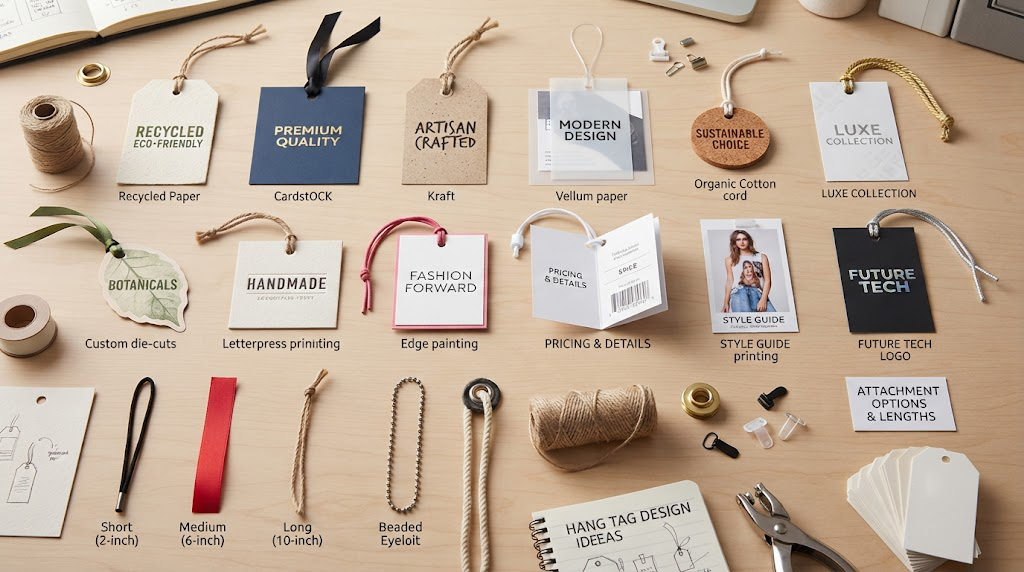
Hangtags serve very different functions depending on whether your bag ends up on a retail shelf or in an Amazon warehouse.
Hangtags are where the retail vs. e-commerce distinction becomes most pronounced, and where most new importers lose money on unnecessary customization or compliance issues.
Retail Hangtag Requirements
If your bags are destined for brick-and-mortar retail—department stores, boutiques, or specialty shops—the hangtag must typically include:
Brand logo and name
Country of origin (mandatory in the USA: “Made in China”)
UPC barcode (the retailer’s POS system needs this)
Style number / SKU
Material composition (especially important for leather or textile)
Price or MSRP (often printed on the back, sometimes as a removable sticker)
Retail hangtags are usually attached with a longer string (8–12 inches) so the tag can hang free for display purposes, and the material is typically 350gsm+ card stock for a premium feel.
E-Commerce Hangtag Requirements
For e-commerce, especially Amazon FBA, hangtag requirements are very different:
FNSKU labels are mandatory and applied directly to the product or packaging (not usually as a hangtag).
SKU stickers are common for Shopify and multi-channel sellers.
Suffocation warnings are required for any bag sold on Amazon that ships in polybag packaging.
Country of origin is still required, but it can be on a sewn-in label or printed on the inner lining instead of a hangtag.
Many e-commerce sellers skip the hangtag entirely to save cost and reduce compliance risk. If you do want a hangtag for branding, it can be shorter and more compact.
CPSIA and US Compliance
Regardless of sales channel, if you’re selling bags in the USA, your hangtag and any small parts must comply with CPSIA (Consumer Product Safety Improvement Act). This affects:
Lead content in printed materials
Phthalates in plastic hangtag strings (use cotton or jute instead)
Tracking labels for children’s products
A reputable Chinese factory will know CPSIA basics, but it’s your responsibility to specify your target market in writing. We’ve seen orders held at US customs because a hangtag string contained non-compliant plastic.
What to Ask Your Supplier
“For retail: please provide hangtags with [brand logo], ‘Made in China’, UPC barcode, and SKU, attached with 10-inch cotton string. For e-commerce: please confirm whether hangtags are needed, and if so, use shorter 6-inch removable string. All hangtag strings must be CPSIA-compliant cotton or jute.”
Are These Items Included in the Unit Price? The Cost Breakdown
Comparison chart of packaging costs between retail and e-commerce bag orders
Typical packaging add-on costs when sourcing bags from China.
This is one of the most common questions we get from new bag importers, and unfortunately the answer is: it depends on the factory. Here’s the realistic breakdown:
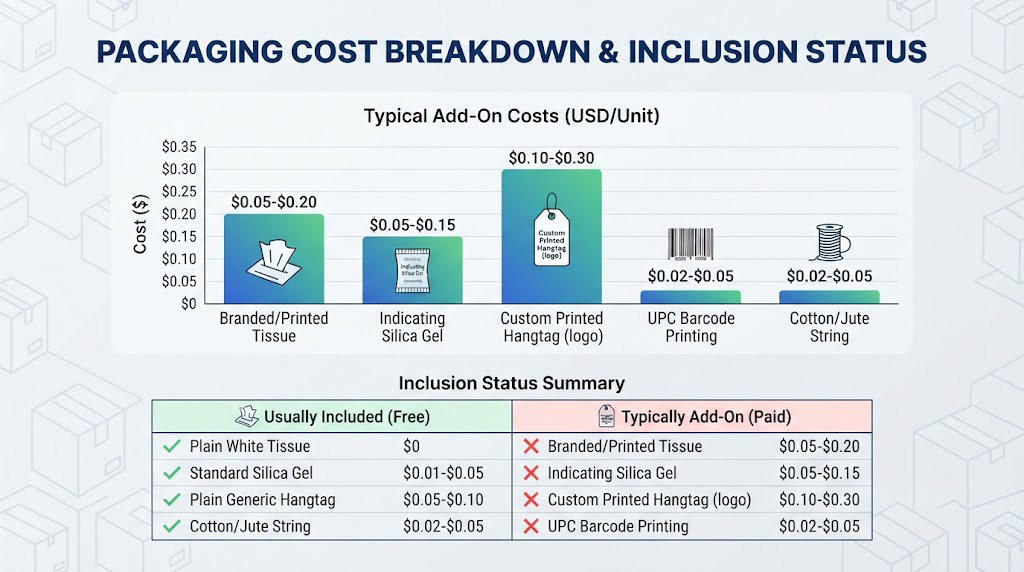
Pro tip: Never assume tissue, silica gel, and hangtags are included. Always get a written confirmation in the proforma invoice. A reliable factory will itemize these so you know exactly what you’re paying for.
Typical MOQ for Custom Hangtags and Branded Packaging
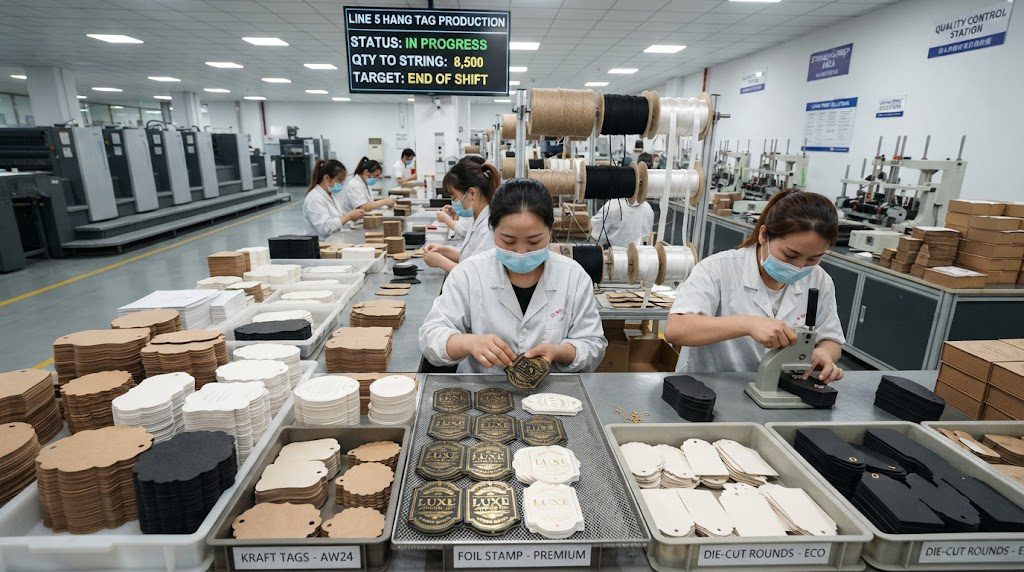
Custom hangtag MOQs are usually driven by the printing plate setup, not the bag order itself.
MOQs are where many small-to-mid-size bag importers hit a wall. Here’s what we’ve learned across hundreds of orders:
Custom hangtags: Most Chinese printing suppliers require 500–1,000 pieces minimum for a new design. The setup cost (die-cut plate, color proofing) is usually $30–$80 per design.
Custom printed tissue paper: MOQ is typically 5,000–10,000 sheets because of the printing press minimums. Some suppliers offer lower MOQs (1,000–2,000) using digital printing, but at a higher per-unit cost.
Custom silica gel packets: Available at surprisingly low MOQs (often 500–1,000 pieces), but only worthwhile if you’re branding them with your logo.
Branded outer cartons / shipping boxes: MOQ 500–1,000 pieces, with setup costs around $100–$200 per size.
For most independent sellers, this means aligning your custom packaging run with at least 2–3 bag reorders to keep unit costs reasonable.
Logo Customization: What Chinese Factories Can (and Can’t) Do
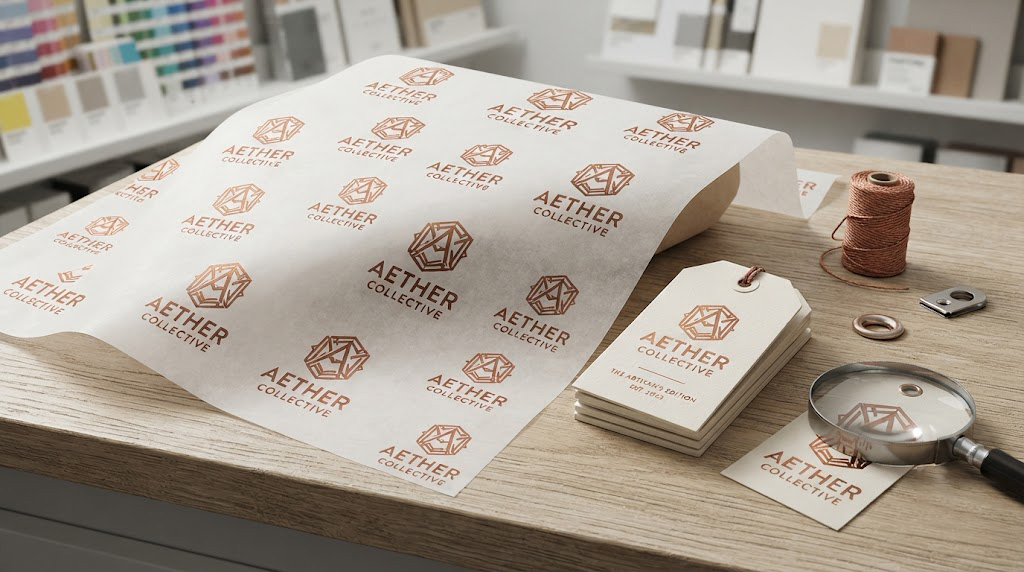
Logo customization is widely available—but quality and minimums vary dramatically between suppliers.
The good news: most Chinese bag factories offer logo customization on tissue, silica gel, and hangtags. The bad news: quality varies wildly.
Here’s our honest assessment:
Tissue paper logo printing: Generally good quality, but color matching can be inconsistent. Always request a printed sample (not just a digital proof) before bulk production.
Silica gel packet logo printing: Possible, but the print area is small. We usually skip this and rely on the hangtag for brand visibility.
Hangtag logo printing: This is the easiest and most impactful. We recommend investing here first. Spot UV, foil stamping, and embossing are all available at most printing partners, though they push MOQs up.
Watch out for: Some factories subcontract printing to third-party vendors, which adds lead time and reduces quality control. If logo customization is critical to your brand, ask whether the factory has an in-house print shop or a long-standing printing partner.
Retail vs. E-Commerce Packaging: The Full Picture
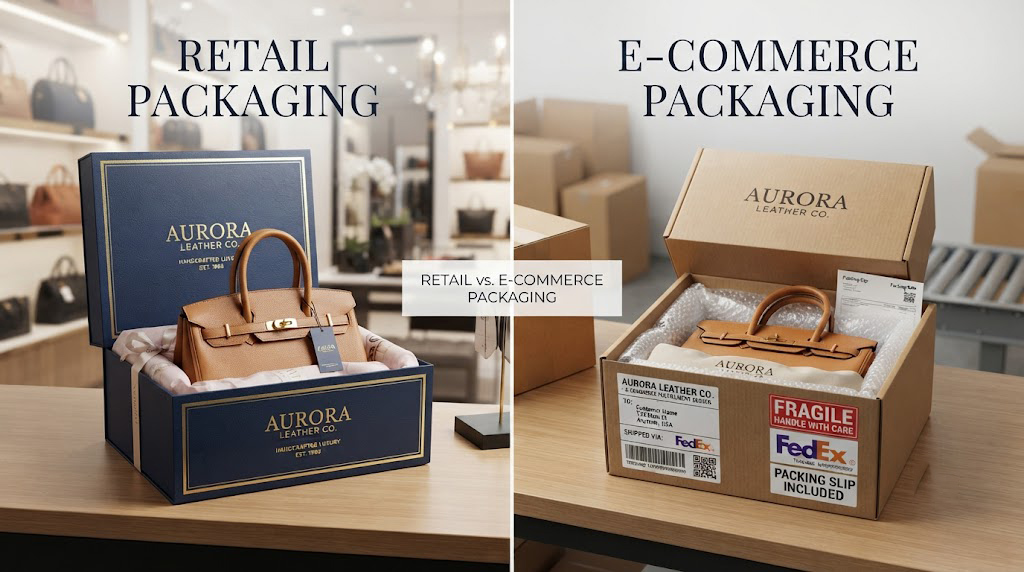
Same bag, two completely different packaging strategies.
Let’s put it all together. Here’s how a single handbag SKU might be packaged differently depending on the destination channel:
Retail-Ready Packaging (Boutique / Department Store)
25–30 GSM branded tissue paper, decorative fold
3–5g silica gel packet inside the bag
Custom hangtag with logo, UPC, country of origin
10-inch cotton string attachment
Optional: branded dust bag, gift box, shopping bag
Outer carton: 5-ply corrugated, single-color print OK
E-Commerce-Ready Packaging (Amazon FBA / Shopify DTC)
17–20 GSM plain white tissue, flat fold
1–2g silica gel packet inside bag + extra in outer carton
FNSKU label on product or polybag
No hangtag (or minimal SKU sticker)
Suffocation warning on polybag
Outer carton: 5-ply corrugated, FNSKU labels on multiple sides
Hybrid Approach (Multi-Channel Sellers)
If you sell through both channels from the same factory order, you have two options:
1. Single packaging standard that works for both (compromise on both ends)
2. Split orders where the factory produces two packaging variants within the same production run (slightly higher setup cost, but better customer experience)
We personally use Option 2 for our top-selling SKUs and Option 1 for slower movers. The split-packaging approach adds about 5–8% to packaging cost but pays for itself in lower return rates and better reviews.
How to Talk to Your Chinese Supplier (Practical Email Template)
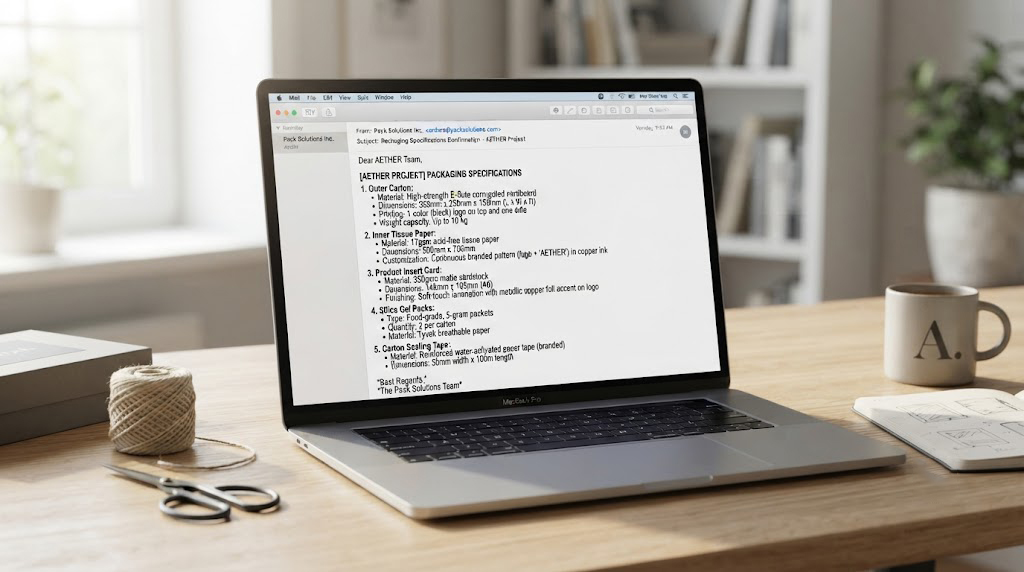
Clear, itemized supplier communication prevents 90% of packaging mistakes.
After dozens of supplier negotiations, we’ve found that the most successful conversations follow a simple structure. Here’s a template you can copy and adapt:
Subject: Packaging Specifications for Order # – Retail & E-Commerce Split
Hi [Supplier Name],
For the upcoming order, please confirm packaging for both retail and e-commerce channels:
Retail (60% of order):
Tissue: 25 GSM, [branded/plain], decorative fold
Silica gel: 5g, non-indicating, inside bag
Hangtag: custom, [our attached artwork], 10-inch cotton string, CPSIA-compliant
Dust bag: [yes/no]
E-commerce (40% of order):
Tissue: 17 GSM, plain white, flat fold
Silica gel: 2g inside bag, plus 10g in outer carton
No hangtag
FNSKU label per Amazon requirements
Suffocation warning on polybag
Please confirm:
1. Are tissue, silica gel, and hangtags included in unit price, or billed separately?
2. What is the MOQ for custom hangtags and printed tissue?
3. Lead time for custom packaging?
4. Can you provide a pre-production sample with actual packaging?
Thanks,
[Your Name]
This kind of specificity saves weeks of back-and-forth and ensures your first production run gets the packaging right.
Final Thoughts: Packaging Is Part of the Product
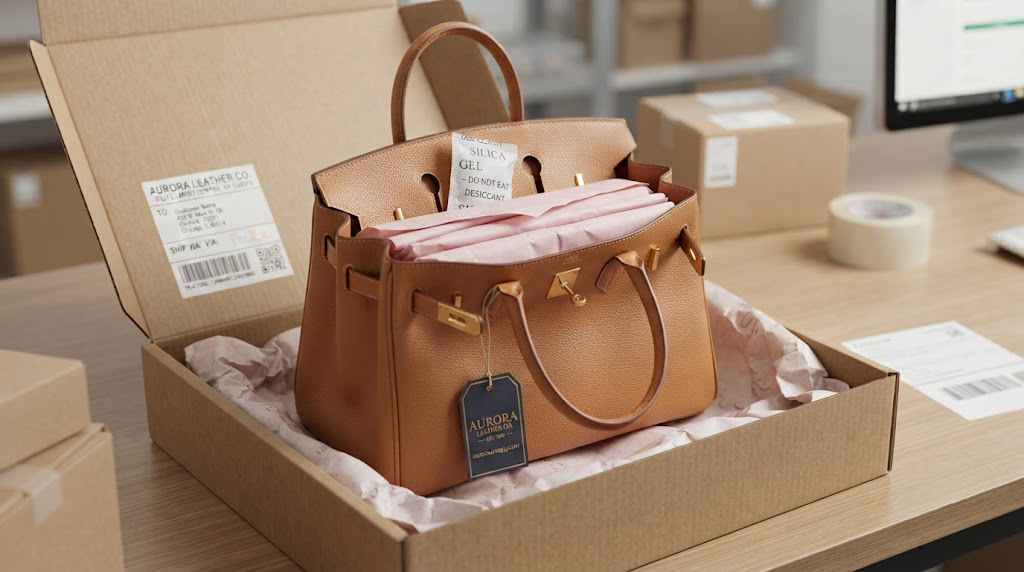
When tissue, hangtag, and silica gel all work together, the customer experience justifies the unit cost increase.
Here’s the mindset shift that changed our business: stop thinking of tissue, silica gel, and hangtags as “extras.” They’re not add-ons. They’re part of the product experience.
A $25 handbag wrapped in beautiful branded tissue, sealed with a premium hangtag, and protected with proper silica gel feels like a $60 handbag. The packaging cost is roughly $0.50–$1.00 per unit. The perceived value increase is multiples of that.
On the flip side, an Amazon-bound handbag with the wrong FNSKU label or a suffocation warning missing can get your entire inventory rejected at the warehouse. Compliance is not optional.
The Chinese bag manufacturing industry is incredibly capable—factories can deliver almost any packaging specification you need. But they will not guess what you want. The suppliers who succeed long-term with US buyers are the ones who ask the right questions upfront and document everything in writing.
We’ve shared what works for us after years of trial and error. Now it’s your turn: take this framework, adapt it to your brand, and ask your supplier the right questions on your next order.
Your customers—whether they shop in a boutique in Manhattan or click “Buy Now” on your Shopify store—will notice the difference.
Quick Reference Checklist
✅ Confirm whether tissue, silica gel, and hangtags are included or billed separately
✅ Specify GSM, fold style, and branding for tissue paper
✅ Specify gram weight and placement for silica gel
✅ Specify hangtag content, string length, and CPSIA compliance
✅ Get a pre-production sample with actual packaging before bulk run
✅ Align custom packaging MOQs with multiple bag orders to reduce unit cost
✅ Use split packaging for multi-channel sellers to optimize both experiences
✅ Document all specifications in the proforma invoice, not just email
Have questions about sourcing bags from China or optimizing your packaging strategy? Leave a comment below or reach out—we’re always happy to share what we’ve learned.
Post time: Aug-04-2026