
When you source handbags in bulk from overseas factories, the smallest visible detail often signals the largest difference in product quality. Topstitching is one of those details — and one of the most underestimated by first-time importers.
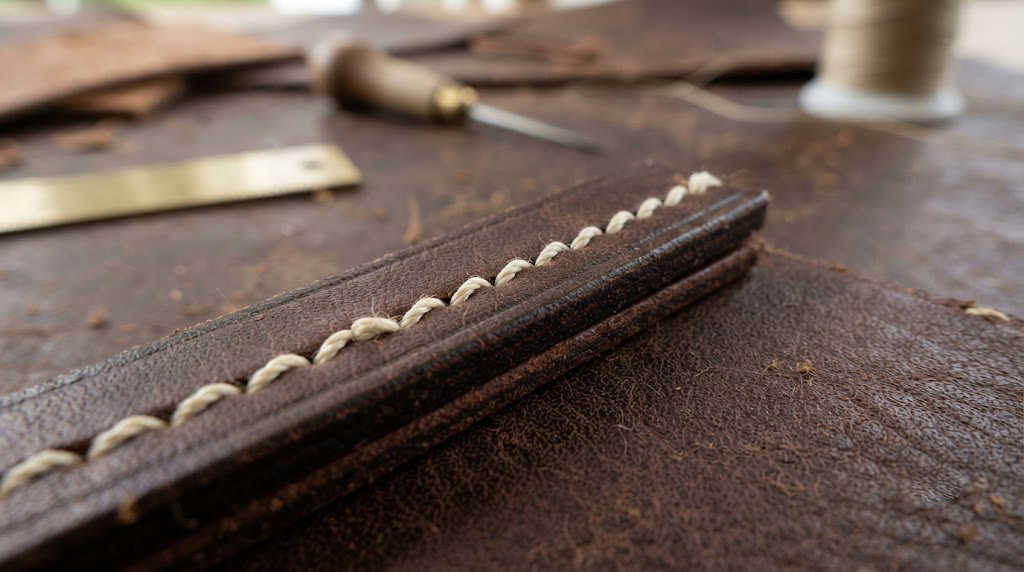
Macro detail of clean, even topstitching along a finished bag panel — exactly the kind of finish your QC team should be looking for.
Why Topstitching Matters More Than You Think
If you have ever walked through a trade show like Magic Las Vegas or traveled to bag factories in Guangzhou, you have probably noticed that the best-looking bags on every sample table share one thing in common: precise, confident topstitching. Conversely, the bags that feel “off” — the ones that look cheap, wobbly, or unfinished — almost always fail on the stitching first.
As a US-based bag buyer selling through your own e-commerce website, you are competing in a market where customers can zoom in on product photos by 400% before they hit “Add to Cart.” A single uneven stitch or pulled thread in a hero image is enough to send a shopper to a competitor.
This guide consolidates the 10 most important technical insights about topstitching in handbag manufacturing, plus the exact language you should use when communicating with Chinese suppliers. By the end, you will have a ready-to-use factory questionnaire, a clearer QC checklist, and the vocabulary to negotiate like someone who has been in the industry for years.
Let’s start with the fundamentals.
What Exactly Is Topstitching?
Topstitching is a visible line of stitching sewn on the right (outer) side of a bag panel, typically set 1/8″ to 1/4″ (3–6mm) away from the seam line. It is performed after the structural seams have been assembled, meaning it is one of the last operations in production — and one of the first things a customer or inspector will see.
In modern bag production, topstitching is not a single-purpose operation. It is decorative and structural simultaneously. That dual role is exactly why it deserves its own specification sheet in your factory agreement.
10 Key Technical Insights Every Bag Buyer Must Know
1. Topstitching Is a Final, Not Initial, Operation
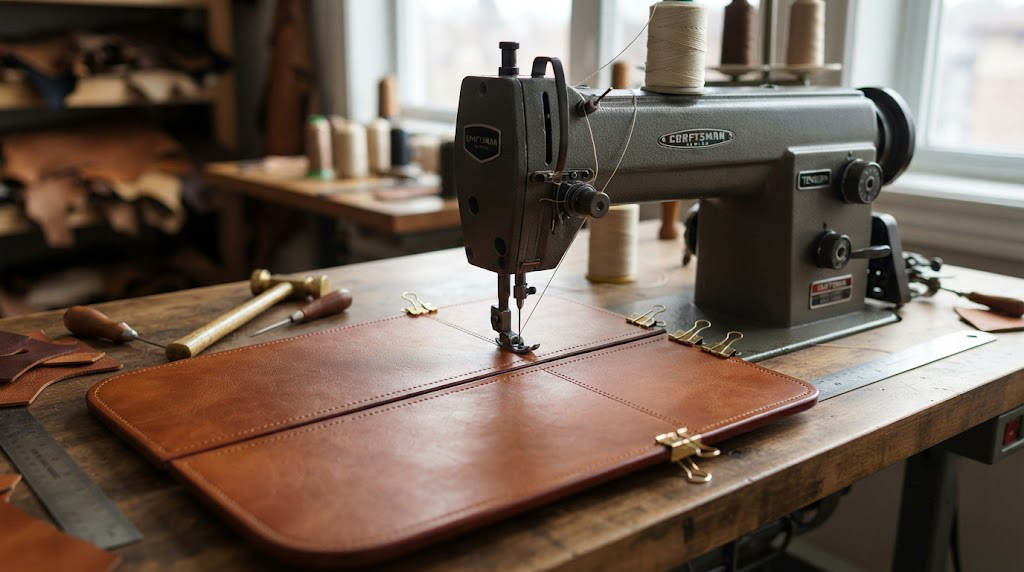
Bag panels being aligned on a sewing machine table before final topstitching
Panels staged for final topstitching — note that all structural assembly is already complete.
Topstitching is performed as the final finishing operation on outer panels only after the structural assembly is complete. This sequencing is critical: if a factory topstitches before the gussets, handles, or base are attached, the topstitching will distort, pucker, or shift out of alignment when those load-bearing components are added.
What to ask your supplier:
“Please confirm that topstitching is applied as the final visible operation on the outer panels, after all structural assembly is complete.”
A reliable factory will answer with a clear “Yes” and a sample process flow chart. If they hesitate or suggest stitching earlier “to save time,” consider it a red flag.
2. Topstitching Serves Two Purposes — Decoration AND Reinforcement
This is the part most new buyers get wrong. Topstitching is not just for looks. Yes, it gives the bag a clean, finished appearance and a premium visual rhythm — but it also locks seam allowances flat, prevents layers from shifting during use, and reinforces areas that will be pulled, lifted, or sat upon every day.
A bag with beautiful topstitching that is structurally weak will fail within months. A bag with strong internal construction but no visible topstitching will look unfinished and will not command premium retail pricing. The goal is both.
When you write your spec sheet, never describe topstitching as “optional decoration.” It is a load-bearing design element.
3. Recommended Thread: Material and Weight
Spools of bonded nylon and polyester thread in Tex 70–135 weights
Industrial thread inventory — bonded nylon and polyester are the two most common topstitching materials.
For outer panel topstitching on handbags, the industry standard thread materials are:
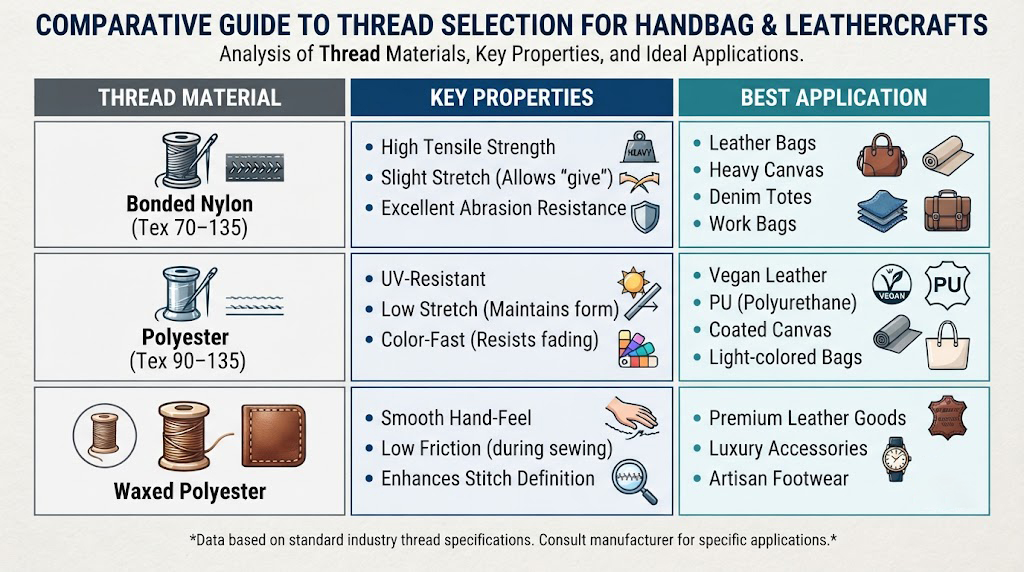
Recommended weight range: Tex 70 to Tex 135 (equivalent to roughly V69 to V138 in commercial thread sizing). Anything lighter than Tex 70 will look “lost” on the panel and may snap under stress. Anything heavier than Tex 135 is reserved for specialty applications like saddlery or industrial gear.
Pro tip for your RFQ: Always request a 5cm thread sample in your chosen Pantone before bulk production. Thread color can shift between dye lots, and a 5% color variance can ruin the visual rhythm of a topstitched panel.
4. Standard Stitch Length and SPI
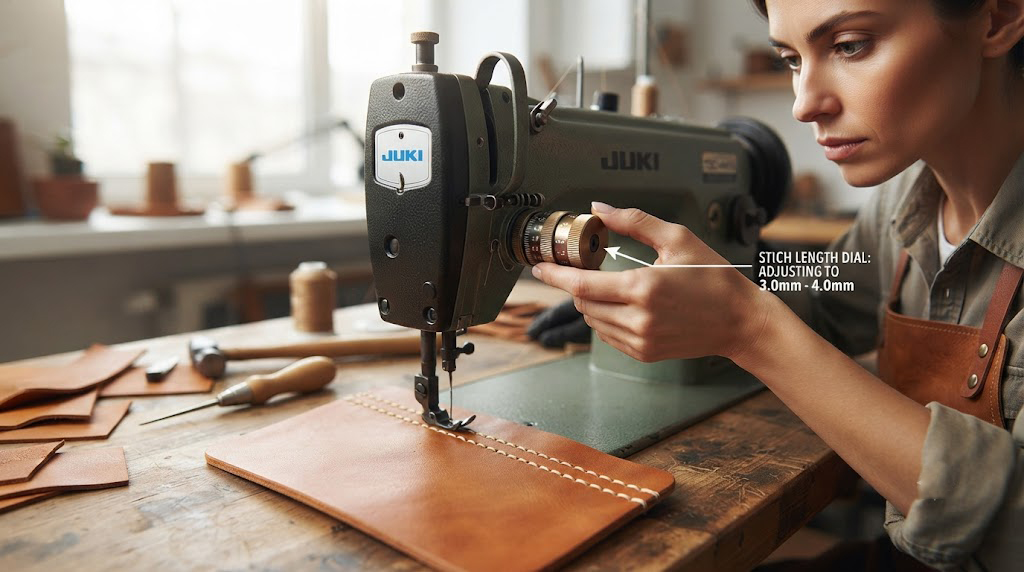
Stitch length dial — 3.0–4.0mm is the typical setting for bag topstitching.
The stitch length for topstitching should be longer than construction stitching, generally in the range of:
3.0mm to 4.0mm (approximately 6 to 8 stitches per inch / SPI)
This longer stitch serves two functions: it allows the thread to be a focal design element (each stitch is visible and contributes to the visual pattern), and it gives the seam more flexibility under stress.
Compare this to construction stitching, which typically uses 2.5mm (10 SPI) because the seam is hidden and prioritizes strength over appearance. Topstitching inverts that priority: visibility and rhythm come first, with structural reinforcement as a built-in bonus.
What to specify in your PO:
“Topstitching: 3.0–3.5mm stitch length (7–8 SPI), Tex 90 bonded nylon, color matched to Pantone XX-XXXX, parallel to seam line at 1/8″ (3mm) offset.”
5. Stress Point Reinforcement — Where Topstitching Is Not Optional
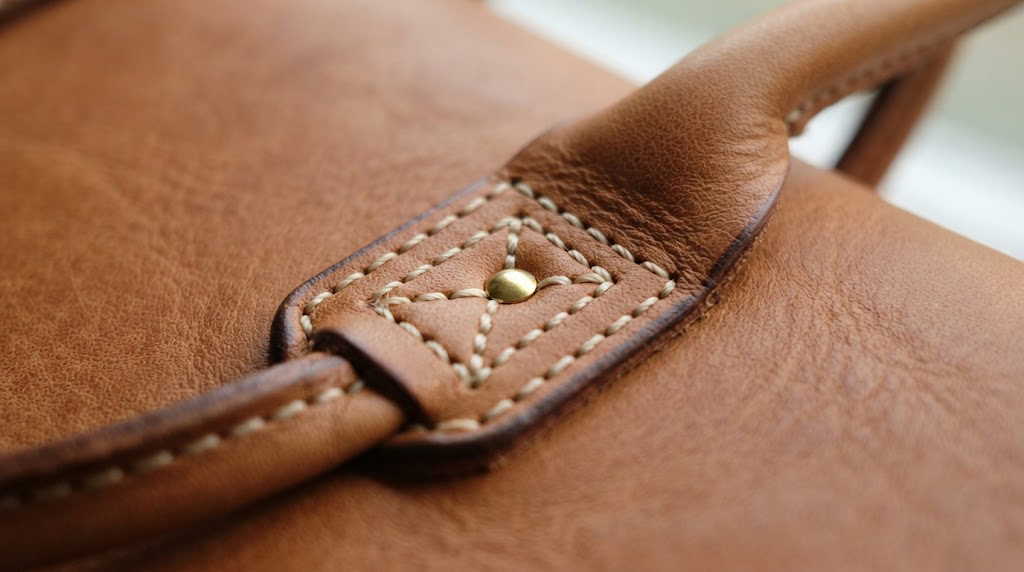
Handle base showing dense topstitching — a critical stress point on every bag design.
There are specific areas on every bag that must receive reinforced topstitching, regardless of the design:
Handle bases — top stitched in a square, box, or X pattern
Strap anchor points — where straps meet the body panel
Pocket openings — to prevent the pocket from tearing away
Zipper flaps and gusset joins — high-flex zones
D-ring and O-ring attachments — load-bearing hardware
Bottom corners — where the bag sits on the ground
A factory that quotes you a low price but is vague about reinforcement at these points is likely skimping on labor. Reinforcement stitches are time-consuming, and that time shows up in the unit cost. If the price seems too good to be true, ask to see a sample with the stress-point topstitching clearly visible — not described in an email.
6. Offset Distance and Parallel Alignment
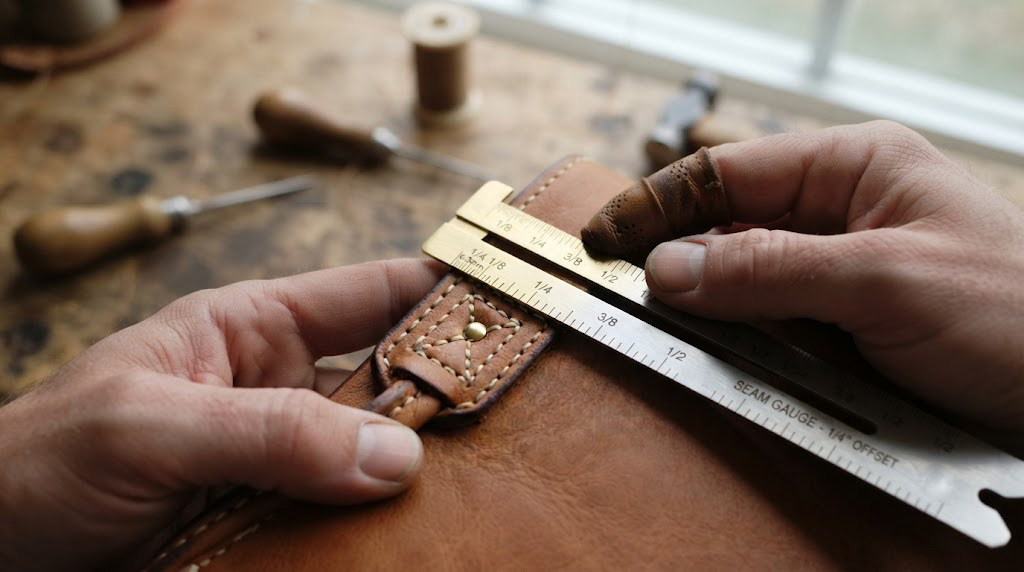
Seam gauge verifying 1/8″–1/4″ offset — precision tools like this separate professional factories from low-tier workshops.
The standard offset distance for topstitching from the seam line is:
1/8″ to 1/4″ (3mm to 6mm)
Anything closer than 1/8″ risks the needle hitting the seam allowance, which can cause broken needles, skipped stitches, or weak points. Anything farther than 1/4″ starts to look like a decorative line rather than a structural finish — and it loses some of its reinforcement value.
The line itself must be parallel to the seam line. A 1mm drift over a 30cm panel is immediately visible on a product photo. This is where template marking, laser guides, or programmable sewing machines come into play on premium production lines.
Quick factory test: Ask the supplier to send two topstitched samples on the same panel — one straight edge, one curved. Measure the offset at the start, middle, and end. The variance should be less than 1mm.
7. Edge Finishing Must Happen Before Topstitching
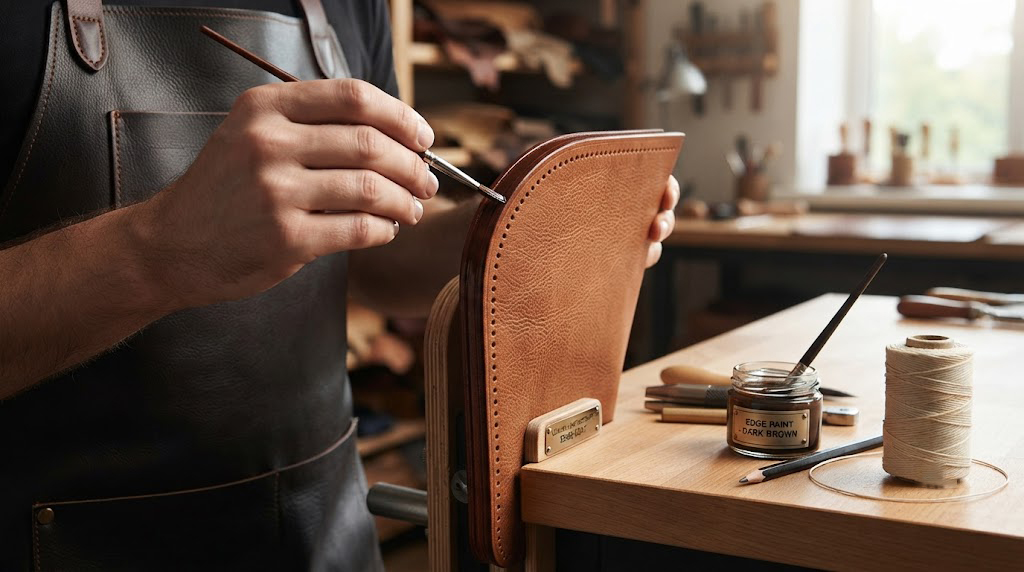
Edge painting process on leather — applied before any topstitching
Edge painting station — note that this step precedes final topstitching to prevent smudging.
This is one of the most common workflow mistakes in lower-tier factories. The correct sequence is:
1. Cut panels
2. Skive (thin) edges
3. Apply edge paint / burnish / glue
4. Allow edge paint to fully cure
5. Assemble structural seams
6. Topstitch outer panels last
If topstitching happens before edge paint is dry, the needle and presser foot can smudge, dent, or stick to the freshly painted edge, ruining the cosmetic finish. A factory that does this out of order will deliver bags with edge paint defects that are nearly impossible to remediate in the field.
Insist on the correct order in your QA documentation. Photograph each step in your pre-production sample so production cannot deviate.
8. Back-Tacking and Lock Stitches at Seam Ends
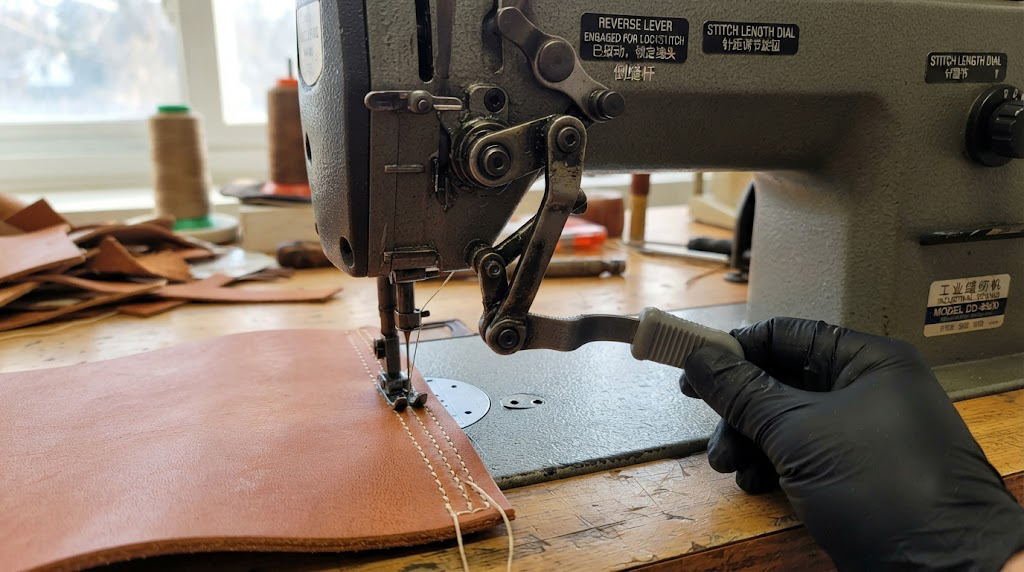
Reverse lock stitch mechanism on industrial sewing machine
Reverse feed lever engaged — this is what creates the back-tack that locks thread tails in place.
Every topstitching run must start and end with a back-tack (also called reverse locking). A back-tack is a 3–4 stitch run back over the existing stitch line that locks the thread tail into the seam and prevents unraveling.
On stress-point topstitching (handle bases, strap anchors), the back-tack is often double or triple-stacked for additional security. Some premium factories also use bar tacks — a dense cluster of zigzag stitches — at the most critical points. Bar tacks can support 50+ kg of pull force and are standard on luxury leather goods.
What to specify:
“All topstitching start/end points must be back-tacked minimum 3 stitches. Stress points (handles, straps, D-rings) require bar tacks of 8–10mm length.”
9. Marking and Template Use for Consistent Spacing
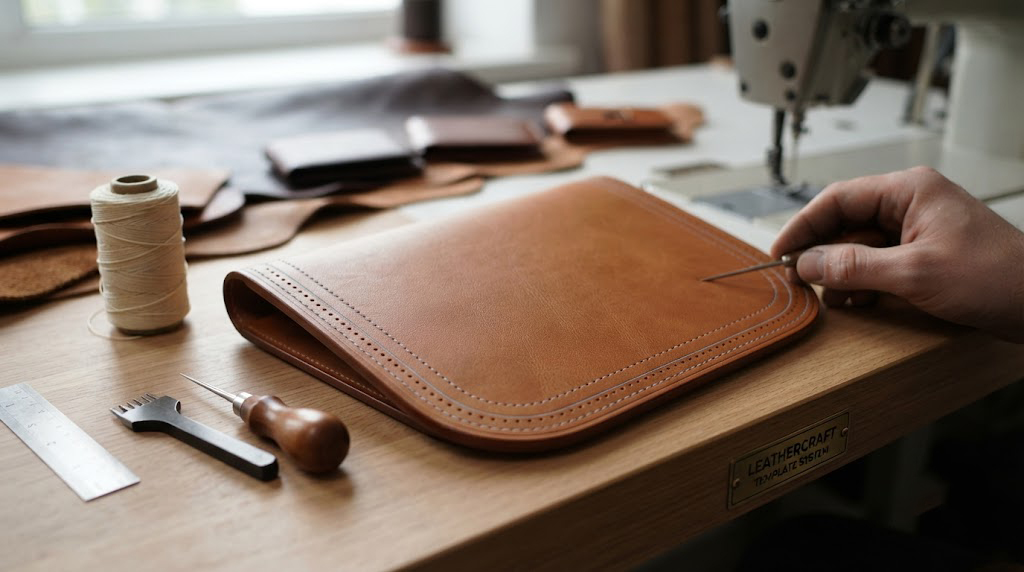
Leather panel with template marks for topstitching alignment
Pre-marked panel — the dots and lines guide the operator’s stitch path on curved or contoured sections.
On straight panel edges, a skilled operator can freehand topstitching with consistent spacing. On curved, contoured, or asymmetric panels (which is most designer bags), this is impossible without guides. Professional factories use:
Paper or plastic templates traced and marked before stitching
Laser line guides on the sewing machine bed
Programmable CNC sewing machines (used by premium OEM factories for $50K+ bags)
Saddle stitching jigs for hand-finished leather goods
If your design has any curves, scallops, or non-linear seam paths, request a marked-up sample for approval before production. This is the single most effective way to catch alignment problems before 500 bags are stitched incorrectly.
10. Double-Needle Topstitching for High-Stress Areas
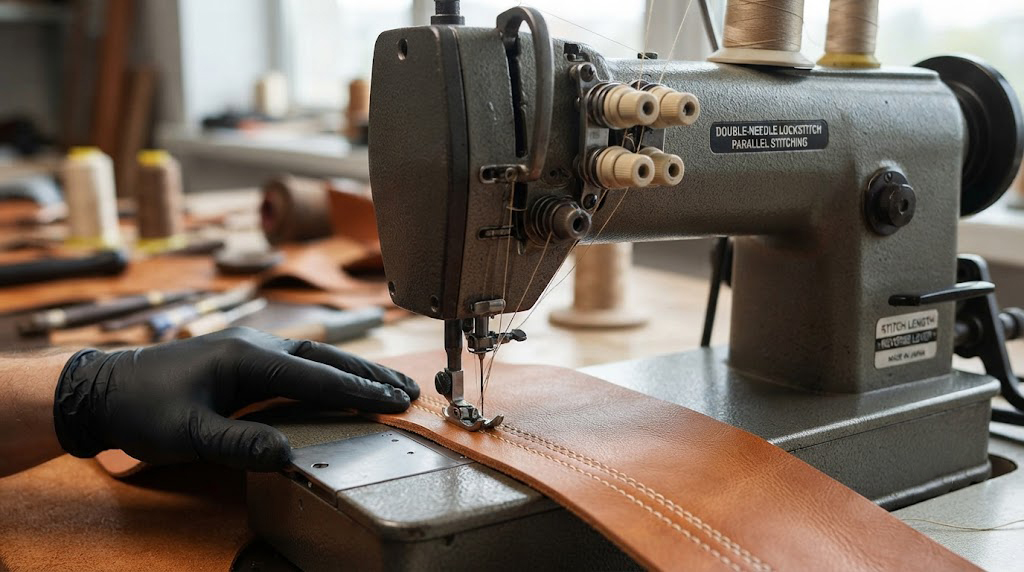
Double-needle industrial sewing machine creating parallel stitch rows
Double-needle setup — note the two parallel stitch rows created in a single pass.
For maximum reinforcement, factories can use a double-needle setup to create two perfectly parallel rows of topstitching in a single pass. This is the gold standard for:
Tote bag straps
Shoulder bag gussets
Backpack handle wraps
Briefcase top edges
Camera and tool bag load points
The two-row pattern is not only structurally stronger (the load is distributed across twice the thread), it is also a visual signature of premium bags. You see it on Coach, Coach Outlet, Tory Burch, and almost every other mid-to-high-tier US brand.
Cost note: Double-needle topstitching adds roughly 5–10% to the sewing labor cost. If your retail price point supports it, this is one of the highest-ROI upgrades you can specify.
QC Inspection: How to Identify Topstitching Defects
QC inspector examining a finished handbag under bright inspection light
Final QC inspection — topstitching defects are easiest to catch under raking light.
Topstitching defects are visual, but they also signal structural problems. Your final QC inspector should check for the following before any bag ships:
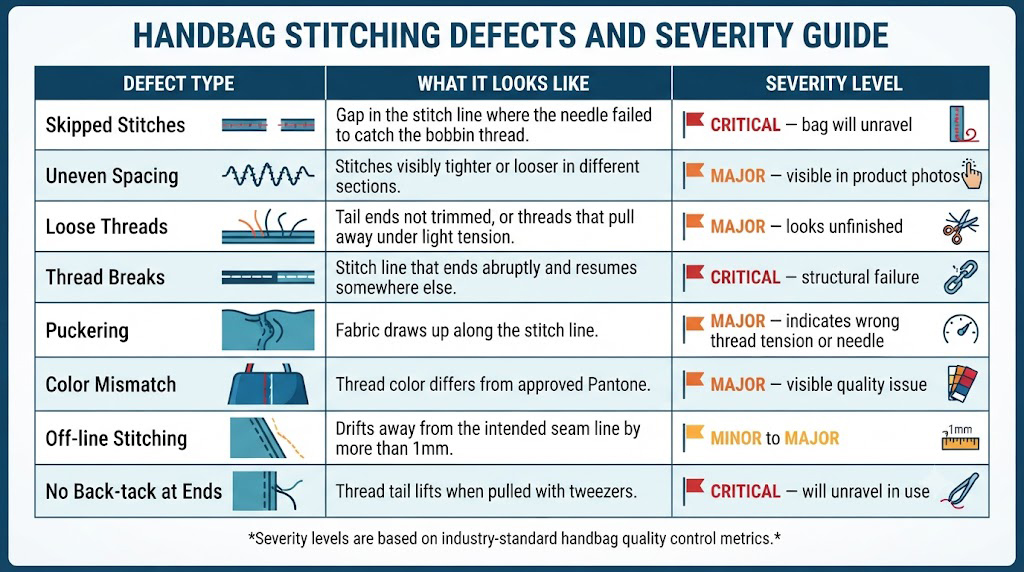
Inspection tip: Inspect under raking light (light coming from the side at a low angle) rather than overhead fluorescent. Raking light makes thread tension problems, puckering, and skipped stitches dramatically more visible. Most AQL inspectors default to overhead light, which hides defects.
Communicating with Your Chinese Supplier: The Right Way to Ask
One of the most valuable skills for an overseas bag buyer is translating technical intent into language that a Chinese factory operator will execute correctly. The sentence you originally wrote —
“Topstitching is performed as a final visual and structural finish on outer panels?”
— is technically correct, but a Chinese factory may interpret it as a question about policy rather than a specification. Here are clearer phrasings that get better results:
More natural factory questionnaire language:
“Is topstitching applied as the final visible and structural finish on the outer panels?”
“Will the outer panels be topstitched at the final stage for both appearance and reinforcement?”
“Is topstitching used to secure seam allowances and improve the bag’s exterior look?”
If you want maximum clarity in a written spec sheet:
“Please confirm whether topstitching is required on the outer panels after panel assembly. Please also confirm the stitch type, stitch length, thread color, thread weight (Tex), and whether topstitching is for decoration, reinforcement, or both.”
When you put this much specificity into writing, factories cannot later claim “we didn’t know you wanted bar tacks” or “we thought Tex 60 was fine.” Written specs protect both sides.
A real factory reply (translated from Chinese) might look like this:
“Yes, topstitching is performed on the outer panels. We provide interior lining construction with internal pockets, organizer compartments, zippers, and a label patch. We will follow up with a dedicated article introducing our lining construction in detail.”
This is a typical, polite, but incomplete reply. It confirms the existence of topstitching but does not specify thread weight, SPI, or stress-point reinforcement. A professional buyer would respond with: “Thank you. Please also confirm thread material, Tex weight, stitch length, and reinforcement method at handle bases and strap anchors.”
Push for specifics in writing — every time.
Your Pre-Production Topstitching Checklist
Before you sign off on a bulk order, use this checklist to lock down the spec:
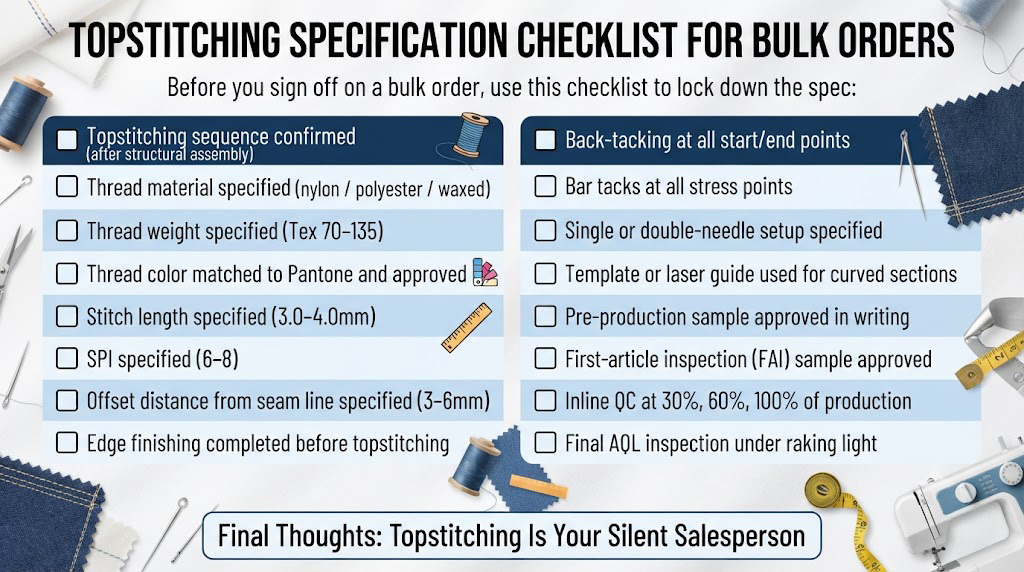
Your customers will never read a spec sheet. They will never know that you specified Tex 90 bonded nylon with 7 SPI at a 1/8″ offset. But they will feel the difference every time they pick up the bag, zip the pocket, or notice the clean parallel lines along the strap. Topstitching is the silent salesperson of your product line — it is doing its job when no one is looking, and it betrays you the moment quality slips.
As you build your brand and grow your catalog, treat topstitching specifications with the same rigor you would apply to leather grade, hardware finish, or zipper brand. The factories that can deliver this level of precision are the ones worth paying a little more to work with. The ones that cannot are the ones that will cost you in returns, negative reviews, and lost customer trust.
Post time: Jul-20-2026